Speaker
Description
Introduction
Using new materials often involes time-consuming validation processes. The project “i-Tribomat” aims to reduce these expenses by providing an Open Innovation Test Bed with up-scaling tools to translate tribological behaviour from simple model tests to component scale behaviour.
This section investigates the tribological behaviour of polymer materials in seals.
Concept
Recently published models show an approach to predict wear mechanisms between two spherical asperities [1,2].
By using the Greenwood-Williamson model to describe the surface topography, these models can be used to distinguish between wear mechanisms.
Results
Tribological experiments showed barely measurable wear at lower loads (see Fig. 1a), while for higher loads wear particle sizes increased strongly and the specimen were worn down quickly (see Fig. 1b). The coefficient of friction dropped slightly, once the first wear particles were produced, since the process of forming wear particles seemed to be a process more easily activated at higher loads. These observations are in accordance with [1,2].
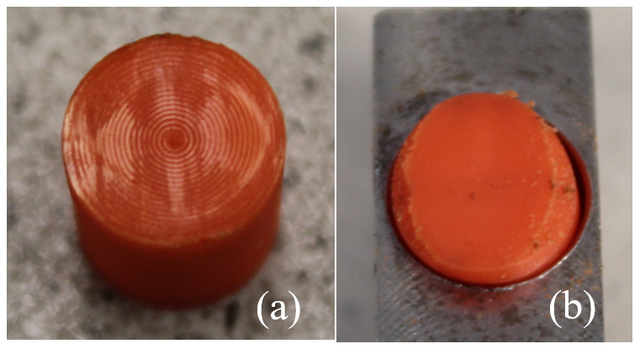
Figure 1: Worn specimens under a load of (a) 1.2 MPa, (b) 2.66 MPa contact pressure.
Outlook
This model differentiates friction and wear mechanisms on micro levels to determine the load and topography dependent tribological processes and translate these to macroscopic levels as wear rate and coefficient of friction. These values can then be used in component FEM simulations to predict energy loss and lifetime of the system.
Acknowledgement
This project has received funding from the European Union’s Horizon 2020 research and innovation programme under grant agreement No. 814494, project i-TRIBOMAT.

http://i-tribomat.eu/
[1] Aghababaei, Warner, Molinari, Nature communications (2016).
[2] Brink, Molinari, Physical Review Materials (2019).
| Speaker Country | Austria |
|---|