Choose timezone
Your profile timezone:

ASMET is pleased to invite you to join EUROMAT 2021.
EUROMAT is the premier international congress in the field of materials science and technology in Europe. This conference will continue a successful series of material science conferences. The main objective is to foster knowledge transfer and exchange of experiences amongst delegates with academic and industrial backgrounds.
In this lecture is made a brief route though the technology that has been the umbrella of all my academic life: powder metallurgy (PM). There are three main reasons to use this technology as an alternative to many others: 1) is a cost saving technology compared with alternative processes, 2) sometimes is a captive way to produce a part or a material and, 3) by the PM route is possible to obtain unique properties, better than any other alternatives. When I started my academic career, I did it working in my PhD thesis (1985), in PM low alloyed steels, materials that can be classified in the first group. In that time, the main questions to solve were why Cu swells during sintering and how was the role of carbon in this swelling. Many years after that, I am still working in answering those questions, but using much more efficient techniques to try to answer it. But I have also worked in materials of groups 2 and 3. As an example of the group 2 I go through one work where the aim is to replace Co as binder phase in harmetals, materials that only can be made by PM. And I also briefly report two examples of materials that can be considered from the group 3: new Co base superalloys for high temperature applications and high entropy alloys. In these later examples the main advantage of PM is the microstructural control and the ability of the technology to control the possible segregations and the grain size.
Aknowledgements.
I wish to acknowledge to all of those people who trusted on me, including those who has decided to award me with this Gold Medal, to all those academics who collaborate with me, and specially to my PhD students and all the students that walked with me part of the path.
Unproper disposal of non-biodegradable plastics and their accumulation on environment triggers the known white pollution. In turn, agrifood waste is a global concern since high foodstuffs amount ends as non-valued waste. To overcome these issues, ecology concepts as green manufacturing/circular economy are being pursued. Therefore, plastics with improved biodegradability, physicochemical, and mechanical profile are required.
From agrifood industries, biobased byproducts still containing valuable biomolecules of interest for the (bio)plastics manufacturing can be generated. From our most recent research, non-value potato washing slurries, potato peels, coffee silverskin, and eggshells revealed to be agrifood byproducts from which polysaccharides, proteins, lipids, phenolic compounds, and minerals can be recovered and further used in the development of starch-based bioplastics with improved physicochemical/mechanical performance and lightweight fillers for plastic materials. Most these formulations have shown compatibility with various plastic manufacturing technologies, namely solvent casting, extrusion, injection molding, and 3D printing by fused deposition modelling (FDM), and are capable of being transposed from lab to pilot scale. Complementary studies about the agrifood byproducts-derived (bio)plastics versatility are ongoing, targeting to exploit materials with a wide application range.
From an ecological and economic point of view, this circular economy strategy can bring sustainability and new business opportunities for both agrifood and plastic industries, and concomitantly contribute to fulfil the European Green Deal objectives.
Acknowledgments: Thanks are due to the University of Aveiro and FCT/MCTES for the financial support of CICECO (FCT Ref. UIDB/50011/2020 & UIDP/50011/2020). IG also acknowledge FCT for the Individual Call to Scientific Employment Stimulus (ref. CEECIND/00430/2017) and to the companies A Saloinha, FEB – Cafés S.A., and Derovo for providing the agrifood byproducts.
Controlling magnetic properties by tuning carrier concentration is a key feature of diluted ferromagnetic semiconductors, giving possibilities for multifunctional spintronic devices. Here, the evidence of the long-range magnetic order in V-doped WSe2 semiconductors will be presented. The magnetic domains of the long-range ferromagnetic order are observed by magnetic force microscopy at room temperature. More importantly, the magnetic domains can be modulated by a gate bias, which is concrete evidence for the ferromagnetic semiconducting characteristics. The mechanism behind the formation of the long-range order will be also discussed and investigated through scanning tunneling spectroscopy and density functional theory.
In addition, the giant Zeeman shift from the spin-polarized state in WSe2 doped with a small amount of vanadium atoms (~0.15%) by investigating resonant magnetotunneling spectroscopy of a vertical graphite/V-WSe2/graphite heterojunction will be discussed. The p-type character of the doping state is located near the valence band, substantially shifted under an external magnetic field at 7.8 meV/T with a giant g factor of approximately 135, an order of magnitude higher than that of other 2D magnetic semiconductors. The evidence of the spin-polarized band edges of V-doped WSe2 is also confirmed by circular-polarized photoluminescence.
In the quantum Hall (QH) regime, charge carriers flow in one dimensional quantum Hall edge channels (QHECs) and are topologically protected against backscattering. Due to its intrinsic two-dimensionality and the massless nature of its charge carriers, graphene constitutes a fascinating platform for studying QH effect. However, graphene edges are known to strongly harm the topological protection of QHECs. Local probe measurements have recently helped understand why. They highlighted that both up- and downstream QHECs coexist along the same device edge and that impurities, located between these counterpropagating QHECs, couple them and allow backscattering of charge carriers, normally prohibited. Nevertheless, the origin of counterpropagating QHECs remains largely debated and it is unclear whether they exist both for holes and electrons.
To answer these open questions, we performed scanning gate microscopy (SGM) in the quantum Hall regime on a graphene constriction. SGM, consisting in scanning a biased AFM tip, used as a local top gate, while recording the device resistance, gives access to the locations where backscattering occurs.
Our results suggest different mechanisms of topological breakdown for holes and electrons. While backscattering occurs along the edges for holes, in line with previous studies, it takes place in the vicinity of the constriction for electrons.
Supported by simulation results, we find that counterpropagating QHECs exist for both types of carriers but the metallic contacts cause the observed contrasting behaviour. By inducing a local doping in their vicinity, contacts lead to a decoupling between counterpropagating holes QHECs while they cause a perfect equilibration of electrons QHECs. Our results highlight the importance of contacts when designing a QHECs-based device and apply to other two-dimensionnal materials, especially for those presenting topological properties.
Studying local variations in the Peltier [1] or Seebeck coefficient of materials is important to optimise their thermoelectric properties and to enable applications like single-material thermocouples [2]. Yet most global experiments overlook spatial divergences in the signal and the role of local variation and the internal structure. Here, we developed Scanning Thermal Gate Microscopy (STGM), a non-invasive method to obtain high-resolution 2-dimensional maps of the thermovoltage [3]. We investigate junctions formed between single- and bi-layer graphene, identify the impact of internal strain and reduction of channel width on the local Seebeck. These findings and the newly developed STGM method will help to further understand and improve the thermoelectric properties of 2D devices.
References
[1] Harzheim et al. Nano Letters, 18, 7719-7725 (2018).
[2] Harzheim et al. Advanced Functional Materials 30, 2000574(2020).
[3] Harzheim et al. 2D Materials 7, 041004 (2020).
Highly filled particulate metal-dielectric nanocomposites films have unique functional properties with hosts of applications. To explore collective interactions between the particles, we control the particle separation on the nm scale by employing vapor phase deposition, which is a scalable approach permitting, inter alia, excellent control of the filling factor. For polymer films, we have recently used initiated chemical vapor deposition (iCVD) to avoid decomposition of the functional groups, e.g. in highly stable electrets for electret microphones and magnetoelectric sensors, 3D superhydrophobic coatings, and nanoscale gradient copolymers. The nanoparticles can form during co-deposition via self-organization or by means of high-rate gas aggregation cluster sources, which provide independent control of filling factor and size. Formation of plasmonic nanoparticles can be monitored in situ via UV-vis spectroscopy. We also demonstrated in situ control of the composition of alloy nanoparticles and the ability to fabricate multiple core-shell particles. Recent examples of nanocomposites range from plasmonic meta-materials through photoswitchable devices to memristors and memsensors for neuromorphic electronics. We also developed a new process for photocatalytic growth of needle-like metallic nanostructures. Research on layered magnetoelectric sensors will be touched only briefly.
Initiated Chemical Vapor deposition (iCVD) is an original technique for the fabrication of polymeric thin films. This method relies on the radical polymerization under vacuum, which takes place on a cooled substrate. The main advantages that render iCVD a very promising method for polymer thin films deposition are the low substrate temperature, the absence of solvent, the large range of monomers that can be used and the possibility to preserve “delicate” functional groups of the monomer structure. In this work, an organosilicate polymer, the p(V3D3), formed from the precursor trivinyltrimethylcyclotrisiloxane was deposited and studied as a low-k dielectric material for use in microelectronics for the realization of capacitors. More precisely, the thickness of the films has been varied from few nm to several microns and the physicochemical along with the mechanical properties were investigated. This study shows that the p(V3D3) is polymerized in uniform thin films on all the surface of a 200 mm Si wafer, for both thinner and thicker films. The polymer has also been conformably deposited on substrates with 3D structures for the evaluation in integrated capacitors. The deposition rate which depends on the process conditions, is constant for all deposition times. AFM, FTIR and ellipsometry results confirm that the obtained polymer is amorphous, cross-linked, and composed of siloxane rings and polyethylene chains. Moreover, the polymer composition remains similar and relatively independent of the film thickness. Electrical tests that were made in order to evaluate the dielectric properties of the material reveal a low dielectric constant (<3), low leakage currents (few nA/cm2 at 1 MV/cm) and high breakdown voltage (higher than 7 MV/cm). These characteristics are maintained over the whole range of thickness studied, which positions this material as a state of the art dielectric polymer for high-voltage applications.
Oxidative chemical vapor deposition (oCVD) is a solvent-free technique, enabling growth of network polymers with stoichiometric compositions in a single processing step. Deposition proceeds via vapor-phase eliminating limitations of insufficient monomer solubilities of conjugated polymers (CPs) faced by conventional methods. Further, unlike traditional methods, oCVD accommodates mild operation conditions providing additional advantages such as the ability to conformally coat sensitive substrates or 3D porous microstructures. In this work, we use oCVD to engineer hybrid conductive polymer hydrogels (CPHs). CPHs are excellent candidates for a plethora of biomedical applications that rely on electrical conductivity, including wearable and flexible resistive strain sensors for healthcare monitoring.
We have developed hybrid CPHs which combine strong mechanical and electrical properties. Ultrathin hydrogel films with gradient microstructure and tunable porosity have been synthesized using two different techniques: (1) salinity-triggered phase-separation of polyelectrolyte complexes, and, (2) electrospinning. Porous interconnected hydrogels serve as a molecular template, guiding in-situ vapor-phase polymerization of a CP backbone into the matrix by oCVD. The growth mechanism of oCVD CP network alongside physicochemical properties of CPHs have been investigated. CPHs are synthesized by oCVD of polypyrrole (PPy) on free-standing hydrogels. FTIR spectroscopy confirms formation of PPy and SEM imaging shows conformal coating of oCVD PPy on the pore-walls within the microstructure. Current work includes mapping dispersion of PPy network inside the hydrogel matrix. Effect of different parameters such as reactant flowrate, substrate temperature, and pressure on the growth rate will be presented. A good control over the deposition parameters enable tunable mechanical and electrical properties of the resulting material. Synergistic interpenetrating CP chains throughout the hydrogel matrix can be used to reversibly manipulate mechanical and electrical properties of the designed CPH.

By applying ion irradiation it is possible to produce materials at room temperature for which generally high temperatures are needed. If we irradiate a layer structure at the interfaces atomic mixing, or ion mixing happens and compound formation might occur as well. Previously we have shown that this method can be applied to produce SiC-rich protective nano-coatings which are applied in harsh environments. The produced coatings exhibited excellent corrosion resistant properties and reasonable good wear resistance as well [1,2]. Now we deal with the possible extension of the method. C/W multilayer structures - with individual thicknesses of 10-20 nm - are irradiated by xenon and argon atoms. The irradiation conditions are chosen with the help of simulation programs (TRIDYN, SRIM). The layer thickness and the in-depth distribution of the formed tungsten-carbide is investigated by Auger electron spectroscopy depth profiling. We show that the thickness of the carbide-rich region can be tailored by changing the ion irradiation conditions and the layer structure. The corrosion resistance of the layers is tested by potentiodynamic corrosion test. Process-property relationships are discussed.
Acknowledgements
RADIATE project, HZDR-Dresden and project funding of Centre for Energy Research is highly acknowledged.
References: [1] A.S. Racz, M. Menyhard, ACS Appl. Mater. Interfaces, 10 (2018) 22851.
[2] A.S.Racz, D.Dworschak, M.Valtiner, M.Menyhard, Surf. Coat. Technol., 386 (2020).
The search for more effective as well as novel functional materials, such as heterogeneous catalysts, would benefit when we could bridge the molecular world with the macroscopic world, which involves materials performance.
Such detailed information can be obtained if we would have access to a very powerful camera probing the dynamics of a functional material when it is at work. By shooting molecular movies of e.g., an active catalytic solid down to the level of single atoms and molecules we could start to understand how solid catalysts really work, but also how they evolve as a function of their lifetime. In other words, can we probe the birth, life and death of a solid catalyst under true reaction conditions, i.e, at elevated temperature and temperatures and in the presence of a gas and/or liquid. This is the field of operando spectroscopy and microscopy. Recent breakthroughs in chemical imaging techniques, based on optical, electron and X-ray methods, demonstrate that such molecular movie concept is within reach.
This keynote lecture discusses the recent advances in in-situ and operando spectroscopy and microscopy of heterogeneous solids at different length scales, starting from single molecules and single atoms up to the level of individual catalyst particles. We will discuss different methods, including scanning probe microscopy (i.e., PiFM and TERS),optical methods (e.g., fluorescence, Raman and UV-Vis spectroscopy) as well as X-ray methods (i.e., TXM, STXM and ptychography). These methods will be illustrated in the areas of thermal catalysis, photocatalysis and electrocatalysis.
Interfaces govern the behaviour of all electronic devices. Herbert Kroemer coined the famous phrase “the interface is the device” in his 2000 Nobel Prize lecture, and we are still applying tremendous effort to understand interfaces in new material generations, with wide-bandgap materials being no exception. If anything, wide bandgap materials are more vulnerable to defect states purely due to their larger bandgap. Understanding of the bulk behaviour of semiconductors can often not be extended to their behaviour in structured film stacks were interfaces play a vital role. SiC/SiO2 is a prototypical wide-bandgap semiconductor/dielectric interface. A multitude of different defects leads to unacceptably large defect densities in the vicinity of the conduction band of 4H-SiC. The management of interfacial defects remains a topic of lively discussion and current interest.
Here, we present a systematic study of the 4H-SiC/SiO2 interface in industrially manufactured samples with a particular focus on the effects of nitridation in N2, NO, NH3 and NO+NH3 atmospheres. High temperature nitridation has been shown to compensate interface defects leading to an increase in device performance, however, information on the local chemistry at the interface after such processes is scarce, limiting the understanding of the interface and consequently the targeted improvement of device characteristics. The present work uses energy-dependent hard X-ray photoelectron spectroscopy (HAXPES) to systematically study the elemental distributions and chemical environments across the 4H-SiC/SiO2 interface. We combine both laboratory- and synchrotron-based HAXPES results to obtain a complete picture of this important technological interface and to benchmark the capabilities of this spectroscopic technique for the exploration of buried interfaces in device heterostructures in general.
The interest in novel carbonaceous materials with large effective surface areas, as well as high conductivity and stability, is growing due to the downsizing of electrical devices and the demand for new low-cost materials. For those applications it is necessary to find materials with high electrical conductivity like it is the case for graphene and nitrogen doped graphene. These nanostructures are of interest for many applications, e.g. batteries, super capacitors, electrodes in electrocatalysis to name a few. Plasma methods provide suitable pathways to obtain high nitrogen doping rates in such materials often in a one step synthesis or by a plasma post-treatment. As there are many possible sites for nitrogen incorporation often a combination of several analytical techniques are needed to relate the incorporation at the different nitrogen sites to the used precursors and processing conditions. Here, it will be shown how a combination of synchrotron x-ray photoelectron spectroscopy (XPS) and near edge x-ray absorption fine structure (NEXAFS) can be used to identify and quantify the different nitrogen species in different plasma grown N-graphene based functional materials including carbon nanowalls and composites with different metal oxides.
The authors acknowledge the support of the PEGASUS (Plasma Enabled and Graphene Allowed Synthesis of Unique Nanostructures) project, funded by the European Union’s Horizon research and innovation program under grant agreement No. 766894. We further thank Helmholtz Zentrum Berlin for the allocation of synchrotron radiation beamtime at BESSY II. Experiments at BESSY have been also supported with H2020 Calypso Plus project, grant Nr. 18207084-ST, 182¬07393-ST and 192-08646-ST.
The progressive miniaturisation of feature sizes in microelectronic devices has increased the probability of higher local power densities and consequently temperatures. Complex multi-layered metallisation schemes, often implemented in devices, can suffer from detrimental interdiffusion phenomena between adjacent layers, compromising device reliability, when subjected to such severe local conditions.
The challenge of interdiffusion is particularly persistent in power semiconductor devices due to the high-power loads. Copper metallisation schemes in combination with titanium-tungsten (TiW) diffusion barriers are used, where the TiW barrier is required to isolate Cu from the silicon substructure, but local high temperature events can induce the diffusion of titanium out of the barrier and into the top Cu metallisation layer. This loss of Ti can ultimately lead to the degradation and failure of the diffusion barrier. Additionally, oxygen accumulation at the TiW/Cu interface can occur, adding an additional reliability challenge as this can promote delamination at the interface.
Here, device-relevant Si/SiO2/TiW and Si/SiO2/TiW/Cu thin film stacks were characterised using a combination of soft and hard X-ray photoelectron spectroscopy (SXPS/HAXPES). Combining the two techniques provides the opportunity to non-destructively study both the titanium diffusion mechanism and the oxidation behaviour of TiW at multiple sampling depths. Annealing for varying durations at 400°C under forming gas is used to simulate temperature stress on the device stacks and systematically follow occurring processes across the multi-layer structures. A clear dependence of the titanium surface enrichment and oxidation behaviour on the annealing duration is observed and can provide a detailed explanation of the degradation mechanisms associated with the TiW/Cu heterostructures. Overall the SXPS/HAXPES characterisation approach delivers an insight of the depth dependent behaviour of metallisation schemes under thermal stress and can be extended to other multi-metallic systems.
High Silicon Strengthened Ductile Irons (HSiSDI) with 3.5, 4.2 and 4.5 % wt. silicon contents were produced in Y-blocks with different geometries to investigate the effects of silicon and solidification rate on microstructure integrity and tensile mechanical properties. With increasing silicon the strength of the HSiSDs increased, while the ductility decreased progressively, with an abrupt reduction for silicon content higher than 4.2 % wt. With decreasing solidification rates the graphite degeneracy with the appearance of chunky graphite became more significant at the highest silicon contents, so chemical ordering and graphite degeneracy seemed to be qualitative explanations of tensile property degradation. However, a deeper analysis of the relationship between solidification rate, microstructure and tensile properties was realized through an innovative approach based on the Matrix Assessment Diagram (MAD) [1,2], where the parameters of Voce equation resulting from best-fitting the experimental tensile flow curves of a significant number of HSiSDI samples, were plotted. For 3.5 % wt. silicon content, the MAD analysis indicated that the microstructure was sound for any solidification rate, while for 4.5 % wt. the microstructure was sound only for the fastest solidification rates. For 4.2 % wt. silicon content the MAD analysis pointed out that the tensile plastic behaviour and the microstructure integrity was in between the 3.5 and 4.5 % wt. silicon contents, representing indeed a composition threshold where however the reliable microstructures were found with the fastest solidification rates, while for the slowest ones considerable variability was found. Support to MAD analysis results was given from microstructure observations.
1 - Angella G., Cova M., Bertuzzi G., Zanardi F. Int. J. of Metalcasting, 14 (3) 2020, pp 816-826.
2 - Angella G, Donnini R., Zanardi F. Int. J. Cast Metals Research 2020, Vol. 33, NOS. 2–3, pp. 89–102.
Fatigue properties of tool steels and ductile irons are a concern in many of its applications, and the two materials may in some applications be competitor selections. In many cases are long life endurance a requirement, and it may even be as high life lengths as ranging up in the Very High Cycle Fatigue (VHCF) regime, i.e. above 107 load cycles. Tool steels are mostly used with a martensitic microstructure in the hardened and tempered condition. Similarly for ductile irons where one class is a bainitic/martensitic structure but with the graphite nodules dispersed in it. For both materials, high static and fatigue strengths are often an engineering requirement.
In the present study, the fatigue strength has been tested in a wide life range for both tool steel and ductile irons. At lower life a servohydraulic machine was used for fatigue testing, while at higher life a 20 kHz ultrasound equipment was used to manage reasonable test times. Hour-glass specimens were loaded in uniaxial fatigue at R=0.1 load ratio, and the specimens were designed to operate in resonance at 20 kHz load frequency. SN-curves were obtained with fatigue lives from 105 to 109 load cycles. Microstructure was characterized and fractography by SEM was performed. The life limiting defect distributions were mapped. Fatigue strength and life was discussed using different model equations, and a comparative perspective of the materials was laid out involving strength, microstructure and defect distribution.
High-chromium cast irons are typically used in high demanding applications, where low production costs and wear performance are key factors. The excellent resistance of these alloys to both abrasion and erosion results from the overall microstructural features, i.e. type, morphology and distribution of hard primary and secondary carbides, along with the matrix constituents. More specifically, it has been suggested that erosive wear resistance is strongly affected by the behavior of the matrix. Hence, according to the specific chemical composition, the microstructure can be tuned, e.g. by increasing its hardness and toughness, to enhance the lifetime of such wear-resistant materials. Heat treatments performed to destabilize the austenite promote its transformation into martensite, the coalescence and thickening of secondary carbides thus increasing the overall hardness of the material.
The present study investigates the effects of different destabilization heat treatments performed on a hypereutectic white cast iron, with 21 % Cr and 4 % Nb, applied as an hardface coating to a low carbon steel substrate to improve its erosive wear resistance. The hardfacing plate was made by the open-arc welding of a flux-cored wire: high-chromium cast iron electrodes were deposited onto the substrate. The as-received and the heat-treated material was analyzed through optical and scanning electron microscopy, X-Ray diffraction and hardness tests to determine the relationship between microstructural variations and heat-treatment parameters. The erosive resistance was evaluated per the ASTM G76 standard in a purpose-built air blast test rig: experiments were performed with clinker powder (with a d90 of 9.73 µm) as erodent particles at an impingement angle of 90°. The tribological performance was assessed through weight loss measurements and analyses of the worn surfaces. The results suggest that erosion is dependent on carbide volume fraction and hardness along with the matrix microstructure: the hardest martensitic matrix gave the greatest erosion resistance.
The interaction between precipitation and deformation in aluminium alloys can profoundly affect microstructure and hence properties. Deformation is observed generally to have an accelerating effect on the precipitate evolution processes of nucleation, growth, and coarsening. This acceleration is due to the interaction of deformation induced defects, such as dislocations and vacancies, with solute atoms. A better understanding and ability to predict these interactions offers the possibility to exploit deformation to reduce process times or improve performance of age hardenable aluminium alloys.
This paper discusses the interactions between deformation and precipitation for AA7075, a widely used commercial aluminium alloy. The effect of important process parameters such and temperature, strain, and strain rate on the dynamic processes are explored using simple models. These predictions are compared with results from recent in-situ dynamic precipitation experiments.
The implications of this work on the warm forming and processing of AA7xxx for applications such as automotive sheet are discussed in light of the model and experimental results.
Precipitation hardening is the key of the mechanical properties for 6xxx series Aluminium alloys. The precipitation sequence is complex and dependent of the alloy composition, particularly on the Mg/Si ratio. A compositionally-graded alloy is obtained with high-temperature compaction using Spark Plasma Sintering on Al-Si and Al-Mg model alloys atomised powders. The different stages of the fabrication process include a sequence of interdiffusion heat treatment, homogenisation, and quenching. Energy dispersive X-ray spectroscopy (EDX) and wavelength dispersive X-ray spectroscopy (WDS) ensure a well-controlled gradient in a single direction. Small pores are formed during the interdiffusion treatment with a volume fraction below 1.5%. After ageing, the composition-dependent precipitation is evaluated by microhardness profiles and multiple differential scanning calorimetry (DSC) measurements, supported by transmission electron microscopy observations. Mechanical behaviour is also inspected through tensile tests on both homogeneous and graded specimens. In parallel, simulations of precipitation kinetics within the graded material are performed and optimised in order to match with the experimental results.
6XXX alloys (AlMgSi) are of great importance for the automotive industry and lightweight design. Currently, more than 100 different compositions (different levels of alloying elements, different magnesium:silicon ratios, trace elements) of the alloy 6082 are known. In this study, quench rates between 1 and 200 K/s were applied to study the effect on mechanical properties and microstructure. Dif-ferent magnesium and silicon levels were analyzed as a function of quench rate and aging parameters. It has been found, that in most cases a higher strength can be achieved with a hot quench medium, acting as a “pre-aging” treatment. TEM studies indicated that not only precipitation hardening, but also solid solution and cluster hardening are significantly contributing to the strength of artificial aged samples.
The Al-6XXX alloys are widely used in automotive applications for their high strength to weight ratio. The desired properties are achieved by precipitate hardening through the process of artificial aging at elevated temperatures. However, these alloys undergo natural aging at room temperature which is undesirable, and a mechanistic understanding of the early stages of precipitation in natural aging is still lacking. We perform off-lattice kinetic Monte Carlo simulations of vacancy migration using a near DFT-accurate machine-learning potential for Al-Mg-Si to study the dynamics of vacancy-solute interactions during natural aging. Early-stage clusters of Si and Mg atoms are found to trap vacancies, in agreement with indirect evidence for 'vacancy prisons'. The clusters and trapping times are studied qualitatively and quantitatively, and the implications of the early-stage kinetics on subsequent artificial aging is discussed.
Abhinav C. P. Jain, Daniel Marchand, Albert Glensk, Michele Ceriotti, W. A. Curtin
The equiatomic CrMnFeCoNi high-entropy alloy (HEA), also named Cantor alloy, was generally considered to be a stable disordered FCC solid solution. Indeed, this alloy was reported multiple times to solidify in this state and remains so after cold forming operations and recrystallization heat treatments. However, it was later discovered that secondary phases precipitate in the Cantor alloy when subjected to long-term anneals below ~800°C [1-3]. In this contribution, different factors affecting the phase stability of the Cantor alloy and the precipitation kinetics of secondary phases, namely, chemical composition and microstructure will be presented [4]. Through a systematic characterization of the temporal evolutions of the phase fractions, the morphologies and sizes of precipitates as well as the concentration profiles forming at matrix/precipitate interfaces, we were able to identify the mechanisms and elementary diffusion processes responsible for the precipitation kinetics [5]. Based on this knowledge, the influence of the precipitation of secondary phases on tensile properties is investigated with a focus on embrittling effects. This work sheds light on the long-term stability and precipitation kinetics in the Cr-Mn-Fe-Co-Ni system but also motivates the investigation of other HEAs and compositionally complex alloys that are considered for elevated-temperature applications.
[1] B. Schuh, F. Mendez-Martin, B. Völker, E.P. George, H. Clemens, R. Pippan, A. Hohenwarter, Acta Mater. 96, 258-268 (2015).
[2] E.J. Pickering, R. Munoz-Moreno, H.J. Stone, N.G. Jones, Scripta Mater. 113, 106-109 (2016).
[3] F. Otto, A. Dlouhý, K.G. Pradeep, M. Kubenova, D. Raabe, G. Eggeler, E.P. George, Acta Mater. 112, 40-52 (2016).
[4] G. Laplanche, S. Berglund, C. Reinhart, A. Kostka, F. Fox, E.P. George, Acta Mater. 161, 338-351 (2018).
[5] G. Laplanche, Acta Mater. 199, 193-208 (2020)
Studies on high-entropy alloys (HEAs) mainly set off to tune the substitutional elements in the single-, dual- or multi-phase matrix, yet, the resultant mechanical properties are often not substantially improved compared to that of the traditional “low-entropy” alloys such as high-strength steels or Ti alloys. In this work, we present how we further tune the phase stability and enhance the mechanical properties of HEAs of CoCrFeMnNi family via the doping of interstitials, e.g., carbon and nitrogen. Thermo-mechanical processing was also employed to refine the matrix grains as well as trigger precipitation of nano-sized particles. The approach enables the synthesis of alloys that show a combination of multiple mechanisms such as significant interstitial solid solution strengthening and twinning-induced plasticity upon deformation. Owing to the multiple strain hardening mechanisms that are jointly active, the combination of tensile strength and ductility of the interstitial HEAs can be significantly better than that of the interstitial-free counterpart, which is strongly related to the phase stabilities affected by interstitials.
Nano-lamellar materials with ultrahigh strengths and unusual physical properties are of technological importance for structural applications. However, these materials generally suffer from low tensile ductility, which severely limits their practical utility. In this talk, we show that markedly enhanced tensile ductility can be achieved in coherent nano-lamellar high-entropy alloys, which exhibit an unprecedented combination of over 2 GPa yield strength and 16% uniform tensile ductility. The ultrahigh strength originates mainly from the lamellar boundary strengthening, whereas the large ductility correlates to a progressive work-hardening mechanism regulated by the unique nano-lamellar architecture. The coherent lamellar boundaries facilitate the dislocation transmission, which eliminates the stress concentrations at the boundaries. Meanwhile, deformation-induced hierarchical stacking-fault networks and associated high-density Lomer-Cottrell locks enhance the work hardening response, leading to unusually large tensile ductilities. The coherent nano-lamellar strategy can potentially be applied to many other alloys and open new avenues for designing ultrastrong yet ductile materials for technological applications.
Recent experimental studies report that several body-centered cubic (bcc) refractory high-entropy alloys (HEAs) exhibit transition-induced plasticity (TRIP) by transforming to the hexagonal close-packed (hcp) structure, which would be beneficial for better ductility. On the other hand, there are also the reports of the ω phase precipitates in bcc HEAs, which would cause embrittlement. It is therefore crucial to better understand phase transitions of such HEAs to further improve their mechanical properties. We study thermodynamic and dynamic stability of bcc refractory HEAs based on ab initio simulations. We first demonstrate that, in atomistic simulations, careful analysis for relaxed structures of bcc HEAs is essential. With the developed proper analysis of structural relaxation, the bcc–hcp phase stability is found to be closely connected to the TRIP composition in Ti–Zr–Nb–Hf–Ta-based HEAs observed in experiments. The obtained bcc–hcp equilibrium composition of these HEAs also show a substantial correlation to the valence-electron concentration (VEC). We also show that thermodynamic integration in combination with machine-learning interatomic potentials enables us to accurately compute the vibrational free energies of HEAs even near the melting temperature.
A detailed study is presented comparing the deformation mechanisms operating at service temperatures in the Ni-based disc alloy RR1000 during monotonic tensile, high stress creep and fatigue conditions. By using bright field conventional and scanning transmission electron microscopy to observe tests interrupted at low strain, it was possible to follow the sequence of events and highlight the many features common to these different deformation modes. While coupled shear of full matrix dislocations forming slip bands is found to different degrees in all test conditions, it is predominantly a process favoured by the high strain rates of tensile and fatigue deformation. The occurrence of stacking fault deformation becomes increasingly prevalent at higher temperature and decreasing strain rate. In this alloy, intragranular carbides appear to act as prolific sources of dislocations which can combine to produce active stacking fault deformation, a feature common to tensile and creep deformation, but there also appears to be the direct emergence of stacking faults from the grain boundaries. While dislocation sources are initially comparable, stacking fault shear plays a negligible role in the analysed fatigue tests. The way in which these detailed observations from monotonic testing can inform the behaviour under complex creep and fatigue conditions is discussed.
Acknowledgements:
This work was supported by Rolls-Royce plc and the EPSRC under EP/H022309/1, EP/H500375/1 and EP/M005607/1.
High temperature and total strain controlled low cycle fatigue tests for smooth and notched specimen were carried out for the nickel base superalloy Rene80. Two different material batches were tested, where smooth specimen with a preferential grain orientation distribution showed distinct higher lifetimes compared to smooth specimen made of material with random grain orientation. However, for notched specimen no lifetime improvement could be determined for both batches.
Polycrystalline finite element simulation were conducted to understand the influence of different grain orientation distribution on the mechanical behaviour of the specimen in order to explain the observed lifetime behaviour. For smooth specimen the texture of the grains lead to lower Young’s moduli in loading direction and therefore to lower stresses during total strain testing, when compared to a random grain orientation distribution. Lower stresses in combination with also observed lower Schmid factors of the grains, delays the crack initiation and extends therefore the lifetime for smooth specimen with textured grain orientation.
For the notched specimen the simulations reveal an inverse behaviour. The texture of the grains leads to a slightly higher stiffness when compared to random grain orientation distribution. Whereas the bulk of the notched specimen, where a uniaxial stress state can be assumed, shows low stiffness (similar to the smooth specimen) the interaction of varying principal stress along the notch with constant grain texture leads to areas at the notch where the stiffness is significantly increased. It follows that high stresses occur within the notch, which are similar to the stresses in a specimen of the random orientation distribution. Also no differences in the Schmid factor for both orientations distributions could be found. Due to minor differences in mechanical behaviour the lifetimes of textured and random orientated are comparable under same test conditions.
The main aim if this study is to investigate influence of coarse grained microstructure of a nickel-based superalloy on TMF crack growth behaviour. For this purpose, single-edge U-shaped notched (SEN) and corner crack (CC) specimens were machined and tested under out-of-phase (OP) and in-phase (IP) TMF crack growth test conditions between 400 and 750 oC in laboratory air. The loading waveform was triangular with a load ratio of R=0 and no hold time. All tests were run on servo-hydraulic test machines with induction heating systems. The crack length was measured using the compliance method with the SEN specimens and a direct current potential drop (DCPD) technique on the CC specimens. Electron backscatter diffraction (EBSD) was used in order to relate the crack growth path to the microstructure on the micron scale. The EBSD characterisation was made by orientation mapping of metallographically prepared specimens in an advanced HITACHI SU-70 field emission gun scanning electron microscope (FEG-SEM) equipped with the Oxford Instruments ESBD detector. Micro-hardness was also measured to examine crack closure effects on the deformed material around the crack tip. It has been found, that in the coarse grained material TMF in-phase crack growth rates are highly sensitive to the material microstructure. TMF out-of-phase tests show no sensitivity to microstructural aspects.
This study has received funding from the Clean Sky 2 Joint Undertaking under the European Union’s Horizon 2020 research and innovation programme under grant agreement No. 686600.
Aluminium castings often possess complex geometries with only selected surfaces machined. Thus, the overall fatigue assessment needs to cover the heterogeneously textured as-cast surfaces considering local casting process conditions as well.
Recent research activities of Pomberger and Oberreiter introduced an alternative sub-area based fatigue assessment methodology for as-cast and pore surface-layer afflicted specimens. The conducted research work focusses on flat sample geometries taken out of aluminium crankcases covering different manufacturing process conditions.
The new testing concept features the experimental fatigue assessment of as-cast surfaces on specimens taken out of the water-cooling-jacket volume crossways to the axial piston movement. The transverse arrangement of the specimen enables a testing load step which is most representative to the actual loading conditions of combustion engines. In addition, the transversal sampling position implies that the local casting process condition is nearly constant throughout the tested volume. A pronounced variation in microstructure and spatial roughness parameters was observed in previous studies for axial orientated samplings. Finally, the new transversal specimen arrangement features the study of local process conditions, as the highly-stressed volume is maintained within a specific height of the cylinder covering statistically coherent roughness parameters.
The tangential ring segments possess a circumferential as-cast surface, which is bend by applying an exterior compressive load at the sector ends. Thus, featuring a cyclic tension load with high stress ratio at the rough surface.
The experimental work covers two cast aluminium alloys, focussing on the effect of local casting conditions. Therefore, several specimens are additionally analysed with computed tomography to evaluate the distribution of casting inhomogeneities within the surface layer. The sub-area based fatigue assessment is statistically applied for the previously non-destructive scanned as-cast surfaces. The conducted experimental results show a sound correlation to the numerical fatigue assessment which enhances the current validation range of the method significantly.
Low alloyed steel slabs produced by the continuous casting process can present transverse corner cracks, which cannot be repaired afterwards due to the formation of an oxide layer within the crack. Because of that, the understanding of the formation of these cracks, as well as the reproducibility of the phenomenon through laboratory tests is of great value. The present work analyzed samples taken from the slab corners, where cracks were identified. The fracture surfaces were observed with the scanning electron microscope (SEM) and afterwards the samples were cut to have the microstructure analyzed with the light optical microscope (LOM). By using two different etching methods to reveal the microstructure, it was clearly seen that the cracks were initiated and propagated at the prior austenite grain boundaries. Furthermore, the SEM images from the corner samples were compared to the samples tested by physically simulating the continuous casting process, and the structure found was similar to the ones tested at the critical temperatures. The same was noted for the microstructure analysis, where cracks were also frequently seen at the former austenite grain boundaries. Therefore, it could be concluded that the steel behavior in the laboratory tests done with in-situ melted samples showed to be in good accordance with the reality of the continuous casting process.
Recent work indicates that HVOF thermal spraying WC-Co coatings have been used to enhance the wear resistance of various engineering components in a variety of industrial environments. In the present work WC-Co powder containing Cr particles in an amount of 10% was deposited on ductile cast iron with high velocity oxy-fuel (HVOF) thermal spray coating technique. An investigation was conducted to determine the role of Cr particles in the WC-Co coating produced with HVOF technique on microstructure, mechanical and wear properties in a system of type: WC-Co coating/ductile cast iron. The microstructure of the HVOF-sprayed WC-Co+Cr coating was characterized by light microscopy, X-ray diffraction (XRD), scanning electron microscope (SEM), transmission electron microscope (TEM) and energy dispersive X-ray spectroscopy (EDS). The analysis of the microstructure showed the formation of coating with low porosity, compact structure, good adhesion to the substrate with typical lamellar structure composed of a fine molten Cr particles and finely fragmented WC grains embedded in a Co matrix, coming to the size of nanocrystalline. For analysis of the adhesion of coatings to the substrate, the scratch test was applied. An assessment of the erosive wear resistance of coatings was also carried out, confirming the significant impact of Cr particles as well as the microstructure and phase composition of the carbide coating on the wear resistance of the tested coating system. Moreover, the results were discussed in relation to the bending strength test, including cracks and delamination in the system of the WC-Co+Cr/ductile cast iron as microhardness and erosion resistance of the coating. It was found that the addition of Cr particles was significantly increase resistance to cracking and wear behaviour in the studied system.
Effective surface pretreatment is the key to long-term stable and durable bonds between different materials, e.g., used in structural bonding and coatings. Its purpose, besides a general cleaning of a joint surface, is to structure and functionalise the interface. Particularly attractive and fast, laser surface pretreatment enables simple, reproducible and waste-free processing of surfaces of different materials (e.g. metals, fibre-reinforced plastics). The laser pretreatment, the requirements for obtaining suitable surfaces as well as the optimisation for structural bonding and coating will be highlighted using different material combinations and application examples.
For structural applications, metal-polymer and -FRP joining is very common. Metals are pretreated with a pulsed Nd:YAG laser and bonded with thermoset or thermoplastic matrices. For the purpose of forming protective metallic coatings on FRP components, the laser can be employed similarly. Various microanalytical, surface and mechanical characterisation methods are used to study the joint interfaces.
Laser pretreatments of titanium, aluminium and steel resulted in nano- and microstructures that consist of solidified melt structures covered by oxidic films. Depending on the alloy, the morphology and chemistry of the surface structures varied. The optimal laser pretreatment leading to a stable interface depends strongly on the alloy itself, i.e., the reflectivity of the surface, the presence of contaminations, and the particular laser parameters. Generally, the formation of a stable, homogeneous nanostructure is a prerequisite for long-term stable adhesive bonding.
Laser pretreatment of FRP, in contrast, leads to structuring of the surface by ablation of the matrix, thus exposing the underlying fibres. The metallic coating on the fibres is substantially more reliable than a coating deposited purely on the polymer matrix.
Therefore, the laser pretreatment of metals and FRP for bonding and coating follow different concepts. The pretreated surfaces allow mechanical interlocking and chemical interactions leading to long-term stable bonds between different materials.
The development of carbon nanotubes (CNTs)-reinforced metal matrix composites (MMCs) is challenged by the production of a homogeneous distribution of CNTs in the metal matrix and the formation of a good interface between the CNTs and the matrix. Therefore, we propose that surface modification of CNTs with a coating material such as silicon carbide that is thermally stable and wettable by the matrix prior to composite processing is an effective solution to address these issues. In this work, a continuous coating on individual CNTs were successfully achieved via a novel coating technique. The tailoring of the coating characteristics such as thickness, geometry and chemical composition was performed by controlling the coating technique parameters to determine the most suitable coating characteristic on the CNTs to improve their dispersion and wettability by the metal matrix. It was discovered that the distribution of the coated CNTs in the matrix was improved meanwhile the grain size of the coated CNTs reinforced metal matrix composites was significantly reduced in comparison to the monolithic material and pristine CNTs reinforced metal matrix composite. Finally, the microstructure of the composites were also studied to characterise the interface and mechanical testing were performed to investigate the strengthening effect of the coated CNTs in the metal matrix.
One of the promising methods of microstructure modification in surface layers is a friction stir processing (FSP). This method is based on the basic principles of friction stir welding technology (FSW) however, the FSP method, unlike FSW, is used to modify the microstructure of the materials, and not to join metal elements. The process consists in heating and plasticizing the material as a result of the friction of a tool equipped with a shoulder and a pin plunged into the material and moving along the modified surface of the element. The movement of the tool causes heating, intense stirring, and densification of the deformed material.
In the study, the FSP method was used to modify the surface layer of a SnSbCu bearing alloy. The modification was aimed at extending the service life of bearings by improving their tribological properties.
The research carried out in this paper covered investigations of the microstructure using light and scanning electron microscopy along with analysis of the chemical composition in micro-areas, as well as Brinell hardness tests and uniaxial compression tests. Additionally, the phase composition was tested using X-ray diffractometer, the size of the precipitates present in the microstructure before and after the modification process was determined, as well as the tribological properties under technically dry friction conditions and lubrication with TU 32 oil.
It was proved that the use of friction stir processing for surface treatment of the SnSbCu bearing alloy causes significant changes in the morphology of the hard phases, including their refinement and improves the tribological properties of the analyzed alloy.
Copper and its alloys play an elementary role in industrial applications due to their excellent thermal and electrical conductivity. In the field of electromobility, plugs made of copper materials are used as connecting elements between the charging station and the vehicle. Another example is the application of precipitation-strengthened copper alloys, e.g., CuCr1Zr and CuNi2SiCr, for manufacturing of welding electrodes and tools. With the help of LPBF, the excellent thermal, electrical and mechanical properties of copper alloys can be combined with the greatest possible geometric freedom, thus enabling new types of application with a high degree of functional integration, like water-cooled plug connections. However, the complete remelting of copper powders with a high copper content (> 95%) by LPBF is associated with considerable difficulties due to the large beam reflection and the high thermal conductivity. In order to increase the absorbance, the usage of a green laser system is therefore recommended for copper alloys.
Within the scope of this study, various copper materials, for example, Cu-OFE, CuCr1Zr and CuNi2SiCr, were considered. By means of gas atomization, metal powder was produced, metallographically prepared, microscopically analyzed with respect to pore formation and spherodicity and eventually processed by LPBF using both, a 532nm green and a 1060nm red laser system. Different process parameters, such as laser power, feed speed, hatching strategy and focus diameter were used. The manufactured components were then prepared metallographically and characterized by means of light optical microscopy (incl. microhardness testing) and analytical scanning electron microscopy in combination with EDX, EBSD and FIB to obtain the microstructure parameters, pore size and distribution, precipitates, layer structure and texture effects.
With the growing industrial application of laser-based powder bed fusion (LB-PBF) there has been an increase in the amount of powder suppliers and powder grades. Despite similar atomizing technology, the quality of the powder feedstock can vary significantly between suppliers and batches in terms of powder flowability, impurities and powder surface chemistry. While high quality powder has its mandated uses, there are instances where high purity is not essential, allowing for lower cost powder to be considered. To date, the effects of powder properties, both physical and chemical, on the resulting mechanical properties of as-built components is still a topic that is not well understood. One of the contributing factors is the lack of relevant methods for evaluating powder spreadability rather than powder flowability. This study presents a review of different 316L powders that were produced using various atomization techniques. The physical powder properties were evaluated using powder metallurgical techniques, a powder rheometer and a revolving drum analyzer. Significant and correlative powder properties were highlighted, with a brief discussion on their applicability to powder spreading. Furthermore, the surface chemical state of the powder with regard to oxide composition was characterized and correlated to defects within the microstructure as well as to the mechanical properties of the as-built components. This review provides insight regarding the implication on potential changes in processability that different powder feedstocks can have and how different levels of e.g., oxygen can impact the final properties.
Given nearly ambient temperature conditions in laser powder bed fusion (LPBF), spatter accumulation is usually the main source of powder degradation. Spatter particles are normally molten/partially molten or overheated particles ejected from the melt pool and its vicinity, that are oxidized due to the presence of residual oxygen in the build chamber. Melt pool ejections are finer and have a higher temperature and hence get highly oxidized during the solidification and cooling process. In this study, spatter generated during the LPBF fabrication of Ti-6Al-4V parts under different atmospheric gas conditions (including Argon, Helium, and a mixture of both) were analyzed. Bulk oxygen analysis has shown a slight decrease in oxygen content of spatter particles with the introduction of He gas, and the decrease was highest in 100% He environment. Morphology analysis of these spatter particles by scanning electron microscopy (SEM) showed that the surface was covered with oxide particulates enriched in Al oxide alongside Ti-based oxides. Further surface analysis by X-ray photoelectron spectroscopy (XPS) confirmed the presence of Al- and Ti-based oxides. The depth profile analysis by XPS illustrated a decrease in oxide layer thickness with the introduction of He gas, in agreement with the trend in bulk oxygen content. The results indicate that introducing He as a processing atmosphere is a potential solution to increase both, productivity and powder reusability.
In the past decade, the industrial interest for Laser Powder Bed Fusion (LPBF) additive manufacturing (AM) process has significantly grown and the technology is on track for full scale production. Yet some key mechanisms of the process are not fully understood. To create a new layer, the powder is deposited on a previously solidified layer. This volume of powder defines the available amount of material for the next solidified layer. The particle size distribution of the powder is an important parameter as it influences not only the laser/material interaction but also the spreading behaviour of the powder. In this study we investigate the use of different particle size distribution of an AISI 420 martensitic stainless steel using powder characterization tools as a rotating drum, a tapped density analyser and an experimental bench for spreading behaviour. This bench allows controlled recoating speed and layer height. The effect of the particle size distribution on the spreading behaviour and the properties of the formed layer has been investigated. A finer powder has shown an aggravating cohesive behaviour resulting in inhomogeneous powder layers. Powder blends has been developed as a proposal for improved layer homogeneity, density and spreading behaviour. This powder blend results from the mixture of two powders with different particle size distribution. The sizes of constitutive powders have been varied in order to study the effect of size ratio. It is shown that, in the blend, the density increases with the weight percentage of fine powder until 40 wt%. Beyond this value, the increase of fine powder doesn’t further increase the density. By changing the weight percentage of fine powder in the blend, a transition has been found between cohesive and non-cohesive behaviour. The requirements for design of a powder blend are discussed according to a part manufacturing perspective.
Thermodynamic properties of phases and phase equilibria are the key to the analysis of pyrometallurgical processes and they enable to describe the limiting boundary conditions for metallurgical processes. The raw materials basis of non-ferrous metals needs an effective control of slag fluxing due to the unavoidable fact that the targeted metal values of, e.g., copper, nickel, lead and tin will be as minority components in the smelter feed compared to iron sulphides, gangue and hazardous elements. This means that the slag compositions will become more complex and the amount of produced slag is several times that of the metal production. This feature has also severe impact to the heat balance of the smelting where autogenous smelting becomes more and more difficult to maintain in industrial smelting vessels.
Thus, minimisation of the slag/metal ratio in smelting and effective fluxing strategies are the big challenges of the non-ferrous smelting and refining industry in the future which is additionally challenged by the massive use of secondaries required by the ethical use of natural resources and the Circular Economy. This is a specific need where computational thermodynamics helps us beyond the printed 3-component and constrained 4-component phase diagrams available in various compilations.
This paper will introduce the use of constrained phase equilibria in the process analysis where the boundary conditions are derived in a straightforward manner from the industrial processes and their characteristic features. The case studies have been taken from the copper and nickel smelting and refining industry.
In this contribution, selected key thermophysical and thermodynamical properties of Fe-C-Cr, Fe-C-Ni and Fe-C-Cr-Ni based alloys such as solidus and liquidus temperatures, peritectic transformation temperature and other phase transition temperatures, heats of fusion, specific heat capacities, enthalpies, densities, coefficient of thermal expansion, viscosity, surface tension, wettability expressed by the wetting angle on alumina substrate of liquid alloys were experimentally determined in a high-temperature area up to the temperature of 1600 °C. The effect of the temperature and chemical composition of alloys on these properties was investigated using 3D heat flux DSC, DTA, dilatometry, sessile drop and viscosity method. The interaction of the studied alloys with the alumina substrate was studied by SEM, EDX, and XRD methods. To assess the influence of the major elements (carbon, chromium, and nickel), the alloys with different carbon, chromium and nickel content varied in the range of 0-1.5 wt.%, 0 5 wt.% and 0–5 wt.%, were chosen.
In steelmaking processes, the presence of higher phosphorus concentrations in the liquid steel is generally undesired as P may affect the product quality during continuous casting, e.g. internal cracking and micro-/macrosegregation. In order to guarantee a successful process control and to precisely predict the solidification progress in the casting machine, thermodynamics of the ternary Fe-C-P system play a key role. The present study deals with the experimental methods of differential scanning calorimetry (DSC), high-temperature laser scanning confocal microscopy (HT-LSCM) and high-temperature X-ray diffraction (HT-XRD) to characterize melting equilibria and solid-state phase transformations in the Fe-C-P system. Based on the novel experimental results a thermodynamic database for the Fe-C-P system was developed using the modified Quasichemical model (MQM) for the liquid phase. Application of the database to continuous casting simulations will be shown in the final part of this work.
Today steelmaking is driven by specific demands regarding material properties for high-quality applications, often involving the precise adjustment of non-metallic inclusion populations in the surrounding steel matrix. On the one hand, fine dispersed inclusions below 1 µm in size can improve the final microstructure by e.g. grain boundary pinning or by acting as nucleation sites for phase transformations. On the other hand, to achieve requirements of super clean steels for high performance applications, the amount and size of undesirable particles needs to be as low as possible, even for small particle sizes. Thus, also analytics are constantly facing new challenges for a representative and comprehensive characterization of non-metallic inclusions.
Although automated SEM/EDS analyses are a well approved and state of the art method for inclusion characterization, the described developments also require an ongoing effort in the optimization of the measurement itself as well as in the subsequent data evaluation. The present paper outlines different improvement approaches in the application of automated SEM/EDS analyses covering the aspects matrix correction in dependence of inclusion size and composition, as well as the accurate representation of inclusion morphology. Using an adapted form for inclusion categorization based on so called morphology factors and next neighbor relations, stereological effects of cross-section preparation as well as different cluster situations can be evaluated. For three-dimensional particle investigation, different techniques for inclusion extraction from the steel matrix are applied. For all aspects, special focus is put on the characterization of multiphase inclusions.
Nanomaterials are important for a wide range of applications because of their unique properties, which are strongly connected to their three-dimensional (3D) structure. Electron tomography has therefore been used in an increasing number of studies. However, the increasing complexity of nanomaterials has driven the development of even more advanced 3D characterization techniques, which will be discussed in this contribution.
For example, 3D characterization of structural defects in nanoparticles by transmission electron microscopy is far from straightforward since the presence of diffraction contrast in a tilt series of images violates the projection requirement for tomography. However, being able to visualize defects is of great importance to understand e.g. the initial growth of metallic nanoparticles or the effect of pulsed laser irradiation on the crystal structure. By simultaneous acquisition of tilt series using different annular detectors, we were able to visualize both the morphology and the defect structure of several types of nanostructures [1,2]. Moreover, also a 3D characterization at the atomic scale could be performed.
In order to preserve the carefully designed morphologies and functionalities, understanding the stability of nanomaterials during application is of equal importance. It is hereby important to note that most electron tomography investigations have been performed under the conventional conditions of an electron microscope. An emerging challenge is therefore to fully understand the connection between the 3D structure and properties under realistic conditions, including high temperatures as well as in the presence of liquids and gases. Therefore, I will discuss novel methodologies to track the fast 3D changes of nanomaterials that occur under such conditions [3].
[1] N. Winckelmans et al., The Journal of Physical Chemistry C 122 (2018), p.13522
[2] J.D. Smith et al., Angewandte Chemie 59 (2020), p.943
[3] W. Albrecht et al. Accounts of Chemical Research, doi.org/10.1021/acs.accounts.0c00711
Even trace amounts of impurity atoms can greatly influence the structural and functional properties of Materials. Applications of this effect range from doping of semiconductors to strengthening of alloys. One important research topic for these applications is the temperature dependent bulk diffusion of impurity atoms in their host lattice. While this has been studied in great detail using computational approaches and experiments on larger scales, atomic-scale observations of the diffusion of impurity atoms are surprisingly lacking.
In this work, we show the diffusion dynamics of individual tungsten atoms in an aluminium matrix using in situ High Resolution Scanning Transmission Electron Microscopy (HRSTEM). The temperature dependence of diffusion is elucidated using a MEMS-based in situ heating holder. We deposit the material using a unique combination of magnetron sputtering (for Al) in conjunction with a nanoparticle gun (for W). With this technique, we are able to get finely dispersed tungsten atoms in a crystalline aluminium thin film, ideally suited for TEM investigations.
We observe that diffusion is largely facilitated by vacancies, which cause random walk patterns of substitutional impurities. In some instances, substitutional impurities may also diffuse to an octahedral interstitial site, which is then followed by diffusion from one interstitial site to another. Looking at different grain orientations, we see preferential diffusion along certain crystallographic planes. Finally, we investigate the effect of defects such as grain boundaries and twins on diffusion. While the movement of the impurity atoms is greatly enhanced by arbitrary grain boundaries, we see very little influence of twin boundaries on the overall speed of diffusion. With this work, we expect to deepen the general understanding of diffusion mechanisms at the atomic scale, benefiting future material developments.
High-entropy alloys (HEAs) are a new class of materials exhibiting a superior combination of magnetic, mechanical and electrical properties. FeNiCoAlMn is a promising candidate for a soft magnet, important for applications in electrical systems such as power generation and electromagnets. However, the high entropy effect is partially true, since other thermodynamic properties can also play a role in phase stability, making the alloys vulnerable to phase separation that could affect their magnetic behavior. Here, we report on the first nanoscale investigation of FeNiCo(AlMn)x processed by Laser Metal Deposition, by applying (Scanning) Transmission Electron Microscopy ((S)TEM) combined with Energy-Dispersive X-ray spectroscopy (EDX) and Electron Energy-Loss Spectroscopy (EELS). Experiments were performed on an FEI Titan G2 60-300 kV equipped with a CEOS DCOR probe-corrector, monochromator and Super-X EDX detectors.
A gradual change of the FCC phase towards BCC by increasing x was observed. A thorough analysis employing STEM-EELS revealed a coexistence of L21 and B2 ordered structures in the BCC phase, and ordered nano-percipitates were detected in the FCC phase. Low-loss EELS revealed a plasmon-peak splitting in FCC indicative of two valence electron densities. This finding in combination with intense Moiré fringes and high-defect density indicate that FCC exhibits intense phase separation tendency. However, ordering and phase separation trends did not have a severe impact on the magnetic properties. All samples exhibited good soft-magnetic behavior since they were easily magnetized to the saturated state with coercivity values of <1000 A/m. This finding indicates that the magnetic properties of ordered B2 or Heusler alloys with similar compositions to HEAs, are more associated with the specific chemical environment of the segregated atoms. Finally, in-situ experiments in STEM revealed that ordering is suppressed with increasing temperature.
Nanomaterials with well-controllable structure are of particular interest in many fields of research, and knowledge on their formation mechanism and structural evolution is essential for developing precise chemical synthesis routes. Complementing the capabilities of liquid-cell transmission electron microscopy (TEM), we can use X-ray ptychography, a scanning coherent diffraction imaging (CXDI) technique, to record micrographs inside an extended and heated chemical reactor. This can enable us to follow the evolution of size and morphology of nanoparticles in a solution-based synthesis in real time. With state-of-the-art nanofocused synchrotron beams, a spatial resolution of a few tens of nanometers can be achieved even when imaging weakly scattering objects in an extended liquid environment [1,2].
I will briefly introduce the Ptychographic Nanoanalytical Microscope (PtyNAMi) [3] at the nanofocus endstation of beamline P06 at PETRA III, and present a sample environment for running chemical syntheses in the X-ray beam, featuring a heatable pressure cell with nanoscale position stability. This setup enables long-term observations of chemical processes.
We synthesize cuprous oxide nanocubes in a solvothermal approach from a metal-organic precursor, that exhibit a dynamic morphological evolution at later reaction stages, when a solid-state reduction to the metallic state takes place [4]. This nanomaterial with sizes in the range of a few hundreds of nanometers is well suited to demonstrate the advantages of our X-ray microscopy approach. Such rare visual insights into structural changes in solution are important to deepen our understanding of the origins of nanomaterial morphology.
References
[1] M. Kahnt et al. Scientific Reports 11, 1500 (2021)
[2] J. Reinhardt et al., Ultramicroscopy 173, 52 (2017)
[3] A. Schropp et al., J. Appl. Cryst. 53, 957-971 (2020)
[4] N. Kränzlin et al. Adv. Mater. Interfaces 2, 1500094 (2015)
Efficient joining materials and characterization techniques are of critical importance for the integration of ceramics in high performance structures.
This talk will overview several issues occurring when measuring the shear strength of joined ceramics and ways to overcome them.
An important topic relevant to the use of joined ceramics and composites to themselves or to other materials is the assessment of the shear strength in a reliable manner.
As it is well known, most lap tests give only an apparent shear strength useful for comparative purposes but unfit to quantify the shear strength of the joint.
The situation can be even more complicated in case of joined ceramics, and the lack of reliable, easy to perform, shear tests may pose limitations in fabricating the desired joined component.
Innovation in joining and their characterization developed within our research group (www.composites.polito.it) will be summarized, together with a brief overview on J-TECH@PoliTO, Advanced Joining Technology research center at Politecnico di Torino (http://www.j-tech.polito.it/).
The influence of the various content of the multilayered graphene (MLG) on the structural and mechanical properties of the final bulk porous silicon nitride-zirconia (Si3N4-ZrO2) based ceramics was investigated. The ceramic composites were prepared in the form of the laminated structure with different (5-30-5 wt% and 30-5-30 wt%) MLG content by hot isostatic pressing. ZrO2 particles were incorporated into the Si3N4 matrix by attrition milling to improve the mechanical properties of the final composite. Homogeneous distribution of the MLGs, a completed phase transition from α to β-Si3N4 in case of 5 wt% MLG have been observed. The structural examinations revealed that the multilayered graphene and zirconia particles owing to their different sizes and shapes influenced the porous microstructure evolution and the related mechanical properties of the composites. The sandwich structures enhanced the mechanical properties compared to reference ceramic with 30 wt% MLG. The position of the layer with higher graphene content, high ratio of α / β phase of Si3N4 and higher porosity had crucial effect on the final mechanical properties.
Keywords: sandwich structure; porous ceramic; Si3N4-ZrO2 / MLG; hot isostatic pressing; multilayered graphene
The authors thank to the support to the FLAG-ERA project „Multifunctional Ceramic/Graphene Thick Coatings for New Emerging Applications”.
This study reports the first experimental evidence of the violation of the classical law for grain growth in twinned boron carbide ceramics. Grain-growth kinetics is drastically dependent on the presence of twin steps at the grain boundaries in B4C ceramics sintered by spark plasma sintering. The conjunction of high temperature gradients with large compressive stress when a pulse electric current passes through the ceramic powders gives rise to an intense twinning–detwinning formation. These forming steps at the grain boundaries change the grain mobility drastically. Therefore, a new ‘exotic’ law for grain-growth kinetics is found and validated at different temperatures and dwell times. The time dependence of the grain size is proved to follow one law which has the same functional form as the Bose-Einstein distribution law.
This study is shown as an example of the potential of synchrotron X-ray refraction technique to determine the evolution of damage in brittle (microcracked) materials. The strength of X-ray refraction resides in its high detectability of features (e.g., cracks, pores) within large volumes, enabling a macroscopic characterization of the microstructure. The case study is a Zirconia-based cast refractory, which is aimed to function at high temperatures (even in excess of 1700°C) in industrial furnaces to enable the production of special glasses. Therefore, this material must withstand severe in-service conditions (both thermomechanical and chemical). X-ray refraction technique is used to monitor the microcracking evolution of the material, which was previously subjected to thermal cycles (crossing the martensitic phase transformation around 1000°C) at two different stress levels.
The range of materials used for additively manufactured products is currently still very limited, as the materials often cannot be transferred to this new production technology or cannot compete with conventionally manufactured products in terms of properties. On the other hand, however, additive manufacturing such as laser powder-bed fusion (LPBF) offers completely new degrees of freedom for the development of novel alloys whose material properties lie far beyond those of conventionally manufactured products. In terms of this, each new alloy composition requires holistic development that consideres the entire process chain - from powder production to the additively manufactured and heat-treated component. The properties of the newly developed alloy can be adjusted either by in-situ heat treatment during LPBF or by a subsequent so called direct aging and can be varied over a wide range. In addition, the potential of specific in-situ technologies enabling a local modification of the microstructure will be discussed as promising methods further improvements of the overall properties.
The presented contribution focuses on selected developments along the process chain, which essentially support the realization of novel alloys with advanced properties.
Due to the high solidification rates of the melt pool in the LPBF process, extreme non-equilibrium states such as highly supersaturated solid solutions can be achieved, which allow exceptional properties. Using the example of the newly developed alloy Custalloy®, which is based on the cost-effective Al-Mg-Si system and, thus, suitable for automotive applications, it can be shown that strength and ductility values can be achieved, which are above of conventional high-strength 7xxx aerospace wrought alloys and close to the most performing, but highly cost and ressource intensive AM Alloy Scalmalloy®. As an outlook, locally acting in-situ technologies are shown, which allow promising local modification of the microstructure.
In search of lower emissions in the transportation sector, the focus shifts to alternative energy storage systems. By switching from fossil fuels with a high gravimetric and volumetric energy density and easy storability to battery systems or hydrogen tanks, a new demand for lightweight and multifunctional designs arises. Fiber reinforced materials help to fulfill these requirements, due to low restrictions on shape and a high specific strength. Load bearing structurally integrated battery casings or hydrogen tanks could benefit from composite materials. In both applications, feedthroughs are necessary either for sensors and cables or for operating fluids. In case of hydrogen tanks, it is obvious that a leak proof design is mandatory. However, for battery casings it is also essential to keep water or any kind of pollution away from sensitive equipment. However, the usefulness of metallic feedthroughs in composite structures offers the best compatibility to piping and wiring demands. Therefore, a hybrid solution of a composite tank or casing in combination with a metallic insert is needed.
The aim of the presented research is the formulation of general design guidelines for metallic feedthroughs fully integrated in fiber-reinforced laminates. Typical solutions to achieve a leak proof feedthrough make use of sealings, threaded fittings or bonding. From injection molded electrical housings the concept of in-mold integration of the feedthrough in the final part is common practice. This is also true for load introduction points in continuous fiber reinforced thermoset laminates. However, the mechanisms for optimal load transfer are different to those leading to leakage at the metallic interface. A newly developed testing procedure is presented as well as the findings for different insert alloys, reinforcement types and measures to enhance the durability with respect to media tightness.
Hybrid laminates are used as a lightweight material system with high specific strength in e.g. the aerospace or wind-energy industry, where fatigue loads occur over decades of service lifetime accompanied by numerous numbers of cycles, in the very high cycle fatigue (VHCF) range. Especially for safety-relevant components a thorough understanding of the fatigue behavior up to VHCF regime is necessary to estimate lifetime expectancy correctly. Hybrid laminates based on metal and fiber-reinforced polymers exhibit complex damage behavior, which affects the integrity of the entire composite structure and the mechanical properties significantly, leading to steady material degradation with progressive numbers of cycles. For thermoplastic-based hybrid laminates, which offer the possibilities of formability, recyclability and mass production due to short consolidation cycle times, the VHCF behavior is fairly unknown.
Thermoplastic-based hybrid laminates containing AA6082 aluminum alloy sheets and unidirectional glass and carbon fiber-reinforced polyamide 6 were investigated. Fatigue tests up to the VHCF regime of max. 10E8 cycles were conducted on an innovative resonant fatigue testing system offering a frequency of 1,000 Hz. A sinusoidal stress amplitude was used with a stress ratio of R = 0.1. Fatigue progress and accompanying damage evolution were monitored through combined stress-strain hysteresis analysis and temperature monitoring. To conclude onto microstructural changes, microscopic analysis of damage states after defined stiffness decreases and numbers of cycles were conducted.
The test results show the necessity of improved air cooling for maintaining thermoplastic matrix properties despite self-heating. During VHCF load the mechanical properties are influenced mostly by changes in microstructure and damage development within the aluminum alloy sheets. Compared to HCF regime the interface damage changes in terms of crack and delamination rate.
Layered material compounds of thin metal sheets and fibre-reinforced plastics (FRP) combine the advantages of the individual components. A decisive advantage is the tailor-made design by combining different compositions, material fractions and fibre orientations depending on the application and load direction. In this work the thermoplastic based hybrid laminate CAPAAL 2/1 composed of a 1.25 mm graded glass- and carbon fibre-reinforced polyamide 6 layer between two 0.5 mm thin sheets of the aluminium alloy AA6082-T4 is used to study the directional properties of this hybrid material utilizing three different configurations of the FRP-layers. The first design is the unidirectional (UD) orientation of all FRP-tapes in the rolling direction of the aluminium sheets. The hybrid laminates with bidirectional (BD) design are composed of 0 and 90° oriented FRP-tapes and the quasi-isotropic (QI) design has a composition of 0, +45, 45 and 90° FRP-tapes in a symmetrical arrangement. The various arranged thermoplastic tapes between aluminium sheets are consolidated by pressing under the pressure of 1.5 MPa and temperature of 295 °C in a dipping edge tool. The microstructure and thickness of the FRP-layer was examined by light microscopy. Tensile tests were performed on water jet cut samples in 0, 45 und 90° direction to the rolling direction of the aluminium. The quasi-isotropic design leads to balanced mechanical properties of the hybrid laminate. It was found that the tensile strength of the hybrid laminate is influenced by the orientation of the fibres. Maximum tensile strength can be reported by a UD design in fibre direction. Across the fibre direction, the tensile strength decreases strongly. Nearly isotropic properties can be reached by the quasi-isotropic design of the FRP.
Chronic bone infection is considered one of the most problematic biofilm-related infections with high morbidity and mortality rates, prolonged hospitalization and costly health care expenses [1]. Nanomedicine has entered into this scenario by bringing new approaches to develop new therapies to enhance the standards used today [2,3]. The scientific efforts are mainly focused on the design of new nanostructured materials with anti-infective properties for both prevention and treatment or the infections [4]. The characteristics of these materials must be tailored to achieve improved antimicrobial performance and good integration with the surrounding tissue [5,6]. Herein we will focus primarily on three areas: (i) new technological advances in the surface modification of biomaterials for the design of antimicrobial coatings; (ii) multifunctional scaffolds with antimicrobial properties and the ability to regenerate damaged tissue; and (iii) nanomaterials based on mesoporous silica nanoparticles with the capability to carry different families of antimicrobial agents to target the bacteria and/or biofilm, and release them in response to certain stimuli.
[1] C. R. Arciola, D. Campoccia, L. Montanaro, Nat. Rev. Microbiol. 2018, 16, 397.
[2] M. Gisbert-Garzarán, M. Manzano, M. Vallet-Regí, Pharmaceutics 2020, 12, 83.
[3] M.Vallet-Regí, D. Lozano, B. González, and I. Izquierdo-Barba. Adv. Healthcare Mater. 2020, 2000310
[4] R. Alvarez, S. Muñoz-Piña, M. U. González, I. Izquierdo-Barba, I. Fernández-Martínez, V. Rico, D. Arcos, A. García-Valenzuela, A. Palmero, M. Vallet-Regi, A. R. González-Elipe, J. M. García-Martín, Nanomaterials 2019, 9, 1217.
[5] M. Colilla, I. Izquierdo-Barba, M. Vallet-Regí, Medicines 2018, 5, 125
[6] M. Vallet-Regi, B. Gonzalez, I. Izquierdo-Barba, Int. J. Mol. Sci. 2019,
20, 3806
In the last few years there has been an expanding concern about osteoporosis due to its constantly growing prevalence and its enormous socio-economic impact.1 As an alternative to conventional treatments, combination therapies, including gene therapy, have emerged with promising results. However, the transport and delivery of those molecules still remains a challenge.2
In this work, we propose a new system based on mesoporous silica nanoparticles (MSNs) able to co-deliver nucleic acids and osteogenic peptides through systemic injection to bone tissue. The nanoparticle administration produced an increased expression of certain osteogenic related genes, improving the bone microarchitecture and achieving osteoporosis remission. In particular, the importance of this work relies on the achievement of delivering both molecules with remarkable results. The treated osteoporotic mice recovered values of healthy animals. The osteoporosis remission in these animals was achieved by using a MSNs-based system designed for co-delivering small interfering RNAs and an osteogenic peptide such as osteostatin.3 The designed system was able to protect and deliver both biomolecules to the target tissue by systemic administration modifying gene expression and improving bone microarchitecture. To the best of our knowledge, this is the first time that MSNs have been employed in a combination therapy for the treatment of osteoporosis, which has leaded to promising results of bone recovery in osteoporotic animals.
References
1. J.E. Compston, M.R. McClung, W.D. Leslie. LANCET, 2019, 393, 364.
2. M. Manzano, M. Vallet-Regí. Adv. Funct. Mater., 2020, 30, 1902634
3. P. Mora-Raimundo, D. Lozano, M. Manzano, M. Vallet-Regí. ACS Nano, 2019, 13, 5451
In recent years, antimicrobial resistance has become one of the main threats to global health. This drawback lies mainly in the formation of biofilms, which are a defense mechanism of microorganisms against external aggressions, including antibiotics [1]. In addition, it has been shown in previous studies that severe infection leads to changes in factors such as vascular endothelial growth factor (VEGF) [2] which plays a key role in initiating the process of angiogenesis [3].
Herein we have developed a multicomponent nanocarrier based on mesoporous silica nanoparticles (MSN) to combat bacterial biofilm and also help angiogenesis during bone tissue regeneration process. The nanosystem has been designed bearing polycationic dendrimers in the external surface (MSN-G3) to favor internalization in bacteria [1]. Cu2+ cations with both bactericidal and angiogenic effect have been anchored to the dendritic branches by complexation with the amino groups of the dendrimer (MSN-G3-Cu2+), and a broad-spectrum antibiotic such as levofloxacin has been incorporated into the mesopores.
In vitro antimicrobial assays performed with E. coli and S. aureus bacteria in planktonic and biofilm state have shown that MSN-G3-Cu2+ exhibit antibacterial behavior in Gram negative and positive bacterial models. In addition, a combined effect was found when the nanosystem incorporates the antibiotic. Biocompatibility has been evaluated in vitro in the preosteoblastic cell line MC3T3-E1, showing adequate cell viability In addition, the effect of Cu2+ on VEGF expression on HUVEC cell line shows an increase in cell proliferation and a higher expression of VEGFR2
[1] González, B., Colilla, M., Díez, J., Pedraza, D., Guembe, M., Izquierdo-Barba, I., & Vallet-Regí, M. (2018). Acta Biomaterialia, 68, 26. [2] Mankhambo, L. A., Banda, D. L., Jeffers, G., White, S. A., Balmer, P., Nkhoma, S., Carrol, E. D. (2010). Critical Care, 14(3), 1. [3] Xie, H., & Kang, Y. J. (2009). Current Medicinal Chemistry, 16(10), 1304.
Mesoporous bioactive glass nanoparticles (MBGNs) are multifunctional materials for various biomedical applications [1]. MBGNs are usually synthesized using sol-gel based strategies. Their composition and morphology (e.g., particle size, pore structure) can be conveniently tailored by tuning sol-gel processing parameters, e.g., the concentration of pore-forming templates [2]. Incorporating biologically active ions into MBGNs can extend and boost the therapeutic effects (osteogenic, angiogenic, antibacterial, immunomodulatory properties. We have developed a series of ion-doped MBGNs for chronic wound healing and infected bone defect repair. Key results will be presented. Specifically, Ag-doped MBGNs exhibited enhanced antibacterial activity as indicated in a 3D infected skin model [3], while B and Ce doped MBGNs showed anti-inflammatory and pro-angiogenic activities. MBGNs could also act as delivery carriers of BMP-2, exhibiting a sustained release of BMP-2 and enhancing bone healing through synergistic effects of released ions and growth factors. In addition, the incorporation of MBGNs as fillers into hydrogels can improve the mechanical performance and osteogenic activities of matrices. Given their unique compositional and morphological characteristics, ion-doped MBGNs exhibit great potential in various applications ranging from (hard/soft) tissue regeneration to drug delivery.
[1] K. Zheng, B. Sui, K. Ilyas, A.R. Boccaccini, Porous bioactive glass micro- and nanospheres with controlled morphology: developments, properties and emerging biomedical applications, Mater. Horizons. 8 (2021) 300–335.
[2] K. Zheng, A.R. Boccaccini, Sol-gel processing of bioactive glass nanoparticles: A review, Adv. Colloid Interface Sci. 249 (2017) 363–373.
[3] K. Zheng, P. Balasubramanian, T.E. Paterson, R. Stein, S. Macneil, S. Fiorilli, C. Vitale-brovarone, J. Shepherd, A.R. Boccaccini, Ag modified mesoporous bioactive glass nanoparticles for enhanced antibacterial activity in 3D infected skin model, Mater. Sci. Eng. C. 103 (2019) 109764.
Biodegradable implants constitute a new generation of biomedical materials that are being developed to assist the tissue healing processes and gradually corrode and degrade in-vivo after their function is being fulfilled. Among others, Fe-based alloys show promising mechanical properties such as ductility and high ultimate strength. However, the corrosion rate of those implants is relatively slow, therefore alloying with other elements such as Mn, is studied to accelerate the biodegradation rate.
In this work, porous Fe-Mn austenitic equiatomic alloy with additions of antibacterial elements such as Zn and Ag has been fabricated through powder metallurgy using two approaches, namely simple pressing of ball-milled powders and vacuum sintering at 1173K and polymeric sponge impregnation with slurry, followed by heat treating the foam/slurry mixtures at 1273K under a flow of Ar+H2. Antibacterial Zn and Ag, aimed at limiting the infection rates of implants, are added to the Fe50Mn50 base alloy using different approaches such as mechanical alloying of metallic powders or incorporation as nanoparticles through electrodeposition. As a result, materials with varying degrees of porosity and Zn/Ag distribution are obtained to assess their influence on the degradation rates. The microstructure of fabricated materials is studied using scanning electron microscopy and X-ray diffraction. Mechanical properties are examined through nanoindentation while biodegradability is investigated by immersing the specimens in simulated body fluid (Hank’s solution).
Our results reveal that porous, non-cytotoxic, metallic FeMn-based biomaterials with higher degradation rates can be fabricated by the powder metallurgy route. The addition of Zn/Ag is believed not only to accelerate the corrosion rate but also to limit the biofilm formation on the surface of implants.
Magnesium alloys exhibit promising properties as bone implant materials due to their biodegradability, non-toxicity and mechanical properties. Compared to steel and Ti, Mg implants can be fully re-absorbed by the human body and the mechanical properties are similar to that of the bones and do not lead to stress shielding. Porous scaffolds are ideal structures for bone regeneration as they allow tissue growth, prevent implant loosening and permit body fluid transportation. However, such structures are difficult to obtain by conventional manufacturing methods, but can obtained by additive manufacturing strategies. Lattice structures of Mg-RE alloys with different strut sizes were manufactured by Laser Powder Bed Fusion (LPBF) process and modified by thermal treatments. The relationship between processing conditions and the microstructure was carefully analysed by means of X-ray µtomography, scanning electron microscopy and electron-backscatter diffraction as well as transmission electron microscopy. The mechanical properties and the fracture mechanisms were ascertained by means of in situ compression tests within an X-ray µtomography system in lattices that have been immersed in simulated body fluid for different time periods. Additionally, in-vitro biocompatibility studies were also conducted. These results were used to ascertain the influence of processing parameters, lattice dimensions and heat treatments on the mechanical and degradation behavior of lattice structures of Mg-RE alloys manufactured by LPBF.
Twinning-induced plasticity (TWIP) steels have been recently proposed for manufacturing biodegradable stents. Thanks to their exceptional mechanical properties, closely resembling those of the commonly used L605 Co-Cr alloy, thinner structures can finally be targeted. However, in vivo studies on Fe-based alloys reported that a compact layer of phosphates formed on the surface during implantation, thus decreasing the degradation rate. In an attempt to reverse this tendence, galvanic coupling was investigated, and the addition of Ag forming noble second phases was studied. Therefore, this work aimed at assessing whether such a strategy could successfully prevent passivation over medium-long degradation time in vitro while preserving excellent mechanical and processing properties. Results showed that the addition of 0.4% wt. Ag did not change the tensile strength nor the yield strength of a Fe-16Mn-0.7C steel, but elongation at failure was reduced by 13%. This was attributed to preferential formation of {111} grains during thermal treatments in the Ag-containing alloy, thus promoting the formation of mechanical twins, limiting dislocation gliding. Furthermore, the presence of Ag promoted galvanic coupling in the first 7 days of immersion. Mn carbonates started depositing at the surface after 7 days, for then forming a nearly compact layer after 28 days, on top of which Fe hydroxide islands were detected. After 60 days, part of this compact layer detached, replaced by Fe phosphates. After 120 days, a new layer of Mn carbonates and Fe hydroxides formed on top of the phosphates attached to the surface. The superposing nature of the degradation layers was further confirmed by impedance spectroscopy. Although the addition of Ag did not prove to effectively prevent phosphate formation, the acquired knowledge on the evolution of the degradation mechanism in TWIP steels can foster the development of new strategies for accelerating their degradation rate when implanted in humans.
Metallic biodegradable alloys constitute a new class of biomaterials for temporary applications. Fe-Mn-C steels are particularly attractive for the production of very thin implants, including stents, mainly due to their outstanding mechanical properties. To cut the complex geometry of stents, laser processing is considered the gold standard, even if it results in debris and slag materials on the surface that need to be removed. Electro polishing constitute the envisaged technique for removing debris and slag, and achieving the appropriate surface finishing of the device made of corrosion-resistant metals. However, for degradable metals, electro polishing may initiate the degradation process, and mechanical polishing is often privileged, although its homogeneity is not comparable with electro polishing. This work aimed to investigate the influence of different electrolytes for electro polishing, and compare with mechanical polishing.
Samples were mechanically polished with 80-240 grit Si-C papers prior to subsequent treatments: a mirror finish mechanical polished (MP) and electropolished samples (EP). Three distinct electrolytes EP1 (ethanol, perchloric acid and glycerol), EP2 (perchloric acid, acetic acid and glycerol) and EP3 (choline chloride and ethylene glycol) were selected. Morphology, chemical composition, topography and wettability were assessed by scanning electron microscope (SEM), X-Ray Photoelectron spectroscopy (XPS), Atomic Force Microscope (AFM), and by water contact angle (CA). Electrochemical tests as potentiodynamic polarization (PDP) and impedance spectroscopy (EIS) measurements were carried out for treated samples in modified Hanks’ solution (MH) and M199 medium.
EP samples showed the typical morphology and wavily structure, mainly due to the dissolution mechanisms governed by electrolyte composition, temperature and duration. Briefly, EP2 samples presented a smoother surface if compared to mechanical polished ones or to other conditions attaining the same cell viability behaviour. Results demonstrate that electro polishing under controlled conditions constitute the choice for surface finishing of Fe-based biodegradable metals.
Networks formed of natural nano-fibrils are an appealing approach to integrate the advantages of nano-scale fibers with sustainable raw materials. Whereas cellulose nanofibrils are already widely applied, nanofibrillated chitin is lagging behind this development. Chitin is commonly derived from crustaceans, necessitating harsh and prolonged chemical and mechanical processes for the isolation of nanofibrils. Opposed to that, fungal chitin, coming in a natural complex with glucan, is easily accessible by mild extraction methods. The structural component of fungal cell walls comprises of chitin nanofibrils covalently bond to glucan thus constituting a native nano-fibrous composite material (chitin-glucan, CG) combining the strength of chitin and the toughness of glucan. Isolation of such fungal chitin nanofibrils (FChNF) does not require energy-intensive extraction methods as necessary for the extraction of cellulose nanofibrils or chitin nanofibrils of crustacean origin. FChNF can also be derived from mycelium, the vegetative part of fungi. Thus, fungal growth can be utilized as low-cost source for on-demand generation of natural nanofibrils that are subsequently utilized in the formation of nanostructured networks.
Here, we extracted natural polymers from white button mushrooms (Agaricus bisporus), tree-bracket fungi (Daedaleopsis confragosa) and mycelium grown on sugarcane by-product molasses. A mild alkaline extraction process was applied and isolated polymer fibrils processed into nanopaper networks. Extracted polymers and nanopapers were characterized regarding their surface characteristics and mechanical properties.
Fungal extracts were readily disintegrated into nanofiber dimensions by low-energy mechanical blending, preserving the native quality of the CG complex. Mechanical properties of CG nanopapers were determined by the nanostructure of the network with glucan playing a crucial role. Furthermore, hydrophobic surface properties originated from the composition of the nanopapers. Biopolymers prepared from these resources are applicable in a wide range of applications from packaging over filtration membranes to composites.
Bacterial cellulose (BC) is an ultrapure form of cellulose nanofibres with mechanical properties exceeding those of both Kevlar and E-glass fibres. A single BC nanofibre has an estimated Young’s modulus of 160 GPa, which makes it a promising reinforcement for biocomposites. In this work, the focus lies on reinforcing impact modified (IM) acrylic to increase its impact strength while maintaining high transparency. The aim is to create a more lightweight alternative to glass-based composites, which are currently used in impact-resistant, protective applications like windshields or bulletproof casings. The challenge here is to obtain a highly transparent composite while using BC nanopaper which is opaque in its untreated form.
In this study composites with alternating sheets of IM-acrylic and layers of BC nanopaper were prepared, using one, three and five layers of nanopaper. The dried BC nanopapers were vacuum impregnated with a ductile, UV-curable matrix, sandwiched in between plates of IM-acrylic and polymerized. As a reference, samples without the BC were prepared by sandwiching plates of the IM-acrylic with the UV curable matrix. All samples with BC showed high transparency with a transmittance of up to 84 % at 550 nm compared to 90 % of pure IM-acrylic at a sample thickness of 3 mm. The impact strength, measured by the Charpy impact test, was increased by 48 % upon the use of one layer of BC and by 130 % to 26.7 KJ/m2 when using five layers of cellulose compared to the neat IM-acrylic. The reference samples exhibit a 2 – 10 % higher transmittance compared to the corresponding samples with BC, however, their impact strength is around 50 % lower, respectively. This study shows that using BC as reinforcement in IM-acrylic based composites results in increased impact properties at a minimal loss of transparency.
Cotton is a predominant raw material in the textile industry. One of the most demanding procedures for the textile industry is dyeing of cotton fabrics with reactive dyes, since traditional dyeing processing leads to substantial environmental impacts, through the discharge of a highly colored and saline dyebath. This can be attributed to the high electrolyte concentrations, such as sodium chloride, needed to overcome the repulsive forces between the negative charges of cellulose fibers surface with the ionic species of dyes.
The most important contemporary challenges is the eco-friendly modification of cotton textiles to achieve a greener dyeing approach. To this end, the present study focuses on the water-based modification of cotton fabrics with cationic polymers, in order to achieve the charge inversion of cotton fabrics’ surface, allowing for a greener dyeing process, bypassing the use of electrolytes. The modification of cotton and the dyeing of the thus-modified cotton fabrics through water-based procedures at ambient temperature and salt-free conditions were followed by a variety of techniques, including UV-Vis spectrometry for the polymer or dye exhaustion and ζ-potential measurements of the net charge of cotton surface. In addition, characterization of the modified fabrics at molecular level by application of Raman as well as XPS spectroscopy revealed the physicochemical processes associated with the modification and the related modification kinetics.
This effective salt-free dyeing procedure, well-comparable to the traditional dyeing process, is an eco-friendlier way to overcome significant environmental problems, providing considerable benefits in industrial application such as elimination of electrolyte and significant savings in process costs.
Acknowledgement: This research has been co-financed by the European Union and Greek national funds through the Operational Program Competitiveness, Entrepreneurship and Innovation, under the call RESEARCH–CREATE–INNOVATE (project code: T1EDK- 03073)».

Antimicrobial coatings that prevent the growth of biofilms are an alternative and effective way to inhibit the spread of microbial infections. The sustainable use of these polymers for the development and application of novel green methodologies remains a challenge. This work demonstrates a facile and scalable fabrication approach for the development of new water-based, stable materials bearing biocidal groups, as potential antimicrobial and antifouling coatings for diverse applications such as paints for aquaculture nets, clean surfaces etc. The new polymeric coatings were constructed by blending water-soluble copolymers with complementary reactive groups such as acrylic acid (AA) and glycidyl methacrylate (GMA). An eco-friendly method was developed for the combination of the copolymers poly (4-vinyl benzyl trimethylammonium chloride-co-acrylic acid) P(VBCTMAM-co-AAx) and poly (cetyltrimethylammonium 4-styrenesulfonate-co-glycidyl methacrylate) P(SSAmC16-co-GMAx) to obtain crosslinked polymers bearing both covalently and electrostatically bound biocidal species. Moreover, a water-based approach was also used for the synthesis of the P(VBCTMAM-co-AAx) copolymer. All these polymers had strong antimicrobial activity against Staphylococcus aureus and Escherihia coli in standard bacterial media. Additionally, these stable materials were used for coating aquaculture nets and were evaluated in respect to their release rate using Total Organic Carbon (TOC) and Total Nitrogen (TN) measurements. Selected combinations were tested under real conditions in aquaculture farms in seawater.
We have recently shown that proximity with a high-temperature superconductor induces unconventional superconducting correlations in graphene[1]. We will here talk about recent experiments demonstrating [2] that those correlations propagate hundreds of nanometers, allowing for the unique observation of d-wave Andreev-pair interferences in YBCO-graphene devices that behave as a Fabry-Perot cavity. The interferences show as a series of pronounced conductance oscillations. We are able to separate from these conductance oscillations the part stemming from the superconducting normal interface and the part stemming from Fabry Perot like oscillations. The present demonstration is pivotal to the study of exotic directional effects expected for nodal superconductivity in Dirac materials.
[1] Perconte, D., Cuellar, F. A., et. al. (2018). Tunable Klein-like tunnelling of high-temperature superconducting pairs into graphene. Nature Physics, 14(1), 25-29.
[2] Perconte, D. and Seurre, K. et. Al. (2020). Long-Range Propagation and Interference of d-Wave Superconducting Pairs in Graphene. Physical Review Letters 125 (08). 087002
We report recent work in DNA translocation in 2D nanoslit. 2D nanoslit devices, where two crystals with atomically flat surfaces are separated by only a few nanometers, have attracted considerable attention because their tunable control over the confinement allows for the discovery of unusual transport behavior of gas, water, and ions. Here, the passage of double-stranded DNA molecules is studied through nanoslits fabricated from exfoliated 2D materials, such as graphene or hexagonal boron nitride, and the DNA polymer behavior is examined in this tight confinement. We observe two types of events in the ionic current:1) long current blockades that signal DNA translocation and ) short spikes where DNA enters the slits but withdraws. We use coarse-grained molecular dynamics simulation in order to explain and identify the different polymer configurations in our measured ionic current signal. DNA molecules, including folds and knots in their polymer structure, are observed to slide through the slits with near-uniform velocity without noticeable frictional interactions of DNA with the confining graphene surfaces. We anticipate a new class of 2D-nanoslit devices that will provide unique ways to study polymer physics and enable lab-on-a-chip biotechnology.
Electron-transfer reactions are ubiquitous in chemistry, however, there are still gaps in the fundamental understanding of electron transfer at the molecular level, particularly the degree to which the nuclear dynamics that accompany the process straddle the quantum-classical boundary. We use graphene-based single-molecule transistors [1] to study the mechanism of electron transfer over a wide range of temperatures – from 3 K to 77 K – at the level of an individual molecule. Charge transport through molecular junctions is often described either as a purely coherent or a purely classical phenomenon, and described using the Landauer formalism or Marcus theory, respectively. In our experiments, however, observe a simultaneous breakdown of quantum coherent Landauer and semi-classical Marcus theory. We propose a theoretical model based on generalised quantum master equation [2], where we derive an expression for current through a molecular junction modelled as a single electronic level coupled to a collection of thermalised vibrational modes, and demonstrate that it quantitatively describes the experimental data. We show that nuclear tunnelling enhances the rates of low-energy electron transfer, and demonstrate that the rates are sensitive to both the outer and inner-sphere environmental interactions. We find that the nuclear dynamics accompanying electron transfer must be treated quantum mechanically as the quantitative validity of Marcus theory is expected to occur at temperatures exceeding 298 K [3].
[1] Limburg et al., Adv. Funct. Mater. 1803629 (2018)
[2] Sowa et al., J. Chem. Phys. 149, 154112 (2018)
[3] Thomas et al., Nat. Commun. 10, 4628 (2019)
Significant advances in the synthesis of low-dimensional materials with unique and tuneable electrical, optical and magnetic properties have led to discoveries ranging from single-photon sources to the observation of Majorana states. However, the lack of ability to precisely integrate individual nanomaterials into devices at scale limits their technological application. In this talk we will examine how graphene nanogaps can be used to directly capture single nanoparticles from solution at predefined locations by exploiting the large electric field gradients generated around their point-like, atomically sharp electrodes. First, we will demonstrate the technique by showing how gold nanoparticles can be trapped to form graphene-gold-graphene devices which behave as single-electron transistors at low temperatures. Then, we will go on to discuss and show how other nanomaterials can be trapped and integrated into nanoscale devices. This platform offers a route to the creation of novel low-dimensional devices, nano- and opto-electronic applications and the study of fundamental quantum transport phenomena.
Graphene is a monolayer of sp2-bonded carbon atoms tightly packed into a two-dimensional honeycomb lattice. This material is very intensively studied nowadays due to its extraordinary properties. While graphene is nonmagnetic in itself, experimental observations show that magnetism can be induced by introduction of impurities, boundaries or defects. The properties of graphene can also be modified by doping, chemical functionalization or decoration by NPs. Magnetic nanoparticles (NPs) have interesting properties, which are dependent on their size. In this work, we are interested in chemical functionalization in order to decorate graphene with magnetic NPs, and in particular with magnetite (Fe3O4). The electronic and transport properties of modified graphene are evaluated thanks to local measurements using AFM-derived techniques. In this context, the chosen functionalization is a very attractive method because it offers the possibility to decorate graphene without disturbing its crystalline network.
The magnetite NPs were synthesized by thermal decomposition of iron acetylacetonate, Fe(acac)3. The adsorption of oleylamine at the surface of the iron oxide leads to the formation of well-formed and separated NPs of 7-10 nm of diameter. The particles are dispersed in hexane and characterized by HR-TEM, EDX and SEM. In parallel, single-layer graphene was prepared and transferred on SiO2/Si chips. The CVD graphene devices are then functionalized by drop casting of the suspension of NPs. The device is rinsed with isopropanol and acetone to remove the excess of NPs. SEM and XPS analyses allowed us to confirm the presence of magnetite on the surface of graphene and to evaluate its coverage. The transport measurements are performed to investigate the influence of the particles on the properties of graphene. The Dirac point and the mobility are compared between pristine and functionalized graphene.
In this work, we study the advantages of two advanced sputtering techniques for the preparation of a nanostructured thin-film conductometric gas sensor. We combined tungsten oxide (WO3) thin films with other materials to achieve enhanced sensory behavior towards hydrogen. Thin films of WO3 were prepared by the HiPIMS technique and annealed in air at moderate temperature (350 °C). By tuning the deposition parameters of reactive high-power impulse magnetron sputtering, specifically the pulse length, we were able to prepare WO3−x films with various stoichiometry and structure. To characterize the sensory behavior of the films, the tungsten oxide films were decorated by Pd nanoparticles before annealing and were assembled as a gas sensor. We demonstrate that the stoichiometry of the as-deposited films influences considerably the type of crystalline phase formed in the annealed films. The appropriate sub-stoichiometry of the films (approx. WO2.76) enabled crystallization of the monoclinic phase during the annealing
The specimens were tested for the response to a time-varied hydrogen concentration in synthetic air at various temperatures. The sensitivity and response time were evaluated. The performance of individual films is presented as well as the details of the synthesis. The sensory response of the films that crystallized in the monoclinic structure was proven to be superior to that of the films containing other phases.
Operando characterization of working catalysts, requiring the simultaneous measurement of catalytic performance, is crucial to identify the relevant catalyst structure/composition and how molecules interact with surfaces/interfaces. The two examples, covering nanoparticles, thin films and meso-scale aggregates, bridge the "materials and pressure gaps".
i) Area-averaging operando spectroscopy: CO oxidation on Pt/ZrO2 prepared by atomic layer deposition (ALD) was examined by sum frequency generation (SFG) spectroscopy and near ambient pressure X-ray photoelectron spectroscopy (NAP-XPS), combined with mass spectrometry (MS) [1]. Combining experimental data with ab initio Density Functional Theory (DFT), we show that the reaction onset is determined by a delicate balance between CO disproportionation (Boudouard reaction) and oxidation. Disproportionation occurs on low-coordinated Pt sites at high CO coverages, when the remaining C-atom is stabilized by a favorable coordination. At variance with the general expectation, rough Pt nanoparticles are seemingly less active than smoother Pt films.
ii) Spatially-resolved operando microscopy: H2 oxidation on polycrystalline Rh was studied by scanning photoelectron microscopy (SPEM) and photoemission electron microscopy (PEEM), which allow local surface analysis and visualising the heterogeneity of ongoing reactions on a µm-scale [2]. This revealed an anisotropy of surface oxidation (depending on the local step/edge density, yielding an oxidation map), as well as its effect on catalytic activity. In situ PEEM imaging of ongoing H2 oxidation directly compares the local reactivity of metallic and oxidised Rh, demonstrating the effect of surface oxides. Employing the velocity of propagating reaction fronts as indicator of reactivity, a high transient activity of Rh surface oxide was observed. The corresponding velocity map reveals the structure-dependence of such activity, representing a direct imaging of a structure-activity relation for plenty well-defined surface structures within one sample.
[1] V. Pramhaas et. al, ACS Catalysis, 11 (2021) 208.
[2] P. Winkler et al, Nature Communications, 12 (2021) 69.
The increasing global energy demand has fuelled considerable effort into improving upon current energy storage technologies to keep in step with this demand. Improving current energy storage technologies, such as lithium ion batteries (LIBs), requires insight and understanding of the fundamentals of their operation. A key component of LIBs is the solid-electrolyte interphase (SEI), which develops at the interface between the electrode and the electrolyte as a result of reaction with, and degradation of, the battery electrolyte [1]. This passivating layer is vital to the operation and performance of batteries, but little is known of its exact structure since these electrode/electrolyte interfaces are buried deep within the battery, and so are difficult to “look” at using standard characterisation techniques [2]. So-called “post-mortem” studies, which involve taking batteries apart inside a glove box, are methodologically simple, but may alter the SEI surface chemistry through exposing highly reactive materials to glove box contaminants.
Here we introduce a platform for in situ characterisation of electrode/electrolyte interfaces, capable of operation and disassembly of LIB components (anode, cathode and electrolyte) completely in situ without the need to transfer materials to a glove box prior to characterisation. We demonstrate the capabilities of the platform using interface sensitive techniques, including data from one of the first lab-based hard X-ray photoelectron spectrometers, which is based at the Henry Royce Institute at the University of Manchester. Electrochemical data is also presented, demonstrating the electrochemical characterisation abilities of the platform, and shows potential for extending beyond studies of LIB technology.
References
[1] Peled and Menkin, J. Electrochem. Soc., 164, 7 (2017).
[2] Wu et al. Phys. Chem. Chem. Phys. 17, 30229, (2015).
Deposition of thin protective films on the cathode surface is an efficient approach to overcome interfacial degradation processes and control ionic mobility across the interface. An essential requirement of a good coating layer is that in addition to surface passivation, it will enable unimpeded ion transport between the electrode and electrolyte. To date, the rational design of such protective layers is limited, mostly due to the lack of sensitive characterization tools that can provide atomic-molecular level insight into both the structure and function of thin amorphous layers.
Here I will present a new approach to examine thin interphases and gain atomic level insight into their composition, 3D structure and lithium ion transport properties by using solid state nuclear magnetic resonance (ssNMR) spectroscopy. The approach is based on (i) 10-10^4 fold increase in ssNMR sensitivity provided by Dynamic nuclear polarization (DNP), a process in which the high electron spin polarization is transferred to surface nuclei in the sample, enabling the detection of otherwise invisible nanometer-thick layers, and (ii) tracking 6Li-7Li isotope exchange processes across the electrode-electrolyte interface.
I will describe the application of this approach to a novel surface treatment for high energy cathodes, here lithium rich LiNixMnyCozO2 (NMC), which leads to substantial improvements in rate performance and capacity retention. Specifically, I will show how the combination of DNP and ssNMR provides a detailed chemical map of the surface composition and structure of this lithium-silicate protection layer. The permeability of the coating and the role of lithiated interphases was assessed by 6,7Li exchange experiments on coated and uncoated NMC and further compared to Electrochemical Impedance Spectroscopy (EIS) results.
The combination of structural insight from high sensitivity ssNMR and lithium exchange brings us closer to understanding the functionality of electrode surface layers.
From single-crystal model catalysts to nanoparticle catalysts deposited on a substrate: Operando characterization of catalytic materials has become an important research field to unravel the complexity of catalytic reactions on the atomic level at the gas-surface interface. To bridge the pressure gap between industrial applications and surface science research , an interest in photon-in-photon-out techniques, which can be applied within a broad pressure range, has evolved.
We combine different optical techniques to simultaneously study the surface and gas properties during catalytic reactions, such as CO oxidation. Thereby, we can capture a maximum of information about the complexity of the reaction by measuring the surface and the gas phase at the same time at ambient pressures.
Polarization Modulation Infrared Reflection Absorption Spectroscopy (PM-IRRAS) probes the vibrational bonds of the adsorbed molecules, such as CO adsorption on Pd(100), while Surface Optical Reflectance (SOR) images the surface morphology over the entire sample providing us with information about surface oxide formation. Simultaneously, we measure the gas formation, e.g. CO2, above the sample using Planar Laser Induced Fluorescence (PLIF).
All techniques are incorporated in a unique compact setup that provides measurements that complement synchrotron-based measurements, and can also be combined with such techniques. We will describe the technical setup and present its capabilities by showing simultaneous data from all techniques in an operando study of CO oxidation over Pd(100).
Understanding the mechanisms behind chemical transformations is key to developing improved catalytic systems. In this context, operando spectroscopy has contributed significantly to advance our molecular view of many reactions at heart of the chemical industry. Here we show the application of complementary spectroscopic techniques to elucidate the mechanism of a reaction that has always occupied a central role in emission control research – the selective catalytic reduction (SCR) of NOx over vanadia-based catalysts.
IR spectroscopy revealed that NH3 could adsorb on Lewis and Brønsted-Lowry acid sites as NH3 and NH4+, respectively. Upon NO addition, the SCR reaction started and adsorbed Lewis-bound NH3 molecules were consumed preferentially over NH4+ species, thereby suggesting that the Lewis sites are the active sites for SCR. The catalyst also reduced simultaneously as indicated by UV-Vis spectroscopy. Under reaction conditions, vanadyl species (VOx) adopt various states of coordination, as demonstrated by the width of the VOx peak in the time-resolved Raman spectra. However, only the coordinatively unsaturated species (i.e., Lewis sites) were found to be responsible for the SCR activity as their response to repeated NH3 pulses caused their characteristic signal to appear in the phase-resolved spectra.
The synergy between complementary operando techniques, demonstrated here in the particular case of SCR, opens up new possibilities in deciphering the structure-performance relationship of catalysts. Ultimately, this would enable the rational design of enhanced catalytic materials.
Nitriding of cast iron can improve mechanical surface properties. The non-nitridable graphite, however, causes heterogeneities in the nitride layer which limit improvements in corrosion resistance usually achievable upon nitriding of other Fe-based alloys. A strategy to overcome this problem for cast iron is surface remelting to form a white-solidified surface layer and subsequent nitriding.
This contribution reports the fundamental insights gained by microstructure investigations on nitrided Fe-Si-C alloys but also C-free variants and variants containing Cu and/or Mn. In case of C-containing alloys, ledeburitic cementite is Si-free, whereas the remaining pearlite is enriched in Si. Occasionally also Fe-Si carbide Fe23Si5C4 is formed. Since Si diffusion is only very short-range at the nitriding temperatures of 540°C, the heterogeneity in the Si distribution present after remelting is retained during nitriding. Whereas Si-free regions basically behave like Fe-C alloys upon nitriding, the behavior of the Si-enriched regions is much more complicated. Si in Fe is regarded as a “weak nitride former”, leading to nanoscopic precipitates of an amorphous nitride of composition classically believed to be Si3N4. In the course of our studies, it was made likely that the amorphous nitride referred to as X has a composition (Fe3N2)x(Si3N4)1-x with the Fe content increasing with the chemical potential of N, implying metastable local equilibrium between matrix and the amorphous nitride.
The slow formation of the amorphous nitrides also affects type and morphology of the Fe nitride, into which the Si-depleted Fe matrix transforms. Remaining Si appears to promote formation of the epsilon iron nitride at the cost of the gamma' iron nitride, an effect which is enhanced by remaining carbon. Presence of Cu, Mn or Cu+Mn change the situation characteristically which can be rationalized in terms of stabilization of epsilon or gamma' or due to acceleration of the precipitation of the amorphous nitride X.
The complex metallurgical interrelationships in the production of ductile cast iron can lead to enormous differences in graphite formation and the local microstructure by small variations during production. Artificial intelligence algorithms were used to describe graphite formation, which is influenced by a variety of parameters. By predicting the local graphite formation, measures to stabilize production were defined and thereby the accuracy of structure simulations improved.
The aim of this paper is to elucidate the controlling factors of graphite formation during manufacture of nodular cast iron. The complex physical relationships in the formation of graphite morphology are also controlled by boundary conditions, which effect can hardly be assessed in everyday foundry operations. The influence of various factors can be predetermined using artificial intelligence based on conditions and patterns that occur simultaneously. In course of this work, the most important dominating variables, from initial charging to final casting, were detected and analysed with the help of statistical tools. A model for the prediction of graphite formation in spheroidal graphite cast iron was created and validated. By prior thermal modelling with common software packages used in the foundry industry, the cooling rates in the castings were calculated and used as additional input variables for the prediction algorithm.
Initial programme designs using machine learning algorithms based on neural networks achieved encouraging results. To improve the degree of accuracy, this algorithm was subsequently adapted and refined. The algorithm is supposed to learn and improve itself with every further attempt due to the increasing amount of data.
Cracks in components are subjected to crack-closure-mechanisms that affect the build-up of the relevant stress intensity range threshold during cyclic loading. These mechanisms are essential for crack propagation under service loads in mechanical engineering applications. Such varying load ratios enforce an appropriate change of the long crack threshold value, thus leading to stress ratio depended resistance curves incorporating the build-up of crack-closure-mechanisms. It should be noted that an extensive number of crack propagation experiments is required to gain statistically evaluable fracture mechanical parameters for a specific material.
In the present work a generalized dataset to describe the formation of crack-closure-mechanisms is developed for the cast steel G21Mn5+N. Numerous crack propagation experiments covering a stress range from alternate to tumescent are conducted and a generalized resistance curve is derived statistically, which allows the description of the build-up of effects on the crack propagation rate uniformly for varying load ratios. The effect of initial pre-cracking by compressive loading on the fracture parameters is also studied.
Furthermore, the approach according to Newman is implemented to derive the respective long crack threshold value for arbitrary load ratios. Thus, a generalized dataset for crack-propagation studies considering closure-effects for G21Mn5+N is maintained by statistical evaluation.
To validate the aforementioned dataset, analytical fracture mechanical calculations invoking a modified NASGRO equation are conducted for the utilized SENB-sample geometries. A sound correlation of analytical and experimental crack propagation rates is observed.
The analytically derived fatigue life calculations show slightly conservative predictions of the experimental fatigue life of the considered specimens and validate the established generalized dataset for G21Mn5+N. Hence the implementation of the derived master resistance curve in numerical crack propagation calculations is featured and finally demonstrated for respective SENB-samples. This facilitates the calculation of the fatigue life of crack-affected cast steel components subjected to arbitrary load stress ratios.
Reheating of steel slabs for further processing such as hot rolling usually takes place in gas-fired pusher furnaces. Temperatures well above 1000 °C, combined with an atmosphere containing H2O, CO2, and O2, lead to substantial oxidation of most steel grades. Newly developed advanced steels often contain significant amounts of Si. This element plays a dominant role in the scaling behaviour near the steel-scale-interface, since fayalite (Fe2SiO4) forms a eutectic with wustite (Fe1-xO) that melts as low as 1177 °C.
To better understand the high temperature oxidation behaviour, lab-scale trials were performed with different steel grades containing up to 3 wt% Si. Possible interactions of Si with other alloying elements present in the samples such as Cr, Mn and Al were also of interest. The atmosphere contained 20 % H2O, 7 % CO2, and 3 % O2 and temperatures ranged from 1100 to 1240 °C. For metallographic investigation, the oxidised samples were cold mounted under vacuum using taper section angles. After preparation, the sections were examined through light microscopy, SEM/EDS, XRD, and TEM. The local distribution of the alloying elements could be mapped efficiently, and phase identification was successful in most parts. Under the applied experimental conditions, the elements of interest were present in their oxidic form either as pure or as mixed oxides. Higher Si-contents led to an increased build-up of eutectic melting phase at the steel-scale-interface at temperatures above 1177 °C, which in turn further accelerated the oxidation.
Composition graded AlMgSi wires were achieved with a to a two-step process. A composite made of 1370AA inserted in a 6201AA tube was first cold drawn to obtain appropriate mechanical bounding and then annealed at 500°C to achieve a composition gradient along the wire diameter. These diffusion gradients were estimated by nano-hardness profiles and a good agreement with theoretical prediction was found. The same approach was used to evaluate the evolution of the property gradient resulting from precipitation treatments. Precipitates that nucleated and grew in the composition gradient were characterized by TEM, and the solute content was measured using APT. These microstructural data were finally correlated to the macroscopic properties of the wires that were evaluated thanks to tensile tests and electrical conductivity measurements. This work shows that a full range of properties combination can be achieved thanks to composition graded structures.
Heat-treatable aluminium (Al) alloys obtain their strength from the nucleation of precipitates during artificial aging. The thermomechanical history of the alloy determine the type of precipitate phase that nucleate, their interface plane and their distribution. If the alloy is stored at room temperature after solution heat treatment, the hardness increases in time due to the formation of nano-sized clusters. The clusters that form are known to affect the subsequent precipitation process during artificial ageing by either promoting or impeding the nucleation of hardening precipitates. Hence, for design of better alloys it is important to understand the crystal structure and to quantify the distribution of these clusters. The main cluster type in the Al-Zn-Mg alloy system is the GPI zones and their crystal structure has been a subject for debate for decades. One of the most powerful tools to determine the crystal structure of precipitates in Al alloys is transmission electron microscopy (TEM). The GPI zones however are small compared to the thickness of a typical TEM specimen, making it challenging to detect them. In this work, we elucidate the structure of the GPI zones [1]. Based on atomically resolved high-angle annular dark-field scanning TEM images, we found a unique fundamental building block for the clusters. The unit is described by partial substitution of Mg and Zn on the fcc Al matrix positions and its surrounding truncated cube octahedral (TCO) shell with a possible interstitial position at the centre of the TCO. A simple set of principles describes how these units arrange to form larger clusters. Density functional theory calculations, scanning precession electron diffraction and simulated diffraction patterns support the proposed atomic models. The newfound undestanding is believed to play a major role in the future development of age-hardenable Al alloys.
[1] A. Lervik et al. Acta Materialia (2021). DOI: 10.1016/j.actamat.2020.116574
The talk brings together two areas of research: the mechanical behavior of nano-structured materials with a grain-size gradient and the plastic instability in metal alloys, known as the Portevin-Le Chatelier (PLC) effect. The treatment of the surface by hyper-deformation processes locally increasing the dislocation density and/or forming a fine-grained layer has proven its effectiveness in the development of metallic materials with high mechanical properties. However, the influence of gradient microstructure on the PLC instability is very little studied, probably due to the complex multi-scale nature of the instability phenomenon. Moreover, most works aim at establishing the relationships between the microstructure and the macroscopic behavior of the material and remain within the framework of the continuous plasticity approach, i.e., are based on the hypothesis of a homogeneous plastic flow, where random fluctuations of the distribution and mobility of dislocations compensate each other statistically. However, the interaction between dislocations results in their self-organization and generates collective effects characterized by mesoscopic-scale internal lengths, which bring into play an intrinsically heterogeneous and intermittent plastic flow. Considering these aspects is crucial when the size of the grains is comparable to the intrinsic lengths controlled by the collective processes.
The talk will present first results of experimental and numerical study of the effect of SMAT (Surface Mechanical Attrition Treatment) on both the mechanical properties and spatiotemporal complexity associated with the unstable plastic flow of an AlMg alloy. The influence of SMAT on the correlations of deformation processes will be revealed through statistical analysis of stress serrations, acoustic emission, and local strain-rate fields provided by the digital image correlation technique. Modeling of the PLC effect will be implemented based on an elasto-visco-plastic model regularized by virtue of the second strain gradient approach.
Natural aging of Al–Mg–Si alloys is a complex process, which is not fully understood yet. Nonetheless, it is widely known that for the EN AW6082 alloy natural aging has a negative effect. For the alloy EN AW6060, however, natural aging was assumed to have a beneficial influence on the hardening potential. Contradicting these assumptions, our studies showed that not only the type of alloy but also the alloy composition influences the impact of natural aging. Within the same alloy positive and negative effects were observed, which led to the determination of a threshold. This has great importance for industrial applications since allegedly same alloys processed with the same thermomechanical parameters possess different mechanical properties.
In further experiments it was evaluated if the effect of natural aging in low alloyed 6xxx also maintains when adding contributions of 0.05 wt% Sc. Long term analyzes of hardness were performed, where
• the material was stored at room temperature after solution heat treatment (T4 process)
• the material was artificially aged with varying aging times after being solution heat treated (T6 process)
The Portevin-Le Chatelier (PLC) effect describing unstable plastic flow in alloys is an exceptional example of self-organization phenomena in plasticity. Its dynamics stems from the mechanism associated with nonmonotonous behavior of the strain-rate sensitivity of stress, negative in a strain-rate interval allowing for dynamic strain ageing of dislocations by solutes. If the motion of all dislocations were identical, this nonlinearity would give rise to periodic relaxation oscillations. The intrinsic heterogeneity of plastic deformation leads to complex behaviors of real materials. Investigations of the PLC effect using acoustic emission (AE) revealed that the microscopic dynamics of dislocations is characterized by scale invariance reflected in power-law statistics of acoustic events. Moreover, such AE statistics were found to be a ubiquitous feature of plastic deformation in the absence of macroscopic instability. These observations led to a conclusion on the avalanche nature of the dislocation dynamics at fine scales. In contrast, the analysis of stress serrations caused by the PLC effect revealed a wealth of dynamics on the macroscopic scale, including avalanche behavior, deterministic chaos, or relaxation oscillations. To shed light on the distinction between different scales, the present study involves analyses with intermediate resolutions. The work will present statistics of local strain-rate maps built for an AlMg alloy exhibiting the PLC effect. The data testify to a coexistence of large characteristic events and power laws for smaller events. The scale separation is interpreted in terms of phenomena of self-organized criticality and synchronization in complex systems. Furthermore, it is observed that bursts in the local strain rate are organized in wavy patterns. This duality, little studied so far, is of great interest for understanding the correlations between temporal instabilities and spatial heterogeneities in the dynamics of crystal defects.
High-entropy alloys (HEAs) open up a new horizon for discovering un-explored mechanical properties and deformation mechanisms. Local chemical fluctuations (LCFs) in HEAs were found to have significant influences on their mechanical performance. In this letter, we briefly discuss experimental findings of formation and characterization of LCFs, as well as their effects on the deformation behavior especially of BCC HEAs. We show that existence of LCFs is a common yet key structural feature of HEAs. The observed change of deformation model caused by the LCFs is beneficial for both strengthening and ductilization in typical BCC HEAs. It was found that tuning the degree of LCFs can be an effective way for optimizing mechanical properties of HEAs.
High-entropy alloys (HEAs) push the boundaries of high-stiffness lightweight alloy design through their exceptional chemical diversity. Specifically, refractory HEA compositions have shown great promise as their specific stiffness surpasses that of even the more advanced high-modulus steels. A common occurrence in BCC refractory HEAs is their limited ductility due to the complete or partial transformation of the high-temperature BCC solid solution to the BCC_B2 ordered phase at lower temperatures. As this transformation is associated with the presence of generally beneficial alloying elements in terms of the elastic properties and the density of said alloys it is critical that it is suppressed without altering the chemical composition. In the literature, a series of heat treatments have been suggested to control the formation of the ordered phase and achieve a proper balance between strength and ductility. In this work we investigate this processing pathway to tackle such problems evident in the equiatomic AlTiVCr and AlTiVCr-7.2Si alloys. Furthermore, we apply this processing route on two novel high-modulus HEA compositions. The associated experimental work involved manufacturing four HEAs based on the AlTiVCr system through Vacuum Arc Melting (VAM). The alloys were heat treated at $1200\unicode{xb0}$C for 8h followed by quenching to room temperature and subsequently aged at $700\unicode{xb0}$C for 24h. The samples were characterised through means of Optical, Scanning and Transmission Electron Microscopy (OM, SEM, TEM), X-Ray Diffraction Analysis (XRD), together with elastic properties measurements through Microindentation testing.
The influence of solutes and stacking fault energy on sazuration grain size after severe plastic deformation was studied recently for binary alloys, whereby the saturation grain size (ds) correlates with the solid solution strengthening contribution and not with the stacking fault energy. In this context we investigate the microstructural evolution of a series of Nickel diluted compositions from pure Nickel to the chemically complex equiatomic CrMnFeCoNi Cantor alloy ((CrMnFeCo)xNi1-x) with x=0.8, 0.4 and 0.08 after high pressure torsion. The solid solution strengthening was determined using the conventional Labusch model and the more recent Varvenne model, which was specially developed for chemically complex alloys. A correlation between the solid solution strengthening contribution and the saturation grain size can be found, whereby higher Δτ cause smaller ds. Isochronal heat treatments were performed in order to reveal the microstructural instability i.e. the decomposition tendencies and grain growth. Significant changes in hardness as well as Young´s modulus were observed for Ni20 and Ni60 for different annealing temperatures between 450 and 600 °C, which indicate the formation of second phases. Nanoindentation strain rate jump tests on the deformed samples show similar low strain rate sensitivities of the deformed states without any pronounced transient regimes. Additionally, all compositions exhibit a history dependent softening, which indicates an unstable microstructure.
The equiatomic hexagonal closest-packed (hcp) high entropy alloy (HEA) YGdTbDyHo consists of rare earth elements with very similar chemical properties. Therefore, it is a suitable candidate for the investigation of the Gibbs paradox and of a possible entropy effect on mechanical behavior of alloys. To evaluate the influence of the configurational entropy, different medium entropy alloys (MEA), low entropy alloys (LEA) and pure constituent elements are considered as well.
All samples were prepared via suction casting in an electric arc furnace. Different manufacturing influences on the suction casting of YGdTbDyHo are discussed. The microstructure and chemical composition of YGdTbDyHo is analyzed via Scanning electron microscopy (SEM), Electron backscatter diffraction (EBSD) and X-ray fluorescence analysis (µ-XRF). To evaluate the strength and ductility of the materials, tensile tests are conducted. Additionally, the Vickers hardness HV 0,3 of all materials is determined.
The results show no direct correlation between Vickers hardness or tensile strength and the configurational entropy of the tested materials. This work contributes to the understanding of mechanical properties and the influence of configurational entropy on the hcp HEA YGdTbDyHo.
Power electronic modules are integral for energy conversion in applications like renewable energy generation and transport. Sintered nanosilver die-attachments have been proposed as a more reliable and environmentally friendly alternative to solder alloy joints for emerging power electronics module designs. However, their degradation mechanisms are not as well understood. This talk is about how three-dimensional (3D) X-ray tomography is used to carry out cradle-to-grave studies of these attachments under operation. 3D tomography provides perspectives otherwise infeasible, such as virtual cross-sections in the lateral plane of the attachment. These perspectives have been key in pointing towards the degradation mechanisms at play. They demonstrate, for example, how the structure of the sintered attachment continues to densify under operation, and a consequence of this is the formation of shrinkage cracks which resemble mud-cracks in the most porous regions.
Focused ion beam (FIB) and electron backscatter diffraction (EBSD) imaging have also been used in correlation with 3D renderings of these cracks to analyse their propagation and reveal their relationship both with the internal structure of the sintered attachment itself, and the structure of the substrate to which it is joined. As-sintered and cycled sintered Ag layers both exhibit heterogenous porous structures consisting of randomly oriented equiaxed grains whose size vary depending on the local density of the region sampled. Power cycling brings about grain growth and the loss of twin boundaries, and these are more pronounced within more dense regions of the Ag attachment. The copper substrate undergoes some grain refinement. Cracks, which appear to initiate within the Ag layer, propagate across the Ag-Cu boundary and transgranularly through fine grained regions within the copper with little tortuosity.
This work was supported by Mentor Graphics and the UK Engineering and Physical Sciences Research Council projects EP/K035304/1 & EP/R004366/1 through the Centre for Power Electronics.
Monitoring pressurized water reactors casted duplex stainless steel parts is of interest in long-term operation of nuclear power plants. It has been shown that these components are subjected to ageing when held at their operating temperature. In the long run, thermal ageing results in embrittlement due to a microstructural evolution of one of the two phases constituting duplex steels. Kinetics and impact of ageing on fracture mechanics have been studied to a great extent. However, deformation and damage mechanisms leading to fracture are not yet fully understood owing to the complexity of duplex steels microstructure. Resorting to traditionally used global energy balance methods (J-Δa curves) is not sufficient to understand the primordial role of microstructure in the evolution of mechanical properties with thermal ageing. In this context, a microstructure characterization is performed jointly to in-situ mechanical characterization to build a consistent micromechanical model taking the multi scale aspect of the microstructure into account. Eventually, the model must provide a fine description of the material mechanical behaviour taking into account the aged state
In order to relate crystal plasticity finite element computations to experimental observations, digital images correlation (DIC) is used to provide full-field measurements. They must be consistent with the deformation mechanisms of the studied steels and be accurate enough to capture small deformation mechanisms occurring in each phase (at a micrometre scale) and the resulting displacements at the larger scale of the microstructure (several millimetres). Duplex steels natural texture is not sufficient to carry out digital images correlation. Thus, an adequate speckle pattern was designed and deposited through electron beam lithography.
Titanium alloys oxidation leads to the simultaneous formation of an oxide layer and an oxygen-enriched layer below the oxide scale due to high solubility of oxygen in titanium. A few tenths of atomic percent of dissolved oxygen is sufficient to weaken the mechanical properties of titanium alloys. It is thus necessary to take into account the impact of this oxygen-enriched layer to predict mechanical behaviour of oxidized thin components. The mechanical properties of samples with various oxygen-enriched layers are studied with room-temperature and high-temperature tensile tests on ultra-thin Ti6242S samples more or less pre-oxidized paired with digital image correlation techniques. Ultra-thin samples were prepared with different thicknesses ranging from 100 μm to 1 mm and then exposed at 650°C for durations between 40h to 120h. The purpose was to explore different ratios between the thickness of the oxygen-enriched layer and sample thickness (5% to 50%). The thickness of the oxygen-enriched layer was characterised with microhardness tests and electron probe micro analyser (EPMA) profiles.
Fracture surfaces have been investigated with scanning electron microscopy to identify the brittle and ductile areas and to quantify their proportion in the different pre-oxidation conditions.The measured thicknesses of brittle areas were in good agreement with the thickness of the oxygen-enriched layer characterised by EPMA and microhardness techniques.
Tensile tests revealed that the oxygen-enriched layer in Ti6242S induced a decrease in yield strength and ductility. Mechanical properties have been studied as a function of sample thickness and proportion of oxygen-enriched section. At room temperature, the decrease of these mechanical properties seems proportional to the proportion of oxygen-enriched section. A good correlation has been found between the losses of ductility, the oxygen gradient and analyses of fracture surface.
Many applications of glass fibres reinforced laminates (GFRP) require stable properties along many years of use, thus studies on how they will behave under the influence of weather conditions are necessary. Satisfactory would be no changes or a slight decrease in the microstructure and mechanical properties that may indicate degradation resistance of the composite material.
The aim of the study was to evaluate the effect of aging conditions on the strength and microstructure of fabricated GFRP laminates. The laminates were fabricated by the vacuum bag method using epoxy or epoxy vinyl ester resins reinforced by glass unidirectional fabrics. The epoxy resin has a higher viscosity than the epoxy vinyl ester resin and its curing is conducted at a higher temperature. The aging tests were conducted under the following conditions: temperature 80 °C, 80% humidity with test duration of two weeks.
In order to verify material properties tensile, bending, and impact strength tests, as well as microstructural observations, were carried out before and after aging. The glass transition temperature was determined by DMA analysis. In the end, Tg temperature was assessed whether it changed after aging.
Based on the test results, it can be concluded that the strength properties decrease by no more than 20% as the result of aging tests. Moreover, laminates fabricated using epoxy resin exhibited higher mechanical properties before as well as after aging in comparison to laminate based on epoxy vinyl ester resin. However, few material defects, such as air bubbles, were observed in the SEM images of the laminate microstructure. In addition, from the industrial point of view, the advantage of the application of epoxy resin is the styrene-free fabrication process.
The work was supported by National Center for Research and Development as a grant no. MAZOWSZE/0141/19-00.
Magnesium silicide and titanium suboxides (TiOx) are considered promising thermoelectric materials to generate electricity from waste-heat thanks to their thermoelectric performance, low-cost, low-toxicity and light-weight. Nevertheless, the stability and oxidation resistance over time at temperatures higher than 500° C for Mg-silicide and 400°C for TiOx respectively, are critical issues. Therefore, the development of protective coatings for TE legs is fundamental in order to prevent the degradation of their thermoelectrical properties at high temperature. Glass-based materials, with low electrical and thermal conductivity, are good candidates as protective coatings against oxidising atmospheres.
In this work, a Sb doped Mg2Si-Mg2Sn based thermoelectric, densified by spark plasma sintering (SPS), was successfully coated with a new silica-based glass, which was specifically designed as an oxidation protective coating for mid-temperature range (up to 500° C) applications. Despite the high coefficient of thermal expansion of Sb doped Mg2(Si,Sn) based materials (17-17.5·10-6 K-1), very good thermo-mechanical compatibility between the substrate and the coating was obtained. Oxidation tests, performed at 500° C for 120 hrs in air, established the effectiveness of the glass coating for the protection of Sb doped Mg2(Si,Sn) thermoelectrics.
Moreover, a new Y2Ti2O7 containing glass-ceramic was specifically produced as a protective coating for the titanium suboxide (TiOx) up to 600 °C. Excellent thermo-mechanical compatibility between the substrate and the coating was obtained. Oxidation tests, performed at 600 °C for 120 hrs in air, demonstrated the effectiveness of the glass-ceramic coating for the protection of TiOx.
To improve the performance and efficiency of combustion engines, higher operating temperatures are required. Commonly used high temperature structural materials (e.g. Ni-base) reach their limitations beyond 1100 °C.
Refractory metals are promising substitutes due to their high melting point and their good mechanical properties at high temperatures. One major drawback of most of these metals is their low oxidation resistance, so further processing, such as coating or alloying, is necessary for their use as high-temperature materials. Among the class of refractory metals, Cr has an outstanding resistance in oxidizing and hot corrosion environments while Mo-Si-based or Nb-Si-based alloys exhibit outstanding mechanical properties.
Using in situ chemical vapor deposition (CVD), Cr-coatings with layer thicknesses below 10 m were successfully applied on the refractory bulk materials Mo, Nb, Ta and W. In addition, such coatings were manufactured on recently developed Mo-Si-Ti alloys (eutectic and eutectoid) [1]. Thermogravimetric analysis (TGA) was used during exposure for 100 h in synthetic air at three different temperatures (700 °C, 900 °C, 1300 °C) to record the oxidation kinetics. The applied layers, the formed intermetallic phases and the formed oxide scales were analyzed before and after exposure to the oxidizing atmospheres using optical microscopy, XRD, SEM, EDX and EPMA. The coated materials show an improved oxidation behavior due to the formation of a protective Cr2O3-scale. This results in a substantially decreased oxide growth rate in comparison to uncoated substrates.
[1] Schliephake, Daniel, et al. "Constitution, oxidation and creep of eutectic and eutectoid Mo-Si-Ti alloys." Intermetallics 104 (2019): 133-142.
Since their first mentioning in the early 2000s, the interest in high entropy alloys (HEA) as a new material class has been ever increasing. Starting with bulk materials, also thin films gained attention in the past years due to the wider flexibility in the available synthesis methods and attainable growth conditions. Among the different HEAs, alloys mainly comprising refractory metals, so-called refractory HEAs, showed a good thermal stability after annealing in vacuum which makes them a potential thin film material for high temperature applications. Within this study a series of refractory HEAs were deposited using high power impulse magnetron sputtering keeping the base alloy MoNbTaW constant and adding a fifth element: Ti, V, Cr, Mn, Zr and Hf. The targets used for the synthesis of each alloy contained all five elements in an equimolar concentration. As analysed by X-ray diffraction (XRD) and transmission electron microscopy (TEM), all films showed a bcc solid solution phase structure in as-deposited state. Subsequently, the thermal stability of the films was investigated using high temperature XRD up to 1200 °C in vacuum. While alloys like MoNbTaW+V and MoNbTaW+Cr showed minimum structural changes up to the maximum annealing temperature, others like MoNbTaW+Ti and MoNbTaW+Zr revealed several phase changes. The obtained high temperature XRD results are complemented by differential scanning calorimetry, temperature-stress measurements as well as by TEM analysis of selected annealed refractory HEA films. The performed work is intended to contribute to a comprehensive understanding about the thermal stability of refractory HEA thin films which in turn can enable their use for industrial high-temperature applications.
The nowadays requirements for high-performance materials in aerospace industry pose a challenge in terms of their tooling and machining. A promising way to reduce the wear of cutting tools, thereby extending their lifetimes, is represented by the application of self-lubricating nanocomposite coatings. It has been recently shown that Ag nanoparticles dispersed in a superhard TiSiN matrix are very promising.
In these systems Ag diffuses to the surface within and along the matrix free surfaces and grain boundaries (GB), and the control of the diffusion rate is fundamental to design the coating and optimize its performance. Here, we employed ab-initio calculations and molecular dynamics (MD) simulations to understand the diffusion mechanism of Ag within the nanocomposite coating.
Firstly, the formation energy of Ag-related point defects such as Ag interstitials and substitutions has been calculated using density functional theory (DFT). Potential energy landscapes were obtained for Ag diffusion over TiN and SiN surfaces, as well as for diffusion along grain boundaries.
MD simulations of TiN/Ag systems have been performed, using a hybrid MEAM-Mie forcefield obtained by merging pre-existing ones and adding a Mie term for the Ag-N interaction, with the help of DFT data. Ag diffusion in presence of GBs and surfaces was characterized under different temperature and pressure conditions.
Our results indicate that the diffusion along TiN surfaces is the fastest diffusion mechanism. Diffusion along grain boundaries is slower and directly related to the size of GB. Conversely, bulk diffusion appears extremely slow due to the high interstitial and defect formation energies. Surface defects might act as diffusion traps for Ag.
Our study provides a clear understanding of the Ag transport in TiSiN/Ag nanocomposite coatings, indicating that the correct strategy to control Ag diffusion is to act on the surface diffusion process.
Spark Plasma Sintering (SPS) is a powder metallurgy technique used for the elaboration of dense materials with a fine-grained microstructure [1]. In this process, a pulsed electric current and a uniaxial pressure are applied simultaneously, leading to high heating and cooling rates, thus limiting the grain growth [2]. The powder is placed into a graphite die and the pressure is applied by two graphite punches. A graphite foil is inserted between the punches and the powder and between the die and the powder to ensure a good electrical, physical and thermal contact [3]. In the case of the SPS sintering of metallic powders, one of the major drawbacks is the carburization of the powder in contact with the graphite tooling. This phenomenon is particularly pronounced in the case of Fe-based powders. The length of the carburized area could reach some hundred microns, depending on the powder composition, then affecting the integrity of the sintered material. In this study, a PVD coating of a carbide element (Ti) was applied on the graphite foils in contact with the metallic powder (pure iron), in order to limit the carburization phenomenon. Several coatings’ thicknesses were tested ranging from few hundreds of nanometers to more than one micron. The contact zones between the coated graphite foils and the metallic powder were analysed by optical microscopy and scanning electron microscopy coupled with EDX. The results showed that a Ti PVD coating is effective to prevent carburization of the metallic sintered sample. The effect of the PVD layer thickness on the diffusion mechanisms is also compared and discussed.
[1] Y. Zhang et al., Mater. Trans., 46 (9) (2005) 2015-2019.
[2] Z.A. Munir et al., J. Mater. Sci. 41 (3) (2006) 763-777.
[3] K. Vanmeensel et al., Acta Mater. 53 (2005) 4379–4388.
The powder as raw material, either for powder bed or blown powder technologies, constitutes an important strategy in metal additive manufacturing (AM). Metal powder used for powder bed fusion AM is characterized by high surface reactivity due to the large surface area of the powder that is about 10 000 times larger than the surface if the bulk material of the same mass. This results in the powder surface chemistry, determined initially determined by powder manufacturing method and alloy composition. This initial chemical composition is, however, not stable and progressively changes with time in dependence on powder handling procedures and especially processing by metal additive manufacturing. Changes in powder surface chemistry during powder reuse and hence its processability are determined by alloy composition and AM technology in general as well as hardware design and processing conditions in particular.
Paper summarizes recent experimental observations and theoretical simulations of the changes in powder surface chemistry during the whole life-cycle of metal powder: from its manufacturing using different powder manufacturing technologies through powder handling and AM processing by variety of powder manufacturing methods. Results of the qualitative and quantitative analysis of the powder surface chemistry by surface-sensitive chemical analyses using XPS, AES, HR SEM+EDX, etc. are presented and combined with thermodynamic and kinetic simulation. Results indicate significant enrichment in the thermodynamically stable surface oxides in case of high-alloyed powders during both, Electron Beam Melting (EBM) and Laser Powder Bed Fusion (LPBF). However, powder degradation processes differ significantly in dependence on AM technology/hardware and alloy composition. Generic model of the powder degradation, depending on the alloy composition, during different AM processes, is elaborated. Effect of the reused powder on the defect formation during AM processing is discussed as well.
In Laser Powder Bed Fusion (LPBF), a significant amount of metallic powder is not melted by the laser beam. Costs and material yield strongly depend on the ability to reuse metal powder efficiently. However, some of the unfused powder is exposed to high temperatures during the manufacturing process in an imperfectly controlled atmosphere. Therefore, there is a need to study and understand powder degradation during the process and its direct effects on the printed parts. One batch of gas-atomized 316L stainless steel powder was used, recovered, sieved and reused to produce 12 successive LPBF prints without adding any virgin powder. Both recycled powders and elaborated parts were characterized throughout each iteration. Particles analysis was carried out using laser granulometry, scanning electron microscopy, flowmeter funnels, inert gas fusion, and X-ray diffraction. Solidified specimens features were investigated by means of optical microscopy, scanning electron microscopy, electron backscattered diffraction, microhardness and uniaxial tensile testing. Powders morphology, rheology, microstructure and oxygen content display slight changes with recycling, along with parts density and mechanical properties. The effects of processing conditions, especially the chamber oxygen content were also studied, and strongly influence the kinetics of degradation.
The development and utilization of metal powder for additive manufacturing processes requires deep comprehension about the complete process chain including atomization, processing and recycling of powder material. Using laser powder-bed fusion, a huge amount of the powder feedstock is left after the process. To increase the efficiency of such processes, it is essential to reuse excess material. Therefore it is from high importance to obtain information about the influence of powder recycling.
In this work, the influence of recycling on properties of AISI 904L powder and on printed parts was investigated. The chemical composition as well as morphology and flowability of virgin and recycled powder was analysed. Furthermore printed parts from virgin and recycled powder were investigated. Besides cubic samples for determining porosity and microstructure also samples for tensile tests and notched bar impact test were produced. To obtain best results, the process parameters were initially adjusted in an optimal range to build parts with relative density higher than 99 %.
Particle size distribution and morphology were determined by optical and scanning electron microscopy. The chemical composition of both powder and built samples was analysed with energy-dispersive X-ray spectroscopy and inert gas fusion for carbon, sulphur, nitrogen and oxygen. Flowability of the different powder grades was measured with Revolution Powder Analyser. The microstructure of parts including porosity and grain size was analysed using optical microscope as well as a scanning electron microscope with electron backscatter diffraction.
In powder bed additive manufacturing technique, the powder characteristics can determine the success or the failure of the job. In the Electron Beam Melting (EBM) process is generally used spherical powder with a particular size distribution of 40-150µm. During the EBM process the powder is spread onto the platform by the rake, therefore is essential to use powders with optimal rheometric properties and powder quality is a key aspect that strongly affects the processability.
In this work, different γ-TiAl powders coming from different suppliers as well as different lots of the same suppliers were characterized in terms of flowability by Hall flow, apparent density, tap density, grain size distribution by granulometer, morphology properties of the particles as well as characterization of the internal defects to correlate the result with processability in the EBM A2X machine.
The thermophysical properties, including viscosity, density and surface tension of some industrial blast furnace slags, industrial basic oxygen furnace slags, ladle slags and mold powders with varying compositions were measured and discussed at a temperature range between 1400 and 1700 °C using the rotating bob and maximum bubble pressure methods. The experimental investigations were supported by thermochemical modelling (FactSage 7.2).
A Gibbs energy minimization algorithm [1] has been developed and is used for calculating phase equilibria in the quinary slag system CaO-SiO2-FeO-MgO-MnO. Assuming local equilibrium at the solid-liquid interface, the kinetics of lime dissolution in this system is simulated by means of a finite-difference diffusion model. Different initial lime particle geometries such as plates, cylinders and spheres can be considered. Experimental observations [2] indicate that the first, comparably fast dissolution stage of the lime particle is competed by the formation of a boundary phase retarding the dissolution kinetics of the particle. The intermediate dissolution process characterized by the formation and dissolution of the boundary phase is considered by a reduced effective diffusion coefficient. Comparison of the simulated results with dissolution kinetics deduced from experimental data suggests that diffusion-convection processes are the rate-controlling dissipative processes for the dissolution of the particle.
[1] M.H.A. Piro, S. Simunovic, T.M. Besmann, B.J. Lewis, W.T. Thompson: “The thermochemistry library Thermochimica”, Comp. Mater. Sci. 67 (2013) 266-272
[2] X. Guo, Z.H.I. Sun, J. Van Dyck, M. Guo, B. Blanpain: “In Situ Observation on Lime Dissolution in Molten Metallurgical Slags − Kinetic Aspects”, Ind. Eng. Chem. Res. 53 (2014) 6325−6333
Key Words: Gibbs energy minimization, metallurgical processes, thermodynamics, kinetics of metallurgical reactions
In the present work, the state of steelmaking slags and their dephosphorization potential is re-evaluated using a computational thermodynamics approach. The thermodynamic simulations are carried out by coupling a newly developed thermodynamic database BOFdePhos to the software package FactSage TM. The non-ideal associate solution model is used for the description of the Gibbs energy of the liquid phase and the Compound Energy Formalism (CEF) for the description of the Gibbs energy of the solid solution phases, while the solid stoichiometric compounds are treated with simple temperature-dependent Gibbs energy functions.
The results indicate that steelmaking slags are heterogeneous for a large part of the blowing process, and are mostly saturated with silicates and/or with monoxide phases. The type and amount of solid phases is a strong function of the temperature, the oxidation state of FeOx, as well as the content of minor oxides such as MgO-, MnO- and Al2O3-content. The overall phosphorus distribution ratio Lp, between the heterogeneous slag and the liquid Fe solution, increased considerably when the solid phase 2CaO.SiO2-3CaO.P2O5 (C2S_C3P) was present while other phases such as 3CaO.SiO2, CaO-ss, and MgO-ss had a negative effect. Based on those findings, a new slag target region for achieving optimal dephosphorization results is suggested for the industrial process.
Typical commercial calcium silicate based mould powders (CaO-SiO2-Al2O3-CaF2) are used in casting high aluminium (Al) steels. The dissolved Al in liquid steel reacts with the mould slag during casting. In high Al alloyed steels, SiO2 of the slag is partially reduced and high amount of alumina (Al2O3) up to 30 % is formed. The resulting change in mould slag composition causes modified physico-chemical properties. Especially viscosity and solidification behavior are affected. Also, lubrication and heat transfer conditions in the mould deteriorate due to the changing SiO2/Al2O3 ratio. This are the reasons why various kinds of casting problems such as increased number of breakout alarms, longitudinal cracks and depressions. Therefore, a calcium aluminate based mould powder (CaO-Al2O3-CaF2-Li2O) has been developed by thyssenkrupp Steel Europe AG and Imerys Metalcasting GmbH. A comparison with a commercial calcium silicate based mould powder was performed. The new calcium aluminate based mould powder reaches the operating point much faster than the calcium silicate based mould powder. Operational tests show that slag composition, viscosity, crystallization temperature and heat transfer rate reach a steady state within about 20 min. Mineralogical phases and fabric of formed slag films were characterized and compared on polished cross sections from both mould slags. Measurements of crystallization temperatures and viscosities of mould slags were performed in laboratory trials. Further optimization of physico-chemical properties was achieved by tuning the chemical and mineralogical composition of the new calcium aluminate mould powder. This optimization procedure was supported by thermodynamic calculations of viscosity and melting behavior for different compositions. The operating tests carried out with the new calcium aluminate mould powder showed an improved surface quality of the slabs with decreased number of longitudinal cracks. It is planned to establish the new mould flux in series production.
Electrometallurgical extraction of metals is becoming increasingly important in the course of higher availability of renewable electricity. Submerged Arc Furnaces use the electrical resistance of the slag produced during the reduction process as their heating medium. The higher the output, which normally goes up to 100 MW today, as more complex is the control technology as more important it is to know the specific electrical resistances of the slag at operating temperatures. Extensive studies of electrical conductivity, the inverse value of the resistance, over a wide temperature range were carried out and evaluated for slags of the type FeO-CaO-SiO2, which are particularly generated in ferronickel extraction, but also in other processes. The results of this work and the relevance for the electromechanical dimensioning of electric furnaces are presented.
CuNiFe alloys have shown to be promising materials in terms of manipulating magnetic properties by controlling their microstructure. Despite extensive research activities for several decades now, the relationship between the evolution of the microstructure and its magnetic properties still remains to be fully explored. In this study, we investigate a spinodally decomposed CuNiFe alloy, using modern (S)TEM methods, particularly EDX spectroscopy and differential phase contrast (DPC) imaging. The specimen under investigation was solution treated and a subsequent heat treatment at 625°C for 10 hours leads to a spinodal decomposition of the alloy. EDX elemental maps reveal the characteristic stripe/plate like Ni-rich phase embedded in a Cu-rich matrix. Those plates are growing along the [100] directions of the crystal which is shown in figure 1 a). The EDX analysis reveals a chemical composition of 54 at% Ni, 27 at% Fe and 19 at% Cu for the Ni-rich phase and 15 at% Ni, 4 at% Fe and 81 at% Cu for the Cu-rich matrix. To investigate the magnetic structure, LM-STEM DPC with a switched off objective lens was performed to ensure a nearly field-free environment. A magnetic field map is shown in figure 1 b) in which the colour represents a certain direction of the magnetic field. The DPC map shows a direct relationship between the magnetic field structure and the nanostructure along the [100] directions. Interestingly, the DPC map displays field vectors that point along the diagonals of the image, suggesting a [111] direction of the magnetic easy axis.
Micromechanical behavior of the dual phase silicon stainless steel alloys during tensile testing has been studied using in-situ electron backscattered diffraction (EBSD). The texture development alongwith the effect of strain on the grain orientation has been studied individually for both the phases. The changes in the grain orientation have been characterized by the inverse pole figure. In the undeformed state γ-austenite grains were found to oriented in the line link <001>-<111> plane-normal. With increasing strain, grains gradually rotated towards their stable end orientation <111> while intensity for the δ-ferrite grains increased in <102> direction. Deformation twins with 60° rotation along the <111> axis was observed in the γ-austenite grains. No deformation twins were observed in the δ-ferrite grains which elucidates that deformation is primarily caused by slip only. However, both slip and twinning are the predominant deformation mechanism in γ-austenite grains. The EBSD phase maps indicate the presence of transformation-induced plasticity where the phase fraction of δ-ferrite increases with the deformation. The present investigation explores the strain accommodation mechanisms in these alloys.
Keywords: Grain rotation, Misorientation, Electron backscattered diffraction (EBSD), Deformation behavior
Mechanical properties of metallic material can be predicted as a function of their microstructure by constitutive laws [1]. One of the key microstructural parameters, which is often difficult to precisely characterize, is the dislocation density.
For the metallurgical community, there is a need for more representative measurements in order to better describe the mechanical behavior of such materials.
Dislocations can be observed in a SEM using ECCI (Electron Channeling Contrast Imaging), when the sample is correctly oriented in a condition to generate a contrast between the matrix and the dislocations. However, the precise orientation of the sample is difficult due to the SEM set-up.
R-ECCI (Rotational-ECCI) method [2-3], consists in acquiring a series of rotating back scattered electron images. From this image serie, an intensity profile of the different dislocations and of the matrix can be extracted. The dislocation density can then be automatically determined by applying a clustering algorithm on the intensity profiles.
The lowest and highest dislocation density measurable with this method was determined by analyzing a duplex steel sample presenting a deformation gradient. Moreover, a quantitative comparison between the results obtained using this method and traditional measurement techniques such as TEM, XRD and EBSD was achieved.
References:
[1] J. Blaizot et al. / International Journal of Plasticity xxx (2015).
[2] L’hôte, G. et al. Rotational-Electron Channeling Contrast Imaging analysis of dislocation structure in fatigued copper single crystal. Scripta Materialia162, 103–107 (2019).
[3] Cazottes Rotational-Electron Channeling Contrast Imaging analysis of dislocation structure in fatigued copper single crystal. Scripta Materialia162, 103–107 (2019).
Keywords: SEM, R-ECCI, dislocation, deformation, clustering
Understanding the relationship between microstructure and properties is a necessary step for the improvement of existing materials or the development of new materials. The microstructure can be characterised using orientations maps, from which information like grain size distribution and deformation state can be extracted.
Apart from EBSD (Electron Backscattered Diffraction), a promising approach to obtain orientation maps with the SEM (Scanning Electron Microscope) is the eCHORD method [1], which is based on electron channelling contrast. This method has the advantage that the sample tilt is only about 10°, and that the accelerating voltage can be lowered to a few kV, resulting in an improved spatial resolution. A series of BSE images is recorded during the rotation of the sample around its tilted normal direction, from which the intensity profiles of each pixel can be extracted as a function of the rotation angle. By comparing the obtained intensity profiles with the one calculated from ECP (Electron Channelling Patterns) simulations, the orientation of each pixel can be determined. The angular resolution achieved on Aluminium alloys is about 0.1°.
In addition to orientation maps, we present here an original method to characterize the local disorientation by comparing the distances between profiles of adjacent pixels, without the need to compute pixels orientation. The results are compared with EBSD Kernel maps obtained on Duplex steels with different levels of strain.
REF:
[1] C.Lafond, T.Douillard, S.Cazottes, P.Steyer, and C.Langlois. Electron CHanneling Orientation Determination (eCHORD): An original approach to crystalline orientation mapping. Ultramicroscopy,
186 :146–149, March 2018.
During laser Additive Manufacturing (AM), a just deposited material undergoes melt-pool dynamics and rapid solidification within a few milliseconds. Then, for the rest of the process, it undergoes cyclic re-heating and cooling in the solid-state i.e., Solid-State Thermal Cycling (SSTC), until the end of the AM process. These non-equilibrium processes result in the formation of metastable hierarchical microstructure with physical and chemical heterogeneities at multiple length scales. Amongst all the microstructural features, precipitates are one of the most important ones due to their direct impact on the mechanical properties of the material.
Microstructure characterization is typically performed via electron and x-ray microscopy/diffraction techniques. However, it is impractical to probe microstructure evolution due to SSTC during the building of an AM part via these techniques. As an alternative, instead of probing microstructure evolution during an AM process, we propose to subject pre-built AM samples to SSTC under controlled conditions.
Recently, we performed a series of novel in-situ rapid/gradual SSTC experiments on Laser Metal Deposited (LMD) 316L Stainless Steel (316LSS) lamellae inside a transmission electron microscope. We evidenced significant changes to the precipitate structure and composition at high resolution.
In order to obtain complementary and statistical information from “bulk” samples, we then performed a series of ex-situ SSTC experiments on micropillars extracted, via focused ion beam, from LMD 316LSS and studied them via Transmission X-ray Microscopy (TXM), also known as 3D nanotomography. These novel experiments provide unprecedented insight on precipitate evolution in the bulk LMD 316LSS during SSTC. Mechanisms such as dissolution, coalescence and formation of new precipitation were observed to govern the evolution of precipitates. In this talk, we present and discuss the results of these ex-situ TXM SSTC experiments.
With the continuous miniaturization and increasingly performance requirements of microelectronic devices, new materials have been integrated as the low-k SiOC:H dielectric, introduced in the interconnections. This low dielectric constant material was developed by introducing porosities, which reversely have negatively affected its mechanical properties. Thus, product reliability becomes a challenge for microelectronic industry. To understand the crack initiation and propagation in these materials, a microbending machine was designed to perform fracture tests under optical or scanning electron microscopy.
Double-torsion tests were performed on 775 µm-thick silicon wafers. Results confirmed that silicon is highly brittle and with no measurable subcritical crack growth. Even at $K_I$ approaching 98% of $K_{IC}$, crack rates were at least lower than $10^{-11}$ m/s. It was even possible to obtain relevant measurements of $K_{IC}$ on thinned substrate (200 µm), for loads lower than the newton. These results agreed with the literature and showed the potential of the method to accurately monitor crack propagation in very thin samples on which films can be deposited.
The same tests were done on a 0.7 µm-thick SiOC:H film deposited on the substrate. The crack initiates in the substrate rather than in the layer. Indeed, the low thickness of the coating, associated to its low stiffness compared to the silicon, lead to a crack propagation from the substrate. The same observations were done with a four-point bending configuration. Therefore, various sample preparations and pre-defect initiations are currently evaluated to contain the crack within the dielectric material.
This work brings insights on the double-torsion tool capability but also on the silicon fracture behavior at low thickness, which may be useful for microelectronics. It also highlights the difficulty to address the crack propagation in SiOC:H dielectric at submicron thicknesses.
Porous anodizing has recently attracted great interest as a simple and inexpensive method to produce nanostructured materials. By varying the anodizing conditions, the structure of the formed porous anodic Al oxide can be tuned and subsequently functionalized, making it highly attractive for various industrial applications from nanoscale electronics and optoelectronics to template, catalysts and sensors surfaces.
During the growth of anodic Al oxide layers mostly performed in aqueous electrolytes, water incorporates in the film and therefore influences the intrinsic properties of the oxide formed. In this study [1], high-resolution neutron imaging was performed using the neutron microscope at POLDI beamline (SINQ, PSI) to visualize and quantify the water content in porous Al oxides as a function of anodizing conditions. While single crystal Al2O3 is almost neutron transparent, we confirm that, as expected, porous anodic Al oxides contain water incorporated directly in the oxide structure (structural) in addition to the one present in the pores (morphological). The differences in water content of porous anodic Al oxide layers are strongly related to the oxide growth parameters but interestingly cannot be directly correlated to a specific change in the amorphous oxide structure or in the pore morphology.
Investigations on reference Al oxides – C-sapphire, sintered Al oxide, plasma sprayed Al oxide, a commercial Al oxide membrane – and Al hydroxide further prove that neutron imaging is highly sensitive to crystalline structure and disorder, allowing differentiating crystalline Al oxides based on their phases and defect content. Lateral resolution permitting, high-resolution neutron imaging can become the ideal technique to study the changes occurring in porous ceramics, in particular with regards to the formation and thermal stability of hydroxides, which can be highly detrimental to surface protection and template applications.
[1] Ott N., Cancellieri C., Trtik P., Schmutz P., Materials Today Advances, 8 (2020) 100121
One of the research tasks for piezoresistive sensing and applications (e.g. healthcare monitoring, electronic skin, human–machine interfaces, and soft robotics) is the realization of efficient processing methods that allow both sensitivity at low and high strains [1]. Here we present such a processing method relying on extrusion involving thermoplastic polyurethane (TPU) and/or olefin block copolymer (OBC) as polymer matrix and carbon black (CB) as filler. By blend design we can access the challenging region of high sensitivity and high strain [2],[3], including a minimization of hysteresis. This is particularly true for ternary blends although basic sensing binary blends can be utilized, provided that a sufficiently high CB amount is employed. The findings are supported by dedicated SEM and TEM analysis as well as mechanical analysis.
[1] L. Duan, D.R. D’hooge, L. Cardon Prog. Mater. Sci. 2020, 114, 100617
[2] L. Duan, D.R. D’hooge, M. Spoerk, P. Cornillie, L. Cardon ACS Appl. Mater. Interfaces 2018, 10, 22678
[3] L. Duan, M. Spoerk, T. Wieme, P. Cornillie, H. Xia, J. Zhang, L. Cardon, D.R. D’hooge Compos. Sci. Technol. 2019 , 171, 78
The behavior of ceramics at the nanometer scale strongly differs from the one of the corresponding bulk material. For instance, strong plastic deformation has recently been reported in isolated nanometer-sized alumina nanoparticles or MgO nanocubes, when tested in situ in a transmission electron microscope (TEM). This plastic behavior may also occur in a powder during the compaction process, even at room temperature. An effect of nanoparticle surfaces may also have to be considered in the plastic behavior of nanoparticle during compression since it can affect the deformation mechanism or induce phase transformation. Controlling plastic deformation of nanoparticles during the ceramics processing might be a way to enhance their properties or to improve the processing route (compaction and sintering steps, for instance). We present here a comprehensive study of the mechanical behavior of transition alumina in the compacted powder.
Transition alumina nanoparticles, stored in different atmospheres to modify the nanoparticle surfaces, have been compacted at room temperature under 15 GPa in a Paris-Edimbourg press. XRD analysis have been performed on the compacted powder to monitor a possible phase transformation of alumina.
Thin foils of these compacted powders have been prepared by Focused Ion Beam machining (FIB) and analysed by TEM. In situ nanocompression tests have then been performed on the different thin foils to compare the behavior of the compacted powder depending on the nanoparticle surfaces of the initial powder. Several imaging conditions have been investigated to follow the nanoparticle movement and/or their deformation during the compression. The results obtained on the compression of thin foils will be presented and discussed in function of the sample microstructure.
The usage of multi material design in modern vehicles and particular in the body in white (BIW) production is steadily rising to fulfil demands of emission laws and conservation of resources. Besides the conservative joining methods for a multi material design (e.g. screws and rivets) the well-known hybrid casting with steel inserts and aluminium can be used with the advantage of reducing the additional joining operations and therefore to reduce the costs and cycle times in the production itself.
The process of hybrid casting is normally applied on non-structural parts where a force or form locking is enough for the life cycle of the component and the desired properties. In order to achieve a high performance material based bonding between the steel inserts and the aluminium cast components for body or chassis structures, a novel physical vapour deposition (PVD) Al-Si coating was developed and applied.
The applied Al-Si PVD coating on the steel insert inhibits the growth of brittle Al-Fe intermetallic phases in-between the components. Several casting trials (low pressure sand casting and high pressure die casting) were done with different casting parameters. Shear tensile strengths of 10 to 13 MPa were measured on simple overlap geometries.
Combined SEM and EBSD analysis showed, that the PVD coating is acting like a bonding agent in-between the steel insert and the aluminium cast. Cross-section analyses predict a fracture of the interfacial area of the coating and the aluminium cast. Nonetheless, a ductile mechanical behaviour can be observed due to the honeycomb like structures on the fracture surfaces. Additional EDX analyses of the surfaces are showing only aluminium and silicon signals, which are contributing to the failure mechanism, that the bonding is breaking in-between the coating and the aluminium cast.
Aluminium alloys have a wide range of applications, especially in the fields of aviation and aerospace. However, the complexity of the manufactured parts is sometimes limited when produced with conventional manufacturing processes. With the use of additive manufacturing techniques, near net-shape parts with a great structural complexity can be produced. When it comes to manufacturing aluminium alloys with laser beam powder bed fusion (LB-PBF), many issues can emerge. These are mainly due to the intrinsic material properties of aluminium – e.g. a high reflectance of the laser beam by the surface of the powder – which make these alloys difficult to process. This study concentrates on the printing of AlSi10Mg, a commercially available alloy widely used in AM, and AA5024, a promising Al-Mg alloy which was modified with Scandium and Zirconium to enhance its mechanical properties. The effects of different process parameters, as well as the influence of heat-treatments on the mechanical properties are discussed. For this purpose, the properties density, hardness, tensile strength and impact energy were investigated on both as-built and heat-treated samples. Microstructural analysis was performed with light optical microscopy and SEM-EBSD in order to understand the process-related phenomena and changes in material properties taking place during LB-PBF. Furthermore, new artificial intelligence models will be addressed to support the understanding and prediction of additively manufactured material properties (i.e. density and hardness) and their correlations with process parameters (e.g. laser power, scanning speed, layer height and hatching distance) .
In laser powder bed fusion (L-PBF), the mechanical performance of fabricated parts are significantly improved by hot isostatic pressing (HIP) as the density increases (pores are closed) and the microstructure improves. HIP ensures consistent and defect-free material, and consequently, this high-temperature and high-pressure process is often a requirement for safety-critical aerospace applications. The use of HIP to directly consolidate intentionally-unmelted interior powder in a L-PBF part was recently demonstrated. By confining the laser melting to only the outer shell (contour) of the structure, L-PBF production times can be dramatically reduced. A subsequent HIP cycle, which may be mandatory for reliability reasons, and therefore does not add additional costs, can then be used to densify the entire structure. Production rates and energy efficiencies can therefore be improved in this way. This presetnation describes the exploration of the effect of relying on the HIP process to consolidate interior sections of test coupons, for which micro computed tomography (microCT), process simulation and tensile tests were conducted. MicroCT of coupons with varying shell thicknesses identify the minimum shell thickness required; and provide indications of the shrinkage ratio as a function of powder content relative to shell thickness. Preliminary results are presented in which any shrinkage has been shown to be compensated for during design with deformation simulations. The simulations allow for accomodatin the 50-60% metal powder density and the consequent collapse as the powders are consolidated with HIP.
In recent years advanced high-strength steels (AHSS) including dual phase (DP) and complex phase (CP) steels have been increasingly used in automotive lightweight design, as these steel grades may improve the crashworthiness without increasing the weight of car bodies. The good formability of AHSS makes them particularly suitable for deep-drawing applications. Hence, the present work investigates the influence of the drawing velocity and of the blankholder force on the formability of different AHSS grades with sheet thicknesses of 1-2 mm. Five typical drawing velocities in the range of 10-120 mm/s and five blankholder forces in the range of 0-1200 kN were considered. Deep-drawing experiments at semi-industrial scale were performed using a standard cross tool consisting of the punch, the die and the blankholder. The cross tool was equipped with a load cell, a distance sensor and an accelerometer for measuring the forming force and the die displacement as well as for detecting the crack initiation at the deep-drawn component during the process. The maximum drawing depth achieved without cracking of the component was considered as characteristic parameter that quantifies the formability. Thinning and strain distributions of crack-free components were determined using optical 3D scanning and forming analysis systems. The results of the experimental investigations were utilized for validating a numerical model of the deep-drawing process, which was built using the AutoForm R8 finite element (FE) software. This model included the actual elastoplastic properties of the investigated AHSS grades. In general, the maximum drawing depth was observed to decrease with increasing tensile strength, drawing velocity or blankholder force, respectively, but with decreasing sheet thickness. For drawing velocities below 60 mm/s, however, the investigated DP steels did not show any significant velocity influence.
In recent years aluminum alloy sheets have been increasingly used in the automotive industry for producing lightweight vehicles. However, the complex tribological system and the occurrence of adhesive wear makes forming of aluminum alloys challenging. In particular temperature-induced friction during deep drawing may remarkably alter the tribological system. Therefore, tribological investigations are required at different testing conditions to determine the coefficient of friction (COF) between the aluminum sheets and the forming tools. In this research pin-on-plate tests were performed using pins of steel 1.3505 and plates of aluminum alloys EN AW-6016-T4 and EN AW-5182. The surface of the plates was either electric discharge-textured (EDT) or mill-finished (MF). The tests were performed under both dry and lubricated conditions and at different nominal contact pressures and surface temperatures. The surface topography of the aluminum plates was investigated by means of an optical 3D profiler before and after pin-on-plate testing. The results showed that the COF depends significantly on the testing conditions. For both, EN AW-6016-T4 and EN AW-5182, the COF mostly increased with decreasing contact pressure or with increasing surface temperature. Investigation of the surface topography after pin-on-plate testing revealed remarkable plastic deformation of the surface asperities of the plates. Plastic deformation and wear of the plates increased at higher contact pressures or at elevated temperatures, respectively.
Borate glasses have gained attention in soft tissue applications, and especially in wound healing due to their lower chemical durability compared with the silicate glasses. The high ion release profile is expected to have a positive effect on the healing process. Boron enhances vascularization during the proliferation phase, and calcium improves hemostasis at the very beginning of the healing process. In this study, 1393-B3 borate glasses doped with up to 6 mol % Ga3+ and Zn2+ therapeutic ions were prepared by the melt-quenching. The effect of the therapeutic ions on thermal, degradation, bioactivity, anti-bacterial, and cytotoxicity properties was investigated. The compositions of prepared glasses were verified by ICP-OES. The real (measured) compositions of all prepared glasses are close to their nominal compositions. Differential thermal analysis was conducted to determine the effect of therapeutic ions addition on glass transition temperature. The ion release profile from doped borate bioactive glass was investigated in PBS and DMEM media. In vitro bioactivity tests were carried out in SBF solution. The antibacterial activity of doped borate glasses was separately tested with S. aureus as Gram-positive and E. coli as Gram-negative bacteria using the broth dilution method for 4h, 8h, 1 day, and 2 days and agar disk diffusion method up to 3 days. The produced glasses showed significant inhibition effect for both S. aureus and E. coli from already the first hours of the test. The E. coli was more susceptible to the presence of Zn and Ga than S. aureus. Preliminary cytocompatibility tests of studied glasses in the cell culture with MG-63 cells were also carried out. The incorporation of Zn and Ga enhanced the cell viability compared to parent glass. The presented study shows the potential of Zn and Ga doped borate glasses in tissue engineering applications.
Mesoporous bioactive glass nanoparticles generated significant attention in recent years as suitable materials for biomedical application. In this study, cerium was incorporated into mesoporous bioactive glass nanoparticles (MBGNPs) using two different approaches. In the first approach, cerium was added to the glass system directly during the synthesis, while in the second approach cerium was added to the as-synthesized MBGNPs ex-post, via post-modification method. The influence of the method of synthesis method on physicochemical properties of nanoparticles was examined by SEM, TEM, XRD, FTIR, and N2 adsorption-desorption method. The MBGNPs have spheroidal and pineal shaped morphology and disordered mesoporous structure. XRD analysis confirmed the amorphous nature of the nanoparticles. The chemical composition was determined by the acid digestion method using ICP-OES. The influence of the synthesis method on the specific surface area, mesoporosity, and solubility of synthesized nanoparticles in Tris and Acetate buffer has been also studied. MC3T3-E1 cells viability after direct exposure to MBGNPs up to 500 ug/mL were evaluated over time using WST-8 assay. MBGNPs did not show any cytotoxicity towards the MC3T3-E1 cells up to 100 ug/mL. To investigate the cell viability further, the cells were stained with calcein-AM and propidium iodide which selectively stained live or dead cells. Additionally, Ce doped MBGNPs also showed antibacterial activity against S. aureus and E. coli. The mentioned features of the obtained cerium containing MBGNPs particles makes them useful for multifunctional applications as drug delivery carriers or bioactive fillers for bone tissue engineering applications with enhanced antibacterial effect.
Mesoporous glass nanoparticles (MGNs) on the SiO2-P2O5-CaO system are receiving great research interest for bone regeneration applications. The good biological capabilities of MGNs can still be improved by doping with inorganic ions and loading with biologically active molecules. In this communication, two MGNs compositions: 79.5SiO2-2.5P2O5-18CaO (MGN-79.5) and 60SiO2-4P2O5-36CaO (MGN-60) were synthesized and doped with 2.5 or 4 mol-% of ZnO, because of the osteogenic and bactericidal properties of Zn2+ ions, and loaded with Curcumin as a bactericidal substance. The osteogenic and antibacterial capabilities of MGNs were evaluated in vitro. Transmission Electron Microscopy showed that both ZnO-containing and ZnO-free MGNs exhibited radial mesoporous and a diameter close to 100 nm. MGNs exhibited good properties for their intended biomedical applications including negative Z-potential (- 18 mV) at physiological pH, due to the presence of silanol groups on the surface, and very high BET surfaces, in the range of 700 ± 100 m2/g. On the other hand, MGNs were successfully internalized by MC3T3-E1 pre-osteoblastic cells that showed proliferation with time without significant differences for ZnO-containing samples. However, MGNs doped with 2.5% or 4% of ZnO exhibited lower cytotoxicity than Zn-free ones. Antibacterial assays showed a decrease in S. aureus population for MGNs doped with zinc and loaded with Curcumin. Thus, after 24 h, S. aureus proliferation decreased to 99% and 97% in Zn-MGN-60 and Zn-MGN-79.5 compared with control. Moreover, a synergistic effect was observed when ZnO and Curcumin were simultaneously present. Therefore, Zn-MGNs loaded with Curcumin exhibited higher osteogenic activity and enhanced the antibacterial effect against S. aureus. These results suggest that the system MGNs + ZnO + Curcumin is a promising candidate for bone regeneration therapies with capabilities to fight infection.
Some bone diseases require the use of biomaterials that facilitate the natural bone regeneration processes. In this context, the use of 3D scaffolds based on mesoporous bioactive glasses (MBGs) improved with therapeutic ions, biologically active molecules and mesenchymal cells (MSCs) is a remarkable strategy to improve bone repair. In this study, the osteogenic ability of ZnO-enriched MBG scaffolds loaded or not with osteostatin (OST) and autologous MSCs was evaluated after implantation in New Zealand osteoporotic rabbits. Cylindrical meso-macroporous scaffolds with composition 76SiO2-15CaO-5P2O5-4ZnO (mol-%) (4ZN) were obtained by rapid prototyping and then coated with a gelatin layer for easy handling and to favor the release to medium of ions and biomolecules in the scaffolds. Then, 4ZN was loaded with OST, by soaking in a 100 nM peptide solution and seeded at 15.104cells/scaffold with autologous MSCs obtained from bone marrow of donor femur rabbits. Bone defects 7.5 mm diameter, 12 mm depth, were drilled in distal femoral epiphysis and filled with 4ZN or 4ZN + MSC + OST. Rabbits were sacrificed at 6 and 12 weeks extracting the distal third of bone specimens for microtomography (µCT) and histological analyses. 4ZN + MSC + OST scaffolds exhibited improved bone repair ability compared to 4ZN scaffolds in histological sections stained with Von Kossa and Goldner's trichrome. These positive results were confirmed by µCT determinations in both trabecular and cortical bone at 6 and 12 weeks. Trabecular bone volume density (BV/TV), trabecular number and cortical thickness parameters were significantly improved by 4ZN + MSC + OST scaffolds compared with 4ZN scaffolds. In this regard, trabecular separation was also decreased in presence of 4ZN + MSC + OST materials. Our in vivo findings suggest the interest of these MBGs-based systems loaded with OST and decorated with autologous MSCs to improve bone repair in the clinical practice.
Bioactive glasses (BGs) are well-recognized multifunctional biomaterials for bone regeneration and wound healing applications. Protein adsorption on BG surfaces plays an essential role in determining biocompatibility, cell adhesion and proliferation as well as influencing a series of cellular pathways after cell-BG contact. Understanding protein adsorption on BGs is thus necessary for accelerating the development and applications of next-generation BG-based healthcare materials and devices. However, the influence of BG characteristics on protein adsorption has not been fully understood.
In this work, we investigated the influence of BG composition on protein adsorption. Specifically, two types of BGs, i.e., bulky 45S5 BG and BG nanoparticles (BGNs), were used to understand how glass composition could affect protein adsorption. A series of techniques including FTIR, XPS, ToF-SIMS and the BCA assay were used to characterize the amount and structure of adsorbed proteins. The results revealed that 45S5 BGs could adsorb a larger amount of bovine serum albumin (BSA) than bioinert glasses at different pHs. BSA adsorption on 45S5 BG surfaces was pH-dependent. Apatite formation on 45S5 BGs could enhance the amount of adsorbed BSA but it attenuated the trend of pH-dependent protein adsorption. For SiO2-CaO BGNs, the incorporated Ca did not significantly affect the particle size, specific surface area, and structure. The amount of adsorbed proteins increased over time at the early stage of adsorption (<2 h), regardless of glass composition and protein type (BSA and lysozyme). Further incubation of BGNs with proteins seemed to induce a reduced amount of adsorbed proteins, which was more significant in BGNs with higher Ca content. The results revealed that the composition of BGs indeed affected protein adsorption behavior. However, the influence is complicated and also depends on the types of BG, medium and protein.
Magnesium (Mg) is investigated as a powerful alternative to state-of-the-art titanium implants for temporary bone support, due to its biodegradability, biocompatibility and mechanical properties. However, certain processes occurring during Mg degradation are still unclear, in particular the relative importance of transport phenomena vs. micro-galvanic corrosion. Mechanistic and computational models consider the degradation as a diffusion-limited transport problem, yet the diffusivity of the medium in the degradation layer is mostly unknown.
We will present a multi-scale imaging approach using micro computed tomography (µCT) and transmission X-ray microscopy (TXM) that enables studying the degradation of Mg at resolutions down to 40 nm. We have degraded pure Mg (>99.92%) discs in simulated body fluid (SBF) or Dulbecco’s modified Eagle’s medium (DMEM) with 10% fetal bovine serum (FBS) for one to four weeks. The immersion tests were conducted under physiological conditions (37°C, 5% CO2). The discs were then imaged using µCT to determine the degradation rate of the material. Subsequently, focused-ion-beam milling was used to extract small cylindrical samples (Ø25µm) for imaging with TXM. Following tomographic reconstruction, we can observe the interconnected pore network within the degradation layer, as well as remnants of micro-galvanic cells, and quantify the network morphology. Additional scanning electron microscopy and energy-dispersive X-ray spectroscopy, as well as X-ray diffraction measurements of the bulk samples were performed to enrich the observed degradation layer morphology with information on its composition. Based on the obtained results, we are able to infer the importance of the nanoporosity of the degradation layer on the overall degradation process of pure Mg in the immersion media. The results can be used directly to inform a computational model of Mg implant degradation, as will be presented in the outlook.
Metallic programmable mechanical metamaterials implement the bioinspired functionalities, for example, adaptability enabled by logical calculations and memory, in hierarchical structured metallic materials, and create huge design space for mechanically robust and functionally smart materials for biomedical, environmental, energy-related applications. The programmability of these materials systems arises primarily from their mesoscopic design (e.g. auxetic structures of hundreds of microns) among the design hierarchies from the atomic to the macroscopic shape levels. The unit cells of these metamaterial systems require the capability of producing large macroscopic or accumulative elastic deformation, compared to typical metallic metamaterials, to achieve the desired functions. The elements in the unit cells can also be loaded under rather complex conditions. In addition, these material systems are constructed hierarchically, which is made possible by minimizing the dimension of the elements in the unit cell, i.e., 100-200 microns in cross-section diameter. The intricate hierarchical structures are usually manufactured by selective laser melting. Structural defects are inevitable and critical for a better understanding and prediction of the micromechanical properties of unit cells. However, the systematic structure-property correlations with the focus on the surface roughness are still missing for metallic cylindrical beam elements, e.g., Ti64, 316L stainless steel, and MS1 steel. Presented here is firstly the quantification of the roughness of the printed beams from the computed x-ray microtomography scans. The comprehensive micromechanical characterization (e.g. tension, compression, bending, and torsion) of the elements are then performed with a micromechanical tester, and the strain distributions are calculated with digital image correlation. Finite element simulation approaches with beam elements are then optimized by the correlation obtained to represent the manufactured elements more accurately. Thus an improved prediction of the mechanical behavior of the unit cell and the cell arrays constructed upon these elements are possible.
Fetuin is a high abundant serum glycoprotein and a major non-collagenous protein, essential for biomineralization. The inductive effect on bone formation, thus mineralization, is one of the major benefits of magnesium (Mg)-based biomaterials for orthopaedic applications. Due to the high affinity of fetuin to calcium (Ca)-salts, fetuin might have a synergistic effect with Mg-based biomaterial on mineralization. Furthermore, as Ca-phosphate precipitates on passive layer, fetuin may also have an impact on Mg degradation behaviour. Therefore, the potential interaction of fetuin with Mg was investigated under in vitro conditions in the presence of Ca. Extruded pure Mg samples were immersed under cell culture conditions in Hank’s balanced salt solution (HBSS) with defined Ca (2-8 mM) and fetuin (1-3 mg/mL) concentrations.
The results showed a significant decreased degradation rate when both fetuin and Ca were present in immersion medium (compared to media without fetuin and Ca). The decrease of the Mg content released in the immersion media supported the reduced degradation of Mg under synergistic impact of fetuin and Ca. Microscopic images combined with elemental imaging showed a dense layer containing Ca and P at the surface, which probably act as degradation protection.
In vitro studies will be performed to show whether this protective layer is improving adhesion, proliferation, and function of osteoblast progenitor cells.
Multifunctional materials based on a combination of permanent and degradable metals open new perspectives for medical implants combining osseo-conductivity and drug-delivery functions, which can significantly decrease the number of implants´ revision. In this work, the hybrid magnesium-titanium materials were produced via sintering and the properties of the permanent titanium component before and after the degradation of the temporary magnesium part were evaluated. The changes of chemical composition and mechanical parameters were determined. Loading of hydrogen into the titanium part at room temperature was observed, which deteriorates the mechanical characteristics, but could also simultaneously improve the biocompatibility of the permanent titanium implant. The control of degradation of the magnesium part and the modification of the titanium part is required for the development of partly degradable hybrid implants.
Wool aerogel created from wool waste fibers is a potentially viable eco-friendly solution to oil spill clean-ups and thermal insulating material primarily due to is naturally oleophilic nature and insulating properties. Repurposing wool waste also allow us to tackle another issue this waste poses: decreasing landfill spaces. This study aims to develop wool aerogels using wool waste fibers and polyvinyl alcohol (PVA) as a cross-linking binder. The synthesized aerogels exhibit high porosity (97.73 – 99.63 %) and low densities (0.004 – 0.023 g/cm3). After being coated with methyltriethyloxysilane (MTEOS), the aerogels exhibit great hydrophobicity with contact angles up to 138°. Using pseudo-first and pseudo-second order models to study the kinetics of the aerogels’ oil absorption performance, it is found that the oil absorption kinetics is better modelled after the pseudo-second order model. The best performing wool-based aerogel recorded an oil absorption capacity of 136.2 g/g, an estimated 9.1 and 15.3 times better than commercial counterparts, polypropylene mat and nonwoven polypropylene respectively. Additionally, a low thermal conductivity (0.0333 w/m.K) can be achieved, making it a good thermal insulating material. The promising results obtained demonstrate that the wool fiber as a great waste material capable of generating high engineering value and provides a novel alternative in solving environmental impacts plagued by oil spills and landfill-demanding wool waste.
The increasing consumption of animal-based food, caused by a growing human population, resulted in the inevitable problem of higher waste generation, in particular faeces produced by the high number of animals bred. Although manure does not have a high commercial value in itself, it causes a high environmental impact by being one of the main contributors to emission of greenhouse gases in the agricultural sector and potentially threatening the safety of drinking water by leakage of nitrates and pathogens. Even though its use in the production of biogas by anaerobic digestion is one way to mitigate this environmental burden, this process is incomplete and wastes valuable resources. Biogas residues contain a significant amount of undigested lignocellulosic fibres and are therefore highly suitable as raw material for the extraction of cellulose, in particular nanocellulose (NFC). Due to elephant’s poor digestion capability and high biomass intake their manure was proposed as model system to study quantity and quality of NFC available from manure-biogas residues. Lignocellulosic fibres were isolated from biogas residues that were fermented for various digestion times and elephant manure directly, respectively. Resulting fibres were characterized with regards to their chemical and physical properties and NFC produced by defibrillation of those. To investigate the influence of anaerobic digestion, NFC papers from both reference and anaerobically pre-treated materials, respectively, were fabricated and their mechanical properties evaluated. NFC papers produced from agricultural waste streams required a lower number of grinding cycles to provide the same tensile strengths compared to NFC papers produced from high grade biomass, in addition to biogas having been produced prior to paper manufacturing. This demonstrates that agricultural waste is much more than an environmental burden but a raw material with high potential.
The cryopreservation of biological material has been consolidating its importance in biomedical research for decades now. Its biggest end goal has been to achieve timeless whole-body preservation but current methodologies still struggle with something as simple as cryoprotectant cytotoxicity. A bio-based approach then shows the most promise in tackling a cytotoxicity problem. Thus, we studied the adequacy of FucoPol, a fucose-rich bacterial biopolysaccharide, as a supplement in cryoprotective formulations.
After several years of studying FucoPol, we have unveiled its biocompatible, cryoprotective, antioxidant and photoprotective properties. FucoPol has demonstrated to be non-cytotoxic to animal and human cell lines, its inherent viscosity does not hinder nutrient diffusion, and is able to preserve the integrity of cells by extracellularly protecting them against cryoinjury. Its strong antifreeze activity is due to a non-colligative increase of the freezing point of water with concomitant reduction of mean ice crystal size. In vitro, this property appears to be independent of ionic composition or cell line studied, demonstrating its high versatility. Ionic multivariate cluster analysis shows that FucoPol can compete with textbook hypothermic formulations and CryoStorTM, showing similar cell viability post-storage whilst reducing formula complexity and production cost. Recently, we have discovered the photoprotective effect of FucoPol against UV radiation. Arctic frost flowers host psychrophilic bacteria that produce cryoprotective polysaccharides, but due to a thinner ozone layer, they are more prone to damaging irradiation. By adaptation, these molecules show good defenses against damaging UV radiation. Turns out FucoPol does not photodegrade under intense UV exposure and can protect human cells against all UV types.
This continuous multifunctional research focusing on FucoPol has raised questions regarding the truthfulness behind the affirmation that structure-function relationships are solely a cause of environmental adaptation when FucoPol derives from a mesophilic bacteria but shows traits of halophilic buffer capacity and psychrophilic antifreeze properties.
The need for a circular economy, given the ever-expanding plastics industry, cannot be contested. Their impact on the environment is one of the biggest challenges of the Millennium. This situation birthed the EU funded H2020 MSCA project C-PlaNeT (Circular Plastics Network for Training). By partnership with eight universities 15 Early Stage Researchers (ESRs) are being trained to be a part of a new generation of scientists, engineers and policymakers who challenge and rethink the design, processing, use and reuse of plastics for the EU’s circular economy vision. C-PlaNeT has five core objectives with one of them being - ‘To decouple plastics from fossil resources’. As part of this objective comes the research topic – ‘Biobased plastics for a circular economy’.
Packaging is one of the biggest applications of plastics. Conventional plastics such as PE, PP, PET, etc., which dominate this sector, are straining the crude oil resources, resulting in a high carbon footprint. Product packaging is indispensable as it protects the product, achieves the product utility, and displays information. In this scenario, biobased plastics come into the picture.
Polyhydroxyalkanoates (PHAs) are a family of bioplastics which are both biobased and biodegradable. They are already making inroads into the packaging and the medical industry (drug delivery, stents etc.) Polyhydroxybutyrates are the first discovered and widely studied in the family of PHAs. Nevertheless, the aspect of mechanical recycling has not been fully realised due to their complex properties. Other known bioplastics like PLA, PBS, etc. can act as reference systems with which several key properties can be compared.
The same processing principles as conventional plastics apply to biobased plastics. The mechanical recyclability of bioplastics has to be checked quantitatively and fine-tuned. Our research aims to achieve this objective. Other applications of the recycled material like food packaging are envisaged.
Concrete is responsible for generating up to 10% of the world’s CO2 emissions and due to its significant mineral resource consumption, has a dramatic effect on our natural infrastructure. There is an urgent need to increase the diversity of feedstock materials suitable for the manufacture of cementitious products, which are environmentally sustainable and have longevity in supply.
The aim of the present work was to investigate whether Redcar Mudstone mineral wastes, blended with recovered steel slags could be reused as an alternative active component for geopolymer production. Geopolymers are inorganic synthetic materials produced through the alkali-activation of aluminosilicates. Hardened geopolymers exhibit ceramic-like high-strength properties, whose production generates up to 60% less CO2 emissions compared with Portland cement manufacture.
The mechanical properties of various hardened geopolymer mixtures were tested by standard unconfined compressive strength (UCS) testing. The microstructure, chemical composition, and mineralogy of the materials were studied by direct physical methods including X-ray diffraction (XRD) and scanning electron microscopy with energy dispersive X-ray analysis (SEM-EDX). The maximum UCS recorded across all geopolymer mixtures was 70.6MPa, mechanical performance is shown to be based on the ratio between slag addition and the mineral waste silica and alumina composition.
These novel geopolymers have demonstrated great potential for numerous applications in the construction industry, including screeds and paving slabs. The potential for these new geopolymers to replace traditional Portland cement-based products while reducing the number of mineral wastes going to landfills has numerous commercial and environmental advantages – particularly in contributing towards an improved Circular Economy and in reducing global CO2 emissions.
KEYWORDS: Waste, Circular Economy, Geopolymer, Soil, Slag, Compressive strength
This presentation will summarise our recent works on the synthesis of functional nanocomposites thin films based on metal atom clusters by a chemical solution deposition (CSD) process namely electrophoretic deposition (EPD) [1-10]. CSD processing of inorganic nanocolloidal solutions is generally acknowledged to be highly flexible in terms of precursor composition, targeted substrate and procedures (dip-spin coating, spray coating, EPD…) in ambient pressures, and thus can be faster and less expensive than physical-based deposition routes while providing materials with matching or even superior properties. In this study, several octahedral atom clusters were characterised and used to prepare highly transparent thin films in the visible. Various coloured and transparent films were successfully fabricated on ITO glass substrates. In addition, transparent films with prominent photoactive or antibacterial properties were obtained by using specific Mo6 clusters whereas UV and NIR filters were realised by using Ta6 and Nb6 clusters. The EPD process appears a performant CSD strategy to fabricate highly transparent and coloured nanocomposite thin films for optical, biological and energy applications.
[1]B. Dierre et al., Sci.Technol.Adv.Mater., 2017,18,459
[2]T.K.N. Nguyen et al., ECS J.Solid State Sci. Technol., 2016,10,R178
[3]T.K.N. Nguyen et al., J.Electrochem.Soc. 2017,164,412
[4]T.K.N. Nguyen et al., J.Mater.Chem.C, 2017,5,10477
[5]T.K.N. Nguyen et al., Bull.Soc.Chem.Jpn., 2018,91,1763
[6]T.K.N. Nguyen et al., Royal Soc.Open Sci., 2019,6,181647
[7]A. Renaud et al., Electrochim.Acta, 2019,317,737
[8]W. Chen et al., Nanoscale Adv., 2019,1,3693
[9]T.K.N. Nguyen et al., ACS Appl.Mater.Interfaces 2020,12,40495
[10]K. Kirakci et al., ACS Appl.Mater.Interfaces 2020,12,52492
Metal Organic Frameworks (MOF), hybrid microporous crystalline materials are attractive for a large panel of applications due in part to their high specific surface area and physico-chemical stability. Recently, vapor phase-based routes were reported for the synthesis of MOF thin films. Vapour-phase process are usually preferred to obtain conformal coatings and they present a good compatibility with the Si technology. These breakthroughs have paved the way for the use of MOF in micro- and nanotechnologies but much remains to be done to control the growth and understand the potential and limits of these growth methods.
Here we developed a process to grow conformal ZIF-8 coatings with thicknesses up to 200 nm. This growth method is based on the deposition of ZnO layers by atomic layer deposition (ALD) on a substrate followed by ZIF-8 formation using cyclic exposure to water vapour and organic ligand in the gas phase. It was observed that this approach allowed formation of thin films with tunable thickness between 5 and 200 nm, independently of the initial ZnO thickness. The deposition was performed on several devices that can be used for gas analysis such as Quartz Crystal Microbalance and Si micro-pillars arrays.
Continuous ZIF-8 films were obtained and the composition, roughness and structure of the films were studied by FTIR, XRD and AFM experiments. Moreover, the growth mechanism was investigated by XPS and Tof-SIMS. Finally, the porosity was assessed using ellipsometric-porosimetry and the adsorption capacity and behaviour of the films towards several gases (methanol, acetone, water) were also established using gravimetric gas sensors in order to determine the benefit of ZIF-8 thin films for sensors.
Metal-organic-frameworks (MOFs) are an emerging porous materials class with many applications ranging from catalysis, chemical species separation to electronics. To date, the key synthesis routes for MOFs are predominantly wet chemistry based, resulting in either isolated MOF micro- and nanocrystals or in so-called surface-coordinated MOFs via layer-by-layer assembly. For conformal coating of complex three-dimensional nanostructures and also controlled core-shell structuring, the use of vapour-phase based synthesis routes for MOFs has promising advantages but has in comparison to wet synthesis to date only been little investigated. We here employ a state-of-the-art atomic-layer-deposition (ALD) system to grow ultra-thin MOF films. We screen the deposition parameter space in terms of precursor feeding protocols, growth temperatures and post-deposition-treatments with respect to structural and chemical properties of the resulting MOF films.
In the last years 2D materials have attracted a huge attention for spintronics thanks to the amazing properties that arise when thickness approaches the single layer level and thanks to the large number of functionalities that they offer. The recent introduction of 2D materials in magnetic tunnel junctions (2D-MTJs) offers very promising properties such as atomically defined interfaces, spin filtering, perpendicular anisotropy and spin-orbit torques modulation. Nevertheless, the difficult integration of exfoliated 2D materials in spintronic devices has limited so far their exploration and performances, maintaining experimental results still far from theoretical expectations [1]. Here, we will show successful fabrication of NiFe/MoS2/Co MTJs thanks to an in-situ fabrication process leading to the highest results reported so far for MTJs based on TMDCs 2D family [2]. Moreover, we will further discuss a path to alleviate fundamental technological and physics issues encountered for the integration of 2D-MTJs [2,3].
[1] (a) W. Wang et al, Nano Lett., 15, 5261, (2015); (b) A. Dankert et al., ACS Nano, 11, 6389, (2017). (c) W.C. Wong et al., IEEE Trans. Magn., 53, 1600205 (2017), K. Dolui et al., Phys. Rev. B, 90, 041401(R), (2014)
[2] M. Galbiati et al., Phys. Rev. Appl. 12, 044022, (2019).
[3] M. Galbiati et al., ACS Appl. Mater. Interfaces, 10, 30017 (2018).
Spintronics has opened a new paradigm through the use of the spin variable as the vector of information and has been largely applied from hard drives read-heads to the STT-MRAMs. While very recent, the introduction of 2D materials in Magnetic Tunnel Junctions (MTJs) has already shown some promising properties (atomic thickness control, diffusion barrier, spin filtering…)[1]. Graphene and the 2D insulator h-BN have been the first 2D materials to show strong impact on spin transport in MTJs. It was shown that strong spin filtering occurred with the creation of an insulating spin channel in metallic graphene and metallic channel in insulating h-BN[1][2]. The recent advent of the wide TMDC family of 2D semiconductors (MoS2, WS2…) opened new opportunities for further tailoring of spintronics properties.
Here, we will detail a protocol to fabricate spin valves based on CVD grown WS2, with step by step characterizations in support (Raman spectroscopy, photoluminescence, AFM measurements…) which aims at preserving interfaces spin properties by avoiding oxidations and degradations. The fabrication process is further validated by the measurements of magnetoresistance spin signals above state of the art for 2D semiconductors based MTJs. We then present experimental results on WS2 spin-filtering tunability with thickness that we discuss in light of its peculiar thickness band-structure evolution, with Density Functional Theory calculations in support. Our work opens the way to the integration of different members of the very large TMDCs family, in order to reveal their spin transport properties in MTJs[3][4].
[1] Review: Piquemal-Banci et al. J. Phys. D: Appl. Phys. 50, 203002 (2017).
[2] Piquemal-Banci et al. ACS Nano 12, 4712 (2018).
[3] Zatko et al. ACS Nano 12, 14468 (2019)
[4] Godel, Zatko et al. ACS Appl. Nano Mater. 3, 8, 7908 (2020)

Graphene's potential for spintronic applications has gained a lot of attention due to its gate tunability, high mobility and low intrinsic spin orbit coupling (SOC) strength. In recent works, researchers exploited these properties to propagate the electron spin up to 30 µm [1]. However, long communication distance is only one aspect in the search for spintronic related phenomena. Manipulating spin currents is essential to encode and process information in the spin degree of freedom. An interesting method to induce such a SOC in graphene is the controlled deposition of ad-particles [2].
Few atom clusters provide the ultimate control on the atomic scale. Gas phase clusters showcased a distinct atom-by-atom size dependence, dominated by quantum confinement effects in the electronic and structural properties. This leads to unique physico-chemical properties, such as magnetism made of atoms that form non-magnetic bulk metals [3] and metal-dielectric transitions that occur when adding a single atom [4].
Here we present the spin transport properties of cluster decorated graphene. It is found that Au$_3$ and Au$_6$ clusters deposited on graphene both reduce the spin lifetime compared to pristine graphene. However, at the same densities of deposited Au$_6$ and Au$_3$ clusters, the spin scattering rate due to the Au$_6$ cluster is significantly larger compared to Au$_3$, indicating the size-specific character of the cluster-graphene hybrid material.
[1] Z. M. Gebeyehu et al 2019 2D Mater. 6 034003
[2] K. Premasiri et al 2019 J. Phys.: Condens. Matter 31 193001
[3] A. J. Cox et al Phys. Rev. Lett. 1993 71 923–926
[4] B. Von Issendorff et al Annu. 2005 Rev. Phys. Chem. 56 549–580
Molecular spintronics involving spin-state switching in first-row transition-metal organic complexes has seen rapid progress in recent decades. In particular, molecular complexes hosting Fe, Co, Ni, or Mn ions can exhibit multiple spin-states depending on a subtle balance between molecular ligand field and Coulomb interaction. However, integration of such molecules into a spin-switch device remains a major challenge, mainly due to the poor reliability and reproducibility of how the molecule is contacted with metallic electrodes. Here, we propose a molecular-switch device with pure organic embedding, where iron-porphyrin bridges graphene nanoribbon electrodes that can potentially overcome these issues. Using density functional theory (DFT) and realistic many-body techniques combined with the Landauer-Büttiker formalism for transport properties, we explore the device under applied mechanical strain. We demonstrate a spin-crossover between low-spin (S=1) and high-spin (S=2) states, triggered at the experimentally feasible mechanical strain. We predict the change of the molecular spin state to toggle the current through the device by an order of magnitude.
We acknowledge financial support from the Science Foundation Ireland [19/EPSRC/3605] and the Engineering and Physical Sciences Research Council EP/S030263/1, European Research Council (Consolidator Grant No. 617196 CORRELMAT), SFI-EPSRC, Austrian Science Fund (FWF) through project ’LinReTraCe’ P 30213-N36 (JMT, AV) and project P 31631 (AV).
Atmospheric pressure plasma allows for the easy modification of materials surfaces for a wide range of technological applications. Coupling the aerosol injection of precursors with atmospheric pressure plasma largely extends the versatility of this kind of process; in fact solid and , in general, scarcely volatile precursors can be delivered to the plasma, extending the variety of chemical pathways to surface modification. Furthermore, labile bioactive molecule, that can be easily damaged in the reactive environment of plasma , when injected with aerosol are protected by a solvent shell. In this conditions, the deposition of drug containing coatings can be easily achieved, with application in the biomedical field as drug delivering systems, biosensing device and alike. Gentamicin, vancomycin and lysozyme containing films have been deposited preserving the antimicrobic activity. Such coatings show a release kinetic when immersed in water. Furthermore, it will be demonstrated that with a proper choice of aerosol solution and addition of ethylene as a source of the embedding matrix, unique core–shell nanocapsules can be obtained.
The macroscopic properties of the polymer are closely related to the morphology of the material. On the other hand, this morphology depends on the conditions used in the synthesis step. In our work, we present the results of morphological tests of polypyrrole deposited on the surface of a steel electrode and determine their influence on the properties of the obtained materials.
Industrial oil-containing wastewaters, derived from the petrochemical, pharmaceutical industries, etc., have become one of the wide-reaching environmental problems. Commonly conventional methods, such as in situ burning, etc., are used for the separation of oil from water. But high cost and low efficiency discourage the use of such conventional methods, especially for large-scale applications. Alternatively, hydrophobic/oleophilic absorbent materials have been developed for oil/water separation due to their low cost and ease of use. However, these materials mostly suffer from lack of good selectivity and recoverability. Therefore, there is a strong demand for oil/water-separation materials that can selectively absorb the oil whereas repel the water. One needs to combine surface topography and surface chemistry to achieve an extreme non-wetting regime. Recently, we have shown that metal and metal oxide micro/nanostructured surfaces can be used to tune wetting properties.[1,2]
In this current study, Ag microstructures were deposited on TiO2 thin film via photocatalytic reduction to create a unique surface topography composed of flower-like structures. These structures showed extremely superhydrophilic behaviour (Contact Angle CA ~0) due to the hydrophilic nature of TiO2. However, following the surface modification [ Polytetrafluoroethylene (PTFE), poly(1,3,5-Trivinyl-1,3,5-Trimethylcyclotrisiloxane) (p-V3D3)] via initiative chemical vapor deposition (iCVD), a superhydrophobic surface (CA > 155°) was achieved. Results showed that not only the iCVD layer, but also unique surface topography of Ag structures promoted the superhydrophobic behaviour. Furthermore, prepared surface exhibited high selectivity for the adsorption of the oil from the oil-water mixture. Especially p-V3D3 coated Ag-TiO2 surface may find application in self-cleaning, oil-water separation, etc., due to its high selectivity and stability under ultra-violet radiation.
[1] Appl. Surf. Sci. 2021, 537, 147795.
[2] Adv. Mater. Interfaces 2019, 6, 1801967.
Initiated chemical vapor deposition (iCVD) is a solvent-free, cost efficient technique to synthesize highly conformal organic thin films from the vapor phase. The underlying free radical polymerization happens directly on the material to be coated, without additional solvents or post-reactional treatment. In our work we present the highly controllable deposition of photoswitchable copolymers via iCVD, using a novel device for transportation of the solid chromophore inside the reactor chamber. Based on the underlying principle of iCVD, we were able to chemically modify the composition of the polymers which had a significant effect on the photoswitchability of the incorporated chromophore. Patterned polymer coatings, deposition on flexible substrates and writable surfaces were achieved, benefitting from the fact that the photoswitch used by us is excited by blue instead of UV-light. This advantage minimizes photodegradation of both substrate and functional coating.
Due to high controllability of the uniform film-formation, topography-preservation and manifold choice of potential substrates it is possible to equip surfaces with photoswitchable properties in the nano-range without losing the characteristic properties of the material.
Polarization-dependent sum-frequency generation (SFG) spectroscopy was applied to study the adsorption of carbon monoxide (CO) on the annealed and sputtered Ir(111) single crystal surfaces at various CO coverages [1]. Coverage was adjusted by varying the substrate temperature (300−575 K) and/or gas pressure (10−7 to 1.0 mbar). The cleanliness of Ir(111) was confirmed by Auger electron spectroscopy, and its long-range order and CO overlayer structures were characterized by low energy electron diffraction (LEED). With increasing coverage (gas pressure), molecularly adsorbed CO exhibited three overlayer structures: (√3×√3)𝑅30° →(2√3×2√3)𝑅30° →(3√3×3√3)𝑅30°. Under all conditions, only linearly bonded (on-top) CO was observed by SFG. Using different polarizations, PPP and SSP spectra were acquired with a high signal-to-noise ratio, whereby tilt angles of CO on Ir(111) could be determined for the first time by SFG. It was found that not only the vibrational frequency of on-top CO, but also the tilt angle was strongly coverage-dependent for CO on the annealed surface. The higher the coverage was, the larger the vibrational frequency and the tilt angle were. At about 0.7 ML coverage, a CO tilt angle of at least 20° was observed, in good agreement with density functional theory (DFT) calculations. In addition, the molecular hyperpolarizability ratio (R) of CO (at 0.13 ML in UHV) was determined to be 0.08. Based on the combined SFG/DFT results, it may change to 0.29 at 0.77 ML coverage. However, on the sputtered surface, CO preferred to stand upright with little coverage dependence. After heating to ~600 K in mbar CO pressure, LEED indicated disordered CO adsorption, but SFG showed red-shifted CO both on the annealed and sputtered surface, with reduced intensity. The irreversibility of SFG spectra may point to CO dissociation around 600 K.
[1] X. Li, G. Rupprechter, Catalysis Science & Technology, 11 (2021) 12.
Methanol has the potential to become an important energy vector. The so-called "methanol economy" is essentially a carbon-neutral cycle consisting of two groups of reactions: Methanol synthesis from a mixture of CO, CO2, and H2, and methanol-to-hydrogen conversion reaction. Latter includes methanol decomposition (or dry dehydrogenation), partial oxidation, steam reforming, and autothermal reforming. Cu-based materials are currently our best option as catalysts, and they are already used industrially in some of the above-mentioned reactions. This makes the interface between Cu and methanol vapor exceedingly important. Yet, only a handful of experimental mechanistic studies (at the molecular level), under realistic reaction conditions, are available in the literature. Herein, the interaction and decomposition of methanol on different copper surface orientations, Cu(111), Cu(100) and Cu(110), have been studied by means of PM-IRRAS and AP-XPS under 1 mbar methanol pressure in the temperature range of 25-100 °C. Our results reveal that methanol is dissociatively adsorbed on the clean Cu surfaces to form methoxy (CH3O*) and hydrogen at ambient conditions. The temporal evolution of infrared spectra with time indicates that a transient state of high-coverage methoxy layer forms immediately after methanol exposure. For achieving an equilibrium coverage, the methoxy excess is eliminated via a further dehydrogenation to CO and its desorption to the gas phase. The kinetics of this process, which involves the activation of C-H bonds, displays a significant structure sensitivity with a much faster kinetics on the corrugated Cu(110) compared to the close-packed surfaces of Cu(111) and Cu(100). We also propose a model that explains the origin of the initial metastable methoxy coverage by considering the previous step of molecular adsorption in the form of H-bonded assemblies.
Organic semiconductors are highly relevant materials concerning future electronic devices due to their advantageous properties like high charge injection ability. Thin layers of acenes on metals like copper or silver are discussed to induce complex electronic characteristics, depending on factors like substrate metal workfunction and molecule adsorbate electron affinity. In this study the growth and energy level alignment of the rod-like, long chain acene heptacene on a Cu(110) surface is evaluated. The impact on the charge transfer to this electron-acceptor molecule on the metal substrate is crucial. Our results show that the orientation of the 7A molecules can be controlled by the preparation conditions. This has also strong influence on the electronic properties. Photoemission tomography is used to investigate molecular geometries and assign specific emissions to molecule orbitals [1]. The findings are supported by other surface science techniques such as STM and LEED. Thermal cycloreversion of diheptacene isomers during evaporation produces highly oriented and epitaxial monolayers of heptacene on the metal surface. The molecules are oriented either along or perpendicular to the close-packed metal rows of Cu(110). Our combined experimental and computational results show that for heptacene oriented along the Cu rows, the lowest unoccupied molecular orbital (LUMO) and the LUMO+1 are occupied. The LUMO+1 receives no charge for molecules aligned perpendicular to the Cu rows. The possibility to tune the energy level alignment and charge transfer at organic-metal interfaces by means of adjustable molecular alignment is fully corroborated by our experiments and density functional calculations.
Acknowledgment
Financial support through FWF (FWF project number I 4145)
References
1. Hurdax, Philipp, et al. “Controlling the Electronic and Physical Coupling on Dielectric Thin Films.” Beilstein Journal of Nanotechnology, vol. 11, no. 1, 2020, pp. 1492–1503.
The ability to study the solid/liquid interface in situ is essential to gain fundamental understanding of electrochemical processes. A poor understanding of surface chemical processes at electrodes is a key bottleneck in the development of many energy technologies -e.g. alternative battery technologies or water splitting catalysts. X-Ray Photoelectron Spectroscopy (XPS) is one of the most powerful probes of surface chemistry available but addressing the electrode/electrolyte interface with XPS is a major technical challenge as it is buried by the electrode on one side and the electrolyte on the other - making detection of photoelectrons from this interface very difficult. There has been intense efforts to overcome these challenges by either establishing (electron-transparent) ultrathin wetting layers on sample surfaces (known as the “dip and pull” method) or by making ultrathin graphene electrodes through which the interface can be addressed.
I will present an alternative approach to establishing an ultrathin wetting layer on the sample surface, through which we can directly probe the electrode/electrolyte interface in-situ. We do this by introducing a droplet of electrolyte onto the sample, offset from the analysis area by a few millimetres. This “offset droplet” approach has the advantages of being applicable to virtually any sample, the capability to alter the solution composition dynamically and a short diffusion length from analysis area to the “bulk” droplet.
I will outline the capabilities and the challenges of this technique and present some results applying it to the study of model electrocatalysts and battery materials.
Tempering of nanostructured bainite has proven to be an excellent choice for components where requirements for enhance service properties at elevated temperatures are needed. Supporting secondary hardening by alloying Mo and V enables the possibilities to combine both effects: nanostructured matrix and secondary precipitation. Detailed characterization by dilatometry and phase analysis using XRD and in-situ XRD reveals and identifies the different tempering events occurring on these specially designed alloys, allowing for the identification of suitable temperatures regimes, where the nanostructured character of the ferritic matrix is maintained and V and/or Mo precipitates takes place, leading to better service properties at elevated temperatures.
This work will present on overview of the most relevant results obtained in a devoted Research Fund for Coal and Steel (RFCS) project, STEELSECO, where this concept has been explored and exploited. Covering from the steel and process design, the general secondary tempering behavior and a detailed discussion on the attained mechanical properties, with especial emphasis in fatigue properties (static and cyclic loading conditions). An attempt in establishing the correlation between the mentioned properties and the austenite stability will be also presented.
This research is funded by the Research Fund for Coal and Steel (RFCS) project, STEELSECO.
In this study, the thermal stability of bainitic ferrite and carbon-enriched retained austenite has been studied in in two steels containing 0.6 C (wt %) and microallowed with V and Mo. For this goal, a nanobaintic microstructure was developed in both steels by a thermal treatment consisting of austinitization at 1150°C for 180 s and a bainitic transformation at 250°C for 14h. High resolution temperature dilatometric studies consisting on heating cycles up to the Ac1 temperature or tempering treatments for 1h at temperatures ranging from 450 to 650°C showed a sequence of different decomposition events, that were characterized by both, X-ray diffraction and microstructural observations with the scanning electron microscope. The first event observed was associated to the precipitation of very fine cementite particles in the austenite thin films. For tempering temperatures higher than 500°C, it was identified another decomposition step in both steels, that was accompanied by a decrease on both, the austenite mass fraction and its lattice parameter. As the carbon content in this phase decreased, this transformation was associated to the precipitation of carbide particles in the retained austenite blocks. This process give raise to the formation of fresh martensite from this lower carbon austenite during cooling to room temperature after the tempering treatment. In the last tempering stages, the remaining austenite decomposes into ferrite and cementite, and due to carbide precipitation the bainitic ferrite loses its tetragonality, its dislocation density is reduced and the bainitic laths coarsen.
This research was funded by Research Fund for Coal and Steel, grant number RFCS-754070.
Tempering of martensitic steels is commonly employed to improve their ductility and increase their strength by secondary precipitation. The different phenomena which occur during tempering were intensively studied and are well established in such steels. Nano-bainitic steels represent a new class of alloys, whose microstructure consists of nano-structured bainite formed at low temperature with a high amount of austenite. This imparts simultaneously high ductility and high tensile strength to the steel. Recently it has been shown that adding secondary carbide forming elements such as V, Mo increases the resistance to softening and hence the properties at higher temperature. Investigating the secondary carbide precipitation inside a nano-bainitic structure is thus necessary to optimize the microstructure and the thermal treatments for this promising new class of steels.
The study aims to combine the mechanical properties resulting from the nano-bainite microstructure with secondary hardening precipitation as observed in martensite steels. One steel grade was chosen whose composition is based on previously investigated nano-bainitic steel (0.67C-1.5Si-1.7Cr-1.3Mn wt.%). Mo and V elements are added to further secondary carbide precipitation. In addition to the nano-bainite microstructure, two martensitic microstructures are also investigated.
The tempering of both martensites and nano-bainite microstructures are investigated in situ during the tempering by dilatometry, synchrotron XRD and ex situ by high resolution TEM. The global kinetics, the sequence of precipitation are established quantitatively, as well as the evolution of ferrite/martensite and austenite phase fractions and cell parameters. A nucleation and growth model with physical basis was used to predict the kinetics of precipitation as well as the particle densities, radii and matrix and carbides composition evolutions considering their interactions during the tempering treatments and give satisfactory results. The model allowed to interpret further the microstructure evolutions.
An important aspect of formability of Al sheet material in the automotive industry is the bendability without degradation of the surface quality. So far, microstructure, texture, the distribution of primary and secondary particles as well as these properties´ homogeneity over the sheet cross section are known as factors influencing the formability of Al-sheets. Recent studies for example evaluated bent EN-AW 6016 sheets and identified Copper and Brass as positive texture components which show a certain resistance against damage initiation via shear bands.
In the present study we include the analysis of microstructural features as primary- and secondary phases and the orientation- and position-dependent ability of the matrix to accommodate the external deformation. For this purpose, (partially interrupted) bending tests were performed on samples from the groups of 5xxx and 6xxx alloys after different processing parameters. Electron microscopic analyses including electron backscatter diffraction are utilized to identify the microstructural and texture changes during deformation. The analysis of deformation structure is comparatively straightforward, whereas the correct interpretation of a deformation-induced texture change is a more challenging aspect as the initial grain size is – especially in 6xxx alloys – large compared to the sheet thickness. Therefore, microstructure and texture can only together be correlated to the experimental bendability for identifying the most beneficial material properties.
The demands from industry and daily live have required the development of structural materials. For example, the heat-resistant Al alloys are expected for the improved performance at higher temperatures (≥300℃) due to their lower density and reasonable cost. However, the traditional heat-resistant Al alloys (i.e., Al-Si, Al-Cu) can only sustain at 250℃ currently, because the rapid diffusion of main reinforcement elements (Si, Cu) should cause the microstructure coarsening and related performance degrade. Therefore, the slowly diffused elements (i.e., Fe, Ni, etc.) are introduced to Al matrix to form eutectic Al alloys, which is considered to have higher potential for high temperature applications.
Typically, the Al-Fe-Ni eutectic alloy was characterized as Al matrix and Al9FeNi compound, and the Al matrix was strengthened by Al9FeNi eutectic frame by load transfer effect. Afterwards, the thermal exposure experiments exhibited that the alloy can maintain long-time stable at 400℃. Beside the load transfer provided by eutectic structure, the Al matrix was designed to be strengthened by thermally stable precipitates synergistically. Herein, the well-known thermal-stable precipitates (Al3Sc or Al3(Sc, Zr)) were introduced to eutectic matrix by the mirco-alloying strategy. Eventually, the alloy hardness was improved significantly by Al3Sc. Furthermore, the co-additions of Sc with Zr improved the alloy performance at 400℃, and the hardness can keep stable at 400℃.
Creep is the critical aspect to evaluate the high temperature mechanical performance of eutectic alloys. Experiments demonstrate that both threshold stress and load transfer effect can be induced by Al9FeNi to improve creep resistance. Furthermore, the Sc addition can improve both threshold stress and load transfer effect of the eutectic alloy, but the influence of Sc is varied with the temperature. Both analytical modeling and Finite Element Analysis methods are used to explain the underlying mechanisms.
The mechanical properties of commercial Al-Fe-Si alloys are influenced by the materials microstructure and microchemistry. In this work, the variation of alloying elements distribution, microstructure (e.g. grain size; dendritic arm spacing) and electrical conductivity across an AA 8079 DC-ingot were investigated. Furthermore, the effects of various experimental homogenization practices on the microchemistry of samples from edge and center of an ingot were analyzed. In particular, the evolution of phase volume fractions of constituents and dispersoids is discussed. This work shows, that a high-temperature, two-step homogenization practice results in larger dispersoids and decreased solute levels, which is expected to influence the materials later softening behavior.
Fragmentation of cube grains during rolling is of interest because their recrystallization advantage decreases when cube is misoriented at least 10 – 15° from its exact orientation. Thus, understanding evolution of cube in-grain microtexture and finding processing conditions promoting cube splitting into subdomains is of great importance.
The influence of crystallographic orientations of neighbor grains on the development of the in-grain microtexture of cube oriented crystals remains unresolved. Only one experimental study has been reported on plane strain compression (PSC) of cube aluminium single crystals “sandwiched” between two Brass-oriented or two Copper-oriented aluminium crystals. The purpose of this work is to assess the influence of different processing parameters (plane strain compression and shear loading conditions) and microstructure parameters (orientation of neighbor grains and of the initial cube misorientation) on in-grain microtexture evolution of cube.
Crystal plasticity simulations were performed using the freeware software package DAMASK considering different neighbor grain orientation sets (Brass, S, Copper and Goss) for cube grains and loading scenarios both in ideal plane strain compression (PSC) or with superimposed shear both, during cold and hot rolling. During hot-rolling, activity of non-octahedral slip systems was taken into account.
For hot-rolling, it was confirmed that non-octahedral slip systems stabilize cube orientation but this is affected by the orientations of the neighboring grains. More specific, when cube grains are surrounded by grains pertaining to the Brass component, they will undergo significant misorientation, while S oriented adjacent grains do not enhance the cube grain misorientation.
During cold rolling, the most effective orientations in misorienting cube grains turn out to be Brass and S. Superimposed shear loading is beneficial for cube splitting; however, for all neighboring orientations, the component F31 of deformation gradient has higher influence than F13 in promoting cube in-grain splitting.
Current state-of-the-art alloys that are used for turbine or high-temperature energy applications, are usually nickel-based (super)alloys. However, the use of these alloys has fundamental limitations such as their melting temperatures, their microstructure instability under irradiation or they limited corrosion resistance. Compositionally Complex Alloys (CCAs) represent a class of alloys that have shown promising properties in extreme environments, but their development is limited by the almost limitless compositional and phase space to explore. A comprehensive high-throughput platform has been developed to design CCAs resistant to extreme environment. Additive manufacturing via directed energy deposition was employed as a high-throughput technique to synthesize hundreds of CCAs. As an example, more than 100 compositions of FeCrMnNi system were synthesized in a week, exploring a vast portion of the composition space. Tight compositional control to within ±5 at% was achieved. Alloys are further heat treated in a high-throughput fashion (50 alloys at a time) which involved homogenization, followed by aging. At each temperature, the alloys were characterized by automated EDS and XRD, SEM imaging, and microhardness. These experiments were coupled with CALPHAD modeling to expand the thermodynamic databases. Novel high-temperature gas and molten salt corrosion, and ion irradiation high-throughput testing methods were designed to test corrosion and radiation resistance of CCAs. Examples of this high-throughput platform will be presented including development of NbMoTiTaAlCr CCAs for turbine applications, FeCrMnMoNi CCAs for structural materials in high-temperature molten salt energy systems, and FeCrMnNi and light/heavy refractory CCAs for advanced fast nuclear reactors applications.
The development of high entropy alloys (HEAs) and compositionally complex alloys (CCAs) have broadened the possibilities of alloy design by exploring wider regions of solid solubility. With an ever-increasing demand for high performance light weight alloys, the concepts developed within HEAs/CCAs is implemented into the design approach to alloys akin to the extensively used A357 alloy. Developing an alloy with an increase in the thermal stability or specific strength will give reductions in emissions within the transportation sectors, particularly within the aerospace industry. By utilising high throughput screening techniques, using the Al and HEA databases developed by Thermo-Calc, the solubility limit of elements currently used in Al-Si alloys is closely examined, as well as all available elements within the databases is further explored. Elements that were predicted to exhibit solid solubility with an Al-7Si (wt.%) alloy without precipitating additional phases was identified. A selection of alloys was designed and produced via conventional resistive heating, gravity casting and subsequent directional solidification containing varying additions of Mg, Zn, Ag, Li, Ga and Ti. The new alloys were microstructurally and mechanically characterised through SEM, EBSD, DSC, hardness and tensile testing at room and elevated (up to 200°C) temperatures. The newly developed alloys exhibited an increase in yield strength (up to 31%) over the base A357 at room temperature, and an improvement in ductility (up to 47%) at 200°C while still increasing the yield and tensile strength, without the introduction of new phases.
Stellite are Co-based alloys used as hardfacing materials of key moving-mechanisms in the primary circuit of pressurized water reactors. They exhibit a Co-Cr-rich matrix and W and Cr carbides that confer exceptional tribological properties under sliding wear conditions that no Ni- or Fe-based alloys have been able to replicate. Counterpart to Stellite efficiency is that 59Co fragments are generated under friction then activate under neutron irradiation in radioactive 60Co that increase workers exposure to radiative fluxes. Here, an alloy-design strategy based on a combination of Calphad calculations and hardness predictions and on experimental characterization was employed to find Complex Concentrated Alloys (CCA) to replace Stellite. Thermodynamic equilibrium calculations using Thermo-Calc and the TCHEA3 database were performed on the Cr-Fe-Mn-Ni alloy system to determine its single-phase solid-solutions at given temperatures. Then, five solid-solution strengthening models from the literature were represented in the “Cr20-Fe-Mn-Ni at 1100°C” pseudo-ternary system to identify elemental strengthening tendencies. Compositions were selected based on their predicted hardness, produced by arc-melting, cold-rolled and heat-treated to produce recrystallized microstructures. Grain growth, tensile and Vickers hardness tests were performed to determine the intrinsic yield strength by Hall-Petch equation. Microstructural characterizations such as X-ray diffraction, BSE and chemical analysis of main and minor elements were performed (resp. ICP and GDMS). The models accuracy was evaluated to assess a more precise and reliable solid-solution strengthening forecast in the single-phased region of the Cr-Fe-Mn-Ni alloy system. Most interesting compositions were selected as “matrix” for the second step of the alloy-design strategy where carbides precipitation was studied. Ternary diagrams were drawn out of solidification microstructures following Scheil calculations, which edges are the “matrix”, the substitutional (ex: W) and the interstitial (ex: C) elements. Therefore, the nature and fraction of carbides are estimated for further alloy synthesis, which should allow determining the prediction accuracy.
Material requirements in harsh nuclear environment are highly demanding. Structural materials in nuclear reactor fixtures require a good combination of high-strength, corrosion and irradiation resistance up to about 350°C. “High entropy matrix” alloys are suspected to bring an improved resistance to irradiation damage. In the purpose of identification of novel alloys from this group that address the demands, fast conception is set up using computational techniques, relying on combinatorial exploration and optimization, as well as on predictive models that co-relate composition, structure and properties. The models employed come from a mix of common approaches like computational thermodynamics using the CALculation of PHAse Diagrams (CALPHAD) method, simple regressions (physical/empirical), machine-learning/data-mining models or a combination of some/all of them. Some of the various combinatorial methods that are utilized are discussed.[1]
In conventional Ni alloys, γ + γ’ based microstructures are commonly found, therefore structure-property relationship can be based on them. Hence, a strategy of designing γ’ reinforced alloys was first framed. Multi-objective genetic algorithm optimisations were set up on Ni-Cr-Fe-Mn-Mo-Nb-W-Al-Ti system, using the predictive models developed. Several alloys were hand-picked for fabrication and experimental exploration, from a set of Pareto-optimal alloys. Their preliminary experimental characterisation is also presented.
However, the so-designed, Pareto-optimal alloys, present a moderate configurational entropy. A systematic CALPHAD exploration of γ + γ’ dual phase region of the alloy system Ni-Cr-Fe-Mn-Al-Ti indicates that the conception of CCAs in this phase region is thermodynamically restricted. An outlook into alternative strategies of different reinforcing phases and strengthening mechanisms to design Co-free CCAs is therefore also examined.
References: [1] D. Ram, A. Fraczkiewicz, and F. Tancret, ‘Development of predictive models for multi-objective optimization in the design of high-entropy super alloys’, presented at the Journées Annuelles du GDR HEA, 17 november.
An integrated framework for deformation modeling has been developed, which combines a physical state parameter-based formulation for microstructure evolution during plastic deformation processes with constitutive creep models of polycrystalline materials. The implementations of power law, Coble, Nabarro–Herring and Harper–Dorn creep and grain boundary sliding are described and their contributions to the entire stress response at a virtual applied strain rate are discussed. The effective diffusion coefficient is considered, which includes trapping of vacancies at solute atoms, excess vacancies, and dislocation pipe diffusion as inherent diffusion mechanisms. In contrast to constitutive correlations between stress and strain, physical effects, such as precipitation hardening, solid solution hardening and cross core diffusion effects can conveniently be included into these models by the mechanical threshold concept, to ensure a realistic reflection of the material behavior during even complex thermo-mechanical processing. The combination of thermally activated stress contributions and the athermal stress contribution from dislocation hardening allows simulating the stress-strain relations over a wide range of temperatures and strain rates. The present framework simultaneously allows calculating the plastic deformation under prescribed strain rate or constant stress, as well as stress relaxation after preceding stress or strain loading. In this presentation, the theoretical background of the underlying physical models of microstructure evolution are reviewed and exemplary stress calculations at a strain rate range of many orders of magnitude are presented.
The development of aeroengines with higher thermal efficiencies, has been facilitated by the advance in materials, notably the development of thermal barrier coatings and their testing techniques. The Small Punch Test (SPT) is a vastly used material test in industry, that is implemented to characterise mechanical behaviour of materials that are in a limited supply, such as thermal barrier coatings present on gas turbine blades.
However, after over 30 years of use in industry, the procedure still does not have a code of practice available and there remains dispute about the reliability of its results. This work therefore investigates the ability of the SPT to measure material mechanical properties. The material studied is CoNiCrAlY which is a bond coat in thermal barrier coatings. The work is undertaken by firstly conducting a sensitivity analysis of the Young’s Modulus (E) and Poisson Ratio (v) of CoNiCrAlY, to changes in the elastic properties of its β-NiAl phase. By creating a Representative Volume Element (RVE) of CoNiCrAlY, the impact of varying the elastic constant of its body-centred cubic β-NiAl phase on its E and v, is determined. Here the RVEs are used to model the polycrystalline microstructure of CoNiCrAlY whilst the elastic constants are responsible for defining the elasticity matrix of the cubic crystals present in the β-NiAl phase. Subsequently a finite element model of the SPT of CoNiCrAlY is constructed, using material properties obtained from the sensitivity analysis. The elastic and elastic-plastic results of the material are analysed based on the impact of several factors which are its yield stress, Young’s modulus and the friction between contacting surfaces in the SPT model. Finally, the results from the investigation are analysed to ascertain whether the SPT results are sensitive to changes in material properties of the material being tested or are more influenced by other factors such test parameters of the SPT.
This paper deals with ductile damage nonlocal modelling of semi-crystalline polyamides using state regularized formulation towards capturing ductile damage localization (softening) while overcoming spurious mesh sensitivity in the predictive numerical simulation. The mechanical behavior is simulated through a viscoelastic viscoplastic ductile damage model (VEVPD), from which the constitutive laws are derived within an extended thermodynamic framework combining both nonlocal viscoplastic and nonlocal damage internal variables. Typical local models often suffer from mesh dependency and non-physical solutions due to ill-posed differential equations in confronting with the model bifurcation limit. This research proposes a nonlocal gradient enhanced model aimed at capturing the material behavior at high damage levels, in which local models lead to instabilities. To this end, a gradient enhanced free energy is introduced into the thermodynamic framework, and the state variables are regularized through the interaction with their nonlocal counterpart. The model is developed as a UMAT subroutine based on a return-mapping algorithm, which updates stress, state variables, and the associated tangent moduli at each time step. The model is firstly investigated based on the nonlocal scalar damage variable and then is compared with the case that the nonlocal variable is derived from the plastic deformation. Finally, the capabilities of the developed numerical approach are examined via a set of representative examples under uniaxial monotonic strain-controlled tension. A parametric study is performed in order to evaluate the effectiveness of the method on the mesh objectivity and the regularization of the local variables in the softening zone. It is shown that the ductile damage localization and mesh insensitivity are evidenced more efficiently when the nonlocal variable is derived from the plastic strain rather than from the scalar damage variable. The current model is developed under small deformation assumption towards combining it with multiscale approaches for composites.
Electrodeposited chromium coatings exhibit high hardness, good wear resistance and corrosion resistance . Development of electrodeposited trivalent chromium coating Cr(III) baths becomes a new challenge for replacing the conventional Cr(VI) baths due to the hazardous character of hexavalent chromium salts. Several Cr(III) electrolytes were developed in the past , but the optimization of the electrodeposited coatings is required with a better understanding of their growth mechanisms and microstructure. This work is one of the objectives of the CRONOS 2024 project which focus on the optimization of the metallurgical state and properties of electrodeposited chromium produced from the trivalent chromium bath.
The organic species in the bath required for the electrodeposition and the co-deposition of hydroxides due to local pH variations near the cathode interface may induce high impurities concentrations in the deposits, mainly hydrogen, oxygen and carbon. Hot extraction analysis was carried out to evaluate the chemical composition of the deposits, confirm this contamination. In comparison with Cr(VI) deposits, the Cr(III) deposits are highly contaminated by H, O and C impurities. Several experimental analyses were performed in order to characterize the microstructure of Cr(III) deposits. XRD and TEM analysis revealed that the as-deposited Cr(III) is mostly amorphous. This amorphization is probably linked to the incorporation of high amounts of impurities during the electrodeposition. The origin and the localization of impurities incorporated in the coating are not well explained to date. In order to evaluate the individual contributions of impurities on the amorphization of the deposit, evolution of the impurities content and microstructure versus thermal treatments were studied by using different techniques namely DSC, in situ-TEM, micro-hardness and hot extraction analysis. This multi-scale approach can help to a better understanding of the amorphous structure of the as-deposited Cr(III) coating and it stability.
Alternative barrier layers have been considered to replace Ta/TaN, such as Ru and Co-based binary systems, e.g. Ru W, Ru-Mn, and Co W, in Cu interconnect metallization. The Co-W system is an interesting candidate to novel barrier materials due to its electrical and thermal properties. Co-W can function as both, the diffusion barrier and the seed layer whereon Cu can be directly electroplated, but this is a frankly unaddressed topic. This work consists of an introductory approach to the Cu electrocrystallization on top of Co W thin films using acidic electroplating baths, focusing on the initial stages of electrodeposit formation. Cu was directly electrodeposited (ED) on Co-W(PVD)/SiO2/Si substrates using a conventional acidic electrolyte, by direct and pulsed current. Co-W and Cu films were characterized by SEM/EDS, AFM, XPS and optical microscopy. The results show that the acidic nature of the solutions dissolves the Co-W substrate, but particularly Co is dissolved quicker than W. Through this mechanism, the nucleation of Cu decreases over time, rendering incomplete/discontinuous substrate coverage. A balance between Cu nucleation and substrate dissolution dictates the final soundness and compactness of the Cu films, which can be improved by decreasing substrate dissolution rate, using less aggressive/acidic solutions of pH 3.5.
The present work focuses on the fabrication and characterization of hard anodizing (HA) and plasma electrolytic oxidation (PEO) coatings on an Al10Si1Mg alloy manufactured via direct metal laser sintering (DMLS). The coatings were fabricated on both XY and XZ directions of the DMLS alloy. A A361 cast alloy was also treated for comparison. The hardness (H) and elastic modulus (E) of the coatings was measured by nanoindentation and the wear resistance was evaluated via reciprocating sliding tests.
The DMLS alloy presented microstructural anisotropy in the XY and XZ planes according to the direction of the Melt Pools (MP) formed along the laser path. The microstructure within the MP consisted on α-Al cells embedded in a fine 3D Si-network, which became coarser at the MPBs. HA and PEO coatings fabricated on both XY and XZ direction of the AM alloy were found to be more homogeneous in terms of morphology, thickness and composition than the coatings on the cast alloy. Crystalline SiO2 was formed in both HA and PEO coatings on the AM alloy probably due to the fine homogeneous distribution of Si. The estimated wear rates (Wr) were 1 and 2 orders of magnitude lower than the ones of the bare substrates for the HA and PEO coatings, respectively. On the other hand, AM-coated samples presented higher Wr than the A361-coated samples, as well as having certain mechanical anisotropy.
These results indicated that the fine 3D Si-network might compromise the mechanical response of the coatings fabricated via HA and PEO on the AM Al10Si1Mg alloy.
Motor neuron diseases like Parkinson’s can induce severe tremors in later stages, which seriously impair the daily life of elderly patients, particularly when drug-based treatments have ceased to work. A possible way to improve the patients’ quality of life is deep brain stimulation (DBS) treatments. Here, platinum neural electrodes are implanted into the brain, providing electric pulses to stimulate the subthalamic nucleus (STN) and in turn tune neuronal activity. Even though this treatment is routinely applied in clinical practice, difficulties such as low stimulation efficiency and reduced battery capacity of the pulse generator due to the increase of impedance over time between electrode tip and brain tissue occur.
Here we show that the impedance of neural electrodes can be significantly reduced in case their surface area is increased by sub-monolayer deposition of ligand-free laser-fabricated platinum nanoparticles (PtNPs). The coating of 3D electrode surfaces is done using electrophoretic deposition (EPD) in a custom-designed chamber with a field strength of 5 V/cm and a platinum mass concentration of 100 µg/ml. We compared the impact of DC (5 min) and pulsed-DC EPD (period of 1 µs and a duty cycle of 50%, 10 min) on stimulation conditions. Our findings reveal that the pulsed-DC coating procedure yields a more homogeneous surface coating and also the impedance is significantly reduced in contrast to the uncoated controls, an effect which could not be observed for DC-EPD in our previous works. In consecutive studies, the coated electrodes will undergo long term in vitro stimulations in saline solutions and in vivo stimulations in rat models and the influence of DC and pulsed DC electric fields on their functionality will be evaluated.
Additively manufactured (AM) porous metal and polymer materials were coated using thermal and plasma-enhanced (PE) Atomic Layer deposition (ALD). Structures were plates, lattice cells with a mesh size between 0.5 and 1.5 mm and random porous with a pore size between 1 and 2 mm. Applied AM methods were laser-beam powder-bed fusion (LB-PBF), material extrusion bonded by thermal reaction (MEX-TRB, fused deposition modelling, FDM) and material jet modelling with curing by ultraviolet light exposure (MJM-UV). The structures were printed from stainless steel 316L and titanium alloy Ti-6Al-7Nb powder, ULTEM 1010 biocompatible thermoplastic filament and MED610 acrylic resin (Stratasys Ltd.). Titanium oxide, zinc oxide and zirconium oxide coatings with a film thickness between 13 and 43 nm (measured on (100) silicon wafers) were applied on the structures by thermal and PE-ALD.
Film thickness, structure, chemical composition and homogeneity were characterized by numerous methods including stylus profilometry, atomic force microscopy (AFM), X-ray fluorescence (XRF), X-ray reflection and diffraction (XRR, XRD), X-ray photoelectron spectroscopy (XPS), spectroscopic ellipsometry, Raman spectroscopy and scanning electron microscopy with energy dispersive X-ray spectroscopy (SEM-EDX).
The oxide coatings could be deposited on the surface and internal parts of 3D-printed substrates, on and in high aspect ratios and porous and mesh structures. However, delaminated coating fragments, and relatively high titanium and zinc concentration ranges suggests lower adhesion energies for coatings on the polymeric substrates. This could be explained by substrate dependent growth mechanisms, forming stronger chemical and weaker physical bonding and mixtures of both. Potential applications of these coatings are for example improvement of biological responses for implants or improved efficiency in fuel cells for power production.
Selective Laser Melting (SLM) has attracted major interest among the Additive Manufacturing methods (AM). SLM can deliver high manufacturing quality by adjusting production parameters on a given alloy which impacts on the grain structure, phase formation, microstructure, roughness, and porosity. AM aims to achieve superior or even comparable properties to the conventionally manufactured parts. Among the metallurgical features, surface integrity characteristics such as distorted subsurface microstructure and roughness primarily determine the functional life, especially in corrosive environments.
The present study involves the 18Ni-C300 Μaraging steel, an alloy with high strength and toughness and compares its behavior in fatigue resistance depending on the manufacturing method. Τhe comparison is made between conventionally manufactured specimens from a rolled bar and different post-treated SLM-fabricated specimens of the same geometry. The post-treatments refer to surface polishing, shot peening and heating. Experiments were performed in corrosion free and in 3.5% wt. NaCl aqueous solution. Metallography, microscopy (optical and electron), surface scanning, finite element analysis and hardness measurements were employed to help explain the results obtained. The rolled material show a both under pure fatigue and corrosion-fatigue, because of its dense and homogeneous microstructure, as well as its lower resulting surface roughness compared to the SLM. The “as received” SLM specimens, due to the distorted microstructure, but primarily to the higher roughness, showed an inferior fatigue and corrosion-fatigue performance which, however, improves with combination of shot peening and polishing in neutral environment. On the contrary, residual stresses imposed by shot peening have a negative impact on a corrosive environment. Heat treatment does not seem to have a positive effect in high stress fatigue life, however, increases the fatigue endurance limit.
Although laser based powder bed fusion (LB-PBF) is a prominent additive manufacturing technique, the number of alloys that have been approved for the process remains limited. This is especially true for iron-based alloys such as low-alloy steels, where the high carbon contents of said alloys can promote cold cracking defects. In other carbon-containing iron-based alloys, preheating of the build plate has proven to be an effective mitigation strategy. However, the understanding of how build plate preheating affects LB-PBF of low-alloy steels remains limited. This study details the influence of build plate preheating (at 25˚C, 100˚C & 180˚C) on the printability of 4140, 4340 and 8620 low-alloy steels. Said study was carried out using pre-alloyed, gas atomized powder that was subsequently LB-PBF processed using an EOS M290 machine. The influence of build plate preheating on crack formation was characterized. Results indicate that increasing the volumetric energy density (VED) and/or the build plate preheating could effectively mitigate crack formation in alloys with carbon contents ≥0.4 wt.%. Increasing the preheating temperature also increased the VED range of crack-free specimens, as it lowered the minimum VED that was required to avoid cold cracking defects. Based on the obtained data, robust processing windows for all studied alloys could be established that produced high-density (>99.8%), crack-free components.
Laser Powder bed fusion (L-PBF) has attracted a lot of interest in recent years, not only for its profound advantage of producing metallic components of complex geometries but also for the possibility of manipulating microstructures and crystallographic textures. Additionally, recent observations on wrought austenitic steels have revealed the strong dependence of the transformation induced plasticity (TRIP) effect in metastable stainless steels on the crystallographic texture. [1]–[3] Taking the aforementioned observations into consideration we employed a 304L steel, processed by L-PBF, in order to produce differently textured specimens. Uniaxial tension and compression tests, paired with in-situ neutron diffraction, enabled the monitoring of the microstructural evolution during deformation. The present study highlights how different microstructures, produced by L-PBF, lead to different deformation behavior in austenitic stainless steels and paves the way for tailored microstructures in different types of steels and for studies under different loading conditions.
Bibliography
[1] E. Polatidis et al., “The interplay between deformation mechanisms in austenitic 304 steel during uniaxial and equibiaxial loading,” 2019, doi: 10.1016/j.msea.2019.138222.
[2] E. Polatidis et al., “Suppressed martensitic transformation under biaxial loading in low stacking fault energy metastable austenitic steels,” Scr. Mater., vol. 147, pp. 27–32, Apr. 2018, doi: 10.1016/j.scriptamat.2017.12.026.
[3] E. Polatidis, J. Čapek, A. Arabi-Hashemi, C. Leinenbach, and M. Strobl, “High ductility and transformation-induced-plasticity in metastable stainless steel processed by selective laser melting with low power,” Scr. Mater., vol. 176, pp. 53–57, Feb. 2020, doi: 10.1016/j.scriptamat.2019.09.035.
Laser based powder bed fusion (PBF-LB) of metals enables the fabrication of geometrically complex structures, which are difficult or impossible to manufacture with conventional subtractive processing methods. Therefore, economic advantages in terms of enhanced cutting velocities can be facilitated by implementing internal cooling channels in drills or milling cutters made of tool steel. However, this microwelding process is restricted to small batch sizes for special applications as a consequence of low build-up rates. Additionally, severe cracking of these high-alloyed tool steels may occur due to a combination of process-related stresses and a susceptible material class.
The aim of this work is to illuminate the crack initiation and growth mechanism in a 0.85C-4.25Cr-2.46W-2.72Mo-2.01V-4.35Co (weight%) tool steel with extremely fine microstructure manufactured by the PBF-LB process. Primarily, multiscale correlations of process-related residual stresses and individual microstructural constituents, both formed as a result of rapid cooling during the fabrication process, were investigated using high-resolution techniques. Scanning and transmission electron microscopies were used to analyze the morphology of crack surfaces and their immediate proximity. These reveal dendritic structures on the surfaces and also crack branching according to a connected dendrite network, which was formed during rapid solidification. In order to investigate the chemical composition of microstructural features determining the crack formation, atom probe tomography measurements are performed. The spatial occurrence of particular cracks was correlated with residual stress concentrations and relaxations evaluated using synchrotron X-ray diffraction. The findings show accumulations of tensile stresses at the sample edges, which obviously promotes the crack initiation and growth.
In practice, the frequently used technique for removing dissolved hydrogen and solid impurities from aluminium melt is blowing of inert gas. The process of aluminium refining by blowing inert gas can be performed in ladle reactors. The efficiency of refining process can be influenced by relevant boundary parameters of the degassing process. The presented paper deals with the use of numerical and physical modelling of the degassing process of aluminium melt in ladle by blowing inert gas through a rotating impeller. The main aim of modelling was to achieve insight into the effect of relevant parameters, such as rotary impeller speeds/ flow rate of inert gas / impeller variant and distance of the impeller from the bottom of the refining ladle, on the removal of dissolved gas during refining. The numerical modelling was done in CFD programme ANSYS Fluent. For the purposes of physical modelling, a plexiglass model in a scale of 1:1 is used for the operating ladle. Based on the results obtained from modelling, the main findings and recommendation for optimal conditions of refining process were formulated.
Increasing interest in ICME for various steps of materials development has led to the development of various tools targeting different aspects of the Process-Structure-Property-Performance chain. When modelling Process-Structure relations of steel, the process-related details of steelmaking which influence the presence of impurities and cleanliness of the alloy are often neglected. Traditionally FEM and CFD based approaches have been utilized to understand the heat and mass transfer during steelmaking, but direct links to the underlying thermodynamics and reaction kinetics have been lacking. Recent advances in modelling capabilities, including CALPHAD-based thermodynamic and kinetic calculations within Thermo-Calc’s process metallurgy module allow for a streamlined integration of predictive calculations of typical steelmaking related challenges. Here, we provide an overview of the newly developed process metallurgy module and showcase how it can be utilized in an ICME framework to accelerate and reduce the up-front risks of development and up-scaling of new steels and steelmaking recipes.
Aluminum refining is a necessary technological stage of obtaining aluminum, both primary and secondary. Currently, refining is widely used by blowing liquid metal with an inert gas using a rotor terminated with a impeller that generates fine gas bubbles which, when introduced into the bath, bring up to the surface hydrogen and non-metallic inclusions. The paper presents the results of mathematical modeling with the use of the Engh and Sigworth equation. The optimal time of refining was calculated and it was found whether the process was determined by diffusion. The further stage of research includes tests of selected impellers on a physical model in order to select the optimal processing parameters. RTD curves were determined. The results of physical modeling were verified by numerical simulations conducted for the same process conditions: gas flow rate 5-25 l/min and rotor speed 200-600 rpm.
A comprehensive model of the steel tapping process addressing the reactions in the ladle is proposed. In the model, thermodynamic equilibrium calculations are performed using thermodynamic library—ChemApp. The effective equilibrium reaction zone (EERZ) method is applied to describe the steel/slag interfacial reaction. Most of the activities, such as the additions of ferroalloys and slag formers, carryover slag entrapment and air pick-up, are included. The model is calibrated by comparing the predicted compositions of the steel and slag with the measurements from a total of 10 heats from two plants. The composition developments of the steel, slag and inclusions can be tracked using the model. The influence of the amount of carryover slag is studied using the calibrated model.
The aim of the work is to get insight into the gas-metal-slag interactions in a bath smelting reactor, and in the settler of the flash smelting furnace (FSF). In both processes, it is important to find ways to enhance slag-metal reactions and separation by improving gas agitation and/or by finding ways to enhance droplet coalescence and, thus, settling and separation. Computational Fluid Dynamics (CFD) modelling towards a scaled down bottom blown copper smelting furnace (SKS furnace) with different tuyere arrangements have been conducted with the Multi-Fluid VOF model. Also, droplet settling through slag in the FSF settler was modelled with CFD-DEM (Discrete Element Method) coupling with a user-defined sub-model for including effects of coalescence and slag-matte reactions.
In the bottom blown copper smelting furnace (SKS furnace), tuyeres installed at each side of the furnace would help to strengthen the agitation. The distance between two line of tuyeres should be limited in a certain range to balance the requirement of better agitation efficiency and less impact on the refractory. It is also noticed that the impact on the side wall mainly comes from the surface wave. Based on the current work, modified SKS furnace structure with new tuyere arrangements can be constructed and simulated. The Multi-Fluid VOF model was found to have a good performance on the simulation of the macroscopic flow field in the submerged gas blowing system.
CFD-DEM gives ability to simulate individual droplets and their behaviour. Additional user-defined models increase accuracy of simulations and a new model can simulate constant changes of droplet properties, as slag and matte compositions would have some local variance in the slag layer. Also, due to high demand of computational resources, the CFD-DEM simulations had to be significantly scaled down and be more focused towards individual properties instead of simulating an industrial process.
During an alloy Additive Manufacturing (AM) process, just after the melting of feedstock, the molten material undergoes melt-pool dynamics and rapidly solidifies (typically, within a few milliseconds). Then, for the remaining build time, it undergoes multiple heating-cooling cycles in the solid-state, i.e. Solid-State Thermal Cycling (SSTC) or intrinsic heat treatment, at varying temperature amplitudes and rates. The thermo-mechanical driving forces during SSTC can trigger a plethora of mechanisms such as dislocation dynamics and defect interactions, precipitation, micro-segregation, solid-state phase transformation, recrystallization, grain growth, etc., which manifest as microstructural changes in the form of texture evolution, grain morphology, grain boundary evolution, low-angle grain boundary formation, etc.
A Scanning Electron Microscope (SEM) is well suited to probe polycrystalline microstructures and extract information on features such as texture, grain morphology, high and low grain boundaries, etc. However, it is impractical to probe microstructural evolution during an additive manufacturing process inside a scanning electron microscope. As an alternative, instead of probing microstructure evolution during an AM process, we propose to subject pre-built AM samples to SSTC under controlled conditions inside an SEM.
To that end, with support from the ERC Starting Grant project GAMMA (ID: 946959), a novel and (at the time of the writing of this abstract) unique coupling between a Continuous-Wave fiber Laser and an environmental-SEM (CWLaser-SEM coupling) has been implemented. In this talk, the details of the design of this CWLaser-SEM coupling and its operation will be presented first. Then, the results of a series of in-situ SSTC experiments performed on a stainless steel using this CWLaser-SEM coupling will be presented; the SSTC will be similar to that occur during an AM process.
Alloy Additive Manufacturing (AM) results in the formation of metastable hierarchical microstructures due to the highly non-equilibrium processes that occur during fabrication. Currently, most experimental/modeling efforts are aimed at studying the role of melt-pool dynamics and rapid solidification on the microstructure formation during AM. We are interested in studying the microstructure evolution occurring after solidification and until the end of the AM process, i.e. the long period during which the solid material is subjected to multiple heating-cooling cycles, called Solid-State Thermal Cycling (SSTC) or intrinsic heat treatment. During SSTC, a plethora of mechanisms could occur such as dislocation dynamics and defect interactions, precipitation, micro-segregation, solid-state phase transformation, recrystallization, grain growth, etc., which can result in a significant evolution of the microstructure, which can affect the mechanical properties of the AM parts.
Microstructure characterization is typically performed via techniques such as electron microscopy. However, it is impractical to probe microstructure evolution due to SSTC during AM via such conventional techniques. As an alternative, instead of probing microstructure evolution during AM, we propose to subject pre-built AM samples to SSTC under controlled conditions, in this case, inside a Transmission Electron Microscope (TEM).
In this work, an investigation of the precipitate microstructure in a 316L Stainless Steel (316L SS) manufactured via Laser Metal Deposition (LMD), a Directed Energy Deposition (DED)-type process, is reported. In situ high-resolution TEM SSTC experiments were conducted on thin film lamellae extracted from the LMD 316L SS. Results show that oxide and non-oxide precipitates can form due to the LMD process, where the material can be subjected to cooling rates as high as ~1e4 – 1e5 K/s. When the lamellae are subjected to SSTC inside TEM, both type of precipitates exhibit evolution in size, morphology and number.
Light alloys based on aluminum are an exceptionally versatile class of materials. They combine low weight and corrosion resistance with adjustable material properties, tunable by alloying with other materials or by subjecting them to accurately defined temperature treatments.
A popular approach is the strengthening of alloys formed from aluminum and copper by age- or precipitation hardening: Performing a careful series of temperature steps triggers the deliberate formation of a certain type of precipitate, yielding a material with defined hardness.
During this artificial ageing process, the supersaturated crystal starts to form small precipitates with a diameter of only several nanometers. When the procedure continues, they start to grow, forming different and larger types of precipitates, with massive impact on material properties.(1)
Commonly, investigations of precipitation processes rely on macroscopic mechanical testing and microscopic investigations of samples taken at various stages of the procedure. In situ TEM methods can be a valuable contribution for this field, since they provide immediate insight in the relevant processes on an atomic level while they are happening.(2)
In this study, we use in situ STEM for the investigation of nano- and microscale effects of temperature treatment on AlCu4. We directly capture growth and decay of the precipitates during various stages of the heating experiment, as illustrated in Figure1. Concomitant analytical investigation with EDS and EELS allows for in-depth “live” visualization of phase separation dynamics.
This high-resolution approach provides novel insights into precipitation processes in aluminum alloys, adding a new perspective for material development and optimization.
(1) Ashby et al, Engineering Materials, Vol2, 2nd Edition (1998) 100-112
(2) Lui et al, Scientific Reports, 7 (2017) 2184
The rise of in situ and in operando techniques for experiments in transmission electron microscopes has opened the door to powerful high-resolution analyses of dynamic processes at the nanoscale. To interpret the results, but also to be able to extrapolate and correlate them to macroscopic properties of a studied material, a precise knowledge of the experimental conditions is crucial. Temperature has a major influence on all dynamic processes, but even when defined by the in situ system, the actual value could vary at different locations of the sample. In experiments involving bias or mechanical loading, heat could be generated locally and critically affect the response of the sample. In addition, the temperature calibration of in situ instruments may deteriorate during sample preparation, potentially adding to measurement uncertainty. Consequently, there is an urgent need for approaches for both temperature measurement with high spatial resolution and system temperature verification. Ideally, these would be suitable for in operando performance testing during a TEM in situ experiment.
Methods for such reliability measurements, like electron diffraction [1], electron energy loss spectroscopy (EELS) [2] or Raman spectroscopy are well established and applicable for different classes of materials. However, previous work incorporates either high-end microscopes or special equipment. We therefore determined the accuracy of temperature measurements through the thermal expansion of Au and Ag nanoparticle “thermometers”, using a mainstream, two-condenser lens TEM with a LaB6 gun, a one-megapixel camera and a precise evaluation algorithm to translate the recorded diffraction images into temperature values. We present the challenges in verifying the system temperature during an everyday in situ TEM experiment and a way to accomplish it for most sample types nonetheless.
[1] F Niekiel et al., Ultramicroscopy, 176 (2017) 161–169
[2] BK Miller et al., Microscopy and Microanalysis, 24(S1) (2018) 1924–1925
95% of non-ferrous/ferrous metals and alloys are processed by strip rolling, arguably the most important metal forming process. Various models have been developed to optimize the multi-pass deformation process, yet further model advancement requires direct, accurate in-situ measurement of the full deformation and strain fields of the strip between the rolls. Standard (Local) DIC algorithms fail at this task, due to the harsh environment (oil, vibrations), high material velocity, challenging imaging conditions (obstructed viewing angle and field of view), unavoidable light reflections, and poor Digital Image Correlation (DIC) speckle pattern.
Therefore, building on our long-standing experience in developing advanced Global and Integrated DIC frameworks (e.g., Neggers et al. IJNME, 2016; Kleinendorst et al. CMAME, 2019), we derived (in a consistent mathematical setting) a novel Integrated DIC framework that fully exploits the knowledge of continuous, recurring material motion during strip rolling. High robustness against the above-mentioned challenges as well as high strain accuracy is achieved by simultaneous correlation of many (e.g. 200) image pairs, each correlated with the same average global displacement field but multiplied with a separate velocity multiplicator to account for (slight) differences in material velocity between image pairs.
The potential of the IDIC framework for recurring material motion is successfully demonstrated on two very different strip rolling experiments (operated at various settings), by unraveling subtle changes in the deformation and strain fields due to variations in pre-deformation, elastic recovery, and geometrical irregularities. Interestingly, these high-fidelity full-field results revealed that the residual stresses, which result from plastic bending on guiding rolls used to bring the strip to the pass line, cause asymmetric feeding of the strip into the mill, thereby altering the lubrication condition of the top/bottom strip surface.
Diamond foils are known to be exceptionally strong yet brittle. One approach to make ceramic foils less susceptible to brittle fracture is to introduce interfaces into the material that provide pathways for crack deflection. In this study, we were able to produce strong yet tough diamond/metal laminates (DMLs) with an outstanding performance from freestanding diamond foils using a brazing process with an active AgTi braze. The mechanic response was characterized via three-point bending (3PB) where the laminates exhibit a stepwise fracture behavior. Crack deflection at the interface induces toughening in the laminates. The diamond/metal laminates exhibit with approx. 3.0 MJ/m3 more than twice the fracture energy of a monolithic diamond foil by maintaining 90% the stiffness and about 70% the nominal strength. Classical laminate theory (CLT) supports to assess the deformation and step-like fracture behavior of the diamond/metal laminates. We find that the diamond-to-metal interface plays a critical role: it must be strong enough to enable the transfer of shear stress, while being weak enough to deflect a crack.
As new energy efficiency regulations tighten in the building sector, the required thickness for insulation with conventional materials (glass wool, polymeric foams...) may become prohibitive. This is a strong driving force for the development of a new class of products, the Super-Insulation at Atmospheric Pressure (SIAP) materials, based on the use of silica aerogel. Silica aerogels are characterized by a very high nanoporosity (~95%) responsible for their unprecedented low thermal conductivities but also for their very low mechanical properties. The materials studied here are composite panels produced using a bimodal distribution of silica aerogel grains, latex as binder and polypropylene fibers. The main objective in designing these composites is to improve their mechanical properties, mainly toughness, while preserving the silica aerogel thermal properties (thermal conductivity is approximately 15 mW/m/K). The composites and the aerogel particles used in their preparation were mechanically characterized: composites by using indentation, three point bending and Double Cleavage Drilled Compression (DCDC) tests and aerogel particles by uniaxial compression tests. Measurements of the thermal conductivity were carried out on composites using heat flux sensors. The data and mechanical properties collected experimentally were used to calibrate Discrete Element Method (DEM) simulations that successfully reproduce the fracture of aerogel particles. DEM simulations on composites were performed to determine potential optimisation paths for composite composition and preparation.
Bioactive-element doped hydroxyapatite bioceramic (dHAp) powders were successfully prepared from different calcium precursors, using wet chemical precipitation method. The bioactive ions were incorporated into the hydroxyapatite crystals by adding appropriate amount of chloride salts of Mg2+, Sr2+ and Zn2+ ions into the base solution and they were co-precipitated with the calcium phosphate particles. The phosphorous precursor was disodium hydrogen phosphate. The micro- and nanostructure of base HAp and dHAp powders from different sources were studied by scanning electron microscope (SEM) and transmission electron microscope (TEM). The measurements revealed that the structure and morphology of precipitated powders were highly dependent on the different precursors used, the precipitation parameters, pH of the suspension, the concentration of doping ions as well as the post treatment of precipitated powders after the chemical reaction. The smallest grain size with almost amorphous structure was obtained when calcium gluconate was used as Ca source, while in the case of nitrate and chloride salt of Ca, the crystallinity was higher and well defined, small, needle-like particles could be obtained. The post-treatment of suspensions with 1M Na2CO3 solution (for adjusting the pH to 11) caused phase transformation from monetite (CaHPO4) into a mixed phase of pure HAp and carbonated HAp with small, disoriented, needle-like particles in nanometre size, according to X-ray diffraction (XRD) measurement. The addition of different bioactive ions into the starting solution also changed the morphology of the precipitated powders. The doping ions were deposited in the form of low soluble phosphate precipitates along with different CaP phases. The elemental distribution of doping elements was homogeneous.
Acknowledgements: The authors are grateful for the SEM/EDX measurements to L. Illes (MTA-EK, Hungary) and thank for the financial support of National Research, Development and Innovation Office – NKFIH OTKA-PD 131934.
Novel eco-friendly method of preparation of Al2O3-AlN (AlON) composite ceramics was investigated using Hot isostatic pressing (HIP) technique. AlON ceramics are being investigated since 1980’s for their high strength and optical properties. Traditional synthesis of AlON ceramics include reactive sintering, carbothermal synthesis or spark plasma sintering. However, these technologies fail yielding a denser and transparent AlON ceramics. As an alternative pressing technology was employed and HIP technique was used in the present study to obtain better quality AlON ceramic. HIP requires shorter processing times and lower temperatures compared to sintering techniques and provides an exciting prospect. The precursor materials – AlN powder (0.80 – 1.8 µm diameter) was oxidized in ambient atmosphere for 3, 6 and 10 hours respectively. The oxidized powder was then subjected to HIP at 20 MPa, 1700 °C under N2 environment for 5 hours. The sintered samples were investigated using TEM and XRD for qualitative analysis. The phase transformation of AlN powder to Al2O3 during oxidation was observed proportional to the oxidation time. XRD analysis of the oxidized powders identified formation of α-Al2O3 and θ-Al2O3 phases. HIP Sintering has resulted in increasing the apparent density of the samples. Mechanical tests were also conducted on the sintered samples. Both 3-point and 4-point bending tests have shown an increase in the mechanical strength of the substrates with increasing oxidation time. Hardness of the substrates was also shown to be increased when compared to reference AlN with the highest hardness value obtained for the substrate with 10 hours oxidation time.
Polymer composites as high-performance materials are widely used and very specific for numerous applications. In building science, connecting and sealing joints with particle-filled thermoset polymers is a beneficial option due to its high mechanical properties and the ability to customize. It is therefore important to systematically predict the future performance depending on deviations between various composite systems.
Environmental exposure causes degradation in composites among which moisture uptake and hydrolysis can cause severe mechanical reduction. Chemical composition, degree of cure, void fraction, filler ratio, size, and material are determining diffusion and degradation rate.
To assess future behaviour of degrading composites, four different particle-filled polymers were stored in 9 in-house built climate chambers at various temperatures and humidities and characterized within defined storage periods. Two epoxy polymers with 18%vol. filler ratio with quartz or cement and two vinylester-based polymers with 45% or 58%vol. quartz filler ratio were the objects of study.
Applied characterization methods:
Electron Microscopy
Energy dispersive X-Ray Spectroscopy
IR Spectroscopy
X-Ray Diffractometry
Differential Scanning Calorimetry
Mechanical Tests
Moisture diffusion for all epoxy- and vinylester-composites follows a Fickian-type of diffusion. Water Saturation was highest for high humidities. A slight decrease in the saturation level with increasing temperature could be observed for composites with a higher void fraction. Mechanical properties declined proportionally with water absorption for all composites. Post-Curing effects could be observed for the epoxy composite with the smallest particle size distribution for higher temperature and low humidity. Spectroscopy revealed degradation effects due to oxidation.
The main reduction mechanism in mechanical properties for all composites
could be attributed to hydrolysis, scission of polymer chains caused by reaction with water. After 1 ½ year, tensile strength was reduced up to around 25% depending on the humidity level. Higher temperature acted positively on mechanical properties in general.
Injection molding of short fiber reinforced thermoplastics enables affordable production of complex geometries. Therefore, injection molded components conquer more and more the section of structural parts, especially in the automotive industry. The combination of lightweight material, efficient processing and design freedom is favorable. To increase mechanical performance and reliability deep knowledge of the material properties in the component is necessary.
Despite the short fiber length, a pronounced anisotropy characterizes the material behavior. Therefore, local fiber orientation needs to be considered in material characterization as well as component design and stress analysis. This paper presents the analytical chain from specimen preparation to consideration of local properties in component design depending on the microstructure. The nature of the injection molding process reveals a core-shell layered structure with changing fiber orientation and different degrees of anisotropy. This internal structure must be taken into account when resolving the measured engineering values from the specimen data. The proposed concept relates mechanical values to the local fiber orientation.
The availability of engineering values as a function of the microstructure of short fiber reinforced thermoplastics enables more precise and reliable design and stress analysis of structural components. Application of the analytical process will be presented by examples from practice.
Short fiber reinforced plastics are important materials in many fields of lightweight construction, especially in transport application. Their advantage is that they can be processed in a rather economic manner by the standard methods for processing of polymeric materials. Therefore, they are suitable for all kinds of industrial scale production. Nevertheless, a major challenge is the lack of validated precise material models for the numerical prediction of their mechanical response considering their complex fatigue damage and degradation behavior.
The present contribution is concerned with the definition of a continuum damage mechanics model for this class of materials. The model is based on the assumption of anisotropic linear elasticity in conjunction with a Tsai-Hill type failure approach. In contrast to the standard Tsai Hill approach assuming failure once the failure envelope is reached by the stress or strain state, a continuum damage formulation is proposed, using the distance of the respective stress point to the failure envelope as the damage driving quantity. Employing the concept of microplasticity, a damage evolution equation for fatigue damage development is derived. The model is implemented as a user-defined subroutine into a commercial finite element program.
The numerical development is complemented by an experimental study on fatigue of short fiber composites using an injection molded glass fiber reinforced PA66 as a reference material. The material is characterized in different directions throughout the relevant temperature range for automotive or similar transport applications. The experimental results are employed for both, material parameter identification and validation of the mathematical formulation of the material model.
New challenges related to the development of sustainable transportation solutions demand innovative high performance lightweight materials, as composites. Due to its recyclability, thermoplastic matrices are preferred. In addition to the recyclability advantage, thermoplastics have higher impact strength and ductility than thermosets [1].
Polyamide 6 (PA6) produced from anionic ring opening polymerization (AROP) of the low viscosity monomer ε-caprolactam (ε-CL) has been used for fabrication of lightweight composite parts [2]. One of the most suitable technologies for processing PA6 by AROP is thermoplastic resin transfer moulding (T-RTM). This process offers a significantly fast reaction rate, reducing the production cycle time. This technology is a natural evolution of the traditional low pressure resin transfer moulding [1]–[4].
This work focuses the synthesis of PA6 with different catalyst and activator dosage levels using a T-RTM prototype equipment. The properties of PA6 produced by T-RTM were analysed as function of catalyst and activator content. The results demonstrate the influence of catalyst and activator content in the final properties and highlight the importance of optimizing the dosage levels in order to maximize the physicochemical properties of PA6.
[1] O. V. Semperger and A. Suplicz, “The Effect of the Parameters of T-RTM on the Properties of Polyamide 6 Prepared by in Situ Polymerization,” Materials (Basel)., 13, p. 4, 2020.
[2] T. Ageyeva, I. Sibikin, and J. Karger-Kocsis, “Polymers and related composites via anionic ring-opening polymerization of lactams: Recent developments and future trends,” Polymers (Basel)., 10, p. 357, 2018.
[3] N. Zaldua et al., “Nucleation and crystallization of PA6 composites prepared by T-RTM: Effects of carbon and glass fiber loading,” Polymers (Basel)., 11, p. 1680, 2019.
[4] R. Boros, I. Sibikin, T. Ageyeva, and J. G. Kovács, “Development and Validation of a Test Mold for Thermoplastic Resin Transfer Molding of Reactive PA-6,” Polymers (Basel)., 12, p. 976, 2020.
Nowadays there is an increasing interest on the development of energy storage systems for electric mobility that could provide enough energy and reduce mass from vehicles. Structural supercapacitors based on composite materials are a potential alternative to satisfy both requirements. Transferring part of the energy storage responsibility towards structural elements will reduce weight from batteries currently used in electric vehicles.
Composite laminates are common structural elements due to their excellent mechanical properties and low weight. Electrical conductivity of carbon fiber also makes it a suitable material for energy storage applications. Supercapacitors storage capacitance rely heavily on the specific surface area of electrodes, which is the main weak point of the fibers.
Different structures with high specific surface have been studied to modify carbon fiber surface and increase their energy storage capacitance. Carbon nanoparticles, such as GNP, MWCNT and carbon black, with specific surface areas from 65 to 750 m2/g and excellent electrical conductivity have been deposited on the surface of carbon fibers. Synthesis of structures that can exceed 2000 m2/g of specific surface area, such as carbon aerogels and metal-organic frameworks, have also been studied.
Influence of particles and deposition technique on the multifunctional behavior of modified electrodes have been studied. Electrochemical characterization through cyclic voltammetry shows important improvements on the capacitance of the fibers. Modified carbon fibers mechanical properties have been evaluated with single filament tensile tests. Deposition of carbon nanoparticles show capacitance values up to 2 F/g keeping tensile strength close to 4000 MPa.
Structural supercapacitors were built with the modified carbon fibers and solid electrolyte developed. Both electrochemical and mechanical characterization were performed to evaluate their suitability for structural applications and study the effect of electrode-electrolyte interphase. These multifunctional composites store three times more energy than pristine carbon fiber with good mechanical properties.
High production rates and short cycle times are essential for an efficient manufacturing of high-performance components made of carbon fiber reinforced polymer composites (CFRPC). Within the framework of the project AIRPOXY, a new epoxy based vitrimer resin was developed, that is targeting at reducing costs in production and maintenance, as well as repair and operations (MRO) costs of CFRPC parts in aeronautics. Vitrimers are polymers, that provide similar specific properties as thermosets at room temperature, but can be processed like thermoplastics at higher temperatures. Due to dynamic-covalent bonds, vitrimers offer high stiffness, good chemical resistance and low tendency to creep together with the advantages of multi-reformability, weldability and recyclability. This unique material behavior allows the application of processes, which are commonly used within the production of thermoplastic CFRPC like continuous compression molding (CCM) and thermoforming.
In this study, the processability of carbon fiber reinforced vitrimer (CFRV) prepregs by hot pressing is investigated. Prepreg types with different resin formulations, curing rates, resin content and glass transition temperature were processed in order to determine the best possible material and processing parameters for the bonding of single layer prepregs to multi-layer laminates. The material layers were consolidated at temperatures between 180 °C and 240 °C, holding times between 5 minutes and 2 hours, as well as varying process pressures (2 – 4 MPa). The quality of the laminates was determined by microscopic examination of the pore content. Additionally, interlaminar shear strength tests (ILSS) were carried out in order to establish a correlation between microscopic properties and mechanical performance.
The results show that CFRV prepregs can be processed into high quality void-free laminates with an interlaminar shear strength of up to 50 MPa.
The regeneration of load-bearing bone segments is a critical need, still unmet due to the lack of bone scaffolds capable of inducing extensive osteogenesis and vascularization, and with appropriate mechanical performance. Indeed, conventional fabrication methods do not allow accurate control of compositional and structural changes, particularly during the consolidation of calcium phosphate bioceramics, where irreversible crystal growth and chemical stabilization occurs, reducing the scaffold bioactivity. The present work describes the unique properties of a large hydroxyapatite (HA) scaffold obtained by biomorphic transformation of natural wood structures, obtained thanks to the application of heterogeneous gas–solid reactions acting in the 3-D state. Thanks to this unpreceded approach, the scaffold shows enhanced bioactivity, induced by the synergistic effect of bone-like composition, lamellar nanostructure and hierarchical osteon-mimicking architecture exhibiting wide interconnected porosity from the nano to the macro scale. We found that these features enable continuous exchange of bioactive ions from and to the scaffold when soaked in physiological body fluids, as chemical signals supporting osteogenic cell differentiation. In this respect, bioreactor studies show overexpression of various osteogenic genes with the biomorphic scaffold in comparison with sintered hydroxyapatite scaffold with similar porosity extent. Moreover, the hierarchical, channel like porosity, closely resembling the osteon structure, was found to facilitate the crosstalk between mesenchymal and endothelial cells, very promising to promote vascularization in the whole scaffold volume. Furthermore, such a hierarchical architecture was found to induce damage-tolerant mechanical performance, unusual for a pure ceramic material, permitting the use of fixating screws during implantation in bone defects. We observe that such mechanical properties make biomorphic ceramics as unique materials laying between ceramics and woods, when depicted in Ashby maps. The biologic and mechanical performance so far observed are very promising for application as scaffolds to regenerate load-bearing segmental bone defects.
The polymer-derived ceramics (PDCs) route is a promising way for the production of silicate-based bio-ceramic/glass-ceramic materials: through suitable heat treatment, they yield materials with a distinctive control of phase purity and microstructures. Silicone-fillers mixture can yield bio-ceramics with a well-defined crystalline phase such as Biosilicate® glass-ceramics (Na2CaSi2O6). Commercially available silicone polymers ( such as H44, Silres® MK, H62C etc.) transform to pure SiO2 upon heating in ambient atmosphere, while their pyrolysis in the non-oxidizing atmosphere gives rise to the formation of amorphous residue composed of Si-O, Si-C and free carbon. In the present work, 3D-printed Biosilicate® glass-ceramic scaffolds with hierarchically porous struts were successfully manufactured by Direct Ink Writing (DIW) and subsequent thermal treatment of H44 silicone polymer filled with anhydrous CaO, Na2O and P2O5 precursors. Natural foaming ability of H44 silicone resin was utilized to obtain open-celled hierarchical micro-porosity. Additionally, green scaffolds were fired in the air and in the N2 atmosphere to compare the effect of residual free carbon on the mechanical properties of 3D-printed scaffolds. The hierarchical structure was created through foaming, which was to the result of crosslinking of the silicone resin at low temperature (ambient temperature, 60 °C and 75 °C) before its conversion to ceramics. Pure Biosilicate single crystalline phase (Na2CaSi2O6) was obtained both in air and N2 atmosphere with the help of anhydrous sodium phosphate filler (Na2HPO4) which provides a liquid phase (remained as a glass phase after cooling at room temperature) upon firing that promoted the ionic interdiffusion. The fabricated scaffolds exhibited compressive strength values up to 8 MPa and 13 MPa after pyrolysis in air and N2 atmosphere, with the open porosity 68% vol. and 66% vol. respectively.
One of the most important tissue engineering strategies is based on porous structures or scaffolds to provide a support for the growth and proliferation of cells in the damaged tissue. For bone regeneration, alumina is a suitable candidate thanks to its biocompatibility and its excellent and tunable mechanical properties. In this work, an original procedure is introduced, based on the combination of two techniques, namely, the spark plasma sintering (SPS), which allows fast sintering and maximizes the mechanical properties due to the control of microstructure, and the sacrificial template, which permits to generate a predesigned porous structures. Hence, we used different types of carbon particles as sacrificial agents which create different porous distributions and sizes with two-fold objective: mimic the porous distribution in human bone, and emulate its mechanical properties. Finally, in order to bioactivate the porous alumina scaffolds, we used the sol-gel method to create PDMS-SiO2 based coatings are employed.
Microstructural characteristics of the samples were studied by Hg porosimetry, nitrogen adsorption, CAT, and SEM and mechanical properties were assessed by uniaxial compression tests. EDX allowed to analyse the elements in the coating. Bioactivity was evaluated by immersion in SBF for identification of the precipitated apatite layer and analysis of ionic concentration in the fluid by ICP. The pore size distribution of the scaffolds as well as their Young’s modulus were compared to those of bone reference samples. First results showed satisfactory porous similarity between scaffolds and bone and suggested additional improvement in the mechanical properties.
In summary, these preliminary results showed an encouraging outcome and indicate that porous alumina scaffolds produced by this strategy are promising candidates for a new line of scaffolds for bone tissue regeneration.
Calcium phosphate scaffolds have been widely studied in the last decades as valuable solution for bone regeneration. However, the design and preparation of large bioceramic scaffolds for load-bearing applications, provided with tailored porosity, still represents a remarkable challenge. On the other hand, their porosity, pore size distribution and interconnection strongly reflect their bioactivity and osteoconductivity in vivo, that is the capacity of the scaffold to promote cell migration and proliferation.
Several methods are reported to produce porous scaffolds, including replica, sacrificial template and direct foaming [1]. In addition, the 3D Printing technology, which involves the extrusion of a bioceramic suspension as a filament following a three-dimensional project, has also shown itself short of preparing scaffolds with controlled porosity.
The issue comes around as all these techniques are based on the manipulation of slurries, that is highly concentrated powder suspensions with critical processing. In this context, a detailed rheological characterization of bioceramic suspensions is highly desired. For example, it was reported that the thermal calcination of the powder and the amount of dispersant agents significantly affect both the viscoelasticity of the slurry and the final properties of the scaffold.
In this work, concentrated hydroxyapatite (HA)-based slurries were prepared, while evaluating the effect of calcination treatment (800 and 1000°C), concentrations of powder (45, 60 and 75 wt%) and dispersing agent (3, 4 and 5 wt%) on the rheological properties of the suspensions. The stability of suspensions was monitored by pH and ζ-potential measurements, while both viscosity and viscoelasticity tests were performed.
The stability of the suspensions was mainly affected by the calcination temperature, while the effect of the dispersant becomes significant with increasing the powder concentration.
[1] Studart et al., Processing Routes to Macroporous Ceramics: A Review, J. Am. Ceram. Soc., 89 [6] 1771–1789 (2006)
Despite Ti alloys are biocompatible and non-allergenic, their use in blood contact applications including stent was rarely reported, mainly due to their low strength-ductility trade-off. In this work, two strengthening strategies were investigated to achieve Ti alloys with required mechanical properties for stent applications. The first tackled the increase of oxygen content in the TWIP (twinning induced-plasticity)/TRIP (transformation induced-plasticity) Ti-12Mo alloy. The second, aimed to design Ti-Mo-Fe alloys to combine TWIP/TRIP effects. Ti-12Mo-0.04O, Ti-12Mo-0.18O, Ti-8Mo-2Fe, Ti-9Mo-1Fe and Ti-10.5Mo-1Fe (wt.%) were produced by casting, swaging and solution treatment. Mechanical properties were assessed by tensile tests, while microstructures and deformation mechanisms by optical microscopy, X-Ray diffraction, transmission electron microscopy and electron backscatter diffraction. Hemocompatibility and direct cytotoxicity (endothelial and smooth muscle cells) were investigated. Results shown that the increase of O content in Ti-12Mo was responsible for an increase of nominal strength from 687 to 841 MPa, and for a decrease of uniform elongation from 39 to 28%. The increased strength of 0.18O alloy is associated to its superior work hardening rate (WHR) caused by the solid solution strengthening effect of oxygen. All the alloys showed plastic deformation by twinning and stress-induced martensitic (SIM) α" transformation. The twin density and area fraction of SIM α" were different for each alloy, affecting their WHR and mechanical properties. Concerning Fe, it resulted effective in strengthening Ti-Mo alloys. Ti-8Mo-2Fe and Ti-10.5Mo-1Fe exhibited high strength (986 and 823 MPa) and large uniform elongation (22 and 34%). The two strengthening strategies studied in this work leaded to Ni-free Ti alloys showing the high strength and high ductility required for stent applications. In particular, Ti-8Mo-2Fe appeared as potential candidate, showing strength comparable to L605 and elongation to failure up to 30%.
Ti6Al4V is the most widely used material for implant applications among titanium alloys that offer unique advantages over 316L stainless steels and Co-based alloys because of its low weight and high corrosion resistance. However, various interactions between implants and the biological environment can lead to the release of Al and V ions into the body fluid and raise long-term biocompatibility concerns.
With the fast development of new technologies and theories for exploring advanced materials, researchers have been attempted to discover a suitable alternative to conventional biomaterials. High entropy alloys (HEAs) with different compositional characteristics have attracted a lot of attention due to their potentially interesting properties for biomedical fields. Among different types of HEAs, the alloys consisting of non-toxic and non-allergenic refractory elements such as Ti, Ta, Hf, Nb, Zr, and Mo, known as refractory HEAs (RHEAs), could be potential candidates for biomedical applications.
This investigation was initiated to develop and study microstructure, mechanical properties, and corrosion behavior of non-equimolar Ti1.5ZrTa0.5Hf0.5Nb0.5 RHEA as bulk and coating in the simulated biological environment and to compare with those of the bare Ti6Al4V alloy. Bulk RHEAs were prepared by arc melting high purity elements on a water-cooled copper furnace in an Ar atmosphere. Ti1.5ZrTa0.5Hf0.5Nb0.5 RHEA thin films with a thickness of about 1.100 micron were deposited on Ti6Al4V substrate by RF magnetron sputtering. Phase and microstructural studies are carried out using XRD, SEM, and AFM. The hardness and elastic modulus of examines specimens were systematically investigated by nanoindentation with a Berkovich indenter. The corrosion behavior of the specimens was assessed using potentiodynamic polarization tests in the PBS electrolyte. The findings demonstrate that RHEAs, as a bulk and coating, could be prosperously used in biomedical applications.
The structural integrity of Nitinol stents is of great importance for the successful deployment and life-time service in the patients receiving stent implantation. Over years, problems caused by unknown reason keep being reported from industrial quality control and clinical operations, such as unexpected corrosion susceptibility, strut damage and incomplete self-expansion. In order to optimize the reliability and safety of industrial products, fundamental researches are carried out on non-metallic inclusions and hydrogen content in commercial Nitinol stents and materials. The presentation firstly reports on the recent findings about the dependence between the corrosion susceptibility and the inclusions contents The comparative microstructural characterization of the laboratory-made and commercial stents are presented before and after ASTM F2129 assessments to show the effects of inclusions on corrosion susceptibility for different area fractions. As the second part of the presentation, the recent findings about the effect of hydrogen is reported regarding the change of deformation mechanisms of Nitinol. The hydrogen concentration in the commercial stents is measured and used as studying targets. In-situ microstructural characterization, coupling EBSD with tensile loading, is performed on the samples charged to different hydrogen concentrations to investigate the hydrogen effect on the local operating deformation mechanisms of NiTi.
In the race towards the perfect implantable material, titanium and its alloys have been subjected to a great number of different surface treatments. A fundamental step in this way is to understand how biological fluids and proteins interact with biomaterials, since the layer of adsorbed proteins strongly influences the cell-surface interfacial region. In this work, c.p. Ti and Ti6Al4V alloy with different surface modifications are investigated to understand how the various surface characteristics, such as roughness, chemistry, zeta potential, hydroxylation degree, wettability and surface energy, affect protein adsorption. A set of conventional and innovative techniques is here proposed to characterize different aspects of protein adsorption on surfaces designed for implantation. Titanium samples were subjected to three different surface modifications for bioactivity enhancement: acid etching followed by controlled oxidation in hydrogen peroxide on Ti6Al4V: combined alkali-acid-heat treatment on Ti; alkali-heat treatment followed by Sr and Ag ionic exchange, for adding antibacterial properties, on Ti6Al4V;. Adsorption properties of these surfaces were evaluated using two proteins, albumin and fibronectin, which are relevant in the osseointegration and inflammatory pathway of implantable biomaterials. Quantification and assessment of adsorbed proteins was obtained by more conventional techniques such as bicinchoninic acid assay, XPS or fluorescent-labeled proteins and it was found that surface energy and micro- and/or nano-structuration play a major role in determining the amount of adsorbed proteins. An innovative approach to surface potential imaging, by means of Kelvin Probe Force Microscopy, allowed to visualize the layer of adsorbed proteins and to study its homogeneity, while proteins conformation and orientation upon adsorption was investigated thanks to novel Surface Enhanced Raman Spectroscopy method and to solid surface zeta potential titration measurements. As to get closer to the implantation environment, competitive and subsequent adsorption of albumin and fibronectin were also investigated.
Recycling of textiles is a major challenge because textiles, whether home or industrial, often consist of two or more materials that form an almost inseparable mixture during the manufacturing process. In the project Tex2Mat, two groups of textiles were investigated.
One group was a cotton-polyester blend for home textiles, the second group was a blend of polyamides (PA 6.6 and PA 6) of industrial textiles.
For the cotton-PET blend, a separation process based on an enzymatic process was developed. The resulting pure PET was to be prepared in such a way that it could be reused in the spinning process and recycled for its original purpose. To this end, the reprocessed PET fibers were systematically analyzed to determine the extent to which the material properties had changed as a result of processing and usage compared to virgin material. Based on these findings, the material was recondensed (solid state polymerization, SSP) to a level from which it can be spun and woven again. Tests on laboratory equipment confirmed that the material could be re-spun. The produced fibers were twisted into threads and the yarn were used to weave towels, the original product.
The polyamide mixture, which was originally used in industrial textiles, was tested for its suitability as material for technical injection molded components and analyzed for any signs of degradation. The material property requirements for spinning differ significantly from those for injection molding, but tests nevertheless demonstrated that the recycled material can be processed well.
In addition, tests were carried out with various impact modifiers in order to optimize the material for use in technical injection molded parts.
Subsequently, technical components with different recycled content were manufactured at project partners and tested according to the specifications. The components met the specifications in all respects.
Due to environmental, economic and regulatory aspects there is a strong need for novel strategies allowing environmentally friendly recycling of plastics and textiles. Enzymes have shown high potential especially for the step-wise recovery of building blocks from blended materials. We will show that enzymes can specifically hydrolyze and solubilize certain components of blended textiles or from packaging materials. Thereby, building blocks and/or polymers (e.g. fibres) can be recovered in pure form and reused for production of materials. Various examples for textiles and plastics will be presented. Despite the high potential of biocatalysts for this purpose, yet more efficient enzymes are required for economic industrial implementation. Hence, we will demonstrate how enzyme discovery, design and engineering can lead to more powerful tools for material recycling.
Polypropylene (PP) is the world’s second most widely used commodity polymer accounting for 13% of total usage by value (23% by volume) and is employed for a huge variety of purposes including packaging, textiles, furnishings, pipes, vehicle components, electrical equipment, ropes and even banknotes. As an oil-derived polymer the downside to PP is that it is a non-sustainable resource as well as an increasing pollution problem. At present only 1% of PP is recycled, for which mostly mechanical and/or thermal recycling methods are employed. These generally result in low quality products, and the rest ends up in either landfills or oceans.
Under the framework of the ISOPREP project funded by the European Commission, focus is put on an innovative, alternative approach for the recycling of PP from multicomponent waste carpet. A recycling process was developed using a proprietary solvent enabling the selective dissolution and recovery of PP. Starting from the pre-processes to increase the PP content in the waste carpet feedstock materials, the dissolution, dye removal, and precipitation processes were developed and optimized in order to obtain high purity recycled PP along with solvent recovery processes. Detailed analyses showed that the newly developed recycling process had no effect on the chemical structure of PP and all thermal transitions as well as thermal decomposition behaviour of the recycled PP polymer were identical to that of pure PP polymer. The process completely removes other polymers, dyes, metals and other contaminants, hence it represents a more environmentally friendly alternative end of life solution for the increasing amount of polypropylene carpet worldwide. Recycled PP was used in subsequent compounding and extrusion processes to produce multicomponent fibres and coatings for textile applications with enhanced fire-retardant, electrical conductivity or improved antimicrobial properties.
Mixed engineering plastic wastes (MPs) at the end-of-life vehicles (ELVs) have been overlooked for decades due to their low weight fraction in automobiles and complex characteristics. These resulted in landfilling 500 kilo tonnes of ELVs plastic waste in 2017. Generally, compounding these MPs, which are the residue after the sorting process, performs poor mechanical properties and devalued because of the immiscibility characteristic of polymer blends. In this study, mechanical recycling via a composite approach aims to revalue these MPs into secondary raw materials and structural application reducing the landfill rate and moving towards to a circular economy. After reinforcing these MPs with high stiffness and strength fibre; short carbon fibre (sCF) at 2.5, 5, 10 and 20%wt, both flexural and tensile properties improve linearly to the weight fraction of sCF. Flexural strength and modulus of sCF20%/MPs increased 2-folds and 5-folds, respectively compared to unreinforced MPs. Moreover, MPs reinforced composite outperforms virgin engineering plastic in both flexural modulus and strength. This leads to equivalent performance with 22% weight reduction. Finally, Life Cycle Assessment (LCA), which demonstrates the environmental effects with consideration of energy, raw materials and fuel consumption from cradle-to-grave was conducted to provide a sustainability overview of this upcycling process.
Plastic waste currently represents a very important environmental issue, with plastic global production being over 300 Mt and the EU recycled fraction under 40%. The non-recycled plastic undergoes energy recovery in the best case, but in the worst is dispersed or landfilled.
Plastic recycling into mortar/concrete is one of the possible solutions for immobilizing plastic for long times. The plastic lowers the density of the mortar/concrete and increases its thermal and acoustic insulation capability, but causes a reduction in mechanical performance.
Here we present three cases of plastic waste recycled into mortar: PVC from cables, where energy recovery is impossible due to the high chlorine content; mixed plastics from waste electric and electronic equipment (WEEE), that comprise several different plastic types; rubber from end-of-life tyres, half of which are still sent to energy recovery.
In all mortars the plastic wastes were partially substituted to the sand, and physical and mechanical testing was carried out. The main conclusions are:
- density of mortar decreases with increasing plastic content, while flexural and compressive strength decrease significantly;
- the adhesion between plastic and cement is scarce, and a weak interface is formed. Thus, cracks can form between plastic and cement, and plastic may behave almost as porosity, from the mechanical point of view;
- countermeasures can be taken to limit the mechanical performance loss. Physical and chemical treatments can be applied, or fibers can be added in small quantity, to counterbalance the strength reduction;
- plastic composition and homogeneity has a limited influence on strength;
- mechanical properties are still sufficient for non-structural applications.
Transparent electronics has gained special attention during the last decade and is today well established as one of the key technologies for a wide range of device applications and is one of the most promising technologies for new electronic products with high added value, away from the traditional silicon technology.
The key components are sustainable abundant and non-toxic materials based on metal oxides (like zinc oxide) of different origins and play an important role, not only as passive components but also as active components, similar to what is observed in conventional semiconductors like silicon. The viability of this technology depends to a large extent on the performance, reproducibility, reliability and cost of the metal oxide based thin film transistors (TFTs). Transistors are the key components in most modern electronic circuits, and are commonly used to amplify or to switch electronic analog and digital signals. The best known application of TFTs is in flat panel displays.
TFTs have been fabricated in a wide variety of materials, but hydrogenated amorphous silicon has been the enabling technology for the active matrix liquid crystal display (AMLCD), common place in portable and desktop computers, high resolution TVs, tablets and smartphones. However, due to low cost of production, low-temperature processing and high resolution, AMLCD technology is gradually shifting towards metal oxide based TFT. Beside higher resolution, one of the advantages of this technology is that it can use existing manufacturing infrastructure which was developed for amorphous-Si TFT. The metal oxide was already adopted by the industry and is based on IGZO (Indium-Galium-Zinc-Oxide) and it was a breakthrough in display technology since it delivers high-resolution, ultra-low power, and slim product profiles, plus exceptionally detailed touch panel capabilities (see Fig. 1). IGZO is a driving force behind new developments in a variety of fields, enabling LCDs, as well as OLED, and MEMS displays, with new levels of performance.
The first panels incorporating IGZO display technology first appeared in 2012 by Sharp. The following years saw the emergence of televisions and other consumer electronic products such as smartphones and laptops featuring the same innovative display technology. With industry trend and market asking for high definition and power-efficient display panels, IGZO is fast becoming a fitting display technology .
As it was projected by some forecast reports, transparent electronics market was valued at USD 1000 million in 2019 and is expected to reach USD 3800 million by 2025, at a CAGR of 25% over the forecast period 2020 – 2025. These numbers justify a real need as well as a scientific and social commitment in order to keep/increase the level of development but in a responsible way in terms of our planet in accordance with the green deal. We start it 10 years ago!. Besides that and by adding electronics to the rest of the 95% of objects surrounding us but do not have electronics yet, the market of electronics will growth at least 10 times.
Optical modulators are fundamental building blocks in a large variety of modern technological applications: phase, frequency, amplitude and polarization modulators such as electro-optic (EOM) and acousto-optic modulators (AOM) are widely used in fibre optic communication systems, ultrafast spectroscopy, metrology, active Q switching/mode locking of lasers and quantum information. The research and technological interest in optical modulators has further increased in concomitance with the progress in the field of integrated photonics with the ultimate goal to replace electrical interconnects with optical interconnects and provide faster response time, wider transmission bandwidth, and lower power consumption. In addition, novel functionalities for photonic circuits could be enabled by active modulation of nonlinear optical effects. Atomically thin two-dimensional (2D) materials could be ideal for such applications. Thanks to their high mechanical flexibility, ease of fabrication and robustness, 2D materials have already been successfully integrated on waveguides, microdisks, microrings and fibres and different kinds of electro-optic, thermo-optic and magneto-optic modulators have been realized. Moreover, 2D materials display strong nonlinear optical response and are thus ideal to enhance the performances and functionalities of standard photonic devices and to allow all-optical modulation of light. In this talk I will discuss our current efforts towards the realization of electro-optical and all-optical nonlinear modulation of third and second harmonic generation in graphene and related layered materials.
2D crystals like graphene and transition metal dichalcogenides are stable because of their fully saturated in-plane covalent bonds. Another way to stabilize crystals in a low-dimensional conformation is to restrict the inclusion of atoms at the crystal edges via kinetic barriers. Such systems that include for instance metal nanowires grown inside carbon nanotubes and molecular crystal in few-layer graphene encapsulation are intrinsically metastable but can continue to exist if the barriers remain unchanged.
Here we demonstrate two distinct crystals of the latter type that have been assembled within the van der Waals gap of two graphene monolayers that prevent the crystal expansion along the normal direction of their basal plane. Their structure is fully characterized via aberration corrected scanning transmission electron microscopy (STEM) and dynamics are observed at the atomic resolution. The first example is a hexagonally close packed monolayer of C$_{60}$ fullerene molecules grown by vacuum evaporation on free-suspended graphene and subsequent encapsulation in ambient conditions. The encapsulated C$_{60}$ molecules exhibit an anomalous, truncated intermolecular spacing of 9.6 Å but retain their rotational degree of freedom at room temperature. The second example is a more complex, trigonal 2D copper-iodine (CuI) crystal created via hydrogenation of Cu-intercalated graphene oxide by using hydrogen iodide. The experimental lattice parameters unexpectedly match well with the density functional theory model of a similar structure without graphene encapsulation. Finally, despite the occasional edge-reconstructions, rotational translations and the appearance of iodine vacancies, their basal plane retains integrity during the STEM experiments under a 60 keV electron beam.
Noble gas clusters trapped between two or more graphene layers form two-dimensional noble gas crystallites that are directly observable in an atomically resolved scanning transmission electron microscope (STEM). These otherwise inert atoms appear in both solid- and liquid-like phases, and in our experiments the clusters exhibit size-dependent, electron-beam driven dynamics that include, for instance, “jumps” over distances greater than the dimensions of the crystallites. Atomistic simulations confirm the stability of small clusters and shed light on the observed dynamics.
Ion irradiation is a widely adopted technique for electronic structure engineering in the context of silicon semiconductors. The implantation of hetero-atoms into bulk is thoroughly understood via existing experiments and semi-empirical modelling. However, applying this technique to 2D materials, which have a stopping power much lower than the samples of a greater thickness, necessitates the use of ion energies lower than what is available in most existing experimental setups. In contrast, in the present work we have used initially high-energy Xe$^+$ and Kr$^+$ ions that were decelerate by an electrostatic lens to kinetic energies ranging from a few tens to a few hundreds of eV to trap them in the van der Waals gap of graphene bilayers.
Understanding the mechanisms governing large scale defect and contaminants in CVD grown 2D materials on transition metal catalysts and their transfer to target substrates are of crucial importance when creating high performance devices. Contamination introduced during transfer and handling is one of the most common factors why devices underperform. The interface between 2D layers in a heterostructure is of great importance when comes to the device performance. A clear understanding of which contaminants affect the most the electrical characteristics of such devices is still overlooked. This research is focusing on understanding the types of contaminations introduced during transfer and fabrication of 2D heterostructures and how these relate to their electrical properties. Here, Time of Flight Secondary Ion Mass Spectrometry (ToF-SIMS) has been used to monitor the interface composition of hBN/graphene/hBN, hBN/WS2/hBN and graphene/WS2 heterostructures. Comparison was done between exfoliated samples and CVD grown samples. Due to the gentle argon cluster sputtering we were able to obtain sub-monolayer sputtering resolution with reduced roughness. Lastly, we discuss ways to address these contaminants found at the interface.
Two-dimensional (2D) antimony (Sb, "antimonene") recently attracted interest due to peculiar electronic properties and suitability as anode material in batteries. Sb however exhibits a large polymorphic/allotropic structural diversity, which is also influenced by the Sb's support. Thus understanding Sb heterostructure formation is key in 2D Sb integration. Particularly 2D Sb/graphene interfaces are highly important in electronics and batteries. We thus study here few-layered 2D Sb/graphene heterostructures by atomic-resolution (scanning) transmission electron microscopy. We find the co-existence of two Sb morphologies: First is a 2D morphology of layered β-Sb with β-Sb(001) || graphene(001) texture. Second are one-dimensional (1D) Sb nanowires which can be matched to β-Sb with β-Sb[2-21] ⊥ graphene(001) and are also closely related to thermodynamically non-preferred cubic Sb(001) || graphene(001). Importantly, both Sb morphologies show rotational van-der-Waals epitaxy with graphene. Both Sb morphologies are resilient against environmental bulk oxidation, although superficial surface Sb-oxide formation merits consideration, including novel epitaxial Sb2O3(111)/β-Sb(001) heterostructures. Exact Sb growth behavior depends on processing and substrate properties including, notably, the support underneath the graphene. This introduces the substrate underneath a direct 2D support as a key parameter in 2D Sb heterostructure formation. Our work provides insights into the rich phase and epitaxy landscape in 2D Sb and 2D Sb/graphene heterostructures.
The use of polymeric nanostructures in bioapplications is gaining attention due to their large surface area and biocompatible nature. The response of these nanostructures to the external stimuli can be controlled by tuning the geometry and the chemical composition of these structures. Furthermore, additional functionalities can be introduced by coating the surfaces of these nanostructures with functional polymer thin films. However, coating of these nanostructures or tuning of their composition and sizes at these length scales prove to be challenging with many of the conventional synthesis methods. In this respect, vapor phase synthesis methods offer advantages by enabling the separate tuning of process parameters to achieve better control over nanostructure performance.
In this talk, I will present our studies on the design and synthesis of functional polymeric nanostructures via the templated chemical vapor deposition method. I will introduce different vapor phase deposition methods that we employ and discuss the effects of the deposition parameters on the formation and properties of the nanostructures. In the last part of my talk I will give examples to the bioapplications of these polymeric nanostructures, mainly in biosensors and controlled drug delivery.
Gradients of organic materials can be found in many structures that occur in nature. Polymers thus represent an excellent choice to artificially reproduce these gradient structures in form of gradient copolymers. In this talk, we report on the preparation of such gradient copolymers synthesized as thin films using initiated chemical vapor deposition (iCVD). The iCVD process is known for solvent-free, large-area deposition of high quality polymer thin films on complex geometries as well as temperature sensisitive substrates. In order to transfer the gradient film approach to the lower nanoscale, a detailed understanding and control of the vapor phase kinetics in the iCVD process is required. This is realized via a new in-situ quadrupole mass spectrometry (QMS) extension and supporting ab initio/density functional theory (DFT) calculations. It enables better understanding and control over the composition and processes in the vapor phase as well as insight into the underlying reaction kinetics that occur during the deposition. This paves the way for gradient copolymer films at the lower nanoscale below 30 nm that exhibit entirely new chemical and physical properties that cannot be achieved with current materials. These films provide new pathways for applications ranging from everyday uses to advanced optical devices and new electronic materials.
Exploring new 2D materials with semi-conductive nature has attracted researcher’s attention especially after the isolation of graphene, aiming to increase the performances in the fabrication of devices.
Transition Metal Dichalcogenides (TMDs) materials belong to a special class of semi-conductors materials with sizable bandgaps, which they found to be useful in the field of optoelectronics. Titanium disulfide(TiS2) is the lightest and cheapest member of the layered transition metal dichalcogenide family. TiS2 monolayer consisting of edge-sharing TiS6 octahedra with electrical properties ranging from semi-metallic to semiconductor makes TiS2 a good candidate as an electrode material for lithium batteries.
Tin disulfide (SnS2) is an emerging Layered Metal Dichalcogenides (LMD) having an indirect semiconducting nature. SnS2 has a cadmium iodide (CdI2)-type structure with outstanding properties useful for future electronic devices.
Atomic Layer Deposition (ALD) and Molecular Layer Deposition (MLD) are well known to be ideal techniques for depositing scalable, conformal, ultrathin inorganic, and organic layers. Most of the previous attempts to grow TiS2 and SnS2 by ALD have used H2S as the sulfide precursor, the use of which is very problematic because H2S is an inflammable and very toxic gas. Finding an alternative precursor sulfur source is a challenge.
For the purpose of obtaining our novel 2D thin films, the synthesis was divided into two stages. First, we grow an intermediate amorphous polymer film by MLD at low temperature on flat 100 nm thick thermal SiO2/silicon substrate, by alternating a metallic precursor (TDMAT, Tetrakis (dimethylamino) titanium) (Ti –thiolates), and (TDMASn, Tetrakis (dimethylamino)tin) (Sn –thiolates) (ALD) with an organic molecule containing sulfur (EDT, 1,2 -ethanedithiol) (MLD), the growth is monitored in situ by ellipsometry. Second, we anneal the thiolate under a controlled atmosphere for obtaining the desired crystalline materials
In this work, we have developed a multi-stimuli responsive sensor for artificial skin applications. The sensor can detect surrounding changes in pressure, temperature and humidity. The proposed design consists of a hydrogel core, responsive to temperature and humidity changes; and a piezoelectric shell for pressure sensing. Swelling of the hydrogel core upon stimuli results in a mechanical strain on the piezoelectric shell, which results in a measurable electric potential, detected by metal electrodes. The two materials are combined into core-shell nanorod structures, using novel vapor-based deposition techniques. Such deposition techniques provide control over material’s mechanical, optical and electrical properties as well as layer conformity and uniformity. Additionally, the core-shell nanorods are deposited into a nanostructured UV-curable resin, providing mechanical stability against structural collapse.
• Fabrication of hydrogel core: humidity and temperature responsive hydrogel, Poly-N-vinylcaprolactam (pNVCL), is synthesized using intitiated chemical vapor deposition (iCVD). The dry vapor-phase technique gives control over the lower critical solution temperature (LCST), amongst other material properties. (1) Tailoring the hydrogel’s LCST improves response over a wide temperature range.
• Fabrication of piezoelectric shell: piezoelectric zinc oxide shell is synthesized using plasma-enhanced atomic layer deposition (PE-ALD). In PE-ALD, substrate temperature defines the crystalline properties of the deposited material. An interchange between (100) and (002) crystallographic orientation gives control over zinc oxide’s piezoelectric properties. In this work, highly-resistive and piezoelectric zinc oxide layer with (100) preferential crystallographic orientation is deposited at room temperature. Using low substrate temperature is advantageous for the use of flexible substrates, such as PET. (2)
• Nanostructuring of UV-curable resin: The multi-stimuli responsive core-shell nanorods are deposited into a nanostructured UV-curable polyurethane acrylate (PUA) resin serving as a template layer for mechanical stability. Patterning the template material is realized using UV nanoimprint lithography (UV-NIL). For this purpose, a UV-transparent nanopatterned polymeric stamp is used.
The electrochemical deposition and growth of nanostructured platinum films was investigated in operando with Grazing Incidence Small Angle X-ray Scattering (GISAXS) - a non-destructive surface-sensitive technique for structure determination in the nm-regime. The deposition of the films was templated using hexagonal ($H_1$) lyotropic liquid crystalline phases of non-ionic surfactants, a ternary mixture of aqueous 0.2 M $H_2PtCl_6$ and $C_{16}EO_8$ (50:50 wt.%).
Previous studies$^{1,2}$ showed that the resulting $H_1$-e platinum films contain regular hexagonal arrays of cylindrical pores separated by platinum walls with a centre to centre distance of 5-6 nm. These films exhibit very high surface areas in the order of up to 91 m$^2$/g. In the present study, the cylindrical pores are preferentially aligned perpendicular to the electrode surface. The high surface area of the mesoporous films and the ability to control pore structure and orientation enable their successful application in fields such as catalysis, analysis separation technology, optical devices, and biomedical science.
The application of GISAXS in combination with the brilliant synchrotron radiation source at the ELETTRA-Sincrotrone Trieste enables in operando monitoring of the $H_1$-e deposited film regarding nanostructure and orientation of the mesopores. Time-resolved characterization of the structure evolution gives new insights into the kinetics of templated electrodeposition.
(1) Bartlett, P. N.; Gollas, B.; Guerin, S.; Marwan, J. The Preparation and Characterisation of H1-e Palladium Films with a Regular Hexagonal Nanostructure Formed by Electrochemical Deposition from Lyotropic Liquid Crystalline Phases. Phys. Chem. Chem. Phys. 2002, 4 (15), 3835–3842. https://doi.org/10.1039/b201845d.
(2) Attard, G. S.; Bartlett, P. N.; Coleman, N. R. B.; Elliott, J. M.; Owen, J. R.; Wang, J. H. Mesoporous Platinum Films from Lyotropic Liquid Crystalline Phases. Science (80-. ). 1997, 278 (5339), 838–840. https://doi.org/10.1126/science.278.5339.838.
Colloidal nanocrystals (NCs) offer the opportunity for realising novel solid state materials with tailored functionalities. By chemical synthesis, a large variety of semiconducting and metallic NCs can be realised [1] that can be used as efficient light emitters [1, 2] or in novel batteries designs [3].
Especially the inner structure and the shape of semiconducting core/shell NCs determine the photoluminescence (PL) output. We have revealed a relation between structure and functionality by combining different scattering techniques at lab and synchrotron sources with microscopy techniques [2]. In a study at the synchrotron ESRF, we have investigated CdSe/CdS core/shell NCs with different dimensions by recording ASAXS and WAXS spectra. We revealed an elliptical and strongly faceted NC-shape and could related this shape to specific crystallographic directions. This increased anisotropy is directly connected to a decreased PL.
The NC’s shape can also significantly influence the structure of colloidal supercrystals, where NCs act as building blocks to form 3D nanocrystal solids with designed properties [1]. We have probed such a self-assembly with in-situ synchrotron SAXS at ELETTRA using colloidal solutions of Bi NCs [4]. By combining synchrotron data with simulations, we are able to link the supercrystal structure via the NC-shape to the atomic Bi crystal structure: besides a positional ordering we found a parallel alignment of the large NC surface facets [4]. Such a global alignment of crystallographic directions within the superstructure is important for controlled electronic properties of the whole nanocrystal solid.
[1] M. V. Kovalenko, et al., & W. Heiss, ACS Nano 9, (2015) 1012–1057
[2] L. Ludescher, et al. & R.T. Lechner, Front. Chem. 6, (2019) 672
[3] K.V. Kravchyk, et al., & M. V. Kovalenko, ACS Nano 12, (2018) 8297-8307
[4] M.Burian, C. Karner, et al., & R.T. Lechner, Adv. Mater. 30, (2018) 1802078M
Recently the SMA and FeSMA field has attracted interest for solid state refrigeration applications. Among NiMnGa-based quaternary systems, NiMnGaCu exhibits an interesting giant magnetocaloric effect thanks to the temperature overlapping of magnetic transition and thermoelastic martensitic transformation (TMT), in particular for compositions with about 6at% Cu content. In the present work in polycrystalline alloy samples with Ni50Mn18.5Cu6.5Ga25 at% chemical composition, we investigate the contribution of TMT to the total deltaS change in the elastocaloric performances, to give a functional characterization of effect of microstructure on caloric properties and to give another term of comparison for the magnetocaloric properties. We present an extensive calorimetric and thermo-mechanical characterization to explore the correlation between microstructural properties induced by means of selected thermal treatments and elastocaloric response. Our results give important hints on how the efficiency of the martensitic transition and its modulation in temperature has a final effect on the total DeltaS measured.
For long steel products, the microstructure components have a major importance to guarantee good mechanical properties. This paper will discuss how the type of bainite microstructure can affect the impact energy. For this purpose, two bainitic steel grades with different impact energy were compared in term of microstructure. Both steel microstructures was investigated in terms of morphology, size and area fraction of martensite austenite islands and in terms of bainitic ferrite misorientation angle distribution by EBSD analysis combined with SEM and image analysis. The results obtained from the EBSD analysis show that the change in impact energy is related to the type of bainite identified in the microstructure according to the misorientation distribution.
In the aviation industry the commercial PH15-5 steel is predominantly applied in structural parts which are subjected to strict requirements for toughness properties. Its microstructure consists of a soft martensitic matrix exhibiting a hierarchical structure consisting of so-called laths, blocks and packets. Previous work of the authors suggested that a small martensitic block size increases the cleavage fracture toughness. The block size is strongly affected by the strength of the austenite, which is dependent on its grain size and chemistry, as well as temperature. Additionally, stress fields induced by martensite formed at early stages of transformation strengthen the adjacent austenite, thereby influencing the block size of martensite formed at later stages of transformation.
Consequently, this study aims to investigate the influence of local variations of austenite grain size, chemical segregations and elastic stress fields on the martensitic block size distribution.
To this end a comprehensive set of methods comprising in-situ secondary electron microscope recordings and high temperature electron backscatter diffraction during martensite transformation, as well as electron diffraction x-ray spectroscopy measurements of regions that transformed at different times has been conducted in this work. This facilitated the distinction between the influence of prior austenite grain size, chemical segregations of especially Ni and Cr, and elastic stress fields induced by the martensitic transformation on the block size distribution of the final martensitic microstructure.
Compared to other types of steels, maraging steels show an excellent combination of high strength and good toughness. This is achieved by precipitation of intermetallic compounds during ageing of a martensitic matrix. However, delta ferrite might be formed during processing due to non-equilibrium solidification. The present work investigates the influence of delta ferrite on the impact toughness of PH 13-8 Mo.
Computational modelling of the development of the phase fraction and chemical composition of delta ferrite during solidification was performed by applying the moving boundary model within the diffusion module (DICTRA) in Thermo-Calc for PH 13-8 Mo with varying chemical compositions. Furthermore, the chemical composition of delta ferrite was estimated by equilibrium calculations and the Scheil-Gulliver model. Results were validated by analysing the microstructure of PH 13-8 Mo in as-forged condition. Charpy V-notch impact testing was performed on specimens with different phase fractions of delta ferrite in order to evaluate its influence on the impact toughness. Since carbide precipitation was largely suppressed due to the low carbon content, it is assumed that solely the effect of delta ferrite on the impact properties was investigated.
The results show that a significant effect of the chemical composition on the phase fraction of delta ferrite was predicted by computational modelling and subsequently validated by means of metallographic examination and energy dispersive X-ray analysis.
Charpy V-notch testing revealed a clear trend, where the presence of delta ferrite led to lower impact toughness, which correlates with results from literature obtained for a low carbon 13Cr-4Ni martensitic stainless steel.
The present work outlines that even small variations within the chemical composition of PH 13-8 Mo might have significant influence on the phase fraction of delta ferrite and subsequently on the impact toughness.
Duplex stainless steels (SS) comprise of both ferrite and austenite phases. The combined properties of the individual phases in austenitic-ferritic stainless steel result in excellent combination of corrosion resistance and mechanical properties, and thus they are fast replacing the conventional single-phase austenitic or ferritic stainless steels. The strength of the duplex SS can be further increased by the addition of dispersoids. The most commonly used oxide (as dispersoids) in ODS steel is yttria (Y2O3). The addition of titanium to Y2O3 dispersed steel leads to the formation of Y-Ti-O clusters having a refined size of ~2-6 nm, also called nano-clusters. These nano-clusters act as obstacles to the movement of dislocations, and thus increase the strength of the alloys, especially creep resistance. Although extensive studies have been carried out with yittria as oxides in ODS steels, other rare earth oxides like lanthana (La2O3) have not been explored.
In the present study, both lanthana and yttria based ODS duplex SS have been fabricated using mechanical alloying followed by spark plasma sintering (SPS). Elemental powders with the composition of Fe-21Cr-8Ni-1Ti-0.5La2O3 (21LNT) and Fe-21Cr-8Ni-1Ti-0.5Y2O3 (21YNT) were mechanically alloyed for 35 h and then sintered at 900 oC and 1000 oC. The variation of the sintering temperatures on the density, microstructure and mechanical properties of the ODS duplex SS has also been reported. Microstructural characterization was performed using X-ray diffraction (XRD), scanning electron microscopy (SEM) and transmission electron microscopy (TEM). The quantification of mechanical properties was carried out using Vickers hardness, nano-indentation and compression testing, which indicated that 21LNT exhibit better mechanical properties than the conventional 21YNT alloy.
Keywords: ODS duplex SS, Spark plasma sintering, Nano-clusters, Mechanical alloying
Oxide Dispersion Strengthened (ODS) ferritic steels are promising candidates as cladding material for 4th Generation Sodium-cooled Fast nuclear Reactors. Conventional reinforcement is achieved by introducing titanium and yttrium oxide Y2O3 during mechanical milling with matrix steel powder. The strengthening particles are dissolved or reduced as sub-nanometric clusters during this step, before precipitating as complex oxides during heating and hot extrusion consolidation process. These ferritic ODS grades exhibit exceptionnal high-temperature strength and thermal creep lifetime. Nevertheless, they are difficult to cold form as tubes and are characterized by a low Charpy impact upper-shelf energy (USE) and brutal creep rupture. These halftone properties are mainly attributed to the uncontrolled precipitation : some nano-precipitates, such as small Y-Ti-O oxides, appear to be highly beneficial to the mechanical behaviour of the material, while coarser ones segregated at grain boundary – e.g. TiC, Y-Al-O, Y2O3 - embrittle it.
In order to avoid these detrimental phenoma, an innovative alloy-design approach is developed at CEA. Nanostructured Y2Ti2O7 pyrochlore phase oxides are elaborated by mechanochemical synthesis, followed by annealing under oxygen atmosphere. Microstructure and time-driven oxygen stoichiometry of pyrochlore oxides are studied through X-ray Diffraction Rietveld refinements.
Added instead of yttria, stoichiometric Y2Ti2O7 prevents from the presence of coarsed Y2O3 particles and reactive titanium excess. Results show that the introduction of these new strengthening nanoparticles reduces the micrometric precipitates volume fraction, and improves the ductility of ODS ferritic steels. Mechanical tests reveal a significant improvement in USE, while maintaining a good tensile strength up to 650°C. A 60% cold rolling rate has been achieved without any intermediate thermal processing, demonstrating the cold-forming possibilities of these new ferritic ODS grades.
Production and machining of titanium alloys are difficult as it involves a complex combination of high loading and rapid temperature evolution. In addition, due to the contact between the cutting tool and the material, the temperature can locally reach 800 °C and above. Consequently, understanding the phenomena behind the phase transformation during machining is scientifically crucial toward not only better machining efficiencies but also to improve the quality of the parts produced. Up to now, literature only provides phase transformation kinetics under thermodynamic equilibrium condition and relatively low heating rates, which are insufficient in describing the case of high heating rate.
These considerations motivate the current study to improve the understanding of phase transformation involved under rapid heating in the Ti-5553 titanium alloy. Phase transformation on heating was tracked in situ with high energy synchrotron diffraction (DESY). Rapid heating at 10, 50 and 100 °C/s from room temperature to 1050 °C were considered. Phase transformation during heating was studied by a combined analysis of the microstructural features that are: mass fractions, mean lattice parameters and full width at half maximum (FWHM) of the $\alpha$ and $\beta$ phases, which were determined by Rietveld refinement. The monitoring of mass fractions compared to equilibrium calculations (ThermoCalc) revealed a shift of the transformation domain toward high temperatures when the heating rate increased. Furthermore, a change in the transformation kinetics was evidenced whose origin was discussed in terms of differences between the nodular and lamellar morphologies of the $\alpha$ phase. The combined analysis of mean lattice parameters and FWHM suggested that the $\alpha$ phase dissolution on heating was controlled by the diffusion of molybdenum with the $\beta$ phase inheriting the solute content of the adjacent parent $\alpha$ phase, leading to chemical heterogeneities in the $\beta$ phase field regardless of the considered heating rate.
Recently, TRIP/TWIP effects causing high ductility due to martensitic transformation (TRIP) or twinning (TWIP) during loading were found to take place in finely tuned metastable β Ti alloys. These effects, well known from steels, are present in alloys that are in the proximity to β -> α” martensitic transformation after quenching. Typically, such alloys exhibit high ductility and very pronounced deformation strengthening, but their yield point is below 700 MPa. High levels of oxygen cause a substantial improvement of strength in β Ti alloys, therefore, oxygen addition was studied as a way to obtain TRIP/TWIP alloy with high yield strength.
Ti-Nb-Zr-O system has been selected for its potential applicability in medicine (all the elements are biocompatible). High throughput method, consisting of layering mixtures of elemental powders (and TiO2 for oxygen addition) and their compaction and homogenization via field assisted sintering technique (FAST), was utilized for preparation of such alloys. Concentrations of Zr and O were kept constant within each sample, while the Nb content was varied.
Individual layers were studied by scanning electron microscopy and microhardness mapping. Compression tests were performed on the layered samples with simultaneous in-situ measurement of acoustic emission and digital image correlation (DIC). The deformed microstructures were analyzed by electron back-scatter diffraction. Stress induced martensite and {332}<113> twinning was found in layers, containing from 26 wt% to 32 wt% Nb in sample with 0.5 wt% of oxygen and 7 wt% of Zr.
A physical-based model is developed to describe the microstructure transformations that occur during the processing of titanium alloys. The evolution of the microstructure during hot deformation is fully coupled with the phenomena of static recrystallisation and grain coarsening that occur during annealing. Static and dynamic recovery and continuous dynamic recrystallisation are considered as restoration mechanisms for β-phase. At the same time, α-phase deforms via crystal rotation, resulting in dynamic globularisation when the α-phase presents an initial lamellar structure. The microstructure evolves via static recovery or static recrystallisation by strain-induced boundary migration during annealing. The starting condition of the substructure plays a vital role in its evolution during deformation. Larger initial β-grain sizes lead to a fast evolution of the fraction of high angle grain boundaries for a given temperature and strain rate. Finer initial β-grains lead to faster annihilation of dislocations due to high angle grain boundary movement and a finer substructure formation. Thus, higher strains are required to achieve a steady-state condition. The microstructure evolves faster via continuous dynamic recrystallisation if the deformation occurs in a fully recrystallised microstructure considering the same initial grain size and the same initial mean boundary misorientation angle. Deformation at higher strain rates leads to higher stored energy, thus higher nucleation rate during static recrystallisation is achieved. A refined microstructure is not easily achieved because higher stored energy also leads to higher growth rates of the recrystallised grains. During heating and cooling, phase transformation is integrated into the model approach using a simple diffusion-based one-dimensional model. Small variations in the cooling rate or the size of primary α-phase lead to significant differences in the final fraction of the different α-morphologies. The integrated modelling tools enable a comprehensive understanding of the several thermomechanical processing steps of typical Ti alloys.
In the present study, the effect of cold rolling and subsequent annealing on the microstructure and mechanical properties of metastable β Ti-10V-2Fe-3Al (Ti-1023) and Ti-5Al-5Mo-5V-3Cr (Ti-5553) alloys have been investigated. Room temperature cold rolling have been conducted on the alloys (5 mm3 samples). A thickness reduction up to 43% and 45%, respectively for Ti-1023 and Ti-5553 have been achieved. Subsequent annealing treatment in single β phase regime have been considered to effectively control the grain size in both Ti-1023 and Ti-5553 alloys. The annealed microstructures have been analysed for their β grain size using a combination of optical microscopy and SEM tools along with ImageJ package. Grain sizes in the range of 45 to 125 µm and 58 to 130 µm, respectively for Ti-1023 and Ti-5553 have been achieved. The β grain orientations have been obtained using FESEM-EBSD tool. A nanoindentation study on the various grain size and grain orientations of the retained β phase was carried out. The alloys showed stress-induced martensitic (SIM) transformation. The triggering stress for this transformation have been measured at room temperature. A clear influence of β grain size and grain orientations on the SIM transformation have been obtained. As well an understanding on the favourable grain orientations for SIM have been obtained. (100), (101), and (111) orientations have been considered for the SIM study.
A physical-based model is implemented as a subroutine and used in FE simulations to predict the microstructure evolution during hot deformation and annealing of Ti alloys. During hot deformation, the material undergoes dynamic recovery of alpha and beta phases by forming new low angle grain boundaries, followed by continuous dynamic recrystallization. The microstructure evolves via static recovery or static recrystallization by strain strain-induced boundary migration during annealing. The model assumes a microstructure composed of three distinct populations of dislocations named mobile, immobile, and wall dislocations. Constitutive equations correlate the flow stress with the microstructure evolution and the flow softening in the α+β field is considered a result of the change in load partitioning. The grain sizes are related to the high angle grain boundary density. A subgrain is surrounded by low and high angle grain boundaries and is the representative microstructure entity. During deformation in the α+β domain, an initial α-lamellar structure suffers dynamic globularisation due to the formation of new boundaries within the α-platelet, and the model also predicts the evolution of this phenomena. During annealing, the static recrystallization kinetics is temperature and stored energy-dependent, and two phenomena of nucleation and growth describe the microstructure transformations. For validation of the model, the FE simulations were compared with EBSD maps measured after thermomechanical treatments. The results show that the mesoscale model predicts the non-linear microstructure evolution in complex-shaped objects during hot deformation up to large strains. Higher overall strain rates lead to higher wall dislocation production at the beginning of the deformation, smaller subgrain and grain sizes, and higher torque/stress values reached in the steady-state. The formation of subgrains, the progressive increase in boundary misorientation, and the transformation of LAGBs into new HAGBs via CDRX are well described in the proposed mesoscale model.
The two types of magnetic materials most important in applications are permanent magnets and soft magnetic materials, with the latter used in in transformers, electromotors, magnetic shielding, etc. This contribution will report on the discovery of an exceptionally magnetically-soft FeCoNiPdCu high-entropy alloy and investigation of the mechanism underlying its properties. Firstly, SQUID magnetometry was performed indicating interesting magnetic properties comparable to commercially used materials – a high relative permeability $μ_{r,max}\approx 3600$, a narrow and steep hysteresis curve with a coercivity of $H_{c}=115\,\mathrm{A/m}$. These properties were also accompanied by a favourably high electrical resistivity of $33.3$ μ$\mathrm{\Omega cm}$. Secondly, by HAADF STEM microscopy combined with EDS spectroscopy it was shown that during the short annealing of our FeCoNiPdCu at 1100 °C the attractive and repulsive interactions between the different atomic species cause the segregation of the elements in the alloy. The non-magnetic elements Pd and Cu form non-magnetic “spacers“ and the magnetic elements Fe, Co and Ni cluster together into magnetic domains. This particular nanocomposite structure of small magnetic domains and non-magnetic spacers of size just 2 – 5 nm is ideal as it means that the magnetic domains are magnetically single domain but still close enough to be exchange coupled. Thus, the prerequisites of the mechanism of exchange averaging of magnetic anisotropy are fulfilled in FeCoNiPdCu guaranteeing good soft-magnetic properties as long as proper heat treatment is performed.
P. Koželj, et. al. Adv. Eng. Mater 21, 1801055 (2019).
Until the early 20’s, metallic alloys were designed in a conventional way as far as their composition was concerned. At saturation level of their properties, the introduction of High Entropy Alloys (HEAs) challenge seemed to upgrade the commonly used alloy concept and transform the traditional view of metallic materials into an original breakthrough. HEAs have a broad range of structures and properties, and find use in multiple structural, magnetic, high-temperature, and oxidation-resistant applications. Due to their unique properties, these systems have attracted considerable attention both from academics and technologists.
In the present work, phase constitutions, either affected by alloying or structural changes, are explored as the key factors allowing to determine the mechanical and magnetic performance of the Additively Manufactured FeCoNi(AlMn)x systems. The microstructural features and crystal structures of the alloys were characterized, in both as received and heat-treated conditions. Hardness tests, under various indentation loads and dwelling times, were performed to assess the mechanical properties of the prepared samples. The work highlights a process-structure-property (PSP) relationship through creating hardness neural network profiles as a function of constituent elements concentration. Regarding the magnetic properties, the alloys exhibited good soft-magnetic behavior, being easily magnetized to the saturated state with coercivity values of <1000 A/m. Magnetic screening through Magneto-Optical Imaging (MOI), Magnetic Force Microscopy (MFM) and Vibration Sample Magnetometer (VSM) confirmed the importance of the structure evolution in defining the magnetic properties of the alloys. The trends in the magnetic behavior, as a function of the alloy composition are revealed.
We have investigated the nature of the magnetic state in a single-crystalline FeCoCrMnAl nanocomposite high-entropy alloy (HEA), composed of crystallographically oriented magnetic nanoplatelets embedded in a magnetic matrix of different magnetic order. The two-phase nanocomposite was formed by a bcc-B2 spinodal decomposition. Due to the single-crystalline nature of the material, there is no symmetry breaking of the surface atomic monolayer at the borders between the two phases and there are no interface regions between the nanoplatelets and the matrix. The material also does not exhibit grain structure, allowing the observation of a true intrinsic magnetism of a nanocomposite HEA. Upon cooling, the predominantly Fe-Cr-Mn chemically disordered bcc matrix orders first at T_C1≈ 425 K in an asperomagnetic-type magnetic state. Below T_C2≈ 370 K, the B2 nanoplatelets that are predominantly an Al30(Co,Mn)70 pseudo-binary intermetallic compound, start to order in a ferromagnetic (FM)-type manner. We have focused to the question whether the magnetic state of the nanocomposite below T_C2 is a collective state of the interacting nanoplatelets and the matrix or their coupling is weak enough that the magnetic ordering of each of them can be treated independently. Experimental results support the development of a single collective, disordered FM-type magnetic state upon cooling due to the exchange coupling between the nanoplatelets and the matrix. The nanocomposite is magnetically soft and the strong variation of the magnetization with the temperature in a large interval ΔT≈ 125 K just above room temperature due to two successive magnetic phase transitions make this material promising for the application in magnetocaloric refrigeration.
A good soft magnetic material that exhibit properties applicable for commercial soft magnets used in transformers, motors, generators and other electromagnetic machinery should show minimal magnetization hysteresis, low magnetostriction, high saturation magnetic polarization, the highest possible permeability and large electrical resistivity to reduce remanence and losses in static and AC application. Examples of widely used commercial alloys at frequencies from DC up to the audio range (100 Hz–100 kHz) are non-oriented and grainoriented silicon electrical steels, V-permendur, Hypernik, Mumetal, Supermalloy, Metglas 2628SC and Finmet, which possess negligible coercivities. For this presentations, the authors report on the discovery of a perfect magnetically soft high-entropy alloy of composition FeCoNiPdCu, which performs comparably to the best commercial soft magnets. Properly heat-treated FeCoNiPdCu develops nanostructure that can be viewed as a two-phase bulk nanocomposite of randomly intermixed FeCoNi magnetic domains and PdCu nonmagnetic “spacers”, both of 2–5 nm cross dimensions. Due to the nanometric size, the FeCoNi domains are magnetically single-domain particles, and since the particles are exchange-coupled across the boundaries, exchange averaging of magnetic anisotropy takes place, resulting in an almost vanishing coercive field and excellent magnetic softness. The formation of a two-phase nanostructure favourable for the exchange averaging of magnetic anisotropy is a consequence of specific values of the binary mixing enthalpies for the chosen elements. Though high-entropy alloys are generally considered to be random solid solutions of multiple elements on a topologically ordered crystal lattice, clustering of the atoms into preferential chemical environments on a nanoscale essentially determines their magnetic properties (P. Koželj et al., Advanced Engineering Materials 2019: 1801055).
Accurate simulation of finite-temperature properties of metallic alloys is often a challenge for computer-aided materials design, mostly performed with density-functional theory (DFT) calculations.
Not only it requires time-consuming molecular dynamics (MD) simulations to capture finite-temperature effects, but also questions like phase stability at different temperatures arise and become important, especially in the case of high-entropy alloys.
In addition, extensive study of a range of materials is often infeasible due to much time consumed by DFT calculations.
In the present work we tackle the challenge of investigating the relation between elastic properties and dynamical instability of bcc-phase in TiZrHfTa$_x$ alloys in a wide temperature range with varying Ta concentration.
We achieve a great performance boost while not sacrificing much accuracy (compared to DFT) by using both accurate interpolation of ab-initio data and intelligent learning principle (theo so-called active learning), allowing for extracting maximum information from the least possible number of DFT calculations.
For bcc-$\omega$ phases distinction we use recently proposed scheme based on analysis of atomic displacements along transformation directions during finite-temperature MD.
As a result a correlation between $C_{44}$ elastic constant and $\omega$-formation tendency has been revealed depending on the temperature and Ta concentration.
The research involves using such software as VASP (for ab-initio energies/forces), LAMMPS (for MD simulations) and MLIP (for interpolation of DFT data).
The framework proposed in the present work is essentially generic and can be used for different high-entropy alloys as well.
Abradable coatings such as AlSi-PES and AlSi-hBN enable small tip clearances in aeroengine axial compressors by reducing the severity of blade-casing interactions. However, as these abradables are typically plasma sprayed onto the internal surfaces of the casing, the precise makeup and properties of every spray batch are not well defined. This poses significant challenges regarding the simulation of blade-casing interactions and design of new systems, therefore a method for determining abradable properties is needed to better guide these processes.
An inverse analysis method utilizing both particle swarm optimisation and an Artificial Neural Network (ANN) has been created to predict the homogenised mechanical properties of an AlSi-PES abradable based on its Rockwell Hardness. Following this, the homogenised properties are set as target values in a second optimization process where the abradable constituent material properties and microstructural information such as PES content and void volume fraction are determined via a tensile test of an AlSi-PES RVE. The newly determined homogenised properties are to be used during blade-casing interaction simulations, allowing for the system behaviour following an interaction with a specific abradable to be investigated. Furthermore, the microstructural information can be used to better predict the specific abradable failure mechanisms.
This top-down-approach enables a target Rockwell Hardness to be used to determine the homogenised and constituent material properties as well as basic microstructural information of an AlSi-PES abradable. This information can then be used to better inform simulations of blade-casing interactions and the design process.
Tungsten and its alloys have emerged as the promising refractory materials to find applications in nuclear fusion reactors such as International Thermonuclear Experimental Reactor (ITER) and the Demonstration nuclear reactor (DEMO). Despite the attractive properties, limited ductility and high ductile to brittle transition temperature (DBTT) are observed in tungsten. Such behaviour is linked to the competition between bond-breaking and dislocation motion, that can be studied only using the powerful atomistic modelling methods like molecular statics/dynamics. However, these studies are significantly influenced by the quality of employed many-body interatomic potentials. Hence, the prediction capabilities of these potentials in fracture settings, along with the development of our own second nearest neighbour modified embedded atom method (2NN-MEAM) potential and the dependence of fracture toughness of single- and bicrystalline tungsten on different material properties, have been the focus of our present atomistic fracture analysis. The study has revealed (i) the existing embedded atom method (EAM) potentials underestimate the surface energies compared to the 2NN-MEAM potentials, as a result of which the reliability of their predictions of brittle fracture is questionable, (ii) the cracks along grain boundaries (GB, also called bicrystals) possess lower fracture toughness than the corresponding single crystalline cracks and (iii) the lattice (bond for GB cracks) trapping plays a vital role in deciding the fracture toughness and is directly proportional to the interatomic potential dependent ratio of peak cohesive stress, $\sigma_{coh,(klm)}$ (maximum in the traction-separation curve of a surface (klm)) and the maximum interaction distance, $\delta_{sep,max,(klm)}$ (the distance corresponding to zero stress in the traction-separation curve). Thereby, this study provides insights into fracture mechanisms and assists in the further development of potentials suitable for fracture studies.
It is vitally important to consider time dependent (or “viscous”) deformation behaviors when formulating material models, particularly when elevated temperature conditions are present in the intended application. In many macroscopic modelling attempts, time dependencies are limited to “plastic” regions of deformation. Under such modelling paradigms stresses will, under periods of strain hold (for example), relax back to the yield locus and no further. This is in direct conflict with experimental observations, wherein “sub-yield” stress relaxation is easily demonstrated. Limitations in how materials are typically tested in the laboratory, and thus how material model calibration data is interpreted, result in important macroscopic phenomena being neglected. The chromium steel P91 is considered in the present work and an an-isothermal elastic-viscoelastic-viscoplastic material model is developed over an industry relevant temperature range (400°C – 600°C). The developed model is grounded using the generalized standard materials and thermodynamics of irreversible processes formalisms. Calibration of material parameters is achieved through the application of targeted isothermal waveforms in uniaxial loading conditions. An-isothermal predictive capabilities are confirmed through application of the model to non-standard in-phase and out-of-phase thermo-mechanical waveform, in which strain and temperature rates are varied within a cycle itself. Strain rates between 0.1%/s and 0.001%/s are considered, with corresponding temperature rates ranging from 16.5°C/s to 0.17°C/s The additional effort of calibrating viscoelastic terms is justified by contrasting the model results with those generated by a simpler elastic-viscoplastic model. Many critical components are designed such that they experience extended periods of operation at modest load. Long term time dependencies excited by these conditions, as indicated by full multiaxial implementations of the two models in commercial FEA packages.
A recent study suggests about 20 % of the consumed energy worldwide is related to friction and 18 % of this energy can be saved. Carbon alloyed transition metal dichalcogenide coatings present a tremendous potential in domains where friction reduction is aimed. They possess exquisitely low friction coefficients in diverse environments and can self-adapt to a variety of sliding conditions. In this investigation, a DC magnetron sputtering device is utilized to deposit MoSeC coatings with carbon content from 6 to 60 at.%C. Then, with compositional, morphological, structural, mechanical and tribological characterization techniques, the influence of carbon content on the final MoSeC film performance is analyzed. A decrease in the chalcogenide over transition metal (Se/Mo) ratio with an increasing carbon content of the films was observed. SEM (scanning electron microscopy) allowed to detect a columnar cross-sectional growth with high porosity and roughness for the pure MoSe₂ films but less voids and continuously more compact development for medium and high carbon content coatings. The scratch test has shown the occurrence of the best adhesion strength for the 51 and 60 at. % C films. The stiffness and hardness of the coatings increase almost proportionally to the carbon content of the films, except for the two highest carbon content films, in which these properties almost stagnate. From POD (pin-on-disk) experiments performed in humid air, NBR (nitrile rubber) countersurfaces sliding against MoSeC demonstrate higher friction values than the steel countersurfaces rubbed on the coating, and that the CoF (coefficient of friction) is higher at 25°C than at 200°C. The lowest absolute specific wear rates were achieved for the 51 % of at. C, which combines increased hardness, stiffness and compactness. The study shows the potential of TMD-based coatings for friction and wear reduction sliding against rubber.
Owing to their advantageous properties such as a high hardness and good oxidation resistance, Ti(Al)SiN protective hard coatings can be used for metal cutting applications. Within this work, the microstructure of arc evaporated TiN, TiSiN and TiAlSiN coatings with low Al contents of 3 and 14 at.% was correlated with their mechanical properties. X-ray diffraction (XRD) as well as scanning electron micrographs of the cross-sections revealed a pronounced grain refinement upon addition of Si and Al to TiN. Furthermore, XRD pole-figures showed a change in texture of the coatings from a (111) preferred orientation for TiN to a (200) texture for Ti(Al)SiN coatings. A significant increase in hardness of more than 10 GPa when adding Si and Al to TiN was detected by nanoindentation. In order to gain a more detailed insight into the mechanical properties of the Ti(Al,Si)N coatings, micromechanical bending tests were conducted that showed an enhanced fracture stress and fracture toughness ($K_{IC}$) for Ti(Al)SiN compared to TiN. Hereby, the initially rather low $K_{IC}$ value of 2.4 ± 0.3 MPa√m for TiN could be increased to 3.3 ± 0.2 MPa√m for the TiAlSiN coating with an Al content of 14 at.%. The present findings provide a systematic overview of the microstructure and mechanical properties of arc evaporated Ti(Al,Si)N coatings, thus allowing to assess the suitability of these coatings for the cutting industry.
Keywords: hard coatings, arc evaporation, Ti(Al)SiN, micromechanical testing
Functional coatings (thin films and multilayers) are widely applied in technological applications due to the tunability of their mechanical, thermal, optical and electro-magnetical properties. An important factor which affects their reliability in applications, is the intrinsic stress generated during the deposition process, which can determine unwanted effects as cracking, peeling, and as well as a inferior thermal instability; contrariwise, in some cases stress can strengthen the mechanical properties. For these reasons, understanding stress generation and evolution mechanisms during thin films and multilayer fabrication and post high temperature processing, is paramount to achieve stress tailoring and engineer-ing for specific applications. This work focuses on Cu/W nanomultilayer (NML) systems; the high number of interfaces in such NML systems was found to govern their final stress state and thermal stability [1,2]. Cu/W NMLs with variable individual layer thicknesses are produced by DC magnetron sputtering, while in-situ monitoring the substrate curvature during growth by a multi-beam optical stress sensor (MOSS) technique. In-situ stress data are acquired at different deposition conditions (pressure, DC power, temperature): 1. to rationalize the stress development inside the NML systems, 2. to correlate it with the films microstructure and stability at high temperatures and 3. to control the desired final stress state. The curvature data will be compared to the ex-situ characterization performed by XRD.
[1] F. Moszner, C. Cancellieri, M. Chiodi, S. Yoon, D. Ariosa, J. Janczak-Rusch, L.P.H. Jeurgens, Thermal stability of Cu/W nano-multilayers, Acta Mater. 107 (2016) 345–353.
[2] A. V. Druzhinin, D. Ariosa, S. Siol, N. Ott, B. B. Straumal, J. Janczak-Rusch, L. P. H. Jeurgens, and C. Cancellieri, Effect of the individual layer thickness on the transformation of Cu/W nano-multilayers into nanocomposites, Materialia 7, 100400 (2019).
In the recent years, a shift from rigid to flexible electronics was observed where the latter enables new degrees of freedom in the design of consumer products like displays, wearable sensors, solar cells, among others. Unlike in rigid electronics, thin film materials used in flexible electronics are deposited on thin compliant polymer substrates and they have to withstand various static and dynamic mechanical loading conditions in order to ensure that the flexible electronic devices remain operational for a sufficiently long period of time. Among these loading conditions are also tribological exposures and, hence, suitable characterisation methods and strategies are needed to analyse friction and wear for a variety of tribological contact situations. In the present work, thin Mo films were deposited by high power impulse magnetron sputtering on polyimide substrates and tested in a ball-on-disk test configuration against a series of counterpart materials. The latter included polymers, steel, ceramics, rubber and glass to establish different tribological contact situations. The obtained results provided a basis for tests where the tribological exposure was combined with stretching. Here, pre-conditioned films were prepared by straining to different strain levels including the crack onset strain and strains within the crack saturation regime. Subsequently, these samples were tribologically tested using the same parameters. A comparison of the results from both experiments revealed information about how straining of the films and crack formation influence the tribological behaviour of the deposited Mo films. This knowledge is intended to aid establishing design rules for the synthesis of thin films on polymer substrates that can be used in flexible and wearable electronics.
Hydrogen-free amorphous carbon films gain increasing importance as wear resistant protective coatings in high-wear applications and are in industrial use on cutting tools and sliding components, especially in the automotive industry. Despite the broad use of these coatings in many applications due to their extremely high hardness, they reach their limits in applications with locally very high stress concentration.
Tailoring the (mechanical) properties often is an effective means for maximum performance in specific applications. Doping amorphous carbon coatings was found to be a promising approach to alter coating properties like hardness, residual stress, tribological interactions, surface energy, electrical resistance and others. The deposition of doped carbon coatings is easily realized with the LaserArc technique, because of its flexibility in the arc evaporation of manifold materials.
This presentation focuses on the effect of doping tetrahedral amorphous carbon coatings (ta C:X) deposited by LaserArc on the mechanical properties, especially fracture tolerance, for which an extensive investigation is given for the first time. For this purpose, ta C:X coatings doped with Boron, Molybdenum, Silicon, Copper and Iron were produced. The coatings were characterized by scratch testing, indentation fracture testing, high deformation bending on cylindrical mandrel and Raman spectroscopy.
The test evaluation was focused on the investigation of failure characteristics, especially crack appearance and the development of specific parameters for assessing the crack tolerance. Cross sections prepared by focused ion beam milling were utilized to investigate the indentation-induced cracks beneath the surface.
Wire arc additive manufacturing (WAAM) is a group of technologies suitable for producing large and/or thick parts due to high material deposition and building rates. Among many materials processed by WAAM, austenitic stainless steels, e.g. 316L, are of the most industrially relevant. The microstructure of WAAM 316L thin parts has extensively been studied, however, multiwalled WAAM 316L remains largely unexplored.
Hence, in this study, the microstructure over many beads, i.e. the repeating AM structure, of multiwalled 316L WAAM parts, produced with different building strategies, is characterized in detail, using optical microscopy with a specially designed automated stitching algorithm, scanning electron microscopy, electron back-scatter diffraction, energy dispersive X-ray analysis, and micro-indentation. The macrostructure of the part consists of large and highly-oriented columnar grains dominated by epitaxial and competitive growth. Long grains, crossing several layers, aligned with the building direction, were identified at the overlapping regions between adjacent weld beads. The long grains exhibited a strong <100> texture aligned with the building direction, demonstrating a strong influence of the building strategy on the microstructure. The microstructure consisted of two main phases, austenite matrix and ferrite with vermicular and lathy morphologies, with dispersed micron-sized silicon-rich oxide inclusions.
All this full-field microstructural information is mapped to an average bead shape to obtain maps of statistically averaged microstructure maps, by employing a novel micrographs mapping methodology for obtaining the representative repetitive microstructure cell of additively manufactured parts [1]. The statistically-averaged spatial variations across an additively manufactured part will be discussed and compared to thin-wall WAAM 316L literature.
[1] L. Palmeira Belotti, J.P.M. Hoefnagels, J.A.W. van Dommelen, M.G.D. Geers, A method for extracting average microstructure cells from micrographs of additively manufactured parts, submitted for publication (2021).
The use of additive manufacturing to fabricate metallic components following design optimization as well as the full Design for Additive Manufacturing (DfAM) paradigm, is now a consolidated reality. The ASTMF42 and ISOTC261 -defined powder bed fusion (PBF) and directed energy deposition (DED) processes are able to build metallic components using layer-upon-layer strategies, which are characterized by peculiar features. In the present study, two laser-based equipment from Prima Additive were used to fabricate samples starting from a micrometric pre-alloyed metal powder of 316L stainless steel. During the laser powder bed fusion (LPBF) process, powder particles in the range of 10-45 µm are spread on a building plate by a recoater blade and selectively fused by a laser source, while during the powder-DED process, particles with a diameter between 45 µm and 106 µm are injected through the path of a high-energy laser and deposited on the surface of interest as a molten metal. The main differences between the two process stand in the powder dimensions, energy input and overall speed of the process. These have a great influence on the final properties of the fabricated parts and on their microstructure, since LPBF has a resulting cooling rate which goes up to 106 K/s, while DED stand in the 103-105 K/s range. By using a wide range of characterization techniques, from optical and scanning electron microscopy (OM, SEM) to microhardness, energy dispersive spectroscopy (EDS) and X-ray diffraction (XRD), the present study shows that it is possible to tailor the process parameters (overlap/hatch spacing, layer thickness, build rate, laser power) and post-process parameters (i.e. time and temperature during heat treatments) in order to reach a unique microstructural and metallurgical configuration, without changing the crystallography and the chemical composition of the starting 316L stainless steel alloy.
Additive manufacturing (AM) is one of the most rapidly developed fabricating techniques over last two decades. The microstructure feature or the residual stress distribution in AM components was widely investigated on its own. However, limited studies were attempted to reveal the correlations between the microstructure and residual stresses in AM components. In this study, high-energy synchrotron X-ray with the cross section of 0.5 mm × 0.5 mm was applied to determine the localized fluctuation in residual stress distribution for direct energy deposited 316L stainless steel thin plate with complementary microstructural investigation. The residual stress in macroscopic scale progressively varies with the changing bulk cooling rate, which was implied by the secondary dendrite arm lengths. The abrupt localized fluctuation of residual stress at meso-scale was revealed along with the corresponding variations in dendritic morphologies. Potential correlations between the meso-scale residual stresses and the microstructure morphologies were analyzed considering localized solidification conditions.
Low-alloy steels are one of the alloy systems missing in the materials portfolio of laser based powder bed fusion (LB-PBF). From a LB-PBF processing point of view, this primarily relates to their susceptibility to cold cracking that stems from their elevated carbon contents. There are number of recent works in the literature showing that in-situ annealing through build plate preheating can alleviate cold cracking issues, producing high-density (>99.8%) and defect-free low-alloy steel specimens. However, the effect of trace elements (e.g., B and P) on processability of low-alloy steels by LB-PBF remains unclear. This study details the influence of B and P on defect formation and mechanical properties of various 4140 low-alloy steel grades. Said study was carried out using gas atomized powder and printed with an EOS M290 machine using a build plate preheating of 180 ˚C. Results indicated that high specimen densities (>99.8%) could still be achieved. However, both B and P can cause micro-cracking within the as-built specimens. The influence of the observed micro-cracks on the mechanical properties were evaluated using Charpy and tensile testing. The B-containing specimens showed an improved material toughness when compared to the P-containing specimens. Furthermore, a fractography study on fractured specimens with scanning electron microscopy was used to identify the failure micro-mechanism and the characteristics of the formed cracks. From these results an improved understanding of how B and P affected the LB-PBF processing of 4140 low-alloy steel could be established.
Additive Manufacturing (AM) technologies can realize complex-shape structures, previously not feasible with subtractive manufacturing machines. From Computer-Aided Design (CAD) to a slicing software, which creates a G-code machine routine, it is possible to realize three-dimensional (3D) parts layer by layer. In the past, 3D printing was used only for rapid prototyping due to the required high tolerances and the low performance of the materials used. Nowadays, AM technologies are improved to the point that 3D printed parts can sometimes be used without tooling or post-processing. Directed Energy Deposition (DED) is a metal Additive Manufacturing (AM) process, where a 3 or more-axis arm moves an extruder with one or more nozzles and a laser beam that melts the powder particles. Parts realized with this technology are always near-net-shape. Due to high cooling rate of the DED process the melt pool is subjected to rapid solidification generating peculiar and thermally unstable microstructures. Therefore, the aim of this research is to characterize the microstructure of as-built DED samples and to understand the effects of a heat treatment. A set of the samples was indeed subjected to an annealing at 1150°C for 2h followed by cooling in air. Optical microscopy (OM) and scanning electron microscopy (SEM) were used together with energy dispersive X-ray spectroscopy (EDS) and X-ray diffraction (XRD) to fully characterize the crystallography and the microstructural and metallurgical features of the as-build and heat-treated samples. Results showed a dendritic microstructure of the as-built 316L stainless steel which is highly influenced by the local cooling rate. Furthermore, preliminary results on the heat-treated samples highlight a peculiar evolution of the austenitic-ferritic microstructure linked to the temperature reached during the annealing phase, suggesting that tailoring the post-processing thermal treatment can be crucial to fully exploit the potential 316L processed by DED.
The SisAl Pilot project is an EC H2020 financed collaboration between 21 partners in the (silicon and aluminum) industry, universities and research institutes. It aims to develop the low carbon SisAl process as an alternative to the traditional carbothermic silicon production process.
The SisAl process encompasses the production of silicon alloy by reducing silica (SiO2) in CaO-SiO2 slag aluminothermically to produce the alloy along with a CaO-Al2O3 slag. Before the process can be implemented at a larger industrial scale, the aluminothermic process must be better understood, in particular the kinetics of approaching phase equilibrium.
Initial experiments were performed in a small-scale laboratory environment, where Al in the form of either pure Al-blocks or Al-dross at different amounts were mixed with pre-fused slag with a CaO/SiO2-ratio of 0.7, 1.0 and 1.2, heated to at 1650 °C and held from 20 to 180 minutes. Phases were subsequently separated and analysed. For some trials the effect of kinetics on Si yield was investigated with varying holding times and by upscaling by a factor of approximately 7.5 (in terms of mass) using a larger but similar induction furnace. The results show that (i) the Si alloy is produced rapidly due to liquid-liquid reactions and (ii) the Si yield mainly depend on the separation ability between Si-metal and the CaO-Al2O3 slag. Aluminium dross was found to be a suitable reductant for silica in slag, enabling a circular economy perspective on this secondary stream.
The climate crisis and the halting of climate change require the industry to detach itself from fossil fuels, both as an energy source and as an input material in processes. The steel industry in particular is called upon in this regard, as it is a significant contributor to the current situation, accounting for ~6-8% of the anthropogenic CO2 equivalent. The presentation will focus in addition to the fundamentals of hydrogen use in industry, on the most important economic points for the future hydrogen-based steel industry. Therefore the production, the future application, and the availability of hydrogen will be presented. Besides, the extent to which the use of hydrogen in metallurgy makes sense now and in the future will be shown. Additionally, the role of Hydrogen Plasma Smelting Reduction (HPSR) and Hydrogen Fineore Reduction (HYFOR) for the future steel industry are explained, and a concept for the industrial processes is presented. All of this should conclude, under which conditions the metallurgy of the future can largely disband from carbon as a reducing agent.
Abstract: The surface tension of liquid iron copper binary alloys containing 0.25 mass %, 0.75 mass %, 1.0 mass % and 2.5 mass % of copper has been investigated in the temperature range 1575 °C to 1650 °C in steps of 25 °C using the sessile drop method (SD). The sessile-drop experiments in a heating microscope have been conducted in Argon atmosphere at low oxygen partial pressure (up to 〖P_(O_2 )=10〗^(-22) bar). The sintered Al2O3 ceramic was applied as substrate. The results indicate that the surface tension of binary iron-copper increases with increasing of temperature. The kinetic of copper evaporation (1.0 mass % as an example) under the experimental pressure (1 bar) was discussed. In order to deeply study copper evaporation process, parameters such as vapor pressure of pure copper and the copper diffusion in the Ar atmosphere D_(Cu-Ar) at the present experimental conditions were calculated and those influence on the evaporation process was discussed.
Keywords: Fe-Cu System, Al2O3, Surface tension, Diffusion, Copper evaporation
A comprehensive experimental and theoretical study of the thermo-physical, thermodynamic, physico-chemical properties of steels and also the modeling of the processes of steelmaking it allow to achieve the top quality of the cast, semi-finished steel product, which is comparable or superior with the quality of world producers of these materials. The paper is focused on the study of phase transformations temperatures in different types of high-alloy steels during its solidification process. The field of the research reflects current world trends in the field of new steel grades, microstructure and mechanical properties of steel, subsurface and surface quality of final products, etc. The realization of highly specialized measurements of thermo-physical properties of steels, respectively the knowledge of phase transformation temperatures (liquidus and solidus temperatures) of steels, is the basic precondition for successfully understanding (manage) the process of cast of steels with the high internal homogeneity. Based on this information, important and significant parameters are specified in the whole technological flow of steelmaking production. Knowledge of those temperatures in combination with utilisation of the method of numerical modeling (setting of boundary condition of numerical simulation of steel solidification process) can then improve the quality of cast steel without any additional treatment.
Modern steel grades are subjected to constant development to perform weight reduction, energy-saving, and automobile safety performance. In the last decades, high strength and ductile steels were developed with increasing quantities of silicon and manganese. Three of these alloying concepts are Dual-Phase (DP), TRansformation Induced Plasticity (TRIP) and even TWinning Induced Plasticity (TWIP) steels. All these steel grades are based on the iron-carbon-manganese system with additions of ferrite former such as silicon and/or alumina, followed by micro-alloying elements. The main difference compared to previous steel grades are the significantly higher levels of ferrite formers.
Apart from the research on these new steels' material and product properties, the knowledge about the production process, particularly the continuous casting (CC) and the initial solidification in a water-cooled copper mold, is of significant importance. In this regard, the high-temperature phase transformation temperatures and the thermodynamic properties play a particular role.
An efficient pre-identification of hypo-peritectic steel grades by experiments or thermodynamics is relevant to ensure surface quality, productivity, and operational safety in the casting process. The potential of different laboratory experimental methods and thermodynamic approaches is critical evaluated in comparison with operational experience.
Since process data in the continuous casting process often overlap with different operating influences (e.g. casting speed changes, width adjustments…), a new approach is presented to identify the process behavior of peritectic steels without additional effects. For this purpose, operating data from the mold monitoring were processed statistically, and only data areas with a steady-state casting length of more than 100 m were used for further consideration. Using this data preparation method, the peritectic area in the continuous casting process can be clearly described. Statistically prepared process data and experimentally verified thermodynamic data are the basis for the development and validation of demanding process models.
Atomic-resolution imaging with a spherical aberration-corrected scanning transmission electron microscope (STEM) is now widely used for the study of interesting, complex material systems. This is owed both to the flexibility in detecting the electrons scattered off from matter, but also to the improved efficiency in collecting spectroscopic signals. Different variants of bright and dark-field imaging techniques provide unprecedented structural insights and electron energy-loss (EELS) or X-ray (EDXS) spectroscopy, have enabled elemental-specific imaging at that scale, while allowing for supplementary electronic and chemical information. The simultaneous collection of all these signals (“multi-modal STEM”) at various observation angles even, defining the technique of STEM-EELS/EDXS tomography, has given unprecedented insight into the 2D and 3D structural and physico-chemical material make-up.
Fundamental research in physics, chemistry and materials science is currently strongly empowered by electron microscopy - to name a few topics: Understanding transport properties (such as charge localization, band versus ballistic transport or the interplay between lattice strain, band structure and charge transport…). Fundamental aspects of spintronics (such as the interplay of structure, chemistry and defects and their role in complex oxides, doped semiconductor materials and other nanostructures,…). Understanding the physics fundamentals of photonic materials (such as excitonic or polaronic coupling, photonic density of states 3D reconstructions, …). In materials science: Improving and understanding defect-engineering (such as the role of dislocations, and remedies to improve mobilities in electro-active materials ,…) or the understanding of phase formations and transitions (like precipitation formation in metals and alloys, role of coatings and additives of precursor powders used in 3D printed materials…).
Overall, the STEM represents a quantitative instrument, which is capable of providing numerical data on some key properties of matter. The talk aims to give an overview to spectroscopic imaging in 2D and 3D, by showcasing some highly topical research questions on selected material systems.
Investigating and analyzing materials - especially comprising light elements - at both high spatial and spectral resolution has always been a challenge requiring sophisticated equipment such as UHV Auger microprobe systems or transmission electron microscopes equipped with an electron energy loss spectrometer. Moreover, these methods need advanced sample preparation techniques and are only suitable to analyze extremely thin layers.
In order to pave the way for easily accessible high-end spectroscopy of even bulk materials, JEOL has developed a new type of wavelength dispersive spectrometer (WDS) that can be mounted on common scanning electron microscopes or electron microprobes. It utilizes a variable grating, allowing the efficient and parallel collection of very low-energy X-rays (so called “soft” X-rays). This new Soft X-ray Emission Spectrometer (SXES) not only exhibits high spectral resolution (0.3eV) which allows, e.g., for the Nitrogen Kα and Titanium Lℓ line to be separated, but also ultra-high sensitivity to detect light elements down to Lithium to facilitate battery material research. Especially, those light elements like Beryllium or Boron can be detected at low 2-digit ppm concentrations.
Additionally, the spectrometer is suitable for chemical bonding state analysis. Differences between conduction band and valence band electrons can be observed as long as they emit X-rays allowing the distinction between bonding and crystal structure in samples containing the same elements. As proof, spectra shifts when observing hexagonal and cubic boron nitride are presented as well as mappings of Fe2B and FeB coatings.
Among other examples, we will also show results on Nitrogen trace element analysis in steel, differentiation of polymer species and characterization of doped amorphous carbon layers.
The focus of this talk is to present both the fundamental and practical limitations of the emerging technique of correlative Raman-SEM-EDX microscopy and to introduce the benefits of this technique using concrete project examples.
Recent years have seen the introduction of commercially available systems that integrate fully capable Raman microscopes with scanning electron microscopes (SEM). This opens up the exciting possibilities of combining high resolution SEM and elemental analysis by energy dispersive X-ray spectroscopy (EDX) with chemical mapping by Raman microscopy for a broad audience from fundamental research to industry. However, when it comes to correlative Raman-SEM, in addition to having the equipment it is also necessary to have experience with both measurement techniques. This is due to a multitude of issues including sample preparation, beam damage/sample contamination (both electron beam and laser), correlation of the Raman mappings and the SEM-EDX data, spectral interpretation especially of the Raman spectra and the inherent limitations that are put on Raman and SEM-EDX by requirements to combine both techniques. A lot needs to be considered in correlative Raman-SEM-EDX microscopy and some general best practices guidelines are very helpful for anybody venturing into this field of research.
Our first focus is to present advice how to deal with the inherent difficulties of correlating Raman and SEM-EDX data/ measuring Raman and SEM-EDX on the same sample. Our second focus is to demonstrate the advantages of this correlative approach using examples from ongoing research projects. Therefore, we are discussing fundamental considerations and limitations that arise for all involved microscopic techniques due to the correlation, best practices guidelines during sample preparation/measurements and the benefits that correlative Raman-EDX-SEM brings especially for complex composite samples.
MAX phases are a highly anisotropic material, giving rise to a large variation in their properties depending on orientation of the crystal lattice. Typically, orientation can be determined through Electron Backscatter Diffraction (EBSD), is a powerful technique with very high spatial resolution and the ability to determine strain in a crystal structure. However, it requires a high level of sample finish, long scan times and can be limited but sample size dependant on the machine used. Raman spectroscopy is highly sensitive to the anisotropic nature of the MAX phases, leading to significant changes to full width half maximums and intensities of peaks. Raman has a lower spatial resolution ( ~700 nm), but requires essentially no sample preparation and allows for rapid acquisition of data in comparison to EBSD. Therefore, we have been able to correlate orientations provided by EBSD to Raman spectra taken in those grains, allowing for rapid orientation analysis of samples.
As Raman is sensitive to changes in bond length, it can analyse strain at the bonding level, as any change in bond length will lead to a shift in the Raman peak. This makes it an incredibly powerful technique for MAX phases as peaks relating to the M-A and M-X are segregated into two different regions of the Raman spectra. This means it is possible to determine how strain is being accumulated in the different layers of the MAX phase. As each peak shows a specific shift, dependant on orientation and loading orientation, correlating to a specific strain. Therefore, we can determine the extent of the non-homogeneous deformation of the MAX phase lattice through Raman spectroscopy.
The fabrication of heterostructures consisting of one-dimensional (1D) and two-dimensional (2D) nanomaterials, based on top-down and bottom-up approaches, as well as their functionalization processes, have drawn much attention over the last decade. Carbon nanotubes (CNTs) and graphene are the most widely studied carbon allotropes that represent the 1D and 2D nanostructures, respectively. Structural characterization and characterization in nanoscale are of great importance to determine their remarkable properties, such as magnetism, piezoelectricity, thermal conduction and others. Because of their unique structural, electrical, mechanical, chemical and optical properties, 1D and 2D carbon nanostructures, hold promising opportunities for the development of new composite materials and have found their way to a wide range of potential applications in energy storage, optoelectronics, electro-chemical/mechanical systems and the environment (e.g. filters). The continuously increasing interest in engineered carbon-based nanomaterials both for research and commercialization purposes, resulted in public and private investments that focus on manufacturing and industrial uptake, with leading manufacturers investing approx. over 1€ Million/year in R&D.
According to the above, R-NanoLab’s research activities focus on the synthesis of CNT and graphene derivatives. CNTs have been applied in coatings providing anticorrosive and antifouling properties, and have been incorporated in polymer matrices to increase the thermal, electrical conductivity and mechanical properties. 1D nanostructures are tested also for the development of flexible supercapacitors, by using conductive carbon-based dispersions. Carbon-based inks for 3D printed biosensors have also been tested. CNTs are also investigated for their capability to sense the crack initiation and increase the mechanical properties when introduced in cement-based structures. Graphene derivatives are synthesized and used for the development of hybrid materials with advanced properties, as well as for their use in recycling activities.
For all the above, advanced characterisation techniques have been exploited, in order to study the properties and performance of the 1D and 2D nanomaterials.
Carbon-based hybrid materials are an important class of artificial materials with potential applications in various fields ranging from energy storage (e.g. harvesting) to recycling applications (e.g. smart debonding). For this reason, both their synthesis process and the assessment of their properties are of high interest. Herein, we present a brief summary of recent developments in the area of functional hybrid materials comprising one-dimensional (1D) carbon allotropes. One of the investigated hybrids are magnesium silicide thermoelectric carbon nanotubes (Mg2Si/CNT) for use as smart flexible n-type thermoelectric materials; these were successfully synthesized through a combined sol-gel and thermal reductive process.
Furthermore, the in-situ growth of CNT-hybrids through chemical vapour deposition process (CVD), was proved to be a facile way to create hybrid materials with unique and interesting properties. In this perspective, the synthesis of hybrid microwave and radiofrequency assisted materials has been investigated, based on metal and ceramic nanoparticles. Synthesis of CNTs on magnetic nanoparticles such as ZnFe2O4 and Fe3O4 was accomplished in a one-step CVD procedure. These hybrids can be used on recycling applications for thermoplastics including carbon fibres, by enabling local heating around the fibre and thus, smart debonding. Also, nanosized silicon carbide has been exploited by utilising the floating catalyst approach, in order to grow SiC/CNT hybrids. The aim for this microwave assisted material is to be incorporated into coatings in a concentration lower than 1 wt. %, in order to provide selective heating on the interphase between the coating and the plastic substrate. By this, smart debonding applications for effective polymers recycling can be achieved.
Acknowledgments:
This study was partially funded by the Horizon 2020 Projects "FAST-SMART", under G.A. 862289 and “DECOAT” under G.A. 814505.
Carbon-based nanomaterials have been proven to be cutting-edge filler materials with advanced thermal and electrical properties, while their nanodimensions facilitate the development of defect—free mechanically robust crystal structures. Their strong hexagonal sp2 lattice allows free electron mobility in plane as well as thermal transport. In particular, carbon nanotubes (CNTs) and graphene, are ideal to add multifunctionality to reinforced composites. In this work, two applications are investigated, i.e., a) functional thermoplastic materials with self-healing properties and application in leisure and every-day life, and b) functional thermoset materials with application on industrial heat management devices with complex architectures, such as heat sinks manufacturing.
The development of these composites covers the need for sustainable, cheap, and re-/up-cyclable composites with advanced thermal functionality. In the first case, Thermoplastic polyurethane (TPU) is reinforced with graphene nanoplatelets (GNPs) and CNTs and self-healing was demonstrated. Due to the high resistance of the polymer matrix, a high portion of electric energy is converted to thermal energy. Local temperature is monitored by using an infrared camera and can reach up to 160oC, and induces local melting and annealing of the TPU matrix. In the case study of a 3D-printed specimens with the TPU masterbatch formulations enriched in GNPs and CNTs, self-healing properties are demonstrated, both in the produced 3D filament and printed parts. Thus, any wear damage will be viable for the nanocomposite and consequently the life cycle will be extended. On the other hand, epoxy-based composites suitable for heat-sink application are also reinforced with GNPs and CNTs to fabricate complex and miniaturized structures. The successful demonstration of enhanced dissipation of heat is realized by achieving composite thermal conductivity equal to 1.4 W/m∙K exceeding many of the published state-of-the-art results.
Carbon nanostructures and specifically nanotubes (CNTs) are materials of significant importance in nanotechnology. They have a wide range of applications ranging from automotive to aeronautics, due to their exceptional mechanical properties such as strength and stiffness-to-density/weight ratio. The synthesis of CNTs includes a variety of methods amongst which the chemical vapor deposition (CVD) is the more attractive, since it can be used for their large-scale production with moderate cost. CVD is an extending technology used for growing thin films and coatings on surfaces, often complex-in-shape. In CNTs production, CVD provides the possibility of controlling the structure of the produced materials and as a consequence their properties. For this reason, it is necessary to control the complex chemistry reactions and transport mechanisms involved in a CVD process.
In this work, a combined experimental and computational investigation is conducted for the growth of CNTs on silicon wafers and carbon fibers fabrics by CVD, with supported and floating catalyst, respectively. The phenomena occurring at the macroscopic level are governed by the conservation equations of mass, momentum and energy combined with the kinetics of the gas phase and surface chemical reactions. The analysis provides information for the flow field and the dominant reaction mechanisms and it reproduces the experimental data successfully in terms of the produced CNTs mass. It also provides valuable information for CNTs properties, such as the termination length and it illustrates their dependence on the process temperature and flow conditions. The presented computational investigation combined with targeted experiments provides an integrated tool for the understanding of the phenomena occurring at the macro-scale of a CVD reactor promoting the optimal design and the upscaling of the process.
Acknowledgements
This study was funded by the Horizon 2020 Project “SMARTFAN», under G.A. 760779.
The increase in the market share of electric vehicles is strongly linked to the increase in autonomy, to the reduction of costs and charging time of batteries, without forgetting to mention that the new generations of batteries will have to offer at least the same life span and safety than current batteries. Concerning the anodes of Li-ion batteries, graphite-integrated silicon composite is an alternative to any graphite which should make it possible to reach the evoked performance objectives. This composite is already integrated in some commercial batteries and is part of the roadmap of many industrials of the sector.
If Silicon is one of the most promising negative electrode (in combination with Carbone) for LIB and sodium-ion (NIB) batteries its practical application is hindered by a series of obstacles. For lithium (Li), the access to high lithiated phases causes extreme volume expansion (310%), resulting in a rapid capacity fade and for sodium (Na), the slow kinetics and the ionic radius restrict the sodiation of c-Si. We have used various strategies to address these issues by playing i) on the nanostructuration of Si in a carbon matrix, ii) on the alloying of Si with higher conductive element such as Ge or iii) by preparing a lamellar Si structure. The latter approach will be detailed and discussed.
Lithium-ion batteries have revolutionized the field of energy storage. World battery production has exploded in recent years, and demand will continue to grow in the future. However, there are fears of supply or cost problems for certain raw materials. Faced with this observation, it is therefore important to consider an alternative to the lithium-ion technology.
Among the so-called “post-lithium” systems, the Mg-ion batteries are interesting. Magnesium metal theoretically exhibits high capacities, and its low redox potential is compatible with the design of batteries with high energy densities. However, the difficult diffusion of Mg2+ ions in the classic host structures of positive electrode materials (layered or polyanionic compounds) is a challenge. The solution could be to consider positive sulfur-based electrodes, whose electrochemical conversion process also theoretically offers high theoritical capacities. The first electrolyte formulations proposed are in particular the Mg(HMDS)2-AlCl3 or MgCl2-AlC3 mixtures in ethereal solvents. The presence of chlorides increases the corrosive nature of the electrolyte, which is not suitable for industrial transfer. We proposed in 2019 the use of alloys to replace magnesium as the negative electrode and thus be able to use simpler electrolytes in particular based on Mg(TFSI)2. This follows from the good electrochemical behavior of certain elements of the p-block (bismuth, tin, etc.) with the magnesium ions. We will present here a first evaluation of the alloys Mg3Bi2, Mg2Sn and Mg2Pb prepared by mechanochemical synthesis, and the comparison of their electrochemical behavior in a system as standardized as possible. With the same objective, we will also present methods to create artificial layer of the same p-block elements on the magnesium surface.
French National Research Agency (ANR-19-CE05-0013 and ANR-10-LABX-76-01) are acknowledged for funding.
Future renewable energy integrated grid systems require rechargeable batteries with low cost, high safety and long cycle life. The much higher abundance and fair distribution of potassium compared to lithium in Earth crust indicates that rechargeable potassium batteries can represent an attractive replacement for lithium-ion counterparts. Rechargeable potassium batteries have gained tremendous attention during the past decade [1,2]. However, the development of rechargeable potassium batteries is still in its infancy.
Due to the large atomic radius of potassium, some electrode materials that are commonly used in Li‐ion systems are not suitable for potassium batteries. Thus, anode materials for these energy storage systems are mainly based on carbon materials, metal alloys and potassium metal. On the other hand, cathode materials can be divided into three categories: Prussian blue and its analogues, layered metal oxides and polyanion oxides.
In this emerging field, the main challenges are: i) achieving a strong structural stability of newly developed electrodes; ii) inhibit the formation of potassium dendrites and build a stable electrode/electrolyte interface; iii) trying to find an electrode to be considered as a reference/standard system when evaluating the performance of newly synthesized compounds for anodes and cathodes. In this contribution, a systematic study of a series of potential systems for anodes and cathodes in potassium batteries is presented, figuring out the most promising strategies to design lab-scale working devices.
References
1. W. Zhang et al., Nano Energy 2021, 83, 105792.
2. Y. Liu et al., Small 2020, 16, 2004096.
Politecnico di Torino is gratefully acknowledged by F.B. and L.F. for granting the fund named “Contributo ERC per chi ha superato il primo step di valutazione”.
In recent years, δ-MnO2 birnessite appeared as a promising positive electrode material for both hybrid supercapacitors and aqueous batteries due to its layered structure, which favors ionic diffusion, its low cost, high abundance and environmental friendly character. The δ-MnO2 phase possesses a high theoretical capacity (~300 mAh/g), however its low electronic conductivity strongly limits the electrochemical applications of the material [1]. In order to increase intrinsic conductivity of the birnessite, several works have been carried out to incorporate other transition metal like cobalt and nickel in the Mn network [2,3]. So as to use an abundant and eco-responsible element, we have chosen to incorporate iron by two different synthetic approaches, aiming at reducing the band gap and thus, improving the intrinsic electronic conductivity [4]. Iron was introduced either as a precursor during the high temperature synthesis of birnessite (HT-MnO2) or via ionic exchange by dispersing δ-MnO2 in rich iron medium during few days, involving different morphologies of initial δ-MnO2 (nano-platelets, nano-veils and micro-platelets (HT-MnO2)). Combining several characterization techniques (XRD, Raman, Mössbauer, XANES, EXAFS), we have shown that Fe3+ ions are incorporated in the structure. Depending on the various synthetic routes, iron is located in different sites in δ-MnO2 : i) only in the metal oxide layer when Fe is incorporated as a precursor during high temperature synthesis of birnessite, ii) only in the interlayer space when Fe is inserted by dispersing HT-MnO2 in Fe nitrate or iii) in both sites when MnO2 nano-veals and platelets are dispersed in Fe nitrate. In all cases, the incorporation of iron lead to a significant increase of the capacity especially due to new redox contributions involving Fe during the cycling. However, this capacity increase is counterbalanced by the limited stability upon cycling.
Solid-state batteries are intensively studied because they promise safer electrochemical storage with larger volumetric and gravimetric energy densities. One of the main scientific challenges in the cycling performance is the limited electrolyte stability, which leads to parasitic reactions that may lead to volumetric changes, contact loss, less conductive interphases and irreversible capacity loss. The electrochemical stability is usually evaluated by the formation energy of decomposition products using the grand potential phase diagram. However, this predicts a very limited electrochemical stability, inconsistent with experimental observations. We demonstrate a novel method calculating the intrinsic electrochemical window of solid electrolytes and apply this method on different classes of solid electrolytes. We show that the electrochemical window determined by (de)inserting Li in the solid electrolyte structure, often predicts the actual electrochemical window. Additionally, we find information about the structural stability and decomposition routes of solid electrolytes. We support our calculation with a full evaluation of an argyrodite solid electrolyte using ex-situ X-Ray Diffraction (XRD) and 6Li and 31P Magic Angle Spinning Nuclear Magnetic Resonance (MAS NMR) and provide an accurate measurement of the electrochemical stability of a NASICON and garnet solid electrolyte. Since the main scientific challenge is to improve the interfaces of solid electrolytes and solid-state batteries. Redox activity and decomposition of solid electrolytes are key aspects to take into account. The provided mechanistic insights provide guidelines for interface design of solid electrolytes.
The discovery of the lithium superionic conductor Li10GeP2S12 (LGPS) has led to significant research activity on solid electrolytes for high-performance and safe solid-state batteries. LGPS exhibits a remarkably high room-temperature Li-ion conductivity of 12 mS/cm, comparable to that of the liquid electrolytes used in current Li-ion batteries. Here, we predict that nanosizing of LGPS can be used to further enhance its already outstanding Li-ion conductivity. By utilising state-of-the-art nanoscale molecular dynamics techniques, we are able to simulate the Li-ion conductivities of nanocrystalline LGPS systems with average grain sizes from 10 to 2 nm. Our results reveal that the Li-ion conductivity of LGPS increases with decreasing grain volume. For the smallest nanometric grain size, the Li-ion conductivity at room temperature is three times higher that of the bulk system. These findings reveal that nanosizing LGPS and related solid electrolytes could be an effective approach for enhancing their Li-ion conductivity.
Lithium-ion conducting argyrodite materials, Li6PS5X (X=Cl/Br/I), are among the most well-studied inorganic solid electrolyte due to their large ionic conductivity. One of the major remaining concerns with the use of these materials in solid-state battery is limited information on their actual stability window. This work presents a systematic study to understand the influence of cationic / anionic substitution on the oxidative electrochemical stability limit of argyrodites, Li6PS5X using a combination of cyclic voltammetry, optical absorption spectra, hard X-ray photoelectron spectroscopy as well as density functional theory calculations. Even though bandgap changes from Li6PS5Cl to Ge/Si- substituted Li6PS5I due to changing cation-anion interaction, the onset of oxidative degradation doesn’t change significantly as the valence band edges are mostly populated by sulfide anion having similar energy. Understanding the underlying mechanism of electrochemical degradation in terms of thermodynamic electrochemical stability and electronic structure would further help design electrochemically stable solid electrolytes.
Design of Lithium ion conducting porous hybrid materials for the development of solid Li-battery electrolytes
Koceila MAOUACINE,Virginie HORNEBECQ,Chrystelle LEBOUIN,Luca PASQUINI
Aix-Marseille Université,France
Solid polymer electrolytes based on poly(ethylene oxid), and lithium-salt complexes are one of the promising materials for developing safe,and durable all-solid-state lithium batteries. However, the low ionic conductivity at ambient temperatur limit their practical application. The attempts to overcome the limitations of SPEs led to the generation of a new class of electrolytes in which ceramic fillers, are incorporated in PEO-Li matrix. In this context, the incorporation of mesoporous silica in the polymer matrix is attractive as its possesses interesting properties, such as its ordered structure and chemical properties.
In our work, we propose a novel approach that leads to the elaboration a porous organic-inorganic hybrid electrolyte containing a higher weight fraction of mesoporous silica than PEO. Here, the polymer-salt is entirely embedded inside the mesoporous silica matrix, offering the mechanical support to the electrolyte. Two morphologies of hybrid silica were tested, both powder and films. These were synthesized by classical (powders) and electro-assisted (films) self -assembly sol-gel method. In the first method, hybrid silica powder was synthesized and then calcined to liberate the porosity. After this, mesoporous silica was functionalized with PEO. Textural, and structural characterizations were performed by SEM,TEM,nitrogen sorption,XRD,FTIR and TGA. In the second method, hybrid silica films were deposited on glassy carbon substrates via electro-assisted self -assembly method. However, the resulting films were covered by silica particles thus reducing the pores accessibility. Several strategies were thus applied to address this problem. The convection of the sol using rotating
electrode was successful leading to particle free films. In this way, hexagonal and vertically oriented pores with a size of 3nm were obtained after template elimination. The permeability of these films was confirmed by electrochemical characterization.
Gelatin nanofibrous scaffolds fabricated using the electrospinning technique and stabilized using chemical cross-linking [1] are characterized using Field Emission Scanning Electron Microscopy (FE-SEM). Biomaterials like gelatin are commonly electron beam sensitive and non-conductive. Thus, high resolution SEM imaging of biomaterial samples is often challenged by charging and beam damage. Options to deal with these two issues are to use a low electron beam energy and low electron beam current which, however, lead to strongly reduced image resolution at low beam energy and very poor signal-to-noise ratio when using low beam current.
With the high-resolution capabilities of the ZEISS GeminiSEM 560 at low beam energies and low beam currents, beam sensitive and non-conductive samples like biopolymers can be pursued without encountering the challenges of charging and beam damage. The characterizations of uncoated crosslinked gelatin scaffolds are more time efficient and reveal even more structural details. A conductive coating on the surface of the non-conductive biomaterial sample is no longer necessary. The GeminiSEM 560 provides sub-nanometer resolution at low beam energy. The novel Gemini 3 column technology introduces the Nano-twin lens and a Smart Autopilot optical engine. Furthermore, the GeminiSEM 560 comes with significantly improved detection efficiency which allows to work with very low beam current and thus avoid sample damage. The low beam energy and low beam current approaches by means of the GeminiSEM 560 were successfully used to characterize the morphology of gelatin nanofibrous scaffolds and provide beneficial insights for the design and fabrication of novel fibrous materials.
[1] C.S. de Oliveira, A.T. González, T. Hedtke, T. Kürbitz, A. Heilmann, C.E.H. Schmelzer, J. Martins de S. e Silva, Materials Science and Engineering: C, Volume 115, October 2020, 111045
Bone is a biological nanocomposite, combining toughness and strength with a low weight. Similar to other complex composites, the hierarchical organization of mineralized tissues affects drastically their mechanical performance across different scales. The elementary building block of bone at the microscale consists of mineralized collagen fibril (MCF, each 10-300 nm in diameter) arrays embedded in an extrafibrillar matrix. Human cortical bone exhibits complex structural arrangement of MCF that may be affected by metabolic bone conditions like osteoporosis or Paget’s disease.
In this study, we explored the capabilities of scanning transmission electron microscopy tomography (STEM), nano X-ray computed tomography (nano-CT) and quantitative polarized Raman spectroscopy (qPRS) for the correlative structural and compositional analysis of bone. Freestanding bone micropillars (~25 µm diameter, ~55 µm height) were fabricated using femto-second laser ablation. The recently developed qPRS method (Kochetkova et al., 2020) allowed us to collect data on bone composition and MCF spatial orientation ~5 µm underneath the pillar surface with a spatial resolution of ~(0.3 µm)³. Laboratory phase contrast nano-CT tilt series were collected from selected volumes of interest up to 20 µm underneath the surface with an enhanced 3D resolution of ~(53 nm)³. Finally, sub-volumes were extracted by an established focused ion beam lift-out technique and imaged by STEM tomography. The quantitative local orientation of MCFs could be successfully estimated after 3D reconstruction and segmentation. The datasets were subsequently registered and correlated to each other to combine and cross validate the extracted information.
The combination of methods used in this study allows to resolve the ultrastructural organization of bone at the level of single MCF at a high resolution. The gained information may be used to identify novel biomarkers for bone quality, increasing the accuracy of bone fracture risk assessment in the future.
Chitin is the second most abundant polysaccharide in the world after cellulose. It is obtained from molluscs, shrimps, and insect shells. Chitin possesses a semicrystalline structure and has been identified in the literature as a piezoelectric system[1,2]. Nevertheless, chitin's low solubility makes it difficult to use in various applications leaving its derivative, chitosan (obtained by chitin deacetylation), as easier manipulating material with better mechanical characteristics for free-standing membranes. The electromechanical response of chitosan has been reported in the literature[3]. However, there is little knowledge about its piezoelectric properties, so a better understanding of this information is needed. The clear electromechanical characterization of chitosan will be useful for biomedical applications, considering the already known antibacterial, non-toxic and biocompatibility advantages.
In this work, we present a systematic characterization of chitosan films fabricated with different acids and amounts of plasticizer, intending to understand the influence of structural modifications on the mechanical performance and consequently on the electromechanical response. Structure modification on the chitosan films was analysed using XRD and FTIR. The thermal response was obtained by TGA and DSC, and the mechanical behaviour was analysed by the tensile until rupture test. The electromechanical response at low frequencies was measured by a vibration-setup and dielectric response was obtained from LCR meter measurements.
The structural characterization suggests that the addition of 50 wt% of glycerol increases the semicrystallinity of the films, the mechanical measurements show that the lactic acid increases elasticity and stretchability of pristine films by ~16%, and the addition of glycerol increases these properties by ~93%. Thermal stability improved with the presence of the plasticizer; electromechanical response increases by 50% with the higher glycerol concentration. The results suggest a high correlation between physical and mechanical properties with the electric performance of the films, highlighting the main variables to modify for further application development.
Poly(L-lactic) acid (PLLA) is a biodegradable and biocompatible thermoplastic polyester and an excellent candidate to replace traditional petroleum-based polymers in a wide spectrum of applications [1]. However, its poor mechanical and barrier properties, thermal stability and low crystallization rate render it slightly inferior to conventional thermoplastics. Tailoring the properties of PLLA through the targeted incorporation of nanofillers is a common approach to overcome these issues [2,3].
PLLA is semicrystalline with α crystal-form being the most common [1]. Upon industrial processing conditions the metastable and conformationally disordered α΄phase can be formed, which transforms to α phase upon heating [1].
Within this work, PLLA/TiO2 nanocomposites, were prepared in a twin-screw extruder in six different concentrations in TiO2. Samples of all concentrations were crystallized from the melt at 85°C and 130°C, where the formation of α΄ and α phase, is respectively favored. The melting behavior and crystallinity are investigated by Differential Scanning Calorimetry and the crystalline structure through X-ray Diffraction. Crystallization behavior and crystal morphology are investigated by means of Polarising Optical Microscopy. Raman scattering is employed to identify the chain packing and conformations of the crystalline forms, while Broadband Dielectric Spectroscopy is employed for the dielectric characterization of the bionanocomposites. Results are compared in terms of the effects of the added presence of the nanofiller and the crystallization temperature, on the properties of the bionanocomposites and are expected to give valuable feedback towards the development of new multifunctional biomaterials with superior properties.
[1] Di Lorenzo ML, Androsch R, Polym Int 68(3): 320-334, 2019.
[2] Kaseem M, Hamad K, Ur Rehman Z, Materials 12(22): 3659, 2019.
[3] Zavvou EE et al., Mod Concept Material Sci. 3(5), 2021. MCMS. MS.ID.000572.
Zeolites are hydrated aluminosilicate minerals with a three-dimensional open structure consisting of aluminium and silicon tetrahedra linked by shared oxygen atoms. Due to this structure, zeolites are characterized by high specific surface and cations exchange capacity making them very useful in environmental pollution remediation. Literature data have documented the synthesis of zeolite using many raw materials including wastes. In this work, fly ash, a waste product of coal combustion in thermoelectric power plants, red mud, a waste produced by the caustic leaching process to extract aluminum from bauxite, volcanic ash deposited on city ground and therefore classified as waste (European Waste Catalogue - EWC) were successful used to form zeolite. The pre-fused hydrothermal aging was compared with ultrasonic pre-treatment as well as short time ultrasonic process. The results indicated that the hydrothermal process determined the zeolite synthesis by a double steps mechanism characterized by geopolymers formation and following newly-minerals crystallization whereas ultrasonic pre-treatment improved zeolite formation at a lower aging temperature. The synthesis process through ultrasonic treatment alone for short time, showed instead the effectiveness of sonication energy in the formation of more stable zeolites over time by precipitation mechanism.
The synthetic products showed good efficiency in both organic and inorganic remediation of soil and water pollutants.
Keywords: wastes, zeolite, synthesis processes, environmental pollution
Circular Economy is a regenerative approach to reduce the waste generated and guarantee the eco-sustainability of post-use products. When a product reaches the end of its life, it is reused to generate high added-value materials, which reduces both the need for primary materials and waste production [1]. This explains the growing interest among the scientific community to develop and optimize different methods for recycling and reuse waste, especially hazardous waste which requires an adequate management.
Batteries are currently used in many electronic devices, including electric and hybrid vehicles. Spent batteries contain heavy metals which may seep out, negatively affecting the environment and human health. Leaching process has successfully been described as a method to dissolve metals present in the black mass, a commonly waste generated in the recycling of the batteries. Previous investigations showed that it is possible to obtain highly pure materials from black mass. However, after the leaching process a large amount of insoluble residues remain, mainly composed of carbon. This carbonaceous residue is an excellent precursor which can be turned into a high added-value material such as graphite, which is used in a great variety of electrochemical applications due to its electrical and thermal conductivity, inertness and resistance [2]. In this work, we report on an easy process to obtain good quality graphite from different black masses from Zn-C and Li-ion batteries, as well as a detailed characterization of its structure and morphology.
References:
[1] Bahar Moradi and Gerardine G. Botte, Recycling of graphite anodes for the next generation of lithium ion batteries, J. Appl. Electrochem. 46, (2016) 123-148.
[2] Mathis Wissler, Graphite and carbon powders for electrochemical applications, J. Power Sources 156 (2006) 142-150.
Funding from the European Union’s Horizon 2020 research and innovation program through Grant No. 776851 (Car-E Service) is acknowledged.
Rare earth elements (REEs) and their compounds are essential for quickly growing advanced technologies. These materials are essential in the area of green/sustainable energy. However, efficient separation and purification of REEs still remain challenging. Additionally, current extraction technologies frequently generate large amounts of wastes. In that perspective, the development of efficient and reusable sorbents is urgently needed. Among several ligands used in the liquid–liquid separation process, the diglycolamide-based (DGA) ligands play a prominent role. Although these ligands show good extraction behaviour in the liquid phase, their extractive behaviour is not broadly studied when these ligands are attached to a solid support. A detailed understanding of the relationship between chemical structure and extraction selectivity at the molecular level is still absent, although it is a main factor for the development of advanced sorbents. To answer this question, we synthetized and tested a series of functionalized mesoporous silica (KIT-6) materials as sorbents for the selective extraction of REEs (Scheme). We performed different spectroscopic studies (solid-state NMR, X-ray photoelectron spectroscopy, and Fourier transform infrared spectroscopy) to better understand the extraction performance of our materials. The obtained results provide valuable insights into the chemical environment and reactivity of the ligand tethered to the silica (KIT-6) support. From our results it can be suggested that depending on the extracted element, structure of the ligand and its attachment to KIT-6, different functional groups (i.e., C═O, N–H, or silanols) act as the main adsorption centres, which in turn can be linked with the different selectivity of the synthesized sorbents. Therefore, different extraction mechanisms or different complexation preferences may occur on the surface. By determining how metals interact with various functionalized silicas, we aim to better understand the solid-phase extraction process of hybrid (organo)silica sorbents and design better extraction materials.

One of the driving forces of the ongoing nanotechnology revolution is the ever-improving ability to understand and control the properties of quantum matter down to the atomic scale. Key drivers in this revolution are quantum materials, such as the two-dimensional (2D) materials of the transition metal dichalcogenide (TMD) family. The realization of novel TMD-based devices relies heavily on understanding the relation between structural and electrical properties at the nanoscale. The ultimate goal is that of crafting TMD nanostructures in a way that makes possible the tailored control of their properties. In this talk, recent studies illustrating novel fabrication approaches of TMD nanostructures based on combining top-down and bottom-up methods will be presented. These allow to control of the resulting geometries and material combinations, making possible the realization of novel functionalities such as metallic edge states arising in MoS$_2$ nanowalls and nanowires, enhanced nonlinear response in vertically-oriented MoS$_2$ nanostructures, and surface and edge plasmons in WS$_2$ nanoflowers. I will emphasize the crucial role that cutting-edge transmission electron microscopy techniques play in these studies, together with that of machine learning techniques which make possible extract a wealth of novel information that would be lost otherwise.
Topological semimetals are candidate hosts of interesting types of low-energy quasiparticles such as type-I and type-II Dirac and Weyl fermions. A type-III crossing point [1-3] emerges as a theoretical possibility exactly at the border between type-I and II, characterized by a line-like Fermi surface and a flat energy dispersion. We theoretically predict [4] that HfTe2 and ZrTe2 transition metal ditellurides are type-I and type-II Dirac semimetals, respectively. By alloying the two materials, a new HfxZr1-xTe2 alloy with type-III Dirac cone emerges at x=0.2 in combination with 1% in-plane compressive strain [4]. We also provide experimental evidence that by using molecular beam epitaxy, single and few layers of HfTe2 [5], ZrTe2 [6] and Hf0.2Zr0.8Te2 [4] can be grown on InAs(111) substrates, and by using in-situ angle-resolved photoemission spectroscopy, that the Dirac points lie at -or very close to- the Fermi level.
We acknowledge the financial support from the European Union H2020, Contract No. 824123 - SKYTOP and the Hellenic Foundation for Research and Innovation and the General Secretariat for Research and Technology, under Grant No. 435 (2D-TOP).
Doping is fundamental to tune the properties of 2D transition metal dichalcogenides for their future integration in the CMOS architecture, hence achieving substitutional doping during growth is of paramount importance. N-type monolayer WSe2 is often exfoliated from bulk crystals and a procedure to directly dope the material is yet to be established. Here, we demonstrate the synthesis of monolayer n-WSe2 via CVD starting from tungstic acid (H2WO4) and zinc selenide (ZnSe). We achieved large WSe2 triangular monolayer flakes, which exhibit n-type of transport which is attribute to donor states due to the incorporation of Zn ions in the lattice. The doping is very stable and the material exhibits good electron mobilities reaching the highest value at 50 cm2V-1s-1. The substitutional doping has been confirmed via secondary ion mass spectroscopy (SIMS), showing Zn inclusions into the individual WSe2 layers and throughout the layers. Our material is of high crystal quality characterized by a sharp room temperature photoluminescence (PL) assessed by the PL spectra evolution from 10 K to room temperature that shows the contribution of neutral and defect-bound excitons, a signal so far reported only in mechanically exfoliated material.
The controllable, reproducible and scalable growth of graphene and related 2D materials remains the foremost challenge for both research and any technologies exploiting their unique properties. While chemical vapour deposition (CVD) has become the most widespread method for 2D material film growth, even basic process parameters remain not well understood due to the manifold, complex parameter space. Here we focus on the catalyst as the key parameter, exploring a novel method of rapid epitaxial metal film deposition that can demonstrate the deposition of single crystal Cu films in any chosen orientation. By focusing on the catalyst, key problems such as contamination, roughness and polycrystallinity can be inherently solved within a single synthesis step to yield epitaxial graphene on single crystal Cu(111)[1]. Because of the simple in-situ nature of this approach there is no subsequent atmospheric exposure before the 2D material growth, removing the need for additional pre-treatments usually used to clean the catalyst[2].
[1] Burton, O. J. et al. ACS Nano 2020, 14, 13593–13601.
[2] Burton, O. J et al. J. Phys. Chem. C 2019, 123, 16257–16267.
Heavier group-IV element bismuth ultrathin films exhibit numerous interesting properties such as strong SOC, high carrier mobility at RT and large Fermi wavelength. These properties constitute Bi films as possible candidates for exploitation of dissipation-less spin channels for both electronics and spintronics applications.
Bi films on HfTe2/InAs(111) templates were grown by molecular beam epitaxy (MBE) and the atomic and electronic structures were studied by Reflection High Energy Electron Diffraction (RHEED), Scanning Tunneling Microscopy (STM), X-ray Photoelectron Spectroscopy (XPS), Angle-Resolved Photoemission Spectroscopy (ARPES) and Raman Spectroscopy.
At 6.5 Å of Bi deposition, atomically flat Bi islands with triangular and rectangular shapes are formed. Atomic resolution STM images on the rectangular islands show the presence of both BP-distorted α-Bi and BP α-Bi phases [1-3], while the triangular areas consist of hexagonal β-Bi phase. The mixed phases are confirmed by ARPES measurements [4].
At 12Å Bi deposition high-quality epitaxial growth of 3BLs β-Bi is achieved as verified by STM. The ARPES data of 3BLs shows the band structure of pure Bi(111) phase, while DFT calculated bands of 3BLs freestanding Bi(111) fit well will the experimental results. Thus, the 2D HfTe2 template [5] favors the formation of hexagonal Bi(111) for even the low thickness of 3 BLs.
3BLs Bi film was successfully capped by AlOx layer and ex-situ Raman measurements verified the presence of hexagonal Bi(111) phase. XPS after air exposure showed that 3BLs Bi film was protected by AlOx capping, which is crucial for future applications.
Self-assembled monolayers (SAMs) of organic molecules have been used for a wide range of applications in medicine, surface protection as well as (bio)electronic devices. Extensive efforts have been dedicated to implement biomolecules in gold based diagnostic tools. The use of SAMs as an interface between metal surfaces and biological moieties allows the covalent attachment of receptors to gold, avoiding denaturation usually associated with physical adsorption approaches. In this context, thiol-SAMs containing ethylene glycol (PEG) subunits proved to be effective linkers to prevent nonspecific adsorption at the sensor surface. However, major drawbacks of thiol-SAMs such as limited thermal and long-term stability under ambient conditions as well as their sensitivity to oxidation of the sulfur headgroups hamper their application.
Recently, stable traceless single-source N-heterocyclic carbenes (NHC) have been introduced as anchor groups on gold. Their thermal and chemical stability render these compounds interesting for biosensing applications. In the present work, the synthesis and characterization of water-soluble PEG substituted NHC-SAMs will be presented. These new NHC-SAMs materials will be applied to functionalize gold nanoparticles as well as flat gold substrates. Furthermore, these functionalized gold materials will be used to immobilize biological moieties and tested toward their applicability in biosensors.
Phenothiazine (PTZ) as a heterocyclic compound contains electron-rich sulfur, and nitrogen atoms play a role of admirable electron-donating (D) moiety in donor-acceptor (D-A) systems. Phenothiazine and particularly its substituted derivatives can be applied in many versatile fields. The synthesis of new compounds based on the donor-acceptor (D-A) system has attracted significant interest and became an important target for scientists in recent years. The many ways to modify phenothiazine structure by adding a different type of substituents and/or elongation of π-conjugation with various linkers allow to get the dyes with desirable optoelectronic properties, significant photovoltaic performance, and be willingly applied in medicine and bio-imaging.
We present the synthesis and investigation of novel A-π-D-A and D-π-D-A systems based on phenothiazine framework with different electron-donating (D) and electron-withdrawing substituents (A). The phenothiazine derivatives were designed to study the relationship between the structure and their optoelectronic and thermal properties. The effect of π-conjugation enlargement by incorporating different heterocyclic substituents with various electron-donor affinity was systematically experimentally and theoretically examined. The novel compounds were obtained via multistep rection starting from phenothiazine and were fully characterized by spectroscopic methods (1H NMR, 13C NMR, HRMS).
The photophysical properties of phenothiazine derivatives were thoroughly investigated and confronted with DFT and TD/DFT calculations. The novel phenothiazine derivatives were applied as organic electronics materials as photovoltaic cells exhibiting PCE up to 6.22%, and emissive layers in organic light-emitting diodes (OLEDs), and additionally in bio-imaging.
The presented compounds' photophysical properties imply that they are very promising D-A materials for various applications.
This study is supported by the National Science Centre of Poland Grant No. 2016/23/B/ST8/02045 and PW-2004-105.
Despite more than a century of research to achieve oral delivery insulin, the current clinical reality remains unchanged in terms of therapeutic administration, due to the challenge of overcoming gastrointestinal barriers. It has been recently reported by our group that with the use of dendritic mesoporous silica nanoparticles (DMSNs) together with a protein-based excipient, succinylated $\beta$-lactoglobulin (BL), pH-responsive tablets could prevent the premature gastric release and degradation of encapsulated insulin. However, there are still open issues related to colloidal stability, control of release rate, permeation enhancement and mucoadhesion, which need to be addressed before reaching in vivo tests. To this aim, we focus our studies on the examination of the influence of surface chemistry/charge and colloidal stability of DMSNs on the loading efficiency and insulin release performances. For this, DMSNs (130 nm; pore size: 7.0 nm) were functionalized with polyethylene glycol (PEG, 2 kDa) and a phosphonate-silane, trihydroxysilylpropyl methylphosphonate (THMP), introduced through different post-grafting strategies. The functionalized DMSNs (DMSNs-PEG and DMSNs-PO$_3$) exhibited an enhanced colloidal stability in aqueous and saline media (PBS) over a wide pH range. Different formulations for oral administration were prepared by mixing BL with pure and functionalized DMSNs containing insulin (20 % w/w) and preliminary release tests were performed with simulated body fluids. Compared to a DMSNs-free formulation, encapsulated insulin was even more protected and the release was lowered down to acceptable threshold (less than 10 %) at pH 1.2, while at pH 7.4 controlled release could be reached for 24 h. The analysis of the released insulin confirmed that drug confinement into the pores of the hybrid DMSNs did not affect the peptide structure. The ability of DMSNs to be internalized by intestinal cells was tested using healthy human epithelial colon cells (HCEC) through live cell imaging, observing enhanced cell uptake of insulin.

The development of new biocompatible materials can lead to new ways to treat diseases in the human brain. By initiated Chemical Vapor Deposition (iCVD) polymeric thin films can be tailored to fulfill the needed specifications of drug release barriers. This way a local and time-specific drug-release can greatly reduce unwanted side-effects in these special surroundings. In combination with a Gas Aggregation Cluster Source, nanoparticles can be included in the polymeric matrix, that enable various stimuli-sensitivities of the polymeric coating. First results of nanocomposites created in this approach will be presented. Furthermore, we will show a new way to deposit 3D polymeric thin film structures via iCVD and present first applications.
The functional properties of materials are increasingly controlled and tuned through structural or chemical architectures whose engineering takes place at the nano or even atomic level. This enables emergent properties relying on the interplay between charge, spin or local atomic-scale chemistry. A particularly powerful means of characterization of these physico-chemical effects lies within a combination of high-resolution scanning transmission electron microscopy and energy-loss spectroscopy (STEM-EELS). Recent instrumentation advances have pushed the energy resolution of these instruments below 10meV while maintaining atomic-sized probes, thus truly realizing the promise of placing a ‘synchrotron in a microscope’ [1].
As a result, it is now possible to fingerprint the functional chemistry of materials as diverse as organic grains in chondrites or metal organic framework glass blends at the nano-scale while simultaneously correlating it with their vibrational response in the sub 100meV energy range. This enables a direct comparison with bulk optical characterization at unprecedented length scales [2]. Further methodological developments have demonstrated the ability to balance momentum and spatial resolution to either determine the electronic band structure of materials in momentum space from nanometre-sized volumes or carry out phonon spectroscopy at the atomic scale, culminating recently in the observation of a phonon signature localized at a single atom defect [3]. It is expected that building on these recent achievements, further improvements in energy resolution and the introduction of new direct/hybrid electron detectors will widen the range of chemistries that can be spectroscopically and spatially resolved, providing the ideal spectroscopic tool to understand the nanoscale organisation of organic and metal-organic bonding and complex interfacial structures in emerging hybrid composite materials.
[1] Q.M. Ramasse, Ultramicroscopy 180, 41-51 (2017).
[2] S. Collins et al., NanoLetters 20, 1272-1279 (2020).
[3] F.S. Hage et al., Science Advances 4, eaar7495 (2018); F.S. Hage et al., Science 367, 1124 (2020).
Indium Selenide (InSe) is a remarkable two-dimensional quantum material whose characteristic properties include a bandgap that increases with fewer layers and a high controllability of p- and n-type doping. Furthermore, its bandgap can lie in the near infrared region, depending on the specific crystalline phase adopted. Indium Selenide is known to crystallize in either the β(2H)-, γ(3R)- or the ε(2H)-phase. Of these three crystalline phases, only the β(2H) and γ(3R) ones exhibit a direct bandgap, which makes them particularly suitable for optoelectronic applications. However, while the β(2H)-phase can be easily disentangled from the other, the γ(3R)- and ε(2H)-phases are indistinguishable from the in-plane point of view and appear also very similar from the out-of-plane one. An attractive possibility to tailor the optoelectronic properties of InSe is based on the introduction of dopants, which leads to structural defects and can modify the crystalline structure and symmetry properties of the material. In this work, we investigate p- and n-doped (as well as undoped) Indium Selenide by means of Transmission Electron Microscopy and related techniques. We determine the crystalline phase present in these Indium Selenide specimens with High Resolution TEM by means of a systematic investigation of both in- and out-of-plane cross-sections, and compare the structural differences arising from different types and amounts of doping. We further assess the impact of dopants on the local electronic properties using Electron Energy-Loss Spectroscopy (EELS) by comparing how relevant features in the spectra (including surface- and edge-related properties) depend on the doping. Finally, we deploy Machine Learning techniques for a model-independent subtraction of the Zero Loss Peak, which makes possible identifying in an unbiased manner the impact of dopants in InSe in the ultra-low-loss region of the EELS spectra.
Within layered (two-dimensional) materials, the stacking sequences (polytypes) and physical properties of the materials are deeply intertwined. Tailoring specific stacking sequences thus provides a powerful handle in the design of nanostructures based on layered materials exhibiting novel physical properties. In this context, Transition-Metal Dichalcogenides (TMDs) based nanostructures crystallizing within in either the 2H or 3R phases have been extensively studied, but unfortunately our knowledge on TMD nanomaterials based on mixed polytypes is far more limited. In this work, we present an exhaustive characterization of CVD-grown free-standing flower-like WS2 nanostructures, displaying a mixed 2H/3R polytype, by means of state-of-the-art transmission electron microscopy. Their rich variety of shape-morphology configurations is correlated with relevant local electronic properties such as edge, surface, and bulk plasmons. Furthermore, machine learning techniques are deployed to determine that the band gap of the WS2 2H/3R polytype is indirect in nature and has a value of $E_{BG}$ = 1.6 eV. High resolution electron energy-loss spectroscopy reveals another striking property of the WS2 2H/3R polytype, namely the presence of energy-gain peaks exhibiting a gain-to-loss ratio greater than unity. This remarkable property could be exploited to design new cooling strategies for atomically-thin TMD nanostructures and devices built upon them. We investigate systematically the differences in the locations of the energy-gain-to-loss ratios, arising between the different shape-morphologies, including with measurements taken on exfoliated WS2 flakes and with theoretical calculations based on Density functional Theory methods. The latter provide unique insights on the underlying mechanism responsible for the appearance and properties of energy-gain features in WS2 2H/3R polytype. Our findings represent a stepping stone towards an improved understanding of TMD nanomaterials based on mixed crystalline phases.
Changes in the martensite structure of 0.1%C-2%Si-5% Mn steel with decrease in the prior austenite grain size have been investigated. While prior austenite grain size in the range of 150 to 24 micro-meter led to the formation of martensite with a multi-packet and multi-block structure, a single packet and multi-block martensite structure formed from the prior austenite grain size of about 7 mico-meter. Furthermore, prior austenite grain size of about 2 micro-meter led to the formation of a single variant (single block) martensite structure. This microstructural analysis indicates that the critical prior austenite grain size to form martensite with a single variant structure is about 2 micro-meter. The tensile strength (TS, 1490 MPa), uniform elongation (UEL, 7.1%), and total elongation (TEL, 14.2%) of the single-variant martensite was found to be higher than that of the multi-packet multi-block martensite (TS = 1270 MPa, UEL = 6.2% and TEL = 13.6%). The improvement in mechanical properties of single-variant martensite was attributed to enhancement in its strain hardening rate as a result of change in the structure from the multi-variant to single variant.
The cooling rate during the martensitic transformation has been shown to have a strong impact on the fatigue performance of case-hardened steels with differences of up to 20 % [1]. The mechanism for this increase is not fully understood. To clarify the underlying mechanism, the impact of cooling rates on the martensitic transformation in two high carbon steels (0.54 and 0.74 w% C) was studied. In-situ high energy x-ray diffraction (HEXRD) during dilatometer tests were conducted to study the transformation kinetics and the martensite tetragonality. A clear impact of the cooling rate on the tetragonality of martensite was found for both carbon contents. These results were supported by the analysis of the final microstructure by electron microscopy, focusing on the local tetragonality of martensite as determined by electron backscatter diffraction (EBSD) using the projective transformation approach by Winkelmann et al [2,3]. The combination of results from in-situ HEXRD with dilatometer tests and microstructure analysis will here be presented.
[1] Fahlkrans, Johan, et al. "Gas quench rate after low pressure carburizing and its influence on fatigue properties of gears." HTM Journal of Heat Treatment and Materials 68.6 (2013): 239-245.
[2] Winkelmann, Aimo, et al. "Mapping of local lattice parameter ratios by projective Kikuchi pattern matching." Physical Review Materials 2.12 (2018): 123803.
[3] Nolze, Gert, et al. "Tetragonality mapping of martensite in a high-carbon steel by EBSD." arXiv preprint arXiv:2011.10275 (2020).
Nanostructurization by bainitic phase transformation is a revolutionary method of improving mechanical properties of the wide range of steels. It can be applied as a single process or as a part of the innovative multistage heat treatment, named B-Q&P, which combines, in one route, two processes: Bainitization and Quenching & Partitioning. While implementing to high carbon low-alloy steels it allows obtaining a new type of complex microstructure consisting of very hard carbides in tough, nanocrystalline matrix. By changing the amount of particular components in the microstructure it is possible to change mechanical and service properties of steel.
In the present work, the kinetics of bainitic phase transformation was investigated in high carbon steel, containing enhanced concentration of silicon and carbide forming elements, by dilatometric tests. The phase composition and morphology of phase constituents were determined by observations with the scanning electron microscope (SEM) and transmission electron microscope (TEM), accompanied by the XRD and magnetic measurements. The study was completed with mechanical tests, including hardness measurements, uniaxial tensile test, impact and fracture toughness tests.
Content and distribution of precipitates in austenite influence the kinetics of bainite transformation, as well as the final microstructure morphology. It occurred that some of the particles can act as additional sites for nucleation of bainitic ferrite, which results in finer structure and larger misorientation. The investigation led to the hypothesis of the significant impact of the bainite morphology on the increase and deflection of crack propagation path.
Heat treatment with an electric current has gained interest in the last few years. However, the physical phenomena occurring in these type of treatments are not always fully understood. Thus, to study the influence of the electric current on the interstitial diffusion of carbon, an ARMCO iron sample is placed between the two graphite punches of a Spark Plasma Sintering facility. The current between the punches is used to regulate the temperature of the sample. The sample is heated in the intercritical domain (between 727 °C and 912 °C). The diffusion of carbon in ferrite induces its transformation into austenite. After cooling, the microstructure of the sample gives information on the transformation fronts positions and C concentration profiles. The transformation front velocity is higher in the direction of the electric current and lower in the opposite direction. To understand and predict this phenomenon, a model accounting for the allotropic phase change and the influence of the electric current on carbon mass transfer in iron is proposed. The simulation results are compared with the experimental observations allowing the identification of some model parameters.
Diverse pathways of {332}<113>β mechanical twinning and stress induced martensitic transformation (BCC-Orthorhombic) were studied in a metastable beta Ti-12Mo alloy, which presents Transformation Induced Plasticity (TRIP) / Twinning Induced Plasticity effect. This work aims to clarify the pathways involved in primary and secondary transformations under external tensile stress, such as the hierarchal transformations in {332}<113>β twin and the twinning-detwinning processes of stress-induced α″ martensite (SIMα″). The grain resolved transformations were traced by in-situ EBSD (Electron backscatter diffraction) mapping and in-situ TEM (Transmission electron microscope) observation under tensile loading and unloading conditions. Observations of unprecedented pathways between {332}<113>β twinning and SIMα″ are achieved by transformation partition mapping via in-situ EBSD statistic coupled with Schmid factor analysis. At finer length scales under in-situ TEM observations, the nucleation behaviors, growth kinetics and the reversible internal transformations are further investigated of both {332}<113>β twinning and SIMα″.
One of the most critical issues in titanium metallurgy has been and remains the impact of interstitial elements and specifically oxygen on mechanical properties of titanium alloys. In these materials, oxygen is indeed known to induce a strong hardening effect combined to a severe decrease of the elongation at fracture. This embrittlement has been interpreted, until now, as a consequence of the deformation localization initiated by the interaction between the dislocations and isolated oxygen atoms in solid solution. To prevent this ductility loss, many efforts have been made to inhibit oxygen diffusion during processing and thermal treatments of titanium alloys. On this basis, there is several key challenges in the development of new “oxygen-tolerant” titanium alloys, that could take advantage of oxygen hardening without suffering from embrittlement.
This work reports on the development of a series of ternary Ti-4.5Zr-xO α-alloys with oxygen contents up to 0.8 wt%. These materials are shown to present nano-precipitates with a Ti6O-structure resulting from local ordering of oxygen in octahedral interstitial sites. Although this structure existence had been predicted by ab initio calculations, these precipitates are here observed for the first time in structural alloys and with such low oxygen contents. This work highlights that the mechanical properties associated with this microstructure in Ti-Zr-O alloys, exhibit unprecedented combination of mechanical strength and ductility, reaching over 1000 MPa and 25% respectively.
During this talk, evidence of oxygen ordering in Ti-Zr-O alloys are exposed by means of several characterization techniques: Transmission Electron Microscopy (TEM) observations and X-Ray Diffraction (XRD) analyses. The influence of the oxygen content on the precipitates size and structure will then be investigated. The consequence of this microstructure on the mechanical properties will subsequently be showed and discussed. Finally, the different perspectives and questions raised by these findings will be considered.
Among the various significant questions affecting titanium metallurgy, the effect of interstitials, more specifically oxygen, on the (mechanical) properties of titanium alloys remains one of the most critical issues. For decades, oxygen has been considered as a detrimental element, leading to drastic embrittlement. However, there is still an important lack of knowledge on underlying mechanisms regarding this effect.
In this work, a series of Ti-O alloys displaying high oxygen concentration (between 0.4 and 1wt%) has been carefully investigated to address more specifically this question. A particular attention is paid to the process route, which is supposed to play a role. Two different aspects are of great interest: (1) the determination of the atomic scale structure of Ti-O alloys, as a function of the chemical composition, with special attention to possible local ordering or local oxygen-driven structural modification. (2) The impact of oxygen content on: (a) the macroscopical properties (resistance/ductility trade-off) and: (b) the operative deformation mechanisms, at room temperature.
Ti-O specimen with different controlled oxygen concentrations were fabricated by arc-melting and were investigated by DRX, EBSD and TEM analysis, at different stages of the process route but in particularly under their fully recrystallized microstructural state. The mechanical properties have been studied by tensile tests in quasi-static conditions. It was shown that this series of newly developped Ti-O alloys displayed a spectacular combination of tensile strength and ductility with a small drop of ductility with increasing oxygen content, in particular.
In this talk, the origin of these peculiar mechanical properties will be extensively discussed, based on new microstructural insights at the nano-scale, regarding more particularly local oxygen ordering in the alpha titanium matrix. The effect of the process leading to the strength-ductility trade-off will also be discussed. The larger perspectives opened by these new findings will then be described and discussed.
α+β-TiAl6V4 alloy is the most important titanium alloy for aerospace applications [1,2]. Depending on the thermo-mechanical processing route, a wide range of microstructures can be achieved which differ in proportion and arrangement of the α- and β-phase and the type of transformed β-phase. The microstructures in turn have a decisive effect on the resulting mechanical properties [3]. Since conventional processing is quite time-consuming for the majority of applications and further requires protective gas atmosphere, there is a general interest in shortening processing steps and avoiding the need of α-case protection measures.
In this work, the focus is set on studying the effects of short-time heat treatments on microstructure and mechanical properties of TiAl6V4 sheet metal. The effects of a) solution treatment temperature (below the β transus temperature) and time, b) cooling rate and c) annealing temperature and time are investigated. Samples were heat treated in ambient atmosphere to produce different STQ (solution treated and quenched) and STA (solution treated annealed) states. Microstructures were analyzed by means of scanning electron microscopy and Image J was used as image analysis tool to quantify the proportions of phases. Mechanical properties were determined by hardness and tensile testing at room temperature.
It turned out, that the deformation behavior in tensile testing of TiAl6V4 sheet metal is significantly influenced by the applied STQ or, respectively, STA processing parameters. In case of the most promising STA state, the strength can be significantly increased compared to the initial state while ductility remains in the same range. These observations are very promising for further studies and potential future applications.
The investigations are part of the BMWi-funded joint project TISTRQ. Within this project the Chair of General Materials Properties of the FAU Erlangen-Nürnberg cooperates with the partners Heggemann AG and Dynamore Materials Competence Center.
Metal-based additive manufacturing (AM) represents a paradigm change which will revolutionize the manufacturing across multiple industries such as the aerospace, biomedical and automotive sectors. However, today only a few alloys are compatible with AM. Most of those being used were developed for other manufacturing processes such as casting and forging processes where the mechanical properties can be controlled using thermal and thermo-mechanical processing, but not by the rapid solidification conditions of AM (steep heating and cooling rates between ~ 103-108 °C/s).
In this context, the control of phase transformations and deformation modes in AM alloys plays a key role to obtain microstructures leading to suitable properties directly in the as-built state. This work uses real-time characterization at synchrotron facilities to reveal the influence of phase transformations on microstructure formation and reveal the activation of deformation mechanisms improving the strength-ductility trade-off. Titanium alloys fabricated by the powder-bed AM technique laser powder bed fusion (LPBF) are investigated using in situ synchrotron tomography and in situ high energy synchrotron X-ray diffraction. They are developed to tackle the drawbacks occurring in titanium alloys fabricated by AM, namely the formation of microstructures with anisotropy and poor ductility.
High entropy alloys (HEA) [1] are alloys containing at least five elements in equiatomic or near-equiatomic concentration. They adopt simple crystallographic structures such as bcc, fcc and hcp structure solid solution phases. Identified rapidly for their outstanding mechanical properties, HEA have also been considered as potential coatings for thermal and diffusion barriers, and for oxidation resistance [2]. Synthesized as nanoparticles, HEA exhibit interesting catalytic properties towards ammonia oxidation for instance, adding to the long list of their attractive physical and chemical properties [3].
As explained above, several HEA potential applications make use of their surface properties. However, fundamental questions remain open on the structural and chemical stabilities of HEA surfaces under operating conditions.
Here, we will report our first investigation of two HEA model surfaces namely the FeCrMnNiCo(110) and (320), system also referred as Cantor alloy [4]. The structural and compositional evolutions of surfaces will be presented for various preparation conditions under ultra high vacuum using a multi-technique approach. While the (320) surface presents an ordered structure, the (110) surface reveals an important degree of structural disorder and local reconstructions. These works will also highlight important surface chemical segregation, demonstrate the influence of the sample annealing history on the surface composition and set an annealing upper limit above which elemental desorption occurs. Finally, the impact of the thermal history on this random solid-solution will be discussed based on transition electron microscopy experiments performed on HEA lamellae.
[1] J.W. Yeh, S.K. Chen et al., Adv. Eng. Mater. 6, (2004) 299.
[2] Y. Zhang, T.T. Zuo et al., Prog. Mater. Sci. 61, (2014) 1.
[3] Y. Yao, Z. Huang et al., Science 359, (2018) 1489.
[4] B. Cantor, I.T.H. Chang et al., Mater. Sci. Eng. A 375-377, (2004) 213.
The single-phase microstructure of high entropy alloys (HEA) makes them perfectly suited to address fundamental scientific issues related to concentrated solid solutions. For this purpose, fcc and bcc HEA CrMnFeCoNi, TiZrNbHfTa and TiZrNbHfV were characterized as single-crystal (SX) and polycrystal regarding tensile and creep properties at higher temperatures, as well as dislocation analyzation using TEM. To compare these results with hcp structured alloys, the equiatomic HEA YGdTbDyHo was selected. The focus of examinations lies on the entropy affecting mechanical properties according to different crystal structures. Furthermore, the oxidation behavior of the YGdTbDyHo alloy is investigated.
Using induction levitation melting the elements were melted under argon and then drop casted in a copper mold to get a homogeneous polycrystalline alloy with a grain size of 100 µm. The miniature specimens for mechanical and oxidation testing are prepared by electrical discharge machining. The tensile tests were carried out from room temperature up to 650°C in air. By using a Netzsch DSC/DTA device the oxidation behavior of the alloy was tested from 500 to 700 °C. Furthermore, the microstructural characterization was done by SEM, EDS, and EBSD.
We identify homogeneous, polycrystalline, single phase microstructures for the hcp HEA. Furthermore, we are able to compare the results of mechanical characterization and microstructural investigations of all three HEA with different crystal structures.
Refractory multi-principal element alloys (MPEA) with single-phase body-centered cubic (bcc) structure, such as the NbMoCrTiAl system and TaNbHfZrTi, are promising candidates for high-temperature applications. NbMoCrTiAl, like other refractory HEAs, are typically brittle at ambient temperature and fail in a catastrophic manner during conventional mechanical testing. However, TaNbHfZrTi shows ductility up to 40% strain. There is limited research to understand the difference in these deformation behaviors and mechanisms. In this study, to understand the mechanical behavior of the two bcc refractory MPEAs in terms of dislocation nucleation nanoindentation is used.
The comparison of dislocation nucleation of the different alloys was made based on a statistical analysis of the pop-in phenomena. Considering the bcc structure of the alloys, the nucleation is expected to be heterogeneous and may be aided by atom-vacancy exchange. The reported dislocation mechanism for the aforementioned alloys is expected to influence the dislocation nucleation mechanisms. There are clear differences in the behaviors of the two alloys studied, which will be discussed with regard to our current understanding of the deformation of bcc metals and alloys.
To apply high-entropy alloys (HEA) of the CrMnFeCoNi family in challenging atmospheres, their degradation behavior under harsh environments needs to be investigated. Oxidation studies to HEAs have not been extensively investigated and most of them are concentrated on environments like synthetic air, laboratory air, CO/CO, O2 and H2O atmospheres [1]. Main corrosion products which were identified after aging times of up to 100 h are Mn2O3 (≤800°C) and Mn3O4 (≥800°C).
Another corrosive medium in high temperature applications is SO2, which preferentially forms sulfides on commercial steels for example. These can occur in the oxide layer, at the oxide/metal interface and at alloy grain boundaries. For instance, on Fe-Cr based alloys sulfides (Cr5S6) were detected along grain boundaries and their number increases with exposure time and Cr-content in the alloy. These sulfides show an increased hardness, compared to the bulk alloy, and cause an embrittlement of the grain boundaries [2]. This is a serious material degradation phenomenon, now addressed for the case of HEAs.
In the present study metal sulfides were identified after corrosion of the HEA CrMnFeCoNi alloy in an Ar-0.5vol.%SO2 atmosphere at 800°C for 24 h, 48 h, 96 h and 192 h exposure time. After all three exposure times, a thin non-protective Cr2O3 layer has formed at the oxide/alloy interface. At the gas side a thick Mn3O4 layer with local voids containing sulfur could be detected by SEM-EDS analysis. Furthermore, S precipitates could be detected in the bulk material near the surface. These sulfides were characterized in detail by scanning and transmission electron microscopy. Based on these results, a model for grain boundary sulfidation of the high-entropy alloy CrMnFeCoNi is discussed.
[1] Anne et al., SN Appl. Sci. 3, 366 (2021)
[2] Nützmann et al., JOM 70, 1478–1483 (2018)
Aluminum is an excellent choice for structural applications in the aerospace industry due to its high strength-to-weight ratio. Aluminum alloys, especially high strength alloys, are however susceptible to corrosion and surface treatments are hence required to withstand the harsh environment of an aircraft.
Since 2017, the use of hexavalent chromium in surface treatments has been prohibited due to its toxicity to humans and the environment. Thus, the need for environmentally sustainable alternatives is urgent. Tartaric sulfuric acid anodization is a commonly used alternative to chromic acid anodizing. The corrosion resistance of high strength alloys provided by anodization is however not enough if not combined with further treatments such as painting or sealing where the latter is also commonly performed using chromate containing treatments.
Therefore, we present a nano-based rare-earth sealing to provide enhanced corrosion protection of the anodic coating. A cerium salt penetrates the pores of the anodic coating and when combined with hydrogen peroxide, small nanoparticles are formed inside the pores producing a sealed coating.
When the sealing is performed through a novel aerosol-based wet thin film coating technique, the surface treatment can be performed in a closed chamber without the need of large surface treatment baths. In addition to the reduced usage of hexavalent chromium, this technique also offers the opportunity to decrease the consumption of chemicals providing an environmentally sustainable surface treatment for aluminum alloys.
High cutting performance and long tool life time are the ongoing demands in the machining industry in order to increase the productivity. Hard and wear resistant coatings with superior hardness and at the same time increased toughness are required to achieve these goals. Within this work, strategies to simultaneously improve the hardness and fracture toughness of TiN based coatings grown by chemical vapor deposition are investigated. The addition of B to TiN or Ti(C,N) is accompanied by grain refinement, which results in a significant improvement of the hardness and fracture toughness. Within the Ti(C,N) system, the most beneficial mechanical properties were obtained for a moderate to high C/(C+N) ratio. In addition to the chemical composition, the coating architecture has been identified as an important influence factor for the mechanical properties. As the individual layer thickness in TiN/Ti(B,N) multilayer coatings decreases, an improvement of the hardness and fracture toughness was observed. Within the investigated coatings, the highest hardness was obtained for monolayered Ti(B,C,N) (32.2±1.4 GPa), whereas a TiN/Ti(B,N) multilayer coating with a bilayer period of 100 nm exhibited the highest fracture toughness (5.8±0.5 MPam1/2). Based on the results of this study, CVD hard coatings with improved damage tolerance can be produced, which enables to maximize the real-life cutting performance.
Titanium alloys and Ti-6Al-4V in particular, are widely used in the aerospace for their excellent mechanical strength to density ratio and high corrosion resistance. However, the relatively low work-hardening capabilities of these alloys compared to other metals still restricts their usage. It was recently shown that a subtransus annealing treatment followed by water quenching could generate an α-α’ dual-phase microstructure displaying a high work-hardening. This work-hardening improvement was attributed to the kinematic hardening that arises from the mechanical contrast between the hard α and the soft α’ phases. Nevertheless, there is a lack of fundamental understanding of this V-rich and Al-poor α’ martensite which is a particularly complex phase characterized by an extremely large number of interfaces between neighboring variants of martensitic plates. The present study provides further insight into the crystallography and the mechanical behavior of such α’. The Phenomenological Theory of the Martensite Crystallography (PTMC) coupled with EBSD and TEM analyses were used to rationalize the configuration adopted by the martensite during the dual-phase thermal treatment and to evidence the crucial role of the interfaces to explain its fine-scale mechanical behavior. It was shown that such martensite preferentially organized into 4 parallel groups of 3 variants that are self-accommodating. The variants of a same group were shown to be separated by a hitherto unobserved {13-41}α' type twin plane which is associated to the well-known misorientation of 63.26°/[-10 5 5 -3]α'. Such interface was shown to be mobile under deformation. This martensite is thus capable to reorientate under deformation, a property which is rather usually associated to the orthorhombic α’’ martensite. The characterization of this deformation mechanism in such martensite offered the opportunity to further investigate the links between the microstructure and the mechanical properties of the dual-phase microstructure.
The influence of grain and coherent precipitates sizes on the ductile-brittle transition temperature (BDTT) are studied in the Fe$_{78}$Al$_{10}$V$_{12}$ (A2 + L2$_1$) alloy. The alloy was produced by induction casting and followed by thermomechanical processes to obtain different precipitate and grain sizes. Further, considering the composition of the matrix phase, a single-phase (Fe$_8$Al$_8$V$_8$) alloy was also produced to analyse in isolation the BDTT of the A2 solid solution. Tensile tests were carried out at different temperatures and strain rates to assess the variation of the yield stress with temperature. The BDTT in the single-phase alloy and in the two-phase alloy with two grain sizes (d) and three precipitate radii (r) was measured by hot impact Charpy tests. The results show that grain refinement reduced the BDTT at the peak hardening condition (t = 0.37 h) from 509 °C (d = 75 µm) to 485 °C (d = 38 µm). Furthermore, increasing the aging time (at 700 °C) in the latter case reduces sharply the BDTT to 409 °C (t = 5 h) and 341 °C (t = 72 h), approaching the BDTT of 154 °C registered for the A2 single-phase alloy. In addition, the experimental data in combination with a physical-based model lead to novel results. For the first time, an inversely linear dependence between cleavage resistance and the size of coherent precipitates is evidenced. The present work provides new insights of microstructural variables affecting the BDTT of bcc-superalloys.
Increasing demands in environmental protection and environmentally friendly solutions are important market drivers for the development of sustainable chemicals. Chromium (VI) is used in electroplating technology to pretreat polymers in order to achieve good metallization. However, it´s applications of now require special permits. This is an EU strategy to prevent the use of dangerous and unhealthy Reduce substances. Currently available alternative chromium (VI)-free technologies for polymer preconditioning have not yet been able to meet the industrial requirements.
One strategy to solve this problem is to focus on very specific and selective reactions. The main aim of this work is to develop a biological system that enables the development and synthesis of tailor-made, selective polymer-binding peptides. The system is based on phage surface display technology (PSD).
PSD generally uses a library of about 109 phages with various peptides fused to the phage coat proteins. All the phages in the library are unique. Phage particles are incubated with the substrate (polymer) in three biopanning cycles. Only a few phages bind to surfaces, most have no affinity and will not bind. Unbound phage particles are removed when the target materials are washed. Finally, the attached phage particles are eluted. After the last cycle of biopanning, there are only a few individual phages left that have exceptionally high surface affinity. The phage particles are used for subsequent sequencing, modification and application.
The identified peptides are then examined for their properties in terms of metal binding, hydrophobicity and chemical stability.
In parallel, new, improved and adapted phage libraries are constructed that minimize the proportion of wild-type phages. These constructed libraries are used for further biopanning experiments and the results are compared with commercial libraries.
The talk will present the proof-of principle for the chromium (VI)-free metallization of polymer surfaces using polymer-binding peptides.
Antisoiling technologies, based on easy-to-clean and self-cleaning coatings have received significant interest in research and commercial applications. For outdoor uses, easy-to-clean hydrophobic coatings have perhaps bigger potential since the major portion of atmospheric pollution is inorganic. On the other hand, hydrophilic self-cleaning coating usually exhibit strong antistatic functions, although they seem to suffer from poor performance in real-field conditions. It is therefore important to combine within a single coating consistent antisoiling in-field performance with strong anti-static attributes. In this work, a facile chemical preparation mode for the development of transparent, hydrophobic coatings with enhanced anti-static properties, is proposed. These can strongly adhere to various types of substrates, even on non-polar surfaces, that lack hydroxyl groups.
Primary focus is given on the structural design of the coating. More specifically, the coating’s matrix comprises an alkoxysilyl substituted organopolysilazane, which offers increased UV, abrasion, chemical and thermal resistance, as well as excellent adhesion to a variety of substrates. This matrix can exhibit surface energies of the order of 30 mN/m and form a dense Si-O-Si/Si-N-Si network with hydrolysable alkoxysilane groups. Additionally, the covalent grafting of a quaternary ammonium silane (which promotes anti-static behavior) to the siloxane-silazane copolymer though hydrolysis-condensation reactions, is extensively described. The hybrid composition is an organic-inorganic copolymer with alternating silicon and nitrogen atoms –N-S-N-, being modified with quaternary ammonium silanes. Finally, the role of an amphoteric wetting agent, based on an acrylic modified copolymer is also highlighted. On anionic surfaces especially, the latter promotes adhesion through charge interactions with cationic ammonium groups. The coating thus produced, can be easily applied through hand polishing or by HVLP. Curing takes place within 7 days under ambient conditions with the dry film thickness being 1 μm. This innovative methodology may be exploited in various applications offering long-lasting protection to surfaces.
Acknowledgment: This research has been co‐financed by the European Regional Development Fund of the
European Union and Greek national funds through the Operational Program Competitiveness,
Entrepreneurship and Innovation, under the call RESEARCH – CREATE – INNOVATE (project
code:T1EDK-04949).
The European Commission estimates that 450GW of offshore wind power is required to keep temperature rises below 1.5°C. To achieve this goal by 2050, the ongoing scientific and technological challenges on wind turbines must be met. Specifically, ice accumulation on turbine blades still stands a major operational issue for wind energy plants. Excessive ice mass on the blades lead to damage or total failure of the blades and the gearbox. To address this challenge, multifunctional coatings are required with water- and ice-phobic abilities to suppress ice accretion, delay the freezing and withstand environmental conditions on composite wind turbine blades.
Different modifications of polyurethane-based nanocomposite coatings are designed and applied at generic fiber-reinforced epoxy composite blades of 250 mm radius. To investigate the effect of coatings on the ice accumulation and especially on the leading edge, scaled rotor blades are tested in various environmental conditions using an in-house developed rotor test rig positioned inside a climate chamber. The coated blades are tested at different temperatures between +5°C to -20°C and ice accretion thickness up to 10 mm. The test bench provides various environmental conditions under different rotational speeds and ice distributions. It is equipped with various sensors to assess the mass, type, and spatial distribution of the ice.
Based on the experimental data, we identify and analyse the structure-property-process relations between the structural-material of the rotor and the functional-material of the coating, the interdependencies and the possible influence on the integrity of the rotor blade. The experimental data can then be applied for both a better understanding and the modelling of the physical phenomena.
-Filippatos, Angelos, et al. "Influence of Ice Accumulation on the Structural Dynamic Behaviour of Composite Rotors." Applied Sciences 10.15 (2020): 5063.
-Przybyszewski, Bartlomiej, et al. "Hydrophobic and Icephobic Behaviour of Polyurethane-Based Nanocomposite Coatings." Coatings 9.12 (2019): 811.
One of the main problems of the injection process is the demolding stage because polymers frequently remain adhered to the mold surface, producing defective polymeric parts and reducing the mold lifetime [1, 2].
In the present work, alumina (Al2O3) and titanium dioxide (TiO2) thin films were deposited by atomic layer deposition (ALD) technique on steel substrates. The superficial chemical nature was modified by studying the effect of oxygen source (H2O and O3) in the ALD coating processes on two different steels (1.1730 and 1.2311). The TiO2 and Al2O3 modified steels were systematically characterized by SEM, EDS, AFM, XPS and OCA. Surface energy values were obtained to predict the demolding behavior of modified steel surfaces when applying different polymers. The lowest surface energy (SFE) was obtained using Al2O3 and H2O as oxygen source on the 1.2311 steel (1.2311-Al-H), representing a 30% decrease when comparing with the 1.2311 grinded steel. The difference in morphology, composition and thickness can be mainly attributed to the substrate and the oxygen source used. The simulation of polymer-mold interaction confirmed that 1.2311-Al-H sample has lower adherence to polycarbonate, when compared with 1.2311 grinded steel. The results suggest a potential application of ALD modified steels to be used as molds.
References
[1] M.V. Candal, et al., Journal of Materials Science, 43 (2008) 5052-5060.
[2] I. Martínez-Mateo, et al., Wear, 271 (2011) 2512-2516.
Organosilanes are well known for their application as coupling agents and surface modifiers as used in anti-adhesive coatings, self-cleaning surfaces and separation layers. The wide range of available organosilanes enables a precise adjustment of the properties of the coating to meet individual requirements. Our previous studies demonstrated that perfluorinated organosilanes (based on mono- and dipodal components processed from the liquid phase) are applicable as antiadhesive layers for metallic molds and dies in the field of polymer processing. The control of film thickness as well as monitoring of wear still remains a challenge, especially during technical applications.
In the present study, anti-adhesive organosilane layers were functionalized with the aim to facilitate the detection and control of deposition. Therefore, fluorescent molecules bearing a trialkoxysilyl anchoring group were synthesized. These fluorescent silanes were deposited together with fluoroalkylsilanes of an anti-adhesive formulation in a sol-gel process which is based on hydrolysis and condensation reactions. The incorporation of the fluorescent marker introduces a visibility-on-demand property, and consequently constitutes a rapid and reliable method to prove the deposition and homogeneity of the coating as well as its abrasion during long-term use.
Coated surfaces were investigated with regard to their surface energy by contact angle measurements. Their surface composition was studied with spectroscopic methods such as XPS and FTIR. The optical properties of the fluorescent organosilane layers were investigated, e.g., by means of UV-vis and fluorescence spectroscopy.
Potential applications of these functional surface coatings are highlighted.
Since additive manufacturing processes typically introduce heterogeneous microstructures and residual stresses, the applicability of parts produced in an as-built state is limited. Therefore, often different post-processing treatments are necessary to obtain the desired stress state and properties.
For additively manufactured Inconel 718, the recently developed standard ASTM F3301 provides guidance for the heat treatment of powder bed fusion specimens. Although this standard is based on standards developed for wrought Inconel 718, it does not include the direct aging variant. In this study, we characterized the microstructure and tensile behavior of Inconel 718 specimens produced by a laser powder bed fusion process. The specimens were heat-treated according to two different routines after stress relieving: a full heat treatment cycle versus a one-step aging process. Differences in the resulting texture and grain morphology were observed. Although these differences prevail, the ex-situ tensile behavior was broadly similar. Minor differences were observed in yield strength and work hardening rate for the direct aged specimen. In order to understand this behavior, investigations with in-situ tensile testing during synchrotron energy-dispersive X-ray diffraction measurements revealed differences in the load partitioning among different crystal directions. This was attributed to microstructural differences between the heat treatment variants. Further analysis emphasized that the various strengthening mechanisms are present to a different extent depending on the heat-treatment cycle applied. In addition, the elastic anisotropy expressed by the differences in the diffraction elastic constants displayed a dependence on the microstructure. Importantly, a precise knowledge of such constants is indispensable to reliably determine residual stresses in parts.
Through the development and improvement of nickel-based superalloys in the past century, they are well proved to show excellent performance at the elevated service temperature. The success of nickel-based superalloy systems attributes to both the well-tailored microstructures with the assistance of carefully doped alloying elements and the intently developed manufacturing processes. The recently developed additive manufacturing (AM) techniques, acting as the disruptive manufacturing process, offers a new avenue for producing nickel-based superalloy components with complicated geometries. However, γ′ strengthened nickel-based superalloys always suffer from the micro-cracking during the AM process, which is barely eliminated by the process optimization.
On this basis, the new compositions of γ′ strengthened nickel-based superalloy adapted to the AM process are of great interest and significance. This study sought to design novel γ′ strengthened nickel-based superalloys readily for AM process with limited cracking susceptibility, based on the understanding of the cracking mechanisms. A two-parameter model is developed to predict the additive manufacturability for any given composition of a nickel-based superalloy. By plotting the additive manufacturability diagram, the superalloys family can be categorized into the easy-to-weld, fairly-weldable, and non-weldable regimes with the good agreement of the existed knowledge. To design a novel superalloy, an alloy family is proposed containing 921,600 composition recipes in total. Through the examination of additive manufacturability, undesired phase formation propensity, and the precipitation fraction, one composition of superalloy, MAD542, out of the 921,600 candidates is selected.
The newly proposed superalloy MAD542 can be fabricated in the crack-free condition via laser-powder-bed-fusion. After the post-processing treatment, more than 60% γ′ was developed, ensuring the superior high-temperature mechanical behavior.
Additive Manufacturing (AM) has clear advantages over conventional manufacturing methods, such as design freedom and manufacturability of hard-to-machine superalloys. A limiting factor, however, is the lack of understanding of microstructural and mechanical performance of AM materials, particularly for high value applications. Laser Powder Bed Fusion (LPBF), which is mainly used to fabricate metals, results in unfavourable microstructures with process induced defects, such as pores, precipitate formation, lack of fusion and suboptimal grain size and morphology. In turn, the mechanical properties, which are sometimes poorer than wrought equivalents, are anisotropic and not fully understood, particularly for high temperatures applications. In this work, LPBF alloy 718 parts were built with 3 different build orientations and with 2 different scan strategies to understand the effects of the LPBF process parameters on the microstructure and on the creep behaviour of the material. Heat treating the LPBF samples resulted in a creep life 5 times longer than its as-built equivalent. Additionally, the build orientation greatly affected the creep life, rate and failure mode. The creep life for the Meander scan strategy was 58% longer than the Stripe strategy, due to the higher number of laser overlapping areas in the latter. Finally, compared to wrought alloy 718, one strategy, resulted in a 24% increase in creep life, showing that it is possible for LPBF components to surpass wrought material properties with further work. It is therefore possible, as a result of this work, to propose build strategies for high temperature creep applications.
Laser powder bed fusion provides valuable prospects for nickel-based superalloys that are used in many applications e.g. aerospace, automotive, chemical, and nuclear industries. However, the microstructure and mechanical properties of these materials are especially sensitive to the manufacturing conditions and post-treatment that are applied to relieve the internal stresses, as they are susceptible to the formation of secondary phase precipitates. Generally, a two-step annealing is performed to obtain the desired microstructure. However, the presence of the residual stresses in the as-built samples requires additional stress-relief treatments.
A combination of in situ high-temperature neutron diffraction and synchrotron X-ray diffraction was used to study the evolution of the residual stresses and precipitation in nickel based Alloy 718 for a temperature range from 600°C to 1000°C. Samples with cylindrical symmetry were prepared and by using the 2-bank detector system at the Engin-X beamline, ISIS UK, it was possible to follow the evolution of residual stresses. Rietveld analysis of the X-Ray diffraction data was used to evaluate the initial phase composition and its evolution during the annealing. These results allow for the optimisation of the annealing treatments to relieve residual stresses and, in the meantime, control the microstructure and tense the mechanical properties of the final material.
Hierarchical porous materials are attractive structures for a variety of applications due to their enhanced mechanical efficiency and their high surface area with minimum permeability loss. Nature showcases remarkable examples of hierarchical porous materials that benefit from such unusual set of properties, including bamboo, bone, marine sponges and wood. However, synthetic porous materials have yet to reach the elaborate architectural design found in their biological counterparts. To fill this gap, processing routes that enable deliberate control over the material’s porous structure at multiple length scales are highly demanded. In this talk, I will show how 3D printing of self-assembling inks can be exploited to fabricate hierarchical porous ceramics with unprecedented mechanical efficiency and architectural control. The key feature of our approach is to design inks with an internal structure that serves as a template for the formation of tailored pores within the printed object. Using oil droplets, air bubbles or phase-separating mixtures as templating structures, this methodology enables independent tuning of porosity and pore sizes at multiple length scales. To demonstrate the potential of the process, we 3D printed complex-shaped parts with bioinspired multiscale porosity and enhanced mechanical efficiency that cannot be achieved through conventional fabrication technologies.
Colloidal processing has been widely used in the manufacture of ceramics and composites because it allows the design of complex shaped parts and a suitable control of microstructure with cost-effective methods and increased reliability. Although ceramic oxides have been largely studied and produced from the basis of focused studies on colloidal stability and shaping performance of aqueous suspensions, the application to non-oxide ceramics has been much lower due to the problems associated to surface oxidation and the difficulties to find suitable deflocculants. The objective of this work was to demonstrate the suitability of using aqueous suspensions for the production of non-oxide ceramics with enhanced properties and better performance by improving the dispersion of the different phases including sintering aids and secondary phases. The feasibility of colloidal processing for the near-net shaping of superhard ceramics is studied focusing on the stability and rheological behavior of B4C aqueous suspensions containing intermetallic additives to promote sintering through a transient liquid phase. Furthermore, the effect of graphene on the suspension properties and the microstructure and properties of the sintered compacts is also discussed. Colloidal methods were used either to achieve a homogeneous dispersion of the components by freeze-drying or to produce near-net shaped parts by slip casting or tape casting with concentrated suspensions. In all cases uniform powders or bodies with high green densities are obtained that can be sintered to near to theoretical density and good microstructural uniformity by pressureless sintering or spark plasma sintering.
This work has been supported by a Spanish Project RTI2018-009033-B-C33 (MCIU/AEI/FEDER, UE).
Texture in ceramics can enhance their functional and structural properties. In porous bodies, it may be used for applications as implants, batteries, filters, etc; in dense bodies, for turbine, shielding, etc. Current methods for texturation in dense ceramics employ plate-like particles or microplatelets as starting powders and processes that drive their orientation in specific directions, such as freeze-casting, tape-casting, pressing, or external fields. However, anisotropy in porous bodies is generally created by aligning the pores in specific directions, using anisotropic porogens, sacrificial templates, or freeze-drying. There is thus lesser control of the grain orientation and texture in porous ceramics. Here, we use rotating low magnetic fields to create alumina ceramics with anisotropic grains, controllable orientations and texture, grain length of 3 to 7 um, open porosity between 30-40% and interesting cracking behaviour. We also apply similar method for slurries containing mixtures of alumina nanoparticles and alumina platelets to control the grain growth at the sintering and yield relative densities from 60 to 95 %. Using predictive models and experiment, we can study the crack propagating path in the specimens. Building hierarchical microstructures that resemble those found in natural materials, we aim at improving the toughness of initially brittle ceramics through microcracking. Future improvement combine these methods with 3D printing and other toughness mechanisms.
Little is known about how colloidal processing methods affect the microstructural features and, in turn, mechanical properties of transparent yttrium oxide. In this work, commercial nano-Y2O3 was considered and shaped by consolidating yttria-ethanol suspension using conventional slip casting and pressure filtration at various applied pressures. The samples were densified by pre-sintering in air, with subsequent hot isostatic pressing. The produced samples were then characterized in terms of the final density, grain size, optical transparency, and indentation fracture toughness to define the impact of shaping parameters on grain growth and the final performance of the nano-Y2O3.
Besides being the first commercial platform with corrector(s), first generation Titan was capable of high tension range from 300 kV down to 80 kV. Thanks to bifilar coil design, swift mode switches at a certain high tension operation was achieved. Since then, market expectations have moved forward and current S/TEMs can go down to 30 kV with stability achieved over a couple of hours. This timescale can be seen long in some cases, for instance for multi-disciplinary institutes.
Research community has also driven the market in terms of x-ray collection efficiency and output count rate maximization in elemental studies. Si(Li) EDS detectors were replaced with SDDs and Super-X became the first EDS detection system with multiple SDDs on a S/TEM. Growing beam sensitive materials research particularly has brought solid angles to around 2 sr and output count rates to 1 million cps.
Recent advances in R&D allow us to introduce a new platform within the Spectra portfolio, addressing the above mentioned demands in full. This new member, Spectra Ultra S/TEM, is equipped with an EDS detection system allowing unshadowed solid angle of above 4 sr without any compromise in spatial resolution (i.e. larger pole piece). Moreover, Spectra Ultra can stabilize within minutes after a high tension switch, whereby introducing the term “probe high tension” to the TEM community. In this way, one can now use high tension as an experiment variable similar to changing probe current or convergence angle in microscope operation.
We believe that Spectra Ultra S/TEM will further accelerate research in beam sensitive materials. Thanks to the unprecedented x-ray collection efficiency, extreme low doses can now be used to generate high quality elemental maps. Furthermore, depending on the specimen behavior under the electron beam, probe high tension can be tuned as often as needed for experiment optimization.
Due to their direct bandgap, GeSn and SiGeSn alloys have aroused great interest for photonic applications [1]. To understand and control the emission properties of GeSn heterostructure based devices developed at CEA (Fig. 1a), the chemical composition at nanometer scale must be accurately determined. One particular challenge is to accurately quantify the composition of 20 nm thick confinement barriers based on a SiGeSn ternary alloy, as the bandgap drastically depends on the Si content [2] and thus modify the emission properties of the device (Fig. 1b). Advanced EDX method is therefore necessary to detect and quantify slight variations of composition in SiGeSn barriers at nanoscale (Fig. 1c). Our presentation will cover all the critical aspects that must be included in such highly accurate quantification such as the thin lamella preparation, the zeta-factor calibration or the X-ray absorption.
Our quantification is validated on the bottom barrier layer by combining XRD and XRF measurements. We will also reveal a slight Si depletion in the SiGeSn top layer that, coupled with crystal deformation analysis, helps to understand the impact of substrate on growth of epilayers. These results are therefore a precious tool to predict and precisely tune the composition of the confinement barriers, and so to enhance emission properties of this device.

Reference:
[1] Chrétien, J. et al. GeSn Lasers Covering a Wide Wavelength Range Thanks to Uniaxial Tensile Strain. ACS Photonics 6, 2462–2469 (2019).
[2] Stange, D. et al. Short-wave infrared LEDs from GeSn/SiGeSn multiple quantum wells. Optica 4, 185 (2017).
This work was performed on the PlatForm for NanoCharacterisation (PFNC) and was supported by the “Recherche Technologique de Base” Program of the French Ministry of Research.
Tread rubber requires wet-grip performance and low-rolling resistance for low fuel consumption. To modify the mechanical properties of the rubber suitable for the tread, dispersion of silica nanoparticles in the rubber is effective. It is believed that the silica nanoparticles connect with the rubber by forming covalent bonds via the silane coupling agent (SCA) and that the amount of the covalent bonds between silica and the rubber should affect the mechanical properties of the rubber. However, the spatial distribution of the bonds between the silica fillers and the rubber has not been visualized experimentally.
In this work, we studied a styrene-butadiene rubber (SBR) composite filled with silica fillers to visualize the spatial distribution of the covalent bonds between the silica and rubber via SCA. Si L2,3-edge spectra were investigated by electron energy-loss spectroscopy using scanning transmission electron microscopy to analyze the chemical bonds and to visualize its spatial heterogeneity. The Si L2,3 spectra were obtained from the silica-filled SBRs containing (a) 0 and (b) 17 vol % SCA. The spectral profiles obtained from the edge of the silica fillers in the SBR with SCA were different from those without SCA. Such difference reflects the presence of the covalent bond via SCA at the surface of the silica fillers. Real-space maps of the chemical bonds were constructed by MLLS fitting method using the reference spectra of the silica and the SCA. The chemical maps of the silica-filled SBRs showed the spatial heterogeneous distribution of the SCA molecule, which corresponds to the chemical bond distribution between silica and rubber. This analytical technique can clarify the origin of the mechanical properties of the silica-filled rubber and can be applied for the evaluation of the rubber products.
Recently, it was shown that scanning transmission electron microscopy (STEM) in combination with electron energy loss spectroscopy (EELS) allows for a real-space mapping of atomic orbitals [1]. Although state of the art electron microscopes offer the required spatial- and energy resolution, the inherently poor signal-to-noise ratio (SNR) for such experiments imposes a major challenge, which necessitates the development and application of advanced post-processing procedures.
To overcome the problems with low SNR EELS data, often multivariate analysis techniques, such as principal component analysis (PCA) are used. For high noise, however, PCA introduces artifacts or even removes faint fine structures, which prevents mapping orbital signatures directly from the raw data. As a remedy, reference dark field images can be recorded simultaneously with the EELS signal. Containing high-spatial resolution information, these references can be used to faithfully stack and re-align multiple cells and to average the corresponding electron energy-loss spectra to a signal level sufficient for PCA denoising.
New generation EELS sensors, based on direct electron detection, intrinsically offer higher SNR through their much-improved detective quantum efficiency. Noise is mostly governed by the shot noise contribution (Poisson noise), which enables the application of weighted PCA optimized to such Poisson noise dominated data.
Figure 1 exemplifies a possible procedure that is capable of imaging orbitals by mapping the eg-like states of the titanium L2 ionization edge in rutile [001]. In this case, a 1.3 eV energy window was chosen to map the states after background subtraction. Our experimental results rather well match accompanying multi-slice calculations based on mixed dynamic form factors obtained from density functional theory simulations [1].

[1] S. Löffler et al, Ultramicroscopy, 177 (2017)
The authors acknowledge financial support by the Austrian Science Fund (FWF) under grant nr. I4309--N36
Surface diffusion is crucial for many physical and chemical processes, including epitaxial growth of crystals and heterogeneous catalysis. Although the phenomenon is common [1] and theoretically understood, measuring adatom migration barriers on 2D materials remains a daunting challenge. We are able to estimate the carbon adatom migration barrier on freestanding monolayer graphene, which has theoretically been predicted to be in the range of 350–500 meV [2,3], by quantifying the temperature dependence of its electron knock-on damage.
To measure damage and healing rates as accurately as possible, we use 90 keV electrons and choose the fastest possible time for image acquisition with our aberration-corrected scanning transmission electron microscope. Contrary to expectations, the damage rate decreases with increasing temperature, which is due to the fast healing of vacancies by recombination with diffusing adatoms. By comparing the predicted and observed damage rates at 300–1073 K, we find a barrier of 140 meV, which is the first measurement reported to date.
We further measured the cross sections of electron-driven processes involving single silicon and phosphorus dopants in graphene. Direct exchange (bond inversion) [4,5], the replacement of dopants by carbon adatoms that has emerged as a hindrance to their manipulation, and knock-on damage of a carbon neighbor transforming the dopants from threefold to fourfold coordination, were all quantified as a function of temperature for the first time.
We gratefully acknowledge funding from the European Research Council (ERC) under the European Union’s Horizon 2020 research and innovation program (Grant agreement no. 756277-ATMEN) and the Vienna Doctoral School in Physics.
[1] Zan et al., Nano Letters 12 (2021) 3936–3940.
[2] Krasheninnikov et al., Physical Review B 69 (2004) 073402.
[3] Lehtinen et al., Physical Review Letters 91 (2003) 017202.
[4] Tripathi et al., Nano Letters 18 (2018) 5319–5323.
[5] Su et al., Science Advances 5 (2019) eaav2252.
Spectroscopic techniques are one of the key steps in the characterization of novel nanomaterials and composites. In the case of infrared spectroscopy, however, there is one particular challenge that complicates its application to these materials, compared to the simpler analysis of homogeneous media: the need to account for the influence of material topology in the effective electromagnetic response of the homogenized effective medium (matrix + inclusions). This means that obtaining the dielectric function of the material’s components is often a complex inverse problem, which leads to widespread use of simplified effective medium models with predefined topologies to facilitate the computation. Here we propose a more robust methodology, based on Bergman’s spectral representation with user-defined arbitrary topological features, to obtain accurate values for the dielectric functions for the components and the topological information describing their spatial arrangement. We illustrate the principles of this method by studying a simple case study of a compacted CeO2 nanopowder, where the matrix medium consists only of air. The obtained dielectric function of the 5-10 nm nanoparticles has been compared to its single-crystal counterpart, and differences have been linked to the effects of particle-size reduction in the lattice dynamics of the material. Complementary information has been obtained using other spectroscopic techniques (Raman, UV/VIS).
Silicon nitride (SiNx) and hydrogenated silicon nitride (SiNx:H) thin films have widespread applications, including passivation films for semiconductor devices in microelectronics industry or antireflective layers for solar cells. The most common deposition techniques of SiNx:H thin films are different types of chemical vapor deposition methods, such as plasma enhanced chemical vapor deposition (PE-CVD) or hot wire chemical vapor deposition (HW-CVD). Due to the hydrogen content of the precursor gases (most often silane) CVD-deposited films always contain hydrogen and its amount cannot be controlled directly during the preparation process. Therefore, sputtering methods could be interesting as alternative fabrication techniques for controlled hydrogen concentration in direct way from zero by adjusting the applied hydrogen gas flow to the chamber.
In this work amorphous SiNx and SiNx:H films were deposited by radio frequency (RF) sputtering on single-side and double-side polished crystalline (001) Si wafers. Hydrogen free films were deposited in pure nitrogen, while hydrogenated thin films were fabricated by applying various hydrogen gas to the chamber while all other deposition parameters were kept constant. Optical properties were investigated as a function of hydrogen concentration of the plasma. Structural investigation revealed correlation between hydrogenation process and the layer porosity. 4 at% of bounded hydrogen content was proved by Fourier Transform Infrared Spectroscopy (FTIR) while Elastic Recoil Detection Analysis indicated 6 at% hydrogen which suggests the presence of molecular hydrogen in the films. Annealing measurements showed that molecular hydrogen was released at temperature of ~65 oC while blisters with approximately 100 nm diameter were created on the thin film surface.
Graphene materials are competitive candidates as electrodes of supercapacitors and other energy storage devices due to their high specific surface area, electrical conductivity and stability. Either heteroatoms doping or incorporation with metal/metal oxides have been reported effective in further improving the capacitive performance of graphene-based electrodes. In this study, a low temperature and environmentally friendly active-screen plasma (ASP) technique has been applied to graphene oxide (GO) to multi-functionalise graphene oxide with simultaneous nitrogen doping and noble metal (Pt and Au) incorporation.
Systematic microstructural characterisation was conducted to study the morphology, chemistry and structure of plasma multi-functionalised graphene oxide using SEM, HRTEM and XPS; both electrical and super-capacitive performances of the plasma treated GO samples were evaluated using four-point probe sheet resistance measurement and the electrochemical measurements including CV, EIS and GCD tests.
The results demonstrate that the ASP treatment can effectively reduce GO into rGO doped with N atoms and incorporated with nano Pt and Au particles. The sheet resistance can be reduced from 5000000 for pristine GO through to 600000 for N plasma treated GO to 400 Ohm sq-1 (about 4 orders magnitude reduction) for the N/Au incorporated GO. The capacitance measure at a scan rate of 20 mV/s increased from 80 for pristine GO through to 480 for N plasma treated GO, and to 1000 and 1300 mF (representing a >16 times improvement) for N/Pt and N/Au incorporated GO respectively.
Clearly, the advanced ASP technique is a simple and facile way for a simultaneous reduction and nitrogen doping of GO with incorporation of Au/Pt nanoparticles for energy storage applications.
Materials with the DyMn2O5 structure type have immense potential for novel physical properties, but they remain largely unexplored. In this research, the isostructural SmFe1-xCrxTiO5 (x = 0-1) compounds were synthesized by the ceramic method. We thoroughly investigated their magnetic properties as well as possible photocatalytic applications. The crystal structure of these materials can be defined within the orthorhombic Pbam space group. There are three distinct crystallographic sites with different geometries: R3+ cations occupy an eight-coordination dodecahedral site, while the transition metals are distributed between octahedral and square-pyramidal sites. For a complete understanding of the structure of these materials, neutron and synchrotron x-ray diffraction experiments were carried out. The samples were also tested for photocatalytic dye degradation, to offer a possible future application.
Magnetization curves reveal that different compositions show different low-temperature transitions. SmFeTiO5 has a transition at around 55 K, which appears to move to lower temperatures with increasing Cr3+ content. This trend was also confirmed by low-temperature Mössbauer measurements. Finally, SmCrTiO5 has a different behavior, displaying a slight increase in magnetization below 175 K, followed by a more marked increase below 45 K. The differences observed in the magnetic behavior are strongly influenced by the distribution of transition-metal cations between two different crystallographic sites. To explore this distribution, Mössbauer spectroscopy measurements were conducted on the Fe-containing samples. Each spectrum was fitted with two doublets, which correspond to Fe3+ cations distributed between square-pyramidal and octahedral coordination. Cr3+ cations show a preference for the octahedral site, forcing more Fe3+ cations to move and share the square-pyramidal position with the Ti4+ cations. Raman spectroscopy measurements also confirm this trend by following the intensity decrease of the TiO5 bending and stretching peaks in samples with higher Fe content.
Layered O3-LiCoO2 (analogue to NaFeO2 structure, crystallizing in the R-3m space group with ahex = 2.816 Å; chex = 14.05 Å) is one of the most widely used positive electrode materials in lithium ion batteries due to its high volumetric energy density which can be further improved by charging at high voltages. However, working at high potential (above 4.3 V vs. Li+/Li) causes a deterioration in cycling performance induced by structural instabilities, electrolyte oxidation and Co dissolution. Extensive studies have been devoted to increasing energy density by increasing the cutoff voltage. The substitution of cobalt with various metals is one of the classic methods, the choice of aluminum as dopant for example is based on several criteria: low cost and non-toxicity, a similar radius for Al3+ compared to Co3+ (0.535 Å vs. 0.545 Å) facilitates the replacement of the latter and maintains the structure leading to the complete solid solution LiCo1-yAlyO2. We will focus here on LiCo0.96Al0.04O2, synthesized by the solid route and characterized by 7Li, 27Al and 59Co Nuclear Magnetic Resonance (NMR) and synchrotron X-Ray Diffraction (XRD). In addition to the characterization of the mean structure by XRD, the NMR allows us to study the local environments of the different nuclei. In order to better understand the role of Al-doping on the mechanisms involved during cycling, several phases LixCo0.96Al0.04O2 were prepared by electrochemical deintercalation and studied by 7Li, 59Co, and 27Al NMR and by XRD. First, we will discuss the homogeneity of the doping, then the changes in the average, local and electronic structures of the material during cycling.
Properties and function of beyond intercalation-type batteries are not only rooted in the chemistry but at least as much in the structure all the way from atomic to sub-micrometer lengthscales. This concerns specifically complex transformations such as the electrodeposition of insulating materials in conversion-type lithium-sulfur (Li-S) or lithium-air (Li-O2) battery electrodes. Substantial performance improvements, therefore, rely on a quantitative physico-chemical understanding at all relevant length scales, which puts high demands on (operando) analytical techniques.
Here we present operando small and wide angle X-ray scattering (SAXS/WAXS) as a novel method to study the nanoscale phase evolution of solid Li2O2 during charging and discharging a custom-built in situ Li-O2 cell. For data analysis our recently developed method used for supercapacitors was adapted (C. Prehal et al., Nat. Energy 2017, 2, 16215) and synergistically combined with modelling of Li2O2 nucleation and growth in a realistic 3D carbon pore model. This allows visualizing the nanoscale product formation in real-time and distinguishing between Li2O2 formed via disproportionation (solution mechanism) or direct electroreduction (surface mechanism). Results explain capacity limitations, ways to overcome them, and overturn significant parts of the currently accepted reaction model in Li-O2 batteries (preprint: https://doi.org/10.26434/chemrxiv.11447775.v2).
Next to Li-O2 batteries, the potential of the method is demonstrated by quantifying the reversible electrodeposition of solid reaction products (Li2S) during charging and discharging a custom-built operando Li-S cell. Operando SAXS / WAXS data analysis combined with stochastic modelling (C. Prehal et al., Nat. Commun. 2020, 11, 1, 4838) indicates that Li2S forms via solution-mediated disproportionation of higher order polysulfides rather than direct electroreduction at the carbon-electrolyte interface. The found mechanism provides rational design criteria for improved capacities and less self-discharge.
X-ray computed tomography is a versatile technique that has been widely used for material structural analysis at scale ranging from the micrometre to the nanometre. Moreover, phase contrast imaging has brought to light a practical way to enhance visibility between weak absorbing materials and/or small details of differing refractive index within structure, and thus accessing a sharpen overview of the 3D morphology of complex material. Thanks to the high flux of synchrotron X-ray nano-beams and the constant improvement of the detectors, fast acquisition rates are now reachable at the nano-scale, leading to dynamic monitoring of phenomena through in situ and operando measurements. These developments present a real interest for the energy storage applications. In fact, with the rapid development of electric vehicles, portable electronic devices and green energy production, the lithium-ion batteries (LiBs) technology is under extensive development towards a higher energy density along with a higher power density. This challenge requires a deeper understanding of the degradation phenomena occurring at the sub-micro scale in the battery for further developing the materials of tomorrow. This presentation will focus on the hard X-ray nano-tomography set-up developed at the ID16B beamline of the ESRF and its applications toward operando measurements applied to different case studies related to energy materials. This will be discussed as well in regards to the benefits and limitations brought by the extremely brilliant X-ray source EBS developed at the ESRF.
Lithium-ion battery is considered as one of the most successful storage methods which enables the sustainability of the energy systems. However, its aging problems present considerable challenges in maintaining performance over its useful life. To study the degradation of lithium-ion batteries, numerous studies have been carried out that analyze the different phenomena that occur in internal components, in order to understand at a microstructural level, which processes are responsible for the loss of performance.
In this work, a Buck-type converter with enviromental temperaure control was build for charging and discharging lithium ion batteries, and later the effects of degradation on their internal components was studied.
The charging process was carried out in two stages: constant voltage and constant current. The discharge was carried out at constant current, subjecting a battery to 60 charge/discharge cycles at temperature of 25 ° C. Subsequently, its electrochemical behavior was compared at three different temperatures, 15, 25 and 35°C, using Electrochemical Impedance Spectroscopy. Batteries were later disassembled to analyze its components. Scanning Electron Microscopy, Energy Dispersion x-ray Spectroscopy and X-Ray Diffraction were used to analyze morphology and phase transformations on the components. The results showed that aging produces an increase in the internal impedance of the battery. Loss of active material was observed at the cathode. Despite the low number of cycles, the presence of cracks on the graphite anodic surface was observed as well as the formation and growing of a surface layer that accelerate the degradation. In addition, in the separators, the obstruction and deformation of pores product of the passage of lithium ions was observed. With the results it is possible to conclude that the operation of lithium-ion batteries is optimized at 25ºC, were impedance decrease as well as the degradation of the components.
Lithium-Sulfur batteries are among promising candidates for next-generation energy-storage devices. Huge efforts have been put into the design of new cathode materials for these batteries. In this regard, sulfur copolymers have recently attracted considerable attention, due to their flexible structure and their ability to provide reversible capacity. Here, the focus is set on sulfur-diisopropylbenzene (S/DIB) co-polymers, which recently have been shown to deliver stable performance. However, their redox mechanism is still not well known. To understand this mechanism, first, the lowest-energy structures of the cathode should be found. For this, we focus on the local structure of two DIB moieties interconnected via a sulfur chain (DIB–S$_x$–DIB, $x$ = 1-8), with two connection possibilities: where (A) S chain connects to quaternary carbon, and (B) it connects via a CH$_2$ group. We aim at finding the most favorable structure based on an optimal S chain length $x$ and its connection $c$ to DIB molecules (AA, AB, BB). Here, we adopt a temperature-assisted minimum-energy structure search, where for each $(x,c)$, classical MD simulations have been performed for 10ns. Out of each trajectory, 10 uncorrelated snapshots have been taken, on which simulated quenching has been carried out at DFT level of theory. Formation energy per S is calculated afterward for all 240 samples. Our results show that S/DIB co-polymers favor short S chain lengths in their local structure. In particular, $x$=3 shows the lowest formation energy for all connection possibilities, implying that the connection type could only have minor effects. Moreover, we present the probability for each $(x,c)$ based on the Boltzmann distribution of formation energies. As such, based on the local insights, we are able to propose a candidate structure for S/DIB co-polymer.
The presence of grain boundaries in solid electrolytes has shown to reduce ionic conductivities. The resistive properties of grain boundaries can be separated into two contributions: an increased potential energy barrier at the grain boundary core as a result of the rearrangement of ions from the bulk crystal structure; and the formation of space-charge regions. Space-charge regions are areas of bulk electrolyte adjacent to the grain boundary core that possess an alter charged defect concentration as a result of the accumulation or depletion of charged defects at the core.
Mott-Schottky and Gouy-Chapman models are often employed to model space-charge regions in solid electrolytes. These one-dimensional, continuum models predict an exponential decay of charged defects away from an interface, using a simple mean-field approach to model interactions between charged species. Whilst these models perform well in the dilute limit, where a mean-field approach to defect interactions is appropriate, they have been shown to perform less well in concentrated systems.
We use kinetic Monte Carlo simulations on a model grain boundary system to test the performance of the Mott-Schottky model beyond the dilute limit. From these simulations we extract space-charge profiles for a number of concentrations and relative permittivities. We find the Mott-Schottky model performs well in a dilute regime, but defect profiles deviate from an exponential decay for concentrated systems. An analytical form is proposed for the profiles resulting from concentrated systems. We hope that this improved understanding of the behaviour of charged defects at interfaces in solid electrolytes will facilitate the generation of methods to reduce interfacial resistance in these materials.
In recent years, ternary halides Li3MX6 (M = Y, Er, In; X = Cl, Br, I) have garnered attention as solid-state battery material due to their high electrochemical stabilities and room-temperature conductivities. In this material class, the influences of isovalent or aliovalent substitutions are rarely studied despite being a common tool for correlating structure and transport properties. This work presents an investigation on the impact of Zr-substitution on the structure and ionic conductivity of Li3InCl6 (Li3-xIn1-xZrxCl6 with x = 0 - 0.5) using a combination of X-ray diffraction, neutron diffraction, bond valence sum calculations and potentiostatic impedance spectroscopy. Analysis of high-resolution diffraction data confirms presence of an additional tetrahedrally coordinated lithium position along with metal-lithium site-disorder which were not reported in the previous data of Li3InCl6. This leads to formation of a three-dimensional lithium diffusion channel which was further supported by bond valence sum calculations. Upon Zr substitution, the structure exhibited asymmetric volume changes along with an increasing number of vacancies, which internally leads to rise the room temperature ionic conductivity from 0.46 mS∙cm-1 to 1.24 mS∙cm-1 for x = 0.4 showing a strong influence of the Li-ion density on the ionic transport of halide electrolytes.
All solid-state batteries (ASSBs) are anticipated to be the next generation lithium ion batteries with their wider operating temperature range, higher energy density, and increase in safety performance compared to conventional liquid electrolyte-based batteries [1,2]. These advantages make them potential candidates for electric vehicles, but many processing and performance challenges must be addressed. Among various solid Li+ ion conducting electrolytes, the inorganic fluoride-based materials such as Li3MF6 and garnet-type Li3Na3M2F12 (M = Al, Sc, In) have attracted greater interest because of their high electrochemical stability, excellent mechanical properties, good interfacial compatibility and easy fabrication [3,4].
In this work, we synthesized fluoride lithium metal garnets, Li3Na3M2F12 (M = Al, Sc, In) by high-energy ball milling and the samples were structurally characterized by powder Rietveld refinement, scanning electron microscopy. The temperature-dependent ionic conductivity and real and imaginary part of the impedance (vs. frequency) were performed on pelletized fluoride garnets by AC impedance spectroscopy. The Li+ ionic conductivities of Li3Na3Al2F12, Li3Na3Sc2F12 and Li3Na3In2F12 found to be 1.7x10⁻⁶, 8.2x10⁻⁶ and 2.4x10⁻⁶ S/cm at 300 oC, and are retained about 1.2x10⁻¹⁰, 2.6x10⁻⁹ and 1.8x10⁻¹⁰ S/cm at 100 oC, respectively. The activation energies (Ea) for these materials are in the range of 0.83 to 0.97 eV.
References:
[1] S. A. Pervez, M. A. Cambaz, V. Thangadurai, M. Fichtner, ACS Appl. Mater. Interfaces 11 (2019) 2202922050.
[2] Umeshbabu Ediga, B. Zheng and Yong Yang (2019). Electrochem. Energy Rev. 2 (2019) 199–230.
[3] M. Feinauer, H. Euchner, M. Fichtner, M. Anji Reddy, ACS Appl. Energy Mater. 2 (2019) 71967203.
[4] Y. Takeda, M. Sone, Y. Suwa, M. Inagaky, S. Naka, J. Solid State Chem. 20 (1977) 261265.
The replacement of the presently used liquid electrolytes by a non-flammable solid electrolyte is an important avenue to create safer batteries. The Natrium Superionic CONductor (NaSiCON) Na1+xZr2SixP3-xO12 (0 < x < 3) that displays high bulk ionic conductivity and good stability towards other NaSiCON-based electrodes is a good solid electrolyte in NaSiCON-based batteries. Here, we analyze the thermodynamic properties of the NaSiCON electrolyte by constructing the Na1+xZr2SixP3-xO12 phase diagram, based on density functional theory calculations, a cluster expansion framework, and Monte Carlo simulations. Through the phase diagram, we identify the concentration domains providing the highest Na+-ion conductivity and previously unreported phase-separation behaviour across three different single-phase regions. Our work is an important addition in understanding the thermodynamics of NaSiCON-based materials and in the development of inexpensive Na-ion batteries. From our results we propose that the addition of SiO44- moieties to single-transition metal NaSiCON-phosphate-based electrodes will slow significantly the kinetics toward phase separation. Based on the phase diagram, we further analyse the effect of the local environments on the ion mobilities based on Nudged Elastic Band simulations. These clarify the intricate mechanisms of ion transport of NaSiCON materials and their optimization.
Reference
The critical role of solid electrolytes in the development and improvement of all-solid-state batteries is apparent, not only regarding lithium but also sodium based secondary cells.[1] A recently reported promising crystalline solid Na-ion conductor candidate is Na11Sn2PS12 with high conductivity in the range of 1.4 - 3.7 mS/cm mediated by intrinsic vacant Na sites.[2,3] Herein, we monitor the induced structural and transport changes upon aliovalent substitution, and thereby stoichiometrically reduced Na vacancy content, in the solid solution series Na11+xSn2P1-xMxS12 with M = Sn, Ge. Rietveld refinements against X-ray synchrotron diffraction at low temperatures show the structural expansion of unit cell, (P1-xMx)S4 tetrahedra and ultimately the Na+ diffusion pathway volumes. AC impedance spectroscopy reveals the associated reduction in activation energy from 0.41 eV in Na11Sn2PS12 down to 0.28 eV in both M = Ge and Sn Na11.625Sn2P0.375M0.625S12 compounds. Further analysing this relation a beneficial effect of increased Na+ density for a reduced activation energy is shown for the compounds investigated.[4] Even though such behavior is typically associated with faster ionic transport, a reduction of room temperature in-grain Na+ conductivity is found, only explained by the overcompensation of the Arrhenius pre-factor σ0 following the Meyer-Neldel rule.
With those results we show that such substitutions are suitable for the design of solid electrolytes in the Na11Sn2PS12 structural family preparing new compounds, shed light on structure- transport relationships and guide future optimization efforts in such materials.
[1] Randau, S. et al. Nat. Energy 2020, 5, 259–270.
[2] Zhang, Z. et al. Energy Environ. Sci. 2018, 11, 87–93.
[3] Duchardt, M. et al. Angew. Chemie Int. Ed. 2018, 57, 1351–1355.
[4] Kraft, M. A. et al. Chem. Mater. 2020, 32, 6566–6576.
Patient specific implant care is gaining momentum due to the recent developments in additive manufacturing. The combination of biocompatible materials and contamination free additive manufacturing technologies allow not only to save material when medical products are created but also to have no additional cost when it comes to patient specific applications. For this reason private companies and governmental support programs accelerate the investigation and integration of such technologies to reduce the overall cost for patient specific medical products. So far the material extrusion process (MEX) in combination with polyetheretherketon (PEEK) has proven itself an ideal candidate. Efforts taken by Apium Additive Technologies GmbH and Evonik Industries AG could show, that parts created by MEX with a filament produced under clean room conditions did not show any contaminations and thus opened the path for further applications into the medical field, for example in the context of the CaMED Project.
However, this is just the beginning and further applications can be realized by looking into different PEEK compounds. Carbon fibre reinforced (CFR) PEEK shows higher strength and can be used for medical products of lower classification, while PEEK compounded with biphasic calcium posphates (BCP) show an improved bone ingrowth behaviour.
In this report we will highlight the biocompatibility tests of PEEK and its compounds, as well as mechanical data of the printed species. The results will give an idea for which applications the materials can be used and allow for new designs in medical products.
3D-Printing is an increasingly used manufacturing method enabling the accurate production of almost any desired geometries. In polymer 3D-printing, mainly light-curable photopolymers based on acrylates and methacrylates are utilized in a layer-by-layer process. These substances provide high spatial resolution and good curing. Although produced parts exhibit high strength and stiffness offering good load bearing, end products are inherently brittle. Thus, low fracture toughness is a fundamental problem limiting industrial applications. One approach to tackle brittleness is the application of the material inhomogeneity effect. Two materials with significantly different mechanical properties (i.e., Young’s modulus and yield strength) are applied to produce a laminated part. While strong and brittle material layers provide high stiffness, soft yielding layers provide toughness. Mechanical properties are adapted via constant alteration of material layers. An increase in fracture toughness can be achieved through very thin soft material layers, thus without deteriorating stiffness significantly. Applying this concept, inherently brittle polymer composites built in a stereolithography process are adapted. A hybrid 3D-printing device combining stereolithography and inkjet printing structures samples of two different materials with strongly varying mechanical properties in a layer-wise manner. Two groups (i.e., hybrid material group A and control group B solely consisting of resin) of single edge notched bending specimens and Dynstat impact test specimens are produced. Fracture mechanical analysis reveals a significant increase of about 50% in Dynstat impact strength of group A compared to group B. Moreover, group A specimens exhibit a decrease in yield strength of about 20% compared to group B and clear plastic deformation before fracture while group B parts show completely linear elastic fracture behaviour in 3-point bending tests. The material inhomogeneity effect concept is successfully implemented in a 3D-printing process to increase fracture mechanical behaviour remarkably.
Additive Manufacturing offers the possibility to perform personalized medicine since patient-specific structures can be fabricated quickly and reliable. The production of orthopedic implants by additive manufacturing could greatly benefit from multi-materials because the skeletal system is composed of hard bones and softer cartilages that perform different tasks in the body. Medical-grade materials should be used to manufacture multi-material implant structures; among these materials, polyurethanes might be good candidates since they can be produced with different hardness, are biocompatible, and can withstand in-body conditions for extended periods. In this study, two medical-grade polyurethanes produced by DSM BioMedical with hardness values of 75 D and 80 A, respectably were used to fabricate three-dimensional structures using a thermoplastic material jetting technique (MJT) known as ARBURG Plastic Freeforming (APF). Tensile and bending specimens were produced using optimized APF processing parameters with the individual polyurethanes. Subsequently, multi-material specimens were manufactured in order to analyze the cohesion at the interface between the two polyurethanes. Based on the information gathered, recommendations are made for the preparation of implantable structures, such as rib replacement systems.
Electronic waste (E-waste) is a huge concern all over the world, as one of the fastest growing waste streams in terms of both volume and environmental impact. Direct writing of laser-induced graphene (LIG) conductive patterns on biological substrates, and especially on wood and wood-based materials, is a promising strategy to promote the development of environmentally friendly and sustainable electronics. However, the large-scale manufacturing of high quality conductive patterns remains challenging due to the complex nature of the surface of wood (inhomogeneous structure with variable chemical composition). Moreover, factors such as high ablation rates, the need of multiple lasing steps and the use of fire retardants are also limiting the applicability of conventional laser processes for the production of sustainable electronic devices. Here, we demonstrate a novel route for direct laser writing of LIG on wood and wood-derived materials (e.g. wood, paper, etc.). Our approach, which combines a fast CO2-laser treatment in normal atmosphere with a simple chemical pre-treatment, allows obtaining highly conductive surfaces on biological materials with unprecedented efficiency at large scale.
Over the last decades, the negative consequences of climate change and the exhaustion of fossil fuels have brought to the forefront one major challenge: the energy crisis. Thermoelectric materials can significantly contribute to the solution of this problem because of their capability to convert heat into electricity and vice versa. Half-Heusler (HH) compounds were recently identified as promising thermoelectric materials for medium-high temperature range applications. Reasonably high ZTs of up to ~1, were achieved for both n- and p- type compositions which were mainly prepared by arc-melting method followed by several days of annealing. Even though the results are encouraging, the high cost of Hf and the time consuming annealing process remain barriers for the applicability of HH alloys in thermoelectric devices.
The aim of this work is to achieve a high thermoelectric performance in (Hf,Zr, Ti)Co(Sb,Sn) solid solutions with reduced Hf concentration, prepared by mechanical-alloying as an advantageous method. The temperature dependent thermoelectric properties (electrical conductivity, thermal conductivity and Seebeck coefficient) were measured on hot pressed pellets and the thermoelectric power factor and dimensionless figure of merit (ZT) values were estimated. In this presentation, our recent results on different compositions of (Hf,Zr,Ti)Co(Sb,Sn) based materials that were successfully prepared by mechanical alloying will be discussed.
The need to reduce global warming and the usage of fossil fuels as well as the increased worldwide energy demand, led the researchers to discover alternative energy resources. Thermoelectric technology has been studied for more than two centuries and is based on the energy conversion of waste heat into electricity. The good reliability and scalability combined with the fact that no moving parts exist in these devices has inspired the worldwide interest for power generation and cooling applications. The discovery of new compounds and their optimization is significant for the community. The Half Heusler compounds have been extensively studied due to their use in the range of medium and high temperatures as well as for their mechanical and thermal stability. The major problem in these materials is the high thermal conductivity that fluctuates in the order of 10W/m.K. These materials can be synthesized in several ways such as arc melting, induction melting and microwave heating. Additional treatments including annealing and milling can contribute significantly to reducing the thermal conductivity. Mechanical involves mix of reactive components at nanoscale and induce chemical reactions in powder mixtures at room temperature. In this presentation a mechanical alloying is presented as a advantageous synthesis method to fabricate low-cost hafnium-free n-type (Zr,Ti)NiSn Half Heusler alloys. Furthermore, the preliminary thermoelectric results and the high thermoelectric performance are discussed in details.
Emerging technologies, such as Na-ion, Zn-air or Al-based batteries (AIBs), constitute excellent alternatives to more mature energy storage devices like Li-ion batteries. In particular, AIBs offer high energy densities, high cyclability and increased safety. Moreover, aluminium is the most abundant metal in the earth's crust and an advanced industry for its production and recycling has already been developed. Nevertheless, there are significant challenges to overcome regarding AIBs, such as electrolyte optimization and the development of suitable cathodic materials 1,2.
This work describes for the first time the fabrication of an AlB consisting of a hexagonal molybdenum trioxide – carbon nanotubes (h-MoO3@CNT)) cathode and a urea-based electrolyte. This battery combines the high load storage capacity of h-MoO3 3 - with CNT providing large values of conductivity - and an electrolyte capable of moving the ionic species involved in this type of batteries. In contrast to conventional electrolytes, urea is cheap, eco-friendly and non-corrosive. An exhaustive study of the electrochemical behaviour of the battery has been carried out by means of different characterization techniques (charge- discharge curves, cyclic voltammetry, XRD, SEM-EDX and Raman spectroscopy), which allowed us to understand the mechanisms of insertion of the ions in our material and to establish the compatibility between the components that conform the battery. A specific capacity of 100 mAh/g is obtained for current densities of 100 mA/g. Even increasing the current rate up to 500 mA/g, the battery returns capacity values higher than 40 mAh/g with an efficiency above 90% in all cases. These results are very promising as it is the first reported metal oxide that shows compatibility with this type of electrolyte.
Storing thermal energy in the summer and re-using it in the winter could be a game-changer for reducing energy consumption. In the EU, 3.6 EJ/year are used for heating, 28 GJ per-capita. The source of this energy comprises 47% natural gas, 16% oil products, 9% biofuel/waste, 3% coal. Saving even a small fraction of this energy would provide an enormous reduction in fuel consumption.
Seasonal thermochemical heat storage is based on the idea that heat can be stored seasonally by using a reversible endothermic/exothermic reaction. In particular, among the best is the hydration/dehydration of MgSO4 or CaCl2. However, to full exploit the thermal potential of the salt, and to guarantee stability after several cycles, the salt must be dispersed homogeneously in a highly porous material. In the literature, materials like zeolites or silica are suggested, but their cost is too high for a real application of this technology. Other porous materials, like vermiculite, are cheaper but they have problems of stability and cyclability.
Here we propose a very widespread and cheap material, cement, as the porous matrix for MgSO4 or CaCl2. Pure cement hydrated at high water-to-cement ratio is in itself a heat storage material, however its performance is rather scarce. But it is a perfect matrix for salts.
We produced cement-salt composites either by infiltrating the porous cement or by a novel one-step approach, by making the cement hydration reaction happen in an almost saturated solution of the salt. The obtained materials were characterized in terms of their physical and thermal properties. The energy density in particular was estimated by a self-built calorimetric analysis. The performance of the composites was compared with literature values, showing that the material cost lies close to 1 €/kWh, significantly lower than literature values for pure zeolite or zeolite/salt.
The development of low dimensional micro- and nanostructures of ternary compounds with controlled morphology and composition is recently gaining increasing attention due to their improved functionalities and enhanced performance in diverse fields of research. However their fabrication is not an easy task and diverse synthesis approaches have been followed so far.
In this work Ni-based ternary compounds in form of nano- and microstructures have been synthesized following different physical and chemical routes. NiGa2O4 elongated micro- and nanostructures were fabricated by a vapor-solid method using a controlled mixture of Ga2O3, metallic Ni and Ga as precursors. In that case, thermal treatments at 1400-1500 C under a controlled Ar atmosphere lead to the growth of nanoneedles and rods with lengths up to several microns, following an autocatalytic process. On the other hand, a co-precipitation route was used for the synthesis of NMC compositions in submicrometric core/shell structures leading to the formation of Ni-rich core and Mn-rich shell at each particle, including Ni-ternary compounds.
Electron microscopy techniques (SEM, TEM) were employed for the morphological analysis of the Ni-based ternary nano- and microstructures. The structure and composition of the obtained samples, as well as the presence of NiO or other secondary phases have been analysed by x-ray diffraction and energy dispersive x-ray spectroscopy (EDS). Photoluminescence and Raman spectroscopy using variable excitation conditions and micrometric resolution have been employed for the analysis of the samples. Special attention has been paid to the study of the vibrational modes of the Ni-based ternary compounds, as the identification and understanding of some Raman modes still remains controversial in these materials [1].
These micro and nanostructures have demonstrated potential applicability as electrodes in Li-ion batteries, as well as in sensors and photodetectors.
[1] X. Ma, C.Wang, G. Wang et al., J. Industrial and Eng. Chem. 66, 141-157 (2018)
Metal Additive Manufacturing and more specifically Laser Powder bed Fusion (L-PBF) is combining very unique process conditions resulting in fascinating microstructures. The very high energy density of the laser leads to very high melt pool temperatures and high cooling rates causing ultrafine and often supersaturated and metastable unique microstructures. The additive nature of the process adds an additional dimension that will greatly determine the directionality of the physical phenomena such as solidification and grain growth. Given the digital control of the laser path and its settings, nowadays even a localized control is possible enabling location specific microstructures and further customizable for different locations within a single part.
However, because the material and the product shape are created simultaneously and that often complex shapes are printed, process conditions vary depending on the local geometric complexity and size of the part. These changes in process conditions can alter the physical behavior of the meltpool leading to various defects such as porosities. Also the dimensions of the printed parts can be effected by these local differences in process conditions through for example a change in shrinkage behavior and/or inhomogeneity in the residual stresses build up. Proper CAD/CAM file preparation of both the shape and orientation of the parts as well as the specific L-PBF process parameters is therefore of paramount importance to minimize (unintended) local process variations and increase the production‘s success rate. In addition to the file preparation, proper heat treatments needs to be selected to first of all relieve the residual stresses and depending on the constitution of the alloy also further strengthen or soften the material.
Finally, from economic point of view, further optimization of the L-PBF process and post treatment parameters towards low run times is often needed. This gives an interesting balancing exercise between economics, part’s shape and dimension and microstructure optimization.
Among various two-dimensional (2D) materials, molybdenum disulfide (MoS2) has received intensive interest owing to its unique physical, chemical, and mechanical properties. Being capable of synthesizing MoS2 nanostructures with controlled dimensions, manipulating, and assembling them to designated structures or locations could accelerate technical breakthroughs in their applications. Herein, we report a robust and scalable approach to synthesize MoS2 into longitudinal forms, i.e., nanoribbons. Owing to the strong shape anisotropy, the electric polarizability of MoS2 can be enhanced remarkably that allows them to transport on a 2D surface with excellent control of orientation; they track arbitrary paths and rotate both clockwise and counter-clockwise. Such a versatile manipulation of MoS2 or any 2D materials has been reported for the first time. The high chemical purity and poly-crystallinity further endow the nanoribbons with enhanced surface reactivity compared to the single-crystal form; they conjugate with click-chemistry and assemble between microelectrodes upon UV-light exposure after the manipulation. These nanoribbons also exhibit rapid electronic response to visible light for optoelectronics and remove mercury for water purification. This research may enable the manufacture and device fabrication of various 2D materials.
The lack of a CMOS-compatible transfer process restricts the realization of large-scale-high-quality monolayer graphene (MLG) applications. Although wafer-scale single-crystal MLG films can be synthesized on epitaxially deposited single-crystal Cu(111) on c-plane sapphire (Al$_2$O$_3$) templates, the non-straightforward intercalation base transfer process becomes a bottleneck. Hence, an interfacial release layer between Cu and sapphire could provide an alternative route for the graphene transfer process.
In this study, we report on the synthesis of large-area multilayer graphene at the interface of epitaxial Cu(Ni)(111)/ Al$_2$O$_3$(0001) using atmospheric pressure chemical vapor deposition (CVD). The interfacial carbon layer (ICL) was synthesized by introducing CH$_4$ and H$_2$ gases into a cold-wall CVD system, and characterized by micro-Raman spectroscopy, XRD, and AFM. Layered carbon with thickness up to 80nm was observed at the interface between 500nm thick Cu and Al$_2$O$_3$.
The effects of the partial pressure of the gases and the template substrate on the growth dynamics were investigated systematically. The growth rate and coverage of ICL increase with $P_{CH_4}$. With the Cu$_{85}$Ni$_{15}$(111) template, the significantly lower ICL coverage indicates the access of carbon to the interface of Cu(Ni)/Al$_2$O$_3$ was blocked by the fast-growing top surface MLG. A higher $P_{H_2}$ slows down the MLG growth, leading to a denser ICL deposition. These findings suggest the growth of ICL to be the result of the competition between diffusion of carbon species in copper and blockage of the species by top surface MLG formation.
After process optimization, the ICL could be synthesized simultaneously with top layer high-quality CVD MLG. In the future, this process could provide opportunities to enable CMOS-compatible large-scale-high-quality MLG transfer.
A promising application of porous graphene is that of membrane for gas separation. In the present work, we apply DFT approximations to calculate the energy barriers, and subsequently, we estimate the permeation of several molecular systems through pores in single-layer graphene. Our calculations are at the level of hybrid-meta GGA functionals. Several different kinds of pores were considered differing in size, shape, and stoichiometry. The goal is to determine the size and type of pores with optimal permeability and selectivity for the application of gas separation. We particularly focus on pores created by carbon vacancies and nitrogen doping (pyridinic, pyrrolic defects). We demonstrate that the size of interest for gas separation is 0.5 nm and that pyridinic pores are the most efficient among the types we examined. We also find examples of pores with industrially acceptable permeance that can effectively separate gases. In addition, we consider pore stacking in bilayer graphene which is studied with atomistic simulations. We show that combinations of pores can be used to enhance/suppress molecular permeability in a non-additive manner.
Acknowledgments: This research is funded by the projects: 1) GATES, “Nanoporous Graphene membrane made without Transfer for gas Separation”, Flag-ERA JTC‐PCI2018‐093137, MIS: 5041612; 2) “National Infrastructure in Nanotechnology, Advanced Materials, and Micro-Nanoelectronics”, MIS: 5002772; Action: “Reinforcement of the Research and Innovation Infrastructure”, funded by the Operational Programme "Competitiveness, Entrepreneurship and Innovation" (NSRF 2014-2020)
Two-dimensional Transition Metal Dichalcogenides (2D-TMDs) have been in the spotlight for the last two decades due to their potential impact in future electronics, thermal and chemical applications. By tuning their composition, number of layers and strain we can control mechanical strength, bandgap, charges mobility, and thermal conductivity. Among them, 2D-MoS2 is of particular interest for post-Si (flexible) electronics, bio- and gas- sensing and catalysis. Chemical Vapor Deposition (CVD) is currently used to produce high-quality MoS2 with controlled defects, crystallinity, and morphology. However, these characteristics are strongly influenced by specific features of the substrate, like the presence of surface defects or sample roughness. Monolayers of MoS2 have been mainly grown in atomically flat substrates, like SiO2, sapphire, copper or HOPG. The smooth surfaces and low density of defects of these substrates typically result in high to complete monolayer growths with relatively large domain sizes. Alternatively, an initiator like PTAS can be deposited on the surface before synthesis to favour nucleation and to achieve high coverage. However, little is known on the growth of MoS2 on highly defective as well as rough substrates. These substrates are specifically relevant for applications requiring high surface areas, like catalysis.
In this contribution we investigate the interplay between substrate roughness on the morphology of CVD-grown MoS2. For this purpose, we have compared the physico-chemical properties of MoS2 grown on atomically flat SiO2/Si reference substrate with those obtained in pyrolytic graphite with surface roughness varying between few micrometres to nanometres. Additionally, we determine the effect of PTAS on these set of samples by performing synthesis on uncoated, partially-, and totally- PTAS coated samples.
The outcome of this work sheds light on how the substrate density of defects and roughness and the presence of PTAS correlate with the MoS2 morphology.
Thermoelectric (TE) materials are called to play a crucial role providing solutions for future sustainable society. One of the most promising applications for the TE technologies is ambient energy harvesting for wireless applications in the booming field of Internet of Things (IoT). Miniaturised IoT sensor nodes need environmentally friendly power sources delivering powers in the range of 0.1 to 100mW that are able to replace primary batteries and their associated economic and environmental issues. Due to the ubiquitous presence of heat sources, TE modules are candidates to provide an ultimate solution for unwired power with lower installation and maintenance cost. However, this ultimate solution is only possible if a radically new generation of highly performing cost-effective and eco-friendly TE materials are developed in the next future. The major limitations are the toxicity and high cost of the used TE materials, and the use of large amounts of these materials in the form of thick pellets which cannot be adapted to curved sur-faces. Here a new technology is presented that enables the transfer to the macroscale of performance improvements due to nanostructuring. The new family of nano-enabled materials consists on large-area paper-like fabrics made of Si-based nanotubes.
The potentiality of the nanostructured fabrics as thermoelectric generator is demonstrated in a wide range of temperatures, from close to room temperature to 700 °C. Delivered power densities range from 10 µW·cm-2, at 40 ºC (appropriate for wearable application range), to 10 mW/cm2 at 700 ºC. Not strictly restricting to power generation capabilities, other interesting applications are presented, showing a straightforward implementation of the material as self-powered catalytic hydrogen sensor.
Smart textiles are defined as textile products where fibers and/or filaments, woven or knitted, can interact with the environment and the user. They are usually based on electrical conductive textiles including metal-based fillers. Nevertheless, most of the metal-based fillers are toxic so the use of graphene sheets is preferred regarding their thermal and chemical stability as well as their high electrical conductivity (10 4 S.cm-1). In the literature, aqueous suspensions of reduced graphene oxide (rGO) have been used to coat cotton fabric due to the presence of remaining hydroxyl groups which favor their adsorption onto cotton.(1)
Graphene suspensions stabilized by an anionic surfactant has also been adsorbed onto cotton fabric and at least 5 padding coating cycles were required to obtain a conductivity of 0.8 S.cm-1.(2)
Herein, the elaboration of electrical conductive textiles was based on the functionalization of cotton yarns by graphene sheets through the use aqueous suspensions of graphene stabilized with a cationic surfactant such as cetyltriamonium bromide (CTAB). Indeed, considering that graphene sheets and cotton yarns exhibit a negative zeta potential, CTAB was well adapted to favor electrostatic interactions. After an immersion time of 1h for the cotton yarns in an ultrasonic bath containing an aqueous graphene suspension of 5 g/L at 20°C, it was shown that the cotton yarns display improved electrical conductive properties under stretching. In particular, the electrical conductivity increased from ≈10 -3 to 1 ± 0.3 S.cm -1 for a strain of 13 ± 1,5% ()
The main objective of this work is to take advantage of the specificities of Zinc Oxide (ZnO) Nanowires (NWs) array (porosity, specific surface…) for LED lighting. The ZnO NWs were grown by hydrothermal synthesis from a ZnO seed layer directly deposited on the sol-gel derived Ce3+-doped yttrium aluminum garnet (Y3Al5O12 :Ce or YAG :Ce) coatings. Highly dense array of vertical ZnO NWs was evidenced on the top of YAG:Ce coating by optical and electron microscopy. ZnO NWs elaboration process was also optimized to achieve networks with controlled optogeometrical properties (profile, height, width and pitch) The use of NWs networks instead of plenary array was expected to influence heterostructure features, notably their optical properties. Classical but also original techniques such as Atomic Force Microscopy (AFM) have been carried out to study the structural, morphological and optical properties of these functional coatings. In particular, the optical study showed that this original design leads to a different angular distribution of light together with an increase in emission efficiency of YAG:Ce coating upon blue excitation compared to the flat coating. These improvements will be discussed in reliance on multiscattering events for photons within the structure, allowing them to escape the phosphor layer by taking optical paths different from those of the flat coating.
Acknowledgements
The authors acknowledge the French Agence Nationale de la Recherche for its financial support in the frame of the ANR SMARtLEDs project (ANR-19-CE08-0001).
Intrinsically conductive polymers (ICPs) have recently attracted a lot of interest in the field of wearable energy storage devices. However, in their unmodified form, they do not dissolve in common organic solvents, which makes their wet processing challenging. Therefore, they need to be structurally modified (which negatively impacts their conjugation) and later be dissolved in toxic solvents, which is undesirable for potential scale-up and commercialization. Additionally, coating substrates such as paper, plastic, or fabric, that are attractive options in wearable electronics is challenging, due to compatibility issues as well as surface defects that arise during wet processing. To this end, solvent-free methods for ICPs processing has been extensively explored in the past decade. Among dry methods, oxidative chemical vapor deposition (oCVD) has shown to be a promising one providing the possibility for a one-step ICP synthesis and film formation on any desired substrate.
In this work, polypyrrole as one of the most promising ICPs with widespread applications in wearable electronics has been synthesized by oCVD. A record conductivity of 137 S/cm is achieved by tuning the reaction condition at a low temperature of 40 C. The deposition rate and doping level could be controlled by reactor pressure, substrate temperature and reactants ratio. These parameters are also used to uniformly and conformally coat the 3D network of the fabric, resulting in a high specific surface area. The polymer-coated fabric was then tested for energy storage application by cyclic voltammetry, galvanostatic charge-discharge measurements and cycling stability. The results show that ICPs processing could be used as a promising method for coating of unconventional substrates (fabric in this case). Due to its compatibility with roll-to-roll manufacturing , it is an attractive option for scale-up and commercialization in the future.
Optical cavities have been achieved in different materials and morphologies. However, ZnO stands out due to its optical properties [1]. Nanostructures have attracted much attention because of their necessity in miniaturized devices. ZnO shows unique properties for this purpose. The wurtzite crystal structure leads to long structures formations, which, along with its relative high refractive index, causes multiple internal reflections. In this work, the vapour-solid method was used to grow micro- and nanostructures of Li doped ZnO. The obtained morphologies are elongated structures with hexagonal cross-section being suitable to confine the light. This morphology assists the Fabry-Pérot (FP) and the whispering gallery modes (WGM) to appear. Nevertheless, the optical cavity behaviour depends on the shape and diameter of the cross-section.
The evolution of the resonant modes has been studied by means of µ-photoluminescence spectra and maps of two selected structures with different shape and diameter. In order to determine the main resonant mode occurring in the cavity, both polarizations were measured: Transverse-Electric (TE) and Transverse-Magnetic (TM). WGM are the dominant mode in both structures while residual FP shows a very low contribution. The calculated refractive index for the structures is in good agreement with the reported values in the literature. In turn, the quality factor and the finesse confirm the quality of Li doped ZnO in regard to undoped ZnO. These results show the potential of Li doped ZnO for applications like sensors [2] and optical filters [3].
[1]Gargas, D.J, et al. Whispering gallery mode lasing from zinc oxide hexagonal nanodisks. ACS Nano 2010, 4, 3270–3276. [2]Khanum, R, et al. Defect engineered ZnO whispering gallery modes via doping with alkali metal ions for label-free optical sensors. J. Appl. Phys. 2019, 125. [3]Absalan, H. A Four-Channel Optical Demultiplexer Using Photonic Crystal-Based Resonant Cavities. J. Opt. Commun. 2018, 39, 369–373.
Industrial catalysts belong to a class of functional materials that play an important role in the sustainable use of natural resources. For the development of improved catalysts, it is of crucial importance to gain atomistic insights about the structure-function relationship. Decades of research in catalysis have demonstrated the difficulty of this task. Challenges are related to the fact that catalysts are operating far from thermodynamic equilibrium in reactions that involve processes at different time- and length scales. Their study thus requires a multi-scale approach.
For many years, electron microscopy has played an important role in the characterization of catalysts and their precursors. Atomically resolved images of catalyst particles serve as reference for theoretical modelling and have influenced the way in which we depict active sites. However, high-resolution imaging and local compositional analysis performed in vacuum and close to room temperature is of limited relevance for the description of an active catalyst. The recent development of commercial solutions for in situ transmission electron microscopy has enabled experiments under controlled liquid- and gas- environment and the study materials under the influence of a physical/chemical stimulus. Using a combination of in situ scanning and transmission electron microscopy, it is possible to realise a multi-scale approach for the study of active catalyst. By bridging the scale from the Å to the mm range and pressures from 10-5 to 10+5 Pa, it is possible to reveal the dynamic nature of active catalysts and to bridge the materials and pressure gap between simplified model systems and real-world catalysis. Examples of simple metal catalysed redox-reactions reveal structure-function relationships and fascinating insights in rate oscillations and oscillatory behaviour inherent to the action of catalysts that have to break bonds and facilitate the formation of new ones over and over again.
The controlled introduction of impurities or defects within the lattice of 2D materials is a promising strategy for tailoring their properties. In this context, advanced microscopy techniques such as aberration-corrected scanning transmission electron microscopy (STEM) are able to characterize low-dimensional structures by resolving every atom, enabling the assignment of atomic bonding and elemental composition based on the image contrast. However, even if the characterization of the introduced disorder would be notably more accurate than with other well-established methods, the manual operation of these instruments and the resulting time-consuming acquisition of images made, until now, an approach based on atomic resolution images not suitable for performing an in-depth statistical analysis of the introduced disorder. Furthermore, to ensure large-scale atomic resolution, the preparation as well as the preservation of clean and uniform samples is essential. In order to overcome these issues, we present a new method where an ultra-high vacuum set-up comprising a Nion UltraSTEM100, a laser, and a plasma source permits superior cleaning of the lattice and the introduction of the atomic-scale disorder. The reliable measurement of defects and their classification is accomplished through the synergetic use of our experimental framework with image recognition based on convolutional neural networks and an automatic routine for the acquisition of images, allowing an atomic-level characterization of defects from large sample areas.
In this work, we report the segregation-driven in situ generation
of Ag NWs on the surface of a Ag2WO4 (AWO) nanorod (NR) under
electron beam irradiation in an aberration corrected-TEM
(AC-TEM). We adopted AWO as the starting material because
previous studies have demonstrated Ag surface segregation and
the formation of Ag NPs on the oxide support under plasma or
electron beam irradiation.(1-3) By controlling the electron
irradiation dose rate, sub-10 nm Ag NWs (9.5 0.2 nm) are
fabricated on the oxide surface. The generated Ag NWs show a
tunable length/diameter aspect ratio, and the formed surface in the
NWs is the low-energy {111} plane. The direct in situ observations on
the nucleation and growth dynamics uncover that the sub-10 nm
silver NWs show a combined growth process of linear first-order
kinetics and nonlinear second-order kinetics in the lateral direction
and the electron dose rate plays an important role in regulating the
diameter of the supported Ag NWs.(4)
References
1. J. Li, Z. Wang, Y. Li and F. L. Deepak, Adv. Sci., 2019, 6, 1802131.
2. M. d. Assis, et al., Sci. Rep., 2019, 9, 9927.
3. R. A. Roca, et al., Inorg. Chem., 2016, 55, 8661–8671.
4. J. Li and F. L. Deepak, Chem. Commun., 2020, 56, 4765--4768.
We report for the first time the trapping of few-atom indium (In) clusters on substitutional silicon (Si) dopant atoms in the graphene lattice. Here, indium was evaporated onto suspended monolayer graphene (that intrinsically includes a small fraction of substitutional Si heteroatoms) using a custom-built preparation chamber (base pressure ~10-9 mbar) directly coupled to an atomic resolution scanning transmission electron microscope (STEM). Our element-sensitive STEM results show that the resulting structure incorporates indium clusters anchored onto the graphene lattice via the substitutional Si atoms. These structures appear stable at room temperature under 60 keV electron irradiation. We find that the exact atomic arrangements of these In clusters depend strongly on the original coordination of Si in the graphene lattice. As an example, 3-fold symmetric In clusters form on 3-fold coordinated Si atoms, whereas 4-fold symmetric clusters are found on 4-fold coordinated Si atoms. In addition, single In atoms and In dimers can also stabilize at Si impurity sites. On the basis of population analysis of semi-local density-functional theory (DFT) calculations, the In clusters anchored on Si are divalent electron donors, where one hole resides on the Si atom and the 2nd hole is being shared (not equally unless required by symmetry) by the In atoms. Such artificial, anchored few-atom molecules may find applications for example as few-atom catalysts in heterogeneous catalysis.
Understanding the functional properties of novel nanomaterials demands and exhaustive characterization effort based on state-of-the-art complementary techniques. This is important for those nanomaterials where different shape-morphology configurations bring in an interplay between bulk properties and surface- and edge- induced effects. In this context, transition metal dichalcogenides (TMD) nanomaterials such as molybdenum disulfide have attracted attention in a variety of fields due to their unique properties from metallic edge states to ferromagnetic behavior. Realizing this potential demands novel instrumental and detection techniques that achieve the highest possible spatial resolution. To this end, recent progress in the structural characterization of these TMD nanomaterials, using transmission electron microscopy, can be complemented with the precise charting of their local electric fields at the nanoscale.
Here, we correlate the structural properties with the local electric fields in low-dimensional TMDs by means of a brand-new measurements strategy on the Electron Microscope Pixel Array Detector (EMPAD). The EMPAD is a fast-pixelated detector with a high dynamic range that can record the unfiltered convergent beam electron diffraction (CBED) pattern at every scan position of the STEM probe, resulting in a four-dimensional dataset. TMD nanostructures are synthesized by means of chemical vapor deposition in a manner that makes it possible to control their size and morphology. The EMPAD allows the precise evaluation of the momentum transfer from the probe electrons due to the interaction with the sample. This information can then be directly translated into the local electric fields present within the sample and responsible for this momentum transfer. We thus demonstrate how the EMPAD enables a detailed mapping of the electric fields in TMD nanostructures, including their edges and point defects, providing complementary insights towards the full exploitation of the rich physical properties of TMD nanomaterials.
The concept of lean medium Mn Quenching and Partitioning (Q&P) steels is supposed to be one of the promising candidates to fulfil the sophisticated requirements for third generation advanced high strength steels (AHSS). The microstructure of Q&P steels consists of a carbon-depleted martensitic matrix with a substantial volume fraction of retained austenite (RA), which undergoes the strain-induced martensitic transformation (SIMT) during deformation. Consequently, the stabilization of an optimum amount of RA by C-partitioning is essential to ensure a sufficient exploitation of the transformation induced plasticity (TRIP) effect, resulting in an excellent combination of strength and ductility. Furthermore, both volume fraction and stability of RA significantly influence the hardness-toughness relationship of Q&P steels and thus their resistance against crack propagation.
Therefore, in the present contribution several lean medium Mn steels were subjected to different Q&P heat-treatments in order to achieve microstructures containing altering volume fractions of RA. The variation of the amount of microstructural constituents, particularly that of RA, was linked to the mechanical properties such as ultimate tensile strength (UTS), total elongation (TE), hardness (HV1) and impact toughness (AK). Here, it was found that an increase of the RA content resulted in an enhanced product of UTS and TE until reaching a maximum, followed by a sharp drop as an aftermath of insufficient RA stability. On the contrary, with rising RA fractions and consequently decreasing RA stability, both HV1 and AK continuously decreased, so that their optimum combination was observed at low RA-levels. Hence, the heat-treatment parameters for achieving the optimum UTS-TE balance differed from those, which enabled the best combination of HV1 and AK, leading to the general necessity of tailoring the process parameters to the individual application fields for components made of Q&P steels.
The concept of quenching and partitioning steels, with a high product of strength and strain, as well as good local formability, has arrived in the high-end commercial steel production and has found promising applications in the automotive industry. To this day, the research has focused on the development of uncoated Q&P grades. By using inline galvannealing lines, which includes beside the annealing- and skin passing, also a coating process, these steels could be produced more cost-effectively. As the chemical composition of the steel is decisive for its mechanical properties, the influence of the alloying elements Si, Al and Mn, was investigated studying three different chemical compositions.
First, the microstructure evolution during the Q&P-process and the influence of a galvannealing treatment was examined via dilatometry and SEM. A detailed look was given to the development of the retained austenite fraction. Afterwards tensile tests were carried out to describe the global formability. For a more in-depth understanding interrupted tensile tests were performed, determining the retained austenite mechanical stability. In order to describe the local formability, the reduction of thickness of the fractured tensile test samples was measured and the fracture areas of the tensile tests were investigated via SEM.
The investigations show a clear influence of the alloying elements Si, Al and Mn on the microstructural development and thus the global and local formability during the Q&P and the galvannealing process respectively. While after the Q&P process, the Si-alloyed grades in particular showed excellent properties, subsequent to galvannealing the Al-concept proved to be more suitable to fulfill the desired requirements.
The quenching and partitioning (Q&P) heat treatment is a promising way to produce third generation advanced high strength sheet steels consisting of martensite and retained austenite. To extend the range of the mechanical properties, especially to increase the formability, ferrite can be introduced into the Q&P microstructure. This can be done by annealing in the intercritical temperature region, which, however, strongly depends on the initial microstructure in terms of recrystallization and transformation properties. Alternatively, ferrite can be introduced by complete austenitization followed by slow cooling. Since this has not been investigated thoroughly so far, the microstructure and properties of a partially ferritic Q&P steel obtained by slow cooling were analyzed in this study. For comparison, the steel was exposed to an intercritical Q&P heat treatment resulting in comparable amounts of ferrite, and to a standard heat treatment obtaining a non ferritic Q&P microstructure.
The mechanical properties were explored by tensile testing and nanoindentation. The microstructure was analyzed by light optical microscopy, scanning electron microscopy, electron backscatter diffraction and dilatometry. Furthermore, the distribution of alloying elements was investigated by energy dispersive X-ray spectroscopy.
The results demonstrate that introducing ferrite into the microstructure is accompanied by a pronounced increase in elongation and a decrease in strength for both partially ferritic heat treatments. In addition, it was found that due to the finer microstructure of the intercritically annealed steel, the local formability is higher than after slow cooling heat treatment. Overall, the intercritical heat treatment exhibits the best balance in formability and strength.
A novel processing route of thermomechanical rolling followed by direct quenching and partitioning (DQ&P) developed at the University of Oulu has shown good potential for the development of tough ductile ultra-high strength steels both for structural and abrasion-resistant purposes. In this study, fresh attempts have been made to conduct DQ&P processing on medium carbon steels with different amount of Si and/or Al contents in order to understand the precise role of these alloying elements on the microstructural mechanisms, particularly at low quenching and partitioning temperatures. Right from designing lean, appropriate compositions using 0.4 wt.% carbon steels to establishing the DQ&P parameters based on physical simulation experiments conducted on a Gleeble thermomechanical simulator, the emphasis was essentially made to develop a process that was amenable for industrial strip rolling. While quenching to temperatures such as 150 °C ensured ≈75 % martensite in the microstructure, low temperature partitioning at temperatures as low as 200 °C largely circumvented the decomposition of austenite to bainite. Detailed interpretation of dilatation curves combined with electron microscopy enabled optimization of processing schedule for subsequent laboratory rolling. Ausforming in Tnr regime resulted in extensive refining of the martensite packets/laths besides fine division of interlath austenite. A preliminary characterization showed an all-round improvement of mechanical properties following DQ&P processing in comparison to just direct quenched (DQ) samples. Evaluation of DQ&P processed laboratory rolled samples confirmed achieving the desired martensite-austenite microstructures. Nature and morphology of interlath austenite, tempered and twinned martensite and different carbides were comprehensively characterized through high-resolution transmission electron microscopy. Possible existence of metastable hexagonal omega phase was identified within the boundaries of nano-twinned martensite. The paper will highlight recent advances made in the direction of DQ&P processing of medium carbon steels and the associated challenges.
The increasing demand for lightweight and energetically sustainable automobile materials has brought the application of the Quenching and Partitioning (Q&P) process into consideration for the development of martensitic stainless steels with improved combinations of strength and ductility. The resulting microstructures are formed by a matrix of carbon depleted martensite and films of retained austenite. This work investigates the thermal stability of retained austenite after applying Q&P processing in two martensitic stainless steels differing in carbon content. The thermal stability is investigated in-situ by magnetic measurements upon cooling down to -100⁰C. Results showed complete stabilisation of retained austenite up to -60⁰C in both alloys and further improvement upon cooling down to -100⁰C in the alloy with the lowest carbon content. The dependence of these observations with the morphology, fraction and carbon content of retained austenite present at room temperature is discussed.
Recent work in the field of magnesium alloy development for sheets has successfully been targeted at improving sheet formability. On the basis of such alloys, a lightweight Passat decklid prototype was fully developed and tested and Volkswagen, highlighting the benefits of such novel sheet alloys with regards to reducing their processing complexity in an automotive production context. The individual steps of this project will be presented, bridging targeted alloy adjustments to suit the manufacturing process, overall component design and its testing. The evaluation of the project showed that major advances could be made in the forming of components and their joining resulting in a satisfactory static and dynamic mechanical performance, while the corrosion resistance of the prototype was weakened by surface iron contamination during the manufacturing process. Such project evaluation provides the basis to derive further material and process design criteria for prospective magnesium sheets.
Dilute Mg-Zn-Y alloys prepared by the consolidation of rapidly solidified (RS) ribbons are characterized by complex microstructure with elongated worked and dynamically recrystallized grains with an overall average grain size about 800 nm containing dispersive Zn- and Y-rich stacking faults (SFs). In order to optimize performance of alloys, the influence of both amount of the alloying elements (between 1-2 at.% of Zn and Y) and the metal flow rate during consolidation of RS ribbons (via extrusion) on the microstructure and resulting mechanical properties has been elucidated. The alloy with optimal values of tensile yield strength and elongation of 362 MPa and 18.9 %, respectively, has been subjected for corrosion performance testing. Corrosion behavior of RS ribbons-consolidated alloy is compared with one of extruded alloy of the same composition having larger grain size of α-Mg (9 µm) and wavy fractures of long period stacking ordered (LPSO) phase (10 µm). For evaluation of corrosion resistance, besides common electrochemical methods, such as hydrogen release, electrochemical impedance spectroscopy, cathodic polarization, an in-situ acoustic emission technique was employed during immersion of the samples in solution. Resulting tensile properties and corrosion performance were correlated to characteristics of the microstructure (dispersion of SFs and LPSO phase, grain size, distribution of internal strain via KAM analysis). Inhomogeneous distribution of internal strain in the complex microstructure was found to be of key importance for performance of RS ribbons-consolidated alloys.
Light metals show an ever-increasing importance in modern society, especially in everyday applications such as various mobility aspects or consumer electronics. The lightest of all structural metals in use, magnesium and its alloys, has received growing attention by the scientific community and industry alike. While the industrial applications are still centered on cast products, the scientific interest increasingly focuses on wrought products, possessing increased mechanical properties and enabling new product designs.
Among the investigated alloys the system of Mg-Al-Ca is regarded as very promising, featuring multiple advantages such as cheap raw materials, reduced oxidation behavior, age hardening capabilities and attractive grain refinement designs. Although, the forming behavior of these alloys can still be considered challenging, investigations on various alloy compositions featuring the mayor forming processes, i.e. rolling, extrusion and forging, have shown impressive results.
In the following, a short introduction to this interesting topic will be given. By presenting specific examples, the processing possibilities, forming performance, microstructural features (e.g., texture and recrystallization behavior) and mechanical properties, will be discussed.
High entropy alloys (HEAs) show interesting mechanical properties and deformation behavior due to their unique structural characteristics, such as high configuration entropy and large local chemical fluctuations. In this talk, our research efforts on strengthening mechanisms in this special family of metallic materials will be summarized. Specifically, focuses will be placed on the following aspects:
1) Precipitation hardening in typical fcc HEAs; precipitation behavior and its effects on strengthening mechanism at both ambient and elevated temperatures;
2) Unique interstitial solid hardening in the bcc TaHfZrTi HEAs; formation mechanism of ordered oxygen complexes and its influences on mechanical performance will be presented;
3) Transformation mediated strengthening in typical bcc HEAs; effects of transformation-induced-plasticity and deformation behavior will be analyzed.
Body-centered-cubic (BCC) high entropy alloys show exceptional strengths up to 1900K [1]. Few such alloys have been tested. Fundamental understanding of the mechanisms that control strengthening is necessary to formulate theories that enable screening over the immense compositional HEA space.
Supported by the recent experimental findings in NbTaTiV and CrMoNbV alloys [2], we show with theory [3] that edge dislocations can control the yield strength in BCC high entropy alloys. We have also formulated a theory for screw dislocation strengthening [4], showing that the cross-kinking controls the high temperature strength of screw dislocations. Cross-kinking cannot persist up to high temperatures, where vacancy and self-interstitials migration can occur.
The theory of edge dislocation strengthening is based on the interaction of the edge dislocations with the random field of solutes in the HEAs. Theory rationalizes and captures experiments on BCC alloys. The theory is cast in an analytical form that is parameter-free and depends on physical quantities (alloy concentrations, lattice parameter, elastic constants, misfit volumes) that can be determined ab-initio or experimentally. By using the Vegard's law on the elemental quantities, we perform screening over 10 million compositions in the whole Al-Cr-Mo-Nb-Ta-W-V-Ti-Zr-Hf alloy family to find the strongest BCC HEAs.
References
[1] O. N. Senkov, G.B. Wilks, J.M. Scott, D.B. Miracle (2011) Intermetallics 19, 698-706.
[2] F. Maresca, C. Lee, R. Feng, Y. Chou, T. Ungar, M. Widom, K. An, J.D. Poplawsky, Y.-C. Chou, P.K. Liaw, W.A. Curtin (2020) Under Review (pre-pring available on Arxiv:2008.11671)
[3] F. Maresca, W.A. Curtin (2020) Acta Materialia 182, 235-249.
[4] F. Maresca, W.A. Curtin (2020) Acta Materialia 182, 144-162.
Contrary to the conventional alloys with one principal element, multicomponent alloys (MCAs), e.g. high-entropy alloys (HEAs) and compositional complex alloys (CCAs), contain many elements in near-equimolar ratios. We investigated whether the structural and functional properties like superconductivity would vary from three- to five-component alloys. For that purpose, we chose six alloys: a ternary TiZrHf, a quaternary TiZrHfSn, and four pentary TiZrHfSn(Fe,Ni,Cu,Nb) alloys. According to the criteria for an ideal equimolar solid solution, the 3-component TiZrHf and the 4-component TiZrHfSn alloys should classify as medium-entropy alloys (MEAs), whereas the four 5-component TiZrHfSn(Fe,Ni,Cu,Nb) alloys would be HEAs. However, these criteria apply only to the near-ideal, single-phase TiZrHf alloy. Our detailed characterization analysis showed that other alloys solidify as MCAs with TiZrHfSnNb being a two-phase mixture of a MEA and a HEA phase and the other four alloys are four-phase mixtures of MEA phases.
From heat capacity and resistivity measurements, we have determined that superconducting phases in the TiZrHf(Sn(Fe,Ni,Nb)) alloys have nano-regions that vary in critical temperatures. For the TiZrHfSnNb sample, the scanning tunneling spectroscopy (STS) measurements yielded consistent results with the nanoscale variation of the local electronic density of states (DOS). The detected superconducting gap widths ranged from zero (no SC gap) to around 2 meV.
We can conclude that the electrons in these investigated superconducting strongly-disordered systems scatter from physical and chemical defects elastically and at an extremely rapid rate. Therefore, they are typical representations of BCS-type “dirty” superconductors.
[1] D. Gačnik, et. al., Superconductivity in High-Entropy and Medium-Entropy Alloys From the Ti-Zr-Nb-Sn-Hf-Ta System, Reference Module in Materials Science and Materials Engineering, 2020 (Elsevier).
High and medium entropy alloys gained increasing academic and industrial interest as novel materials for engineering applications. This project is aiming to clarify and compare the general and local corrosion properties of high entropy alloy CrMnFeCoNi and medium entropy alloy CrCoNi in different aqueous environments. The focus lies on the local corrosion processes that result either from microstructural imperfections (inclusions, defects at grain boundaries etc.) in the base material or processing related changes in the microstructure and/or local composition.
The corrosion behavior of the alloys was monitored via potentiodynamic polarization experiments and the local corrosion characteristics were further investigated by means of scanning electrochemical microscopy (SECM). Their passivation behavior was analyzed in three different electrolyte systems (NaCl, H2SO4 and NaClO4; c = 0.1M). The characterization of the surface morphology and composition of the passive film was performed by means of atomic force microscopy (AFM), scanning electron microscopy coupled with energy dispersive X-Ray spectroscopy (SEM/EDX) and X-Ray photoelectron spectroscopy (XPS), respectively.
Considering long term corrosion effects, electrochemical work was supported with immersion tests and the analysis of corrosion products by SEM/EDX and XPS depth-profiling. Our results indicate that the medium entropy alloy CrCoNi has a significantly higher corrosion resistance in comparison to the high entropy alloy CrMnFeCoNi. The presentation will summarize our results on the mechanistical aspects of the observed high corrosion resistance.
The CoCrFeMnNi high-entropy alloy (HEA) is a magnetically concentrated crystalline system with all lattice sites magnetic, containing randomness (five different types of spins are randomly positioned on the lattice) and frustration (a consequence of mixed ferromagnetic and antiferromagnetic interactions). We have studied experimentally the nature of the magnetic ground state and found out that upon cooling, no long-range magnetic ordering takes place, but the spin system undergoes a kinetic freezing transition to a spin glass phase, where below the spin freezing temperature Tf ≈ 20 K, ergodicity of the system is broken [1]. The observed broken-ergodicity phenomena include zero field cooled – field cooled magnetization splitting in low magnetic fields, frequency-dependent cusp in the ac susceptibility, ultraslow time-decay of the thermoremanent magnetization and the memory effect, where a state of the spin system reached upon isothermal aging at a certain temperature can be retrieved after a negative temperature cycle. All these phenomena are associated with the out-of-equilibrium dynamics of a nonergodic, frustrated system of coupled spins that approach thermal equilibrium, but can never reach it on a finite experimental time scale, so that we are observing only transient effects of partial equilibration within localized spin domains. The observation of the memory effect prompts for the application of the CoCrFeMnNi HEA as a thermal memory cell, where a byte of digital information can be stored into the material by pure thermal manipulation, in the absence of any external magnetic or electric field.
[1] P. Koželj, S. Vrtnik, et al., J. Magn. Magn. Mater. 523, 167579 (2021).
Understanding the effects of irradiation damage from fusion reactor environments on the properties of structural materials is crucial for safe and efficient reactor design. The study of FeCr binary alloys provides fundamental insights into irradiation damage and defect behaviour without the microstructural complexities of steels.
Previous studies of irradiated FeCr have largely focused on the structure of irradiation-induced defects, probed by transmission electron microscopy (TEM), as well as changes in mechanical properties. Key properties, such as irradiation-induced changes in thermal transport and lattice strain, are little explored along with the relationship between defect structures and material properties.
We have conducted a systematic study of Fe3Cr, Fe5Cr and Fe10Cr alloys implanted with 20 MeV Fe3+ ions to nominal doses of 0.01 dpa and 0.1 dpa at room temperature. Nanoindentation, transient grating spectroscopy (TGS) and X-ray micro-beam Laue diffraction were used to study the changes in hardness, thermal diffusivity and strain in the material as a function of damage and Cr content. Our results suggest that Cr leads to an increased retention of irradiation-induced defects, causing substantial changes in hardness and lattice strain. Thermal diffusivity was measured for the first time with TGS in irradiated FeCr and its degradation is found to be dominated by the presence of Cr while the effect of the defect population is small. We find significant lattice strains which cannot be fully account for by the visible defects observed in TEM, suggesting that TEM may not fully capture the irradiation-induced defect population.
The comparison of trends across different material properties reveals unique insights into the behaviour of defects and their effect on the FeCr material system. These results will be useful for understanding irradiation damage in more complex steels and demonstrate the potential of using TGS and X-ray based techniques for the characterisation of irradiated structural materials.
Tungsten is the prime candidate for plasma-facing components in future nuclear fusion reactors because it is capable to withstand harsh operating conditions and neutron irradiation. It is known that high-energy neutrons that occur in nuclear fusion reactions change the structure of the material and its properties. In particular, they create displacement damages and transmutations. During the operation of the reactor, tungsten will transmute into rhenium (Re) and subsequently osmium (Os). The predictable damage level in the facing components will be more than 1 dpa (displacement per atom) and the accumulation of Re will be less than 1 at.%. Because the reproduction of conditions of the reactor is quite complicated, experiments of the structural damage imitation by irradiation with heavy ions got widespread use. Now there is a big number of investigations of the irradiation hardening behavior of neutron-irradiated tungsten but the general picture is still not clear. This study examines the microstructure of W–6at.%Re induced by 5.6 MeV Fe^+2 ion irradiation to 5 dpa at 500 K. Microstructure of the alloy was obtained by Atom Probe Tomography (APT) and Transmission Electron Microscopy (TEM). TEM has shown presence of dislocation loops, with the size 2-15 nm and the number density 1.2×10^23 m^-3. Needle-shaped precipitations and rhenium-enriched clusters were observed by APT technique. The increase in hardness was studied using nanoindentation. The alloy after irradiation exhibited a hardness of 1.6 GPa.
Liquid metal embrittlement (LME) is a phenomenon in which a solid metal suffers a total or partial loss of its ductility when it is under mechanical solicitation in contact with a liquid metal. The occurrence of this phenomenon depends on intrinsic factors, which are related to the nature of the metals or metallic alloys in contact; and on external factors, which are the conditions of the mechanical solicitation (temperature, strain rate, etc.). In the present work, we consider and study the effect of variations in the strain distribution on the occurrence of LME on the 30%Zn brass in contact with the liquid eutectic Ga-In (eGaIn).
Miniaturized notched samples (2101 mm) were tested with different bending test setups at room temperature. We used not only the 4-points and the 3-points standard setups, but also unconventional setups to obtain intermediate strain distributions. The bending tests were performed both in air and in contact with the eGaIn. The stress and strain distributions were calculated through finite element analysis using the software ABAQUS. Furthermore, the fractured surfaces were observed by scanning electron microscopy (SEM).
We observed a sudden drop on the force-displacement curves of the samples tested in contact with the eGaIn when the strain distribution was close to that of the 3-points bending test setup. The SEM observations showed that these samples had a partially brittle fracture; indeed, a small zone close to the notch presented a ductile fracture, while the rest was brittle fracture, specifically a transgranular fracture. On the other hand, all the other samples, including those tested in the air, had a ductile fracture. Correlating the observation and the modelization, the occurrence of LME according to the strain and stress distribution is discussed.
Thin film architectures often incorporate easy to fracture brittle layers for functionality. In flexible electronic applications, these brittle layers (e.g. Mo or Cr) are needed as adhesion, diffusion barrier or protective layers, while more ductile layers (e.g. Al or Cu) are deployed as conductive layers. Using dc magnetron sputtering, three thin film architectures of Mo and Al layers were deposited on flexible polyimide (PI) substrates for in-situ biaxial tensile tests with X-ray diffraction analysis. The three architectures, Al/PI, Al/Mo/PI and Mo/Al/PI, were prepared to demonstrate the impact of the brittle layers on the fracture behavior under quasi equi-biaxial tensile loading. Variations of the layer order and the Al layer thickness in the three material systems enabled more insights into the underlying deformation and fracture mechanisms, and the significance of layer arrangement in simple multilayers. The in-situ quasi equi-biaxial tensile tests, performed at the Diffabs beamline (Synchrotron Soleil, France), allowed the extraction of film stress and full width at half-maximum data as a function of strain. These data were used to differentiate between elastic and plastic deformation domains of the individual layers, as well as necking and fracture. Post-mortem scanning electron microscopy analysis of the surface and cross sections revealed different fragmentation behavior not only dependent on the architecture, but on the thickness of the Al layer as well. It will be shown that, the layer order strongly impacts the observed mechanical behavior, particularly for the brittle Mo layers, and further changes regarding deformation and fracture mechanisms of the three thin film architectures (Al/PI, Al/Mo/PI and Mo/Al/PI) are observed as a function of ductile layer thickness.
Micro-alloyed (MA) steels are used in the automotive and energy industries for their interesting strength properties, partly due to the presence of nanometric (Ti,Nb,V)C precipitates [1].
During the welding process, there is a significant decrease in ductility of these steels in the Heat Affected Zone. Welding indeed changes the precipitation state, thereby altering the mechanical properties of the material. The objective of this work is to better understand the mechanisms leading to this loss of ductility.
Therefore, a coupled experimental and simulation approach was applied aiming at describing both the precipitation state and associated mechanical properties evolution during heat treatments.
Three laboratory castings of different composition (V, Nb, V+Nb) were elaborated. Firstly, in order to calibrate the precipitation model, isothermal heat treatments at 700 and 1000 °C are performed and the precipitation state in ferrite and austenite for each grade was characterized. Secondly, anysothermal heat treatments performed in the thermomechanical simulator Gleeble allow to reproduce experimentally the welding cycles at different distances from the weld (1, 2 and 4 mm).
The nature and size distribution of precipitates was characterized by means of Transmission Electron Microscopy (TEM) using Carbon replicas. Precipitation kinetics in the austenitic domain, as well as in the ferritic domain was fully described using Kampmann and Wagner Numerical model approach [2]. Charpy tests were performed on all studied samples.
Mixed carbonitrides precipitate in both ferrite and austenite. The precipitation model, validated on isothermal treatments was used to predict the precipitation state after various non-isothermal treatments. The localization, density and volume fraction of precipitates was correlated with resilience in the heat affected zone.
[1]. Ioannidou et al. Acta Materialia 181, pp. 10-24 (2019)
[2]. D. Bardel et al Acta Materialia 6, pp. 129-140 (2014)
According to World Health Organization (WHO), diabetes will be the seventh cause of death by 2030. One of the main problems of the disease is related to the Diabetic Foot (DF) pathology. The DF defines various injuries that can occur on the foot of the diabetic patients and can lead to lower extremity amputation. One way to prevent the risk of foot injury is to use adequate footwear to avoid the generation of regions with high pressure and low friction. When it is impossible to prevent the appearance of the wound, the ideal scenario is to have a footwear capable to avoid the spread of an infection by having antimicrobial properties.
In the present work, silver (Ag) and silver oxide (AgOx) thin films were deposited by DC reactive magnetron sputtering technique on different insoles substrates. The coatings were systematically characterized by SEM, EDS, XRD, TGA, FTIR, adhesion, coefficient of friction (CoF) and Zone of Inhibition test. Among the uncoated and coated leathers, AgOx modified samples have higher CoF indicating that this coating can permit higher immobilization of the foot in relation to the skin. The AgO coating has also impressive antibacterial and antifungal activity, suggesting the potential application of AgOx modified leathers to diabetic specialized footwear.
Implant surfaces with cytocompatible and antibacterial properties are extremely desirable for the prevention of implant’s infection and the promotion of osseointegration. In this work, both micro-arc oxidation (MAO) and DC magnetron sputtering techniques were combined in order to endow tantalum-based surfaces with osteoblastic cytocompatibility and antibacterial activity. Porous Ta2O5 layers containing calcium (Ca) and phosphorous (P) were produced by MAO (TaCaP) to mimic the bone tissue morphology and chemical composition (Ca/P ratio close to 1.67). Furthermore, zinc (Zn) nanoparticles were deposited onto the previous surfaces by DC magnetron sputtering without or with an additional thin carbon layer deposited over the nanoparticles (respectively, TaCaP-Zn and TaCaP-ZnC) to control the Zn ions (Zn2+) release. Before osteoblastic cell seeding, the surfaces were leached for three time-points in PBS. All modified samples were cytocompatible. TaCaP-Zn slightly impaired cell adhesion but this was improved in the samples leached for longer immersion times. The initial cell adhesion was clearly improved by the deposition of the carbon layer on the Zn nanoparticles, which also translated to a higher proliferation rate. Both Zn-containing surfaces presented antibacterial activity against S. aureus. The two surfaces were active against planktonic bacteria, and TaCaP-Zn also inhibited sessile bacteria. Attributing to the excellent in vitro performance of the nanostructured Ta surface, with osteoconductive elements by MAO followed by antimicrobial nanoparticles incorporation by magnetron sputtering, this work is clearly a progress on the strategy to develop a new generation of dental implants.
Implant-associated infections are a crucial issue for the failure of medical treatments which leads economic and social associated costs. Bacterial adhesion and biofilm formation are important steps for the development of implant-related infections. Titanium-base bulk metallic glasses (BMGs) have attracted much attention for future medical applications such as orthopedic implants for prosthesis, fixation, and dental implants, thanks to its specific mechanical properties and superior biocompatibility. In this work, a new concept of biomaterials is proposed to handle this problem. Biocompatible Ti-based BMG without toxic elements such as Ni, Al and Be were casted. The cast BMG were thermo-mechanically characterized to determine the proper processing temperature and time for compression molding based thermoplastic net-shaping (TPN) without crystalizing its amorphous structure. To generate micro-/nano-patterned surface features, the casted BMG were then processed in super cooled liquid region (SCLR) with an optimized template. The patterned surface features were characterized with scanning electron microscope and contact angle measurement. Afterward, PEG-based biopolymers were spin-coated on the patterned surface of BMG and then annealed under different temperatures and times to induce self-organizing hierarchical structures. The final self-assembled hierarchical structures were characterized by polarized light microscopy and confocal laser microscopy. This new strategy aimx to enhance antibacterial properties and inhibit biofilm formation for hard tissue implants in biomedical application.
In the last decades, mobile miniaturized devices have attracted an increasing interest due to their great potential in a broad range of applications. Untethered microrobots would allow less invasive surgery, precise cell manipulation and efficient drug delivery [1]. In this context, artificial bacterial flagella (ABF) are highly attractive due to their precise magnetic control. One of the most interesting techniques for their production is direct laser writing (DLW) [2], which permits the reproducible fabrication of polymeric microdevices. Following DLW, metallic layers are normally sputtered on the devices [3] to allow magnetic manipulation.
In an attempt to overcome the intrinsic limitations of sputtering (shadowing effect, high cost and limited obtainable magnetic properties), we investigated for the first time the possibility to apply functional coatings on DLW printed polymeric ABFs via wet metallization. This approach is costless and able to yield conformal metallic layers with tunable hard magnetic properties [4]. Moreover, wet metallization can be exploited to deposit composites that combine two or more functionalities in the same layer [5].
The wet metallization of micrometric delicate objects like ABFs presents significant challenges and it must be carefully investigated. Consequently, we initially fabricated micrometric ABFs using DLW and we subsequently conformally deposited a semi-hard magnetic alloy (CoNiP) on them via room temperature metallization. The morphology and the swimming behavior of the devices obtained were characterized. We also demonstrated the possibility to introduce multiple functionalities on the ABFs by depositing a silver layer via Tollens’ reaction. In this way, we were able to implement a bacteria killing functionality.
[1] Chen et al., DOI: 10.1002/adma.201705061
[2] Li et al., DOI: 10.1039/D0CS01062F
[3] Kim et al., DOI: 10.1038/srep30713
[4] Bernasconi et al., DOI: 10.1039/C8MH00206A
[5] Bernasconi et al., DOI: 10.1016/j.addma.2019.04.022
Fe-Mn-C alloys show unique mechanical properties making them a promising candidate to fabricate thin biodegradable cardiovascular stents [1]. However, compared with the conventional Co-Cr stents, these alloys have low radio-visibility under X-ray imaging, and this can impede their visualization during the clinical implantation, and the follow-up procedures [2][3]. Currently, tantalum markers have been used in the extremities of biodegradable stents to improve their radio-visibility. However, Ta is corrosion-resistant and its medium- and long-term fate upon degradation raises concern. The present work investigated the use of radiopaque biodegradable coatings to increase the overall visibility of stents while avoiding corrosion-resistance markers. Tungsten, a high-density biodegradable element (19.3 g.cm-3) with high X-ray attenuation coefficient, was selected to improve the radio-visibility of stents [3]. Fe-Mn-C-W coatings were deposited on Fe-Mn-C substrates by magnetron sputtering plasma deposition. To investigate the effect of W on the properties of the coatings, two coatings with different chemical compositions (50 and 80 at.% W) were prepared using two different sputtering powers for tungsten (200W and 400W), and three different deposition temperatures (25°C, 300°C and 600°C). The effect of the chemical composition and deposition temperature on the physicochemical, electrochemical and mechanical properties and radiopacity of the coatings were carefully studied. The coatings fabricated with higher amount of W (400W) showed different microstructures if compared to the 200W, and the presence of an intermetallic phase was revealed. This peak was not observed in XRD of 400W deposited at 600°C. Finally, the results showed that sample 400W deposited at 600°C had a suited corrosion rate and higher radiopacity, and could therefore be a promising candidate.
References:
[1] H. Hermawan, Prog. Biomater., vol. 7, no. 2, pp. 93–110, 2018.
[2] B. D. Cullity, Addision-Wesley Publishing Company, Inc., 2001.
[3] S. Schewe and D. A. Glocker, “Coatings for Radiopacity,” pp. 115–130, 2016.
Laser powder bed fusion (L-PBF) is a versatile additive manufacturing process that can print geometrically complex metal parts for a variety of applications. However, poor control of the formation of defects such as pores and cracks during processing remains an obstacle to its widespread industrial adoption. In particular, many materials suffer from a high crack susceptibility during L-PBF, which results in degraded mechanical properties, and hampers the certification of critical parts. In order to unveil the mechanisms of crack formation in a prone-to-cracking metallic alloy, we employ high-speed synchrotron X-ray imaging in combination with a miniaturized L-PBF set-up that reproduces close-to-reality processing conditions. This set-up provides operando imaging of crack formation during L-PBF, which is complemented by post-mortem microscopy analysis of the cracks. Further thermal simulations supported by operando X-ray diffraction-based measurements of the temperature evolution allow to identify the cracking mechanism and to differentiate hot cracking from liquation. Additionally, these operando experiments demonstrate the ability to monitor with a high temporal resolution and in realistic processing conditions a variety of critical transient phenomena taking place during L-PBF, such as formation of keyhole pores, healing of cracks and pores, or spatter formation.
Components for high temperature gas turbine applications are increasingly complex with aerodynamic shapes and internal cooling systems. These components require materials that offer a combination of excellent high-temperature strength and oxidation resistance such as nickel-based superalloys with high gamma prime (g’) volume fractions. Additive manufacturing (AM) has gained increasing interest for manufacturing these alloys which are highly susceptible to cracking during processing. This study shows the process development for a derivative of a high g’ nickel-based superalloy including successful laser powder bed fusion (LPBF) manufacturing and post-processing using hot isostatic pressing (HIP). This high boron, high zirconium containing derivative was best suited to investigate microcrack healing of strain age cracking (SAC) during HIP due to its increased cracking susceptibility. SAC was successfully suppressed by tailoring both the temperature and pressure profiles during heating of the HIP application.
Additive manufacturing (AM) by laser powder bed fusion (LPBF) involves melting of layers of material onto a substrate, called a building platform. Due to cost or convenience considerations, building platform materials rarely match the LPBF material, especially for high temperature/strength materials. As it is often required that an additively manufactured component is stress-relieved/heat-treated while still attached to the build platform to assure tolerances in component geometries, it is important to understand the effect of dissimilar building platform materials on properties of the built-up material. These effects may be particularly important for high performance materials such as Ni-base superalloys used for critical applications in the aerospace and energy industries. To investigate this effect, samples of a Ni-base superalloy were built onto steel and Ni-alloy building platforms. The samples were removed from the building platform after heat treatment and subjected to detailed microstructural characterization to investigate the effect of the building platform material on the properties of the additively manufactured part. Room temperature tensile testing, high temperature tensile testing, as well as hardness testing were used to characterize the material. The chemical composition profile using X-ray photoelectron spectroscopy (XPS) from the build plate into the deposited material was carefully traced.
This paper compares the fatigue properties of Inconel 625 elaborated by Laser Powder Bed Fusion (L-PBF) and Direct Energy Deposition (DED), at room and service temperatures. The two processes are based on metallic powder fused by laser, and the microstructures obtained are similar. A high chemical inhomogeneity is revealed by dendritic structures surrounded by the micro-segregation of heavy elements, and a grain size and shape that depend on the process parameters chosen. Similarly, porosities and lack of fusion are defects commonly encountered in both. The major difference is that DED has coarser grains and dendrites due to lower solidification and cooling rates, as well as bigger defects.
First, stress controlled fatigue tests at room temperature were performed using a loading ratio of R=0,1. For the DED, it was shown that the high cycle fatigue limit was higher than its yield tensile strength (YTS), while as-built L-PBF barely withstands 40% of its YTS. Fractographic investigation highlighted that the initiation takes place on surface or sub-surface lack of fusions in both cases, but the propagation mechanisms are different. In spite of the bigger size of defects and its lower mechanical properties, the DED microstructure accommodates the defects better than the L-PBF.
Then, the oligocyclic fatigue behaviours at the service temperature (650°C) of the microstructures obtained by the two additive manufacturing processes were compared using the strain controlled fatigue tests with a strain ratio of R=-1. The difference in their tensile properties makes it difficult to compare their performance in terms of total strain. It is suggested to compare the Manson-Coffin behaviour using the inelastic strain, and thus at similar mechanisms plastic phenomenon.
Finally, the effects of different annealing treatments on the metallurgical and mechanical properties of these two microstructures were explored.
Pure tungsten carbide nano-powder can be densified in less than 10 s by Electrical Resistance Sintering (ERS) technology under high current and low voltage which activate an ultra-fast Joule heating. The triggering of the flash-like phenomenon in the metal-like conductor is shown to be concurrent with a non-linear reduction of the green compact resistivity. This work investigates the relationship between the electrical properties of the conductive ceramic and the possibility to achieve the condition of “flash sintering”, wherein complete densification can be achieved in a couple of seconds. In particular the nature of the superior resistivity of conductive particles in contact was investigated.
ERS experiments were carried out at various applied pressure to analyze its effect on the electro-thermal runaway phenomenon. The constriction effects at particle-particle nanojunctions and surface chemistry as characterized by XRD and XPS were shown to be fundamental in determining the very high initial resistivity. A higher pressure increases the particles contact radius and the initial conductivity of the system. A larger contact radius shortens the time-scale and the magnitude of the resistivity drop, thus decreasing the onset time for the occurrence of the flash-like power evolution. The attainable final density is therefore limited by the applied pressure, decreasing from 94% at 4 MPa down to 70% at 1000 MPa. This effect is more evident for lower sintering times (10 s), when the material densifies under the power surge with respect to 60 s duration where the sintering progresses also under constant current.
The obtained results reveal the potential to reduce the energy consumption in the processing of conductive ceramics by more than 1000% if one operates on the ratio of the electrical energy absorbed during the power surge with that corresponding to the entire process.
Along ceramic processing cycle, it is well known that even a small change of the powders surface energy can cause a considerable effect on the final properties. The processing steps which are most affected by the change of surface energy are powder synthesis, shaping (especially wet methods), and sintering.
A fundamental issue is to enhance densification process using non‐conventional-sintering techniques capable to allow densification of complex parts through fast and energy saving technologies. The surface energy of powders can be modified by conventional methods like high‐energy milling, coating etc. However, Atomic Layer Deposition (ALD) of particles allows the development of novel routes in the production of advanced ceramic materials.
Part of this research consists of studying new processing and sintering routes for the manufacture of components with improved properties by modifying the surface energy of the material. For such purpose LSM (La0.8Sr0.2MnO3) + yttria stabilized zirconia (8Y-TZP) composites were prepared according two processing routes: on one hand, a mixture was prepared by a colloidal method, and, on the other hand, the base commercial LSM powder was coated by a 8Y-TZP nanolayer by ALD. In the last case the coating process was carried out by means of temperature and pressure in a closed chamber, using nitrogen as a vehicle for deposition. The materials obtained by both routes were sintered making use of unconventional Spark Plasma Sintering (SPS) and Microwave (MW) sintering processes. The microstructure and mechanical properties of the sintered materials were finally studied and compared.
Cold sintering is a relatively new process useful to consolidate ceramic-based systems at relatively low temperature (usually below 300°C) under pressure and in the presence of a solvent. Cold sintering has therefore a great potential as an innovative process, enabling the consolidation in a single step of organic materials in an inorganic matrix.
In the present work, natural source-derived calcium phosphates (CaPs) are consolidated via cold sintering introducing water and other solutions as solvent. CaPs were produced by mechanochemical synthesis, mixing calcium carbonate (CaCO3) derived from mussel shells with phosphoric acid in distilled water solution. Mussel shells, a biogenic source of CaCO3, are a green raw material recycled from food-industry waste, easily accessible all over the world. Shells are also characterized by the presence of trace elements (like Na+, Sr2+, Mg2+ and K+) which, in a biomaterial, can be useful to stimulate bone cell activity. The obtained synthesized powder was a Ca-deficient and carbonate-substituted hydroxyapatite, with a nanometric size and a flakes-like morphology.
Synthetized CaPs were also combined with organic materials to produce a composite having a ceramic matrix filled with a polymer. The physical, mechanical, and biological properties of the final component were investigated.
Cold sintering experiments were carried out to evaluate the effect of solvent amount, temperature, heating and pressing rate. External pressure and temperature provide a synergic effect on densification, allowing to achieve a relative density above 80%, without exceeding the maximum temperature of 300°C.
As preliminary biological investigation, the cytotoxicity of cold sintered samples was accessed to explore possible applications as scaffolds or prosthetic elements.
Introduction
The application of nanoCT for biological sample screening, however, remains limited due to very low intrinsic contrast of soft tissue, which means that soft tissues does not appear on regular X-ray. However, the utilization of different contrast agents can aid in visualize such soft tissue structures. Here we will present some recent advances in X-ray enhancement agents used on teeth and hydrogels, which has enabled us to visualize and quantify both soft and cellular tissues. The presentation will show that with our protocols it is possible to visualize cells alongside with mineralised tissues.to minimal speculation about the significance of the work.
Methodology: PTA in various concentrations and immersion time was tested and scanned with high resolution nano-CT. The method was applied to freshly extracted teeth where we examined both cementum and pulpal region.
Results: Three-dimensional nano-CT imaging of dental cementum and periodontium as well as interior components, such as odontoblasts and predentine, with high resolutions was made visible when using PTA staining. The thickness of the cementum could be computed over the height of the tooth made possible by the PTA-enhanced contrast, and the attached soft tissue components of the interior of the tooth could be shown on the dentine-pulp interface in great detail.
Conclusion: The developed methodology show that it is possible to visualise hard tissue along with cellular structure and soft tissues using laboratory based nano-CT technique.
Polymorphism represents the ability of materials to crystallize into different forms. These crystal forms are called polymorphs and show different physical properties. It has been reported that some new polymorphic forms could only form near a solid substrate and are called substrate-induced polymorphs (SIPs). Recently, SIPs of organic molecules have drawn increasing attention since they can possess distinct physical properties compared with the bulk phases. SIPs are conceptually different from physisorbed self-assembled molecular networks (SAMNs) of organic molecules as SIPs extend at least over several molecular layers. The SAMNs of organic molecules have been studied extensively in the last couple of decades. However, the connection between the SAMNs and SIPs for organic molecules is still unclear.
The compound of interest for this study is a prototypical molecular semiconductor: lead phthalocyanine (PbPc). We investigated the possibility of SIP formation for PbPc on highly oriented pyrolytic graphite (HOPG) by a combined experimental-modelling approach. The physisorbed self-assembled monolayers of PbPc formed at the solution/HOPG interface were studied using scanning tunneling microscopy (STM). STM images reveal long-range ordered self-assembled networks. A multiscale computational chemistry approach, combining quantum chemical calculations and forcefield simulations, was then employed to gain energetic and structural insights into the assembly. The excellent agreement found between the simulated STM images and the experimental data allowed determining unambiguously the molecular orientation at the surface.
The growth of a SIP templated by the physisorbed monolayer was then modelled by successive adsorption of up to four molecular layers, focusing on the comparison with the two bulk polymorphs known for PbPc. Complementarily, the atomically-resolved structure of few nm-thick PbPc films was determined by transmission electron microscopy (TEM) and compared with the modelled SIP, to gain an integrated view over the 2D to 3D assembly of this molecular semiconductor.
Scanning electron microscopy (SEM) and atomic force microscopy (AFM) are two of the most used, complementary techniques for surface analysis at the nanoscale. Thus, combining them by integrating a compact AFM into SEM brings novel possibilities for true correlative imaging and advanced multi-modal sample characterization that would be often unfeasible using each imaging modality separately.
LiteScope represents a compact AFM, which is designed to be integrated into a large variety of SEMs. In general, the strength of this AFM-in-SEM approach lies in combining the AFM modes (3D topography, electrical, mechanical and magnetic measurements) with SEM capabilities (fast imaging with wide resolution range, chemical analysis, surface modification using FIB/GIS etc.). Further benefits include precise AFM tip navigation by SEM to the region of interest, enhancement of both AFM and SEM techniques and in-situ conditions, which is essential for sensitive samples and minimizes sample handling. Uniquely, LiteScope design enables simultaneous acquisition and correlation of AFM and SEM data by proprietary technique called Correlative Probe and Electron Microscopy (CPEM).
CPEM functionates in a way that the electron beam and AFM tip keep a constant offset and remain static during the image acquisition. The scanning movement is conducted by a piezo scanner that carries the sample. This ensures simultaneous SEM and AFM data collection in the same coordinate system and with identical pixel size. The resulting 3D CPEM view can combine multiple channels, both from AFM and SEM, enabling thorough sample analysis and clear data interpretation for specific applications.
In conclusion, the AFM-in-SEM strategy benefits from the complementarity of both techniques alongside significant savings both in time and resources. Also, it opens completely new possibilities for advanced data correlation and measurements in variety of industrial and research applications, such as semiconductors, material-, biological- and earth-sciences.
Recent advances in Artificial Intelligence (AI) have helped researchers of various fields develop fast, intelligent and reliable tools which can automate manual processes, save time and reduce user bias in the results. We present two real-world use cases of Artificial Intelligence and Computer Vision which were proven to provide trustfull results. The first use case refers to a methodology for the automated analysis of metal powder SEM images towards material characterization. This tool takes advantage of a combination of recent Artificial Intelligence advances (Faster R-CNN), conventional Image Processing techniques and characterization prior knowledge to assess metal powder quality for Additive Manufacturing applications. SEM is being used for characterizing metal powder, specifically diameter and amount of spherical structures, which are key characteristics for assessing the quality of the analyzed powder. We propose a method that can overcome the above challenges and is also developed as a software. Initially, a Deep Neural Network detects spherical structures with structural malformations which reduce quality. Subsequently, conventional circle detection techniques are applied to detect perfectly spherical structures. Finally, the remainder structures are further analyzed with custom classifiers. All the above information is stored and reported to the user as a final statistical result giving an extensive report on the distribution of structural types that were identified in the material. In addition, the proposed method can be extended to accurate quality assessment. This can be done with a semi-supervised way using the aforementioned collected data combined with one-time user input. The second use case is a software which uses a custom made algorithm which detects Carbon Nanotubes in SEM images and estimates various statistics on the diameter distribution. Both use cases highlight the advantages of using newly developed algorithms of Artificial Intelligence and Image Processing towards advanced and automated characterization.
Grain microstructures formed during solidification processes have a large influence on the mechanical properties of cast metals and alloys. The Cellular Automaton – Finite Element (CAFE) method is a method for simulating grain microstructures coupled with thermal evolution at a scale of approximately one liter. In the classical CAFE method, only the envelop of dendritic grains is modeled on a cellular grid, using an analytical law to determine the envelop growth velocity at the scale of automaton cells. This analytical law is however not relevant to describe dendritic kinetics under non-stationary state. The Parabolic Thick Needle (PTN) method, representing dendritic branches as a network of needles, is a numerical method to model dendritic growth at a scale between the microscopic scale of the Phase-Field (PF) method and the mesoscopic scale of the Cellular Automaton (CA) method. This model determines the growth velocity of dendrite branches from the concentration flux in the vicinity of dendrite tips. In order to improve the precision of the classical CAFE method, we couple the CA method with the PTN method. The PTN method is implemented based on Finite Element method and adaptive anisotropic meshing technic. Growth of dendritic grains under both stationary and non-stationary condition is simulated using the Cellular Automaton – Parabolic Thick Needle (CAPTN) method. Our simulation results are compared with benchmarks of published results of the PF method.
Quantitative modeling of solidification microstructures growing under the influence of convection is a challenging multiscale problem. It is of particular interest in processes where strong flow is present, such as centrifugal casting of Ti–Al alloys, where hypergravity strongly reinforces the buoyancy-driven flow. We present the coupling of the mesoscopic envelope model for dendritic solidification with fluid flow. We use the model to investigate columnar and equiaxed dendritic growth of the β-solidifying Ti–45 at.%Al under the influence of flow. The calculations are compared to phase-field results in 2D. For equiaxed growth the case of forced flow is treated. For columnar growth, the influence of buoyancy-driven flow on the growing structure and on the primary dendrite arm spacing is characterized for gravity levels ranging from 0 to ± 15 g. The computational cost of the mesoscopic simulations is around two orders of magnitude lower than that of phase field. We show that the mesoscopic model can accurately reproduce the microstructure characteristics, such as grain shape and primary arm spacing (PDAS), as long as the dendrite tip remains parabolic. When flow effects in columnar growth are strong enough to change the tip shape and induce tip splitting events, the mesoscopic envelope model does not reproduce the resulting branched microstructures. It does however predict the corresponding PDAS reduction at the correct gravity level [1].
[1] A.Viardin, Y.Souhar, M. Cisternas Fernandez, M. Apel, M. Zaloznik, Acta Materialia, vol 199 (2020) 680-694
During solidification processing of metals and alloys, buoyant flow of thermal and/or solutal origin is known to significantly affect microstructure selection. Here, we use a multiscale Dendritic Needle Network (DNN) model for directional solidification with buoyant liquid flow, in order to study the effect of gravity on the growth dynamics of dendritic arrays. First, we compare our simulation results to time-resolved x-ray imaging of thin-sample directional solidification experiments performed on Sn-Bi alloys [1], in order to highlight the differences between hydrodynamically stable and unstable regimes as a function of the growth direction with respect to gravity. Then, we focus on the unstable regime leading to oscillatory dendritic growth velocities, as recently reported in directional solidification of nickel-based superalloys [2]. On the basis of our simulations, we provide insight into the underlying mechanisms of this oscillatory regime, with the aim to further our understanding and capacity to produce defect-free single-crystal superalloys.
[1] J.W. Gibbs et al., JOM 68 (2016) 170-177
[2] G. Reinhart, et al., Acta Materialia 194 (2020) 68-79
In alloy casting, primary dendrite arm spacings (PDAS) affect the mechanical properties of individual grains, solute (micro)segregation, defects (e.g. freckles), but also electrochemical properties (e.g. corrosion resistance). Moreover, in the same alloy, the PDAS may vary by orders of magnitudes when processed under different conditions. Usual models rely on power laws linking PDAS to processing conditions (e.g. temperature gradient, cooling rate) and alloy phase diagram (e.g. partition coefficient). Macroscopic volume-averaged models may incorporate the effect of the PDAS, but they do not directly predict them. Meanwhile, microscopic-scale physics-based models, such as phase-field, suffer from a high computational cost, such that they can only be compared to reduced-scale experiments [1].
Here, we combine phase-field (PF) and dendritic needle network (DNN) models to predict PDAS in Al-Cu alloys [2]. We compare our results to measurements from an extensive literature review and from instrumented lab-scale casting experiments. Using a dendrite tip selection constant calculated with PF in our DNN simulations, first we show that both models lead to similar results for a dilute Al-1wt%Cu alloy, and then we upscale our simulations to a Al-4wt%Cu alloy (too computationally demanding for PF due to the scale separation between tip radius and diffusion length). Our simulations show that PDAS can be calculated by directly combining physics-based models — with barely any adjustable parameters. They also highlight novel fundamental observations on PDAS selection, such as a widening of the PDAS stability range with a decrease of the temperature gradient.
[1] A.J. Clarke, et al., Acta Materialia, 129 (2017) 203-216. https://doi.org/10.1016/j.actamat.2017.02.047
[2] B. Bellon et al., Acta Materialia, in press (2021). https://doi.org/10.1016/j.actamat.2021.116686
Sodium-metal chloride (ZEBRA) batteries apply ceramic Na-β”-alumina electrolytes with molten sodium metal anode. As electrolyte and anode support extreme current densities of above 1 A/cm2 [1], it is the cathode which limits cycling rates and power capability in these batteries.
We have designed planar sodium-metal chloride battery cells capable of cycling (partially) molten electrodes at up to 350 °C [2]. Here we investigate cycling of sodium-metal chloride cells with a mixed Ni/NiCl2 and Fe/FeCl2 cathode. Cells are assembled in the discharged state, comprising nickel and iron as active cathode materials. Molten NaAlCl4 as secondary electrolyte enables fast transport of ions through the thickness of the cathode. Based on the voltage drop upon cycling, we can show that an ohmic behavior of the internal cell resistance is maintained over a wide range of current densities (up to 80 mA/cm2). We identify separate Ni/NiCl2 and Fe/FeCl2 reaction fronts progressing through the thickness of the cathode as a function of state-of-charge. The mixed Ni/NiCl2 and Fe/FeCl2 cathode can be cycled at 1.6C over a total of 50 cycles (cathode loading 50 mAh/cm2, 10-90% SOC, cumulative capacity 2.1 Ah/cm2). Our study further indicates that combination of a reaction-front mechanism with mixed cathode materials enhances the power capability in high-current pulses.
[1] D. Landmann, G. Graeber, M. V. F. Heinz, S. Haussener, C. Battaglia, Mater.Today Energy, 2020, 18, 100515.
[2] G. Graeber, D. Landmann, M. V. F. Heinz, C. Battaglia, in preparation.
Recently, potassium-ion batteries (KIB) have been considered as a potential alternative of Li-ion batteries due to the cost effectiveness and the variety of electrode materials. Graphite – the well-known anode in LIB – has gained numerous attention from KIB scientists owing to its ability of intercalating K+ ion to form KC8 with high theoretical capacity (278 mAh/g) and good cycling retention. KFSI in DME has been considered as a promising electrolyte for KIB due to its compatibility with not only K metal but also the electrode materials. However, the electrolyte concentration strongly affects the electrochemistry of graphite. A change in the intercalant as increasing the salt concentration, from [K(DME)x]+ (1M) to bare K+ ions (5 M), was confirmed by galvanostatic profiles and operando XRD. Additionally, Raman spectroscopy combined with quantum chemistry provided an insightful understanding on the solvation of K+ ions in DME in terms of conformational complexation. TGT – one among the five existent conformers of liquid DME - was found to form stable bidentate complexes, based on the binding energies of DME with K+ ions. Conformational vibration recorded on Raman spectra are well-defined thanks to the calculated Raman frequencies and activities. A statistical combination between computational and experimental data was applied to calculate the solvation number. At low concentration, the solvation number is 2.7, while it is lower than two in highly concentrated solutions. This difference provides a convincing explanation for the (co)-intercalation mechanisms mentioned above.
Li3RuO4 is an intriguing model system for investigating the importance of atomic superstructure in the absence of compositional changes in anion redox active cathode materials. Li3RuO4 exhibits both an ordered structure (O-Li3RuO4) and a disordered rocksalt (DRX) polymorph (D-Li3RuO4). The electrochemical performance of these two phases is very different; D-Li3RuO4 exhibits much larger first cycle capacity, with very significant capacity fade, whereas O-Li3RuO4 delivers much more consistent capacity, but the first cycle first cycle-capacity is significantly lower than in D-Li3RuO4 [1]. Despite these clear differences, experiment shows that the redox processes in the two phases are the same. It was noted that the differences in first cycle capacity could potentially be attributed to the superior kinetics of the DRX phase. Crucially, lithium transport in DRX materials is linked to short-range cation ordering [2], which has been identified but not characterised for D-Li3RuO4, and so the question of whether the lithium percolation networks of the disordered phase are superior to the ordered phase remains open. Additionally, short-range order has implications for oxygen redox with specific local coordination around oxygen ions dictating the nature of anion redox reactions [3]. In this work, we have characterised the short range order D-Li3RuO4 using a cluster expansion, and will present its implications for anion redox and electrochemical performance in comparison to O-Li3RuO4, revealing the role of long-range structure in controlling lithium transport, and the influence of local structure in determining the nature of redox.
[1] Li, H.; Ramakrishnan, S.; Freeland, J. W. et al., J. Am. Chem. Soc. 142, 8160−8173 (2020).
[2] Ji, H.; Urban, A.; Kitchaev, D. A. et al., Nat. Commun. 10, 592 (2019)
[3] Seo, D. H., Lee, J., Urban, A. et al., Nature Chem. 8, 692–697 (2016)
The most common energy storage system for the portable electronic and automotive markets are lithium-ion batteries which demand is constantly growing. However, because of the low abundance of lithium in the earth’s crust the search for an alternative is on. One of them could be sodium-ion batteries (SIBs), especially for a large-scale energy storage system. Nevertheless, the lack of anode material for SIBs constitutes a bottleneck issue for the application of Na-ion batteries. From this point of view, antimony-based materials, working via alloying reaction attract considerable research attention as a negative electrode. Their advantages include high theoretical capacity (660 mAh/g), high conductivity, and ease of the formation of the intermetallic compounds with sodium. However, they suffer from volume changes (around 293% during alloying/dealloying) which impede the overall durability of the electrode layers, ion transport, and electronic conductivity.
Within this work, we present the comprehensive investigation aiming to engineer Sb-carbon composite materials with enhanced structural stability and electrochemical performance. We analyze the impact of the morphology of selected types of carbon additives and their amount on the electrochemical properties of the electrodes. By thorough scanning electron microscopy investigation, we verified the evolution of the morphology of electrodes at different states of charge and after long-term cycling. The electrochemical properties of materials were verified by means of the standard charge/discharge cycles, rate capability tests, XRD in situ measurements, CV voltammetry, and electrochemical impedance spectroscopy.
For magnesium ion batteries to be used commercially, new cathodes must be developed that show stable reversible Mg intercalation. VS4 is one such promising material, with vanadium and disulfide anions [S2]2– forming one-dimensional linear chains, with a large interchain spacing enabling reversible Mg insertion. VS4 has shown uptake of 0.84 mol of Mg2+ during the first discharge (rate C/12), and long term cyclability restores to nearly 0.5 mol of Mg.1 X ray photoelectron spectroscopy has identified the surface oxidation of V4+ to V5+ and reduction of [S2]2- to S2- at the end of discharge. However, the questions remain, including how is Mg2+ intercalated in the VS4 layer? Is VS4 reforming on charging? Does any conversion take place? And, what would be the structure of insertion materials?
In this presentation, we will revisit the magnesium electrochemistry of VS4, unravelling the mechanism behind the electrochemical features of magnesiation and demagnetisation.2 Employing a suite of local structure characterization methods including XPS, V and S XANES, and 51V Hahn-echo and MATPASS NMR, we show that the reaction proceeds via internal electron transfer from V4+ to [S2]2–, resulting in the simultaneous and coupled oxidation of V4+ to V5+ and reduction of [S2]2– to S2–. We present the formation of a previously unknown intermediate in the Mg–V–S compositional space, Mg3V2S8, comprising [VS4]3– tetrahedral units, identified by using an evolutionary structure-predicting algorithm, and verified experimentally via XPDF analysis. The voltage associated with the conversion reaction to form MgS + V metal is similar to that of intermediate formation, resulting in two competing reaction pathways. Partial reversibility is seen to re-form the V5+ and S2– containing intermediate on charging instead of VS4.
Solid-state lithium-sulfur (Li-S) batteries are promising candidates for next-generation energy storage devices with a high theoretical capacity of sulfur. However, there are still challenges to overcome for being competitive with ubiquitous Li-ion batteries. One of the significant challenges is to maintain sufficient charge carrier transport in the composite cathode. As active material sulfur is ionically and electronically insulating, a composite cathode with an optimized volume fractions of conductive additive (typically carbon) and solid electrolyte (highly conductive Li-thiophosphates) is required. Toward high energy density, it is necessary to reduce the total fraction of non-active materials; however, a too little fraction of conductive materials leads to a high overpotential and, with it, poor cycling performance. Besides, Li-thiophosphates in contact with conductive additives can decompose during cycling with its limited electrochemical stability window. The electrolyte degradation may deteriorate ion transport in the composite and it can further degrade the battery performance. Overall, a systematic investigation of carrier transport in the composite is necessary. In this study, charge carrier transport in a cathode composite for solid-state Li-S batteries was investigated as a function of carbon and electrolyte contents, cathode thickness, temperature, and applied potential. The transport properties were measured using effective ionic/electronic conductivity with DC polarization and impedance spectroscopy, indicating that sluggish ion transport in the composites is the rate determining process. Furthermore, compared with stability and cycling tests, the stability window of effective ionic conductivity was found to be larger than the electrochemical stability window of the employed Li-thiophosphate. These results highlight the role of conductive interphases and the impact of their degradation on cycling. In the end, we demonstrated an enhanced cycling performance and achieved a capacity retention of 81.8% in the 100th cycle with 3.68 mAh/cm2
Metallic lithium electrodes hold promise for increasing the energy density of Li-ion batteries, and when used in conjunction with solid electrolytes, adverse safety implications associated with dendrite formation in organic liquid electrolytes can be overcome. To better understand the stability of solid electrolytes when in contact with lithium and the reactions that occur, requires experimental approaches to access the chemistry of the buried electrode-electrolyte interfaces. All solid-state batteries are typically assembled and studied within ‘inert’ glovebox environments, however in practice trace contaminants alter the surfaces of battery materials with carbonate/hydroxide surface layers often formed. Such contamination has been observed to affect the cycling performance of sulphide-based electrolytes increasing interfacial resistance, acting as a barrier to lithium-ion transport. Additionally, these contaminants react with cycled, disassembled surfaces studied by ex-situ methods masking the true nature of reactions occurring at the interface.
We thus present an experimental approach for forming and cycling cells in an ultra-high vacuum environment, in the absence of these trace contaminants. Cell preparation consists of evaporation of an ultra-thin (≈ 30 to 60 nm), X-ray transparent lithium film, to study the Li-electrolyte interface. Such a cell, in conjunction with hard X-ray photoelectron spectroscopy (HAXPES) allows operando measurements of the electrode-electrolyte interface. The long inelastic mean free path of photoelectrons through alkali metals allows photoelectrons to escape through the Li electrode. By changing the incident X-ray energy the photoelectron escape depth varies, providing a depth resolved study of the interfacial layering between the electrolyte and the electrode. Herein, we discuss the detection of different chemical species formed at different charge states and different locations within the solid-electrolyte interphase whilst cycling, including reactive intermediates which cannot be observed by ex-situ studies. This approach is expected to elucidate the nature of the interfacial layers and degradation processes occurring in promising, argyrodite-type electrolytes.
Thin film solid state batteries can provide a compact and environmentally friendly solution for powering future micro-devices. While few commercial solutions exist, there is a major interest in providing improved performances and capabilities by developing appropriate electrodes with high capacity, stability and fast performance, and electrolytes with a low ionic resistance. Here we present the development of LiMn2O4 (LMO) and Li4Ti5O12 spinel electrodes, and Li1 xAlxTi2-x(PO4)3 electrolyte thin films. The materials have been deposited by means of Large Area Pulsed Laser Deposition (LA-PLD), using multi-layering strategies to compensate for the lithium loss during processing. Exhaustive structural and electrochemical characterization of the layers has been carried out. In particular, recently developed operando spectroscopic ellipsometry (SE) technique has been applied for the study of ion-transport phenomena and for the track of Lithium content and volume expansion during cycling. This procedure allowed to observe the evolution of the layers with a time resolution below 100 ms, with a simple setup and in a non-destructive way. Using this approach, we finally provide information about relevant phenomena such as self-discharge or volume expansion during cycling.
Lithium-metal solid‐state batteries based on solid polymer electrolytes are at the forefront of the candidates to face energy density and safety issues encountered by conventional Li-ion batteries. Dry solid electrolytes have been developed for several decades [1] but still face several challenges to be compatible at high voltages [2] and versus Li metal [3] at the same time. The combination of different organic polymer layers within the same electrochemical device may bring remarkable benefits towards high-performance solid-state batteries. Ideally, the selection of the polymers must be done according to their compatibility with the negative electrode (Li0) and the positive active material. However, this approach is not straightforward, and requires a thorough understanding to attain performing devices. In this work, two common dry polymers have been combined within the same device to assemble Li-metal solid-state batteries. The success of such approach relies on the in-depth understanding on the thermodynamics of the polymer mixture. For this purpose, Nuclear Magnetic Resonance (NMR), Electrochemical Impedance Spectroscopy (EIS) and galvanostatic cycling have been applied as powerful techniques to provide insights on the kinetics, compatibility between materials, ion transport phenomena, interfacial kinetics and electrochemical performance. Following this approach, solid-state cells using LiFePO4 and NMC active materials were successfully studied. The present work will illustrate the importance on the choice of materials on the rational design and development of Li-metal solid-state batteries.
To keep pace with the ever-increasing demands for high energy density, low cost, and long cycle life of rechargeable batteries, advanced battery designs are needed. The greatest improvement over conventional batteries is expected to come from the use of metallic lithium as an anode. However, non-uniform electroplating of lithium metal results in the formation of dendrites, which greatly shortens battery life.
Researchers from Samsung have recently shown that introducing an amorphous interlayer of Ag-C composite leads to long term stability without dendrite formation.[1] However, the reason why the interlayer shows this advantageous behavior is not understood. We deposit amorphous carbon interlayers with different properties between the current collector and solid-state electrolyte by direct current and high power impulse magnetron sputtering. We show the influence of the microstructure and conductivity of the carbon interlayer on lithium plating through lithium phosphorus oxynitride (LiPON). We find that both the overpotential for lithium plating and the initial lithium loss due to interphase formation strongly depend on the carbon deposition temperature. Finally, we show how the carbon interlayer affects the cycle life of an anode-free thin-film solid-state battery. Our results shed light on the key factors that enable homogeneous lithium plating and thus the use of lithium metal in solid-state batteries.
References
[1] Y.-G. Lee et al. High-energy long-cycling all-solid-state lithium metal batteries enabled by silver–carbon composite anodes. Nat. Energy 5, 299–308 (2020)
Hydrogels are ubiquitously used in a wide variety of applications in tissue engineering. Traditional processes like casting are time and cost intensive and as an alternative, 3D printing is agile, versatile, and cost-effective. Recent developments in 3D printing have created opportunities for scalable production of measurement platforms for engineered contractile tissue studies.
Such measurement platforms use micron size hydrogel structures that are 3D printed using UV stereolithography and the engineering lies in tuning their mechanical properties to achieve a right match with the contraction of the engineered tissue.
This experimental work presents a set of initial results from the feasibility studies to reveal the key considerations such as hydrogel composition, printing parameters, environmental conditions, and mechanical properties required for successful 3D printing of poly (ethylene glycol) diacrylate (PEGDA) hydrogels. During the in-situ experiments, their swelling behaviour were monitored, and their swelling ratios were measured at fixed intervals while varying PEGDA concentration, photoabsorber concentration, UV dosage, pH level, ionic strength, temperature, and daylight exposure.
Macroscale stiffness measurements were conducted using uniaxial compression testing equipment and values for elastic modulus were extracted at different intervals.
The novelty in the work is that it probes an investigation into the aging of hydrogel and environmental response of the ingredients, the mixed solution and manufactured 3D printed PEGDA hydrogel which are important in achieving longevity of engineered contractile tissues. The findings will pave way in developing newer mechanistic models to study viscoelastic material response in wet conditions which will create new digital twins for predictive process standardisation, quality control and troubleshooting in the fabrication of 3D printed hydrogel structures for engineered contractile tissue studies.
Gelatin-based hydrogels are known to be excellent materials for cell encapsulation and growth, mimicking the properties of the natural extra-cellular matrix. In order to create complex, three-dimensional cell-containing structures which overcome limitations related to the isotropy of the hydrogel, we present a novel method to locally and precisely modify its physical properties.
After UV cross-linking cell laden gelatin methacryloyl (gelMA) with the aid of a photoinitiator, we soaked the hydrogel pellet overnight in a solution containing 4,4′-diazido-2,2′-stilbenedisulfonic acid (DSSA). Upon femtosecond laser irradiation, DSSA forms reactive species that can bind to the hydrogel backbone, following an arbitrarily defined 3D pattern with micron-scale resolution. The change in stiffness and hydrophobicity of the material can be used to align and guide cell migration, as we demonstrated with a series of experiments.
We first encapsulated human adipose-derived stem cells (hASC) in gelMA, and grafted DSSA in a grid-like pattern. After two weeks of culture we could quantify the preferential orientation of hASCs along the horizontal and vertical directions, compared to the non-grafted control.
Then, we encapsulated hASC spheroids and grafted star-shaped patterns around them, varying the laser power for each beam of the pattern. The cells preferentially migrated into the grafted regions, with a higher migration speed measured where the laser power was increased.
Finally, we prepared co-culture spheroids of hASCs and human umbilical vein endothelial cells (HUVECs), and observed the formation of HUVEC sprouts following the hASCs migration, which is the first step towards the formation of a microvascular network.
The achieved results can be translated to other hydrogels with no need for a specialized functionalization of the material, thanks to the fact that the photoactivated reactive species can bind to C-H or N-H bonds of the hydrogel backbone.
As cartilage tissue does not possess sufficient self-repair capacity the regeneration of cartilage defects represents a challenge for reconstructive surgery. Existing therapies include risks for patients e.g. the development of osteoarthritis. In the field of cartilage tissue engineering suitable biomaterials, cells and different scaffold fabrication techniques are combined, aiming to imitate native cartilage tissue. Additive manufacturing techniques have gained increased attention over the past decade, giving the opportunity to create 3D constructs of required complexity. However, a challenge with 3D bioprinting is to develop a bioink mimicking the structure and composition of the extracellular matrix (ECM) of native hyaline cartilage while at the same time having a high plasticity and hydration capacity. Hydrogels have earned widespread interest to meet these requirements due to their ability to form a 3D network with potential to resemble the native cartilage ECM. They provide an appropriate network for adhesion, proliferation and differentiation of cells. Alginate di-aldehyde (ADA) covalently bound to gelatin (GEL) presents a favorable material for 3D bioprinting. The crosslinking of protein-based hydrogels, such as GEL, using microbial transglutaminase (mTG) has shown promising results for tissue engineering applications. Therefore, standard ionic crosslinking using calcium chloride was supplemented with mTG for the manufacturing of ADA-GEL hydrogels. We characterized the resulting hydrogels regarding microstructure, mechanics, and degradation behavior. Human nasoseptal chondrocytes were embedded within ADA-GEL hydrogels and the influence of the mTG crosslinking was investigated. We examined the suitability of this matrix for cartilage tissue engineering. We found that neither the printing process nor the crosslinking by mTG impaired chondrocyte viability. The formation of cartilage specific ECM components, such as collagen II and cartilage proteoglycans, was shown. The results demonstrated that ADA-GEL has no cytotoxic effects on hNSCs, and offers a suitable microenvironment for cartilage ECM generation.
The production of biocompatible hydrogels, used as important drug delivery systems (DDS) in medical applications, is widely known as a state of the art technique. Common manufacturing processes of these materials suffer from burst release due to the increased swelling degree in aqueous media.[1]
We present the 3D-printing of polyelectrolyte hydrogels via digital light processing (DLP)[2] for DDS with controlled drug release. We investigated a high-precision photopolymerizing 3D-printing process for a DDS overcoming the burst release. It was recently shown that hydrogels functionalized with ion groups have the ability to retain the release of counterionic drugs.[3] Due to the high precision DLP printing process more complex and patient specific geometrics are possible.[2]
Different blends of polyethylene glycol diacrylate (PEGDA), [2-(acryloyloxy)ethyl]trimethylammonium chloride (AETMA) and deionized water (DI), utilizing lithium-phenyl-2,4,6-trimethylbenzoylphosphinat (LAP) as photoinitiator and the dye Orange G as absorbing agent for adequate DLP were 3D-printed. Specifically controlling the ratio of PEGDA (as the base polymer and crosslinking agent) and AETMA (as polyelectrolyte functionality) enabling a tailored release behaviour of the 3D-printed DDS. In conclusion, ion functionalized hydrogels are promising candidates for ion exchange-controlled DDS, being advantageous over diffusion-controlled DDS.
[1] J. Claus, A. Brietzke, C. Lehnert, S. Oschatz, N. Grabow, U. Kragl. Swelling characteristics and biocompatibility of ionic liquid-based hydrogels for biomedical applications. PLoS ONE 2020, 15, e0231421.
[2] R. Mau, J. Nazir, S. John, H. Seitz. Preliminary Study on 3D printing of PEGDA Hydrogels for Frontal Sinus Implants using Digital Light Processing (DLP), Curr. Dir. Biomed. Eng. 2019, 5(1), 249-252.
[3] J. Claus, T. Eickner, N. Grabow, U. Kragl, S. Oschatz. Ion Exchange Controlled Drug Release from Polymerized Ionic Liquids. Macromol. Biosci. 2020, 20, e2000152.
Comminution is the process through which the size of rock extracted from a mine is reduced, so that a certain mineral can be more easily obtained. This stage is the one that uses the most energy in the copper production process. Therefore, a reduction in the energy consumption of comminution would have a significant impact in the industry and also in the environment, as CO2 emissions can be significantly reduced.
A heating pretreatment of the rock, before comminution, reduces the energy requirements of comminution due to fracture generation produced by thermal stress in the mineral. In this work, we analyzed fracture generation in CMET copper ore due to a heating pretreatment using conventional furnaces. A Bond test was carried out in order to investigate the reduction in energy of the process due to the thermal treatment. Samples of 7 kg were taken with a size - # 6 (3.36 mm) which were heated in an electric furnace at temperatures of 300, 400, 500 and 600 ° C. Grindability tests were carried out through the conventional Bond method. Besides, to elucidate the mechanism by which the cracks are generated, microstructural characterization of the samples was performed by X-ray diffraction and scanning electron microscope.
Through the analyses it was found that the heating pre-treatment resulted in a reduction of 19 % of the Bond work index. The microscopic analysis shows that this reduction is due to induced micro cracks, which occur in between different phases and though them, which may have an impact in mineral liberation. The results of this work are the first one of its kind performed with Chilean copper ores, and it is crucial initial step in the development of a technology that fulfills the requirements of decreasing the mining industry energy consumption.
The steadily increasing amount of ultra-fine iron ores, especially magnetite, due to the intensive beneficiation of low-grade ore deposits in combination with the industrial de-carbonization towards a hydrogen-based economy, require new solutions for the iron and steel industry. Taking the endothermic behavior of the hydrogen-based reduction of iron ore into account, a pre-heating step of the input material is a straightforward approach providing sufficient energy to the process. In case of magnetite, a pre-heating step under oxidizing atmosphere would facilitate the heating due to the exothermic character of the oxidation to Fe2O3. Therefore, the effect of a pre-heating step under oxidizing atmosphere on the reduction behavior of magnetite-based iron ore ultra-fines was investigated. The reduction tests were conducted with a thermogravimetric analyzer with hydrogen as reducing gas in a temperature range of 873 to 1098 K at ambient pressure. The experimental results show that the oxidizing pre-heating step has a significant effect on the reduction performance of magnetite-based ore using hydrogen as reducing gas. A multi-step kinetic analysis, based on the model developed by Johnson-Mehl-Avrami, was used to identify the limiting mechanism during the reduction as well as to evaluate the influence of the pre-oxidation. The kinetic analysis reveals that at temperatures of 873 and 948 K for both, raw and oxidized magnetite, the reduction proceeds at the initial stage correspondingly to nucleation and reaction and for the final stage nucleation only. At 1023 and 1098 K, the reduction of the raw magnetite is mainly controlled by diffusion, which has changed for oxidized magnetite towards a mixture of all three mechanisms at the initial stage but still diffusion for the final stage. The results are confirmed by the morphology of the reduced samples.
The present paper deals with investigations conducted on waste glasses as components of new sustainable binders. Waste glasses include materials from the melting of inorganic waste (such as fly ash from coal combustion, red mud from refining of aluminum-rich minerals, etc.) as well as cullet from the dismantling of common articles. In fact, strict recycling is not always feasible, for risks of contaminations or degradation of properties (e.g. fractions of soda-lime container glass enriched in heterogeneous contaminants, pharmaceutical container glass, opal glass, etc.). A stable semi-crystalline geopolymer-like gel could be obtained either by producing a highly reactive CaO-Na2O-Fe2O3-Al2O3-SiO2 glass, from the melting of a waste mixture, and subjecting it to alkali activation, by means of an aqueous solution comprising just NaOH (8M). As an alternative, similar gels could be obtained by mixing cullet with reactive alumino-silicate residues, consisting of basalt powders, and operating the activation with an alkaline solution of lower molarity (NaOH not exceeding 3M). Finally, a further form of stable gel could be obtained even by direct reaction with pure water, operating on a waste glass of particular composition (Ca- and Al-rich CaO-Al2O3-SiO2 glass), deriving from a carbothermal approach, enabling the conversion of most Fe2O3 and extraction of molten iron.
Basic oxygen furnace slag (BOFS) is a by-product of the steelmaking process, of which about 10.4 Mt are produced annually in the European Union. Besides its predominant use in road construction, earthwork, and hydraulic engineering, it is also possible to use BOFS as a source material for Portland cement clinker.
The main difference in the chemical composition of BOFS from the chemical composition of Portland cement clinker is its high content of iron oxides (7-50 wt.%). In recent decades, many researchers have investigated the production of both Portland cement clinker and crude iron from BOFS via thermochemical reductive treatment. Carbothermal treatment of liquid BOFS causes reduction of iron oxides to metallic iron, which separates from the mineral phase due to its higher density.
In this study, German BOFS was reduced in a small-scale electric arc furnace using petrol coke as reducing agent. The produced low-iron mineral product was chemically similar to Portland cement clinker and contained the most important Portland cement mineral alite (Ca3SiO5) as main component. Besides alite, the mineral product contained other Portland cement clinker constituents such as belite (β-Ca2SiO4) and tricalcium aluminate (Ca3Al2O6).
The production of Portland cement clinker and crude iron from BOFS has economic and ecological benefits for both the cement and steel industry. Cement clinker from reduced BOFS may be used as a substitute for cement clinker from conventional cement production, thereby CO2 emissions will be reduced. The steel industry benefits from a high-value application for its by-products that avoids cost expensive landfilling and may even bring economic advantages. However, reductive treatment requires high temperatures and, for economic reasons, has to be carried out immediately after casting of the liquid BOFS, which is a logistical challenge for most steel plants. A cost-benefit analysis is therefore essential.
Wafer-scale monocrystalline two-dimensional (2D) materials can theoretically be grown on the basis of seamless coalescence of individual domains into a large single-crystal. However, the coalescence behavior of 2D materials is not sufficiently understood to be controlled and utilized in industrial production.
Building on our in situ studies of graphene and hexagonal boron nitride growth [1,2,3], we recently conducted a concise study of the coalescence behavior of crystalline 2D films using a combination of complementary in situ methods. Direct observation of growth dynamics from the atomic to the mm-scale and under model- and industrially relevant growth conditions reveals how the strength of the film-substrate interaction determines the growth and coalescence behavior.
For the case of weak film-substrat interactios, we found that the merging of co-aligned domains leads to a distinct modification of the growth dynamics through the formation of fast-growing high-energy edges (see Figure 1). In the case of strongly interacting substrates, the lattice mismatch between film and substrate induces a pronounced Moiré corrugation that determines the growth and coalescence behavior. It furthermore imposes additional criteria for seamless coalescence and determines the structure of grain boundaries. It is demonstrated that the findings obtained for the case of graphene and hexagonal boron nitride growth can be generalized to other 2D materials. Based on the gained understanding of the link between film-substrate interaction, shape evolution and coalescence behavior, a general framework for optimizing the large-scale production of monocrystalline 2D materials is established.
Graphene is a promising material for different applications due to its high surface area, conduc-tivity and possibility of chemical modification; but technical material production of greater quantities is yet difficult and expensive. Electrochemical exfoliation processes appear to be a viable solution to produce single-sheet to few-layered graphene oxide powder from graphite. Based on this assumption a three-step exfoliation process was developed to produce graphene oxide in higher quantities.
The exfoliation process was executed within a cooled double-wall reactor with mechanical stir-ring. As working electrode and counter electrode graphite rods were used to prevent contamina-tion. After a pretreatment step, the electrochemical exfoliation was executed consuming the working electrode. After ultrasonication for exfoliation promotion, filtration, washing and drying of the powder, fine grained graphene oxide flakes were gained.
The product powder was afterwards characterized by Raman-, IR-spectroscopy, SEM-EDX, Thermogravimetric measurements, X-ray powder diffraction and powder conductivity meas-urements. Raman-spectrocopy showed a significant increase of the D-band and a shift of the G-band compared to the educt material. SEM-EDX measurements showed small flakes with few µm length. Thermogravimetric measurements showed mass losses of about 20 w% above 100 °C corresponding to the loss of oxidic groups. XRD confirmed the assumption of few-layered graphene structure with oxidic residues.
With the combination of good conductivity and the possibility of chemical modification, the produced powder is applicable for various different applications like integration into compo-sites. Due to the up-scaling potential, industrial production via this route is possible. Further in-vestigations regarding the reduction and chemical modification, as well as the implementation in composite material will show application possibilities in the areas of de-icing and flame-inhibition within polymer composites, interesting for the aeronautical industry.
The bottom-up approach provides almost endless possibilities toward the creation of molecular based materials with designs that can be tuned by learning-doing cycles using structural-functional correlations.
Curcuminoids (CCMoids) are small conjugated molecules increasingly studied in the fields of Nanoscience and Nanotechnology due to their straightforward synthesis and purification, versatile chemistry and reasonable yields, being attractive as low-cost materials as well. In the last years, my group has studied these bio-inspired molecules coordinated to 3d/4f metal centers toward the creation of potential anticancer agents, single-molecule magnets and coordination polymers. In addition, CCMoids can provide a variety of dimensional species, from single coordination molecules and chains to 2D/3D structures.
Lately, we concentrate our efforts on the creation of T-shaped CCMoids. The structural features of such family of molecules allow us the deposition of CCMoids on functionalized substrates, keeping available further groups (e.g.: the b-diketone, for coordination, and polycyclic aromatic hydrocarbon groups (PAHs), toward their luminescent properties). In this way, we can create patterns on substrates, identify our molecules through fluorescence and used them as sensors of 3d metals/metalloid centers, in particular, we concentrate our studies on boron units. Furthermore, these molecules are designed to explore the electronic transport at room temperature between graphene electrodes, functioning the CCMoid as a nanowire.
Our work emphasizes the potential of CCMoids as multifunctional materials and key components in electronic devices and sensors owing to their thorough design. Here, I would like to highlight their use on surfaces/electrodes to create 2D hybrid materials and their future applications.
The amount of fresh water in the globe is just around 1% and part of it is trapped in snowfields/glaciers. The lack of hygienic water in mid to low-income countries has created several health concerns like cholera outbreaks in disaster zones. This project focuses on the methodology of capturing solar radiation for heating water so that in combination with a filtration system, pathogen-and toxin-free water can be made available for drinking. Although there are lots of solar harvesting-related techniques, two problems still exist, producing boiling water (economically) that destroys pathogens and then cooling such water for potability.
Crystalline semiconductor quantum dots (Q-dots) with a size in a similar order to the exciton Bohr radius exhibit discrete energy levels. Depending on their size, these Q-dots can be tuned in the glass matrix to control the absorption and emission of electromagnetic radiation. In our scientific approach, we are exploring the engineering of Q-dots in glass media for efficient solar radiation harvesting and converting the radiation into thermal energy. The Q-dots of rare-earth (RE) and transition-metal (TM) ions will be used to engineer blackbody hotspots as such materials have enhanced absorption properties across a large part of the terrestrial solar radiation spectrum.
In this research, we have been investigating the structural and spectroscopic properties of RE and TM-ion doping of CdS and RE3+-CdS Q-dots in a silicate glass in which the size distribution of the Q-dots was controlled by selecting the TM/RE-ion, melting and post-melting heat treatment of silicate glasses.
The mechanism of captured radiation transferred as thermal energy through the glass interface into the water is analysed using a heat transfer model and radiation absorption spectroscopy. The photothermal heating and Newtonian cooling rates are analysed and compared with the standard Pyrex glass for designing an efficient heat exchanger system for boiling water.
In this contribution, we address the deposition of iron oxide thin films with different composition and morphology, through RF-sputtering of an iron target in argon/oxygen plasma mixtures, and their application as catalyst for photo-Fenton water remediation. Nanostructured iron films deposited in pure argon were converted to Fe2O3 upon thermal annealing in oxygen atmosphere, obtaining different morphologies depending on the thickness. These nanostructured materials resulted to be efficient catalysts for the photo-Fenton degradation of methylene blue dye (photodegradation percentage up to 90%). In order to avoid the cost and time consuming annealing step, hematite films were also deposited by deposition in Ar/O2 mixtures, reaching a quite good dye removal efficiency (photodegradation above 80%). In order to increase the photocatalytic performances, double-step deposition processes were also explored. In optimized conditions, a degradation of 97% was accomplished and the reusability of the catalyst was demonstrated.
As an efficient and sustainable alternative to fossil fuels Hydrogen gas (H2) has emerged to be of great importance for the future of energy generation and storage. However, H2 production from the electrocatalytic hydrogen evolution reaction (HER) still remains a challenge. Although platinum and its alloys have been the benchmark electrocatalysts for HER, the scarcity, substandard stability and expensiveness limit their usage. In this quest, nanoporous metals, built of 3D scaffolds of bi-continuous ligament-pore structure, have shown growing inclination owing to their large surface area to volume ratio and enhanced catalytic properties. This work focusses on Nanoporous Gold (NPG) as a promising candidate with its noble nature, high conductivity and large surface area. Instead of common precursors constituting various alloying metals and high Au concentration, a supersaturated solid solution of AuFe2 was selected – with cheap and abundant Fe and minimum possible Au concentration according to the parting limit. Long and homogeneous melt-spun ribbons were obtained by rapid solidification of the arc-melted precursor. The as-quenched ribbon was dealloyed chemically in 1 M HNO3 and 1 M HCl at 70 °C for different durations. The structural and compositional investigation was accomplished using XRD, SEM and EDS techniques. The as-dealloyed samples possessed nanoporosity both on surface and cross-section with high Au content. The samples with best nanoporous morphology and supreme Au-rich composition were tested as electrocatalysts for HER in 0.5 M H2SO4. One of these samples shows low values of onset potential and Tafel slope as -4 mV and 47 mV/dec respectively while high exchange current density of 0.12 mA cm-2. Thus, the sample demonstrates excellent electrocatalytic activity given that an inexpensive precursor and simple procedure were employed for the fabrication.
Design and synthesis of new quantum materials is a high-priority task of modern materials science and condensed matter physics. New classes of high-temperature superconductors, anisotropic magnetic materials and topological insulators may push forward electronics, spintronics, energy-saving technologies and information processing. Of particular interest are inorganic materials that belong to several such classes, e.g. the (MnBi$_2$Te$_4$)(Bi$_2$Te$_3$)$_n$, $n$ = 0, 1, 2, 3 family that combines properties of topological insulators and quasi-2D magnetic van der Waals compounds [1, 2].
We have developed crystal-growth protocols of (MnBi$_2$Te$_4$)(Bi$_2$Te$_3$)$_n$ based on the combined output from powder X-ray diffraction experiments and differential scanning calorimetry [3-5]. These crystals enabled the first experimental characterization of their magnetic, transport and topological properties. (MnBi$_2$Te$_4$)(Bi$_2$Te$_3$)$_n$ are the first intrinsically magnetic topological insulators, whose (001) surfaces exhibit exotic spin-resolved surface states below the critical temperature (T$_N$ = 25 K for $n$ = 0, T$_N$ = 11-13 K for $n$ = 1-3).
These materials in their magnetically ordered state are a promising platform for quantum anomalous Hall effect [6]. Hence an increase of the magnetic ordering temperature and manipulation of the magnetic ground state via chemical and structural modifications are the most pertinent materials-specific optimization tasks. We report synthesis, crystal structure and magnetization studies of an isostructural analogue, MnSb$_2$Te$_4$, which is ferromagnetic up to a notably higher T$_C$ = 42 K. Another recently published study characterizes MnSb$_2$Te$_4$ as a ferrimagnet with T$_C$ = 25 K [7]. We discuss its magnetic ground state as elucidated by first-principles calculations and magnetization experiments, and investigate its connection with the Mn/Sb cation intermixing.
References
[1] Nature Rev. Phys. 1 (2019), 126.
[2] Nature 563 (2018), 47.
[3] Nature 576 (2019), 416.
[4] Chem. Mater. 31 (2019), 2795.
[5] Phys. Rev. X 9 (2019), 041065.
[6] Science 367 (2020), 895.
[7] Phys. Rev. B 100 (2019), 195103.
Since the discovery of 2D materials almost two decades ago, the family of atomically thin materials has grown immensely and includes now not only semi-metallic graphene but also semi-conducting and insulating representatives. The ability to draw from a set of materials with such diverse properties is highly beneficial in the development of new applications. Combining two or more 2D materials in the form of van-der-Waals (vdW) heterostructures and thus utilising the outstanding properties of, e.g., semi-conducting monolayer MoS$_2$ and semi-metallic graphene, even enhances the application potential in these artificial solids. However, post-growth modification techniques on the nanoscale for vdW heterostructures that can be applied with monolayer precision are still missing.
Here we present slow highly charged ions (HCIs) as a tool to carve nano-pores into the topmost monolayer of a vdW heterostructures only. HCIs carry high amounts of potential energy, which is - in contrast to their kinetic energy - released within a few atomic layers only upon impact on the surface. We show that irradiation of a MoS$_2$/graphene heterostructure with slow highly charged xenon ions thus allows to perforate the MoS$_2$ layer whereas the graphene layer stays intact. By irradiation of a heterostructure with reversed stacking order, i.e., graphene on top of MoS$_2$, we find that, owing to its high carrier mobility, graphene acts as a shield and prevents the MoS$_2$ from being damaged. But even for MoS$_2$ which is more susceptible to HCI induced potential sputtering, the perforation of up to three MoS2 layers on top of graphene is limited to the topmost 1-2 layers [1].
[1] J. Schwestka, H. Inani, M. Tripathi, A. Niggas, N. McEvoy, F. Libisch, F. Aumayr, J. Kotakoski, and R.A. Wilhelm ACS Nano 2020 14 10536
While S/TEM imaging methods and characterization techniques give insights on specimens, acquired images intrinsically represent a limited area (due to S/TEMs being high resolution instruments) with scarce statistical input. When nanoscale statistical data is required, this is achieved through manually acquiring multiple S/TEM (spectrum) images and processing them individually, which is not an ideal workflow. Moreover, sample size is kept small (around 50 particles) due to the extent of manual operation in image acquisition and processing.
To eliminate manual involvement in (spectrum) image acquisition and processing, Thermo Fisher has developed an automated nanoparticle workflow (APW). With clever communication between microscope optics and stage, large area (spectrum) imaging can now be carried out in high resolution in an automated way on S/TEM. Moreover, thanks to the integrated energy dispersive x-ray spectroscopy (EDS) detectors, one can simultaneously conduct elemental analysis and acquire STEM images during APW workflow. Acquired data is processed on-the-fly, enabling immediate access to statistics and considerably reducing time to data. With the whole workflow being automated, large sample sizes can be achieved, ensuring more reliable and meaningful statistics.
As electron microscopy techniques are nowadays generating large datasets, APW will help users retrieve meaningful information on their specimens in an unattended way without any additional time for data processing. We believe that APW will address numerous research fields/industries where sample statistics are of great significance, such as metals (precipitate analysis), catalysis (correlation between particle size and surface area) and food industry (additive sizing and quantification).
Here we present studies on the growth of metals on suspended two-dimensional materials. Two-dimensional suspended monolayer substrates are imaged at the atomic scale, using a scanning transmission electron microscope, and deposited with metals using physical vapour deposition. Ubiquitous surface contamination is removed from the substrate on a 100 micrometre scale before the deposition, using a high-powered laser. Further contamination is avoided transferring the specimen in a vacuum transfer system at a base pressure of 10-8 millibar. Rigorous control of surface contamination that can build a barrier between the deposited material and the specimen, as well as influence nucleation and growth, allows for a better understanding of the interaction between the substrate and the deposited material.
Titanium is found to interact strongly with a graphene substrate. Stoichiometric CuAu is found to be more weakly bound on graphene, but displays a new two-dimensional phase.
Energy devices are commonly assembled from multiple functional components. To gain fundamental understanding of the microstructure-property relations between individual components, their degradation and failure mechanisms and to enable characterization/optimization cycles through transmission electron microscopy (TEM), it is desirable to prepare electron transparent cross sections of entire devices or of as large sections of a device as possible. Since most TEM specimen preparation techniques are optimized for specific material classes, preparing TEM samples of devices consisting of different materials may be difficult. Therefore, TEM sample preparation is often preceded by the disassembly of a device down to individual components rendering an investigation of relations between the individual components impossible.
Ultramicrotomy as a cross-sectioning technique can solve these problems as it can generate ultra-thin, electron transparent cross sections tens to hundreds of micrometers in size, which is typically larger than the structure sizes in modern, micro- and nanostructured devices. As no ionizing radiation is used, artifacts due to beam damage are avoided.
We demonstrate the capabilities of ultramicrotomy in conjunction with advanced TEM characterization down to the atomic scale, when high quality, thin samples are provided. Examples include devices like complex PEM fuel cells and battery parts. The achieved thickness of the cross sections is commonly below 50 nm, which enables routine (atomic-resolution) imaging by various techniques, each providing their unique image contrasts, but also the application of various spectroscopic mapping techniques. This renders TEM ideally suited to investigate the interfaces of individual layers and components in terms of their morphology and contact as well as the systematic identification of their composition and chemical bonding states.
Part of this work was performed at the Micro-and Nanoanalytics Facility (MNaF) of the University of Siegen.
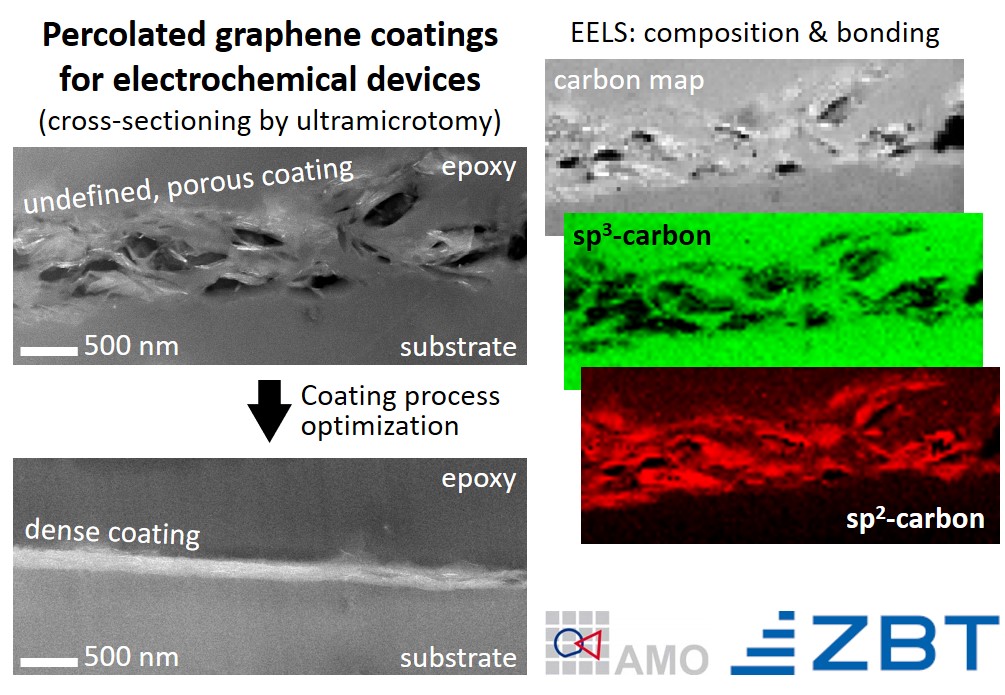
New functional materials combining stability, resistance to degradation, and efficiency with reasonable cost and ease of synthesis are crucial for their use in renewable energy applications. In catalysis, active metal nanoparticles dispersed on oxide surfaces are of fundamental interest to overcome the use of bulk noble metals. However, these bear the substantial limitations of the conventionally employed “top-down” deposition techniques, resulting in loss of activity and performance during operation.
Exsolution, i.e. metal atoms that, in a reducing environment, segregate to the surface from sites within a host oxide lattice to generate anchored nanoparticles, has proven a successful strategy to overcome such issues. However, many questions remain regarding their growth mechanism and the host crystal structure evolution during the reduction process. Here, the SrTiO3 perovskite has been doped with iridium (∼0.5 wt. %) at the B-site and subjected to reducing conditions required for exsolution. Ex situ characterization with a range of techniques including XRD, XPS, HR-TEM, and STEM–EDX showed that iridium metal nanoparticles are grown on the SrTiO3 surface with the unique characteristic of “socketing” to the host lattice. In situ TEM/EELS studies allowed to monitor in real time nanoparticle exsolution, enabling us to gain general understanding on the mechanistic steps involved, and to investigate variations in composition, chemistry, and structure of the nanoparticles and the host during reduction. Insights in the crystallographic behaviour of both the host lattice and the exsolved nanoparticles at the atomic scale were obtained, and the materials composition at the unique anchoring interface was studied through high-resolution chemical characterization. This approach allowed us to explore the evolution and transformation of the exsolved NPs to understand the structure of the NPs and the support substrate, which is of fundamental importance in order to tailor materials design for even better reactivity.
The mechanisms governing variant selection phenomena in bainitic microstructures formed during ausforming treatments are not fully understood yet. Previous results cannot be explained by the same rule, which suggests that variant selection is controlled by different mechanisms depending on the steel. In this work, we aim to understand the mechanisms governing variant selection in a medium carbon-high silicon steel subjected to ausforming treatments. A microstructural characterization carried out in different regions of barreled samples has been combined with Finite Elements simulations and Crystal Plasticity simulations, respectively. It has been shown that variant selection can be explained by understanding the distribution of the plastic strains at the macro and micro level in these microstructures.
Evaluation of microstructural evolution is often essential for comprehension of aspects of locally occurring physicochemical based phenomena. Often this evaluation is restricted by external limitations such as high temperature phases and therefore impossible to put into execution or too complex to be performed excessively. Simulations have been used widely to model material behavior or properties in regions where a direct observation is impractical, but their extra- or interpolations are only as good as the assumptions they are based on. Those assumptions should be as few as possible for complexity reasons, but as many as necessary to reproduce the details you want to model in the first place. By "reverse engineering" the key aspects to obtain realistic grain size distribution over time and temperature, considering normal and abnormal grain growth have been found, with a discrete grain neighbor relationship to be the main inevitable parameter, to predict microstructural development in HSLA-steels. Annihilation, recovery and recrystallization during and after hat rolling has also been implemented considering subgrain formation and growth regarding additional driving forces such as dislocation density.
The validation of the grain growth model has been performed by taking control samples at different times and temperatures. Validation of the recrystallization kinetics has been done with double hit experiments with a Gleeble®. Since the high temperature austenitic phase was of interest, this information had to be extracted from the martensitic/bainitic microstructure at room temperature. Different approaches have been utilized to visualize and quantify the prior austenitic grains such as the Merengue2 software which performs the reconstruction based on EBSD measurements and etching primary grain boundaries with a modified picric acid solution.
As the steel industry is tending to the autonomous line control and to improve the control of the products properties by predicting them as a function of the process variables, a model that could estimate the mechanical properties of low-carbon martensitic steels after tempering is required. Modifications to a physical-based model previously developed [1] were applied to simulate industrial short time tempering treatments (between 200 and 400ºC for 300 s maximum) for three low-carbon (0.1, 0.15 and 0.21wt%C) low-alloyed steels. The model considers classical nucleation theory, growth under paraequilibrium condition and coarsening of coexisting precipitate populations, precipitation sequences and carbide size distributions [1].
The model parameters were adjusted on the basis of in situ HEXRD analysis of microstructure evolutions, performed at DESY, Germany (PETRA-III), TEM measurements and calorimetry experiments. Dislocation densities were estimated by the Modified-Williamson-Hall method. A dislocation recovery model was considered and calibrated on the recovery kinetics determined on the single 0.21wt%C grade. The yield strength has been carefully determined and compared to experimental yield strengths. The yield strength was calculated on a physical basis with accounting of the Peierls barrier, strengthening by carbon and substitutionals in solid solutions, dislocation hardening, and precipitation strengthening/softening. The precipitation contribution was analyzed, and a linear sum was applied to consider the effect of the ε-carbide and the cementite. As the precipitates have sizes in the nanoscale, the shearing mechanism was accepted even for the cementite particles.
Good agreement was found between the simulation and the experiment.
[1] Y. Wang, S. Denis, B. Appolaire, and P. Archambault, “Modelling of precipitation of carbides during tempering of martensite,” J. Phys. IV JP, vol. 120, pp. 103–110, 2004.
A new model has been extended to predict austenite $\leftrightarrow$ ferrite transformation kinetics for complex thermal cycles with the cementite dissolution on a wide range of Fe-C-Mn steels. For each alloying element, the concentration profile is computed solving a unique diffusion equation (including the 2 phases and the interface). The interface is described assuming linear variation of chemical potentials, saving thus computational time. Interface motion is driven by the minimization of Gibbs energy. The model naturally reproduces the transition between thermodynamic equilibria (Para equilibrium, Local equilibrium with negligible partitioning, Local equilibrium) during heating. The model validity for reverse transformation has been validated on cyclic heat treatment.
Quenching and Partitioning (Q&P) is not a typical heat treatment for martensitic stainless steels, but variation of the interception temperature and subsequent holding at low “tempering” temperatures (<500°C) has a significant impact on these steels due to partitioning effects.
With the help of physical models, the microstructure after Q&P heat treatment can be predicted. In comparison to low-alloyed advanced high strength steels, martensitic stainless steels are characterized by higher alloying contents, especially by additions of nitrogen. In order to describe the onset of the martensite formation during quenching from the austenitic region, a new MS formula was determined in this study. For this purpose, MS temperatures at four different austenitizing conditions were determined for several steels and the corresponding austenite composition was calculated using ThermoCalc®. The influence of different databases on the calculation was taken into consideration.
The transformation of austenite to martensite during quenching was observed by dilatometry and mathematically described using the Koistinen-Marburger equation. The k-value for this equation was also redetermined in the course of this work for the selected materials.
In the present model, partial partitioning was assessed instead of full partitioning as considered by constrain carbon equilibrium model. Additionally, nitrogen was taken into account for the partitioning. Another factor considered in the model is not only the chemical stabilization of austenite via C- and N-partitioning, but also the mechanical, which was derived from the dilatometric curves.
Complete Q&P heat treatment cycles were conducted on a dilatometer using different austenitizing and interception temperatures. The samples were subsequently analysed, in order to determine the retained austenite content and it was confirmed partial partitioning taking place during isothermal holding at tempering temperature. The calculated results of the model were compared with experimental data from dilatometer samples and showed good agreement.
Magnesium alloys are of interest for space applications. Their low density would be beneficial to substitute aluminium in many aerospace structure applications, depending on the exact stiffness and load-bearing requirements. However, magnesium alloys are more challenging to process than aluminium. Advanced manufacturing technologies are required to allow broadening the range of applications using the appealing properties of magnesium.
Plasma Metal Deposition (PMD) is an additive manufacturing technique that belongs to the Direct Energy Deposition group, using a plasma as energy source for melting materials in powder or wire shape with high deposition rates.
The application of PMD manufactured Mg-alloys components in space hardware is beneficial as allows implementing integral designs, complex and large structures.
In this study, the processing of experimental AZ91 wires into a near net shape component using the additive manufactured technique PMD is developed with the aim of producing a complex technological demonstrator. This demonstrator will then be tested to assess its compliance with the requirements of the intended application.
Thin-wall structures are fabricated, tensile test samples and test coupons are extracted to evaluate mechanical properties, microstructure and phase formation of the as deposited and heat-treated material. Furthermore, to be qualified for space applications the corrosion behaviour of the processed AZ91 material is studied.
The present study investigates the thermal stability of the microstructure of the rapidly solidified ribbon-consolidated Mg97.94Zn0.56Y1.5 alloy. In the as solidified state, the material has a very fine grain structure with an average grain size of around 900 nm. Moreover, dispersive Zn- and Y-rich stacking faults segregated in basal planes can be observed in the microstructure. The alloy is characterized by a weak basal texture with a more pronounced intensity at the (10-10) pole. As a result of these features, the material has shown a superior yield strength of 360 MPa and an elongation of 18%. In order to study its thermal stability, isothermal annealing for 2h in a range of 300 °C - 500 °C was applied. Scanning electron microscopy (SEM), including backscatter electron images (BSE), and electron backscatter diffraction (EBSD) techniques have been used to study the microstructure changes. Furthermore, X-ray measurements were performed for reliable texture analysis. The microstructure was found to be stable with increasing annealing temperature up to 400 °C. With further temperature increase, the growth of the grain size and changes in the texture of the alloy, particularly, redistribution of the intensity at the (10-10) pole, can be related to the recrystallization process. Microstructure changes were correlated with the results of the microhardness measurements.
Agata Kulig1, Haneen Daoud1, Johannes Weiser2, Uwe Glatzel1,3
1 Neue Materialien Bayreuth GmbH, Gottlieb-Keim-Str. 60, 95448 Bayreuth, Germany
2 Evobeam GmbH, Am Hofgut 5, 55268 Nieder-Olm, Germany
3 Metals and Alloys, University of Bayreuth, Prof.-Rüdiger-Bormann-Str. 1, 95447 Bayreuth, Germany
Abstract
Titanium (Ti) based lightweight alloys are widely known in aerospace and medical applications due to their advantageous properties, such as low density and high strength. However, Ti has a high affinity for oxygen, which leads to difficulties during production. Therefore, the cost of production is considered to be high. This represents a major challenge in the production of large-sized components.
In this presentation, newly developed wire-based laser deposition welding process to produce Ti-based components with a high build-up rate of more than 150 cm3 / h is presented. The process is carried out in pre-vacuum (10-3 mbar) with pre-heating of the wire-shaped raw materials. The microstructure and the mechanical properties of Ti-based printed components at both room temperature and high temperatures were characterized and tested. The results obtained show a very low oxygen content with less than 0.002% by weight. The tensile strength of the Ti-based printed components using this new process is higher comparing to the conventional manufactured Ti-components at high temperatures.
The HORIZON2020 project "ENSUREAL" is developing a modernized version of the Pedersen process for production of alumina. The process counters challenges in raw material availability, energy availability, CO2 emissions and sustainability. European universities, institutes, technology partners, metal producers, fertilizers and plant suppliers cooperate to consider newest technologies, research results and current boundary conditions like climate change discussions. After calculations, simulations lab tests and pilot tests now all data are evaluated for upscaling to the investigated case, a capacity of 500 kt industrial grade alumina. The flowsheet and the industrial scale plant will be shown as a first complete process concept, consisting of four main sections: Pretreatment, pyrometallurgical melting, hydrometallurgical steps and calcination.
The pretreatment contains mixing, milling and pelletizing of bauxite or bauxite residual, limestone, coke and gray mud reverts.
In the pyrometallurgical section the pellets are dried, pre-reduced and preheated by a rotary kiln. The hot pellets are afterwards hot transferred to a large SAF to produce a Ca-Al-slag and to separate iron. The Ca-AL-slag is cooled down slowly. This is important to enable the formation of leachable crystal phases and the formation of phases that make the slag self-disintegrating. The modern SAF enables to use renewable enerygy, to integrate energy management and heat recovery.
The hydrometallurgical part contains as first step the leaching of the Ca-Al-slag using a recycled Na2CO3 solution, forming solid gray mud (CaCO3) and dissolved NaAlO2. Afterwards the NaAlO2 solution is treated with CO2. As a result dissolved Na2CO3 and solid Al(OH)3 are generated. While the Na2CO3 solution is returned to leaching step the generated Al(OH)3 is finally transferred to the calcination step.
The updated Pedersen process requires a long well cooperating process line, gives flexibility in usage of a wide range of raw materials and renewable energy and a contribution to reduce CO2 emissions.
Eutectic high-entropy alloys (EHEAs), with mixed microstructures of HEA matrix and intermetallics, have advantages on flexible adjustment of microstructures. Recently, we developed a novel non-equiatomic eutectic high-entropy alloys (FeCoCrNiTaAl) with appreciable high-temperature strength. However, the intrinsically brittle Laves phase in the lamellar structure causes limited ductility at room and high temperatures. Therefore, we used direct hot extrusion of gas-atomized powder, and produced EHEA with equiaxed microstructures. The Laves lamella were disintegrated and recrystallized to be network-like, with a mean width of about 1μm. Simultaneously, the nanosized L12 phase (4–5 nm) precipitated homogeneously in the FCC matrix. The microstructure is highly stable upon annealing at 1000°C, which leads to attractive high-temperature strength. At 800C, the as-extruded alloy shows a high elongation to fracture (εF) of 33.3% and yield strength (σ0.2) of 554 MPa. Interestingly, annealing of the alloy at 1000°C for 100 h leads to a continuous/anomalous increase of the yield strength to 800 MPa, with a good enough tensile ductility of 16%. The microstructural evolution and the fracture behaviour of the EHEA were carefully characterized.
A particular need to increase the efficiency of gas turbine engines induces the searching for new materials with higher performance than currently used commercial alloys. One of the prospective candidates for high-temperature applications is the so-called refractory high entropy alloys (RHEAs). RHEAs are often based on body-centered cubic (bcc) or ordered B2 solid solution and can contain Laves, ZrxAly, M5Si3, or MC phases. However, the enormous amount of possible compositions perplexes a choice of the microstructure type and constitutive phases for a better properties combination obtaining. Recently, a promising approach to get coherent B2 precipitates in the bcc matrix was reported. Nevertheless, alternative methods must also be considered. This study introduces a CALPHAD-aided strategy to design eutectic RHEAs (ERHEAs) based on the light-weight Al-Cr-Nb-Ti-Zr alloys system. The multielement origin of program ERHEAs was shown to be a reason for appearing a unique eutectic B2/C14 Laves phase microstructure. Mechanical properties evaluation exhibited an exponent-like strength enhancement and ductility drop when a transfer from a single-phase to eutectic microstructure occurs.
The study was supported by the Russian Science Foundation grant № 19-79-30066.
We first report the microstructure and mechanical properties of a non-equimolar eutectic high-entropy alloy (EHEA) CoCrFeNiTaAl fabricated by additive manufacture. The as-printed EHEA consists of a nanostructured network-like Laves phase (width ~ 30 nm) embedded in an fcc phase matrix (average grain size of 17μm). The alloy exhibits an excellent mechanical property (yield strength ~ 2.3 GPa, plasticity > 50%) via compressive micro-pillar test. The underlying mechanisms are unraveled based on the coupling between the extremely fine in-situ composite of the hard Laves phase and ductile fcc matrix derived from the eutectic reaction and fast cooling speed in additive manufacture processing. The eutectic high-entropy alloy is believed to be a promising feedstock material for metal additive manufacturing.
Two parallels of tensile tests at room temperature and at 650 °C were performed on the AlCoCrFeNi2.1 eutectic high-entropy alloy (EHEA) in as-cast and aged conditions. The as-cast AlCoCrFeNi2.1 has a eutectic microstructure with B2-type NiAl lamellae inside the L12-type Ni3Al matrix in a ratio of 35% and 65%, respectively. Isothermal aging at 800 °C for 100 h was performed in order to induce the precipitation of a B2 (BCC) micro-phase of ellipsoid shape inside the L12 (FCC) matrix. Fractography was performed on all samples in order to study the failure mechanisms at different material conditions. In addition, longitudinal sections of fractured specimens were prepared for metallographic analysis. Tensile-test results of parallel samples do not deviate much from each-other even at the as-cast condition and show lower values as compared to the aged samples, both at room- and elevated temperatures. This is mainly due to the precipitation strengthening effect from the B2 micro-phase inside the ductile L12 matrix. Fractography reveals that the fracture of the room-temperature tested samples generally occurs inside the more brittle B2 phase and propagates toward the more ductile L12 matrix. In contrast, in the high-temperature tested samples, the fracture initiates and propagates mainly along the semi-coherent B2-L12 interface and along the grain boundaries.
Within the frame of a joint European project we developed a dual-phase medium entropy alloy Al8.5-Cr16.3-Fe35-Ni36.8-Mo3.5 (in wt.-%) which forms an ultrafine vermicular microstructure upon casting. The two phases (fcc) and (bcc) form a bi-continuous network with nearly equal phase fractions. We quantitatively describe the microstructure using scanning electron microscopy (SEM), energy- dispersive X-ray spectroscopy (EDS), and electron backscatter diffraction (EBSD). Further, we present the results from surface hardening experiments, which include wear, shot peening and cavitation erosion tests performed on annealed samples. As reference material we include the super-duplex steel 1.4517 (DIN EN 10283/ASTM A890). On this basis we will discuss potential applications and outline future development steps.
Duplex stainless steels (DSSs), containing bcc and fcc phase, are one of the strategically important structural materials in critical components of e.g. chemical industry, gas sector, nuclear power plants, etc. due to their excellent corrosion resistance and mechanical properties. However, the application of DSSs is limited when they are exposed to 250-500 ºC due to the separation of the original bcc phase into Fe-rich (𝛼) and Cr-rich (𝛼′) bcc phases, which occurs when these steels are thermally treated inside the Fe-Cr miscibility gap. This phase separation (PS) is the main reason which is responsible for the low-temperature embrittlement of DSSs, changing mechanical properties such as hardness of ferrite and impact toughness significantly.
Due to the importance of DSSs, significant efforts have been made to investigate the PS in the bcc single-phase model alloys and fcc+bcc dual-phase alloys. However, a full understanding of the key mechanisms governing PS and subsequently embrittlement is still lacking. One limitation is that the investigations have been almost solely performed by ex-situ characterization of the nanostructure that develops during thermal treatment. In-situ characterization could provide a significant contribution, especially on the early stages of the process. Effects of alloying content, cooling rate, externally applied magnetic field, etc. on the PS are investigated. Quantitative information about the spinodal decomposition such as wavelength, amplitude have been calculated by our developed method to calibrate the current theoretical model. Mechanical testing, e.g. micro-hardness and impact toughness, will complement the neutron scattering in order to obtain a comprehensive understanding of the correlation of microstructure-property evolution. The gained knowledge can be used for the further design and optimization of the new grades of DSSs. These would pave the way for controlling the notorious ‘475 °C embrittlement’ in technical applications, and to promote the development of more sustainable DSSs by increasing their lifetime.
Ti-xNb-7Zr-0.8O alloy was prepared from elemental powders by a field-assisted sintering technique (FAST). Nb is the main beta-stabilizing element, as well as being the element with the slowest diffusion. A compositional gradient of Nb was produced in the alloy, allowing the observation of phase transformations over a wide range of compositions. Scanning and transmission electron microscopy investigations revealed that Nb-rich regions retained the metastable β phase, surrounded by transition region consisting of the β and ω phases and Nb-lean regions consisting of the α and β phases. The critical concentration of Nb determining whether α or ω will precipitate during cooling was determined to be 22 wt%. The observed as-sintered microstructure is discussed with respect to the Gibbs free energy curves and the phase diagram.The paper validates the viability of using FAST to prepare heterogeneous alloys permitting the study of phase transformations over a wide range of compositions.
Zirconium and titanium are in the same group of periodic table of elements and therefore some of their properties are similar. For example, they occur in the same crystallographic structures – HCP α phase at room temperature and BCC β phase above β transus temperature. Although titanium alloys and their phase transformations have been already well-studied, zirconium alloys with higher amount of β-stabilizing alloying elements are rather unexplored. While titanium alloys are nowadays widely used for example in aircraft industry or biomedicine, zirconium is utilized in nuclear industry due to its low cross section for neutron capture.
In this work, phase transformations of metastable Zr-(12/15)Nb alloys were studied in-situ during heating using resistivity measurements and synchrotron X-ray diffraction. Based on the results, SEM and TEM observations were made on ex-situ prepared samples. For first characterization of mechanical properties, microhardness was measured. Achieved results were compared with Ti-(12/15/18)Mo alloys.
It was confirmed that phase transformations in both Zr-Nb and Ti-Mo systems are qualitatively similar. After quenching from temperature above temperature of β-transus, α phase does not precipitate and during subsequent linear heating to temperatures in range 300 °C – 500 °C, metastable ω phase grows. On the other hand, quantitatively, these systems behave differently.
Modifying the architecture of multilayered hard coatings used in the metal cutting industry allows to tailor the mechanical properties such as hardness or fracture toughness of these coatings. Within this work, the effect of the bilayer thickness (Λ) and the individual layer thickness ratio on the microstructure and mechanical properties of ZrN/TiN multilayer coatings was investigated. Multilayer coatings with Λ on the μm scale (~300-600 nm) and two different ZrN:TiN thickness ratios of 6:1 and 3:1 as well as multilayers with Λ on the nm scale (<40 nm) were deposited by cathodic arc evaporation. In addition, TiN and ZrN single layers were synthesized. The microstructure was investigated by X-ray diffraction (XRD) and scanning electron microscopy. All coatings exhibit a face-centered cubic structure and a similar texture, which was predominantly (111). A columnar structure was observed for all samples and grain growth through the ZrN/TiN interfaces was discovered for all multilayer samples. For all coatings compressive residual stresses were determined by XRD using the sin²Ψ method, where the ZrN single-layer sample and the multilayer sample with the largest Λ exhibited the highest compressive residual stress of -1659 ± 163 GPa. Lower compressive residual stresses could be correlated with decreasing Λ and decreasing ZrN:TiN thickness ratio for the multilayer coatings. Micro-mechanical bending tests as well as nanoindentation experiments were conducted to assess the mechanical properties of the coatings. The obtained results allow to design a suitable architecture for ZrN/TiN multilayer coatings yielding the desired coating properties for application in the cutting industry.
Keywords: Fracture toughness, mechanical properties, multilayer, ZrN, TiN, arc evaporation
In recent years, the use of magnesium alloys in air transport has mainly been hampered by a ban on use because of its high flammability. In particular, the ban on the use of magnesium alloys on passenger seat design elements was prohibited by the Standard (AS) 8049C issued by SAE International. However, in 2015 this standard was revised and magnesium alloys meeting the flammability criteria were enabled.
Two magnesium alloys containing yttrium, gadolinium and calcium (4 – 4 – 2 and 2 – 2 – 1 wt. %) designed with emphasis on high ignition temperature and solid mechanical properties were processed by extrussion. Microstructure and mechanical properties were investigated in this work. Extrusion parametres (temperature and extrusion ratio) had a great impact on grain size and texture. Optimalized parameters led to finegrained homogenous microstructure with significantly improved mechanical properties. The microstructure was studied by scanning electron microscopy (SEM) including electron backscatter diffraction (EBSD). Transmission electron microscopy (TEM) was also used to determine the composition of secondary phases. The mechanical properties were studied by microhardness measurements, tensile and compression deformation tests.
The unique microstructures of nanoscale coatings are the reason for their superior properties in wear applications like cutting tools. By using chemical vapor deposition (CVD) a nano-lamellar AlTiN coating consisting of TiN and AlN was achieved by spontaneous self-organization during layer growth. These results suggested the investigation of the AlZrN system.
In this study, AlZrN coatings were deposited by CVD from ZrCl4 and AlCl3 precursors and reaction with NH3 at 950 °C. By changing the AlCl3:ZrCl4 ratio various layers with changing chemical composition could be deposited. The layer thicknesses were determined gravimetrically and by means of dome grinding. To verify the microstructure of the coatings transmission electron microscopy (TEM) and X-ray spectroscopy (XRD) were applied. The coatings showed the formation of nanocrystalline phases but additionally some amorphous phases. Pillar structures were found throughout the coatings, with a higher crystallinity in the pillar compared with the surrounding material. Regarding the transition area between the substrate and the deposited coating, differences in the elemental composition as well as the crystallinity compared to the bulk of the coatings were observed. Depending on the elemental composition, the formation of hexagonal AlN or cubic ZrN was found. Additionally a shift of the respective lattice parameters was observed by x-ray diffraction, which indicates the incorporation of other elements in the crystal lattice.
With the obtained results new information on the microstructure as well as the crystallinity of AlZrN coatings with varied Al/Zr ratios was received, which can further help to customize coating properties such as the phase formation accompanied with different crystal structures.
The ever-increasing demands for longer tool life in high-speed machining require multifunctional coatings that display several interlinked characteristics such as high thermal stability, hot hardness and toughness. For this purpose, hard nitride (Ti, Al)N-based nanocomposites coatings have been developed [1–3], but they still suffer from low fracture resistance. In this work, a series of high Al-fraction multilayered TiAlBN nanocomposite coatings deposited by HiPIMS is presented and compared with another TiAlN series (an industrial standard) deposited under the same conditions. The coatings microstructure and compositon were characterized by GDOES, XRD, SEM, TEM, while mechanical properties, including fracture toughness, were tested by room and high temperature nanoindentation and micropillar splitting. TiAlBN coatings exhibit a refined grain structure with individual layer thickness down to 2 nm, which translates into improved fracture toughness over TiAlN while maintaining hardness values up to 40 GPa. In-situ hot-hardness measurements up to 700 ºC and vacuum annealing tests of the coatings up to 1100 ºC were carried out to infer the behavior of the coatings during the intended final cutting application. The results demonstrate the advantages of TiAlBN multilayered coatings over monolayer TiAlN coatings in terms of thermal stability and hardness at all studied temperatures.
Metastable solid materials such as amorphous or nanocrystalline alloys, supersaturated solid solutions, high-temperature or high-pressure phases persisting at normal conditions, have been of great interest due to a possibility to explore novel structures with unknown properties. These materials are kinetically determined and can be therefore synthesize only by non-equilibrium processes. Magnetron sputtering is thus a suitable technique for their preparation as thin films.
The present study focuses on preparation of thin-film metallic alloys from the binary W–Zr system by non-reactive magnetron sputtering and systematic investigation of their structure, properties, and thermal behavior at elevated temperature. The films were sputter-deposited in argon gas using two unbalanced magnetrons equipped with a W and Zr target, respectively. The elemental composition of the films was controlled in a very wide composition range (0 – 100 at.% Zr) by varying the deposition rate from individual targets.
Using this PVD method, we were able to prepare W–Zr thin-film alloys with several metastable structures in respect to the equilibrium phase diagram. Up to 24 at.% Zr, the structure of the films is characterized by a supersaturated bcc α-W(Zr) solid solution with a highly oriented structure, columnar microstructure, enhanced hardness and very low residual stress. In the range between 33 and 83 at.% Zr, an amorphous structure with features indicating metallic glass behavior is observed. These films exhibit a very smooth surface, moderate compressive stress, and constant electrical resistivity. Above 83 at.% Zr, high-temperature bcc β-Zr(W) and high-pressure hcp ω-Zr(W) phases with an enhanced hardness are prepared. Moreover, a very interesting dual structure with crystalline columnar submicrometer-sized conical domains surrounded by a metallic glass is formed at 28 at.% Zr. Thermal stability and oxidation behavior of these metastable structures will be discussed as well.
Soiling of mirrors is one of the main reasons for the increase of maintenance costs in concentrated solar thermal power (CSP) generation (Bellman, 2020). Such a problem poses multiple challenges originating both from the surfaces' nature and their interaction with their environment - such as desert dust - which previous approaches have failed to address fully. For this application the durability of the layers is critical hence techniques such as sputtering are needed that have shown a remarkable record in the mass scale production of tribological films. The proposed solution takes advantage of the superhydrophilicity of sputtered thin films on the mirrors. As the mirror is the first component to interact with the sunlight in the energy harnessing process, its efficiency is critical to the system performance. Mirror reflectivity is one of several factors affecting the energy delivered by the solar field to the receiver, whilst the reduction of cleaning water consumption (Duvenhage, 2019) is another key factor that needs to be addressed. In this work, we study and develop stable superhydrophilic amorphous TiO2 coatings (Lee, 2017) deposited using magnetron sputtering, and we optimize the pre-deposition surface cleaning. We also perform superhydrophilicity measurements and other characterization techniques (SEM, EDS, XRD, Raman, AFM) gaining significant information on the structural and morphological properties of samples of various thickness'. Moreover, we demonstrate the augmentation of the superhydrophilicity and the stability of the deposited layer, whilst maintaining the mirrors' reflectivity.
Acknowledgment: Project Nano4CSP is supported under the umbrella of SOLAR-ERA.NET Cofund 2 by: GSRT (General Secretariat for Research and Development, Greece), RIF (Research and Innovation Foundation, Cyprus) and FFG (Austrian Research Promotion Agency). SOLAR-ERA.NET is supported by the European Commission within the EU Framework Programme for Research and Innovation HORIZON 2020 (Cofund ERA-NET Action, N° 786483)
Since the 60’s, the interest of the scientific community for metallic glasses (MGs) has increased considerably. Thanks to their amorphous structure, they display intrinsic chemical homogeneity combined with a lack of crystallographic defects, leading to unique characteristics in comparison with conventional polycrystalline materials. Bulk MGs are synthetized from a fast quenching (which inhibits the crystallization process during the cooling stage) and results in a metastable amorphous phase. The cooling rate directly depends on the melted alloy composition, and only a narrow range of chemical composition and small pieces can be obtained in bulk state. However, due to the really fast cooling rate involved during the deposition process, magnetron sputtering is a well-adapted process to generate thin film metallic glasses (TFMGs) for a wide range of chemical compositions [1]. This allows a chemical optimization of TFMGs, depending on the targeted applications.
Within the wide panel of TFMGs, Zr-Cu-Ag TFMGs are of particular interest for biomedical applications, thanks to their good antibacterial and corrosion properties [2,3]. In this work, multifunctional properties of Zr-Cu-Ag TFMGs with various compositions (several Zr/Cu ratios and Ag contents) were evaluated. In particular, the antibacterial and corrosion properties of these films were investigated, and put in perspective with physico-chemical surface properties and microstructural observations. Results lead to optimal compositions, balancing between antibacterial properties and corrosion resistance.
[1] Mihai et al. J. Alloys Compd. 2015
[2] Etiemble et al. J. Alloys Compd. 2017
[3] Nkou Bouala et al., Surf Coat Tech. 2018
Ti-6Al-4V alloy is intensively used in the aerospace industry because of its high specific strength. However, the application of Laser Powder Bed Fusion (LPBF) Ti-6Al-4V alloy for structurally critical load-bearing components is limited. One of the main limiting factors affecting the structural integrity, are manufacturing defects. Additionally, the high cooling rates associated with LPBF process result in the formation of large residual stress (RS) with complex fields. Such RS can cause cracking and geometrical distortions of the part even right after production. Also, the microstructure of LPBF Ti-6Al-4V in the as-built condition is significantly different from that of the conventionally produced alloy. All these factors affect the mechanical behavior of the material. Therefore, to improve the material performance it is important to evaluate the individual effect of RS, defects, and microstructure on fatigue life. To this aim Ti-6Al-4V LPBF material in as-built condition and subjected to different post-processing, including two heat treatments (for stress relief and microstructural modification) and Hot Isostatic Pressing (HIP, for densification), were investigated.
Prior to fatigue tests at elevated temperature, the microstructure, the mesostructure, and subsurface RS on the fatigue samples were investigated. It was found that the fatigue performance of HIPped samples is similar to that of conventionally produced Ti-6Al-4V. The tensile RS found at the surface of as-built samples decreased the fatigue life compared to heat-treated samples. Additionally, the modification of the microstructure (by heat treatment) did not affect the fatigue performance in the regime of mostly elastic strain. This shows that in the absence of tensile RS the manufacturing defects solely control the failure of LPBF components and densification has the strongest effect on the improvement of the mechanical performance.
Laser powder bed fusion (L-PBF) is a complex process in which many parameters intervene and interfere with each other and can have a significant impact on the melting behavior. Few of them: laser power, scan speed, hatch distance; are usually considered when developing the process while others such as powder size and gas atmosphere are most often neglected. The gas is an important parameter of the process as it prevents oxidation of the material and removes process by-products from the process chamber.
This study focuses on the effect of the process gas and O2 content, on spatter formation and process stability during L-PBF of Ti-6Al-4V lattice structures and resulting properties.
Results from optical tomography showed that spatter emission was reduced when working with argon-helium mixtures compared to argon and even more so when working with helium. Process stability was improved similarly. The use of argon-helium mixtures was effective in reducing porosity content according to micro-computed tomography analyses, while the compression properties remained comparable to parts processed with Argon only.
Scope of this work is to overview the influence of a multiple step electrochemical surface treatment, heat treatment and print orientation on microstructure and mechanical properties of Ti 6Al 4V processed by laser powder bed fusion (L-PBF). Experiments were carried out from a first patch, after using virgin powder to avoid powder quality and morphology quality.
First tests include density and surface roughness to optimize process parameters using design of experiment. Mechanical test specimens for tensile, notched bar impact (charpy) and compression tests were build in three different orientations, vertically, horizontally and leaned at 45° to the build plate. Subsequently, thermal treatments stress relief, furnace annealing and hot isostatic pressing were performed to determine the changes on microstructure and mechanical properties. In addition to as-build samples, mechanical machining and electrochemical polishing surface treatment were applied to investigate the influence of surface roughness.
As-build specimen shows little anisotropy in yield- and tensile strength, but a strong influence on the necking and a brittle fracture behavior due to their martensitic microstructure. Heat treatment can increase ductility and further decrease strength anisotropy with both, furnace annealing and HIP showing similar results for tensile properties. Electrochemical polishing is a viable way to decrease surface roughness (down to a Ra of 1µm and Rz around 4µm from 7.5µm and 40µm respectively for vertical parts) and drastically increasing fracture necking and its isotropy compared to as-built parts from 4% to over 30%.
As titanium-based alloys possess interesting specific mechanical properties, they are increasingly used in aerospace industry. Additive manufacturing is able to produce complex near net shape parts reducing the raw material quantity involved. This potential is of great interest for industrial applications. Among additive manufacturing processes, Selective Laser Melting (SLM) has proven to be an attractive manufacturing route for the production of titanium alloys as Ti-6Al-4V. However, even if these new ways of elaboration offer several advantages, there is a lack of knowledge about the microstructures inherited from SLM and the microstructural evolution during post heat treatment. Consequently, this study aims to obtain a further understanding of the microstructural evolution (recovery and decomposition of martensite α’) during post heat treatment in the Ti-6Al-4V alloy elaborated by SLM. The microstructural evolutions were tracked using the synchrotron radiation facilities, the dilatometry and the electrical resistivity measurements. In addition, interrupted heating at different temperatures were conducted to observe the microstructural evolution during heating by Transmission Electron Microscopy (TEM).The phase amounts, the d-spacing and the Full width at half maximum (FWHM) variations were determined by Rietveld refinement from XRD patterns during continuous heating up to the single β-phase domain with different heating rates and elaboration strategies. The complementarity of characterization tools clearly evidenced a shift of the α’/α $\longmapsto$ β transformation kinetics toward higher temperatures as the heating rate increases. The variation in transformation kinetics will be discussed with regard to the predicted values at thermodynamic equilibrium. In addition, the combined analysis of d-spacing and FWHM has shown the deviations from linearity at intermediate and high temperatures, which amplitude depends on the heating and elaboration conditions. These variations will be analyzed in regard of internal stress relaxation or changes of chemical composition.
Zircon (ZrSiO4) is a ceramic material whose properties make it especially interesting to be applied in thermal and environmental barrier coatings at a competitive cost. However, its decomposition at high temperature during the deposition step has so far limited its use by plasma spraying from powder feedstocks.
The aim of the present work is to assess the potential of using suspensions instead of powder feedstocks in plasma spraying in order to obtain coatings in which a high proportion of zircon is preserved. For that purpose, aqueous suspensions were prepared at different solids contents from a commercial zircon powder with a d50 = 1 µm. The chosen contents were 10 vol.% and 30 vol.%. Liquid feedstocks used in plasma spraying must fulfil two requirements, i.e. very good physical and chemical stability and low viscosity. Therefore, different proportions of an ammonium poly(acrylate) were added to the suspensions to stabilise them. The optimum amount of dispersant was determined through zeta potential and rheological measurements. The liquid feedstocks were deposited by suspension plasma spraying (SPS) on metallic substrates testing different spraying distances. The topography of the coatings was analysed by confocal microscopy, their surface and cross-section were observed by scanning electron microscopy, the different crystalline phases were determined by X-ray diffraction and the thermal conductivity was measured by means of a laser flash equipment.
The results showed that a significant amount of zircon phase is preserved in the final coatings. Additionally, a clear effect of both the feedstock solids content and the spraying distance on the thermal decomposition of zircon particles was observed. Thus, different microstructures and proportion of crystalline phases in the resulting coatings were obtained giving rise to some thermal conductivity variations.
This work has been supported by the Spanish Ministry of Science, Innovation and Universities (RTI2018-099033-B-C3, MCIU/AEI/FEDER, UE).
Structurally and functionally optimized ceramic materials can revolutionize many applications that rely on biocatalytic reactions. In general, the design of these materials is based on anchoring of biocatalyst phases within randomly porous ceramic supports with huge surface area within as small as possible volume. Nevertheless, the real-world applications require to address the issues related to effective mass flow and stability of anchored biocatalysts. Having this in mind, different strategies were implemented.
In order to increase surface area and permeability of reactor structure, a hierarchical porosity distribution and implementation of mass flow oriented porosity channels hold a great promise. In this study, hierarchical porosity distribution at micro – and macro- structural levels was pursued through deployment of combined freeze and robocasting techniques. The ceramic supports obtained presented high surface area and mass flow oriented channels delivering high permeability at low penalty to structural robustness.
Varying strategies were screened to achieve highly effective biocatalyst phase anchoring to ceramic support. Different chemistries of enzyme immobilization based on both reversible and irreversible biocatalyst coating were evaluated. First, surface activation with amino groups was implemented to study tailor-made enzyme immobilization based on strong ionic adsorption by anion exchange. Second, surface activation with metal ions was developed to implement metal affinity-based immobilization of engineered enzymes. Finally, surface was activated with aldehyde groups to engineer enzyme immobilization based on covalent attachment. A library of enzymes with structural diversity with technological interest were used as case study.
Out-of-equilibrium phase transformation is the main phenomenon controlling the chemical partitioning of elements at micro-scale during additive manufacturing, impacting as a result the isotropy of microstructures. Currently, the behavior of out-of-equilibrium interfaces is not well understood, although it is mandatory for investigating the formation of microstructures. This lack of understanding is due to the difficulty to design and perform controlled experiments at the scale of the interface.
The Cu-Ni system has been chosen as a study case for a solid-liquid interface simulation using molecular dynamics. The Cu-Ni EAM potential used in this study is described in [1], with a simulation box of roughly 400,000 atomes at 1400K for a duration up to 100ns.
The diffusion controlled motion of the interface is studied during the solutal melting of the two pure elements using LAMMPS, where the composition profiles evolutions are extracted along with interface velocity and diffusion coefficients. The later results serve as feeding parameters for a diffusion model in order to compare the obtained results to the available literature experimental data.
[1] B. Onat, and S. Durukanoğlu (2013), "An optimized interatomic potential for Cu–Ni alloys with the embedded-atom method", Journal of Physics: Condensed Matter, 26(3), 035404.
Understand and control the growth of intermetallic phases between dissimilar alloys is the key factor in optimizing the bond strength of hybrids produced by compound casting. Being able to predict the final state of a cast part is the driving force to the development of mathematical models and numerical methods that can represent the phenomena and be applied to assist the interpretation of processes parameters effects over the casting quality. Analytical models have long been used to describe the final cast state, such as well-known models to predict porosity and the fraction of phases in cast irons. These models have provided the link between what happens on the microscopic level with the macroscopic scale, as in many situations, exact simulations at the microscopic level are still unpractical. In this work, we present an analytical model for predicting the thickness of intermetallic layers at the interface contact of aluminum-brass hybrids produced by compound casting. To assist the construction of the model, we apply solid-liquid diffusion couple experiments to isolate the temperature and time effects at the interface and obtain the necessary parameters of our model, such as growth rates and activation energies. The model extension to non-isothermal conditions is constructed and validated, which resembles the compound casting processes. In this matter, we evaluate the process parameters' influence over the interface by including the developed model as an interfacial condition in our current compound casting model. Now, the model is limited to the temperature range in which no intermetallic phases precipitate within the ones formed at higher temperatures as we only predict the growth of the layers and not their shrinkage. To overcome this limitation, as further steps, we seek to include in the model the effects of thermodynamic quantities to assist the phase transformations evolutions during the diffusion-reaction process.
Studies on the formation of layered peritectic solidification structures have been carried out by using the model system TRIS-NPG (tris[hydroxymethyl]aminomethane - neopentylglycol). As such structures are highly affected by thermo-solutal convection, further studies are planned aboard the International Space Station in 2020/21. Since convection is always present on earth, the required process conditions for µg-experiments need to be elaborated by experiments under earth gravity (1g) conditions, also by numerical investigations. In order to do so, not only adequate physical properties are required, but also numerical parameters have to be characterized. Given that there is insufficient knowledge of corresponding physical properties for the model system, the determination of the required parameters takes place by parameter variation with the aim to match with the obtained experimental results.
SiMoCr spheroidal graphite cast irons contain a high silicon content (>3.8%) as well as molybdenum and chromium. Silicon provides a solid solution strengthened ferritic matrix while chromium and molybdenum contribute to the formation of carbides and influence the amount and properties of perlite. These alloying elements thus increase strength indicators at the expense of ductility and impact strength. Furthermore, the ductility of these cast irons degrades as the solidification time increases. This degradation is often associated in the literature with a degeneration of nodular graphite to chunky graphite.
The objective of this study is to predict by simulation the risks of chunky graphite formation of an SiMoCrNi spheroidal graphite cast iron as a function of the solidification conditions. Three standard Y-block specimen molds were manufactured in ALPHASET type chemically-bonded sand under industrial conditions and each mold had 4 Y-block cavities of sizes I to IV. The moulds were instrumented with thermocouples inserted in the Y-blocks of sizes I and IV to record thermal analysis curves representative of different solidification conditions during three castings. The characteristic solidification temperatures were determined to estimate the solidification times for each curve. In parallel, the Novaflow&Solid software was used to simulate the thermal analysis curves at any point of each Y-block and compare them with those recorded experimentally. To reinforce the agreement between simulations and experiments, the curves of the evolution of thermal conductivity and heat capacity of sand and cast iron as a function of temperature obtained experimentally by Laser Flash tests were integrated into the simulation parameters. The simulation results were then combined with microstructural observations to predict the risk of chunky graphite formation as a function of solidification conditions.
The understanding of columnar dendrite growth is essential for microstructure modelling. In additive manufacturing, direct measurement of the growth velocity or undercooling is difficult. To use the undercooling and growth velocity as a tool to control the microstructure, thermal modelling with growth kinetics is meaningful.
The classic approximate dendrite growth model based on the Ivantsov solution have been widely used with the macroscopic thermal calculation. This combination allows calculation of undercooling at the part-scale. For additive manufacturing new considerations are required due to the very high growth velocity and temperature gradient, which leads to the objective of this paper: finding the right model to predict undercooling and growth rate in the additive manufacturing process.
Approximate growth models were compared with results from phase field simulations for a binary Ni-Nb system. The comparison shows that the LGK model agrees well in both dendrite growth rate and tip radius with the phase field results, therefore could be used for the additive manufacturing modelling. For more realistic multi-components system, a pragmatic approach by extracting the functional relationship between dendrite growth velocity, tip radius and undercooling from phase field simulations and combining it with macroscopic model is proposed. A demonstration calculation with the truncated Scheil model introduced by Flood and Hunt is carried out for a single Laser Powder Bed Fusion (LPBF) process. Simulations of remelting and solidification in a single track scan require a short calculation time, while the results give the dendrite tip velocity and undercooling in addition to the temperature gradient and melting pool geometry by means of a classic thermal analysis.
The LiNi0.6Mn0.2Co0.2O2 layered oxide is a very attractive positive electrode material for Li-ion batteries and possibly in a near future for all-solid-state batteries, thanks to good capacity, stability and cyclability upon long range cycling in the former. To optimize its performances in both systems, a better knowledge of its reactivity, versus liquid and solid electrolyte, is needed. The aim of this work is to tailor its morphology, particle size and shape, in order to determine their impact on the reactivity. A series of samples with crystallographic structure close to the ideal 2D layered structure (less than 5% Ni2+ ions into the Li+ sites) and the targeted composition were obtained by a two-step synthesis, consisting of a coprecipitation followed by a solid-state reaction. Samples with primary particle sizes from 200 nm to 2 µm were obtained by varying the solid-state reaction temperature and atmosphere. Samples with platelet-shaped particles were obtained by using a large amount of ammonium hydroxide as template during the coprecipitation step. Two thicknesses, around 10 nm and 85 nm, were obtained by varying the thermal treatment temperature. Electrochemical tests, as well as XPS and Auger analyses, were performed to characterize the electrochemical performance and surface properties of the materials. Analyses were also performed after cycling to study the electrode/electrolyte interface and compare the reactivity of the materials as a function of their morphology. These results will be discussed in details in the frame of this communication.
Keywords: battery, layered oxide, NMC, morphology, reactivity, performance
Increasing the cycle life and the energy storage density of Li-ion batteries are key challenges in making rechargeable batteries a more sustainable option. This has led to the development of Ni-rich LiNixMnyCo1-x-yO2 (NMC) materials with offer higher energy densities, but for commercial applications their rapid capacity fade must be addressed. We report here out detailed ex-situ studies of NMC vs. Graphite full cells that links electrochemical signatures of cell degradation with surface chemistry changes taking place on the electrodes using Hard X-ray Photoelectron Spectroscopy (HaXPES). From the cycling data it is seen that electrolyte reduction is the main cause of the capacity fading during the first few hundred cycles, followed by an increasing contribution from loss of active NMC material. It is well established that transition metals in the solid electrolyte interphase (SEI) can cause ongoing electrolyte reduction. Here we reveal that the relative rates of plating for the different transition metals change as cycling proceeds. Mn is found to be plated more rapidly in the beginning, whereas Ni becomes a more significant contribution at higher cycle numbers. From x-ray absorption spectroscopy (XAS) changes are apparent in the Ni spectra of the graphite electrodes, indicating chemical changes to the plated Ni-ions with cycle number. For the NMC electrodes, Li2CO3 impurities are found on their surface which decompose over the course of extended cycling, rather than just in the initial cycles as previously assumed.
Despite the insights obtained, ex situ measurements suffer from potential ambiguity due to changes to the electrode surfaces occurring during glovebox disassembly, and cannot capture intermediate species involved in interface degradation. We will therefore also report our initial results using operando electrochemical cells that we have recently developed that accommodate a thin silicon nitride window through which soft XAS can be measured during cell cycling.
Nickel-rich cathode materials such as LiNi$_{0.8}$Mn$_{0.1}$Co$_{0.1}$O$_2$ (NMC811) are promising next generation materials for lithium-ion batteries due to their high theoretical capacity and low cobalt content. However, NMC811 suffers from rapid capacity fading and poor cycle life. The solid electrolyte interphase (SEI) layer forms as a result of electrolyte decomposition during electrochemical cycling at low potentials. Transition metal (TM) dissolution, particularly Mn dissolution has been assumed to behave as an (electro)catalyst, consuming active lithium promoting further growth of the SEI layer. The mechanisms by which this occurs are poorly understood partly due to the wide adoption of post-mortem characterisation methods.
Adoption of Operando characterisation techniques (i.e. measurements performed during electrochemical cycling) are beginning to be utilised by the battery community. Techniques such as Raman and x-ray spectroscopies can provide information on the chemical and structural evolution of battery materials during cycling. However, these techniques often require a specialised and high cost cell design which may not be representative of standard cells for battery cycling.
Herein, we demonstrate a novel operando cell design which incorporates an x-ray transparent SiN$_x$ membrane window and allows soft X-ray absorption spectroscopy (XAS) during cycling of realistic battery electrode materials. XAS measurements in total electron yield (TEY) mode reveal chemical changes to the electrode-electrolyte interface related to electrolyte decomposition and electrode degradation processes. We will show how this approach can elucidate the precise chemical changes occurring at specific cell potentials enabling greater understanding of the impact of key battery degradation processes, such as TM dissolution. This understanding is expected to inform the selection of electrode and electrolyte materials as well as the design of mitigation strategies that inhibit the observed degradation pathways.
Among the various solutions, energy can in particular be stored electrochemically in batteries and supercapacitors. Although supercapacitors are now commercially available, they still require improvements of electrode materials, electrolytes and integration in systems, especially for enhancing their energy density. For reaching these objectives, various strategies have been proposed in the literature, involving the development of new materials, new geometries and new electrolytes. Thus, new positive electrode materials have been developed involving exfoliation and restacking processes of lamellar “building blocks”: AxHyMnO2 for their pseudocapacitive properties and AxHyCoO2 for their high electronic conductivity (10-3 to 1 S.cm-1). These composite materials have been designed by stacking nano-objects of different compositions so as to combine complementary properties to go towards the optimization of performance in terms of power and energy.
In particular, we are interesting to a better understanding of the mechanisms of charge storage on the surface of manganese oxide and cobalt oxide particles of nanocomposite materials for hybrid supercapacitors. Our study is focused on CoO(OH) materials. The surface reactivity (basic and redox character) of the synthesized compounds, which consist in aggregates of particles with 60-100 nm length, has being explored from the adsorption of SO2 molecules followed by X-ray Photoemission Spectroscopy analyses. A kinetic studied of the reactivity allowed us to identify three steps in the adsorption mechanism of our CoO(OH) samples. The coupling of XPS and first-principal calculations allows us to establish a link between the surface reactivity in the identified domains, the formation of sulfate and sulfite species, and the cobalt Co3+ and Co4+ species of the active sites along with the underlying electronic processes. First results obtained on MnO2 materials of different morphologies and size (rigid and veil-like platelets) and will also be discussed.
Solid-state electrolytes (SSEs) are promising candidates for resolving the intrinsic limitations of the organic liquid electrolyte currently employed in Li-ion batteries. Complex hydrides (e.g. LiBH4) are suggested as solid-state electrolytes. Among the different polymorphs of LiBH4, only the hexagonal phase, which is stable at temperatures above 110°C, has a remarkable high ionic conductivity (~10-3 S/cm at 120 °C). To practically access a room temperature (RT) SSB, a promising approach to enhance the Li-ion conductivity of LiBH4 at RT is the development of high conductive interface by mixing it with oxide (such as SiO2, and MgO).
In this work the Li-ion conductivity of LiBH4 has been enhanced by means of MgO-mixing. The optimum composition of the mixture demonstrated a Li-ion conductivity of 2.86 10-4 S/cm at 20 °C. The improved Li-ion conductivity relies on the formation of a conductive interface that can be described by a core-shell model where the fraction of LiBH4 (the core) is in direct contact with the oxide (the shell).
The formation of the composite does not affect the electrochemical stability window, which is similar to that of pure LiBH4 (about 2.2 V vs. Li+/Li). The mixture has been incorporated as solid-electrolyte in a TiS2/Li all-solid-state Lithium metal battery. A freshly prepared battery failed at RT only after 5 cycles. On the other hand, a stable solid electrolyte interphase can be obtained by a pre-conditioning cycling at 60 °C. Afterward, a capacity retention of about 80 % at the 30th cycle was obtained operating at RT. We illustrate that the addition of oxide nanoparticles to LiBH4 offers a promising strategy to obtain novel SSE candidates for Li-based SSB.
The development of commercial solid-state batteries is up to date hindered by the individual limitations of inorganic and organic solid electrolytes, motivating hybrid concepts. However, room temperature performance of hybrid solid electrolyte is limited by the sluggish interfacial Li-ion transport between the organic and inorganic electrolyte phases. This challenge is further complicated by the difficulty to assess the Li-ion transport over the interfaces directly. In order to understand the lithium ion (Li+) conductivity in hybrid solid electrolytes, the interface structure and Li+ interface transport was investigated by state-of-art solid state nuclear magnetic resonance (ssNMR) methodologies. In hybrid solid PEO polymer – inorganic electrolytes, two representative types of ionic liquids, namely piperidinium-based and imidazolium-based, having a different miscibility with PEO were used as a benchmark to tailor the local environment at the interface of the inorganic and organic solid electrolytes species. It is found that the charge transfer between phase boundaries is strongly improved by piperidinium-based ionic liquid, which driven by the poor miscibility with PEO, is located at the interfaces. The effective wetting and high polarizability of the ionic liquid lowers the barrier for diffusion between the two electrolyte species, which activates the inorganic solid electrolyte to contribute to the overall conductivity. In conclusion, by tailoring the local interface environment, the bottle neck in hybrid solid electrolytes is revealed, providing insights for the design of highly conducting hybrid solid electrolyte concepts.
Solid state batteries (SSBs) are the most promising candidates to overcome safety and energy density drawbacks of conventional Li-ion batteries. Polyethylene(oxide) (PEO) mixed with lithium conductive salts is an excellent choice amongst the available solid electrolytes due to the processing into thin electrolyte layers with improved electrode/electrolyte interfacial contact. However, the heterogeneous nature of PEO-based electrodes, results in various resistive interfaces and interphases, jeopardizing the smooth performance of the cell, by decreasing the capacity, increasing the polarization and inhibiting fast rate cycling. Therefore, an important challenge of SSBs which require high-power and high-energy, is to decrease such resistive sources by improving ionic and electronic conductivity.
In this work we provide an evaluation of the electrochemical properties of PEO-based SSBs with electrodes optimized from a careful selection of active materials such as LiFePO4 (LFP) or Li4Ti5O12 (LTO) and electronic conductive additives with various morphologies such as carbon black and multi-walled carbon nanotubes. It is demonstrated that a rational and careful electrode design is the key to overcome important limitations of solid state batteries. The optimized electrodes exhibit an enhanced power capability and long cycling life. LTO electrodes exhibited high rate capability up to C/2 during 40 cycles and deliver the theoretical capacity during 140 cycles at C/20. LFP electrodes exhibit the theoretical capacity at 4 C and demonstrate 800 cycles at 2C with 80% depth-of-discharge and 100 % coulombic efficiency.
Besides, post-mortem studies on the ageing of the components were assessed by electrochemical impedance spectroscopy and scanning electron microscopy/EDAX mapping at the cross-section of the cells in order to provide insights on the sources of failure. It was found that the current density is closely tied to either dendrite formation or degradation of interfaces as main causes.
Lithium borohydride solid-state electrolytes (SSEs) have recently drawn considerable scientific interests owing to the fast Li-ion conduction in their high-temperature hexagonal phase (h-LiBH4), which can be preserved down to room temperature (RT) by partially substituting for [BH4]- with halides such as I-, Cl- and Br-, resulting in RT conductivities in the order of 10-4 S cm-1. Further addition of sulphides forming a glassy borohydride-halide-sulphide composite can increase the RT conductivity to ~10-3 S cm-1. The light-weight LiBH4 provides a good ductility for cells engineering and forms chemically stable interfaces against lithium metal, hence benefiting the development of solid battery systems with high specific energy.
We have previously investigated the Li(BH4)0.75I0.25-Li2S-P2S5 and LiBH4‧LiCl‧P2S5 composite systems for solid-state Li-ion batteries. With high RT Li-ion conductivity of ~ 10-3 S cm-1 as well as promising capacity retention and Coulombic efficiency in the initial cycles, the total cycle number of cells using Li metal and TiS2 electrodes is limited. The complex interface issues, such as the slow transport kinetics across the solid-solid interface, the formation of Li dendrites along the voids in SSEs, and the contact loss due to lattice change (~ 10%) in the layered LixTiS2, are considered responsible.
In this work, we present our recent results dealing with the LiBH4-based solid batteries, and focusing on the interface diagnoses and optimizations to achieve longer cycle life. Composites with varying LiBH4-halide-sulphides ratios are characterized to select a system with the best conductivity. Interface engineering and alloying are applied to improve the SSEs/Li metal contacts. Disordered rock-salt cathode materials that exhibit small lattice change upon lithiation/delithiation are demonstrated for their suitability and compared with the layered TiS2. In addition, post-cycle SEM, XRD and XAFS will be used to monitor the evolution of materials chemistry and morphology.
The techniques of additive manufacturing (AM) are encompassed within the disruptive technologies that aspire to revolutionize industrial production systems within the so-called Industry 4.0. The flexibility of the designs and the complex geometries that can be generated open a new scenario of possibilities for the realization of new industrial products with improved properties. One of the main challenges in the application of these technologies focuses on the development of new functional materials processable by AM. In this context, surface science and engineering is a well-established technological area that encompasses a series of processes of modification at the surface level of the materials to confer new functional properties (or improvement of existing ones). The concept of surface functionalization integrates a wide variety of procedures and technologies that include surface modification by plasma, laser, ions or chemical agents and the deposition of coatings using physical (PVD) or chemical (CVD, ALD) techniques. However, these techniques have not yet been sufficiently explored for improving the properties of materials processed by additive manufacturing, in particular for the biomedical sector.
In this talk, a summary of potential applications of plasma-based surface science and engineering techniques will be given. These will include the use of different plasmas (atmospheric, barrier discharge, corona, etc.) for the modification of material properties (i.e. biocompatible thermoplastics processable by AM as polyether ether ketone (PEEK) or polyether ketone ketone (PEKK) and during the manufacturing process (i.e. for improvement of adhesion between the layers of the printed material), but also the application of plasma-based coatings (metallic or ceramic-based) for the surface functionalization of the materials at the nano- and micro-scale to provide the printed pieces with new functional properties (i.e. better osteointegration, bio-tribological response or antibacterial activity).
Additive manufacturing is gaining importance in the medical field. One of the main drawbacks of additive manufacturing is the lower mechanical performance compared to the bulk material. However, mechanical properties can be improved by doing parameter optimization. This was done for two additive manufacturing technologies such as the ARBURG plastic freeforming (APF) and the Fused Filament Fabrication (FFF) process. The APF uses a small injection molding unit for melting thermoplastics pellets and a discharge unit that forms droplets. The droplets are deposited on a movable platform to build a part layer-by-layer. Due to the deposition of droplets instead of strings, different process settings are used, e.g., the drop aspect ratio (DAR). The DAR is the ratio between the drop´s height and width and affects the printing paths. In additive manufacturing, processing profiles can either be optimized for geometrical accuracy or mechanical properties; thus, a compromise between profiles must be defined for each application. It is crucial to determine the parameters with the highest impact on mechanical properties. Therefore, a design of experiments (DoE) was used to find these parameters for a medical-grade poly(methyl methacrylate). The DAR, nozzle temperature and chamber temperatures were varied for the APF process. The extrusion multiplier, the extrusion temperature and building platform temperature were analyzed for the FFF process. Different mechanical tests were performed on printed parts. The results indicate that for FFF, the extrusion temperature has the highest impact, while for APF, the DAR has the highest impact. For both methods, the tensile strength was found to be strongly related to the density. Thus, the density must be maximized to get the highest mechanical properties possible.
Lattice structures obtained by additive manufacturing and based on Triply Periodic Minimal Surfaces (TPMS) have been shown as a potential solution for implants to replace human bone owing to the control of the apparent mechanical properties they offer and the range they reach. The control of the mechanical properties allows the adapted solution to biomechanical problems that occur after the bone replacement with an architectured medical device.
In this study, two biomechanical problems are addressed; the minimization of the stress shielding and the long-term fatigue behaviour of a medical device. These are caused respectively by the high elasticity contrast between the medical device and the surrounding bone and the local stress concentrations on the unit cells. The main objective is the selection of one TPMS topology that can mimic the natural bone and reduce the effects of the former problems.
The numerical integrated design of TPMS-based lattices and the numerical investigation of their elastic properties using a periodic Homogenization method are described. Then, the local stresses on the unit cells are computed and compared statistically to highlight the impact of the topologies on the local stress field. The comparison of the results leads to the selection of the topology that can fit the design requirements.
The investigated topologies cover a large range of apparent elastic modulus based on the elastic modulus of the initial bulk material. Using the material properties of the biocompatible TA6V, we succeed to reach the targeted apparent elastic modulus of a bone that can reduce stress shielding. Regarding the local stress distribution, the topologies present different heterogeneous stress fields for same effective elastic properties investigated through a statistical approach to identify the suitable one.
The aforementioned results demonstrate the potential ability of the TPMS-based lattices to address various biomechanical problems concerning biomedical devices.
Background: Additive manufacturing (AM) technologies such as Fused Filament Fabrication (FFF) and ARBURG Plastic Freeforming (APF) have become increasingly important in personalized medicine. To finally introduce AM to the clinic, preclinical investigations are necessary to guarantee patients’ safety. 3D-printed parts are expected to bear mechanical properties to serve as reliable bone replacements. PMMA (Polymethylmethacrylate) has already been used for years for medical applications and shows optimal characteristics in its milled form.
Material and Methods: Standard PMMA samples with dimensions of 80x10x4 mm were manufactured by FFF or APF to be evaluated for their mechanical characteristics by 3-point bending and charpy impact tests (ISO178 & 179). The printed samples were scanned in a µCT scanner (parameters: 80 kV potential, 500 µA current, 750 ms exposure time, 35.19 µm thickness). Segmentation, 3D modelling and volumetric analyses were done using 3D Slicer v4.10.2. A gap/hole in an image slice was defined as an island with a signal intensity below the threshold value without connection to the outer surface through neighbouring image sections.
Results: µCT analyses showed higher porosity of FFF specimens compared to ones manufactured with APF. Nevertheless, the levels of porosity observed in either of the groups (<0.5 %) did not seem to have a detectable impact on the strength and performance in the mechanical tests. Nevertheless, it should be noted that degrading or toxic ingredients used for cleaning and disinfection of the finished material might tend to be preserved in porous specimen for a longer time and may therefore reduce its biocompatibility.
Conclusion: Internal porosity was not at an extent to influence mechanical characteristics of AM PMMA samples. In a sister study, however, we observed that FFF specimens seem to release formaldehyde over a longer period compared to APF specimens due to a lower sample density.
Background: Additive manufacturing (AM) have become increasingly important in personalized medicine. To finally introduce AM to the clinic, preclinical investigations are necessary to guarantee patients’ safety. 3D-printed parts must be free of pathogens and contaminants, but reliably maintain their mechanical properties. PMMA (Polymethylmethacrylate) has already been used for years for medical applications and shows optimal characteristics in its milled form.
Material and Methods: Standard PMMA samples with dimensions of 80x10x4 mm were manufactured by FFF or APF. Samples underwent standard clinical washing and formaldehyde sterilization procedures for low-temperature polymers according to ISO 14937. Internal porosity was assessed with µCT image data. Finally, they were tested for their mechanical properties by 3-point bending and charpy impact tests (ISO 178 & 179). To investigate potential negative effects of sterilization procedures on biocompatibility, cubes with dimensions of 10x10x10 mm were manufactured. Cleaned or untreated samples were soaked into culture medium, eluates obtained from this procedure were tested for their influence on cell viability.
Results: In 3-point bending tests, there was no significant differences in the flexural stress – flexural strain curves of the treatment groups (untreated, washed & formaldehyde-sterilized). FFF specimens neither showed a maximum nor failure before reaching the conventional deflection, while APF specimens fractured before reaching the deflection limit. Charpy tests also did not show differences in impact strength neither for FFF nor for APF samples. Eluates obtained from incubation of FFF specimens resulted in lower cell viability compared to those from APF specimens. This difference correlated well with the higher porosity in FFF specimens detected by µCT analyses
Conclusion: Clinical washing and sterilization procedures do not seem to have an effect on mechanical characteristics of AM PMMA samples. FFF specimens seem to release formaldehyde over a longer period compared to APF specimens due to a lower sample density.
During iron and steel production, several by-products such as slags, dusts and sludges are generated in addition to pig iron and steel as primary products. While established recycling routes exist for slags, there are still considerable recycling problems for other residual materials, especially for filter dusts and sludges containing zinc and lead from waste gas purification. However, the high heavy metal contents make landfilling these dusts and sludges cost-intensive and ecologically problematic. In addition, the relatively high zinc and iron loads represent a valuable material potential, which can make reprocessing of the material with recovery of the zinc and iron loads as secondary raw materials ecologically as well as economically attractive. Against this background, a process is being developed in a cooperative project between Ferro Duo GmbH and the Federal Institute for Materials Research and Testing (BAM), in which the heavy metals (zinc, lead, cadmium, etc.) contained in the filter dusts and sludges are selectively converted into chlorides in a thermochemical process after the addition of a chlorine donor and evaporated at temperatures between 650 and 1100 °C. This process can be used to recover zinc and iron as secondary raw materials.
Experiments to date in a batch reactor show that >99% of the zinc and lead can be removed from the treated material. However, a continuous process is necessary for an economical process, which is why this process is transferred to a rotary kiln and relevant process parameters are identified and optimized. The results of these investigations will be presented here.
Following the China’s ban on foreign trash and media coverage on the presence of microplastics in the environment, there is a pressing need to develop a sound management strategy for plastic waste. Thermochemical reactions, especially catalytic pyrolysis, is identified as the most promising solution to convert plastic waste into liquid fuels and chemical feedstock. At present, there are several challenges associated with such technology, including the need for liquid products upgrading and decontamination. On the other hand, following the rapid development of nanotechnology, it is expected that carbon nanomaterials, especially carbon nanotubes, will be used in more engineering and consumer products. Recently, there is a growing research interest in conversion of plastic waste to carbon nanomaterials, which could provide a solution to plastic waste management and high carbon footprint related to the carbon nanomaterials synthesis. Despite a growing number of publications on this topic, there is a lack of systematic examination on the rapid development of this topic. This study aims to fill in such research gap by providing an updated publication landscape related to the global development of plastic-to-(carbon nanomaterials) research, based on the publications extracted from Web of Science. The productivities of the key researchers in this field will also be revealed. This will be followed by synthesis of a knowledge structure related to plastic-to-(carbon nanomaterials) research to reveal the research hotspots in this field. The visualization of the publication landscape and knowledge structure related to plastic-to-(carbon nanomaterials) research is expected to presentation will definitely stimulate further intellectual discussions on the potential, opportunities and challenges of the plastic-to(carbon nanomaterials) conversion as a solution to the European’s strategy for a circular economy of plastics, as well as a more sustainable production of carbon nanomaterials.
The increasing world population and waste production, together with the excessive levels of resource extraction, generate a growing demand to move the society towards a circular bio-economy and to use environmentally friendlier materials. Therefore, the development of greener materials and the use of waste materials as raw materials are of great interest. The aim here is to produce laminated biocomposites based on poly(lactic acid) (PLA) and recovered lignocellulosic fibres (RF) from municipal solid waste (MSW) with thermo-mechanical properties that can compete with commercial fossil fuel-based polymers and/or can fulfill the recent government demands of producing recyclable materials for packing or at least with 30% of recyclable material.
In this work, RF networks were produced by bleaching and refining the fibres, followed by vacuum filtration and heat consolidation in a hot-press at 120 °C for 30 min under a weight of 1 t. Fibre networks with a grammage of ~ 100 gm−2 were produced. Thin PLA films were prepared from pellets by hot-press. Model recovered fibre-reinforced PLA laminated composites were produced by stacking the RF networks together with the thin PLA films and compression moulded at 190 °C for 5 min under a weight of 1 t. PLA composites showed a flexural modulus of ~ 6.4 GPa, while neat PLA possesses a flexural modulus of 4.6 GPa. The flexural strength and strain of neat PLA were measured to be 100 MPa and 3% and were not significant affected with the incorporation of recovered fibres. The results show an increase of 40% of the PLA stiffness by the incorporation of ~ 35 w.t% of recovered fibres without sacrificing the flexural strength and strain of neat PLA. The further mechanical and thermal characterization will be carried out and the recyclability of the municipal solid waste recovered fibres-reinforced PLA composites laminates will be studied.
Research data paired with Artificial Intelligence (AI) enable of a new level, a new quality of science. The ultimate goal in our research domain is to predict novel candidate materials for a given application, possibly even in regions of the materials space that no-one would think of. A real breakthrough is, however, only possible if a few key prerequisites are brought together: Big Data – the relevant data – reliable data – novel AI tools with predictive power, all combined in a FAIR data sharing platform. In 2014, the Novel Materials Discovery (NOMAD) Laboratory set out to make this happen for computational materials science. For reaching the ultimate goal, data from synthesis, experiment, and theory must be brought together. I’ll review where we are on this road.
Blending polypropylene (PP) with high performance polymers is an efficient way to improve its properties and enlarge its range of applications. Examples of PP and thermostable polymers blends [1] showed a great improvement of mechanical and thermal properties, but presented limitations due to their high processing temperatures. Compared to conventional melt-blending, reactive extrusion consists in synthesizing in situ a dispersed phase during extrusion of the matrix. This one-step, solvent-free process is well suited for immiscible polymer blends as chemical reactions are occurring at the interface [2]. In our study, polypropylene/polyimide (PI) blends were developed by reactive extrusion, with the in situ synthesis of the polyimide phase in the polyolefin matrix.
In the frame of our project, two polyimides were synthesized from commercial diamine and dianhydride monomers. The kinetics of the imidization reaction was studied and confirmed its feasibility in an extruder with a residence time of less than 2 minutes at 200°C. PP/PI blends with a polyimide content varying from 10 to 30 wt% were prepared in a twin-screw extruder in presence of maleic anhydride grafted polypropylene as a compatibilizer. Soxhlet extraction allowed the characterization (Molecular Weight Distribution and glass transition temperature) of the in situ synthesized polyimide phase and confirmed the complete polymerization. Examination of the blends’ morphology showed a fine sub-micrometer dispersion of the polyimide phase ranging from 100 to 400nm in diameter. Properties of the blends were deeply investigated to understand the impact of the polyimide phase on the thermal and mechanical properties.
[1] Paszkiewicz et al., Characterization of polypropylene/poly(2,6-dimethyl-1,4-phenylene oxide) blends with improved thermal stability. Polymer Bulletin, 2018
[2] Bounor-Legaré et al., In situ Synthesis of Inorganic and/or Organic Phases in Thermoplastic Polymers by Reactive Extrusion. Reactive Extrusion, 2017.
Living organisms can grow a huge variety of materials with the highest degree of sophistication, and an overall efficiency that remains largely unparalleled by artificial fabrication techniques. Moreover, living materials are adaptive i.e. they exist and perform autonomously under dissipative conditions. These features are made possible by the ability to control complex reactions networks, carefully organized in spatiotemporal sequences.
Developing autonomous chemical systems that could imitate the properties of living matter is a challenge at the meeting point of materials science and systems chemistry. Chemical clocks thus become versatile tools to program in time the autonomous and transient self-assembly of organic as well as inorganic building blocks.
The design of such ad hoc reaction networks is at the core of my current research efforts. I will show how to “clock” molecules, polymers and metal cations into different structures, from nanoparticles to gels, without the need for external control, and demonstrate how this approach paves the way to the development of (almost) living artificial materials.
Tin sulfides thin films (SnS, SnS2 and Sn2S3) are promising candidates for low-cost photovoltaic technologies based on non-toxic and earth-abundant elements. [1, 2] The tin sulfide thin films can be prepared by various approaches such as chemical vapor deposition (CVD) [3] atomic layer deposition (ALD) [4], or sulfurization of a pre-deposited tin oxide layer [5]. In general, elemental sulfur (S8) and hydrogen sulfide (H2S) are used as sulfur sources. However, the processes with solid precursors or toxic gas are not well suited to industrial production owing to security and reproducibility issues. In this context, volatile organosulfur compounds represent a serious alternative for both H2S and elemental sulfur. In the present study, tin sulfide thin films are prepared by low-temperature sulfurization of ALD-deposited SnO2 thin films using different organosulfur compounds. Sulfurization kinetics were investigated. The sulfurized SnO2 thin films were examined by various characterization techniques (Raman spectroscopy, x-ray diffraction, x-ray fluorescence, etc.) to access the physical and chemical properties. This study pointed out the ability of selected organosulfur molecules to convert amorphous SnO2 into polycrystalline SnS or SnS2 phases below 400 °C. The conversion of SnS into SnS2 was also demonstrated, thus opening the way towards the formation of p-SnS/n-SnS2 heterojunctions. In contrast, another organosulfur molecule has demonstrated its ability to etch SnO2 at temperatures as low as 200 °C. The different reactivity of organosulfur molecule
will be discussed further.
References
[1] Whittles T.J. Electronic Characterisation of Earth-Abundant Sulphides for Solar Photovoltaics. Springer, Cham, Switzerland, 2018, 175-208.
[2] Guc et al. Acta Mater. 2020, 183, 1-10.
[3] Delabie et al. J. Mater. Chem. C, 2018, 6, 6172-6178.
[4] Kim et al. Sci. Rep., 2019, 9, 10225.
[5] Kim et al. Nanoscale, 2018, 10, 17712-17721.
The development and design of bimetallic electrodes by deposition of foreign adatoms on a host metal is one key tactic to tune their activity and selectivity for various electrocatalytic reactions. Here, irreversible adsorption$^{1}$ of Ni$^{2+}$ ions was used to prepare Ni(OH)$_{2}$ modified Cu(111) electrodes with different adatom coverages and to study their effect on the hydrogen evolution reaction (HER) and CO reduction in alkaline media. To investigate the structure-activity relation, electrochemical scanning tunneling microscopy (EC-STM) was performed and shows strong morphological changes upon adatom modification consistent with preferential adsorption of Ni(OH)$_{2}$ on the step edges. The presence of Ni(OH)$_{2}$ on Cu(111) not only leads to a significant enhancement in the rate of the HER, similar to what has been demonstrated for Ni(OH)$_{2}$/Pt(111) electrodes$^{2}$, but also changes the selectivity of the CO reduction reaction. Intriguingly, laser induced temperature jump experiments reveal that the modification of Cu(111) with Ni(OH)$_{2}$ influences the charge distribution at the solid/liquid interface by a decrease of the electric field strength negative of the potential of zero charge. This implies an easier reorganization of the interfacial water molecules facilitating charge transfer through the double layer, and thus enhancing the efficiency of electrocatalytic reactions.
References
[1] J.M. Feliu, J.M. Orts (1991) Irreversible Adsorption of Metal Atoms in Electrocatalysis. In: Brongersma H.H., van Santen R.A. (eds) Fundamental Aspects of Heterogeneous Catalysis Studied by Particle Beams. NATO ASI Series, vol 265. Springer, Boston, MA.
[2] F. J. Sarabia, P. Sebastián-Pascual, M. T. M. Koper, V. Climent, J. M. Feliu, ACS Appl. Mater. Interfaces 2019, 11, 1, 613–623.
Mesoporous Co-based transition metal oxides and their electrocatalytic performance have been very well studied [1,2]. Combining two and more metals in the oxide structure is known to improve their intrinsic properties and performances. Here, we developed a series of ordered mesoporous Cu/Ni/Co oxides (CNCO) with variable composition to assess the role of hetero-metals and their synergy on their electrocatalytic performances towards OER. The porosity, mesostructure, and phase and elemental compositions were characterized in detail. Most Cu and Ni were incorporated into the spinel structure of Co3O4 resulting in (Cu,Ni)xCo3-xO4 with only a small amount of impurities, such as CuO and NiO. Regarding electrocatalytic activity and stability of these high surface area materials, it was found that Ni-rich CNCO outperforms bimetallic Ni/Co and Cu/Co oxides in 1M KOH electrolyte, being activated over 200 CVs. As a result, the most active material CNCO-2-8 (Cu/Ni~1/4) exhibits a current density of 411 mA cm-2 and an overpotential of 312 mV after the activation process. Following this, to exclude any activation due to the interaction of Ni with Fe impurities present in the electrolyte, and to investigate the intrinsic role of Cu, the activity of the electrocatalysts was also investigated in purified 1M KOH. High loading of Cu in CNCO enhanced the activity of the Cu/Ni/Co oxides. However, the most active and stable catalyst was found to be CNCO-5-5 (Cu/Ni~1/1) and not the Cu-rich CNCO-8-2, presumably due to higher dissolution of CuO species in the alkaline media. Summarizing, Cu/Ni (Cu/Ni≤1/1) inclusions in Co oxide provide a high number of active sites resulting in a highly efficient and stable catalyst for OER in both purified and non-purified alkaline solutions.
[1] H. Tüysüz et al., Nano Res. 2013, 6, 47.
[2] J. Wang et al., Adv. Mater. 2016, 28, 215.
For carbon neutral transport as well as storage of excess energy, the conversion of atmospheric CO$_2$ into valuable fuels is a promising solution.$^1$ Methanol or ethanol are especially useful as fuels, since they can be easily purified and provide a high energy density when used in fuel cells for public transport.$^2$ The reaction pathway of the CO$_2$ electroreduction (CO$_2$RR) has already been extensively studied, but is still not clearly understood in its full complexity.$^{1,3}$ Small organic acids, i.e. formic or acetic acid, which are well-known products of the CO$_2$RR, are believed to not be further reduceable, which is rather not desirable. Here we present results on the electroreduction of these acids on Mo2C and Mo electrodes, where notable amounts of methanol or ethanol were formed. The results obtained with ex situ nuclear magnetic resonance (NMR) spectroscopy were further verified with online differential electrochemical mass spectrometry (DEMS), where exact reaction onsets could be determined. Interestingly, we find that formic and acetic acid readily form in humid CO$_2$ atmosphere Mo$_2$C and Mo. We realize that a thin native oxide layer is ubiquitous on these electrodes, which is the key factor for the activation of CO$_2$ and formic/acetic acid formation. Similar behavior has been reported for TiO$_2$.$^4$ With these results we can provide cutting-edge insights in the mechanistic understanding of the CO$_2$RR, since the reactivity of formic and acetic acid is exceptionally higher than believed and, hence, these molecules play an extraordinary role as intermediates in the most desirable alcohol formation pathway during the electroreduction of CO$_2$.
References:
[1] Nitopi, S. et al.; Chem. Rev. 2019, 119 (12) 7610-7672.
[2] Braunchweig, B. et al.; Catalysis Today 2013, 202, 197–209.
[3] Kortlever, R. et al.; J. Phys. Chem. Lett. 2015, 6 (20), 4073–4082.
[4] Balajka, J. et al.; Science 2018, 361, 786–789.
Dynamic surface modification of suspended graphene at high temperature was directly observed with in-situ scanning transmission electron microscope (STEM) measurement. The suspended graphene devices were prepared on top of the SiN membrane with hole substrate so that STEM observation was conducted under Joule heating processes. Current-voltage characteristics of suspended graphene devices inside of STEM chamber were measured to monitor and control the high temperature condition of graphene surface by estimating electrical power on the devices. During the in-situ STEM observation, it was found that residual materials remained on the graphene surface were removed at high temperature. Dynamic movement of residue on the graphene surface and shrinkage of atomic distance of graphene were also observed while the Joule heating process. The details of substrate and graphene device fabrication, STEM observation, and data analyses with simulation are described in this presentation.
Diamond and graphene are carbon allotropes with starkly different electronic properties. Combining them into graphene-on-diamond heterostructures provides new perspectives for devices that will benefit from these complementary properties. Graphitization, in particular mediated by a metal catalyst, is a promising synthesis route. In the present work, nickel-catalysed graphitization of single crystalline diamond is studied using aberration-corrected transmission electron microscopy in combination with electron energy loss spectroscopy, Raman spectroscopy and electric transport measurements. Depending on different crystallographic orientations of the diamond surfaces, the morphology of the different phases (diamond, Ni, and graphite) as well as the atomic structure of their interfaces are systematically analysed. We propose competing atomistic processes of graphitization occurring at one- and two-dimensional contact sites of diamond and Ni. Laterally moving Ni nanoparticles etching surface steps of diamond convert it to graphite atomic layer by layer. This process dominates on (111) diamond surfaces remaining almost atomically flat during the diamond to graphite transformation. At (100) and (110) surfaces of diamond, two dimensional etching is prevailing by Ni nanoparticles drilling into the diamond substrate. The results obtained provide evidence at the nanoscale on the reaction rates of the catalytic etching. The (100) surface of diamond covered with the largest amount of well-crystallized graphite is the most reactive. Contrary to that, the (111) surface shows a rather high stability against catalytic etching. In the latter case, only a thin disordered graphite layer is formed yielding relatively low electric conductance.
The water-processable nanoparticles (WPNP) assembled by hydrophobic conjugate polymers represent a new technology that finds application wide range of scientific filed, we focused on the organic photovoltaics (OPVs). In order to obtain a water-stable suspension of WPNPs, we selected four amphiphilic low band gap (LBG) rod-coil block copolymers (BCPs) composed of a rigid hydrophobic p-type semiconductor polymer, PCPDTBT, and 4-vinylpyridine-based (4VP-based) coil block that differ the molecular structure and length of the coil. We supposed that the coil block in the BPC backbone acts as a surfactant during the surfactant-free miniemulsion synthesis of the WPNPs, making the WPNPs stable in water. In order to reduce the use of halogenated solvents in the fabrication of the OPV active layer, we mixed the LBG-BCPs with an electron acceptor fullerene derivative ([6,6]-phenyl-C61-butyricacid methyl ester, PCBM) to achieve blend WPNPs (b-WPNPs). The WPNPs and b-WPNPs were fully characterized by TEM, STEM-EDX, EFTEM, AFM, and DLS and-potential [1,2].
We showed that the WPNP and b-WPNP were spherical but the b-WPNP mean diameter increases as the size distribution. Exploiting the sulfur present in the BCP composition, the STEM-EDX analysis showed the WPNP internal composition. In particular, the rod block, rich in sulfur, thickens mainly in the core of the WPNPs, while the 4VP-based coil tends to locate on the edge, actually acting as a stabilizer. The EFTEM images of the b-WPNPs identified the PCBM rich areas and their shape, allowing to correlate the PCBM distribution inside the WPNP with the material efficiency [3]. In conclusion, we developed a new method to prepare BCP-based WPNPs in aqueous suspensions preventing the use of surfactants, which require long purification procedures. Moreover, we fully characterized the WPNPs and b-WPNPs correlating their characteristics to their properties.
Acknowledgments: MAECI, Direzione Generale per la Promozione del Sistema Paese Italia – Messico (Prot. MAE0044292)
The use of superconducting thin films on copper are proven technology for application in superconducting radio frequency (SRF) cavities, with Nb-coated cavities already in use at both the LEP and LHC at CERN. NbN is a candidate material for multilayer (ML), superconductor-insulator-superconductor (SIS) film structures which are reported to improve superconducting properties further. NbN offers several advantages over Nb, such as a higher superconducting transition temperature and higher critical field. In this respect, single layer NbN thin films and Nb/AlN/NbN ML SIS films, have been deposited onto Cu substrates by DC magnetron sputtering. To understand and optimize the thin-film microstructure and the structure-property-relationship, cross sections of the films were investigated by transmission electron microscopy (TEM).
The cross sections are obtained by conventional preparation of TEM cross-sectional samples in conjunction with optimized, single-sector Ar-ion milling [1]. The TEM analysis of single layer NbN thin film samples includes the detailed characterization of the obtained microstructure of the NbN film as well as the NbN/Cu. For ML SIS films, the microstructure, morphological evolution and epitaxial relationship between layers are observed.
For high critical temperature NbN thin films, BF-TEM images revealed a well-ordered columnar morphology with a high degree of crystallographic texture as proven by electron diffraction. High entry field NbN thin films featured a nanocrystalline structure [2]. This shows that the superconducting properties of the NbN thin films are highly dependent on its crystallinity and morphology.
Acknowledgements:
The EASITrain project has received funding from the European Union's Horizon 2020 research and innovation programme under grant No. 764879.
References:
[1] L. Dieterle, B. Butz, E. Müller, Optimized Ar+-ion milling procedure for TEM cross-section sample preparation, Ultramicroscopy 111 (2011) 1636-1644
[2] S. Leith, M. Vogel, J. Fan, Superconducting NbN thin films for use in superconducting radio frequency cavities, Supercond. Sci. Technol. 34 (2021) 025006 (12pp)
The development of strong yet light fiber reinforced polymer (FRP) structures has attracted increased attention over the past few years. Epoxy foaming systems as core materials for carbon or glass fiber reinforced structures (CFRPs or GFRPs) find applications as primary or secondary structures in transportation, sports, and energy fields. Significant efforts have concentrated in increasing the performance of foaming core structures through nano-enabling of multifunctionality.
The presented work focuses on the enhancement of the intrinsic properties of polymer epoxy foams, investigating the effect of different nanoparticles on the resulting materials of the systems in terms of mechanical performance, flammability, water permeability and thermal & electrical conductivity. Three different density epoxy foam systems have been employed in combination with varying concentrations of nano-reinforcements such as multiwall carbon nanotubes and montmorillonite nanoclays, to investigate their effect on the examined properties. For each system presented, a unique saturation point has been identified as the optimum nano-reinforcement concentration. Along with dedicated test for each property under investigation, Scanning Electron Microscopy has been performed to investigate the morphological properties of the nano-enabled foams. Results will be in alignment with the current market demand for light multifunctional core materials for fiber reinforced polymer structures.
A numerical model to capture the foaming process with the inclusion of nano-reinforcements will be presented, to elucidate the mechanism of formation in an attempt to predict the cell generation and growth along with nano-reinforcements nucleation and arrangement within the foaming structure. This will further aid the development of the bespoke systems to achieve the desired properties since microcellular homogeneous foams exhibit superior properties compared to nonhomogeneous counterparts.
This work was co-funded by the European Regional Development Fund and the Republic of Cyprus through the Research and Innovation Foundation (Project: POST-DOC/0916/0015).
Introduction/Purpose
The need for steels with high strength, increased toughness and good weldability led to the development of high - strength low - alloy (HSLA) steels. In this steels a combination of microalloying elements and thermomechanical processing leads to the required properties. An understanding of the precipitation behavior of the nanometer - sized precipitates is essential for controlling the recrystallization behavior and can only be achieved using high - resolution characterization techniques such as scanning transmission electron microscopy (STEM) and atom probe tomography (APT).
Methods
In this study HSLA steels with different contents of microalloying elements, such as Nb and Ti, were investigated. Double - hit experiments were carried out under various process parameters to investigate the recrystallization and precipitation behavior. Different annealing temperatures were chosen with regard to the precipitation behavior of Nb(C,N) and the interaction with TiN precipitates. Therefore, STEM and APT measurements were carried out to analyze the precipitates in the as - rolled condition and after deformation in the dilatometer.
Results
In the as - rolled condition, TiN precipitates were found which were enriched with different Nb contents, depending on their size. A variation of the microalloying content and the annealing temperature in the double - hit experiments has shown that this leads to differences in the strain - induced precipitation behavior of Nb(C,N) and the recrystallization behavior.
Conclusions
The results of this study clearly show that an understanding of the relationship between the microalloy content and the process parameters is crucial for optimizing the properties of HSLA steels.
Thermochemical surface treatments, such as carburizing are widely used methods for case hardening in order to improve wear resistance, impact strength, and fatigue properties in gear applications. Alternatives to carburizing are nitriding or carbonitriding by diffusing nitrogen into the surface of metals. Previous works have shown that the nitrogen enrichment in austenite has drastic consequences on austenite decomposition, with accelerated kinetics and fine resulting microstructures. This is ascribed to a large variety of nitrides precipitates which form inside the austenitic matrix during the enrichment: micro-sized nitrides at prior austenite grain boundaries and nano-sized intragranular nitrides.
While previous works mostly investigated kinetics aspects (dilatometry, HE-XRD) and microstructural characterizations (by TEM), the present study exploits the possibilities offered by orientation-based imaging technique in a scanning electron microscope (EBSD), including in-situ observations at high temperature and the application of crystallographic parent reconstruction method with Merengue software. The challenges are to characterize (by EBSD) multiphase and nanoscale inherited microstructures, often having phases with the same crystal structure (such as CrN, retained austenite, MnS). The purpose is to establish the role of the nitrides on (i) the austenite grain size evolution during re-austenitization and (ii) the nucleation sites of ferrite/bainite upon austenite decomposition during cooling. Note that it seems difficult to determine nucleation sites for martensite (even without the presence of nitrides).
The nitrogen-enriched samples (after nitriding and carbonitriding) are found to show drastic austenite grain refinement from 10 µm in the as-enriched samples to 2 µm in the re-austenitised samples. The fine austenite grains combined with the presence of the nitrides have large consequences on the inherited microtextures in the bainite (formed at 400°C) and martensite in terms of spatial organization of the crystallographic variants and presence of proeutectoid ferrite.
Keywords: Nitriding, Carbo-nitriding, Enrichment, Micro-texture, Grain refinement
High-strength low-carbon steels are of considerable technological importance in engineering applications such as automotive, shipbuilding, and energy industries. Precipitation strengthening is an effective method for strengthening low-carbon steels. Among various potential precipitates used for precipitation strengthening, NiAl is one of the most effective phases to achieve high strength, and the precipitation of which occurs either continuously or discontinuously. Control of discontinuous and continuous precipitation is crucial for tailoring the microstructure and mechanical properties of NiAl-strengthened steels. In this talk, we will report that Cu is effective in not only promoting the nano-scale continuous NiAl precipitation but also in suppressing the coarse-scale discontinuous NiAl precipitation at grain boundaries, which results in the development of new NiAl-strengthened steels with high yield strength (1400 MPa) and good ductility (10%). Our analyses indicate that the mechanisms for suppressing discontinuous NiAl precipitation are twofold. The main one is the acceleration of continuous NiAl precipitation through Cu partitioning, which swiftly reduces the matrix supersaturation, thereby decreasing the driving force for the growth of discontinuous precipitation. The other is the reduction of grain boundary energy through Cu segregation, which is likely to decrease the nucleation rate of discontinuous precipitation. Consequently, Cu increases the number density of NiAl nanoparticles by more than fivefold, which leads to a twofold enhancement in the strengthening and an improvement in the over-aging resistance of NiAl-strengthened steels.
In this ever-changing world the automotive industry, due to the European requirements related with the greenhouse gases emissions, the efficiency in the use of resources or sustainable transportation, has many projects with the aim of finding new materials.
Among the metallic material, aluminium is the third most abundant element in the earth crust and considering the low density and the high mechanical properties the material has, the study of different aluminium alloys is now the object of many studies. The work done studied the metal matrix nanocomposites (MMNC) obtained due to the incorporation of ceramic TiC nano particles into the molten pure aluminium.
The background of the project is the die casting process, which is being applied to the manufacturing of metallic components since the 19th century. The work shows the procedure used to obtain the MMNCs, the micrographs in which the nano particles appears and the mechanical properties of the material.
The TiC nano particles are introduced in the molten aluminium using the well-known stir casting method in semi-solid condition. With the aim of improving the performance of the incorporated particles, the temperature of the aluminium rises to 720oC. A simultaneous improvement, in tensile strength and elongation of the material, is observed after the introduction of the ceramic nano particles with an incorporation of <0.2wt.% of TiC. In case of the resistance the improvement of the result is more than 50%, alike the elongation capacity of the material increases by 40%. The position and the structure of the introduced nano particles after solidification is shown in some micrographs obtained by TEM.
This is only the start of a promising future in which nanotechnology applied to die casting processes is expected to increase the portfolio of applications in different industries such as automotive or aerospace.
In view of global warming, the reduction of greenhouse emissions has become a central topic for the transportation sector. In this context, the development of light metals is attracting attention for structural applications. Nanoparticle reinforced metal composites are a promising solution due to potentially excellent mechanical properties and low density. However, experimental results fall short of the theoretical predictions. The reinforcing mechanisms acting in nanoparticle composites are also not yet well understood.
The well understood strengthening mechanisms for metal composites are load transfer, Orowan strengthening, grain refinement and thermal mismatch as summarised in our previous work [1]. However, those mechanisms were formulated for micrometre-sized particles and therefore have certain limitations when applied to nano-reinforcements.
Load transfer: requires good interfacial bonding between nanoparticle and metal matrix, which is said to be poor according to some research.
Orowan strengthening: It is not clear whether dislocation motion in the context of nanoparticles requires the formation of Orowan loops, or whether the strain caused by shearing of the metal around nanoparticles can be accommodated by deformation or failure of the nanoparticle-matrix interface leading to a quasi-cutting mechanism.
Grain refinement: There is no clear evidence of nanoparticles acting as nuclei due to their nano-scaled dimension.
Thermal mismatch: It is unclear to which extent the analysis of Arsenault [2] developed for micron sized particles can be applied to the scale and geometry of nanoparticles.
In this paper, we looked into using different nanoparticles including carbon nanotubes, graphene and SiC with different geometry in lightweight metal matrix. Both, experimental and theoretical results were compared to gain a better understanding on the influence of difference nanoparticles. We also discussed possible reinforcing mechanisms regarding nanoparticles based on both micro-scale observation and simulation.
[1] Q Li et.al Composites Science&Technology 2009; 69: 1993-1999.
[2]RJ Arsenault et.al Mater Sci&Eng 1986; 81: 175-87.
The study investigates the crushing behaviour of the open-cell aluminium foam by means of experimental testing and numerical simulations. For this purpose, a wide range of quasi-static and dynamic compression experiments at different velocities were performed. Conventional Split Hopkinson Pressure Bar (SHPB) are limited by the maximal axial strain, defined by the length of the specimen and striker, bar material and the impact velocity. To overcome this limitation, a new so-called Direct Impact Hopkinson Bar (DIHB) test was implemented for dynamic testing. The open-cell sample's crushing behaviour was characterised by the single-side strain gauges measurements and high-speed camera observation. The dynamic experiments were conducted in loading velocity range from 14 m/s to 95 m/s, to account for all dynamic modes. Critical velocities were predicted with two constitutive crushing models and later validated by observing the deformation front formation at different rates. Micro-Computer Tomography (microCT) was implemented to capture the detailed morphology and topology of the samples, such as cell size, shape, and imperfections. Moreover, the sample's computational 3D models were generated from the microCT images and implemented in the numerical simulations (LS-DYNA). The results showed evident stress enhancement by the increase of the impact velocity. From that, the inertia effect, associated with the deformation front formation and propagation, was studied. Furthermore, a good agreement was achieved between numerical and experimental results, validating the novel experimental technique and the computational models.
Selective laser melting (SLM) technology is promising to fabricate complex-shaped metal components,especially light-weight aluminum (Al) alloy. Facing the grow requirement of thermal stability for applications in aviation and aerospace at high temperatures, the poor thermal stability of Al alloy needs to be improved. Thus, in this study, we developed a novel heat-resistant eutectic Al-Fe-Ni alloy which is suitable for the SLM process. Firstly, the composition of Al-1.75Fe-1.25Ni (wt%) alloy was designed and confirmed through the calculation of hot crack susceptibility index |dT/d(fs0.5)| and the analysis of the as-cast microstructure. Then, the designed alloy was fabricated using the optimized SLM processing parameters. Finally, the effects of heat treatment on microstructure evolution and phase stability during thermal exposure were investigated. Results show that the SLMed alloy is consisted of α-Al and cellular eutectic Al9FeNi phases. The fine grain structure and nano-sized Al9FeNi phase of the SLMed sample result in high hardness which is more than twice higher than that of the as-cast sample. During long-term thermal exposure at 300 °C, the fine grain structure and cellular eutectic phase remain almost unchanged, and thus, the hardness of the alloy can be kept stable. When the exposure temperature further increased, the fine grains gradually grew up and the cellular Al9FeNi phases were gradually collapsed and coarsened. Heat treatment at such high temperature (above 400 °C) resulted in microstructure coarsening and formation of large-sized rod-like or spherical phases, which significantly degraded the hardness. The novel heat-resistant Al-Fe-Ni alloy together with the alloy composition design method provides new insight into light-weight and complex-shaped components produced by the SLM process for high-temperature applications.
The 7XXXAl alloys are extensively used as structural components in the aerospace and automotive industries due to their higher strength and lower density.The precipitation behaviors and mechanical properties of the slow-quenched 7085Al alloy subjected to various aging treatments were studied by multi-scale microstructural and mechanical properties characterization techniques. There were coarse quench-induced precipitates (QIPs) including η phases and lath-shaped S phases identified at grain boundaries and Al3Zr particle interfaces during the slow quenching process. Both precipitate free zone and precipitate rich zone were characterized in the slow-quenched samples after various aging treatments. It was found that the average size of the age-induced precipitates (AIPs) after the double-step aging treatment (D3) was finer, and the number density of the AIPs was larger than those after the single-step aging treatment (S1). Meanwhile, the precipitate free zones around the coarse QIPs and at grain boundaries became narrower in the D3 sample. Critically, the heterogeneous nucleation of ηphase on the lath-shaped S phase which was previously unreported has been characterized. The orientation relationship between the η phase and S phase was determined, and the detailed heterogeneous nucleation mechanism was discussed. Furthermore, the yield strength and ultimate tensile strength of the D3 sample increased by ~94.4 MPa and ~73.8 MPa over the S1 sample, respectively. Finally, the underlying mechanisms of such yield strength variations were discussed. The mixture rule was used to model this microstructure-mechanical property relationship quantitatively, in which the calculated results showed the good agreement with the measured results.
In this contribution the AlxTiyCoCrFeNi alloy system is explored thoroughly over a wide compositional range of x = 0 to 1. (0 to 17 at% Al) and of y = 0 to 0.7 (0 to 10 at% Ti). For this alloy system compositional gradient structures were produced by laser metal deposition of pre-alloyed CoCrFeNi and elemental Al and Ti powders using an in-house developed coaxial cladding system COAXpowerline.
The evolution of the microstructure with increasing Al and/or Ti content was analyzed in the as built as well as the homogenized condition (1350 K for 20 h). Metallographic cross sections were prepared and thoroughly analyzed by means of scanning electron microscopy, energy dispersive X-ray spectroscopy, and electronbackscattered diffraction. Additionally, the evolu-tion of the sample hardness with increasing Al and Ti contents was determined for both sam-ple conditions. In the AlxTiyCoCrFeNi alloy system the lattice structure as well as the sample hardness can easily be adjusted by the variation of Al and Ti content. Both with increasing Al and Ti content a phase transition from a solid solution fcc phase toward a multiphase bcc mi-crostructure consisting of a Fe and Cr rich solidsolution bcc phase and an ordered Al and Ni rich bcc B2 phase can be observed. Thisis combined with an increase in sample hardness from around 200 HV up to around 700 HV in the as built condition. The compositional regions of the phase transitions for both sample conditions were compared to ab initio thermodynamic calcu-lations done using a CALPHAD approach. For the as built condition a strong deviation from the calculated transition regime could be observed. After homogenization the experimental and calculated data are in better agreement.
Additive manufacturing has shown great potential for the development of high-performance high entropy alloys (HEAs), which is partially correlated to the fact that the rapid solidification within the melt pool could facilitate the formation of supersaturated metastable solid solutions. In this work, we introduce a metastable non-equiatomic FeMnCoCr HEA produced by selective laser melting (SLM) and post-annealing. The microstructure of the as-SLM processed sample is composed of two phases, i.e., face-centered cubic matrix and hexagonal close-packed martensite. Also, there are a number of 100 nm sized oxides enriched with Mn. After heat treatments at 500 ℃, 600 ℃, 700 ℃, 800 ℃ and 900 ℃ for 30 min, the tensile behavior and microstructure evolution are analyzed. It is found that the tensile properties and the phase metastability are maintained against heat treatment even at 900 ℃, compared to that of the as-SLM processed material. The mechanisms responsible for the mechanical and phase stabilities are discussed in terms of the special hierarchical microstructure of the SLM processed metastable HEA.
The main aim of this study is to understand the printability, phase stability, microstructure and resulting mechanical properties of the high entropy alloys using laser powder bed fusion (L-PBF). High entropy alloys (HEAs) are a novel class of alloys which contain multiple principal elements in near equiatomic proportions. The unprecedented compositional complexity has reportedly enabled HEAs to perform better than conventional alloys in various situations. Preparing HEAs using additive manufacturing techniques such as L-PBF helps in reducing the phase segregation and preventing the formation of detrimental phases, owing to the very high solidification rates. In this study, pre-alloyed gas atomized powders of CoCrNi medium entropy alloy were used for the L-PBF process, and the influence of various printing parameters on the densification and its resulting phase stability, microstructure and mechanical properties were investigated. CoCrNi showed excellent printability with a broad parametric window with densities greater than 99.9%. The printed parts were then characterized using X-ray diffraction and EBSD which proved the stabilization of single phase fcc and no detrimental phases were observed. Microstructural examination on the printed parts showed the epitaxial growth of grains in the build direction with a cellular solidification structure owing to the complex solidification conditions induced by the L-PBF processing parameters. The resulting mechanical properties of the CoCrNi medium entropy alloy showed improvement compared to its as-cast counter parts. The tensile test results showed anisotropy in the different building directions which could be attributed to the anisotropy in microstructure in different building directions.
Engineering alloys, such as steel, are often produced by the combination of several elements with one to be the base material, such as iron, with a mass contribution of about more than 70%. In the past couple of decades, a new group of alloys, known as high entropy alloys (HEAs), have been introduced that contain different elements with an equal mass contribution that could deliver considerably enhanced mechanical and functional properties compare with conventional alloys. Due to the demand in transportation industries to utilize novel light-weight materials, the development of a new generation of light-weight alloys has also brought widespread interest in HEAs to the materials science and engineering communities, particularly for the purpose of saving energy and raw materials.
In the present investigation, AlCrFeMnTi light-weight high entropy alloys (LWHEAs) were prepared by mechanical alloying followed by spark plasma sintering. The powders were produced by high energy ball milling (HEBM) after 20 h with a speed of 400 rpm. SPS was performed at 1100 ℃ with a uniaxial pressure of 30 MPa. The heating rate was 100 ℃/min up to 1100 ℃. The maximum temperature and pressure were held for 10 min, before allowing the furnace to cool down.
Furthermore, the as-sintered sample was annealed at 1000℃ under a vacuum atmosphere for 2h and slowly cooled inside the furnace till the room temperature. The phase and microstructure of the as-sintered and annealed samples were studied by SEM and XRD and the results were compared with CALPHAD calculations.
The TOPAS 4.2 was also employed for the phase fraction calculation by Rietveld refinement analysis of XRD spectra. Besides, mechanical properties, including hardness, modulus of elasticity, and stress-strain response, were measured using the nanoindentation method.
High entropy alloys (HEA) are a new class of promising materials with very interesting properties. These alloys have particular and sometimes unstable microstructures. Using additive manufacturing (AM) processes for shaping these innovative alloys allows mastering their microstructures through the versatility and the flexibility of these processes. The AM processes like the laser powder bed fusion (LPBF) uses, generally, powders produced by atomization with excellent physical properties such as flowability, sphericity, etc. However, the elaboration of powders by atomization with particular chemical compositions is difficult and sometimes impossible.
In this study, two powders obtained by two elaboration processes; atomization and mechanical alloying, were used to produce Al-containing CoCrFeNi HEA samples by LPBF process. Firstly, both pre-alloyed powders were characterized. Then, the effects of LPBF energy parameters on the porosity, microstructure and mechanical properties were investigated to define the optimal process parameters. Finally, the part densities obtained by both powders were confronted for different process parameters.
Results show that laser power and scan speed involved in volumetric energy density (VED) plays a significant role in the densification behavior. Parts made using atomized powder are denser than those produced from mechanical alloying powder. The Al-containing CoCuFeNi HEA with full density (obtained by the optimal process parameters) exhibited superior mechanical properties in comparison with as-cast or wrought counterparts.
To conclude, despite its homogeneous chemical composition, the mechanical alloying HEA powder exhibits insufficient morphological properties to be used in LPBF. The flowability and the sphericity must be specifically improved to obtain results comparable to those of atomized powders.
Functionally Graded Materials (FGM) are materials whose composition, and hence properties, vary gradually throughout the material. These materials are commonly used as thermal barrier coatings without thermal stresses when they are required to ensure the structural integrity of components. Graded W/Cu materials, are potential candidates for the joining of the tungsten monoblocks plasma-facing material to the Cu-based cooling system of the future EU-DEMO reactor.
This FGM would replace the thick copper interlayer with a W/Cu compositionally graded thin film, fabricated by Cold-Spray with Cu and with an increasing W content from 0 to 75 vol.%W. In previous work, the properties of the free-standing coatings were studied, as well as their tensile behaviour. The results revealed that the addition of 75 vol%W increased the ultimate tensile strength by more than 50%, since the W acted as strengthening mechanism, halting the cracks generated.
In this paper, the adhesion between W-Cu was evaluated by performing in situ tensile tests of the FGM joints at different temperatures (RT to 600ºC). A micro-tensile testing machine was used for this purpose, and the DIC (Digital Image Correlation) technique was used to evaluate the real deformation suffered by the samples. The evolution of the microstructure and the deformation behaviour of the FGM joints were also observed.
Mechanical properties of metallic materials, such as strength and ductility, strongly depend on the microstructure. In technically pure materials, grain boundaries are the most important microstructural feature and might cause crack initiation. In molybdenum, a much used refractory metal, beside intrinsically weak interfaces, grain boundary cohesion is further influenced by impurities. Due to the low solubility of interstitials in the molybdenum matrix, elements like oxygen, carbon or nitrogen segregate to the grain boundaries. It is well known that oxygen has a detrimental effect, whereas carbon and/or boron show a beneficial effect on grain boundary cohesion. An advanced approach, so-called segregation engineering, is the introduction of small amounts of cohesion enhancing elements segregating to the grain boundaries to improve material performance.
To analyze early stages of intergranular crack formation, three-point bending tests on recrystallized commercially pure and boron micro-doped molybdenum were conducted between -28°C and room temperature. The specimen surface, subjected to tensile stress during bending, was examined post-mortem close to the final fracture plane by scanning electron microscopy. The occurring, mainly intergranular, separation of grains is investigated for distinct features, such as the crystallography of involved grains and length of grain boundary cracks. Necessary requirements for a direct comparison between the material variants and the effect of boron doping are discussed.
WC-Co hard metals are used in various fields, e.g. for wear protection or for metal, wood, or stone machining tools. In these applications, hard metals are exposed to different stress and temperature conditions that promote the formation of fatigue cracks and thus material failure. In this work, cyclic uniaxial tests were performed to investigate the shape changes of stress-strain hysteresis loops during the tests. Experiments were performed in a stress-controlled mode under a stress ratio R = $\sigma_{min}/\sigma_{max}$ of minus one at 700 °C and 800 °C in vacuum. For both temperatures the tests were performed at three different stress amplitudes $\sigma_{a}$ = 750, 1000 and 1500 MPa. The investigated specimens were made of a WC-Co hard metal with 10 wt. % Co-binder and an average WC grain size of 1.8 µm. The results show that the area and strain evolution of the stress-strain hysteresis loop increases with increasing number of load cycles for certain stress amplitudes and temperatures. Additionally, an increasing tensile-compression-strain asymmetry was observed with increasing number of load cycles. Changes in the microstructure, such as defect formation with increasing number of load cycles, are discussed using scanning electron microscopy on argon ion polished surfaces. The microstructure of one undeformed and two cyclically tested specimens up to $\sigma_{a}$ = 1000 MPa at 800 °C was analysed. The two cyclically tested specimens were subjected to up to 20 and 80 load cycles, respectively, without fracture. The results revealed that there is a clear correlation between the increase in the area of the stress-strain hysteresis loop and the tensile-compression-strain asymmetry and the formation of cavities and nanopores at WC/Co/WC and WC/Co interfaces.
Additive manufacturing is used to build complex parts that are difficult to produce by conventional methods. Selective laser melting process is used to melt metallic powders layer-by-layer and form near net-shape parts. However, during the process, a large amount of powder remains unmelted. The powder is generally reused but its quality may decrease after tens of building cycles, which may have an impact on manufactured parts.
The aim of this study is to assess the effect of Inconel 718 powder recycling, by the use of multi-scale analysis of the microstructure. Samples are manufactured from virgin and reused (after 50 building cycles) powders and analyzed in their as build state and after heat treatment. Grain morphology, crystallographic texture, precipitation is discussed and compared between virgin and recycled powder made samples. Their mechanical behavior is also characterized by monotonous tensile tests and fatigue tests.
No significant changes are observed in the microstructure, both as-build and heat-treated, after 50 construction cycles. The as-build state samples are characterized by the same dendrite size and grain size, while the oxygen content is slightly higher for the reused powder samples. High cycle fatigue tests show a slight reduction in fatigue life. However, the influence of recycling is insignificant compared to the variation in process parameters observed on other studies. After solution heat treatment, followed by ageing, recrystallization and precipitation are examined. Observations are currently in progress. At this time however, no clear differences in grain morphology or precipitate density are evaluated, which is consistent with the similarity of the as-built samples. This should lead to a great similarity in their mechanical properties. In conclusion, this work shows that process parameters are more critical than the reuse of Inconel 718 powder on mechanical properties.
Functionalized surfaces can be obtained by fabricating deterministic or stochastic structures with features in the micrometer, submicrometer and nanometer range. In particular, significantly enhanced surface properties can be produced by using micrometer scaled features covered by nano- or sub-micrometer structures, which occurs typically in natural examples. This presentation summarizes different research studies which have been focused on the development of new concepts and strategies for the fabrication of advanced functionalized surfaces based on topographical surface patterns with a multiscale characteristic as well as understanding the effects of two and three-level multiscale patterns. Within the used technologies, Direct Laser Interference Patterning and Direct Laser Writing have been utilized.
Direct Laser Interference Patterning (DLIP) is a versatile technique which allows for the fabrication of nano- to micrometric scale periodic structures over large areas in a variety of materials. The sinusoidal shape of the intensity profile at the sample surface induces a periodic alternating pattern of molten and non-molten fringes, whose periodicity and width can be tuned by modifying the irradiation configuration and pulse fluence, respectively. However, few works have reported on the complex formation dynamics of the topography modulation within the fringes as a result of the laser-induced melting-solidification process.
In this work, we have employed DLIP to process crystalline Ge and Si wafers under different irradiation conditions, using interfering unpolarised UV excimer laser pulses (ArF, λ=193 nm,τ=20 ns). Topographical AFM measurements revealed a steep modulation profile of the surface across the molten fringes for specific irradiation conditions. This final state into which the molten material is frozen after single pulse irradiation provides strong evidence that thermocapillary waves are driving the motion of the molten material. The different thermophysical properties of Ge and Si influence directly the complex dynamics of the topography change and solidification processes, resulting in different final states. However, since both the laser pulse duration and thermocapillary waves occur in the ns time scale, separation of such physical phenomena becomes extremely challenging. Thus, in order to gain a deeper understanding of the mechanisms responsible for the formation of topography profiles observed, our experiments have been complemented by numerical simulations based on coupled physical phenomena.
Silicate glasses are commonly used materials in numerous application fields, such as microelectronics, photovoltaics, optical components, and biomedical devices due to their outstanding combination of mechanical, optical, thermal, and chemical properties [1,2]. Functionalization through nano/micropatterning can provide new or enhanced surface properties, expanding the applicability of such engineered glasses into new technical areas [3]. Laser structuring methods are nowadays relevant tools employed to process absorbing materials in lab and industrial scale. However, the processability of materials which are transparent to the used laser wavelength has not been intensively studied, especially for producing structures with feature sizes on the order of the µm. Here, Direct Laser Interference Patterning (DLIP) was used to structure and functionalize soda-lime glass substrates through non-lineal absorption with visible ps-pulsed laser radiation. Overlapping two and four coherent beams, periodic line- and dot-like patterns, respectively, were fabricated with periods between 2.3 and 9.0 µm and aspect ratios up to 0.3. Additionally, laser-induced periodic surface structures (LIPSS) with lateral sizes around 300 nm were identified in the microstructures. The nano/microstructured surfaces presented significantly modified properties. For instance, all the laser-treated surfaces had an increased hydrophilic behavior and for some cases, the texture enabled a super-hydrophilic state, spreading the water droplet all over the textured surface. In addition, the periodic micropatterns acted as relief diffraction gratings, splitting the incident light into multiple diffraction modes in transmission and reflection mode. The DLIP process parameters were explored to produce high-quality textures with super-hydrophilic properties and diffraction efficiencies above 30%.
References
[1] Ottevaere H et al. J. Opt. A: Pure Appl. Opt. 8 S407–29 (2006).
[2] Ainslie K et al. Lab Chip 8 1864–78 (2008).
[3] Coltro W et al. Lab Chip 7 931–4 (2007).
Plasmonic metasurfaces based on the extraordinary optical transmission effect (EOT) can be deliberately designed to efficiently transmit specific spectral bands from the visible to the long-infrared regimes, but can also provide high electric field confinement in regions much smaller than the operation wavelength. Such nano/microphotonic devices (which consist of subwavelength periodically or randomly arranged apertures on ultrathin metallic films) could therefore find applications in important technological fields such as compact biosensing, transmissive colour displays, non-linear optics or enhancement of the Raman signal. However, due to their subwavelength nature, fabrication of EOT metasurfaces operating in the visible and infrared spectral regimes is typically conducted through expensive, micro- and nanofabrication techniques carried out in strict cleanroom environments. Therefore, patterning of large areas required for applications currently dominated by conventional optical elements are translated into several fabrication steps and long lithography writing times: procedures that significantly increase the operation cost and energy consumption to a non-acceptable level for most industrial entities.
In this work, we propose and experimentally demonstrate “on-the-fly” fabrication of EOT plasmonic metasurfaces based on pulsed direct laser writing techniques, exploiting laser-induced ablation of gold. Via carefully adjusting the experimental parameters (namely laser power, spot size, repetition rate and scanning velocity), we have successfully achieved dimensions (aperture sizes and spacing) close to nominal design specifications for a wide variety of devices operating in different spectral bands such as the mid and the long-wave infrared.
In summary, our novel approach to nano/microfabrication of EOT metasurfaces allows for single step ultrafast processing of large areas, which can be scaled up further, offering high reproducibility and versatility in terms of achievable dimensions and hole shapes. Our results open up a new technological direction that puts EOT metasurfaces in a realistic position to compete with classical bulky optical components, while overcoming them in performance.
Transparent conducting oxides (TCOs) are materials with low optical absorption in the visible [1], which makes them particularly suitable for key applications in information technologies (displays…) and energy harvesting (photovoltaics...). Among them, Indium Tin Oxide (ITO) still plays, in spite of In scarcity, a crucial role, especially in niche applications where the chemical stability in water solutions is a decisive factor (electrochemical sensors).
In this work we report on the production of highly anisotropic resistivity surfaces by fs-laser irradiation of ITO films at high repetition rate at 1030 nm [2]. Electrical anisotropy appears as a consequence of the formation of Laser Induced Periodic Structures (LIPSS) at the material surface. These self-organized structures [3] have been coherently extended over cm-sized regions. We have identified two main optimized processing conditions. At high fluence, nearly complete ablation at the valleys of the LIPSS and strong ablation at their ridges, accompanied by a preferential In-loss, lead to an insulating structure in the direction transverse to the LIPSS and conductive in the longitudinal one. At a lower fluence, the material at the LIPSS ridges remains essentially unmodified while partial ablation is observed at the valleys. The latter structures show a longitudinal conductivity twice the transverse one, and a resistivity similar to that of the pristine ITO film. The compositional changes induced as laser pulses accumulate, condition the LIPSS evolution and thus the result of the structuring process.
[1] K. Ellmer, Nat. Photonics 2012, 6, 809
[2] C. Lopez‐Santos, D. Puerto, J. Siegel, M. Macias‐Montero, C. Florian, J. Gil‐Rostra, V. López‐Flores, A. Borras, A. R. González‐Elipe, J. Solis, Adv. Opt. Mater. 9, 2001086 (2020).
[3] J. Bonse, S. Hohm, S. V. Kirner, A. Rosenfeld, J. Kruger, IEEE J. Sel. Top. Quantum Electron. 2017, 23, 9000615
With the development of additive manufacturing, new possibilities for the repair of damaged metal components are developing. Powder Laser Metal Deposition is one of these processes. In order to master and qualify this repair process, it must be characterized, controlled and optimized. This includes first of all the preparation of the part to be repaired by carrying out a pre-machining process which allows on the one hand to give access to the spray nozzle and on the other hand to remove the damaged material (for example following a corrosion phenomenon). The second step is the deposition and melting of the powder by laser in the area to be repaired. Finally, the last step consists of a finish machining. In this study, we are interested in the repair of stainless steel 316L parts with SS316L powder. Firstly, the repair process is optimized to obtain a dense, defect-free repair (e.g. porosities) and a good metallurgical bonding between the substrate and the deposit. Then, the influence of the geometry of the pre-machined groove is studied in relation to its opening angle and further optimizations of the deposition process. First results show that the groove with an opening angle of 120° is the most suitable for the repair process. Indeed, compared to the other opening angles of 135° and 105°, the spray nozzle has a better access to the bottom of the defect, the quality of the deposit is very satisfactory and the quantity of powder used is also optimized. After repair, the microstructure of the samples is observed by optical microscopy and EBSD mappings are performed to observe the transition zone between the substrate and the repair deposit. Microhardness mapping, tensile tests and Charpy impact tests are also performed. The results of these different tests are presented and discussed.
The objective of this work is to improve the microstructure of the Ti-6Al-4V titanium alloy, especially during the Wire-Arc Additive Manufacturing (WAAM) using Tungsten Inert Gas (TIG) process. Indeed, WAAM processes may dramatically lower material consumption compared to conventional machining from a solid bloc. Although, the thermal gradient during solidification in additive manufacturing highly promotes large columnar grains leading to poor mechanical properties and anisotropy of the manufactured material, especially for titanium based alloys. In this case, the epitaxial solidification of the β grains layer after layer leads to centimetric grains with high aspect ratio lowering the mechanical performances and promoting the material anisotropy. First of all, the purpose of the improvement of additive manufacturing of Ti-6Al-4V alloy is to prevent the epitaxial growth of β grains in order to limit their size and reach the CET (columnar equiaxial transition). To achieve this aim, adding particles oxides which precipitate seems to be an appropriate option to increase the number of nucleation sites and/or hinder grain growth. La2O3 or Y2O3 have a great impact on Ti-6Al-4V microstructure by reducing β grain size and also hindering grain boundary migration of β grains in a first place and α plates during further thermal cycles. In order to characterize the changes related to the addition these particles, hardness testing, OM (optical microscope) and SEM (scanning electron microscope) associated with EBSD (electron back-scattering diffraction) are be used to analyze and compare the process-related preferential orientation and the impact of inoculation.
Abstract
Nowadays, the production of complex components becomes more and more difficult due to its cost. In order to reduce the latter, companies tend to use additive manufacturing (AM). This technique consists of building the component layer upon layer. Many technologies of additive manufacturing can be used such as Electron Beam Melting (EBM), which is a powder bed fusion process that creates metallic parts with the aid of a beam source. However, defects are detected in parts after EBM. The aim of this study is to seal these defects using hot isostatic pressing (HIP) treatments, with regards to the mechanical properties (density, hardness, and microstructure). Three HIP were studied: standard HIP (T=950°C, P=1000 bars, t=2h), High-Temperature HIP (T=1050°C, P=1000 bars, t=2h), and 2 steps HIP (hold above the β-transus, rapid quenching, and tempering.). The different HIP seal internal porosity, but only the 2 steps Hip causes a columnar-to-equiaxed transition in the morphology of prior-β grains, changes the α lath aspect ratio, removes microstructural heterogeneities leading to a better match with the as-built condition.
Laser power bed fusion (L-PBF) of Ti-6Al-4V results in the formation of large directional prior-beta (β) columnar grains cooling down into brittle alpha/alpha prime (α/α’) phases with anisotropic properties and poor ductility. We have recently showed that it is possible to minimize microstructural anisotropy and control phase fractions by adding minor concentration of β stabilizer Fe (Metallurgy and Mater Transac A, 51.5, 2020). However, the particular role of β stabilizer on grain refinement and phase transformation is not fully understood in relation to various laser energy inputs and solute diffusivities. Operando X-ray diffraction experiments (Hocine et al., Materials Today, 34, 2020) are carried out on Ti-6Al-4V-3Fe and Ti-6Al-4V-3Cr, revealing phase evolution and temperature profiles during rapid cooling and repeated thermal cycling in L-PBF process. The powder is prepared by decorating the Ti-6Al-4V powder with pure Fe or Cr particles using the satelliting method (Simonelli et al., Materials Chara, 143, 2018). The operando diffraction shows that Fe is much more effective in stabilizing β-Ti phase than Cr during printing operations. Moreover, Fe can diffuse over larger areas and as such further stabilize β phase during thermal cycling of the layers underneath the newly printed surface layer. The obtained microstructures are characterized by electron backscatter diffraction (EBSD) and energy dispersive X-ray (EDX) spectroscopy and then discussed in terms of laser processing parameters during printing and thermal cycling.
Metal Additive manufacturing (AM) processes, such as Selective Laser Melting (SLM) or also called Laser Beam Powder Bed Fusion (LB-PBF), enable the fabrication of highly complex components from a 3-dimensional CAD model. Research is rapidly progressing in this field, thus ensuring application and promising achievements in the science and industry sector. Production of structures with unprecedented degrees of freedom represents an excellent condition for development of metallic implants for biomedical applications. Titanium and titanium alloys are most commonly used in biomedical engineering due to their good mechanical properties and biocompatibility. In this study, the effects of laser energy density on relative density, microstructure and on mechanical properties of commercial pure (CP) Titanium Grade 2 (TiGd2) produced by SLM are studied. The aim of the study is to develop AM process parameters that can achieve improved mechanical properties and performance of commercial pure TiGd2 compared to existing technologies for biomedical implants. Metallographic characterisation by light microscopy and scanning electron microscopy as well as static mechanical tests were performed. A wide range variation of process parameters lead to an optimized process for this material with high density up to 99.97 %, acicular martensitic microstructure and increased mechanical strength.
The manufacturing of ideal implants requires fabrication processes enabling an adjustment of the shape, porosity and pore sizes to the patient-specific defect. To meet these criteria novel porous hydroxyapatite (HAp) implants were manufactured by combining ceramic injection molding (CIM) with sacrificial templating. Varied amounts (Φ = 0–40 Vol%) of spherical pore formers with a
size of 20 µm were added to a HAp-feedstock to generate well-defined porosities of 11.2–45.2 Vol% after thermal debinding and sintering. At pore former contents Φ ≥ 30 Vol% interconnected pore networks were formed. The investigated Young’s modulus and flexural strength decreased with increasing pore former content from 97.3 to 29.1 GPa and 69.0 to 13.0 MPa, agreeing well with a fitted power-law approach. Additionally, interpenetrating HAp/polymer composites were manufactured by infiltrating and afterwards curing of an urethane dimethacrylate-based (UDMA) monomer solution into the porous HAp ceramic preforms. The obtained stiffness (32–46 GPa) and Vickers hardness (1.2–2.1 GPa) of the HAp/UDMA composites were comparable to natural dentin, enamel and other polymer infiltrated ceramic network (PICN) materials. The combination of CIM and sacrificial templating facilitates a near-net shape manufacturing of complex shaped bone and dental implants, whose properties can be directly tailored by the amount, shape and size of the pore formers.
The fabrication of advanced ceramic matrix composites (CMCs) with low dimensional phases such as carbon nanotubes or graphene is currently an open research topic because their potentiality as reinforcement phases for tougher ceramics. Despite several decades of research, some common experimental issues, such as the homogeneity of the dispersion, their location within the ceramic matrix, and the type of bonding between reinforcing phase and the matrix, still hinder the achievement of unquestionable and significant mechanical reinforcements.
This work introduces a new fabrication procedure of fully-dense alumina matrix with graphene oxide flakes based on the sol-gel route and the reactive spark plasma sintering [1,2], as an alternative methodology to improve the dispersion of the graphene flakes within the composite, to induce the intragranular location of the flakes, and to promote the formation of strong bonds between graphene flakes and ceramic matrix such as Al-O-C oxygen bridges [3]. The micro- and nanostructure of these composites are researched by techniques such as nitrogen physisorption, Raman spectroscopy, electron microscopy and XPS. The high specific surface of the sol-gel precursor powder has revealed as an interesting characteristic for enhancing faster sintering. Thorough SEM inspections of the precursor powder have revealed the absence of graphene agglomerations. Raman analyses have confirmed the integrity of the graphene along the fabrication process. Besides, the mechanical properties are studied by Vickers indentations and uniaxial compression. Features such as hardness, Young’s modulus and indentation fracture toughness are measured for different graphene contents. Finally, results are compared with those from conventional alumina-graphene CMCs.
[1] P. Rivero-Antúnez et al., Ceram Int 46 (2020) 19723–19730
[2] M. Satam et al., J Amer Ceram Soc 99 (2016) 2905-2908
[3] I. Ahmad et al. J Compos Mater 52 (2018) 417–28
Nacre-like ceramic composites are of importance in a wide range of applications, because of their mechanical properties, combining high mechanical strength and high fracture toughness. This unusual combination of properties comes from its structure formed by strongly aligned platelets glued in a matrix. To obtain such a ‘brick-and-mortar’ structure in ceramic composites, different processing methods can be used. For example, Bouville et al. used a method based on ice templating [F. Bouville et al., Nat. Mater., 13, 508, 2014]. The final composites are composed of well-aligned alumina platelets glued in a silica-based glass matrix. Starting from compositions similar to those proposed by Bouville et al., we use here the self-assembly of the different components to shape the composites, deriving benefit of oppositely charged surfaces. Our suspensions are mainly composed of alumina platelets, which correspond to the bricks of nacre structure, and silica nanoparticles, which after sintering form a vitreous phase between the platelets mimicking the mortar. The mechanism of heteroaggregation between the alumina platelets and the silica nanoparticles is studied in details both by experiments and numerical simulations. Then, suspensions are formulated and used to shape nacre-like ceramic composites. Observations of green and sintered samples are performed. A particular attention is paid to the alignment of alumina platelets in the composite.
Zinc oxide is a widely applied ceramic for electronics due to its semiconductor properties. An example is the ZnO varistor which possesses a non-ohmic conductivity over several orders of magnitude. ZnO varistors are usually made with Sb2O3 and Bi2O3 as sintering aids. In addition, oxides of Cr, Mn and Co, for example, are included as dopants, and a complex microstructure with several secondary phases is the result. This finally controls the properties, e. g. the non-ohmic behavior of the varistor. Although it is understood which dopants are necessary to achieve the desired conductivity characteristics, little is known about the mechanisms being involved in the doping process. This includes the (solid state) chemical behavior of the dopant species as a function of parameters like dopant concentration or sintering regime.
This contribution deals with principal investigations of doping effects in the pure secondary phases commonly found in ZnO ceramics made with Sb2O3 and Bi2O3 as sintering aids. Namely, these are a Zn7Sb2O12 spinel and a Zn2Bi3Sb3O14 pyrochlore phase. Doping of these compounds with trivalent Al, Sc, Cr, Mn, Fe and Ga ions is presented with a focus on the structural evolution and the thermodynamic stability of these phases, on the one hand, and the effect on the (electronic) properties as a function of the dopant concentration and the processing parameters, on the other. Finally, an outlook will be given about the effect of the M3+ doped spinel and pyrochlore secondary phases on the properties of the corresponding ZnO ceramics.
Fast and accurate interatomic potentials are critical for atomistic modeling in materials science, physics and chemistry. Driven by machine learning (ML) recent years have seen rapid progress in the field. In contrast to most ML models, the atomic cluster expansion (ACE) provides a complete representation of the atomic energy, expressed in polynomial multi-atom basis functions. ACE is amenable to physical and chemical interpretation, while its accuracy and computational efficiency was shown to be as good or better than that of leading ML models.
I will briefly summarize the derivation of ACE and discuss its application to metals and semiconductors. The extension of ACE to further variables, such as atomic charges and magnetic moments, as well as vectorial and tensorial properties will be introduced. I will then show applications of ACE including magnetism and the computation of phase diagrams.
Large-scale atomistic simulations play an important role in the multiscale materials modeling approach. Traditionally, these simulations rely on the classical interatomic potentials. Classical potentials have proven useful for multiple applications thanks to their performance and linear scaling with the system size. However, these potentials often describe chemical behavior of the materials with insufficient accuracy and have limited transferability. Machine-learning (ML) interatomic potentials, a rapidly developing field in the last years, promise to overcome these limitations and while staying computationally efficient ML potentials also can reach the accuracy of the DFT simulations. However, most of the developed ML potentials suffer from the limited transferability as well as the classical potentials and lose their predictive power outside the certain range on volumes, temperatures, compositions, etc.
Recently developed Atomic Cluster Expansion (ACE) ML interatomic potential [1] offers a systematic approach to overcome such issues. Here, we demonstrate the performance of the ACE potential on the example of the transition metals. We implement an efficient and automated parameterization algorithm in order to train the ACE potential on the reference DFT data. We utilize trained potentials to compute a broad spectrum of ground state properties (energy-volume curves, vacancy formation and migration, surface energies, stacking faults, etc.) as well as temperature dependent properties (thermal expansion, melting point, etc.) and show that ACE accurately reproduces the DFT predictions. We also show that ACE accurately describes not only the properties of the bulk material but clusters as well.
[1] “Atomic cluster expansion for accurate and transferable interatomic potentials”, Phys. Rev. B 99, 014104
Stable and fast ionic conductors for magnesium cathode materials have the prospect of enabling high energy density batteries beyond current Lithium-ion technologies. So far, only a few candidate materials have been identified leading to data only being scarcely available. One of the reasons is the long time it takes to quantify ion conductivity computationally. This limits the development of simple descriptors that can predict ion conductivity.
Here, we present a systematic screening study, in the framework of Density Functional Theory, including the estimation of the diffusion barrier for 16 materials through employing Nudged Elastic Band (NEB) calculations. By introducing a path finder tool based on the idea of Voronoi tesselations, we show that an estimate of the transition state configuration can be extracted prior to running NEB-calculations. Using geometrical descriptors in combination with a Principal Component Analysis it is possible to further subdivide the NEB-paths into diffusion topology groups. We show that this approach also extends to materials which are not part of the screening study, making it a viable approach to more efficiently explore crystal structures with distinguishable diffusion characteristics.
Studying fundamental mechanisms of deformation in metals and alloys requires dependable interatomic potentials because dislocations and cracks are above scales accessible with first-principles calculations. While classical potential forms like the modified embedded atom method (MEAM) have been successfully employed in many cases, non-fcc metals and almost all alloys are not modeled sufficiently quantitative. As a first step towards Mg-alloys we present a broadly applicable machine learned potential for pure Magnesium in the Behler-Parrinello neural-network framework trained on first-principles density-functional theory. We show that the potential predicts dislocation and crack structures very well and subsequently apply it to cross-slip of prismatic screw dislocations, which is not accessible to first-principles approaches. Prismatic slip is achieved by double-cross-slip of stable basal dislocations in steps of c/2 driven by a shear stress on the prismatic plane. The geometry of the observed process compares very well with the process deduced from experiments, the enthalpy barrier not. This mimics the stress-driven double-kink nucleation in bcc elements: the geometry of the mechanism is predicted well, but stress and activation barriers are overestimated by first-principles predictions.
The formation process of equiaxed structure is a very complicated phenomenon including the dendrite growth, advection and diffusion of heat and solute, liquid flow, solid motion, and so on. We have developed the multi-phase-field lattice Boltzmann (MPF-LB) model to express the formation process of equiaxed structure [S. Sakane et al., Comp. Mater. Sci. 178 (2020) 109639, T. Takaki et al., Comp. Mater. Sci. 147 (2018) 124–131], where the dendrite growth and grain growth after completion of solidification are computed by the MPF method, the liquid flow is computed by the LB method, and the motion of the multiple solids is expressed by solving the equations of motion. In this talk, we introduce the large-scale 2D simulations of the formation process of equiaxed structure. Also, the MPF-LB model was successfully applied to the semi-solid deformation [N. Yamanaka et al., IOP Conf. Ser. Mater. Sci. Eng., 861 (2020) 012067, N. Yamanaka et al. (2021) submitting]. The large-scale 2D semi-solid simulations are also introduces in this talk. The large-scale simulations are performed using the multiple Graphics Processing Unit in a supercomputer [Y. Shibuta, M. Ohno, T. Takaki, Adv. Theory Simul., 1 (2018) 180006].
Magnesium alloys offer promising routes for weight reduction in structural applications, e.g. potentially leading to significant energy savings in the transportation sector. During Mg alloys solidification, primary dendrites typically solidify with a hexagonal close packed (hcp) structure, which has been relatively less explored than its cubic-symmetry counterparts. In this work, using thin-interface quantitative phase-field simulations as our main tool, we investigate some key mechanisms of microstructure selection during solidification of Mg alloys (e.g. Mg-Al, AZ31B). On the one hand, we compare the various formulations of solid-liquid interface energy anisotropy proposed in the literature (mainly based upon atomistic simulations [1,2]) and we discuss their implications in terms of preferred growth direction and inner grain morphologies. On the other hand, we simulate the columnar growth of bi-crystalline samples in a temperature gradient for a range of processing conditions and grain orientations, in order to explore the selection of grain boundaries, which have a predominant importance in hcp systems that exhibit relatively complex deformation mechanisms compared to fcc and bcc phases. Beyond the current application to Mg alloys, these simulations should bring deeper insight into the selection of hcp dendritic microstructures in solidification processing in general.
[1] D.Y. Sun, et al. "Crystal-melt interfacial free energies in hcp metals: A molecular dynamics study of Mg." Physical Review B 73 (2006) 024116.
[2] E. Asadi, M.A. Zaeem. "The anisotropy of hexagonal close-packed and liquid interface free energy using molecular dynamics simulations based on modified embedded-atom method." Acta Materialia 107 (2016) 337-344.
A key advantage of additive manufacturing is that it provides a means for producing parts with complex shapes unavailable for other solidification techniques. Another advantage of the method is that the very high cooling rates in the melt pool can result in solids with very fine microstructure and therefore improved mechanical properties. The subject of this presentation is our phase-field study of the solidification of a model eutectic system under conditions resembling the laser-additive manufacturing of a Fe-Fe2Ti eutectic alloy. Using a cyclic temperature programme we could reproduce the layered microstructure observed in the experiments, where each repetitive layer builds up starting from a thin globular layer which then transforms to a thicker layer with an ultrafine lamellar structure.
In the phase-field simulation of columnar dendrite growth, it is essential to treat multiple dendrites because columnar structure is formed through competitive growth between multiple dendrites. Meanwhile, the computational cost of phase-field simulation is very high due to the diffuse interface model. Thus, we developed a large-scale phase-field simulation scheme of columnar dendrite growth by introducing multiple GPUs parallel computing [S. Sakane, et al., IOP Conf. Ser. Mater. Sci. Eng., 84 (2015) 012063.]. Using the scheme, we simulated competitive growth between multiple columnar dendrites of single crystal [T. Takaki, et al., Acta Mater., 118 (2016) 230-243.], bi-crystal [T. Takaki, et al., ISIJ Int., 56 (2016) 1427-1435.], and polycrystal [T. Takaki, et al., Materialia, 1 (2018) 104-113.]. Also, we enabled permeability prediction of liquid flow in columnar dendritic structure [T. Takaki, et al., Acta Mater., 164 (2019) 237-249.]. As mentioned above, we succeeded the large-scale phase-field simulations using the multiple GPUs parallel computing. On the other hand, columnar dendrite growth simulation with large primary arm spacing is a challenging topic, and we need further efficient computational scheme.
In this study, we implement the multiple GPUs parallel computing for the adaptive mesh refinement (AMR) method with the aim of further accelerating large-scale phase-field simulations of columnar dendrite growth. Here, we also introduce the dynamic load balancing, which keeps the computational load between GPUs constant. Through simulations of directional solidification of a binary alloy, acceleration and accuracy of the implemented AMR method are evaluated. We also confirm the scalability in weak scaling test, and demonstrate the usefulness of the developed method in the simulation of columnar dendrite growth with large primary arm spacing.
Electrochemical deposition is a particularly elegant and effective route for the preparation of thin and conformal solid polymer electrolyte layers. We reported the synthesis of Li-ion conducting solid polymer electrolytes for use in lithium-ion microbatteries based on titania nanotubes. The cyclability, energy and power density are among the best in literature. Furthermore, we studied the electrodeposition of anion-conducting solid polymer electrolytes that might be applied in microfuel cells.
In this work, we explore the electrochemical synthesis of amphoteric ion exchange membranes by co-deposition of two precursors with acidic and basic groups. The sequential deposition gives bipolar layers with an ionically blocking interface. These ionomer films may be used for various applications, such as pH-sensitive microactuators, ionic diodes or catalytic layers for water splitting.
In the last years, enzymatic fuel cells (EFCs) were developed as an alternative to classical fuel cells and recently promising performance improvements were reported. EFCs work mostly with liquid electrolytes, but for the miniaturization of the devices, an ion exchange membrane separator is necessary. The membrane should be biocompatible, not alter the enzymatic activity, and its swelling behavior and conductivity need to be optimized in buffer solutions that are essential for the enzyme catalyst.
This work presents the study of the gravimetric and volumetric water uptake and ionic conductivity of two ionomers, sulfonated poly(ether ether ketone) (SPEEK) and polysulfone-trimethylammonium chloride (PSU-TMA), after immersion in phosphate, acetate and citrate buffer solutions at different pHs and concentrations.
The swelling and the hydration data can be interpreted using the osmotic pressure dependence on the ion exchange capacity of the ionomers and the concentration of the buffer. Anisotropic swelling is observed for SPEEK in diluted buffers. A large water uptake is observed for citrate ions, due to their large hydration. The ionic conductivity is related to the conducting ions and, in the case of SPEEK, to sorbed excess electrolyte. The highest value is observed after immersion in phosphate buffers. Ionic cross-linking is for the first time observed in the case of PSU-TMA in presence of divalent citrate ions, limiting the volumetric swelling and the ionic conductivity.
Furthermore, membranes based on sulfonated poly(ether ether ketone) (SPEEK) and sulfonated poly(phenyl sulfone) (SPPSU) are optimized in phosphate buffer in terms of hydrolytic stability, conductivity and mechanical behavior. The hydrolytic stability can be adapted by changing the casting solvent (DMSO, water or ethanol) and procedures, including a crosslinking heat treatment, or by blending the two ionomers.
The development of energy storage technologies, such as rechargeable batteries, is crucial for the transition to a sustainable energy supply. Lithium-ion batteries have already proven to be an effective means of energy storage, which is illustrated by their wide application ranging from mobile phones to laptops and electric vehicles. Unfortunately, Li-ion batteries suffer from safety issues arising from their combustible organic electrolytes. All-solid-state batteries, in which the common liquid organic electrolyte is replaced by a solid electrolyte, could potentially lead to safer batteries with increased energy density.
Metal hydrides (e.g. LiBH$_{4}$) have gained attention as promising solid electrolytes due to their electrochemical and thermal stability, low density and high ionic conductivity at elevated temperatures. However, sufficient conductivity at ambient temperatures remains a challenge. Fortunately, it was shown that the room temperature conductivity can be enhanced via two methods: partial ionic substitution and nanoconfinement.$^{[1,2]}$
In this contribution, we will show a conductivity enhancement approach in which both methods are successfully combined to obtain high ionic conductivities at moderate temperatures. Specifically, via partial ion substitution, followed by confinement in a nanoporous metal oxide, LiBH$_4$-LiNH$_2$/oxide nanocomposites with excellent ionic conductivity were obtained. The ionic conductivity of nanocomposites electrolytes is strongly influenced by the chemical and physical nature of the nanoporous metal oxide, leading to conductivity variation up to three orders of magnitude. We will discuss how the conductivity of the both LiBH$_4$- and LiBH$_4$-LiNH$_2$ nanocomposite electrolytes can be optimized by tuning both the physical and chemical properties of the metal oxide nanoscaffolds.
References
Solid-state electrolytes (SSEs) are promising candidates for resolving the intrinsic limitations of the organic liquid electrolyte currently employed in Li-ion batteries. Nevertheless, an SSE must fulfil several requirements to be employed in an all-solid state battery (SSB), such a high ionic conductivity. Complex hydrides (e.g. LiBH4) are suggested as solid-state electrolytes. Among the different polymorphs of LiBH4, only the hexagonal phase, which is stable at temperatures above 110°C, has a remarkable high ionic conductivity (~10-3 S cm-1 at 120 °C).
In this work, different approaches to enhance the RT Li+ conductivity in LiBH4 are presented, such as halide substitution and oxide-LiBH4 composites synthesis. Firstly, the effect of the halogenation on the electrochemical properties in the LiBH4-LiBr-LiCl system has been investigated. The LiBH4-LiBr-LiCl ternary phase diagram has been determined at RT, showing that a ternary hexagonal solid solution containing chloride anion was stabilized at RT. The Li-ion conductivity has been enhanced by the LiBH4 halogenation and the insertion of the chloride decreases the weight of the electrolyte and hence increases the energy density.
Secondly, the effect of the mixture composition on Li-ion conductivity in the LiBH4-SiO2 system was analysed showing that a clear effect of the SiO2 volume fraction is present. In addition, different oxides were tested and all increased the Li-ion conductivity of the LiBH4, achieving the highest conductivities for the samples containing ZrO2 and MgO.
Finally, the possibility to have a synergetic effect between these two approaches has been highlighted.
Various plastics have a long tradition and have been successfully established as biomaterials for implants. For many years they have proven their advantages in processes such as injection molding and milling. As of today, however, very limited plastic implants are manufactured and implanted using additive manufacturing.
Now, along with the rapid development of material extrusion process technology, suitable materials of assured quality can bring this technology to a breakthrough. 3D printing technology provides unique possibilities of new and innovative medical device designs - such as porous structures - and thus supplements current conventional production methods. Close collaboration and exchange between raw material suppliers, printer producers, medical device companies and key opinion leaders is key to further boost 3D printing for novel designs and patient-specific plastic implants.
Evonik is the only material supplier in the world to offer a range of absorbable polymers (RESOMER) and permanent PEEK polymers (VESTAKEEP) for conventional processing technologies as well as 3D printing. In this report we will give an overview about innovative materials for 3D printing, especially for the manufacture of medical implants, and give an outlook on upcoming material developments.
Preferred materials for personalized implants, orthopedic and medical devices are facing a multitude of high requirements at the same time. Besides biocompatibility, manufacturability and surface functionality, especially the adaption of complex geometries are current challenges that create the bottleneck between a material solution and the application reference.
The promising approach of using amorphous metals in this context has already been shown to be viable in practical studies and implementations. The properties of these metallic glasses are the focus here to form applications for previously unsolved problems.
The structural and mechanical properties, in particular the Young’s modulus close to the human bone combined with the high elasticity at high strength of the amorphous metallic materials, bring advantages in the use of compression plates or spine implants. Certifications according to ISO10993-5 and ISO10993-12 are already available for AMLOY alloys and show an excellent classification of biocompatibility.
Likewise, this product range is already applicable in 3D-printing, so that the individualized components of medical applications can be manufactured with high quality according to the state of the art. Due to their unique atomic structure and the absence of grain and phase boundaries, as well as a resulting high corrosion resistance and MRI-compatibility, amorphous metals enable their beneficial use in many other medical applications including dental and prosthetics. Advantageous approaches can also be shown for yet unsolved implementations such as bone implants in the costal arch region.
In summary, conventional materials are reaching their limits in the areas of bone-implant-interaction, reproducible manufacturability and surface functionality, for example in customized humeral plates or mechanical heart valves. At the same time, these demanding applications demonstrate the advantageous fields of action of amorphous metals, which unfold their potential in these challenges and open up new possibilities.
[Amloy] [http://www.amloy.com]
Metallic glasses (MG) are a kind of metallic materials recently developed which present attractive mechanical properties and corrosion resistance, thanks to an amorphous atomic structure. The on-going development of powder additive manufacturing techniques offers the opportunity to produce rather large parts (bulk metallic glasses), which make them a good option for durable orthopedic implants.
In this presentation, we will present a 3D printing process that consists of extruding a paste filled with metallic particles, debinding the organic components of the paste and pressureless sintering the final structures. The study mainly focuses on optimizing the debinding and sintering of the scaffold after 3D printing.
Here, we propose to study the liquid sintering of a blend composed of MG powder particles and additive metal powders which have a melting point lower than the crystallization temperature of the MG. In order to study in details the phase transformation, the crystallization kinetics and the sintering, different systems composed of biocompatible MG powder (such as Zr-based MG with Tcr > 470°C) and low melting point metals (Zn, Zn alloys, …) have been studied combining post-mortem characterization (SEM, EDX, EBSD, XRD, …) with in situ characterizations of metal/MG interfaces using environmental SEM). Characterizations of the 3D printed MG materials will also be presented. The results of this study will permit to define the best system MG/additive metal and develop designed MG architectured structures by 3D printing.
Structural ceramics as silicon nitride, silicon carbide, zirconia, boron carbide, and alumina have favorable properties like high hardness, wear resistance, high strength at elevated temperatures, creep resistance and, corrosion resistance making them applicable as cutting tools, tribologically loaded components, heat exchangers and engine parts [1].
As alumina is bioinert, it is also used as bioceramics [1], whereby it is one of the most studied ones. Having excellent corrosion resistance compared to metallic alloys, alumina is frequently used for total hip prostheses and is considered a promising material for dental implants [2]. One approach to treat patients with the need for prosthesis is using personalized implants. Using additive manufacturing it is possible to fabricate individual and complex geometric parts directly from a CAD model, which is not processable with conventional manufacturing methods.
Within this work, advancements of printing alumina parts using lithography-based ceramic manufacturing (LCM) are shown. Processing of alumina parts by LCM is a two step process. First, green bodies are printed via the energy of light. Second, the green body is treated thermally to gain a dense ceramic object. The feasibility of realizing dense objects by recycling ceramic scrap and supports is presented. Furthermore, objects printed using recycled alumina are compared to parts printed with virgin alumina powder and it was possible to print, debind and sinter defect free alumina bodies with a wall thickness >10 mm (green body) and 10 mm (after sintering) [3].
[1] Carter, C. B., & Norton, M. G. (2013). Ceramic Materials Science and Engineering. (Vol. 766, p.7). New York: springer.
[2] Huang, J., Li, X., & Guo, Z. X. (2020). Biomechanical and biochemical compatibility in innovative biomaterials. In Biocompatibility and Performance of Medical Devices (pp. 23-46). Woodhead Publishing.
[3] Schwentenwein, M. (2017). Provide characterization of sintered ceramic and cermet parts. Retrieved from http://www.tomax-h2020.eu/media/
The implementation of a fully flipped methodology in the University courses is extremely difficult. The main reasons for this are the workload for both students and teachers, and the needs for coordination in the different disciplines.
In this course we have made an approach using a MOOC that was elaborated as an introduction to Materials Science for non specialists. The different modules of the MOOC have been reordered to fit the main themes in the syllabus, and combined with complementary lectures on those topics non covered in the MOOC.
Since we are using our own videos, we fill the gap that the students could otherwise find, between the persons appearing in the videos and their own teachers. As the video is accessible anytime they can go on their own pace. The fact that the same person is in the classroom an in the video contributes to minimize the feeling that an extra work is being made, and has the advantage that doubts can be worked out in class, directly with the person acting in the video, with the same language and materials.
The MOOC takes eight weeks, and cover most of the program, then we have the rest of semester to solve problems, work on projects, etc…
A summary of the tasks and the way to combine them with the MOOC and the rest of the topics to be considered during a Materials Physics course in the Degree in Physics will be presented.
Hands-on type training of Integrated Computational Materials Engineering (ICME) is characterized by assisted application and combination of multiple simulation software tools and data. In this talk, we present recent experiences in establishing a cloud-based infrastructure to enable remote use of dedicated commercial and open access simulation tools during an interactive online training event. In the first part, we summarize the hardware and software requirements and illustrate how these have been met using cloud hardware services, a simulation platform environment, a suitable communication channel, common workspaces and more. The second part of the talk focuses (i) on the requirements for suitable online hands-on training material and (ii) on details of some of the approaches taken. Eventually, the practical experiences made during three consecutive online training courses held in September 2020 with 35 nominal participants each, are discussed in detail.
The appearance of the virus COVID-19, led us to a situation in which it is necessary to increase the use of virtuality to develop educational processes [1], [2], [3]. Despite the existence of multiple tools, which facilitate interactions and explorations, to support these virtual processes [4], the academic difficulties that teachers and students present when faced with the teaching-learning process [5], [6] are evident. . The above, due to the fact that in these Information and communications technology (ICT) tools used in education, the same contents that were designed for face-to-face educational processes are maintained. Virtuality highlights, among many others, the need to review terms, which sometimes overlap, since they are used in different disciplines. As an example, three terms found in fundamental theories related to the study of acoustics were analyzed. In this research work, three words that are used for teaching sound waves are identified and searched on the web; it was found that the same term has at least two different approaches, according to the discipline (physics, materials science, music) [7], [8], [9]. Some of the ways of presenting the concept assigned to each word according to the discipline are analyzed and it is intended to propose a method so that students and teachers, from virtuality, identify the orientation that is given to each term and relate it with your academic needs.
References
[1] L. Mishra, T. Gupta y A. Shree, «Online teaching-learning in higher education during lockdown period of COVID-19 pandemic,» International Journal of Educational Research Open, vol. In press, 2020.
[2] E. Vergara de la Rosa, R. Vergara Tam , M. Alvarez Vargas, L. Camacho Saavedra y J. Galves Olortegui, «Educación médica a distancia en tiempos de COVID-19,» Educación Médica Superior, vol. 34, nº 2, 2020.
With the aim of enabling as many students as possible at our Grenoble INP- Phelma engineering school (France) to discover the clean room environment, the notion of process flow and the various characterization techniques required to monitor a technological process, we have developed two virtual reality tools. To this end, we chose to rely on an electronic device attractive to students: the photovoltaic cell.
First of all, a virtual reality visit to the CIME-Nanotech clean room allows immersion in the situation, a presentation of the process flow, the machines and the environment. Next, a video game allows students to characterize the materials throughout the integration process as if they were actually in the clean room.
Finally, we have chosen an original scenario to arouse the curiosity and motivation of the participants. Thus, the players take on the role of a spy for an activist association wishing to make available to mankind all the inventions and technologies that are beneficial to the planet and humanity. The association's next mission is to obtain the architecture of the latest first-generation solar cell manufactured in the CIME-Nanotech clean room. To do this, the spy first joins a visit to the clean room open to the public (virtual tour), which enables her or him to prepare the spying mission where the data sought are collected (video game).
This work has benefited from a grant from the French State under the IRT Nanoelec Investment for the Future programme, under grant agreement ANR-10- AIRT-05 and has been partly financed by IDEX Université Grenoble Alpes
Modern cultural and governmental attitudes towards sustainability are progressing industry towards a circular economy model. Here, the reuse, recycling and remanufacturing of products prolongs the useful lifetime of materials. Metallic scrap, generated during conventional manufacture and at the end of life of metallic components, is often recycled into a raw product suitable for the production of new components. The recycling process, however, may introduce impurities in such magnitude as to critically degrade the alloy components mechanical properties. Where this is the case, the scrap may find reuse as a metallic Phase Change Material (mPCM) for thermal energy storage.
Aluminium and copper alloys are among the metals with the highest recovery rates and show promise as mPCM constituents due to their high energy and power density relative to organic and salt-based materials. Convenient melting temperatures for many applications are found in eutectic transformations in systems involving these elements. Synthesis of specific compositions may be optimally achieved by mixing different scrap sources according to the composition range from the existing DIN standards.
Several aluminium and copper binary eutectic compositions were identified as recycled latent heat storage materials through a survey of phase equilibria. These were synthesised and characterised to observe how the purity of the recycled metals impacts the thermophysical properties including melting temperature, heat of fusion, heat capacity and thermal diffusivity. Characterisation was performed in a Differential Scanning Calorimetry (DSC) to determine the melting temperature, heat of fusion and heat capacity of the recycled alloys. A Light Flash Apparatus (LFA) was used to determine the thermal diffusivity. The identification, synthesis method and determined properties sufficient for engineering evaluation will be presented. An appraisal of the suitability of recycled scrap sources in mPCMs will be given.
Methane pyrolysis is a process that produces hydrogen and solid carbon through the thermal decomposition of methane or natural gas (CH4 => 2 H2 + C). This process has the potential of enabling a sustainable hydrogen production with low to zero CO2 emission. In 2016, roughly 60 million tons of hydrogen were produced worldwide. If current production processes like steam methane reforming were to be replaced by methane pyrolysis, 180 million tons of carbon would be produced as a complementary product. This carbon material must be utilized to achieve an efficient use of resources and to allow methane pyrolysis to be economically competitive to steam methane reforming. Within this work, carbons obtained from three different methane pyrolysis process routes were investigated, i.e. fixed bed-, plasma-, and metal bath processes. The structure of the carbons derived was investigated using advanced characterization techniques. X-ray diffraction and Raman spectroscopy showed either graphite-like carbon (fixed bed process) or turbostratic carbon (plasma-, metal bath processes). Carbon purities of up to 99 wt% were detected based on thermogravimetric analysis in oxidizing atmosphere (synthetic air). Scanning electron microscopy revealed that carbons from different process routes displayed different morphologies, ranging from flake-like and spherical particles to irregularly shaped particles with a bimodal particle size distribution. Carbons derived from the plasma process displayed a reasonably large specific surface area (~200 m²/g), as deduced by gas sorption measurements (N2 at 77 K), along with a sufficient carbon content (~70 wt% based on thermogravimetric analysis). These carbons may have the potential to replace biochars by serving as supplements in agriculture, thus enabling a large-scale industrial hydrogen production using a sustainable methane pyrolysis process.
In this work, carbon free pyrometallurgical treatment of non-ferrous iron residue was studied. This approach aimed to recover the valuable metals and convert the material into reusable benign slag using hydrogen as non-fossil reducing agent. Pyrometallurgical treatments involve two stages (oxidation and reduction). The use of hydrogen as a reducing agent after oxidative smelting was studied in this work. Reduction tests were performed within 1200 and 1400℃. Variable compositions of H2 and N2 were used. The reduction time was found to be short, less than 30 minutes. Both oxidation and reduction tests were carried out in a vertical tube furnace.
Preliminary results show that hydrogen is an effective reductant. During reduction stage, speiss phase was observed within the slag. The laboratory scale experiments suggest that slag obtained from pyrometallurgically treated iron residue slag can be further cleaned in fuming process using hydrogen and its mixtures to obtain cleaner slag with respect of volatile metals. The results also show that one can tune the reduction and control the formation of metallic iron phase.
Thermodynamic modelling has also been performed to simulate the fuming stage i.e. reduction of the slag. Speiss formation was studied and elemental distribution between speiss and slag, and results agree well with experimental results.
There has been growing concern in recent years about the security of supply of strategic raw and advanced materials that are critical for our modern technologies. This is the case of Rare Earth Permanent Magnets (REPMs) and Li-ion Batteries (LiB). For the latter, Europe is almost fully dependant on import of both battery cells and their constituting raw and processed materials, exposing the industry to supply uncertainties and potential high costs. This is the reason why boosting the recycling of LiB is necessary, in order to allow key elements such as cobalt, lithium, manganese and nickel to be recovered and reused.
The increasing applications of REPMs have direct influence on their growing global market. However, recent socioeconomic pressures, partly due to the monopoly of China in Rare Earth Elements (REE) production led to the development of recycling Waste Electrical and Electronic Equipment (WEEE) in industrialized countries, included in “urban mines”.
In this study, we present new and environmentally friendly approaches for recycling REPMs and cathodes of LiB. The recycling processes are based on solvothermal treatments, and their advantages, compared to existing processes are as follows :
- They lead to the separation of the elements initially present in the materials (NdFeB magnets or cathodes of LiB) ;
- They are performed at low temperature (<500°C) ;
- They do not require the use of acids or bases since the materials remain solids throughout the process ;
- They use low environmental impact and low cost solvents.
We have shown that the completed process leads to the separation of all the chemicals elements in solid form, but also in the case of NdFeB magnets, that if the process is stopped at the right time, it makes it possible to obtain a magnetic powder which can be used directly to make new magnets.
The use of aluminium-based alloys has been steadily increasing in different product sectors such as transportation, construction, electronics, packaging, etc. Recycling of materials from end-of-life products is essential to close the material loop and reduce the environmental footprint in production. The increasing use of aluminimum in packaging applications results in many different aluminium-based products ending up in consumer mixed-waste bins. This waste is typically incinerated, generating an aluminium-containing bottom ash. The current work investigates the recyclability of the aluminium fraction in the bottom ash from waste incineration plants in the USA, UK and Denmark. Incinerated Al-samples from different size fractions (2-6mm, 6-12mm and 12-30mm) were characterized in terms of inherent oxide thickness, re-melting yield/coagulation and composition. The measured average oxide thickness on Al particles was 68 µm ±100, with the metal yield and coagulation efficiency measured to between 76-92% and 87-99% respectively. Larger particle size fractions resulted in a higher metal yield due to their higher mass to surface ratio. A simplified model correlating metal yield and particle size was proposed. The aluminium content of the melted material was determined to between 95.6 and 98.5% with main impurities being Fe, Si, Mn, Zn, Mg and Cu, corresponding to major aluminium alloying elements and waste charge components.
Selective recovery of Pd from complex aqueous industrial waste and process streams is of increasing interest due to its high economic value and supply disruptions. Given the low pH and high anion concentrations encountered in these streams, the development of hydrolytic stable Pd scavenging materials with tailored surface chemistry is envisaged. In this project, titania surfaces are grafted with mercaptopropylphosphonic acid (MPPA). The impact of the MPPA concentration on the obtained surface properties of titania powder is provided via a combination of complementary analysis techniques such as elemental analysis, Diffuse-Reflectance Infrared Fourier Transform (DRIFT) measurements, XPS and solid-state 31P NMR. In parallel, sorption experiments with single-Pd solutions revealed important correlations between the surface properties and adsorption performance. In addition, the knowledge on surface modified powdered sorbents has been transferred to macroporous 3D printed titania structures with mesoporous features in the composing titania fibers. 3D structured metal scavengers offer many advantages over free flowing powder such as an improved mass transport and significantly reduced backpressure under dynamic conditions (i.e. column set-up). The impact of the porosity, fiber diameter and inter-fiber distance on the homogeneity and intrusion depth of grafted MPPA groups has been studied. Due to the complexity imposed by the 3D structure, advanced sample preparation and spectroscopic techniques with high lateral resolution (XPS and TOF SIMS mapping) have been applied to gain insights into the intrusion depth of the MPPA groups in the fibers with varying diameter and in the entire 3D structure. The sorption performance of these materials has been evaluated in dynamic sorption tests, simulating industrial relevant conditions.
An innovative way to improve the electrical and mechanical properties of fibre-reinforced polymers is the implementation of CNT-doped veils as the surface finishing. They are lightweight nonwoven materials consisting of randomly distributed fibres, characterized by high flexibility and easy handling during operation. CNT-doped veils were developed and are manufactured by the melt-blowing method using a pilot line designed and owned by TMBK Partners Sp. z o. o., Warsaw, Poland.
For this study, CNT-doped veils were manufactured from low temperature copolyamide hot melt (coPA), high temperature polyamide 12 (PA12) and polyphenylene sulphide (PPS). All polymers were mixed with multi-walled carbon nanotubes (MWCNTs) by Nanocyl using an industrial twin-screw extruder. The fabricated nanocomposite pellets were used as initial material in a melt-blowing pilot line. The produced CNT-doped veils have an areal weight around 20 g/m2 and fibre diameter of 30-50µm. In order to prove the concept, CNT-doped veils were incorporated on the surface of glass fibre reinforced polymers (GFRP) and produced by out-of-autoclave method with a liquid polyester resin.
The electrical conductivity measurement confirmed that implementation of CNT-doped veils made of PPS and coPA significantly improved the surface electrical conductivity of GFRP in comparison to the reference panel without veils. At the same time, the impact resistance analyzed by Charpy flatwise was improved by about 29% for PPS veils and only by about 8% and 9% for coPA veil and PA12 veil, respectively. The microstructure observations showed that CNT-doped veil made from coPA and PA12 are not compatible with the polyester used resin while veils made of PPS adhere to the resin resulting in a continous structure without any defects.
The funding for this research was provided by the European Union’s Horizon 2020 research and innovation program under GA 814581 “OASIS”.
Apatite-type rare-earth silicates are one of the most promising materials as electrolyte for oxide fuel cells (SOFCs) applications, due to their high ionic conductivity along the c-axis apatite structure. Previous studies have shown that this ionic conductivity is about one order of magnitude greater for c-axis-oriented oxyapatite. The aim of this work is to determine the optimal operating conditions for the production of oriented La9.33+x(SiO4)6O2+3x/2 by reactive diffusion between La2SiO5 and SiO2 layers.
In a first step, the synthesis of La2SiO5 was studied from solid-state reaction between high purity powders of La2O3 and SiO2. High temperatures (1700°C) and prolonged synthesis time are reported in the literature. In others systems it has been shown that the solid-state reaction pathways and the phase purity could differ according to the particle size and the size ratio of reactive powders. Therefore, the influence of these two parameters was more particularly studied, using in situ high-temperature X–ray analysis and Rietveld refinement. By using an alternative synthesis method with a colloidal silica precursor, the purity levels achieved at 1500°C after 10 hours were very satisfactory, with La2SiO5 content more than 90%. A reaction mechanism was proposed and supported by chemical kinetics analysis, highlighting the strong impact of the size ratio (La2O3/SiO2: 1µm/0.002µm) to improve the reactivity and La2SiO5 phase formation.
In a second step reactive diffusion between La2SiO5 and SiO2 layers was studied, and gave promising preliminary results through the successful formation of c axis-oriented oxyapatite
Due to the ongoing global warming and the upcoming energy crises, the exploitation of alternative, renewable energy sources has become a major focus of materials chemistry. The ultimate solution for sustainable energy lies in the concept of solar fuels – commodity chemicals that can be generated from nothing but sunlight and abundant feedstock through heterogeneous photocatalysis. The reactions of water splitting and carbon dioxide photoreduction, however, involve complex multi-electron redox processes that require a rational design of the surface catalytic sites. When working with ill-defined inorganic surfaces, these sites are inevitably hard to study and understand on a truly fundamental level, which limits the rational synthesis of active and selective photocatalyst.
In this contribution, I will address this challenge and introduce a novel approach that merges traits of heterogeneous and homogeneous photocatalysis. I will discuss it in light of several particular systems developed in my group.
Driven by the decreasing fossil fuel consumption, increasing energy demand, and environmental pollution, the search for clean and sustainable energy is attracting tremendous research interest. Photocatalytic water splitting to produce hydrogen (H2) using a semiconductor material is considered one of the most promising technologies to take advantage of solar energy conversion [1,2]. However, the core challenge of this process lies in the low efficiency offered by single semiconductors, which often suffer from the fast recombination of electron-hole pairs. The construction of two-dimensional (2D) heterostructures nanomaterials has proven to be an effective strategy for enhancing photocatalytic performance. These 2D/2D nanohybrids can offer a short migration distance and boost the separation of photoinduced carriers, thus improving light conversion efficiency. In this context, the present work aims to fabricate and optimise the design of 2D/2D materials by coupling different loads of a CuAl layered double hydroxide (CuAl-LDH) material with graphitic carbon nitride nanosheets (GCNN) by electrostatic co-assembly. The photocatalytic results revealed that all the nanohybrids exhibited higher visible-light-driven photocatalytic H2 and O2 evolution than the bare GCN and CuAl-LDH. Several characterisation methods depicted the physical chemistry and morphology nature of the photocatalysts. The enhanced performance efficiency was ascribed to efficient electron-hole separation at the intimate heterojunction interface (according to steady-state and time-resolved photoluminescence), improved visible light absorption and narrower bandgap (shown by diffuse reflectance spectroscopy) and increased number of active sites (higher specific surface area). These results will hopefully offer new insights on the construction of innovative LDH-GCN nanomaterials for photocatalytic applications.
[1] E.S. Da Silva, N.M.M. Moura, M.G.P.M.S. Neves, A. Coutinho, M. Prieto, C.G. Silva, J.L. Faria, Appl. Catal. B-Environ., 221, 2018, 56-69.
[2] E.S. Da Silva, N.M.M. Moura, A. Coutinho, G. Dražić, B.M.S. Teixeira, N.A. Sobolev, C.G. Silva, M.G.P.M. S. Neves, M. Prieto, J.L. Faria, ChemSusChem, 11, 2018, 2681-2694
A high efficiency, low band-gap photocatalyst is presented. The platform consists of gold nanoparticles (AuNPs) confined in the pores of a silicon substrate. Careful fabrication of the pores and choice of the particles allows for a maximum of two AuNPs within a single pore, preventing agglomeration. The nanoporous substrate is produced by first, creating a mask with block copolymer templating and metal infiltration on a silicon substrate, and second, reactive ion etching to remove the silicon which has not been masked by the template. In this work, the pores are 60 nm in depth and 25 nm in diameter and the AuNPs are 18 nm in diameter. The AuNPs’ access to the analyte, provides more active sites for redox reaction, leading to enhanced efficiency. While proximity of nanoparticles enhances coupling efficiency, confinement prevents rapid recombination of photogenerated charge carriers, a major factor contributing to low efficiency of photocatalytic materials. Degradation of methyl orange (MO) is used to determine the photocatalytic efficacy of AuNSM compared to (i) bare silicon and (ii) AuNPs randomly dispersed on silicon. After 90 minutes exposure to UV light (λ = 353 nm) in the AuNSM, the MO absorption is <1%, indicating near complete degradation, while it is still 85% and 70% for systems (i) and (ii), respectively. Finite Element Method simulations of the confined structure suggest that the AuNPs act as a mediator/receptacle for photogenerated charges rather than a source of them at this wavelength and thus enhance the performance of the photocatalyst by creating more effective Schottky junctions—preventing recombination of electrons and holes—rather than by a localised surface plasmonic resonance effect.
Porphyrins and metalloporphyrins are versatile molecules, which offer a large variability of their properties due to the possibility to attach different ligands or metal atoms to the porphyrin macrocycle. The surface-confined self-metalation reaction describes the replacement of two aminic protons in the macrocycle of the porphyrin molecule by a metal atom of the substrate. This reaction was first observed on metal surfaces, but more recent investigations show that it also occurs on oxides such as magnesium oxide (MgO). Previous work has shown that the self-metalation of 2H-tetraphenyl porphyrin (2H-TPP) on MgO is strongly dependent on the morphology of the material and occurs only on surface irregularities but not on a perfect planar surface.
By a combination of results obtained with scanning tunneling microscopy, photoemission spectroscopy, and DFT computations, we show that the self-metalation reaction on MgO can also be induced on planar MgO surfaces. The key to this is the use of only few atomic layers thin MgO films, which are grown on a metallic substrate. Because of the reduction of the work function of the silver substrate by the MgO film, electron transfer occurs into adsorbed 2H-TPP molecules, which then leads to the self-metalation reaction. By chemical tuning of the work function we could furthermore show that states where the molecules are charged and metalated or uncharged and non-metalated can deliberately be generated. These results suggest a method to control the electric and chemical properties of porphyrins on surfaces, which opens the way for selective surface functionalization.
To understand the role of charging, we compare the self-metalation of 2H-TPP and 2H-porphine on ultrathin MgO films. Our results suggest, that charging helps to bring the macrocycle closer to the MgO surface, which facilitates the transfer of an Mg ion from the oxide lattice into the molecule.
High resolution AFM with CO terminated probing tip is a valuable tool to determine the structural properties of molecular assemblies. In combination with on-surface chemistry rather complex 2d networks, ribbons or nanowires can be grown. In particular, graphene nanoribbons were succssfully grown and nano-friction experiments performed [1]. In a second stage, porous N-doped GNRs were grown and characterized by AFM. STM spectroscopy and theoretical analysis indicate that the energy gap is enlarged [2]. Finally, 2d assemblies with a Kagome structure are presented. Theoretical analysis indicates the occurence of flat bands, which is promising for unconventional superconductivity and magnetism [3].
[1] S. Kawai, A. Benassi, E. Gnecco, H. Söde, R. Pawlak, X. Feng, K. Müllen, D. Passerone, C. A. Pignedoli, P. Ruffieux, R. Fasel, E. Meyer, Superlubricity of graphene nanoribbons on gold surfaces, Science, 351, (6276), (2016), 957
[2] R. Pawlak, X. Liu, S. Ninova, P. D'Astolfo, C. Drechsel, S. Sangtarash, R. Häner, S. Decurtins, H. Sadeghi, C. J. Lambert, U. Aschauer, S-X. Liu, E. Meyer, Bottom-up Synthesis of Nitrogen-Doped Porous Graphene Nanoribbons, Journal of the American Chemical Society, 142, (29), (2020), 12568-12573
[3] Rémy Pawlak, Xunshan Liu, Silviya Ninova, Philipp D’Astolfo, Carl Drechsel, Jung-Ching Liu, Robert Häner, Silvio Decurtins, Ulrich Aschauer, Shi-Xia Liu and Ernst Meyer, On-Surface Synthesis of Nitrogen-Doped Kagome Graphene, to appear in Angewandte Chemie (2021).
Nanostructuring of surfaces and subsequently tuning its properties is an important toolkit in nanoscience and surface physics. The formation of nano-hillocks and ion-tracks, induced by slow highly charged ions and swift heavy ions, respectively, were found to be mediated by a strong coupling of electronic excitations to lattice heating. In order to compare to previous results with slow highly charged ions, we utilize CaF2(111) surfaces as a model system. We present here a more direct way to trigger a nanomelting process by using Au-cluster ions at keV energies. These cluster impacts trigger surface melting on the nanoscale due to a high energy density converted into surface atom temperature by nuclear collisions. Subsequent expansion of a nanometric surface volume and rapid quenching leaves hillock structures similar to those observed by irradiation with slow highly charged ions. We show that not only comparable nano-hillocks can be obtained with cluster-irraditions but that the size can be fine-tuned by varying the cluster-size in the range of 1-10 atoms/cluster keeping the kinetic energy constant at 30 keV. Our results on the CaF2 model system pave the way to use slow cluster ion beams to tailor surfaces of materials not susceptible to highly charged or swift heavy ion impacts.
The Ti49.2Ni50.8 alloy has a bcc lattice ordered according to the B2 type and a phase enriched with nickel Ti2Ni, was chosen as the research material. Thermal cycling of samples in a free state in various initial states was carried out by sequential immersion of the samples in liquid nitrogen, which is obviously lower than the temperature Ms of the direct transformation, followed by heating to a temperature of 150 °C, which is higher than the Af temperature of the reverse martensitic transformation. The number of thermal cycles "heating - cooling" ranged from 0 to 250. In this work, the ultrafine-grained structure was formed by equal-channel angular pressing (ECAP) on a hydraulic press using tooling of the USATU design. A mode was chosen in which cylindrical TiNi alloy billets were subjected to 8 passes along the BC route at a temperature of 450 °C, the channel intersection angle (φ) - 120 °. In the Ti49.2Ni50.8 alloy in the coarse-grained and ultrafine-grained states, thermal cycling makes it possible to increase the strength of the material due to the accumulation of defects. With multiple martensitic transformations, an increase in the values of the ultimate strength, yield strength, and phase yield occurs, the most intensive increase is observed up to n=100 thermal cycles, then, starting from n = 150 cycles, the values of mechanical characteristics stabilize in the coarse-grained and ultrafine-grained states. Generation and accumulation of dislocations in the structure occurs; in addition, compound nanotwins (001)B19' at n=100, which were formed during thermal cycling, were found. In the ultrafine-grained state, a similar trend in structural changes is observed; however, nanotwins are observed only at n=250.
The study was supported by a grant from the Russian Science Foundation (project No. 20-72-00075).
Phase transformations and the partitioning of carbon play a key role for the evolution of the microstructures of high speed steels. In particular the microstructural contributions to the hot properties of high-speed steels (matrix strengthening and strengthening due to secondary hardening carbides) have to be revealed. The quenching process after austenitization of high speed steels is a key processing step investigated in this work. To this end in-situ X-ray diffraction experiments of the fast heating and cooling process are used to complement dilatometer tests. In-situ data, however, may exhibit a low signal-to-noise ratio in particular due to the limited time available for recording the diffractograms. Detection of fine microstructural changes is often complicated by noise in dilatometric data. Regularization terms - as they have been developed in the field of machine learning and as they are used in image processing - are applied to suppress the noise coming along with the experimental data. Real phenomena are distinguished from artifact e.g. false peak detection due to tube tails for X-ray diffraction analysis. In this case imperfect in-situ X-ray diffractograms can be advantageously analyzed by the Bayesian approach with a Markov Chain Monte Carlo (MCMC) algorithm. It is expected that these measuring and evaluation tools have future potential in steel characterization and design.
Low alloyed, creep resistant CrMoV alloys such as 2.25Cr-1Mo-0.25V are often used for high pressure vessels like hydrocracking reactors in the petrochemical industry. Therefore, they are usually joined via submerged-arc welding. For this purpose, the material and especially the weld seams have to withstand high temperatures in combination with high pressures. Fine V and Nb containing carbonitrides which precipitate primarily at dislocations are known to play a key role for obtaining good mechanical properties and creep resistance by stabilising the dislocation substructure.
Nm-sized MX carbonitrides in as-welded 2.25Cr-1Mo-0.25V multi-layer submerged arc weld metal were systematically investigated by means of atom probe tomography and transmission electron microscopy. Particular attention was payed to the influence of multiple-reheating caused by multi-layer welding on the precipitation behaviour of the carbonitrides. Furthermore, comparative thermodynamic calculations were performed. Multi-layer welding leads to continuous precipitation and partly dissolution of fine MX precipitates during reheating. These carbonitrides consist of Nb, V, C and N. Due to multiple reheating, more and more carbide formers like Cr, Mo, V and C are incorporated. Nonetheless, no precipitation of MX carbonitrides was detected by means of atom probe tomography in the upper, non-reheated layer of the weld metal. Thanks to the combination of high resolution investigations of the fine carbides and additionally performed thermodynamic calculations, we were able to build an improved understanding of the precipitation behaviour of MX carbonitrides during submerged-arc multi-layer welding of 2.25Cr-1Mo-0.25V.
Austenite-to-ferrite phase transformation in steels has been largely investigated during the last decades as it plays an important role in controlling the mechanical properties of steels. Despite tremendous efforts in understanding the mechanisms controlling ferrite formation, the role of substitutional elements during ferrite
Validation of the developed models requires an experimental study of the effect of both composition and temperature on growth kinetics. Combinatorial materials coupled with high throughput structural characterization provides a new alternative to improve the understanding of microstructures evolution.
The aim of this contribution is to present a complete combinatorial methodology to accelerate the investigation of austenite-ferrite growth kinetics dependency on substitutional composition in alloy steels.
The essence of the methodology is to fabricate materials with macroscopic composition gradients, and to perform time- and space-resolved high energy X-ray diffraction experiments to gather the austenite-to-ferrite phase transformation kinetics in many points of the compositional space.
Diffusion couples with solute gradients were generated using hot compression between different ternary Fe-C-X alloys (where X: Cr,Ni,Mn,Mo,Si), followed by high temperature diffusion treatment and hot rolling to generate and extend the gradients. Ferrite growth kinetics during austenite-ferrite phase transformation at inter-critical temperatures were gathered within the substitutional gradients using high-energy X-ray diffraction experiments. In-situ kinetic maps were gathered for many points of the compositional space and for different sets of temperatures. The obtained dataset are used to validate and optimize models describing solute drag effect on ferrite growth kinetics.
Advance High Strength Steels (AHSS) have been widely used in the automobile industry during the last decades due to their excellent combination of strength, ductility and weldability at a competitive cost. In this context, low carbon bainitic steels have proved to be interesting alloys to obtain high strength and toughness microstructures with good formability. However, the final mechanical behavior of bainitic microstructures can vary dramatically depending on the thermal treatment parameters, e.g. the cooling rate. In this work, bainitic microstructures obtained using continuous cooling heat treatments with different cooling rates have been studied in a Ti – Nb – Mo - V low carbon microalloyed steel. Start and end transformation temperatures have been identified using dilatometry. The morphology of bainite has been characterized by performing a stereological quantification of the martensite/austenite constituents (MA) and a crystallographic study has been carried out by using electron backscatter diffraction (EBSD) data. Results show that, as the cooling rate increases, the bainite transformation takes places at lower temperatures, and the MA constituents morphology gradually changes from islands to films, which is directly related to the granular (MA islands) or lath-like (MA films) bainite. Besides, an evolution of the crystallographic features as the transformation temperature changes has also been observed.
"The solidification behavior of a eutectic AlCu specimen is investigated via in situ scanning transmission electron microscope (STEM) experiments. Solidification conditions are varied by imposing various cooling rates via a micro-electro-mechanical system (MEMS) based membrane. The methodology allows the use of material processed by a melting and casting route close to industrial metallurgically fabricated material for in situ STEM solidification studies. Several rapid solidification morphologies could be obtained solely on a single specimen by the demonstrated strategy. A change from nanometer scaled lamellar to dendritic morphology is observed by differing cooling from medium to the highest tested rates. Cooling rates of 100, 10000 and 30000 K/s are used. For the comparatively slow cooling rate of 100 K/s, a coarser three-dimensional morphology is gained. Additional post-solidification heat treatments are investigated in terms of observation of spheroidization of lamellas during annealing at elevated temperatures." [arXiv:2101.02935]
In this study, rapid solidification of single micro-sized AlSi12 (mass%) particles of various diameters has been investigated via differential fast scanning calorimetry (DFSC), employing cooling rates from 100 K/s to 90,000 K/s. Based on nucleation undercooling and on microstructure analysis of rapidly solidified single particles under controlled cooling rates, two different heterogeneous nucleation mechanisms of the primary α-Al phase are proposed. Surface heterogeneous nucleation dominates for particles with diameter smaller than 23 μm. For particles with diameter larger than 23 μm, the nucleation of the primary α-Al phase changes from surface to bulk heterogeneous nucleation with increasing cooling rate. The present study is relevant for the cooling rate, the nucleation behaviour, and the microstructure during rapid solidification of fine metallic powder-particles used in additive manufacturing. This work not only proposes a new approach to rapid solidification processes, but also provides a theoretical foundation for further understanding of microstructures and properties in additively manufactured materials.
With the emergence of new manufacturing routes, leading to highly heterogeneous microstructures and/or geometrically complex components, there is a need for advanced electrochemical characterization of light metal degradation at the micro- and nanoscale to efficiently predict their durability.
The scanning electrochemical nanocapillary (SEN) technique allows assessing, in the sub-micrometer range, the local surface reactivity and the influence of anodic/cathodic areas on the corrosion mechanisms of high performance industrial materials. One strength of the technique lies in the possibility to simultaneously track the topography and record the electrochemical response of rough, high-aspect ratio surfaces while only the area under the nanocapillary glass tip (< 100 nm) is exposed to the electrolyte. This allows a direct correlation of the measured electrochemical response to specific micro- or nanostructural features. Consequently, the SEN technique is a promising tool to deepen our mechanistic understanding of microscale galvanic coupling and localized corrosion initiation processes in modern light metal alloys.
The SEN technique has already successfully been applied to characterize the local surface reactivity of very active systems. In the case of Mg, local electrochemical measurements of various purity materials with high lateral resolution are critical to determine the presence, nobility and distribution of nanoprecipitates, induced by the trace amount of impurities. The reactivity of these cathodic sites will drastically impact the corrosion rates of the respective Mg. These observations have been validated on a model Mg50-Fe composites produced by HPT.
The technique has been further applied to investigate the passive surface oxide reactivity on modern Al alloys in aggressive environments. By correlating local potential changes to specific microstructural features, we can identify the ones leading to corrosion initiation and surface damage.
Zr-containing dispersoids act as barriers for grain boundaries movement to hinder recrystallization in aluminum alloys. However, they have a non-uniform distribution and small volume fraction, making it challenging to characterize their features in terms of size, volume fraction, and specific surface. The present work is about to answer the question: “is it possible to employ the Small-Angle Scattering (SAS) techniques to determine the important microstructural parameters of dispersoids in aluminum alloys?” to address the question, Small-Angle X-ray Scattering (SAXS) and Small-Angle Neutron Scattering (SANS) were used to characterize the Zr-containing dispersoids in an industrial Al-Zn-Mg-Cu alloy. It was shown that it is possible to characterize the Zr-containing dispersoids by adopting an appropriate SAS technique and heat treatment approach as well as careful data evaluation. The results will be compared with other microstructure characterization techniques such as scanning electron microscopy (SEM), and the new insights from the combinations of these methods will be discussed.
During heating of Al alloys, typically a sequence of precipitation and dissolution reactions occurs and the single reactions superimpose. Differential scanning calorimetry (DSC) is one common technique to analyse the kinetic development of precipitation and dissolution in Al alloys, but the superposition of the exothermal precipitation and endothermal dissolution reactions complicates the DSC signal interpretation, as DSC measures the sum of any heat effect. Synchrotron wide-angle X-ray scattering (WAXS) allows the kinetic development of phase transformations to be obtained and can support the separation of superimposed DSC signals. WAXS results from this work offer a new approach to separate part of the superimposed reactions and their kinetic development for the equilibrium phases β-Mg2Si in EN AW 6082 and η-Mg(Zn,Cu,Al)2 in EN AW 7150. Comparing DSC and WAXS results confirms serious overlap issues. Common DSC evaluation methods using zero crossing between endothermal and exothermal heat flow or peak positions are misleading regarding individual reaction start and finish temperatures as well as regarding reaction intensities.
With the partial dislocation assisted twinning and/or displacive transformation upon stress loading, metastable high-entropy alloys (HEAs) and their interstitial variants have shown excellent strength-plasticity synergy. However, the fundamental mechanisms of the dislocation nucleation and the onset of plasticity in these emerging materials remain unclear. The presentation is aimed to provide quantitative insights into the nucleation of dislocations in the metastable HEAs and reveal the corresponding effects of interstitial alloying elements through nanoindentation experiments and statistical physical modeling. The results indicate that dislocation nucleation in a representative metastable non-equiatomic FeMnCoCr HEA is motivated by the thermally activated displacement of single principal atom, suggesting a dominant homogeneous mode of dislocation nucleation. As well, minor heterogeneous nucleation via monovacancy-atom exchange is possible based on a quantitative analysis for the potential effects of initial defects. The activation volume necessary for dislocation nucleation in the metastable HEA is increased upon doping 0.5 at. % Carbon and 1.0 at. % Nitrogen into the face-centered cubic structure. Statistical modeling and experimental nanoindentation results both suggest that interstitial Carbon and Nitrogen atoms are prone to facilitate the nucleation rate of Shockley partials under intense shears. But the significant drag effect by interstitial atoms can trap those neonatal mobile partials and reduce their mean free path before exhaustion. Thus, the width of stacking faults (SFs) formed by slip of such partials is severely constrained, which hinders the generation of SFs on multiple atomic layers and inhibits the displacive phase transformation of the C-N co-doped metastable HEAs.
Nitrogen is a well-known gamma-stabiliser in austenitic steels, also responsible for significant improvement of mechanical resistance of these materials. Most of its interest is found when this interstitial element is dissolved in the matrix. Its impact in austenitic high-entropy alloys (HEAs) is already largely reported in the literature. However, nitrogen can also take the form of nitrides by reacting with a constituting element of the matrix, though, few papers studied the impact of precipitation on the alloy’s behaviour. This study focuses on a cobalt-free, non equimolar CrFeMnNi HEA doped with nitrogen. A series of alloys was cast under a nitriding atmosphere to promote nitrogen absorption into the liquid alloy up to 0.45 wt. % (1.7 at. %).
Microstructure and phase stability were investigated through SEM/EDX and TEM observations and analyses. The impact of nitrogen in solid solution on mechanical properties has been assessed with hardness and tensile tests. Precipitation was then studied after several heat treatments. Formed nitrides, in agreement with thermodynamics predictions (Thermocalc Software), were successfully indexed as Cr2N (TEM and XRD analyses). Impact of nitrides on mechanical properties and recrystallization phenomena was also analysed.
Tayloring the properties of N-doped HEA through an appropriate heat treatment is possible. When in solid solution, nitrogen is confirmed to be efficient to increase mechanical resistance without affecting ductility. Not surprisingly, when intergranular nitrides are present, a significant decrease of toughness is observed. However, fine precipitates help refining the microstructure during a recrystallization process.
The best-known and widely-studied among high-entropy alloys is the so-called Cantor alloy (CoCrFeMnNi) with a face-centered cubic (fcc) structure. Cantor alloy and its derivatives have high ductility at room and cryogenic temperatures, , excellent fracture and impact toughness, etc., but mostly have quite low strength. It is known that doping with interstitial elements can lead to a significant hardening of alloys. In present work, we studied the effect of nitrogen doping on the structure and mechanical properties evolution of the equiatomic CoCrFeMnNi alloy during thermomechanical processing.
CoCrFeNiMn high-entropy alloys with different content of nitrogen (0.5-2.0 at.%) were prepared by induction melting. The as-cast alloys were cold rolled to a thickness reduction of 80%, followed by annealing in the temperature range from 700 to 1000°C for 1 hour.
The alloys with 0.5-1.0 at.% of N in the as-cast condition had a single fcc phase coarse-grained microstructure. An increase in the content of N to 2.0 at.% resulted in the precipitation of a small amount (~1%) of M2N nitride particles. The yield strength of the alloys increased proportionally with nitrogen content at room and cryogenic temperature. It was revealed that cold rolling with subsequent annealing results in significant grain refinement. The alloy with a low amount of N (0.5 at.%) had a single fcc phase structure. An increase in the content of N to 2.0 at.% produced fine-grained structure due to the precipitation of M2N particles. The fine-grained alloys also demonstrated attractive balance between strength and ductility both at room and cryogenic temperatures. Relationships between chemical composition, processing conditions, structure, and mechanical properties were discussed.
This study was supported by Russian Science Foundation, grant № 21-19-28005.
Alloy development efforts in the Al-Co-Cr-Fe-Ni and Al-Cr-Fe-Ni systems have shown that novel duplex materials composed of a mixture of FCC and BCC phases can be obtained. Among them, the Co-free alloys with a composition close to AlCrFe2Ni2 are interesting candidates for casting, forging and powder based additive manufacturing routes. This is due to their strength-ductility balance that can be tailored by adjusting the relative phase fractions of FCC and BCC through compositional modifications and heat treatment.
Within the frame of a joint European project, we aimed at developing the high entropy alloy around the composition of AlCrFe2Ni2 with the use of prealloyed and elemental powder blending. We optimized the process parameters for powder based additive manufacturing, specifically for laser powder bed fusion (LPBF). In this presentation we will report on:
(i) The powder properties and the critical process parameters for minimizing defect formation during LPBF of AlCrFe2Ni2.
(ii) The alloy microstructure in as-built and heat treated conditions corresponding to alloy compositions with different Aluminum content.
(iii) The mechanical properties obtained by tensile testing of the specimens after heat treatment and their comparison with those of reference duplex steels.
We will discuss the origin and the transformation pathways which lead to the different microstructure features and their effect on mechanical properties. At last, we will give an outlook to potential applications of the novel alloy and present a demonstrator part built with LPBF.
This study is focused on in-situ alloying of Al0,8FeNiCr composition
by melting commercially available powders using the LMD process. To obtain
an equivalent composition, commercially available powders of 316L, Inconel
718, pure Chromium and Al2024 were selected and provided in 45-105μm
powder diameter range. The final composition contain also Nb, Mo and Ti
from the alloys used in this study, their cumulated atomic ration represent
less than 2,5%. The 316L, Inconel 718 and pure Chromium powder were
mixed to obtain the equimolar ratio of FeCrNi. The mix was
homogenized 30min in a tumbling machine and set a separated powder distributor.
The aluminium powder was set in a second powder distributor to
allow finer control on its mass rate. The substrate used was low carbon
steel, it was pre-heated to 200°C on a hot plate to avoid cracks during deposition.
The chemical composition and microstructure were investigated,
the chemical analysis shows higher Fe content (42,5 atomic%) in the coating
due to the mixing of materials with the substrate, the Al, Cr and Ni atomic
ratio were under the aimed atomic ratio (17,4 atomic %, 17,0 atomic% and
20,1 atomic % respectively). The element repartition is homogeneous in the
coating without showing a clustering effect. It appears that the Nb, Ti and Mo segregate at the grain boundary, forming intermetallics such as TiNb around
globular grain containing FeCr and AlNi phases. In conclusion, fully dense
coatings of HEA were obtained by in-situ alloying of commercially available
powders using the LMD process. The chemical composition obtained is modified
by the mixing of the substrate material with the deposited material, increasing
the iron atomic ratio.
The usual characterization of the fatigue behavior of metallic materials based on constant amplitude tests requires high experimental efforts. However, for dimensioning of highly loaded components a sound knowledge of fatigue strength as well as cyclic deformation behavior of the used material is a prerequisite. Moreover, the influence of microstructural defects, i.e., pores and non-metallic inclusions, has to be considered for reliable design.
To efficiently determine the cyclic properties of metallic materials and thus, significantly reduce experimental effort, the short-time procedure PhyBaLCHT, which is based on cyclic indentation tests (CITs) and is explained in detail in [1], can be used. By analyzing the cyclic deformation behavior in CITs, the cyclic hardening potential of a material can be characterized. Investigations on differently heat-treated copper alloyed steel as well as additively manufactured 316L show, that the cyclic hardening potential determined in CITs correlates well with the defect tolerance of a material, obtained in common uniaxial fatigue tests. In addition to that, the results obtained at copper alloyed steel indicate that this experimental approach can further be used to asses the fatigue strength of different material conditions. Note that in CITs multiaxial stresses are applied beneath the indenter, which has to be considered for estimation of the fatigue behavior at uniaxial stress conditions. However, in further investigations on differently heat-treated 42CrMo4 [1], the cyclic deformation curves obtained in uniaxial fatigue tests with cyclic compressive stresses (R=-∞) correlate well with the cyclic deformation behavior observed in CITs. This underlines the applicability of this short-time procedure for the characterization of the cyclic properties of a material.
The presented results demonstrate, that the short-time procedure PhyBaLCHT is a powerful means to qualitatively characterize the relevant cyclic properties of metallic materials.
[1] Blinn et al..: Int. J. Fat. (119), 2019.
MYRRHA (short for Multi-purpose hYbrid Research Reactor for High-tech Applications) is a new accelerator driven system, currently under development at SCK CEN in Mol, Belgium. This nuclear system will use liquid Lead Bismuth-Eutectic (LBE) as spallation source for fast neutron production and as coolant. One of the main challenges of building MYRRHA is to find a material which can withstand the heavy liquid metal environment. Currently, the main candidate materials for the structural parts of this reactor are austenitic stainless steels similar to AISI 316L. Two different plates of 316L-type material (35 mm and 72 mm) have been welded (by Gas Tungsten Arc Welding and Submerged Arc Welding resp.) and are investigated in this study. In order to test the suitability of this material (including its welds and heat-affected zones) in contact with the liquid metal environment, a variety of experiments have to be performed to investigate the potential influences on mechanical properties. LBE is opaque and electrically conductive. In combination with the high temperatures of up to 500 °C, standard equipment such as extensometers and clip gages cannot be used and hence no live measurement of strain or crack length can be observed. Next to the difficulties with the environment, the availability of welded material for testing is limited, which results in relatively small test specimens. Nevertheless, by combining reference testing with modern measurement methods such as digital image correlation (DIC) and finite element modelling (FEM), it is possible to overcome these challenges. In the current work we show the results of mechanical tests of the base, weld and cross weld material and how to get additional information from the DIC method that can help with the interpretation of the tests performed in liquid metal environment.
A good understanding of time-dependant (viscous) phenomena in materials is important for the modelling of transient and long-term behaviours of components, especially at high temperatures. Viscosity has usually been assumed to occur solely after yielding, and most high temperature constitutive models for metals are therefore designed to model elasto-viscoplastic materials. Recent work however suggests the existence in some metals such as aluminium alloy 7175 of viscous behaviour at stress levels that would typically be considered fully elastic.
To investigate the causes of viscoelastic phenomena at the microstructural level, an experimental program of tensile tests was conducted on small specimens of aluminium 7175. Specimens were heated up to 160 °C, a temperature at which creep phenomena have been observed in the literature. They were then loaded up to stress levels around what would be considered initial yield in a viscoelastic material model, held at constant displacement, and allowed to relax for extended times of the scale of several hours. They were then quickly unloaded and cooled using forced convection at zero load to freeze the microstructural changes in place before microscopic observation. Small specimens of two different geometries were tested: small rings and two-bar specimens, the first allowing multiple stress states within a single specimen for a given applied load and the second allowing for straightforward interpretation of stress and strain states within the specimen from measured force and displacement values.
Microstructural changes were then linked to the visco-elastic behaviour through an internal variable and an evolution law was developed that captures the evolution of the microstructure of aluminium alloy 7175 under arbitrary viscoelastic loading.
The applicability of the well-known Irwin’s estimate to metals containing particles becomes dubious when the size of the plastic zone (PZ) is comparable to the particle spacing. In this work, a 3D multiscale model is used to investigate the crack tip plasticity in a cyclically loaded elastic-perfectly plastic matrix containing a realistic distribution of spherical particles. Homogenization and dimensional analysis are used to show that the shape of the cyclic PZ differs from what expected based on standard von-Mises plasticity. Due to its irregular shape, it is suggested to characterize the PZ in terms of the square root of the plastic area. The scaling of the cyclic PZ size with the square of the stress intensity factor is confirmed, but the proportionality factor is strongly affected by the particle volume fraction. Consequently, a new formula to estimate the size of the cyclic PZ is proposed. A thorough sensitivity analysis demonstrates that the formula is applicable over a wide range of material properties, spanning from Al-matrix composites to nodular cast irons, and it is robust to minor particle deviations from the spherical shape.
Dual-Phase (DP) steels are commonly used in the automotive industry and are known for their favorable strength and ductility. Under deformation, damage initiates in the microstructure, which is composed of relatively soft ferrite and hard martensite, in critical locations, and can propagate and coalesce until fracture occurs. Although the various types of damage and their usual initiation sites are rather well known, the exact deformation mechanisms that control the damage initiation are still under debate. While high-resolution SEM-DIC could potentially resolve the strain fields at sub-micron scales [Hoefnagels et al., Strain 2019], the damage initiation sites are not known in advance, leading to unacceptably large areas that need to be tracked. In this work we therefore aim to predict damage initiation sites that can be observed upon subsequent in-situ SEM-DIC deformation testing.
The damage prediction is based on the principle wherein it is presumed that damage initiates at typical microstructural configurations, "hotspots", such as a thin martensite “notch”. First, ex-situ tensile tests are performed, with microstructure characterization before and after deformation to construct the hotspot, which essentially is an average of microstructures at many damage initiation sites. The hotspot is then used to find locations in the new undeformed microstructure by cross-correlation of the hotspot with respect to a large area of the microstructure.
Several predicted damage locations are then characterized in detail using Electron Backscatter Diffraction and are tracked under deformation using SEM-DIC, yielding strain fields at high spatial resolutions (<100 nm). These measurements result in unexpected observations of martensite plasticity before martensite “cracking” occurs, as martensite is usually assumed to fail in a brittle manner. Moreover, other martensite notches show much more plastic deformation without damage, leading to new insights into the mechanisms that dominate damage in DP steels.
Phase switching in chalcogenide alloys (containing Ge, Te and Sb) is a commercially used technique for optical and electronic data storage in phase change memory (PCM) devices. The unique behavior of those materials exploited in PCM applications is an ability of being quickly molten by an optical laser pulse, quenched into a glassy (amorphous) state and subsequently switched back to a crystalline phase by rapid laser annealing above the crystallization temperature [1]. A particular feature of this technique is a possibility of reaching a number of intermediary, mixed amorphous/crystalline states allowing storage of multiple bits in a single cell. In this work, we demonstrate that similar, reversible laser-induced phase switching can be achieved in metallic Pd$_{95}$Si$_5$ thin films. The investigated alloy is a marginal glass-former which can be vitrified only when quenched from the liquid extremely rapidly and which crystallizes easily on annealing of a glass. The evolution of the atomic structure during switching was monitored by micro-beam X-ray diffraction (XRD). We found that partial amorphization of the initially fully crystalline film can be achieved by irradiation with a single, high-energy fs laser pulse which induces melting followed by an ultrafast ($10^{12}$ K/s) quenching by dissipation of heat into the film substrate. Progressive, step-wise recrystallization is driven by repetitive irradiation with a series of low-energy fs laser pulses. By a quantitative analysis of the XRD pattern acquired at different stages of transformation, we trace the structural pathway of the system on its way between the amorphous and the crystalline state. Finally, we show the reversible character of phase switching important for potential applications for fast-crystallizing metallic systems in PCM devices.
This paper presents the experimental results obtained along the laser processing of some Al alloys for architectural applications. Hidden/open cavities are performed using the laser beams to improve the folding behavior of some metallic plates using an abkant equipment. The influencing factors (sheet thickness, cavities’ geometry and laser parameters) induce different structural changes in the Al alloy sheets and influence their folding behavior. Using techniques as XRD, SEM+EDS, EBSD, etc. before and after the laser processing, the Al alloys samples are complex analyzed in order to determine the impact of the thermal processing by the laser beams on the straight lined or curved folding. Based on previous experience in Al processing by laser beams [1], one of the main challenges of this research is to identify the technological conditions of the laser processing to obtain a bimodal crystalline grain size (micrometric and nanometric) [2] reported to improve the folding behavior of the metallic materials. Also, the identification of the deformation mechanisms in case of nanostructured crystalline grains will be studied [3, 4].
References
1 Gingu O, Mangra M, Orban R L, In-situ production of Al SiCp composite by laser deposition technology; Journal Of Materials Processing Technology vol: 90, pp: 187-190, ISSN: 0924-0136, doi:10.1016/S0924-0136(99)00129-6 (1999)
2 Skripnyak V A, Skripnyak N V, Skripnyak E G, Skripnyak V V, Influence of grain size distribution on the mechanical behavior of light alloys in wide range of strain rates, AIP Conference Proceedings 1793, 110001; https://doi.org/10.1063/1.4971664 (2017)
3 Ovid’ko I A, Deformation of nanostructures, Science 295, 5564, ProQuest Central, pg. 2386 (2002)
4 Huang X, Hansen N, Tsuji N, Hardening by annealing and softening by deformation in nanostructured metals, Science, 312, 249-251 (2006)
Thanks to the non-linear absorption nature of ultrafast laser-matter interaction, femtosecond lasers offer a means to modify materials in their volume and to induce localized density changes, self-organized nanoscale patterns and phase transitions. Specifically, laser-induced crystallization has been reported for a variety of materials and exposure conditions, and ultrashort pulses have been shown to induce crystallization in bulk and thin film dielectrics alike.
In this work, we explore the behavior of dielectric multilayer systems exposed to femtosecond laser pulses. In particular, we show that in systems having individual layers with sub-wavelength thicknesses, ultrafast laser exposure offers a versatile method of achieving localized crystallization and atomic intermixing in systems composed of SiNx and SiO2 layers materials.
Specifically, we report the formation of embedded, localized clusters of crystallites, both in the multilayer structure and in the substrate nearby. Due to the samples’ geometry and the intrinsic parameters of ultrafast laser systems, the experimental framework is a complex entity where pulse parameters (wavelength, pulse duration, chirp), optical parameters (beam waist, beam quality) and samples’ design (materials selection, multilayers thickness), all contribute to the unfolding of this physical process. Understanding the influence of these parameters on the dynamics and the spatial extension of the phase transition areas enables a finer control over the direct writing of these structures as well as their localization.
TeO2-based glass have large optical nonlinearities and a wider transparency window, showing second order harmonic generation (SHG) that are promising photonics applications.
Here, we investigate the physical mechanism leading the formation of self-organized nanostructures under femtosecond laser exposures of a TeO2-based glass surface and subsurface under different laser parameters.
In practice, repetitive laser patterns were written on the surface and in the bulk of tellurite glass using 270 fs-femtosecond laser pulses. The effect of the repetition rate, pulse energy, translation velocity were selected as main process parameters to explore laser-induced microstructures.
Specifically, we report on characteristic morphologies, elemental analysis and structural bond arrangements within the laser-modified areas. At low-repetition rate, we show that self-organized nanostructures consisting of parallel nanoplanes perpendicular to the laser polarization are forming in the focal volume, while self-organized nanostructures extend well beyond the zone under direct laser exposure at high repetition rate. We observed that such irradiation lead to bond rearrangements and subsequent changes in the material properties in both rates. Further examination of the modified regions revealed evidences of phase changes, from a glassy tellurium oxide phase to a crystalline metallic tellurium one, associated with elemental dissociation due to strong thermal and pressure effect, followed by fast cooling during laser inscription. In addition, the self-organization process is associated with elemental redistribution and reversible deoxygenation, itself triggered by the optical-field strength. To understand the physics of the process, the formation mechanism of these self-organized nanostructures is highlighted. These results give new insights toward a better understanding of laser-induced modifications in tellurite glass in the ultrafast exposure regime.
In nature, high-pressure phases of silica are found in meteoritic craters resulting from high-velocity impacts. Studying these phases in a laboratory setting remains a tedious task, as it requires high-pressure generation, from tens of Giga-Pascal (GPa) to Tera-Pascal (TPa). Diamond anvil cell (DAC) is commonly used for high-pressure generation but suffers from intrinsic limitations of volume and processing time restrictions [1]. On the other hand, femtosecond lasers can be used as a tool for mimicking high-pressure impacts, as demonstrated in sapphire using single spot experiments [2].
However, these techniques provide a modified zone as a result of laser-matter interaction, and the material is not exclusively subjected to intense pressure waves, but also to photo-induced effects, making the interpretation of the outcome difficult.
Here, we recreated high-pressure phases in fused silica using a double-beam ultrafast laser exposure scheme. The basic idea is to separate spatially zones under laser exposure from zones subjected to high-pressure conditions. This non-contact method offers a powerful alternative to classical methods used to investigate high-pressure phases in materials. Raman analysis of zones that experienced high-pressure, indicates structural changes comparable to mechanically-induced densification. Further, we have conducted volume variation measurements using a cantilever-deflection method [3] and investigated pressure-induced chemical etching enhancement effects. In a nutshell, we have demonstrated that spatially separated femtosecond pulses create the condition for high-pressure densification, possibly up to 10 GPa, exclusively due to interfering shock waves emitted from the two foci.
References
P. Richet and P. Gillet, "Pressure-induced amorphization of minerals: a review," Eur. J. Mineral 9, 907-933 (1997).
S. Juodkazis et.al, "Laser-Induced Microexplosion Confined in the Bulk of a Sapphire Crystal: Evidence of Multimegabar Pressures," Phys. Rev. Lett. 96, 166101–4 (2006).
Yves Bellouard et. al, "Stress-state manipulation in fused silica via femtosecond laser irradiation," Optica 3, 1285-1293 (2016)
This paper introduces a family of novel aluminium alloys, two ternary and two quaternary alloys. The alloys have been designed in a way to utilise the unique processing conditions provided by rapid solidification and re-melting which occurs during additive manufacturing using laser powder bed fusion process. These alloying design principle follows simple solidification calculations using ThermoCalc© software. This has enabled a straightforward path to avoid solidification cracking completely. The basis for designing such alloys is to develop aluminium alloys containing higher amount of solutes in the solid solution, which can be later employed to achieve high strength via solid solution strengthening integrated with secondary precipitate strengthening. These alloys are expected to be suitable for high temperature applications, as it is shown that they are resistant to hardening up to 523 K in as-printed condition. The microhardness results showed that upon ageing at 678 K, the maximum hardness goes from 105 HV in as-printed condition up to 130 HV in peak aged condition.
A method to avoid hot cracking phenomena for aluminium alloys in Laser Beam Melting (LBM) has been developed, here focused on the 6061 alloy. 6061 is a precipitation-hardened aluminium alloy, containing magnesium and silicon as its major alloying elements. This alloy is particularly prone to hot cracking, in particular during LBM processing. The proposed solution to remove cracks is to induce grain refinement to avoid the development of large columnar structures. To this end, various quantities of Yttrium Stabilized Zirconia (YSZ) are added to Al6061 base powder using a dry mixing (Turbula®) procedure. Experiments highlight a grain refinement effect depending on the added YSZ quantity. From 1 vol% on, SEM and EBSD images reveal an equiaxed-columnar bimodal grain microstructure. Results show that the addition of 2 vol% allows to fully avoid cracks due to a continuous equiaxed band at each melt pool boundaries. TEM investigations provide new insights into the becoming of added particles. A clear variation of nucleant sites density with melting pool depth explains the two successive microstructures transition (columnar to equiaxed and equiaxed to columnar). The evolution of the microstructures of this new 6061+2vol% YSZ alloy after post-processing heat treatments is investigated and rationalized. Subsequently, room temperature tensile tests are carried out. More precisely, the influence of the building direction, the use of recycled powder (mixing process adhesion robustness) and the effect of different heat treatments highlighted many interesting results. Charpy tests complete the study.
Laser beam melting is a powder bed additive manufacturing process, allowing the fabrication of complex parts from 3D models. For each layer, powder is spread on building platform and particles are melted following the model by laser scanning. AlSi10Mg is a heat treatable alloy generally processed by casting, widely employed for transportation applications. This grade is one of the most used thanks to good foundry behavior. Parts properties depend on process parameters, such as building strategies and preheating temperature. The latter is fixed whether cold to exploit the ageing potential of supersaturated solution with subsequent artificial ageing or warm to minimize thermal stresses.
The study aimed to highlight the effect of building platform preheating (170°C) on the microstructural and mechanical properties of parts manufactured in different platform areas, at various heights and in multiple orientations. Microstructural analyses, Charpy, hardness and tensile tests confirmed different properties between axis parallel and perpendicular to the building direction: fracture energies and elongation are higher for samples built horizontally. Moreover, a gradient of fracture energy and hardness over the manufacturing height is also revealed. The closer the sample is to the platform, the higher its fracture energy and the lower its hardness. The hardness gradient exhibited the shape of an ageing curve as a function of height. Samples located close to the platform borders showed higher hardness values in both directions in comparison with center samples. The latters displayed higher fracture energies only for horizontal building orientation. These results were linked to the inhomogeneous heat dissipation and to an in situ heat treatment caused by preheating. Multiple post-fabrication ageing of the furthest parts from the platform made it possible to recover the hardness gradient over height. Finally, the anisotropic behavior is accompanied by properties gradients within the platform and on height with preheating.
In the Horizon 2020 project MULTI-FUN, the manufacturing of fully integrated multi-functionalities of metal parts is the main focus. These functionalities include integrated electrical conductivity, embedded fibre-optical sensing or enhanced active/passive heat management. Several additive layer manufacturing technologies are under development to generate both the internal functional layers (lines/areas/volumes) as well as the final outer geometry of structural parts or manufacturing tools.
In this paper, the additive layer manufacturing of a gas-tight media carrying component will be discussed. The bulk part of the near-series design will be prototyped by wire+arc AM technology handled by up to 8 axes (6-axes-robot + 2-axes-turn/tilt table) in an hybrid approach, utilizing conventionally machined sections as well. The applied Aluminium alloy 6063 wire is new to additive manufacturing, offering medium structural strength combined with high thermal conductivity. The latter is important for requirements with respect to high temperature control dynamics.
Beyond this main function, embedded thermal sensors as well as integrated electrical conductors enabling novel thermal management concepts are part of the investigations. The isolating and conduction layers are generated by atmospheric plasma powder deposition.
The presented results will contain hardness, strength, porosity and tightness of the main body as well as the manufacturing experience from multi-material setup of sensors and conductors. The industrial application in automotive testing equipment will be described. Furthermore, the applicability in other demonstrators in MULTI-FUN will be addressed.
Fused filament fabrication enables the production of ceramic, metallic and multimaterial components with complex geometries. The parts are generated by the selective extrusion of thermoplastic filaments highly filled with powder. Following, the polymers are removed and the parts finally sintered. Each step of the process has a strong influence on the final properties. Here, the influence of the shaping parameters of on the properties of zirconia parts and the phenomena occurring during shaping were analysed. Zirconia filaments with three powder contents (43 vol.%, 47 vol.% and 50 vol.%) were produced and used in the fused filament fabrication of bending bars. For the filaments with 47 vol.% parts with three different infill orientations (0°, ±45° or 90°) were additionally produced. Three-point bending tests were conducted on the specimens and the defects were identified with cuts in different sections. The interroad defects, the defects due to the material under- and overextrusion, and the defects caused by the shearing-off by the nozzle of the already deposited material were originated during shaping. The variability of the filament diameter further promoted the defects apparition. Moreover, the binder degradation and or moisture evaporation pores resulted in pores inside the extruded roads. The powder content and infill orientation influenced the apparition and orientation of all these defects, and the infill orientation had the largest influence on the bending properties.
While lithographic additive manufacturing (AM) of oxide ceramics is starting to become well established, the use of non-oxide ceramics for this particular printing approach is still less matured. One main reason for that is the higher light absorption that non-oxide ceramic powders often have due to their coloration.
This contribution focuses on the advances concerning AM of aluminum nitride, silicon nitride and silicon carbide-based ceramics. By using the so-called Lithography-based Ceramic Manufacturing (LCM) process it was possible to print and sinter silicon nitride components with the same thermal and mechanical properties as from parts made by conventional manufacturing (isostatic pressing). With relative density of 99.8 %, a hardness of 1500 and a biaxial bending strength of 760 MPa the tested composition is exactly at eye-level with its conventionally processed analogue (hardness of 1500 and biaxial bending strength of 770 MPa) or aluminum nitride components with a thermal conductivity of 175 W/m.K. These material properties in combination with the high precision of the LCM process allow the production of highly complex components that have not been feasible before and that are fully functional. Beside the printing process and the properties of the ceramic material, this presentation will also give an outlook on the status of lithographic printing of other non-oxides such as silicon carbide. For these silicon carbide-based ceramics, first components could be successfully manufactured using two different material routes: one involved the shaping of classic photocurable suspension and the subsequent infiltration with molten silicon giving Si-SiC, the other route was based on the concept of structuring preceramic polymers leading to SiOC. Using both routes it was possible to obtain precise and defect-free components, showing that lithographic AM can indeed be used for broad range of ceramic materials.
Heterogeneous catalysts are used under increasingly harsh conditions, requiring the use of high-performance ceramics with high thermal and chemical stability as carrier material. In addition, a high surface area for an effective reaction at the active sites and well tailored macroporous structures for high product flow are required. Currently, conventional ceramic processes are highly limited in meeting these shaping requirements, which calls for the use of additive manufacturing (AM). SiC-based ceramics, which are suitable candidate materials for these applications due to their excellent thermal and chemical properties, are notoriously difficult to produce via traditional powder and sinter routes, which in turn brings the use of polymer-derived ceramics (PDCs) into focus.
In this study, Lithography-based ceramic manufacturing (LCM) of preceramic organosilicone polymers was used as AM technique to produce macroporous preceramic polymer structures which were converted into silicon oxycarbide-based ceramics during a controlled pyrolysis treatment. The preceramic organosilicone polymers were used in combination with acrylate or thiol-ene systems enabling fast photopolymerization for the LCM process. As PDCs are limited in terms of part sizes due to their high shrinkage during pyrolysis, SiC particles were introduced as inert fillers. A variety of photo-curable formulations were evaluated both with and without the addition of particulate SiC fillers. The general feasibility of LCM for simple and complex silicon oxycarbide ceramic parts was assessed and demonstrated through iterative production development. The resulting ceramics were examined with regard to their elemental composition, and pyrolysis parameters were adjusted accordingly. The distribution of SiC filler particles and crack development during pyrolysis was shown to strongly affect mechanical material properties. It was possible to elucidate relationships between the photo-curable polymer composition, SiC particle content and resulting material properties, which will enable the production of specifically structured catalyst carrier materials.
Aluminum nitride is a highly suitable material for thermal management applications due to its excellent thermal conductivity in combination with promising mechanical properties. However, owing to its tendency towards hydrolytic decomposition and the effect of oxygen impurities on its performance, the selection of shaping and processing methods typically employed is limited, resulting in rather simple geometries of parts typically available.
As complex shapes are desired for many currently envisioned application scenarios, the aim of this work is to present an approach towards developing an AlN materials system applicable for Lithography-based Ceramic Manufacturing (LCM), a state-of-the-art additive manufacturing technique.
In a first step, a starting powder system facilitating the generation of dense AlN ceramics by conventional cold-isostatic pressing and sintering with suitable thermal and mechanical properties is developed. A systematic investigation of the effects of a variety of compositional characteristics and sintering parameters combined with in-depth characterization of structural, thermal, and mechanical properties is conducted to obtain benchmark characteristics, to be compared with LCM-based materials later on.
Subsequently, these findings are transferred towards developing starting materials suitable for shaping by LCM, identifying a variety of necessary modifications, in particular during heat treatment steps.
Our results show that by carefully selecting the starting mixture, by tightly controlling debinding and sintering parameters, and by applying suitable post-processing treatments, complex-shaped parts with mechanical and thermal properties comparable to conventionally produced materials can indeed by obtained by LCM. These key findings demonstrate the suitability of these materials for highly demanding thermal management application scenarios.
3D printing of lightweight mullite honeycomb structures could be successfully demonstrated by the FDM (Fused Deposition Modeling) technique. To achieve 3:2 mullite from preceramic polymers, continuous ceramic filaments containing an alumi-na powder, a polysiloxane polymer and EVA (Ethylene vinyl acetate) as a thermo-plastic component with a diameter of 1.75 mm were made. A temperature above 1550°C was needed to fully convert the alumina and the SiO2 residue of the pol-ysiloxane powder into pure mullite. To obtain a dense microstructure, a sintering aid (0, 0.5 and 1 wt.% MgO) was used to investigate the densification process. Sintering of the sample with 1 wt.% MgO for 5h at 1600°C, a dense mullite structure could be achieved. Viscosity of all three thermoplastic feedstocks and their sintering behavior (SEM, XRD) was investigated to understand the effect of MgO content and sintering dwell time. Rectangular probes were printed in vertical and horizontal direction for four-point flexural test. Based on the results, printing direction and sintering additive strongly affected the mechanical strength. Interestingly, using MgO, no significant change in mechanical behavior influenced by the printing direction could be ob-served.
I will make the somewhat bold claim that over the past 10 years, a new computational task has been defined and solved for extended material systems: this is the analytic fitting of the Born-Oppenheimer potential energy surface as a function of nuclear coordinates under the assumption of medium-range interactions, out to 5-10 Å. The resulting potentials are reactive, many-body, reach accuracies of a few meV/atom, with costs that are on the order of 1-10 ms/atom. Important challenges remain: treatment of long range interactions in a nontrivial way, e.g. environment dependent multipoles, charge transfer, magnetism. Time is ripe for a “shakedown” of the details among various approaches (neural networks, kernels, polynomials), and more standard protocols of putting together the training data. Tradeoffs between system- (or even project-) specific fits vs. more general potentials will be ongoing. I am particularly concerned with the amount physics and chemistry that we impute into these approximations, and that they can be used to help "extrapolate" correctly into regions of configuration space far from those in the data set.
Metal-organic frameworks (MOFs) represent a highly porous class of materials formed by metal nodes connected by organic linkers. Their modular nature enables an almost limitless pool of possible materials leading to a wide range of different applications like gas storage, gas separation or catalysis. Many of the processes occurring during these applications rely on the dissipation of heat. Therefore, it is crucial to understand the structure-dependent mechanism of heat transport to design MOFs tailored for specific applications.
Obtaining thermal conductivities with atomistic simulations is computationally highly demanding. Thus, accurate classical force fields are utilized to make the simulations feasible. To maximize the accuracy, we employ second-generation force fields parametrized system-specifically using periodic ab-initio reference data. Their functional form is based on MOF-FF, which has been specifically developed for MOFs and has provided accurate results in the past. A focus is laid on an excellent description of phonon properties, which are crucial for heat transport.
We employ non-equilibrium molecular dynamics simulations to determine the thermal conductivity for a selection of different MOFs and to spatially resolve barriers for heat transport. In this way, we identify the interface between node and linker, specifically the bond between the metal and oxygen atoms, as the major bottleneck for thermal energy flow. This bottleneck can be controlled by utilizing metals with different masses or by changing metal-linker bonding strengths, as shown by investigating a series of modified isoreticular MOFs. Complementarily, the impact of several different linkers on heat transport is examined. Additional insight is gained by identifying the most relevant phonons for thermal transport and by analyzing their harmonic and anharmonic properties.
The generalized-gradient approximation within DFT is a workhorse of computational chemistry especially in modeling metal particles and chemical transformations at their surface. Mixed metal oxides that may be reduced during operation pose a very special challenge to computational methods, as standard DFT methods do no longer provide reliable results. This talk will highlight typical challenges arising when modeling such reducible mixed metal oxides and how to keep track of the arising oxidation states.
For the mixed metal oxide catalysts, we discuss elementary building principles to understand the experimental structure. We will highlight the immense variability introduced by variable oxidation states and flexible occupancies, resulting in a multitude of structures, currently defying a comprehensive modeling in the traditional way. Therefore, we resort to identifying guiding principles for understanding these materials that are then refined by machine learning methods on the example of MoVO type oxides. This enables us to characterize the most stable material variants without time consuming DFT modeling. Finally, we apply this knowledge to the adsorption of small molecules at the surface of mixed metal oxides, providing a glance on the chemistry to be expected.
Quaternary chalcogenides, $A$Zn$CX_{4}$ with $A$=Cu,Ag, $C$=Si,Ge, and $X$=S,Se, are potential building blocks for the third generation of thin film solar cells. While the prime examples like Cu$_2$ZnSnS$_4$ and Cu$_2$ZnSnSe$_4$ crystallise in the kesterite structure, for the other quaternary chalcogenides different crystal structures can be found, e.g. stannite, wurtz-kesterite, and wurtz-stannite. Moreover, in order to tune material properties to be more suitable for possible device applications, solid solutions on the $A$, $C$, and $X$ sites have been proposed, leading to a complicated interplay of structural properties of the quaternary end members involved.
Here we present our results on electronic and optical properties of quaternary chalcogenide solid solutions based on density functional theory calculations, employing different levels of sophistication for the exchange and correlation functional [1]. All our structure models are geometry optimised using the recently developed SCAN exchange and correlation functional. In order to obtain more reliable electronic and optical properties, selected optimised structures are subjected to one-shot calculations employing the more accurate hybrid functional HSE06 and subsequent quasiparticle calculations based on the $GW$ method. In order to simulate the different concentrations within the solid solutions, we’re employing a supercell approach and different theoretical methods. All the presented results on the structural, electronic, and optical properties will be critically discussed alongside experimental findings.
This work made use of computational resources provided by the North-German Supercomputing Alliance (HLRN).
[1] D. Fritsch and S. Schorr, J. Phys. Energy 3, 015002 (2021).
Continuous casting is nowadays the world leading technology for the steel production. The thin slab casting (TSC) is featured by a slab shape close to the final products, which are casted at a high speed with the fast solidification rate. The quality of the thin slabs strongly depends on the uniformity of the turbulent flow, the super-heat distribution, and the growth of the solidified shell after the hot steel is fed into a funnel-shaped mold via a submerged entry nozzle (SEN). Here the solidification during TSC is modeled including the effects of the turbulent flow. These effects are considered with and without the applied electromagnetic brake (EMBr), which is simulated using an magnetohydrodynamics (MHD) model, developed as an in-house code within the open-source CFD package OpenFOAM®. In the current study, based on the presented numerical studies and the experimental results published elsewhere, we briefly review and summarize the following: (i) the alternation of the initial flow pattern and the calmness of the meniscus with the magnetic field growth; (ii) possibility to control the asymmetric melt flow due to the SEN clogging by employing the EMBr; (iii) influence of the applied magnetic field on the local remelting of the solidifying shell. The origins of the described phenomena are disclosed by a detailed analysis of the induced electric current density distribution and its closure through the liquid bulk and the highly conductive solid shell. The braking and accelerating action of the Lorentz force is discussed.
Ultra pure metals have various applications in biology or electronics. Crystallization from the melt, e. g. via zone melting, accompanied with segregation of impurities at the solidification front is the basic mechanism behind many different processes for the refining of metals and semi-metals. In this presentation, we focus on a crystallization methodology with a gas cooled (cooling finger)
dipped into a metallic melt in a rotating crucible [1]. The basic requirement for purification in a solidification process is a morphologically stable, solidification front. This is the only way to achieve macroscopic separation of the impurities. For cellular or dendritic solidification morphologies, the segregated impurities will be only pushed into the interdendritic melt, remaining as so-called micro-segregation in the solidified metal. The morphological stability [2] depends on the process parameters temperature gradient G at the solidification front, the solidification front velocity v and thermodynamic properties of the alloy.
To quantify the impact of varying cooling rates and temperature gradients on the morphological evolution especially on the planar/cells/dendrites transition and thus on microsegregation profiles, phase field simulations coupled to thermodynamic database are performed for an aluminium melt with three impurities, Si, Mn and Fe. The simulations provide the process window for an energy efficient purification process, i. e. low thermal gradients and elucidate the benefit of melt convection. We have investigated the dynamic evolution of the temperature field by using the homoenthalpic approach together with a 1D temperature field approximation to solve the transient long range temperature evolution to mimic realistic experimental conditions [3].
[1] D. Curtilo, G. Shankar Nayak, B. Friedrich, Metals – Open Access Metallurgy Journal, (2017)
[2] Danzig, J.; Rappaz, M.: Solidification, 1. Edition, EPFL Press, (2009)
[3] B. Böttger, J. Eiken, M.Apel, Journal of Computational Physics, vol. 228 (2209)
High pressure die casting (HPDC) is an increasingly important production process for large components and thin-walled housings. When geometries combine large thin areas with volumetric areas, defects due to misrun, cold shut, air entrainment and porosity can be found in one part and influence each other. The simulation based process optimization must describe these defects in a fully coupled manner using a combined modelling approach.
A three phase fully coupled mold filling and solidification methodology is used to accomplish this task. Liquid melt and gas are treated as compressible fluids separated by a sharp interface. Reduced melt flow due to solidification is achieved by a mushy-zone model. At higher volume fractions of solidified melt, a flow stop model completely hinders the melt flow, even if high pressure is still present. The methodology enables a fully coupled simulation of reduced melt flow, air entrainments, misruns and cold shots.
The formation of porosity due to volume shrinkage is combined with this method using a gas evaporation model: If the pressure in areas enclosed by the solidified melt falls below a critical value due to the volume shrinkage of the melt, the model creates a gas phase to compensate for the volume deficit and keep the pressure at the critical level. In this way, the formation of the shrinkage porosity is modeled in a realistic way. Only after the velocities in the melt have fallen below a critical value, the flow simulation is stopped and a pure thermal macro-shrinkage model is used to calculate the formation of porosity up to complete solidification.
The model has been validated by casting trials using a specially developed test geometry for thin-walled aluminum HPDC applications.
Electrofusion is a foundry-like process at extremely high temperatures (1 850°C) to produce refractory blocks. The annealing of the ingot lasts several days/weeks. The blocks are composed of Alumina-Zirconia-Silica (AZS) and a header is casted above the block to keep the macro-porosity outside of the useful section of the ingot. As temperature lowers, a macro-porosity is created inside the header, due to density variation over temperature, and hot tears might appear along the block edges. Several criteria have been published in the literature to predict the formation of hot tears on steels and aluminum alloys but they have not been adapted yet to ceramic ingots. It is therefore relevant to combine computation software, that used such criteria, and experimental data about AZS refractories to understand better the annealing step.
The objective is to understand the link between the solidification step and the final quality of the blocks (macro-porosity and foundry defects such as hot tears) thanks to the 3-D finite-element software THERCAST®. The constitutive equations, determined from available experimental data, have been implemented in the THERCAST® software to model the deformations and stresses evolution in the block after its casting. The validation of thermal computations is made by comparison with experimental temperatures recorded in the mold during industrial ingot castings. Simulations are then run to compare different block geometries and material compositions.
The purpose is to better understand the annealing step for refractories thanks to THERCAST®, initially designed for steel foundry ; even if data adjustments are still needed to better fit the experimental annealing temperature curves. The long-term objective is to predict the feasibility of new industrial processes before testing them at industrial scale, saving a huge amount of raw material and energy.
Li4+xTi5O12 (LTO) is a well-known anode active material with promising properties for its use in lithium-ion batteries. LTO can accommodate up to 3 excessive Li+ ions (and e− electrons) in its crystal structure with marginal volume changes and is, therefore, known as a so-called zero-strain material. During Li+ insertion, the Li-ions change their preference for the available crystallographic positions. This occupational disorder gives rise to a huge increase in both electronic and ionic conductivity. Rapid Li+ exchange between the sites 8a and 16c governs the main conduction mechanism in samples with x being larger than 0. Here, we focused on the conduction mechanisms present at the start of insertion, that is, in the non-lithiated Li4Ti5O12. Via impedance spectroscopy, we observed two different conduction processes, a fast short-range and a slow long-range process, respectively. While the slow process must be characterized by an activation energy Ea of 0.83 eV, the faster one reflects Li+ translational dynamics with Ea = 0.54 eV. Interestingly, cycling the sample between RT and 200 °C in a slightly reducing nitrogen atmosphere increases the conductivity of the short-range process. To identify the responsible mechanism, we mimicked this soft annealing by annealing the sample in a vacuum at 300 °C. This treatment further increased the conductivity of the short-range process while that of the long-range process becomes slightly reduced. Making use of electron paramagnetic resonance (EPR) spectroscopy, we found that in vacuo annealing generates a strong resonance signal with a Landé-factor of 2.003 pointing to free electrons that are most likely trapped in oxygen vacancies. Most importantly, EPR gave no evidence for Ti3+, which could give rise to polaronic conductivity. Therefore, we assume that the oxygen vacancies induce increased short-range ionic conductivity.
Na3PS4 is a promising electrolyte for future sodium all-solid state batteries. Its readily available components make it a compelling and more sustainable alternative to recent Li-technologies. At ambient temperature, the ionic conductivity in its cubic crystal structure is in the order of 10−4 cm−1 [1]. Even though several studies focused on explaining the dynamic properties of cubic Na3PS4, the driving forces that lead to fast Na+ exchange are not yet completely clear.
Here, we synthesized nanocrystalline, defect-rich cubic Na3PS4 via a solid-state synthesis with subsequent annealing at 250 °C for 12 h. Additionally, we synthesized doped Na3PS4 to investigate the influence of foreign atoms in the crystal structure on the ionic transport properties. Ion dynamics of the powder samples were analysed using high-precision broadband impedance spectroscopy and variable-temperature, time-domain 23Na NMR spin-lattice relaxation rate measurements. We were able to separate bulk ion dynamics from electrical relaxation associated with grain boundary regions. While macroscopic transport is characterized by an activation energy of 0.36 eV, 23Na NMR indicates a much lower value of 0.18 eV, see also [2]. This discrepancy points to length-scale dependent dynamic parameters. Indeed, electric modulus spectroscopy, i.e., the analysis of resistivity peaks ρν (= M''/ω)(1/T), revealed a low-temperature activation energy of 0.13 eV, which is consistent with our result from NMR. We attribute this barrier to extremely fast local Na hopping processes constituting the basis for long-range ionic transport in Na3PS4.
[1] A. Hayashi et al., Nat. Commun., vol. 3, pp. 856-860, 2012.
[2] C. Yu et al., J. Mater. Chem. A, vol. 4, pp. 15095-15105, 2016.
Solid electrolytes are a key component in enabling new technological advances for rechargeable batteries by mitigating many of the challenges associated with the use of liquid organic electrolytes. One of the key properties of solid electrolytes is their ability to transport ions between anode and cathode. This ion migration is usually characterized by measuring the ionic conductivity by means of impedance spectroscopic measurements. However, the ionic conductivity is proportional to both the density and the mobility of mobile ions. Only the mobility represents the actual velocity of the mobile ions.
We show how measuring temperature-dependent current transients can be used to independently quantify mobility and density of mobile ions in solid electrolytes in addition to the electronic conductivity. Using this method, we show that co-sputtering Li7La3Zr2O12 (LLZO) with Li2O increases the number of mobile lithium ions within amorphous LLZO, which reduces the electrostatic interaction between the disordered Zr-O and La-O chains and the lithium ions, thus decreasing the activation energy for ion migration. Finally, we quantify the changes in ion density and mobility upon doping crystalline LLZO with Al and Ga. The proposed approach in the quantification of mobile ions can be extended to other mixed ionic-electronic conductors for a better understanding of ion migration and the influence on battery performance.
High-entropy oxides (HEOx) are novel materials, which have great application potential due to their unique features coming from entropic stabilization: enhanced structural stability, significantly increased solubility limits and, most of all, the presence of synergistic effects. Although known only since 2015, they have already been proven to exhibit numerous extraordinary properties yielding advantages in many applications including usage in catalysis, as thermal barriers, in solid oxide fuel cells, and promisingly, in Li-ion batteries. In the literature it was proposed that the Li-doped rocksalt-structured HEOx are pure Li-conductors, with the conductivity values exceeding 10^-3 Scm^-1 at room temperature for (Co,Cu,Mg,Ni,Zn)0.7Li0.3O composition. This feature immediately placed them among the best solid electrolytes for all-solid-state batteries. However, the proposed mechanism of Li conduction occurring through percolating channels created by oxygen vacancies can be considered rather unconvincing, mainly due to the presence of high coulombic repulsion. Thus, elucidation of the true nature of conduction in the Li-doped HEOx was the main goal of our studies.
The high-entropy (Co,Cu,Mg,Ni,Zn)1-xLixO (x = 0, 0.05, 0.10, 0.15, 0.20, 0.25, 0.30) oxides were synthesized via the solid-state route with subsequent air-quenching. All of the samples were confirmed to be single-phase, with Fm-3m rocksalt-type structure. The electric properties as a function of Li content in a series were investigated through impedance spectroscopy and DC polarization techniques. It was proven that these materials are in fact mixed ionic-electronic conductors, not as previously believed, the pure ionic ones. This behavior was further supported by electrochemical measurements, showing good performance in Li-ion cells. Additionally, the model of mixed ionic-electronic conduction was postulated in this work.
As the energy production becomes less of a bottleneck, its storage is still not fully understood. For example the changes occurring at the molecular level are challenging to grasp by integral techniques of pure electrochemistry, therefore the use of operando spectroelectrochemistry becomes an asset.
Raman spectroelectrochemistry for example provides information about changes in the vibrational structure of the molecules at and in some cases (tip enhanced Raman spectroscopy) below the diffraction limit. As many materials used in e.g. Li-ion batteries (LIB) are challenging in spectroscopic investigations due to the small Raman cross-section, surface enhanced spectroscopy is a tool to overcome this obstacle. We present a methodology towards investigation of mechanisms underlying the energy storage in LIB.
A precise coupling of Potentio-Electrochemical-Impedance-Spectroscopy (PEIS) with Surface-Enhanced-Raman-Spectroscopy (SERS) allows for distinguishing between the movements of specific ions in delithiation processes and indicates a surprising fact of e.g. carbon being involved in the overall mechanism. The charge transfer mechanisms and mass-transport properties (intercalationof lithium) can be monitored in time and the kinetics of each reaction/movement investigated in-time (Fig. 1). Raman shifts were found to follow the applied potential and the skin-depth resolved investigation in transition state metallic states of RedOx reactions was made possible. We also present the perspective results about the coupling of Raman Spectroelectrochemistry to Operando X-Ray-Photoelectron-Spectroscopy (XPS) for direct insights into changes of both vibrational and electronic structure during the battery's operation.
References:
M. Radtke, C. Hess Operando Raman shift replaces current in Butler-Volmer analysis of Li-ion batteries: a comparative study (submitted)
M. Radtke, C Hess Surface Enhanced Raman Spectroscopy Substrates for Use in Operando Raman Spectroelectrochemistry (in preparation)
Cranial deficits are usually caused as a result of surgery and require repair through cranioplasty in order to protect the underlying brain tissue. Advances in 3D-printing technologies allow to move towards patient-specific solutions in cranioplasty. In this study, we exploit two 3D-printing approaches based on stereolithography (SLA), which is proved to be more accurate in comparison to the most commonly used method of fused filament fabrication. The outcome is examined for its efficacy in personalized cranioplasty using reconstructed digital models from medical CT scan data (Fig.1). The medical data, from a patient with a large size of cranial deficit, were obtained from the General Hospital of Chania, Greece.
In the first method, the designed 3D cranial implant, is transferred to a SLA 3D printer and a real polymeric object is formed as an exact replica of the designed model. The 3D-printed part serves as the mold negative of the final cranial implant. This object is post-processed and validated for its dimensional accuracy using a 3D-printed replica of the defected area of patient’s skull. A medical grade silicone forms the mold and the bone cement is casted. This material is clinically-approved and is based on poly(methyl methacrylate). In the second method, the reconstructed digital model incorporates the remaining skull together with the cavity that replicates the inner surface where the implant will be placed. Then, this model is 3D-printed using SLA and serves as the direct mold. The clinically-approved biomaterial is casted in the printed cavity, where special attention is taken in the demolding process. In both cases, the accuracy of the casted biomaterials is compared using reverse engineering. The next step is the clinical validation of the fabricated cranial vault derived from the aforementioned additive manufacturing approaches.
Availability and regeneration of bone are crucial topics in implant dentistry and orthopedics. Especially compromised healing by underlying pathologies and age can be challenging. With increased time efficiency, decreased complication risks, and maximized healing capabilities customized 3D -printed biomaterials can counteract these challenges. In this study, we evaluated biocompatibility and osteoconductivity of a novel biodegradable 3D -printed β-TCP scaffold in proximal tibia and calvaria of rats, for its use in guided bone regeneration.
We created bilateral critical size calvaria defects (Ø 5 mm) together with mono cortical proximal tibia defects (Ø 1.5 mm, depth: 6 mm in 36 (n=12 for each group) adult male Sprague Dawley rats. Sham controls were on the left sides, the right sides were filled with one of the following bone substitutes: 1) a novel biodegradable 3D printed β-TCP (LithaBone TCP 380 D; Lithoz GmbH Vienna, Austria), 2) a proven 3D printed β-TCP (LithaBone TCP 300; Lithoz), and 3) deproteinized bone (Bio-Oss®Block; Geistlich Pharma AG (Wolhusen, Switzerland). Different fluorochromes were administered at week 2 and 3 to evaluate dynamic bone formation. For evaluation of newly formed bone, in vivo micro-CT scans at week 2 and 4 and ex vivo scans were performed. To assess biocompatibility, new bone area, penetration depth, vessel number, vessel area and bone apposition rate histological undecalcified thin ground sections will be used.
Preliminary results of qualitative analyses showed almost full calvaria scaffold penetration after 4 weeks c with remarkable biocompatibility and osteoconductive properties. Quantitative results are pending and are expected to be ready for the congress.
In case of confirmation of the qualitative results, biodegradable 3D printed β-TCP scaffold could be a candidate for guided bone regeneration in alveolar regions to facilitate implant placement in orthopedics and neurosurgery to promote bone regeneration after flat and long bone defects.
The additive manufacturing technologies have created huge growth for frontiers research allowing breakthroughs in multidisciplinary sciences connected to bone tissue engineering and bioapplications.1 All technologies must challenge the features demanding by the natural biomimicking of the bone as ceramic composite materials. One of the potent forming technologies include melted material extrusion techniques known as FDM, FFF or FDC. In addition various concepts for production of applicable scaffolds can be found in the literature: i) scaffolds based on pure biocompatible polymers such as PLA (Polylactic acid) or high performance polymer PEEK (Polyether ether ketone) ii) composite scaffolds with biocompatible inorganic phase such as Hydroxyapatite (HAp), calcium phosphates (CaP) or biocompatible glass (BCG).2 After an optimisation study, we have recently developed a HAp highly loaded filament applicable for FDM 3D printers which is planned for iii) production of ceramic HAp scaffolds after debinding of polymeric matrix and sintering HAp to desired density.3 However, from the literature it is known that bone healing occurs if there is a correct anatomical reduction of the fracture ends and a stable fixation. In contact healing, the gap between bone ends is less than 10 µm and interfragmentary strain is less than 2 %. The bone gap healing occurs only if the gap is less than 800 μm to 1 mm, therefore, the accuracy of the 3D printing of bone scaffolds is very important for close match of the defect shape.4 From these reasons we have investigated the dimensions of HAp scaffolds produced from filament containing 50 % wt./wt. of HAp printed with 400 µm nozzle and layer height 300 µm.
ACKNOWLEDGMENT
The financial support of the Slovak Grant Agency for Science VEGA grant No. 1/0342/21 and Slovak Research and Development Agency APVV-16-0341 are greatly appreciated.
Long lasting regeneration of extensive and severe traumas and related damages to anatomically complex osteochondral region is still a challenging goal to reach by tissue engineering. The request for materials able not only to fit the anatomical site but also to fulfill the requirements in terms of physic-chemical and mechanical properties, properly supporting the attachment, growth and spread of cells together with leading their differentiation, has not yet been satisfied. In this work, we focused on the realization of a bioinspired, biomimetic and resorbable hybrid-hydroxyapatite (hHA) based ink for 3D printing of osteo-inductive three-dimensional scaffolds. We started from the synthesis and characterization of the hHA together with the formulation of the most suitable polymer matrix. hHA was proven to closely resemble all the features of the biological synthetized hydroxyapatite. Rheological behavior and printability of the so obtained composite were assessed, and the ink optimized to realize 3D printed scaffolds with a duly designed morphology. The omogeneous presence of hHA within the ink and the 3D printed scaffolds was proven and good printability and reproducibility of the printing process were obtained. A study to determine the best crosslinking method was performed and the physic-chemical and mechanical performances of the scaffolds evaluated. As last, cells behavior in terms of attachment, growth and spreading, morphology and differentiation within the scaffolds was appraised.
Laser additive manufacturing (AM) technologies allow the homogeneous densification of complicated shape bio-ceramic parts. Among AM techniques, the powder bed selective laser processing (PBSLP), also known as selective laser sintering/melting, could enable the production of convenient, fast, and individualized implants and shorten the production period of patient-matched tissue engineering scaffolds from bioactive calcium phosphate powders, as hydroxyapatite (HAP). HAP is a well-known bio-ceramic material in bone tissue engineering because of its ideal properties for bone tissue reparation. Its bioactivity and biocompatibility ensure good osseointegration of the implants, keeping good mechanical and chemical resistance.
The shaping of pure HAP bio-ceramic, or at least as the main mixture component, by a PBSLP machine is still a challenge. The unfavorable optical and thermal properties of the HAP calcium phosphate phase make it decompose before it can sinter/melt to produce proper densification of the parts. A deeper study of powder feedstock composition is required.
In this communication, the processability comparison of different HAP based powder feedstocks is discussed, considering the flowability, thermal stability and laser-material interaction, as key factors for its correct shaping (Figure 1). Powder flowability and its interaction with the laser were improved through a multi-step process involving the synthesis and modification of HAP particles and their mixing with laser absorption additives. An ion-substitution process of HAP powder was performed to produce substituted-HAP with improved thermal stability. The characterization of slurries stability (through rheological behavior, zeta potential, and granulometry measurements), as well as powder chemical and structural properties (SEM, UV-VIS spectrophotometry, FTIR, and XRD), was decisive to produce and study the different powder feedstocks.

Figure 1. Hydroxyapatite sintered part by powder bed selective laser processing with 1 euro cent coin for scale reference.
Li-RE codoped ZnO nanostructured particles were prepared by the polyol method at low temperature and short growth times. Different contents of lithium were evaluated, keeping constant the Nd&GD atomic %. The nominal stoichiometric composition has been: (Zn1-y-xREyLixO, y=0.0, 0.02, x=0, 01, 0.015, 0.02, 0.025). The samples were analyzed using X-ray diffraction (XRD), scanning electron microscopy (SEM), BET, and photoluminescence. X-ray diffraction patterns have shown that the samples have a polycrystalline wurtzite-structure. No secondary phases have been identified in the concentrations studied. The Cell parameter has been determined, and the Scherrer's Formula's crystallite size has been calculated considering the three most important diffraction peaks. Transmission electron microscopy (TEM) pointed out the purity of the obtained phase and its high crystallinity. Raman analysis will be made to confirm the hexagonal wurtzite-structure. Diffuse reflectance measurements have been made to evaluate the band-gap modification with the lithium content. The morphological and size changes have been observed by SEM and TEM, particularly from semispherical NPs (ZnO NPs) to spindle particles (Li-Nd co-doped ZnO). The Li-Nd-codoped ZnO nanocrystal's photocatalytic behaviour has revealed that the Zn0.97Nd0.02Li0.01O sample exhibits the highest photocatalytic activity among all samples (after 30min a degradation of 95%) to a Rodhamine B (2.5 ppm) solution. The influence of the initial pH and photocatalyst amount in the photodegradation efficiency were also monitored.
Carbon dioxide electrochemical reduction reaction (CO2ERR) is a route to convert unwanted CO2 into chemical products of interest (ethanol, methane…). Actual conversion processes present problems of low efficiency and selectivity. The main challenge for implementing CO2ERR is by finding novel electrocatalysts and optimized process conditions to achieve more selective production of the intended product, with a high conversion and production rate.
Attending to the catalysts, a higher active surface area greatly enhances the activity since reactions occur on the materials surface. In this sense, metallic foams, which are 3D high surface area porous materials composed by one or more metals, are presented as a potential candidate. The synthesis of these structures by the hydrogen bubbling dynamic template-electrodeposition (HBDT-ED) is a simple, inexpensive, scalable, flexible and environmentally friendly method that allows variations on composition, morphology, structure and porosity of the foams just by adjusting the synthesis conditions [1].
In this research, porous metal foams based are employed as catalysts for CO2ERR. Different experimental parameters (CO2 concentration, applied potential, electrode composition and microstructure,…) will be evaluated with the aim to optimized the system CO2 conversion.
Reference
[1] P. Arévalo-Cid et al. Mater. Charact. 2020, 169, 110598.
Niobium oxides have proved to have excellent properties for use in coatings, photocatalysis or energy storage and sensing devices. Added benefits of the use of these niobium oxides are their biocompatibility, non-toxicity and resistance to corrosion. This can increase the lifetime of the material and facilitate the recuperation if it is used in liquid environments (for example, used as photocatalyst to clean contaminated water). The performance of these oxides in the different applications can be improved by tuning the electrical conductivity, which can be achieved by introducing changes in the concentration of oxygen. Typically, it has been observed that Nb and NbO have a metallic character, NbO$_{2}$ is a semiconductor and Nb$_{2}$O$_{5}$ is typically insulator [1]. Less studied are the non-estoquiometric phases (Nb$_{2}$O$_{5-δ}$), but they present superior conduction performance, allowing to use them as transparent conductive oxides [2], as efficient photocatalysts [3] or for energy storage devices [4].
In this work, we have prepared ceramic pellets of niobium oxide with different crystallographic phases and oxygen concentration. We have studied the effect of fs-laser irradiation (350-fs) with different repetition rates and energies on the electrical and optical properties of the niobium oxides, showing that fs-laser irradiation can be used to control the formation of oxygen-deficient compounds.
[1] C. Nico et al. "Niobium oxides and niobates physical properties: Review and prospects." Progress in Materials Science, 80, 1-37 (2016).
[2] T. Ohsawa et al. "An n-type transparent conducting oxide: Nb$_{12}$O$_{29}$." The Journal of Physical Chemistry C, 115, 16625-16629 (2011).
[3] W. Zhao et al. "Black Nb$_{2}$O$_{5}$ nanorods with improved solar absorption and enhanced photocatalytic activity." Dalton Transactions, 45, 3888-3894 (2016).
[4] F. Liu et al. "Binding Sulfur‐Doped Nb$_{2}$O$_{5}$ Hollow Nanospheres on Sulfur‐Doped Graphene Networks for Highly Reversible Sodium Storage." Advanced Functional Materials, 28, 1800394 (2018).
Indoor lighting has a substantial influence on people’s wellbeing but are often non-sustainable, made of glass or plastics. Wood, a renewable and CO2-storing material with excellent mechanical properties, is a promising substrate for developing sustainable indoor lighting materials [1].
State-of-art reports of wood-based lighting applications make use of potentially toxic quantum dots as fluorophores or impregnate the wood structure with non-biodegradable polymers to improve the matrix transparency, compromising the sustainability [2-4].
Our approach makes use of the intrinsically hierarchical wood structure to achieve uniform illumination, maintaining sustainability and aesthetic appearance. We studied how light propagates inside wood as a function of different parameters (wood species, cut direction, lignin composition). We then impregnated wood with environmentally friendly fluorescent metal-organic complexes. In addition to their strong photoluminescence, these metal-organic fluorophores are also responsive to acidic or basic gases, allowing their use as sensors of indoor air quality.
Our concept is applicable even to large-scale applications and, thanks to the preservation of the natural wood structure, could be highly attractive for interior design (such as for lamps or luminescent partition walls).
References
[1] K. Strobel, A. Q. Nyrud, and K. Bysheim, “Interior wood use: linking user perceptions to physical properties,” Scand. J. For. Res., vol. 32, no. 8, pp. 798–806, 2017, doi: 10.1080/02827581.2017.1287299.
[2] Q. Fu et al., “Luminescent and hydrophobic wood films as optical lighting materials,” ACS Nano, vol. 14, no. 10, pp. 13775–13783, 2020, doi: 10.1021/acsnano.0c06110.
[3] K. Yu, T. Fan, S. Lou, and D. Zhang, “Biomimetic optical materials: Integration of nature’s design for manipulation of light,” Prog. Mater. Sci., vol. 58, no. 6, pp. 825–873, 2013, doi: 10.1016/j.pmatsci.2013.03.003.
[4] L. A. Berglund and I. Burgert, “Bioinspired Wood Nanotechnology for Functional Materials,” Adv. Mater., vol. 30, no. 19, pp. 1–15, 2018, doi: 10.1002/adma.201704285.
Intermetallic TiAl alloys based on the γ-TiAl phase are already used as engineering lightweight high-temperature materials in aircraft and automotive engines. Thereby, they partly substitute the twice as heavy Ni-base superalloys. Present applications are, for example, blades in the low-pressure turbine of advanced aero-engines, turbine wheels for turbocharger systems of car diesel engines and engine parts used in racing sport applications. All the applications mentioned above require balanced mechanical properties, i.e. sufficient ductility at room temperature as well as high creep strength at elevated temperatures. In the framework of this presentation the alloy design strategies, which have been applied for the development of so-called process adapted TiAl alloys will be explained. Besides the considerations which have led to the selected alloying elements, the heat treatments conducted subsequent to conventional hot-forging and additive manufacturing are discussed. In this context it will be shown that a combination of computer-aided alloy design and novel characterization techniques, e.g. in-situ high-energy X-ray and neutron diffraction, has accelerated both alloy and process development as well as the understanding of this class of alloys sustainably. This plenary talk, however, is not only addressed to the TiAl scientific community, because the presented theoretical and experimental aspects and ideas can be adopted to multitude of material systems and technology developments.
Among the different CVD techniques to deposit polymer thin films, initiated chemical vapor deposition (iCVD) presents a great potential. iCVD involves the injection in the vapor phase of at least two precursors (a monomer and an initiator) into a vacuum chamber. The activation of the initiator occurs selectively through an array of heated filaments, inducing the production of primary radicals allowing the polymerization at the wafer surface. However, even if a wide range of polymer thin films can be deposited by this technique, most of the demonstrations are still at a lab scale.
In this work, wafer-scale processes in CMOS clean room conditions have been developed on a 200 mm single wafer iCVD tool. It is shown that iCVD is fully compatible with Si microelectronic requirements, showing good uniformity on large scale (200 mm), good repeatability and no generation of particles. Moreover, for the industrialization of this technique, a better understanding of the parameters influencing the polymer deposition process, especially at the beginning of the growth, is necessary. This is critically important for micro-nanotechnologies, for which very thin films (sometimes only few nanometers thick) should be produced on large substrates. Our works show that the growth kinetics depends on the monomer type and the process parameters used and that the growth rate is not necessarily constant with the deposition time, especially in the case of linear polymers. Examples of the growth of thermoplastics (methacrylate-based) and of cross-linked polymers (organosilicates) will be detailed and the growth mechanisms will be discussed. Then, different applications which have been studied in the field of microelectronics and microsystems will be presented, including the development of dielectrics for integrated-circuit interconnections (low-k dielectrics, insulation of Through-Silicon Via) and the development of sensitive layers for the functionalization of integrated gas sensors.
We show that the control of the composition of CuCrO2 thin films allows the synthesis of highly conductive and transparent oxides by Aerosol Assisted CVD, a low-cost and non-vacuum deposition technique. The compositional, structural, and morphological properties were analyzed to understand the effect of the cationic ratio in the film, Cu/(Cu+Cr), on electrical and optical properties. The resistivity, the transparency, and the bandgap are reduced with the increase of Cu/(Cu+Cr) in the film. The electrical and optical properties were found optimal for Cu-rich CuCrO2 thin films with Cu/(Cu+Cr)=65%, resulting in a resistivity of 0.05 Ω.cm, and an average transmittance around 58%, culminating in a Gordon’s Figure of Merit (FoMg) of 2200 µS. Besides, a greater Cu incorporation leads to the synthesis of a composite film formed by Cu2O and CuCrO2. These films present an improved carrier mobility and reduced energy gap, with a resistivity around 0.02 Ω.cm, an average transmittance of 52%, resulting in a FoMg of 1400 µS.
These nanocomposite thin films were coupled with ZnO deposited by Spatial ALD in a planar p-n junction. This transparent diode was entirely synthesized by chemical deposition techniques at low temperature and atmospheric pressure, with no required post-deposition treatment. It shows an extremely high rectifying behavior, Ion/Ioff (±3V) around 10000, and a transmittance in the visible around 70%. The fitting of the diode characteristic led to values of 2.5, 3 Ω.cm2 and 5*105 Ω.cm2 for the ideality factor, series resistance, and shunt resistance, respectively. The combination of Cu-rich CuCrO2 and ZnO in a p-n junction here reported results in an all-oxide performing transparent diode revealing a great potential for transparent electronics.
Monitoring and detection of local over-temperatures in temperature-critical electronic devices is vital to ensure the proper operation and safety of individual components or complex systems. The use of thermo-responsive polymeric coatings is considered as a potential solution to register an overheating of the device. For this purpose, a functional polymer coating must release tracer gases at a defined critical temperature which can be detected by low-cost metal oxide (MOx) gas sensors.
The present work focuses on the development of coating formulations with thermally activated functional groups or additives that are able to release tracer gases in two different approaches. First, the implementation of azo compounds, which decompose into volatile products at very well-defined temperatures, is investigated. A second approach is the introduction of thermally labile functional groups in polyurethane-based coatings that are cleaved and later detected by MOx gas sensors when reaching the specific temperature.
Based on a project defined critical temperature in the range of 80-120°C, different coating formulations are prepared and the thermal behaviour of the formulations by techniques such as differential scanning calorimetry (DSC), thermal gravimetric analysis (TGA) and thermal desorption coupled to gas chromatography mass spectrometry (GC-MS). The release of tracer gases at the measured temperatures and suitability of the coatings is validated using a set-up consisting of a heating chamber connected to MOx sensors.
Flexible electrode membranes and thin films are of broad interest for various technological applications including sports, medicine, sensor developments, and environmental signal monitoring. Medical and sports applications concern for example TENS (transcutaneous electrical nerve stimulation) for the stimulation of nerves or ECG (electrocardiography) for health monitoring under movement. An increasing application interest of transparent flexible electrodes is particularly given for long-term use in medical and environmental biosignal monitoring.
In this study we have designed and fabricated transparent flexible nanocomposite electrodes for biosignal monitoring. We present our recent results on transparent flexible electrodes based on polyvinylidene fluoride (PVDF) and silver nanowires (AgNW). Flexible conducting AgNW-PVDF nanocomposite membranes and thin films were produced using spin-coating, blade coating and electrospinning. The obtained electrode materials were studied using electrical four-point probing, optical microscopy, optical spectroscopy (UV-vis-NIR), and atomic force microscopy (AFM). Furthermore, stability tests under bending, stretching, and exposure to water as well as to further test liquids were performed.
The results are discussed as a function of the silver nanowire load, as well as for the different materials processing techniques. We compare different underlying material formulation and processing strategies and discuss mechanical, optical, and electrical properties of the nanocomposite materials for different design concepts and material architectures of the electrodes in the light of biosignal sensor applications, as well as their optimization and device fabrication.
Finally, we present recent results from biosignal detection and monitoring as obtained with our flexible electrodes and gel-free signal detection. The results show, that our transparent flexible nanocomposite electrode devices allow for virtually invisible long-term biosignal monitoring.
This work has been financially supported by innosuisse (project SIENA, grant number 42751.1 IP-EE), and HES-SO (projects PRONANO (81265/IA-EXT17-57), PROINDAV (900668/UA-EXT18-23), and P3.2-SIENA (107566/IA-EXT20-28)).
Utilization of excess CO2 and H2 from industrial production plants to produce methane appears a suitable route to store energy in chemicals. Nickel is a typical active metal for this reaction due to its price and availability but suffers from volatility, particle growth and carbon deposition especially in industrial feeds. Nickel can be stabilized by incorporation at the octahedral Fe-site of the LaFeo3 perovskite-type oxide and can be exsolved under reducing conditions to generate metallic Ni nanoparticles that become active for CH4 production. The unreduced mixed metal oxide produces CO.
We show that Ni is effectively incorporated within LaFeO3 to form LaFe0.8Ni0.2O3 and that it can reversibly exsolve and dissolve under appropriately selected reducing and oxidising conditions, respectively. Temperature programmed reduction and oxidation cycles were used to establish the optimal conditions of temperature for this reversible process. Re-oxidation at the appropriate temperature can be used to recover Ni into LaFeO3 to avoid particle growth but especially to recover the catalyst from carbon deposition during reaction in the presence of ethylene that simulates chemical agents present in industrial feeds. Oxidation at a lower temperature produces supported NiO that is active upon reduction but does not allow to take advantage of the perovskite-type structure to avoid particle growth over the cycles of reduction and oxidation at elevated temperature. After recovery from carbon deposition, the catalyst can be reduced to generate cyclically the metal nanoparticles required for catalysis. Beside various characterization methods, X-ray absorption spectroscopy was exploited to determine the structure of Ni in every single step of this process.
Design of active and selective co-catalysts constitutes one of the major challenges in developing heterogeneous photocatalysts for energy conversion applications. This work provides a comprehensive insight into thermally induced bottom-up generation and transformation of a series of promising Cu-based co-catalysts. We demonstrate that the volcano-type HER profile as a function of calcination temperature is independent of the type of the Cu precursor but can be linked to the change in state and location of the copper species. Supported by DFT modeling, a combined assessment using Raman spectroscopy, FTIR, DRS, HRTEM, XRD, XPS, UPS and TXRF, our data suggest that low temperature (< 200 °C) treatments facilitate optimal electronic communication of the Cu species to the TiO2, which allows for a more efficient charge utilization and yields maximum HER rates. In contrast, higher temperatures (> 200 °C) do not affect Cu oxidation state further but facilitate gradual, temperature-dependent surface-to-bulk diffusion of Cu, which results in stabilization as interstitial, tetracoordinated Cu+1 species. The disappearance of Cu from the surface and the introduction of new defect states marks the drop in HER performance. This work examines the variety of electronic and structural effects that are in control of photocatalytic activity of similar co-catalyst loaded semiconductor photocatalysts and will thus be relevant to the development of other advanced photocatalysts.
The Suzuki coupling reaction is an important method to construct C-C bonds and has been broadly applied in fine-chemical synthesis.[1] Homogeneous Palladium catalysts were confirmed to possess a relatively high efficiency for the Suzuki reaction, but challenges with the recovery of the costly and toxic palladium catalyst were found. The alternative strategy of supported Pd nanoparticles has also faced limitations because of insufficient activity and poor chemoselectivity. Single-atom catalysts that integrate the merits of homogeneous and heterogeneous catalysts may provide an option to overcome the obstacles.[2] Herein, we have developed abundant surface sites for anchoring Pd atomic species on a few-layer polymeric carbon nitride through a wet impregnation method, producing an efficient and stable Pd/CN catalyst for the Suzuki-coupling reaction. IR spectroscopy was used to characterize the supported metal and to investigate the reaction mechanism. We chose CO as probe molecule for in-situ DRIFTS measurements to study the electronic and coordination structure of the surface metal sites, in order to distinguish the Pd single atom from clusters. In-situ ATR-IR measurement and DFT calculation were conducted to study the reactants and intermediate species on the surface metal sites to get an in-depth mechanistic understanding. Besides, for comparison, a Pd cluster catalyst was synthesized using a calcination method with H2 treatment. We evaluate the metal dispersion of both Pd single atom and clusters catalyst via H2 and CO pulse chemisorption technology to explore the relationship among the surface metal size, metal loading, and metal density. This work provides insights into the electronic and coordination structures of single-atom catalysts at the molecular level and contributes to the understanding of the structure-reactivity relationships.
References
1. R. Martin and S. L. Buchwald, Accounts of chemical research 2008, 41, 1461-1473.
2. X. Cui, W. Li, P. Ryabchuk, K. Junge, M. Beller, Nature Catalysis 2018, 1, 385-397.
The current global energy crisis, caused by the depletion of fossil fuels and pollution that goes with it, has forced mankind to seek for alternative energy sources. Photocatalysis presents a viable solution for clean and renewable energy production: it allows the transformation of solar to chemical energy with the aid of a photocatalyst. Through it, the photon’s energy can be stored in the chemical bonds of “solar fuels” – commodity chemicals generated exclusively from abundant feedstocks (e.g. water or carbon dioxide), sunlight and the catalyst itself.
However, the catalytic reactions (e.g. water splitting or CO2 reduction) to produce these fuels involve kinetically complex redox processes, which limit the efficiency and applicability of contemporary photocatalysts. Besides, the most investigated photocatalysts to date rely on scarce noble metals, while more abundant transition metals remain underexplored due to their inferior performances.
In an effort to address these challenges, heterogenous single-metal-site catalysts (HSMSCs) have emerged as promising materials due to their ability to bridge the advantages of homo- and heterogeneous catalysis, generating more unique, selective and effective (co-)catalysts. In this work, we take inspiration from the concept of HSMSCs and follow the idea of site-isolation aiming towards single-site species. We synthesize a set of photocatalysts using bare and phosphate-modified TiO2 as model supports for earth-abundant metals (Cu, Ni) with various loadings (0.008-5 wt.%) as co-catalyst. These are characterized by TXRF, UV-vis and FTIR spectroscopy for elemental analysis, metal states and binding modes clarification, and also SEM, HRTEM and XRD for elucidation of the photocatalysts’ surface morphology. We evaluate photocatalytic hydrogen evolution reaction (HER) performances and show that lower co-catalyst loadings result in much higher turnover frequencies (TOFs), indicating an improved atom-utilization efficiency, reaching performances comparable the noble Au co-catalyst reference and confirming a strong structural reconstruction upon site-isolation towards smaller, perhaps even single-site-like species.
Solid-liquid interfaces play a central role in a variety of chemical process including electrochemistry, electrolysis, and catalysis. They are at the heart of modern devices such as batteries, fuel cells, supercapacitors, and electrocatalytic reactors. The electrical double layer (EDL) which forms at the solid-electrolyte interface, plays a key role in moderating these processes. Due to the difficulty in probing this thin layer, very few experimental mechanistic studies under realistic reaction conditions have been reported. Free-standing graphene is largely transparent to both electrons and photons. When used as the solid interface in an electrochemical environment, a variety of microscopic and surface-sensitive spectroscopic techniques can be used to probe that interface from the upper side. Single layer graphene (SLG) has the three desired traits: it is electrically conductive, mechanically robust, and atomically thin, which makes it ideal for this job.
Our study examines some of the fundamental issues in such a set-up. We have built an electrochemical micro-reactor cell enclosed by a SLG membrane, which also acts as the working electrode. The double layer thickness is varied controllably by changing the pH of the aqueous NaOH solution. Since our SLG is not doped via any support or contaminants, the changes occur only due to doping from applied electric field. Kelvin probe force microscopy (KPFM) measurements are used to monitor the shift of Fermi-energy. Due to cleanliness of our technique, our result can be described fairly well by a model considering the applied electrochemical potential, modified by the capacitative drop in the EDL. Differences between experimental values and those predicted by the model can be explained by electrochemical doping during the evolution of oxygen and hydrogen.
Scattering-type Scanning Near-field Optical Microscopy (s-SNOM) is a scanning probe approach to optical microscopy and spectroscopy bypassing the ubiquitous diffraction limit of light to achieve a spatial resolution. s-SNOM employs the strong confinement of light at the apex of a sharp metallic AFM tip to create a nanoscale optical hot-spot. Analyzing the scattered light from the tip enables the extraction of the optical properties (dielectric function) of the sample and yields nanoscale resolved images simultaneous to topography [1]. In addition, the technology has been advanced to enable Fourier-Transform Infrared Spectroscopy on the nanoscale (nano-FTIR) [2] using broadband radiation from the visible spectral range to THz frequencies.
Recently, the combined analysis of complex nanoscale material systems by correlating near-field optical data with information obtained by other SPM-based measurement methodologies has gained significant interest. For example, the material-characteristic nano-FTIR spectroscopic imaging of a phase-separated PS/LDPE polymer blend verifies sharp material interfaces. Complementary near-field imaging at 1500cm-1 verifies the change of the materials on a length scale <25nm. Correlative mapping of nano-mechanical properties like adhesion of the different materials [3,4] fully analyses the ca. 50nm thin film.
Other applications include correlation of nanoscale electrical properties of functional nanostructures by KFPM with near-field microscopy in the THz frequency range. With the ability to determine the charge carrier concentration in a contact-free manner from s-SNOM images[5], the correlative measurements to the local work function can be used for a comprehensive characterization of the functional semiconductor nanostructures.
Nowadays steel research is devoted to improve mechanical properties in order to produce lightweight products, in particular for automotive industry. 3rd generation of advanced high strength steel (AHSS) represent a significant step in the reduction of fuel consumption and the production of light and safe car bodies. In particular, carbide free bainitic TRIP (TRansformation Induced Plasticity) steels represents a serious candidate for the future. In this work a novel composition of a carbide free bainitic steel with high silicon content has been investigated. Specimens have been subjected to different austempering treatment: they were austenitized at 900 °C for 30 minutes and held at different austempering temperatures (AT), in the range (200-370 °C), in order to guarantee bainitic transformation for different dwell times. A carbide free bainite matrix was obtained, with martensite and significative amount of retained austenite. Two morphologies of retained austenite have been found: blocky type and film like austenite, characterized by high carbon content and stability at room temperature. Specimens microstructure have been characterized by optical microscopy, scanning and transmission electron microscopy and by standard mechanical testing (hardness and tensile tests). Retained austenite, martensite and bainitic ferrite volume fraction have been evaluated by X-ray diffraction and performing Rietveld analysis. This investigation was performed before and after tensile tests and after fixed amount of deformation (by interrupted tensile tests) in order to analyze the microstructural evolution, in particular the martensitic transformation related to strain application. Microstructural investigation demonstrated that increasing the holding time at AT there is an increase in retained austenite volume fraction due to completition of bainitic transformation and carbon partitioning process. Moreover, for the same dwell time at different AT different final amount of austenite were found due to different kinetics. Mechanical tests allowed to observe TRIP effect and interesting strength-ductile ratios.
K340 steel thanks to the high value of alloying elements and high mechanical properties is used for dies and punches in mint industry. In this work we tried to increase its properties via different heat treatments. A series of simulations and dylatometric measurements was made to determine optimal parameters of heat treatment. Then properties such as hardness, crack resistance, tensile strength, yield strength and impact toughness were measured, and microstructural observations were conducted on light and electron microscopes. New types of heat treatment were developed for this steel based on austempering and BQP (bainitisation- quenching-partitioning) process.
Heat treatments containing interrupted quenching and bainitizing below the primal Ms temperature were investigated for EN X38CrMoV5-1 steel. Via complex treatment triple-phase microstructures including martensite, bainitic ferrite and austenite were obtained. Prior martensite provided additional surfaces for bainite heterogenous nucleation. In this way, bainitic transformation was supported by anterior segment. Low temperature bainitization, below the primal Ms temperature, allowed to decrease bainitic sheaves size and to refine retained austenite. On the other hand, the presence of martensite limited the volume of austenite from which bainite could be formed. Moreover, martensitic ferrite appeared as a possible source of carbon atoms partitioning to austenite during isothermal hold. Thus presence of martensite promoted the austenite stabilization and extinction of the bainitic transformation. Designing a complex heat treatment therefore required taking into consideration opposing, mutually compensating phenomena and finding a compromise between them. The combination of dilatometric study with magnetic tests allowed to investigate the kinetics of the phase transformations and to estimate evolution of the phase composition during individual treatment segments. Then appropriate process temperature-time conditions were selected to achieve intended amounts of martensite, bainitic ferrite and retained austenite. The microstructures obtained via designed heat treatments were investigated using SEM and TEM. Also tensile and impact toughness tests as well as hardness measurements were carried out to examine mechanical properties of obtained materials. The achieved results were compared with the properties of the steel after conventional quenching and tempering treatment. As it was noticed, the designed complex treatments allowed to obtain higher impact strength and elongation at comparable hardness and tensile strength, however leading to the decrease in yield strength.
The desired microstructure of advanced high strength steels is often multiphase in nature, combining softer (ferrite, retained austenite) and harder (martensite, bainite) phase constituents in order to achieve high strength-ductility combinations. The thermomechanical processing of these steels may involve isothermal heat treatments around the Ms temperature. The presence of pre-existing martensite provides additional nucleation sites available for subsequent isothermal transformation, in turn accelerating the transformation kinetics. In the present work, a 0.2C-3Mn-2Si (wt.%) steel (Ms temperature: 350 °C) was investigated using Q&P annealing treatments. A quench-stop temperature of 340 °C was applied, resulting into approximately 17% prior martensite. The partitioning temperature was varied in the range of 380 – 450 °C. The bainite formation kinetics measured at these temperatures were compared to the results for bainitic holding treatments at the same temperatures without a pre-quench. The initial transformation kinetics were at least two times higher due to presence of prior martensite. The bainite fraction varied in a comparatively narrow range (40-60%) in the Q&P treatments compared to the treatments without a pre-quench where it varied between 6-75%, with a general decreasing trend with increasing temperature. At temperatures of 420-450 °C the bainite fraction was significantly higher in cases with prior martensite, which also resulted in less fresh martensite and more retained austenite. These observations indicate that pre-existing martensite can enhance the bainite formation and thereby increase the stabilization of austenite.
The development of Very High Bypass Ratio (VHBR) aero-engines can contribute to fulfilling the goals of the Sustainable and Green Engines (SAGE) programme. The potential environmental benefits of the new
aero-engine concept require increased speed and loading capabilities as compared to today’s solutions.
This paper describes the development of an advanced temperature resistant, corrosion tolerant steel for hybrid bearing rings for aero-engine applications. The target was for an increase in the hybrid bearing load capacity by 15% plus an increase of 25% in the rotation speed capability.
In order to achieve the load capacity target, the steel rings of the hybrid bearing needed to be improved in terms of hardness, specifically hot hardness. The composition of Pyrowear 675 was taken as a basis for the development and the alloying philosophy centred around the use of cobalt because of its beneficial effects on hot hardness.
A series of small scale test melts were made with the initial compositions being modelled using ThermoCalc. The heat treatment response of the initial melts was used to define further test melts to refine the composition to a final target composition for an industrial 16 ton VIM-VAR melt.
The toughness properties of the core microstructure of the VIM-VAR steel have been assessed, as has the response to thermochemical heat treatments such as carburising and carbonitriding. The hot hardness properties and tribological properties will be compared to baseline aerospace steel and heat treatment combinations such carburised M50NiL.
Rolling contact fatigue testing of components has shown good results compared to existing aerospace steel and heat treatment solutions.
The next steps towards implementation of the concept will be outlined.
Refractory complex concentrated alloys (RCCAs) are potential substitutes for nickel or TiAl alloys for high temperature application in aircraft engines, between 800°C and 1000°C. In particular, the Ti- Nb-Al ternary system with the precipitation of stable orthorhombic phase in the bcc matrix shows good mechanical properties both at both room (with good ductility) and high temperatures (with high resistance), but its use is limited above 800°C. In order to increase the service temperature of such alloys the effects of the substitution of Nb by Ta (0 to 25 at%) and of Al by Si (1 at%) on the microstructure and mechanical properties have been investigated. On the one hand, if the addition of Ta does not modify the O-phase precipitates morphology, two populations can be distinguished by their crystal structure. One remains orthorhombic whereas the second one exhibits a very similar crystal structure but with a hexagonal symmetry corresponding to the well-known α2 phase. On the second hand, addition of Si leads to, in addition to the O-phase plates, the precipitation of very thin needles of δ–Nb11Si4 silicides identified for the first time in this system.
The evolution of the mechanical properties with the chemical composition and heat treatments has been followed by hardness measurements and compression tests at 800°C, and discussed in relation with the observed microstructures.
The internal twin-boundaries in lamellar $\gamma$-TiAl alloys, namely true-twin (TT), rotational boundary (RB), and pseudo-twin (PT), are known to be effective in strengthening the TiAl microstructures, but a better understanding of the role of these boundaries on fracture behavior is still required for designing microstructures with optimised mechanical properties. To this end, molecular statics simulations were performed in conjunction with a linear elastic fracture mechanics based analysis, to understand the inter-lamellar and as well as trans-lamellar crack advancement at a TT, RB, and PT interfaces. Inter-lamellar cracks exhibit prominent in-plane direction sensitivity, changing the crack tip mechanism from dislocation emission to brittle cleavage. In case of trans-lamellar crack advancement, the crack tip shows significant plastic deformation and toughening for all interfaces. However, at a TT, a brittle crack is able to penetrate through the interface at a higher applied load, and propagates in the adjacent $\gamma'$ phase. In case of RB and PT, the crack tip is blunted and arrested at or near the boundary, resulting in dislocation emission and crack tip toughening. This suggests that a variation of the sequence of the different rotational boundaries could be a possibility to tune the crack tip plasticity and toughening in lamellar TiAl.
Reducing the emissions of CO2 and NOx in aviation and automotive industry requires the usage of innovative high temperature materials. An important class of materials meeting the specific requirements are intermetallic γ-TiAl based alloys. Their properties include a low density compared to other high temperature materials, a high specific strength and a good creep resistance up to 750 °C. A promising alloying element for a further improvement of the creep behaviour of γ-TiAl alloys is Si. In this study the effect of Si on the microstructure evolution and phase transformation behaviour is adressed in four TNM-based alloys, nominal composition Ti-43.5Al-4Nb-1Mo-0.1B (in at.%), with different Si contents up to 0.75 at.%. A Si-rich eutectic phase was found in the as-cast microstructure of alloys with a Si content higher than 0.5 at.%. A heat treatment simulating the hot isostatic pressing process resulted in a microstructure consisting of α2/γ colonies surrounded by βo phase and globular γ phase. Alloying with Si yielded an increased amount of γ phase at the expense of α2 phase, as well as the formation of silicides within the microstructure. These silicides were found to have a significant impact on the grain coarsening of the α phase during heat treatments at high temperatures. Due to the pinning of grain boundaries, the silicides are capable of suppressing grain growth of the α grains in the alloys with a sufficient number of silicides. In situ high energy X-ray diffraction heating experiments as well as differential scanning calorimetry measurements were conducted to study the effect of Si on the phase transition temperatures. Additionally, the amount of the occurring phases and their lattice parameters in dependence of temperature and Si content were determined from the in situ heating experiments.
In order to improve the efficiency of modern turbines in aviation technology with simultaneous reduction of exhaust gas emissions, intermetallic TiAl alloys are implemented as structural material for highly durable turbine blades. Fourth-generation TiAl alloys typically exhibit an excellent high-temperature behavior, promising oxidation resistance and represent a lightweight alternative for heavy Ni-base alloys. However, at ambient temperatures, TiAl alloys are lacking ductility and therefore possess a certain risk of brittle failure. As the preferred fully-lamellar microstructure consists of α2/γ colonies, the fracture toughness of single phases or interfaces within the compound is crucial for lifetime predictions or foreign object damage estimation. Thus, two alloy variants were analyzed by complementary in-situ notched cantilever experiments and SEM video recording to study phase and interface dependent fracture properties. Here, the J-integral as well as the conditional fracture toughness were determined, which allowed to unveil the fracture process and path. This allows to assign the mechanical response of the material to the particular phase or interface. The propagation of the crack length was determined from both, cantilever stiffness and by the use of computer vision, which were in excellent agreement with each other. Based on these results, further alloying design and heat treatment development can be realized to enhance the ductility and toughness of this material system.
The capability of Ti-Al-based alloys to substitute Ni-based superalloys in high-temperature, high-strength applications has led to intensive research over the last decades. Today, such alloys based on the intermetallic phases TiAl and Ti3Al with some additions of, e.g., Cr, Nb, or Mo, have made the step into real applications for example as turbine blades. Regarding the production of parts from this type of material, there is still a need to improve the high-temperature deformability without reducing its strength at application temperature. By adding Mo and W, so-called β-stabilizers, the cubic (βTi) phase is stabilized to higher Al contents than in the binary Ti-Al system at typical manufacturing temperatures (1200°C), which improves the hot working capabilities significantly. Therefore, the phase relations especially at temperatures above 1000°C play an important role in the development of next-generation TiAl-based alloys. The literature data of phase equilibria above 1000°C are often contradicting (Ti–Al–Mo) or very limited (Ti–Al–W) even though a lot of research has been done. The results presented here aim to contribute to the clarification of such high-temperature phase equilibria in both alloy systems. The research is carried out within the scope of the CleanSky 2 EU-project ADVANCE, which has the goal to improve an existing CALPHAD database of related materials systems and to speed up the development of next-generation TiAl-based alloys.
The so-called refractory high entropy alloys (RHEAs) attract enormous interest from researchers worldwide due to their encouraging mechanical properties at elevated temperatures. However, most of the RHEAs are quite brittle at room temperature. RHEAs mostly have body-centered cubic (bcc) structure with the possible presence of B2, Laves, and other secondary phases. Here, we have systematically explored the mechanical behavior of various equiatomic bcc refractory alloys to get a better understanding of their fundamental deformation behavior. The NbTiZr, HfNbTa, HfTaTiZr, and HfNbTaTiZr equiatomic alloys with single bcc phase microstructure were examined. At room temperature, the yield strength of the alloys increased with the number of components. Variations in strength agreed reasonably with predicted solid solution hardening. The dislocation motion of different alloys was controlled by a single thermally-activated dislocation glide mechanism, i.e. overcoming the Peierls-Nabarro stress barrier. Further, stress equivalence, i.e. identical values of activation volume in different alloys at the same flow stresses was found between alloys with various chemical compositions and a number of components. Tensile testing of the HfNbTaTiZr alloy at cryogenic temperature has revealed a pronounced increase in strength together with the drop in ductility. Low-temperature plasticity was found preferred on {112} planes. The apparent activation volume analysis has suggested kink-nucleation as a dominant deformation mechanism at 77K. Meanwhile, evidence of dynamic strain aging was found during testing of the NbTiZr at 473K. The effect of chemical complexity and temperature on deformation mechanisms in bcc refractory alloys are discussed.
This study was supported by Russian Science Foundation, grant № 19-79-30066.
Refractory high entropy alloys (RHEAs) present a new class of metallic alloys with promising high-temperature properties. These alloys are mainly based on single-phase bcc or ordered B2 solid solution and can contain different secondary phases. However, secondary phases in RHEAs usually precipitate in an uncontrolled manner deteriorating room-temperature ductility abruptly. Thus, there is a need to develop precipitation-hardenable RHEAs with balanced mechanical properties. In this study, we proposed new non-equiatomic RHEAs composed of Ti, Nb, Hf, Al, and Ta. The experimental alloys were fabricated by vacuum arc melting. It is revealed that after annealing at 1200°C for 24 hours, the alloys had a single-phase microstructure and substantial ductility at room temperature. Further annealing at 600°C for 24 hours resulted in precipitation of the Widmanstatten orthorhombic particles embedded into the B2 matrix. Annealing at 600°C was found to substantially increase the strength of certain alloys at room and elevated temperatures while maintaining sufficient room temperature ductility. The composition-structure-property relationships and possibilities for further improvements in properties are discussed.
This study was supported by Russian Science Foundation, grant № 19-79-30066
High-entropy alloys (HEAs) constitute a new class of metallic materials attracting increased attention due to unusual combination of mechanical and functional characteristics. One of a strategy to design Ti-rich high entropy alloys with various active modes of deformation mechanisms (such as TRIP, TWIP or dislocation slip) is using the bond order (Bo) - mean d-orbital energy level (Md) approach. The primary objective of the present study is to investigate deformation mechanisms of new Ti-rich bcc HEAs designed using the Bo–Md approach. Three alloys of Ti-Zr-Hf-Ta-Sn, Ti-Zr-Nb-Al-V and Ti-Zr-Nb-Al-Mo systems were considered. The studied alloys demonstrated very unusual combinations of mechanical properties depending on the operating deformation mechanisms. Specifically the Ti38Zr25Hf25Ta10Sn2 alloys demonstrated exceptionally high strain - hardening and ductility due to deformation-induced martensite transformation. The Al5Nb24Ti40V5Zr26 and Al4Mo4Nb8Ti50Zr34 high-entropy alloys in recrystallized conditions showed properties typical of gum like metals, i.e. high strength, low work hardening and rather large elongation. The manifestation of such behavior can be ascribed to the formation of dislocation channels due to the local disordering of the bcc matrix in shear planes.
It was suggested, based on the obtained result, that the ‘d-electron alloy design’ approach can be used to predict not only TRIP/TWIP effect in Ti-rich alloys, but also some other effect of plastic flow localization caused by low stability of the bcc lattice, including the formation of deformation bands or giant faults in gum like metals.
High Entropy Alloys (HEAs) and the strongly related Compositionally Complex Alloys (CCAs) constantly draw much attention from both fundamental and applied research prospective. For special high temperature applications, γ’-precipitation strengthened CCAs have a high potential to replace some types of classical Ni based superalloys. This is because they partially show similar or even better mechanical properties than the classical one-element based alloys. In connection with future material design concepts, it is important to get deeper insights into the mechanical properties and acting deformation mechanisms in CCAs at elevated temperatures. As a function of the stacking fault energy and temperature, deformation mechanisms in solid solutions can alter from formation of different types of twins to deformation by dislocation slipping. Coherent particles are usually sheared while incoherent are bypassed.
In this work, we investigate the deformation behaviour of a novel precipitation strengthened CCA in comparison to the well-established Ni-based superalloy IN718 at elevated temperatures. To this end, high temperature compression tests on the casted alloys in heat treated state are carried out. In order to compare the deformation mechanisms, SEM and EBSD investigations are performed on tested specimens, as these methods can provide indications to distinguish between dislocation slipping and twinning in the matrix and show changes in the precipitates’ appearance. Therefore, a quantification of localized slip deformation and twinning in the matrix, as well as shearing of the particles, caused by deformation, can be estimated. Moreover, additional DFT calculations along with alloy strengthening models are employed to provide physical insights into the mechanical properties of the CCA and the Ni-base superalloy and to analyse the differences between them.
During the last few years high entropy alloys (HEAs) have drawn a lot of attention mainly due to the vast range of designed compositions and properties. For many potential applications good corrosion resistance is among the principal requirements. In spite of numerous publications covering this topic, much information is still missing about the influence of individual components on the corrosion behaviour of HEAs. One of important components is molybdenum, which is known to supress the pitting corrosion of stainless steels, but its effect on HEAs is not obvious. In this work, a nanostructured medium-entropy alloy, AlCrFe2Ni2, with excellent mechanical properties and resistance to corrosion in NaCl solutions was modified with molybdenum to investigate the electrochemical behaviour in an acidic solution, 0.1M H2SO4. The experimental alloys had a general formula AlCrFe2Ni2Mox (x = 0.00, 0.10, 0.15, 0.32 and 0.64).
The evaluation was based on immersion tests, potentiodynamic polarization tests, time-dependence of current density and electrochemical impedance spectroscopy. After exposure the samples were characterised by scanning electron microscopy and different X-ray techniques. Thin foils were analysed by transmission electron microscopy and electron diffraction. Regardless of the Mo content, all alloys showed passivation in a wide range of potential, i.e. enhanced corrosion resistance resulting from the formation of protective films. Immersion test at 50⁰C allowed identification of an amorphous layer of MoOx on alloys modified with molybdenum. As the data on phase composition, chemical composition, microstructure and formation mechanism of the Fe/Cr/Mo-containing passive films on alloy surface are still very limited in the literature, the results of systematic studies presented in this work will contribute to better understanding of the relevant processes.
Acknowledgements.
The work being part of M-ERA.NET2 NADEA project has been financially supported by the National Science Centre in Poland, UMO-2017/26/Z/ST8/01238. Experimental alloys have been produced by ACCESS e.V. Aachen, Germany.
Recent developments in high temperature nanoindentation have opened the way to investigate Young’s modulus [1], hardness and creep properties [2] at very high temperature (up to 1100°C). In the meantime, Baral et al.[3] carried out in situ nanoindentation measurements at high temperature to characterize the recrystallization kinetics of a cold-rolled aluminum during annealing at 300°C. However, before being able to conduct tests at high temperature, time-consuming heating and stabilization steps have to be carried-out. Therefore, important information about early material’s transformation could be lost.
A new methodology, named High Temperature Scanning Indentation [4], has been developed to overcome issues of high temperature nanoindentation testing. It is based on a high-speed indentation cycle which lasts 1 second to minimize thermal drift issues. The idea is to linearly ramp the system in temperature and to applied multiple high-speed indentation cycles at the same time. This technique allows quasi-continuous determination of Young’s modulus, hardness and creep properties versus temperature in a more efficient way than previous methods. It was validated on fused silica and pure aluminum up to 325°C.
This new methodology has been applied on cold-rolled pure aluminum that undergoes microstructural changes during a thermal ramp. The variations of hardness against temperature upon heating and cooling point out the occurrence of static recovery when heating. Moreover, the drop of hardness at high-temperature is related to recrystallization. Those results were assessed using post-mortem Electron Back-Scattering Diffraction measurements.
[1] C. Minnert et al., Materials & Design, 192, 108727, 2020
[2] P. S. Phani et al. Acta Materialia, 111, 31–38, 2016
[3] P. Baral et al. Materials & Design, 152, 22–29, 2018
[4] G. Tiphéne et al., Journal of Material Research, accepted for publication
Triboscopy is the numerical imaging of the evolution of a tribosystem and combines local and time-resolved information, most often the evolution of friction. We further developed triboscopic imaging for identifying wear mechanisms in tetrahedral amorphous carbon coatings (ta-C) during dry friction. Based on this approach we demonstrate the additional analytical opportunities enabled by this technique compared to conventional friction curves and wear track images.
ta-C coatings have been shown to exhibit exceptionally low friction and wear under dry sliding in the presence of water vapor as well as acceptably low friction and wear in the presence of inert gases. However, these properties deteriorate rapidly under vacuum conditions with decreasing pressure.
The methodology is based on measurements which were carried out with a custom-built ultra-high vacuum tribometer in ball-on-disc configuration with 1 kHz logging rate. The environments used were dry and humid air, nitrogen, and vacuum up to 10 8 mbar. The transformation of the raw measurement data to the triboscopic images was performed with a custom Python program. The carbon coatings used ranged from a-C to ta-C and were prepared by Laser-Arc-PVD.
All features present in the resulting images were identified and classified by their persistence regarding position in the track and wear duration. From the analysis four classes were defined: uniform, random, cycle-persistent, and position-persistent. This classification permitted to distinguish different wear mechanisms. For example, “random” spikes in friction could be attributed to debris in the contact from the abrasion. Additionally by evaluating the absolute value of the acceleration, high deceleration and acceleration were observed that can be attributed to a stick and slip behavior.
This work was supported by the Deutsche Forschungsgemeinschaft (DFG – German Research Foundation) under grant agreement 415726702.
The paper is focused on the experimental research of the heat transfer during in-line heat treatment. Real distribution of the heat transfer coefficient (HTC) is necessary for the numerical simulation and optimization of the cooling process. The methodology proposed by the Heat Transfer and Fluid Flow Laboratory, Brno University of Technology is typically used to determine the HTC on the position and the surface temperature of material in the applications of heat treatment. The paper presents examples of design of cooling sections for in-line heat treatment of long products (plates, rails, tubes and other profiles). The methodology enables identifying the effect of nozzle water jets on the heat transfer coefficient, microstructure, hardness and mechanical properties of materials.
In-situ material testing in SEM is already an established technique. It can deliver unique information about the dynamic response of material under mechanical load and reveal the relationship between its macroscopic mechanical properties and microstructure. Especially when combined with further techniques such as EDS and EBSD, the response of material microstructure under load can be related to its chemical composition and crystallographic orientations. Such understanding is essential for developing novel materials. However, performing an in-situ experiment in the SEM is nowadays still a demanding task, especially for new users. The complete in-situ system is usually composed of parts and their corresponding control software from different vendors. Doing experiments here usually involves operating different software modules and multiple computers. Such intensive manual operation limits typical in-situ experimentation to only highly experience user, and only a few deformation steps.
In this contribution, a fully integrated in situ lab will be presented together with its application examples. It combines a mechanical tensile-compression sub-stage, a heating unit, dedicated high temperature SE/BSE detectors and EDS/EBSD analytics into a FE-SEM system. A unified software environment controls all components of the system from a single PC. Furthermore, the system enables unattended automatic in situ experiments whereby the user can define multiple region of interests (ROIs), which will be investigated during the automatic workflow. A robust feature tracking and autofocus method is presented to center and focus ROI automatically at each deformation step. Different imaging condition such as scan methods, dwell time and image resolution can be chosen individually for each ROI. EDS/EBSD maps can also be triggered for selected ROIs. The features on the sample surface can then be used for digital image correlation (DIC) to analyze the local strain field during sample deformation.
One approach to decrease emissions and improve the efficiency of combustion engines is reducing friction losses, especially in the interface between piston ring and cylinder liner. Therefore, a new application-oriented reciprocating long-stroke tribometer at component level as well as a new multi-body system / elastohydrodynamic simulation model are evaluated by studying crank angle resolved friction data. The simulation allows investigating the local nominal gap height and the division of the pressure in its hydrodynamic and asperity contact contributions in detail. The results show that this combined tribological testing method obtains a quantifiable distinction between the investigated tribological systems and in general a high correlation between measured friction results and simulation, which prospectively allows further investigations and parameter studies of reciprocating contacts.
The demand for miniaturization of electronics and geometrical footprint reduction stresses the need for novel manufacturing processes and materials. Laser-Induced Forward Transfer (LIFT) of nanoparticle-based conductive inks answers to this demand by increasing the printing speed and quality, as well as by enhancing the resolution and electrical properties in the printed raster. Ink formulations with high particle concentrations and viscosities have been proven compatible with LIFT’s processing parameters. Although LIFT is tolerant of large particle sizes, small particles and uniform size distributions facilitate the formation of dense printed patterns, leading to higher conductivities. Solvents with high boiling points that ensure their smooth evaporation during printing are preferred. Although copper nanoparticle-based inks appear to be promising candidates against expensive noble metal nanoinks due to copper’s excellent electrical properties, they are easily oxidized. Oxidation can be avoided by using copper compound or precursor nanoparticles instead of metallic copper nanoparticles. This work focuses on the preparation of superconcentrated copper oxide (CuO) nanoinks from commercial CuO nanoparticle suspensions. The use of different solvents and the rheological properties of the suspensions prepared were examined. The evaporation rate of the solvents was studied via Thermogravimetric Analysis. The size of the nanoparticles was observed via Scanning Electron Microscopy and the stability of the nanoparticles was evaluated via UV-Visible Spectroscopy. The inks prepared were stable for the period of a few months. Their concentration varied between 20 and 60 wt.% and their viscosity was greater than 10,000 cP. Particle sizes were uniform and smaller than 100 nm. The properties of the inks prepared were deemed promising for their employment via LIFT.
Acknowledgement: This research has been co-financed by the European Union and Greek national funds through the Operational Program Competitiveness, Entrepreneurship and Innovation, under the call RESEARCH – CREATE – INNOVATE (project code: Τ1ΕDΚ-00814).
The recent advances in nanomaterials and micro-fabrication processes have fostered the rapid growth of flexible electronics over the past few years. Resulting applications, ranging from flexible displays and sensors, to biometric devices and healthcare, have already showcased transformational advantages in terms of form factor, weight and durability. In this study, Laser-Induced Forward Transfer (LIFT), a direct, digital laser printing process, is employed, for the fabrication of highly conductive micropatterns with increased environmental stability. Meticulous screening and testing of Ag nanoparticle inks (in terms of metal loading, viscosity and particle size), used in laser printing and high-resolution laser sintering allow for large area patterns, with footprint up to 30 x 30 cm2 and resolution down to 50 μm. Laser sintering delivers patterns with resistivity down to 5 x bulk Ag. The resulting structures validate the compatibility of LIFT with conventional, high resolution nanofabrication processes. The combination of the digital and subtractive processing enables breakthroughs in the field of flexible displays, wearables, smart watches or sport computers.
Diffusion-weighted magnetic resonance imaging (DWI) is a non-invasive in vivo imaging technique that is based on mapping and characterizing multiscale diffusion processes in biological tissues. It is a powerful scientific and diagnostic tool, which enables the exploration of white matter in the human brain. Increasingly complex models to analyze DWI data and to create brain tractographies are proposed. To test and verify those models, objects with a known ground truth that reliably mimic different axon configurations, so called brain phantoms, are needed.
Two-Photon Polymerization (2PP) is a versatile tool within additive manufacturing technologies that enables the fabrication of objects with resolutions in the sub-micrometer range by utilizing nonlinear absorption of femtosecond laser pulses to induce cross-linking with a high spatial and temporal control. The high-resolution nature of 2PP allows it to create phantoms with complex networks of microchannels that mimic axons. However, to perform DWI measurements the imaged phantoms need to show an overall volume of several mm3. Creating large-volume 2PP structures while preserving sub-micrometre features is challenging due to long structuring times and limitations in set-up and material properties. The 2PP fabrication process was up-scaled and optimized in regard of throughput, feature size and material properties enabling the production of phantoms of a volume in the range of millimeters traversed by liquid diffused microchannels reaching physiological relevant sizes and a high packing density. DWI measurements with a 7T microgradient system showed the expected anisotropy and the tractographies were reconstructed correctly, proving the utility of large-volume 2PP structures as ground truth phantoms.
3D printing technologies for pharmaceutical manufacturing provide new opportunities for personalized medicine and on-demand tailored drug products, such as implants and other dosage forms. This work presents our recent achievements in developing a viable manufacturing process for printed personalized dosage forms onto thin films. Laser-Induced Forward Transfer (LIFT) printing technology has been successfully applied by means of a 355 nm, nanosecond laser to deposit active substances starting from solutions of varying concentration and viscosity. The main advantage of LIFT printing lies in the preparation of thin films as dosage forms, each with different designs, multiple actives and sizes. In the context of investigating the effectiveness of the LIFT printing, a Mass Spectrometry (MS)-based analytical technique was developed and applied for the study of paclitaxel printed with LIFT on two receiving substrates, namely thin potato starch and glass. The active pharmaceutical ingredient (API) quantification of the LIFT-printed dosage forms was confirmed using a High-Performance Liquid Chromatography tandem Mass Spectrometry (HPLC-MS/MS) analysis. The obtained thin films were characterized regarding their recovery, disintegration time and homogeneity. The final aim is to develop slow-release skin patches containing paclitaxel which can be applied transdermally.
Current freeform microfabrication methods are either sequential two-dimensional layering processes, or are experimental methods that have difficulty in producing at industrially viable speed three-dimensional parts of dense metal with a spatial resolution of one micrometre or less. We show that metal casting provides an alternative approach for the three-dimensional freeform fabrication of dense metal components with micrometric resolution. High-temperature metal casting has so far resisted downscaling to the micron-scale because at that scale capillary phenomena interfere both with melt flow and with precise fine-scale mold production. We combine femtosecond laser micro-machining of glass molds with metal pressure infiltration to produce glass/metal combinations that can serve together in microdevices or can yield cast metal microparts after selective mold dissolution. Dense 3D parts of arbitrary shape and made of silver, copper, gold and their alloys are demonstrated, with features of size down to ~1.5 µm. This gives microfabrication the same ability to turn, as is done in macro-scale fabrication, to casting when geometrically complex metallic parts are to be produced.
In this work, the authors present molybdenum alloys related to the TZM alloy, which were produced by Laser Powder Bed Fusion (LBPF). The results are put in relation to the alloying elements carbon, titanium and zirconium and their effects on the manufacturability, microstructure, and the material properties. The role of titanium and zirconium as getter elements for oxygen under the process conditions of Laser Powder Bed Fusion is investigated and compared with the effect of carbon as an alloying element. The interaction of the alloying elements to achieve dense and crack-free samples with material properties that meet market requirements is presented.
Wire-based electron beam additive manufacturing (AM) has become an efficient and attractive directed energy deposition technique to produce mid-size near-net-shape parts. Due to the electron beam, the manufacturing takes place in a vacuum chamber, thus protecting the material from deleterious impurity pick-up. Important structural materials, such as titanium and aluminum, do not reflect the beam due to its concentrated high energy. Hence, when compared to laser-based techniques, electron beam presents higher energy efficiencies. Moreover, energy losses decrease to near zero when using wire as a feedstock. Therefore, wire-based electron beam AM (or electron beam freeform fabrication – EBF3) has gained momentum. AM has been playing an important role in broadening the deployment of materials of difficult processability. As an example, one can highlight NiTi shape memory alloys, a unique alloy regarding its functional property: strain recovery after stress releasing (superelasticity) or heating (shape memory effect). Powder bed fusion techniques - such as selective laser melting - have been applied for this alloy. Nonetheless, the processing of NiTi by wire-based techniques was barely explored, and thus a new field of investigations has emerged. Based on this fact, this work aims to evaluate the effects of the process parameters on the structural integrity, microstructure, and mechanical behavior of NiTi additively manufactured by EBF3. This investigation used the Box-Behnken DoE to correlate process parameters and material properties of EBF3 specimens. Statistical analysis was used to understand how beam current, welding, and feeding speed influenced the fabrication process. EBF3 specimens’ microstructure was characterized by optical and scanning electron microscopy, and thermophysical analysis. The mechanical assessment of produced and heat-treated parts was performed in compression mode, taking into consideration the strain recovery of the superelastic behavior. Thus, a relationship between process parameters, microstructure, and mechanical performance was established.
Titanium aluminides are presently used in aircraft engines and are also promising for the application in energy technology due to their low density, high stiffness and favorable high temperature properties. However, conventional manufacturing by casting or forging is relatively cost intensive, since the low ductility of these alloys requires special strategies, such as processing above the brittle-ductile transition temperature (BDTT) for forging. Additive manufacturing can provide a suitable alternative processing route for near-net shape manufacturing of titanium aluminide components. The high preheating temperatures, which typically occur during electron powder bed fusion (E-PBF), can significantly improve the processability of titanium aluminides and facilitate the fabrication of complex parts.
In this study, a SEBM processing window for the β-solidifying TNM™ alloy Ti-43.5Al-4Nb-1Mo-0.1B was developed. A main focus was placed on the microstructure obtained as a function of the melting parameters, such as energy density and layer thickness. The correlation between the processing parameters, the formation of defects and the resulting mechanical properties was investigated. For this purpose, both non-destructive (e. g. computed tomography (CT)) and destructive (e. g. scanning electron microscopy (SEM) on metallographic cross-sections, hardness measurements, tensile tests) characterization methods were applied. Moreover, the evaporation of alloying elements, especially aluminum, was thoroughly studied. The identified correlations will be discussed carefully in this contribution.
In comparison to their monolithic alternatives, composites of alumina and zirconia are particularly interesting for biomedical applications, thanks to their good mechanical and tribological properties and biocompatibility. The alumina toughened zirconia (ATZ, 80wt. % ZrO2 – 20wt.% Al2O3) was the main consideration as the starting material for this case due to its greater ageing (a.k.a. low thermal degradation) resistance. The focus of this study is the microstructural and mechanical characterization of dense alumina toughened zirconia pieces printed by direct powder-bed selective laser processing method with a commercial 3D Systems Prox200 machine. Commercially available ATZ powder from TOSOH with the addition of 0.75wt. % graphite was used for direct manufacturing. Various combinations of printing parameters were tested in-room atmosphere to obtain an adapted parameter set-up to manufacture ATZ solid parts resulting in a relative density of 96 %. With XRD, no change was observed in the crystalline structure and phases of unprocessed ATZ powder and the PBSL processed pieces. The tetragonal phase of zirconia remained after the process. Surface and cross-section SEM observations were applied to understand the effect of printing strategies. Compression and bending tests were carried out to study the effect of parameter changes like printing direction, hatch distance, etc. The study shows an adapted direct SLPBP set-up to obtain mechanically resistant ATZ pieces with good dimensional accuracy and the structural and microstructural properties will be discussed.
Mechanical metamaterials with variable stiffness gained a lot of research interest, as they allow for structures with complex boundary and load conditions. Herein, we highlight the design, additive manufacturing and mechanical testing of a new kind of bending-dominated metamaterial. Advancing from well-established mechanical metamaterials concepts, the proposed geometry allows to vary the stiffness in the three spatial directions independently. Therefore, structures with different orientational properties can be designed, ranging from isotropic to anisotropic structures, including orthotropic structures. Gradual transitions from one unit cell to the next can be realized, enabling smooth transitions from soft to hard regions. Different additive manufacturing techniques have been employed to manufacture polymer-based specimens, namely Fused Filament Fabrication, Digital Light Processing and Selective Laser Sintering. The manufacturing of the structures is not limited to the presented techniques, but can be expanded to all available additive manufacturing techniques and their respective materials, including non-polymer-based ones. The properties of the structures were determined by mechanical tests in the form of compression tests. Two different numerical models have been employed using ABAQUS. First, simulations on the full-size structures were performed to verify the applicability of simulations to represent the compression tests. Second, a homogenization method was implemented to reduce the computational cost of the simulations. The material model for the simulations is based on three-point-bending tests.
The test results were in good agreement with the simulations and both showed a wide range of possible mechanical properties. In addition to isotropic structures, the possibility to create orthotropic and anisotropic variations was also investigated and affirmed via simulations. Thus, further highlighting the design-flexibility of the newly developed mechanical metamaterial.
Within the framework of the development of ceramic based on mixed composition (Al2O3 - mullite), the formulation of the raw materials involves the kaolinite Al2Si2O5(OH)4 (phyllosilicate) as a source of silicon. Natural kaolinite generally crystallizes in the form of pseudo-hexagonal platelets of small thickness (from 1 µm to 100 nm). The shape of these grains, composed of stacks of several sheets associated with a structural anisotropy, promotes complex surface properties with faces/edges of aluminous (layers of octahedrons AlO2(OH)4) or siliceous (layers of tetrahedrons SiO4) types. A patch model based on the dissociating the contributions of surface charges attributed to the basal and lateral surfaces of the layers, better explains the physicochemical phenomena occurring at the interface between the grains and the aqueous solution. Both density of reactive sites with water molecules combined with the ratio between the sites density on the basal and lateral surfaces and the crystallinity of the sheets influence the electrical charges developed onto the grains surface and thus their dispersion. This research work has consisted in characterizing by acoustophoresis, the electrokinetic properties of two kaolin powders, mainly composed of kaolinite but exhibiting different particle size distributions and specific surface of grains. The results show that this technique is highly sensitive to the crystallochemistry of kaolinite ; specific molecules also allow to characterize the reactivity of the basal and lateral faces according to the pH and ionic strength conditions. The rheological properties of concentrated suspensions were also studied and related to the electrokinetic properties of diluted suspensions.
The unique combination of foaming gas and freezing ice during the Freeze Foaming (developed by Fraunhofer Institute for Ceramic Technologies and Systems) of biocompatible materials results in a hierarchical porous structure consisting of macro-structural foam cells and micro-structural porous struts. Porous calcium phosphate ceramics are highly suitable as bone substitute materials due to their proven biocompatibility. In a successfully completed DFG-project main process influencing parameters for controlled foaming of hydroxyapatite ceramics were identified.
In the follow-up project it is of great interest to control both pore hierarchies, the foam cells, and the strut pores, with the aim of developing tailored foams for biomedical applications. Following this aim, a model-suspension with stable foaming behavior was chosen to investigate the influence of most important process parameters: the water content of the suspension, temperature, air content and the pressure reduction rate during foaming. For this purpose, a full factorial DOE (Design of Experiments) was established. Special molds made of flexible thermoplastic polyurethane were developed by 3D-printing, because of a greater design freedom in comparison to rubber molds. Also, they had to show a low absorption of X-ray radiation.
Foam cells were examined by computer tomography analysis and strut pores with mercury Porosimetry and electron microscopy. An in-situ CT device (developed at Institute of Lightweight Engineering and Polymer Technology of Technical University of Dresden) allows material phenomenological investigation and foam structure analysis during the foaming process.
Deep insights in the mechanisms during foam growth, but also during freezing of the foam could be gained. A discrete investigation of macro- and microstructure development was possible for the first time. With the help of the gained knowledge, it will be possible to manufacture tailored Freeze Foams for specific biomedical applications, but also others like catalyst support or thermal insulators if different materials are used.
Porous $\alpha$-Al$_2$O$_3$ monoliths and membranes were prepared using a novel synthesis approach. Compared to the conventional method of applying carcinogenic epoxides for the initiation of gelation, our synthesis technique is based on gelation by means of cross hydrolysis, thus, rendering the use of carcinogenic epoxides redundant. In this respect, a mutual hydrolysis between the aluminum salt and the aluminum alkoxide forms the sol. Form-stable lyogels can then be obtained from this sol if the synthesis is conducted at 100 °C under elevated pressure using an autoclave.
Furthermore, drying of the lyogels results in the formation of an intact monolithic xerogel after carrying out multiple solvent exchanges with solvents of increasing vapor pressures. In this way, the capillary stress which occurs during drying and which may lead to a fracturing of the material is reduced. Subsequent calcination at 1200 °C yields mechanically-stable and porous $\alpha$-Al$_2$O$_3$ monoliths with a BET surface of 11 m$^2$/g and a monomodal pore diameter of 170 nm. The monolith samples prepared in this manner have a hight of 6 mm and a diameter of 15 mm.
On the basis of this synthesis approach $\alpha$-Al$_2$O$_3$ membranes can be obtained in two different ways. Either, the $\alpha$-Al$_2$O$_3$ monolith is sawed into discs of < 1 mm thickness – the $\alpha$-Al$_2$O$_3$ membranes, or thinner lyogels are formed by reducing the volume of the sol used for synthesis. Further treatment of the lyogels in line with the above-described procedure gives rise to $\alpha$-Al$_2$O$_3$ membranes of 1 mm thickness.
Zircon, or zirconium silicate (ZrSiO4), is a ceramic material widely known for its excellent thermal properties, such as low thermal conductivity and high resistance to thermal shock. This makes it an ideal material for obtaining coatings used as thermal barriers and other structural applications.
In this work, dense zircon complex shape parts have been obtained by means of polysaccharides gelation. For this purpose, concentrated solutions of the biopolymer agar, which is a natural biopolymer extracted from the cell walls of several species of algae and whose production involves a low environmental impact, were used. The colloidal stability study was performed for the zircon particles by means of Z-potential measurements as a function of both the pH and the concentration of a polyacrylic type anionic polyelectrolyte (PAA), which acts as a deflocculant. The rheological study of the different zircon suspensions was also carried out, varying the total solids content and the dispersant concentration, as well as the sonication mixing time. For this objective, the corresponding flow curves were measured first at room temperature and, once the conditions were optimized, the rheological study of the suspensions with the polysaccharide, which was added in solution, was performed. To conclude the rheological studies, the viscosity versus temperature curves were recorded for the zircon-agar mixtures, observing the gelation process of the material at around 35ºC. Once the green pieces were obtained, dynamic sintering (0 - 1600ºC) and static sintering (1550ºC and 1600ºC) tests were carried out, studying the shrinkage and densification of the material. Finally, the phases evolution study and the microstructural characterization of the sintered parts at different temperatures were performed using X-ray diffraction (XRD) and scanning electron microscopy (SEM) techniques.
This work has been financed by the Spanish Ministry of Science, Innovation and Universities (RTI2018-099033-B-C33, MCIU/AEI/FEDER, UE).
Nanoporous perovskite solid solutions are versatile materials and well suited for the use in catalytical applications, due to their large surface and thus higher reactive area [1,2]. The combination of high surface areas and the use of electric fields provide an adequate tool to further improve the properties required for catalysis by controlling defect formation and mobility. It has been previously shown that electrothermal treatments in air can improve the catalytic properties of perovskite materials via cationic segregation and formation of oxygen defects [3].
In order to better understand the influence of the electric fields on the surface states of nanoporous perovskites oxides, we investigated La$_{0.1}$Sr$_{0.9}$TiO${_3}$ (LSTO) treated at high temperature with the assistance of electric fields under inert gas conditions. LSTO under oxygen poor atmosphere has metallic properties and is used as electrode in fuel cells. Therefore, electrothermal treatments could improve the reactivity of the material by imparting new defect species. Samples were prepared using a modified Pechini synthesis, which yielded perovskites with surface areas ranging from 5 m$^{2}$/g to 60 m$^{2}$/g [4]. After electrothermal treatments the samples were characterized using different spectroscopy and diffraction techniques to assess changes in defect structure and composition. For reactivity studies, CO oxidation was used as a test reaction.
Compared to electrothermal treatments under air, an increase in conductivity was observed already at very low temperatures (T = 300 °C). As shown by spectroscopy measurements the band gap of the materials decreases proportionally with the increase in surface area. After treatment with electric fields, the high surface area samples showed a higher proportion of O$^{-}$-species and also performed better in the catalytic tests. In conclusion, treatment using electric fields can decisively influence surface reactivity of perovskite oxides and thus offers exciting prospects for the further development of high-performance functional materials.
Ab initio databases such as the NOMAD repository or the Materials Project have become a useful and quickly available tool in materials design. However, all these databases consist primarily of T=0K energies, whereas typical experimental conditions for materials design correspond to finite temperatures for which free energies are the relevant quantities. An accurate description of free energies necessitates the inclusion of various excitation mechanisms, related to fully anharmonic atomic vibrations, electrons, magnetic moments, and coupling effects. For example, it has been shown that anharmonicity, i.e., the explicit interaction of phonons with each other, can have a strong impact on thermodynamic properties.
In this presentation, our group's efforts in developing a highly accurate ab initio free energy database will be introduced. We have a long-standing expertise in computing free energies including the various excitation mechanisms mentioned above. We have developed several methods to expedite the otherwise computationally very demanding simulations. Most recently, the Two-Stage Upsampled Thermodynamic Integration using Langevin Dynamics method coupled with machine learning potentials (Moment Tensor Potentials) has enabled highly accurate free energy calculations for chemically complex multicomponent alloys. Other developments allow us, for example, to calculate ab initio free energies of liquids and to extract melting properties. An overview of the various methods and applications under the umbrella of the database will be given.
Guided design of metallic alloy materials,
such as high entropy alloys (HEA),
necessitates reliable prediction of equilibrium properties of solid
solutions. However, traditional methods based on density functional
theory (DFT) with semi-local exchange correlation (XC) functionals suffer
from systematic errors in the determination of the equilibrium volume,
which in turn leads to errors in other equilibrium quantities.
In this work, we apply a simple semi-empirical correction to the equation
of state, which enables us to considerably reduce the error in
the equilibrium volume. Moreover, taking into account thermal effects
of phonons and paramagnetic spin fluctuations, this approach is capable
of producing the equilibrium volume as a function of temperature.
Combined with the coherent potential approximation (CPA)
the methodology allows us to appreciably improve the accuracy of
predicted equilibrium properties of solid solutions when compared
to traditional approaches based on semi-local XC functionals.
We create a fully automatized workflow for calculating all necessary
quantities for estimating the solid solution strengthening within
a parameter-free phenomenological model and demonstrate that
the proposed lightweight scheme is suitable for efficient
high-throughput workflows for predicting rather complex alloy properties.
Modern industrial alloys for nuclear energy are complex multicomponent materials with a wide range of concentration of components. Precipitates of secondary phases form during thermal and radiation aging. These precipitates play crucial role in hardening of the materials. Experimental verification of promising candidate alloys is expensive and time-consuming process. Therefore, methods of atomistic modeling can be used for preliminary analysis of candidate materials. Accurate and computationally effective methods are required for correct prediction of alloys behavior.
Coupling of DFT and kinetic Monte Carlo (kMC) is the high-precision approach to model evolution of multicomponent systems. However, thousands of DFT calculations are required for single simulation. Efficient representations of local atomic environments as cluster expansion [1] is a promising way to speed up on-lattice calculations.
We use alternative to the cluster expansion method [2]. It consists decomposing the interaction energy into contributions of local atomic environments, and representing the contributions as low-rank multidimensional tensors. Ballistic mixing [3] and vibrational entropy is also taken into account. All features are integrated with kMC. Thus, we accurately model solid solution stability of multicomponent systems during neutron and ion radiation aging.
In this work, the proposed approach is employed to investigate the kinetics of the formation of secondary phases in Fe-Cr, Fe-Cu and Fe-Cr-Si-Ni-Mn systems in a wide range of temperatures. We observe the formation of the Cr-rich, Cu-rich and Ni-Si-Mn precipitates, respectively. Obtained data are in good agreement with the results of experimental studies. The developed technique can be used for prediction of the formation of the precipitates in industrial alloys with a close chemical composition.
References:
1. Lavrentiev, M. Yu, et al. Physical Chemistry Chemical Physics 16.30 (2014): 16049-16059.
2. Shapeev, A. Computational Materials Science 139 (2017): 26-30.
3. Novoselov, I.I. Journal of Nuclear Materials 546 (2021): 152762
A phase diagram provides a wealth of information, such as coexistence lines, phase stability and phase changes along the thermodynamic variables. It is crucial that an interatomic potential is able to describe significant sections of the phase diagram reliably. The calculation of phase diagrams requires estimating the Helmholtz and Gibbs free energy of the different phases and its variation with the thermodynamic state variables. The calculation of free energies, however, is far from trivial. Although numerous methods exist, they are either technically challenging or computationally intensive. Here, we formalise automated workflows to calculate both Helmholtz and Gibbs free energies and provide corresponding computational tools. We further illustrate the calculation of the temperature dependence of thermodynamic potentials in an automated manner. Our automated workflows need minimal user input and are computationally efficient. In this way our method also provides a robust way to test and validate interatomic potentials through the calculation of phase diagrams. We illustrate the use of our workflow for calculating the pressure-temperature phase diagram for the recently developed Atomic Cluster Expansion potential for Cu and discuss extensions to multi-component materials.
Silver chloride, AgCl, is well known crystalline solid that has been greatly recognized for its photoactive properties for two centuries and as such is intensively researched up to date. It can be prepared in variety of structural forms and morphologies and on various size scales. Intriguingly, no other crystallize phase of silver with chlorine is known [1]. This is quite surprising considering the richness of stoichiometries in other transition metal chlorides, the most frequent being apart from monochlorides also di- through pentachlorides. Recent ab initio study points out to conceivable existence of AgCl2 which should be targeted via non-equilibrium approaches [2]. The authors have demonstrated that stable AgCl2 structures can be all derived from cubic closed packed metal sublattice with counterions in the interstitial sites, which is a common structural building principle observed widely in metal halides. In our present contribution we have used this structural principle as starting point for modelling of a wide range of Ag-Cl phases [3]. Our ongoing study based on Density Functional Theory and evolutionary algorithms for crystal structure prediction reveals rich crystal chemistry in the Ag-Cl system including simple subchlorides, cluster compounds and ionic crystals with subsequent formation of polychlorine sublattices. Here we will present results of our crystal and electronic structure calculations that will reveal to what extend silver chlorides with varied Ag/Cl ratio follow close-packing principle and formulate the structural bonding principles for phases of silver with chlorine [4].
[1] H. Okamoto, JPED 37(2) (2016).
[2] M. Derzsi et al. Crystals, 9, 423 (2019).
[3] M. Uhliar, Bachelor thesis 2018, available at https://opac.crzp.sk/ and Master thesis, in preparation 2021.
[4] Uhliar et al., publication in preparation (2021).
This work describes the application of the discrete approximate meshless method with the explicit Euler time scheme for simulating the solidification of a binary alloy with grain motion in a square cavity. The volume-averaged physical model couples mass, momentum, species, and energy transport equations by dividing the flow into the porous region with stationary solid phase and into the slurry region with free motion of the solid grains. The motion of solid grains in the slurry region is coupled with the motion of the liquid phase, and with the pressure and buoyancy of the solid phase. The nucleation of grains is described with the grain population transport equation. On the microscopic scale, the assumption of infinitely fast diffusion is made by using the lever rule model. The coupling between the pressure and the velocity is solved by using the fractional step method. The performance of the method has been previously verified by comparison of the results with the reference results from the literature, based on the stationary solid phase. The influence of the node arrangement density and timestep on macrosegregation evolution and final macrosegregation pattern is analyzed and discussed for the much more computationally involved moving grains physical model.
Metal Matrix Composites (MMC) reinforced with nanoparticles are becoming increasingly important in the field of foundry industry in order to increase the mechanical properties of light weight metals. Motion and distribution of nanoparticles during solidification play a dominant role in defining the quality of final cast products. This requires modelling and simulation to bridge the gap between the nano-, micro- and mesoscale ranges.
Based on a developed Lagrangian framework, this study examines the modelling and simulation of nanoparticle tracking in solidification processes. Thermophoretic and Brownian forces, which play a dominant role for the motion of nanoparticles, were adapted to analyse the motion behaviour and the distribution of nanoparticles in the mushy zone of metal melt. Phenomenon at the interface of phase change during solidification process was captured. Strategies to simulate nanoparticle tracking in mushy zone were proposed. Verifications were carried out to investigate the motion behaviour using benchmark cases. The developed model was used to run light weight metal matrix composites casting simulations.
The gravity sand casting process is ensuring to achieving 20% low mechanical properties than that of a permanent mold casting because of low rate of solidification. A considerable amount of research and development has concentrated in studying how the resulting mechanical properties are linked to the solidification process in sand gravity casting. In order to simulate the complex physical process at work at the dynamic mold-liquid interface, numerical and experimental solidification analysis was performed in sand mold by use of 3D sand printing technology. Using advanced industrial simulation software compared to smoothed particle hydrodynamics (SPH) numerical model, the melt filling and solidification processes were investigated. One of the main of the aims of the simulation is to record the solidification process in-situ trough the temperature filed of mold-liquid interface using instrumented 3DP sand mold with specific local density. Numerical results of the SPH simulations have then been compared with experimental data from heat field and provide insight into its validity trough the resulted spatial distribution of the local temperature of mold-liquid interface compared to industrial software
In continuous casting of Ultra-Low Carbon (ULC) steel grade, adding Ti leads to increases clogging tendency in Submerged Entry Nozzle (SEN) comparing Ti-free ULC. Two key mechanisms have been proposed for it: (1) formation of solid oxide due to the chemical reactions on the SEN refractory wall, called ‘early stage’ and (2) deposition of suspended solid non-metallic inclusions (NMIs) on the SEN refractory wall, called ‘late stage’. A combined model is developed considering both stages. Modeling of early stage is based on the carbothermic reactions inside the SEN refractory and the further reaction of the generated CO gas with the steel melt [1]. Modeling of late stage of clogging is according to clog growth by deposition of the NMIs on the clog front [2]. The combined model can correlate several parameters, like velocity and pressure of the melt, composition of SEN refractory, size and number density of NMI in the melt, to the clogging tendency in the casting of Ti-ULC.
Solid-state electrolytes potentially offer an increased energy density and safety for Li-ion batteries as required for the large-scale production of electrical vehicles. Recently, halide solid electrolytes with formula Li3M(III)X6 (M=In,Sc, lanthanides, X=Cl,Br,I) have come to the attention of many researchers, due to their stability against high potential cathodes and high ionic conductivity. Li3InCl6 is a promising candidate, reaching room temperature ionic conductivities in the order of 10^-3 S/cm. It crystallizes in the monoclinic space group C2/m, with a quasi-cubic close packed framework of the Cl atoms and In/Li in (mostly) partially occupied octahedral sites. Nazar and coworkes found for Li3M(III)Cl6 with M(III)= Er,Y that aliovalent doping with Zr leads to a phase transition from trigonal P-3m1 to orthorhombic Pnma, accompanied with an increase in ionic conductivity.
In this study we doped the Li3InCl6 with varying amounts of Zr(IV) to obtain series of solid electrolytes with composition of Li3-1In1-xZrxCl6 where 0>=x>=0.5. The structural body of that material is not affected by this substitution, probably due to their similarity in Shannon radius. We found an almost twofold increase in ionic conductivity measured by impedance spectrometry of 2.2 mS/cm for the Li2.7In0.7Zr0.3Cl6 doped variant. With a combined X-ray and neutron diffraction analysis, the structures of the different compositions was solved, shedding light into the complex cation arrangements in these materials and their correlation to the enhanced conductivity observed. The effect of these arrangements on the Li-ion diffusivity is further investigated with solid-state NMR relaxometry.
Cubic Li7La3Zr2O12 (LLZO) garnets have attracted lots of attention in previous years as they show promising properties for Solid-state Li batteries (SSLB) as solid electrolyte including a high electrochemical stability of up to 6 V and a high ionic conductivity in the range of 1 mS cm-1.1 Despite of these favorable prerequisites, its current use in such devices is limited as high temperature treatment is required to form a good contact between LLZO and, e.g., LiCoO2 leading to a high interface resistance by the formation of interdiffusion layers.2
In this study, we present that Co does not only lead to Co diffusion into the LLZO lattice but further induces the formation of resistive interlayers, such as La2CoO4. Since Co is a transition metal, its incorporation could change, e.g., the band gap and, thus, the electrochemical stability window or ionic conduction.
Herein, we simulated the properties of the LLZO|LiCoO2 interface by incorporating Co from LiCoO2 powder into transparent Czochralski-grown Li6.4Ga0.2La3Zr2O12 single crystals over the gas phase at high temperatures. We noticed a color change of the crystals from yellow, orange to dark blue depending on the heating history. To investigate the role of incorporated Co in LLZO garnets, we applied a wide spectrum of techniques, such as UV-VIS, TOF-SIMS, SC-XRD, 57Emission Mößbauer spectroscopy or impedance spectroscopy.
For example, we found that the optical band gap decreases to 1.5 eV by the incorporation of 0.92 Co per formula unit. By conducting impedance analysis a significant change in the Li ion transport was revealed resulting in an increase of the activation energy Ea of 0.54 eV and a decreased room temperature ionic conductivity σ = 7.60 x 10⁻⁷ S cm-1 for dark blue LLZO compared to Ea = 0.30 eV and σ = 1.20 x 10⁻⁴ S cm-1 for pristine LLZO, respectively.
Solid-state electrolytes (SSEs) for battery systems is a fast developing field. Here, we focus on a new class of solid-state electrolytes based on metal organic frameworks (MOFs). In this study MIL-121 (Al centres linked by pyromellitic acid) was synthesized by a hydrothermal route [1], post synthetically modified with lithium acetate and sodium acetate and subsequently soaked with $\mathrm{LiClO}_4$ or $\mathrm{NaClO}_4$ in propylene carbonate in order to increase the ion content even further.
X-ray powder diffraction (XRD) revealed that the structure of pristine MIL-121 could be largely maintained after lithiation or sodiation together with a small loss in crystallinity. At 303 K a conductivity of $4.6 \cdot 10^{−6}$ $\mathrm{S/cm}^{−1}$ for Li ions and $1.2 \cdot 10^{−4}$ $\mathrm{S/cm}^{−1}$ for Na ions was measured; in line with other MOF based SSEs.[2] Interestingly, activation energies were different at higher and lower temperatures. The kink in the Arrhenius curve could not be assigned to structural changes or phase transitions. Hence, the observed non-Arrhenius behaviour was attributed to a change from correlated to uncorrelated motion as suggested in the model of Ngai.[3] $^7$Li NMR line shapes and spin-lattice relaxation (SLR) NMR suggested two different conduction processes pointing out the vital role of the liquid electrolyte. $^1$H SLR NMR measurements revealed that indeed the alkali metal ion is the moving species in the material. A correlation between the alkali metal ion and hydrogen might, however, play a major role in the diffusion process at lower temperatures. The successful modifications (lithiation, sodiation) of MIL-121 lead to encouraging conductivities and proved the potential suitability in batteries of this young class of solid-state ion conductors.
It is documented in the literature that hexagonal rare earth manganites can reversibly incorporate significant amount of interstitial oxygen at temperatures in the range of 200-300 °C. Despite that normally the process occurs only in O2 atmosphere, proper manipulation of the composition can enable the materials to absorb oxygen even from air: as reported, even small substitution of Y with Pr (e.g. 5 mol.%) in Y0.95Pr0.05MnO3+δ improves its oxygen storage capacity from 0.4 to 2.5 wt.% in the same conditions of the thermal swing process. The oxygen incorporation is expected to significantly affect transport properties of the compounds, through the associated partial oxidation of Mn3+ to Mn4+.
In the presented study, two mixed ionic-electronic conductors, YMnO3+δ and Y0.95Pr0.05MnO3+δ, were investigated in terms of their transport properties in various atmospheres at elevated temperatures. Materials were synthesized via sol-gel auto combustion method, followed by high temperature (1000 °C) annealing in Ar. As-prepared powders were hexagonally structured (P63cm), as confirmed by X-ray diffractometry. Electrical conductivity of the sintered samples was examined by 4 probe DC method. Measurements were performed in synthetic air (ca. 20 vol.% of O2) and in Ar (cO2 ≤ 2 ppm), which together with thermogravimetric data allowed to establish the influence of the interstitial oxygen content on the total conductivity. It was found that for Y0.95Pr0.05MnO3+δ sample, value of the total conductivity increased significantly after gas change from Ar to air: e.g. from 10-6 to 10-3 at 250 °C. Seebeck coefficient measurements were conducted to evaluate dominating charge carrier. Moreover, conductivity was also studied in H2O-containing atmospheres in order to evaluate potential application of the oxides as mixed protonic-electronic conducting ceramics for low-temperature SOFC/PCFC electrodes.
Biological material systems are very divers and complex systems that are best adapted to the environment and have been developed and optimized over 3.8 billion years of biological evolution. These systems serve as concept generators and “biological models” for bioinspired material systems that transfer the functions of living nature into technical applications and thus enable novel functions such as embodied intelligence and embodied energy. Current artificial Venus flytrap systems representing plant-inspired (soft-)robotic systems draw their inspiration from various plant movements, actuation and adaptability strategies as role models utilizing e.g. principles of carnivorous snap-trap plants for hinge-less movements and various types of actuation principles.
Here, we present novel bio-inspired “artificial Venus flytrap” demonstrators which not only incorporate the snap-trap movement principles of two carnivorous plant species (Venus flytrap and waterwheel plant), but also show adaptive responses to different environmental triggers. As a first example, the presented actuator systems successfully implement several principles based on plant movement actuation and deformation systems into one versatile adaptive technical compliant mechanism. These systems have been characterized and compared as to their movement speed, energy requirement and overall performance.
Within our project, envisaged technical demonstrators like an “artificial Venus flytrap” will demonstrate the feasibility of the developed materials systems with dynamic, life-like and non-equilibrium features for implementation in soft-machines. The demonstrators are a first step towards future implementation of novel technologies into industrial products and everyday life applications.
Soft robots are increasingly used in remote inspection, medicine and other applications with man-machine-interaction as they allow a safe and “natural” interaction between machines and humans. Within the “GrowBot” project, an interdisciplinary consortium of researchers aims for the development of a new generation of plant-inspired growing soft robots, including the construction of innovative robots with thin and flexible backbones. Due to their intrinsically soft materials setup these types of robots often show difficulties in maintaining their intended posture under gravitational and other external loads. Interestingly, the thin-stemmed searcher stems of climbing plants, which often have to span the gap between different supporting host trees face the same problems. Our studies prove that a highly effective solution adopted by such plants is the formation of braid-like structures by intertwining of several individual thin searcher stems. Structural and mechanical analyses of such intertwined searcher braids showed that the flexural stiffness and thereby the potential reach, i.e. the spanable gap, can be markedly increased with significantly reduced material invest compared to a single stem that would be able to span the same distance. We present the structural (increase in axial second moment of area) and mechanical (increase in flexural stiffness / spanable gap) benefits of intertwining for several species of climbing plants, and derive ideas for the development of new plant-inspired robots using inspirations gained from new insights into intertwining mechanics and behavior. Finally we shortly discuss practical applications of the resulting “GrowBots” in various fields of application.
The green European mistletoe (Viscum album subsp. album) can even be seen with bare eyes on tree branches. It is the most prominent representative of (hemi-)parasitic plants in Central Europe and deprives its host of water. Both the mistletoe and the host can be regarded as composite materials. The scientific question is: "How can two fiber-reinforced composites connect structurally and functionally?”. The results of the morphological-anatomical and biomechanical investigations lead to a deeper understanding of the mistletoe-host tree connection and have the potential for a transfer of the underlying functional principles to technical materials systems. Micro–computed tomography scans and morphometric measurements provided high-resolution insights into the location and distribution of mistletoe tissue in the host and cell orientation at the attachment site. Microscopic analyses displayed (sub-)cellular structures of the junction between mistletoe and host and allowed a visualization of the cell lignification. In biomechanical tests, intact mistletoe-host samples and cut slices from the interaction region were characterized under tensile load until failure. For the latter additional information on local deformation patterns was obtained using digital image correlation. Digital microscopy was used to quantify the roughness of the fracture surface and to provide more precise calculations of various mechanical properties. The results show a distinct cellular boundary line at the mistletoe-host interface. Geometrical arrangements of the tissues and their gradual lignification, however, do not only maximize the mistletoe’s capacity for water uptake from the host but make the connection also very resistant to failure. Multiple pre-failure events occurred in the mechanical tests, suggesting that lateral sinkers fail first, before the disintegration of the main haustorium occurs. These hierarchically structured, graduated and multifunctional materials systems could serve as a model for the technical implementation for secured connections of fiber-reinforced composites.
Within a biomimetic technology pull process, biologists and engineers faced the challenge to develop a plant-inspired actuator without articulated hinges on an architectural scale. Hinges are moveable connection between rigid bodies, which are widespread in animals and technology. However, hinges are subject to wear and tear through friction and thus become prone to failure. In contrast, most plant movements take place without conventional hinges by elastic deformation, which makes them ideal models. The opening and closing movement of grass leaves is a suitable biological concept generator. Morphological, anatomical and mechanical investigations were carried out on the model plant Sesleria nitida. Its leaf halves show pronounced kinetic amplification actuated by turgor changes of fan-shaped groups of motor cells right and left of the leaf midrib. The motor cells or bulliform cells are large bubble-shaped cells in the upper leaf epidermis. The leaf halves fold, when the turgor pressure in the bulliform cells is low and unfold again, when the bulliform cells become fully turgescent. We incorporated all insights on the leaf movement and the underlying functional principle into a finite-element analysis, as a prerequisite for the development of a pneumatic cellular actuator. The first prototype consisted of a row of single cells with compliant hinges positioned on a plate. When increasing the pneumatic pressure applied to each individual cell, the cells become wider at the upper side and the entire structure bends. Since the size of the technical cells can span from centimeters to meters, the pneumatic cellular actuator has the potential for applications on an architectural scale. To illustrate the feasibility of the concept as a bending actuator, it has been successfully integrated into the midrib of the facade shading system Flectofold, where the bending of its midrib controls the hoisting of its wings.
At Davos 2019, the World Economic Forum welcomed POSCO as ‘Lighthouse Factories’ for spearheading innovation in manufacturing. POSCO is the first South Korean company to receive such recognition, through its smart-factory platform to drive productivity and quality improvements in the steel industry.
POSCO has leveraged artificial intelligence to drive productivity and quality improvements in the steel industry and built its own smart-factory platform through a collaboration with a local ecosystem of academia, SMEs and start-ups. POSCO’s capacity to manufacture top quality products is due to the combination of veteran knowledge and new technology – with 50-year operation under its belt, the company abounds in the industry knowledge, on top of which POSCO’s nimble adaptation of cutting-edge technology such as IoT, AI, and the Big Data continues taking the company forward. For example, POSCO utilized AI technology in the field such as smart blast furnace, AI based coating weight control, etc.
POSCO has established three data centers as a data infrastructures (Po-hang, Gwang-yang, and Chungn-ju) until 2020, and now putting great interest in the propelling of integrated manufacturing in various degrees of the firm's production phase. For a material quality design of steel products, POSCO has started to utilize AI technology to meet various quality requirements of steel products from customers . The formation of networks utilizing IoT on all equipments and facilities can drastically increase production efficiency. The massive amount of data that integrated manufacturing offers enables a real-time diagnosis of all equipment and production environment and is a viable option in coping with the limitations of individual equipment optimization. The expected return of last year's 600 smart projects is an estimated value of 170 million euros.
The Data Centre Industry (DCI) is concentrated in North-West Europe, especially UK, Germany, France & Netherlands. DC equipment is replaced every 1–5 years, substantially contributing to the production of WEEE (Waste Electrical & Electronic Equipment), one of the fastest growing waste streams. WEEE contains Critical Raw Materials of high technical and economic importance and vulnerable to supply disruption, usually exported or sent to landfill at end of life. At present only 10% of Critical Raw Materials are recycled and recovered per year.
In this context, project partners from UK (London South Bank University), France (TEAM2, Terra Nova Development and WeLOOP), Germany (Wuppertal Institute for climate, environment and energy) and Netherlands (Green IT Amsterdam) are working together on a sustainable Circular Economy for the Data Centre Industry (CEDaCI). CEDaCI will facilitate the implementation of a Circular Economy (CE) for Critical Raw Materials in NWE and reduce the environmental impact arising from the growth in redundant equipment, by simultaneously increasing materials recovery, reducing use of virgin materials and developing a secure and economically viable CRM supply chain. The project is co-funded by Interreg North-West Europe Programme.
This contribution aims at presenting the CEDaCI project and sharing results of the circular economy situational analysis for Data Centre Industry. The results of this phase include: State of art and assessment of current practices & emerging trends (with focus in all partner countries), identify challenges and barriers and potential solutions for implementation, establishment of criteria (age of the equipment, technology, components, etc.) for sustainable refurbishing and recycling of DC equipment.
The role of critical materials in the economy has been highlighted by the European Union (EU) as requisites to achieve the Sustainable Development Goals. There are several methodologies to assess the impact of material use and benefits of material recycling, such as Life Cycle Assessment or Material Flow Analysis. However, criticality is mainly overlooked in these assessments. In this article, we propose a set of indicators that incorporate material criticality, as per EU definition, in assessing material resource consumption impacts.
For developing the indicators, the values of Supply Risk and Economic Importance are combined with the specific indicators for Abiotic Depletion of Materials into “Criticality Weighted Abiotic Depletion of Materials”. As validation, Life Cycle Assessment is used to apply this set of indicators to calculate the use impact of critical materials from real data center components, which are known for their high content of precious metals.
The results of the indicators allow measuring which components have a high demand of critical materials for their production and show which of them have high potential for material recovery. Additionally, by normalizing the results, the indicators show equivalent criticality of the assessed product, a direct measure of critical material content intensity.
The incorporation of this criticality indicators is limited by the amount of information required for their development, and by regional differences in the definitions and evaluation of criticality. The application of these indicators allows assessing the total resource consumption of critical materials in a system, comparing critical material consumption of products, analyzing potentials for recovery of critical material of products, and mapping the potential supply of secondary critical raw materials from EU stocks.
Die forging is a manufacturing process for the industrial and economical serial production of metal components. Forging dies are subject to high mechanical, thermal, tribological and chemical loads. These loads can lead to deterioration of the tool surface in form of abrasive wear, plastic deformation and crack formation. The reduction of tool wear and increase of tool lifetime are major challenges for tool development. A promising strategy for reducing tool wear is to lower the maximum tool temperature to counteract softening of the tool surface layer. As a result of a reduced maximum temperature, the temperature gradient is reduced, which is expected to improve the thermal cracking behavior.
In this study, the additive manufacturing process selective laser melting is used to fabricate wear-resistant tool areas of forging dies with internal cooling channels. The hybrid tool design allows a cost-effective fabrication of small build-up volume and an integration of conformal cooling channels with complex shapes to control the temperature during the forming process. Conventional manufacturing processes cannot produce these conformal cooling channels. Thus, gas-atomised hot work tool steel powder H10 is used to build up the complex geometries of the forging dies. The powder material is used on commercially available machines with different parameter settings. Within the scope of this study, these parameter settings and the process-induced defects are discussed. The as-built microstructure and the material specific heat treatment strategy of the additive fabricated H10 tool steel are presented. In addition, the relative density of H10 tool steel is determined and the powder preheating temperature is adapted to achieve a crack-free fabrication of H10 tool steel. Numerical simulation is applied to evaluate the mechanical loads of different designs of the fabricated hybrid forging tools and to investigate them in relation to critical tool areas.
The work presented was carried out in the course of a research project aiming at establishing a 3D printing center at the clinic for the in-house production of patient specific medical products, such as implants, anatomic models, and any kind of tools. Establishing a 3D printing center in a clinic poses many challenges. One of these challenges is the seamless integration in the existing clinical environment in consideration of existing regulatory requirements. As a first step towards this goal a process landscape was created to design the operational level of the 3D printing center. This process landscape serves as an overview and provides insights in the activities for various stakeholders, such as clinical management, quality management, auditors (internal and external), and also for managers and employees of the 3D printing center itself. The process landscape specifies all required processes to run the 3D printing center including mandatory processes required by regulations such as EN ISO 13485 Medical devices - Quality management systems, EN ISO 14971 Medical devices - application of risk management to medical devices, Medical Device Regulations (MDR), or the Medical Devices Act. The processes are clustered in management processes (value-defining), core processes (value-adding), support processes (value-preserving), and research & development processes. Besides that, also strategic elements such as vision and mission, quality policies/quality targets and elements such as customers and products are incorporated in the process landscape for a holistic view on the business. The process landscape is implemented via ADONIS NP to ensure availability for all stakeholders and compliance with constraints of the organization of the clinic. At the current design stage regulatory aspects and constraints are also visualized in the process landscape and will also be presented.
Pure polylactic acid (PLA) and PLA composite with graphene (GPLA) were used for the production of parts by additive manufacturing via 3D printing. Samples were produced by Fused Deposition Modeling (FDM), with the aid of the Repetier-Host V2.1.6 software and the processor of 3D printing models (Cura Engine). The PLA samples were printed varying the printing parameters: percentage of filling (20%, 40%, 60%, 80% and 100%), pattern of printing (concentric, grids and lines) and thickness layer (0.1mm and 0.2mm) and tested for Vickers microhardness evaluation. Using Scanning Electron Microscopy (SEM), it is possible to observe the presence of C-nanotubes with diameters between 100 and 200nm in length up to 8µm in composite structure. Raman Spectroscopy was used to characterize the PLA filament with the identification of a multilayer graphene in GPLA composite. Vickers Microhardness tests using 4 different loads were carried out and three-Way Analysis of Variance (ANOVA) were separately run for each testing load at the 5% level of significance for the printing parameters varied with the R-software. The load of 100g was found as the most suitable for this analysis. The pattern of printing in lines increased the microhardness in general. Its combination with the 20% of filling for both layer thicknesses reached high microhardness, resulting in the best relationship between resistance to penetration, quantity of raw material and printing time. Although there is a commitment to reducing the hardness values in the PLA, the choice of parameters was necessary for the 3D printing of the composite to be the most economical, since the costs of GPLA filaments are high and of low availability.
Atomically precise, bottom-up-synthesized graphene nanoribbons (GNRs) have attracted strong interest from researchers worldwide as they constitute an emerging class of quantum designer materials, ideally suited for future electronic devices. Some of the major challenges towards their exploitation, however, is their reliable contacting due to their small size (<50 nm), as well as the preservation of their physical properties upon device integration. In this presentation, I will cover our recent experimental efforts in contacting GNRs using various field-effect transistor device geometries using graphene-based electrodes. One of our important findings is the observation of single-electron transistor behavior at cryogenic temperature, yielding addition energies in the range of 200-500 meV, comparable to DFT calculations. I will also introduce Raman spectroscopy as a highly sensitive method for the characterization of GNRs, in particular for investigating their width, length, and structural integrity. The latter two properties are critical for device integration, and we will show how these two can be assessed using a length-dependent, Raman-active low-energy vibrational mode that is present in all armchair GNR families. We demonstrate that this mode is a sensitive probe for the overall structural integrity of the ribbons and their interaction with technologically relevant substrates.
Nowadays, molds and plastics companies are aware of markets increasing globalization, which leads to major competition in the industrial environment. This requires the best conditions of productive flexibility in order to overcome the challenges. An example is microfabrication, which was initially applied in integrated circuits production, up to several small-scale components today. Injection molding microfabrication allows production of parts/systems/devices or its features where the scale is sub-millimeter, based on polymeric materials, at high series and complex geometries in relatively short periods of time. However, this technology involves a rigorous control of the process in order to ensure the quality of injected microparts. Thus, it is essential that the injected material is properly distributed inside the µmold in order to minimize the occurrence of defects during the process. This is depending on the pressure process and mixture viscosity, which is directly related to the temperature during injection in mold. An ultra-fast response of temperature sensors, it is necessary. This oblige to have thin film thermocouples deposited on the critical zones of the mold (i.e. inserts). However, the µmold must be coated to accomplish two proposes: improve the lifetime of the mold and to contribute to the part/system/device extraction. Coating base on WS2 with the addition of C (W-S-C) is revealed to be the solution in what concerns high hardness and very low friction coefficient. However, the presence of C excludes the possibility to be the substrate to deposit the ultra-fast thermocouple (T-type). The present study shows that other type of WS2 (W-S-N) has a lower electrical conductivity than the other kind of WS2 coatings, maintaining the characteristics of mold surface coatings and is suitable to let an evaluation of temperature with precision and ultra-fast response.
The large-scale fabrication of nanoporous materials has generated significant research interest on account of the wide range of possible applications, including nanophotonics, optoelectronics, biomedical systems, and environmental sciences. Block copolymer (BCP) self-assembly is one such potential fabrication strategy, owing to its low cost and large-area production of periodic ordered domains. Nonetheless, a number of roadblocks remain – in particular obtaining reliable and controlled self-assembly of suitable templates for nanoporous structures. In this regard, the present report studied the microphase separation of an “inverse” cylindrical P2VP-b-PS BCP system (where P2VP is the majority block (fP2VP = ~0.7)), with the intention of producing perpendicular cylindrical arrays consisting of PS cylinders and a P2VP matrix. Self-assembly was achieved using solvent vapour annealing (SVA) in a non-selective solvent, which was optimised via fine-tuning of parameters including film thickness, annealing temperature, and time. The resulting films were characterised using reflectometry, AFM, SEM, TEM and GISAXS, showing long-range lateral order and highly ordered, vertically aligned cylinder structures. The cylinder diameter and cylinder-cylinder separation had average values of 34 nm and 60 nm, respectively. The BCP films were subsequently infiltrated with metal ions and exposed to UV/ozone treatment, hence removing the polymeric material, and leaving a metal oxide hard mask. These hard masks were then utilised for pattern transfer into the silicon substrate through the use of an ICP etcher. This resulted in the creation of pores with the same diameter as the original PS cylinder, showing that the mask was resistant to the process. Altogether, we expect our BCP lithography strategy will enable the controlled production of nanoporous membranes, with potential applicability in cooling, separation, filtration, and sensor systems.
The formation of III-V semiconductor nanowire (NW) heterostructures as building blocks for advanced electronic and optoelectronic devices is a major goal of the NW community. However, strategies to realise complex III-V semiconductor NW heterostructures solely by the metal-assisted growth and going beyond the axial arrangement of the segments are rare. In this contribution, we report the formation of biaxial III-V semiconductor NW heterostructures using two-phase nanoparticles as growth promoters. For that purpose, Ag-Cu nanoparticles generated in a spark discharge generator were deposited on a heating chip for in situ transmission electron microscopy (TEM) investigations. Subsequently, the chip was transferred into the environmental transmission electron microscope (ETEM) at Lund University, which enables the supply of metalorganic precursors for III-V semiconductors to the heated area of the chip. We investigated basic processes before and during the growth of biaxial InP-InAs1-xPx NW heterostructures via high-resolution TEM imaging, high frame rate TEM movies and scanning transmission electron microscopy-energy-dispersive X-ray spectroscopy. Particularly, we found evidence of the presence of Cu3P and an Ag-In alloy on the tip of the NW heterostructure. This allowed deeper insight into the growth mechanism, which involves a strong interaction between the Ag- and the Cu-rich phase. The findings of our study underscore the suitability of two-phase nanoparticles as growth promoters for complex NW heterostructures and thus demonstrate an innovative attempt to exploit the full potential of metal-assisted NW growth.
Selective area epitaxy of semiconductor heterostructures takes place on a crystal inside predefined patterns obtained by lithography inside an oxide mask. This technique allows the growth of complex structures which are highly scalable. As a typical example, we will consider InGaAs nanowire networks grown on InP. Based on physical information obtained from scanning probe microscopies, such as the shape, the orientation of the facets and the facet reconstruction, we will model the growth and explain the overall morphology of the nanowires by providing the effective diffusion length of group III elements. In a second part, we will be address the band alignment between the InGaAs nanowires and the InP buffer layer. We will introduce two different methods based on multi-tip scanning tunneling microscopy to measure the band offsets. In contrast to single probe tunneling spectroscopy, where electrostatic simulations of the tip-induced band bending are required to accurately determine the band offset, we will show that two-point probe tunneling spectroscopy and four-point probe transport measurements give a direct access to the band offsets. As the experiments are performed in ultrahigh vacuum, we will also address the contact resistance between the tips and the clean and well-ordered top InGaAs (001) facets. Finally, we will discuss the limitations of these techniques by providing other examples of multi-tip conductivity measurements performed with different heterostructure nanowires.
Assembling nanostructured building blocks into network materials unlocks macroscopic properties inaccessible with monolithic solids. Recently we were able to show that silicon nanowires (SiNWs) can be produced via floating catalyst chemical vapor deposition (FCCVD), a method that enables large-scale and continuous synthesis of SiNWs suspended in the gas phase exploiting metal-catalized vapor-liquid-solid (VLS) growth. [1] The combined high aspect ratio and large concentration of SiNWs (in the gas-phase) enable formation of macroscopic solids solely comprised of percolated SiNWs, such as free-standing sheets and continuous metre-long SiNW tapes.
In an attempt to explore new FCCVD growth conditions, a large range of parameters were tested with emphasis on different precursor (SiH4) to carrier gas ratios (N2 & H2). These resulted in various SiNW morphologies entailing different precursor conversion rates and changing grades of nanowire contamination, stemming from non-catalyzed precursor decomposition. We found that the latter can be effectively characterized using Raman spectroscopy. This enabled us to introduce a novel observable ("crystallinity") that is of high value within the characterization spectrum of nanowire samples. Thus, amongst other, we could identify an unambiguous conversion rate boundary of 0.3% at 90% nanowire crystallinity. We further discuss the crucial role of adding hydrogen to the FCCVD gas mixture for successful nanowire synthesis. Finally, our most effective growth parameters are compared to other known FCCVD processes, such as CNT fiber spinning. [2] Hence, we identify common traits in metal-catalyzed gas phase growth processes which are likely to be applicable to virtually any one-dimensional inorganic nanomaterial known to be able to undergo VLS growth.
[1] Schäufele, Richard S., Miguel Vazquez-Pufleau, and Juan J. Vilatela; Materials Horizons 7.11 (2020): 2978-2984.
[2] Reguero, Víctor, et al; Chemistry of Materials 26.11 (2014): 3550-3557.
Aerotaxy is a unique technique to grow nanowires in a continuous gas flow without a substrate[1]. Controlled dopant levels have been demonstrated in this technique to high concentrations[2]. Recently, we have used high-throughput techniques to reveal the relationship between internal quantum efficiency and Zn-doping in GaAs[3], a crucial parameter to determine the nanowire performance.
In our study, we calculate the internal quantum efficiency of aerotaxy-grown nanowires with Zn dopant levels spanning (1019-1020 cm-3). By measuring photoluminescence from >1000 nanowires, we use intrinsic spread in doping level to study interwire inhomogeneities. The active hole density in nanowires with high Zn concentration is sub-linear with doping, indicating that a high Zn concentration may lead to Zn agglomeration which hence reduces the number of holes produced per Zn atom. This correlates with a reduction in material crystallinity observed via Raman spectroscopy.
By correlating the emission intensity with the hole concentration, an expected increase of the efficiency is observed with doping. However, further increases in doping lead to Auger recombination which results in reducing efficiency.
High-throughput measurement is an important method to probe the interwire inhomogeneity in nanowires produced by aerotaxy. Relating functional parameters with doping provides deep understanding, as well as a route to optimize performance in many optoelectronic applications namely lasing, LEDs, and photodetection.
[1] Heurlin, M.; Magnusson, M.; Lindgren, D., et al. Continuous gas-phase synthesis of nanowires with tunable properties. Nature 2012, 492, 90-94
[2] Yang, F.; Messing, M. E.; Mergenthaler, K., et al. Zn-doping of GaAs nanowires grown by Aerotaxy. Journal of Crystal Growth 2015, 414, 181-186
[3] Alanis, J.; Lysevych, M.; Burgess, T., et al. Optical Study of p-Doping in GaAs Nanowires for Low-Threshold and High-Yield Lasing. Nanoletters 2018, 19, 362-368
In CO2 photoreduction, the structural characteristics of the photocatalyst influences the selectivity of the reaction and the concentration of products. High specific surface area (SSA) and porosity allow for more reactants to bind on the surface of the photocatalyst. This adsorption potentially facilitates the one-electron transfer to CO2 a crucial step in CO2 photoreduction. Carbon-containing impurities are often present on the surface of metal oxides. Those impurities under light can form apparent products, not originating from CO2 photoreduction, thus overestimating the photocatalyst’s performance.
In this work, experiments were performed under high-purity conditions where all potential impurity sources were considered. Extensive blank measurements under pure He were performed to remove impurities (cleaning step) and to determine the true origin of the detected products. Three samples were synthesized and tested: a mesoporous TiO2 (m-TiO2), and two ZnO/m-TiO2 mixtures (3 or 10% ZnO) using incipient wetness impregnation. Both m-TiO2 and 3%_ZnO/m-TiO2 produced similar amounts of CH4 (≈95 ppm), four times more than 10%_ZnO/m-TiO2 (200 W Hg/Xe lamp, 1.5% CO2 in He). The addition of a co-catalyst at high loadings can lead to the formation of aggregates which may increase charge recombination events. Under He, H2 was formed for all samples. The addition of CO2 suppressed H2 by 40 and 47% for the 3 and 10%_ZnO/m-TiO2 respectively, while an 80% increase was observed for m-TiO2 because of the lower SSA of the 3% and 10% ZnO/m-TiO2 samples compared to the pure m-TiO2, and the potential blocking of H2O binding sites from CO2. The addition of H2 to the CO2/He reaction mixture lowered CH4 production in m-TiO2. Both ZnO/m-TiO2 samples benefited from H2, increasing their CH4 yields up to five times (for 10%_ZnO/m-TiO2).
Acknowledgments
The authors acknowledge BMBF (Bundesministerium für Bildung und Forschung) for funding through projects PROPHECY (CO2Plus, 033RC003) and PRODIGY (CO2WIN, 033RC024A).
Porous organic polymers are at the forefront of many research efforts owing to their broad chemistries and excellent textural properties. One promising family of such materials is hypercrosslinked polymers (HCPs), a set of low-cost nanoporous networks. These polymers are typically prepared by the crosslinking of aromatic compounds using simple Friedel–Crafts chemistry, allowing broad ‘bottom-up’ design for a fraction of the cost of many leading porous materials.
The design of robust, high-performance photocatalysts is key for the success of solar fuel production via CO2 conversion. We recently reported the first examples of HCPs as the sole active material in the selective photocatalytic reduction of CO2 to CO, requiring only sacrificial H2O for visible-light-driven photocatalysis. HCPs can significantly outperform the benchmark material TiO2 P25 and achieve gaseous product selectivities of over 95 %. We hypothesise that superior H2O adsorption capacities of these HCPs facilitate access to photoactive sites, improving photocatalytic conversion rates when compared to sacrificial H2. These networks are an intriguing set of organic photocatalysts, displaying no long-range order or extended pi-conjugation. The as-synthesised networks are the sole photocatalytic component, requiring no added co-catalyst doping or photosensitiser, representing a highly versatile and exciting platform for solar-energy conversion.
Given the versatility of HCP synthesis, an unfathomable number of design iterations are possible, presenting a huge opportunity to use this work as a foundation for organic photocatalyst engineering. Furthermore, HCPs do not contain, nor require, rare-earth metals, presenting significant sustainability benefits. This approach equips researchers with a powerful new set of photocatalyst design tools.
The increased concentration of carbon dioxide in the environment poses a great threat to human health and environmental safety, thus, CO2 utilization is of crucial importance nowadays. Noble metals especially in the nanoscale have proved to show excellent catalytic properties in many important processes. However, they are expensive materials which amount is limited, hence, search for new solutions is of great interest. Using supported noble metals catalysts is a promising approach, resulting in good activity while remaining more economically feasible.
Implementation of mesoporous metal oxides with adequate porosity as supports can greatly enhance surface activity in CO2 methanation. In noble metal-metal oxide catalytic systems metal oxides not only aid for the dispersion of noble metals but also affect catalytic activities and selectivity due to the presence of strong metal-support interaction. The nature of this interaction is not trivial and influenced by many factors such as support electronic structure, support surface area, basicity, reducibility, morphology.
In this work, we fabricated different types of mesoporous oxide skeletons (Co3O4, and MnO2) through replica method using mesoporous KIT-6 as a hard template and nitrate salts of the transition metals as precursors. Mesoporous Co3O4 (m-Co3O4) was almost exclusively methane selective while over m-MnO2 the carbon monoxide was detected as the main product. Different techniques such as HRTEM, XRD, NAP XPS, DRIFTS, Raman Spectroscopy, EXAFS, and CO2-TPD were utilized to identify which properties of mesoporous metal oxides are responsible for the observed activity. We also have made an attempt to enhance the catalytic activity of the catalysts in question by drop-casting 1% 5nm Pt nanoparticles and applied the abovementioned techniques to analyze the noble metal loading effect.
Driven by the demands for energy efficiency and weight savings, the improvement of Advanced High Strength Steels (AHSS) is of high industrial interest. Despite the high strength and ductility of AHSS, the Zinc (Zn) coating typically applied to increase its corrosion resistance can be the origin of significant mechanical property degradation if, for example, joined with spot welding. This property degradation is a manifestation of the well-known Liquid Metal Embrittlement (LME) phenomena, during which liquified Zn infiltrates into the steel substrate along grain boundaries (GBs). In response to the infiltration, the GB-network weakens, thereby promoting microcracking and eventual failure. Much work has focused on evaluating cracked and Zn infiltrated GBs, with a focus on the phases being present inside the infiltrated cracks. Based on such efforts, a sequence of mechanistic events for the LME phenomena in galvanized steels has been proposed, but the early stages of this damage process continue to remain poorly understood. In order to shed more light on the early stages of LME in AHSS, we pursue here the approach to study infiltrated but uncracked GBs. We use scanning transmission electron microscopy (STEM) to investigate these boundaries and conclude that prior to cracking nucleation and growth of intermetallic phases occurs inside the uncracked GBs. We discuss these findings in the context of resulting local strain heterogeneities that may eventually trigger microcracking in LME.
Zn-coated advanced high strength steels (AHSS) of the 3rd generation are an important part of modern car body lightweight constructions with excellent corrosion properties. However, liquid metal embrittlement (LME) during manufacturing processes such as resistance spot welding of AHSS is still a major concern that has attracted a great attention of industries and academic researchers. Despite numerous studies, a thorough understanding and a conclusive mechanism of how different alloy elements, for instance, boron and Si influence LME behavior is still missing.
The present study was therefore undertaken to demonstrate how the variation of Boron and Silicon in a high ductility dual phase (DP-HD) steel could affect LME. Next to the crystallographic investigation of the initial material, hot tensile tests were conducted to interpret LME susceptibility of different electrogalvanized DP steels. Results indicated that the presence of boron mitigates LME sensitivity at elevated temperature. Additionally, it was proved that decreasing Si-content from 1.5% to 0.9% led to lower LME susceptibility. Furthermore, detailed electron backscatter diffraction in conjunction with transmission electron microscopy results verified the intergranular penetration of Zn along prior austenite grain boundaries, where Zn as a ferrite stabilizer can promote the formation of α-Fe(Zn). Thus those Zn-wetted and α-Fe(Zn) decorated grain boundaries could be a promising path for LME crack propagation. Eventually, LME cracks in resistance spot welded DP-HD steels were investigated and the grain boundaries that are prone to LME crack propagation were analyzed in detail. The gained results help to develop a simple model system based on an interstitial free steel to better understand the basics of Zn diffusion along different steel grain boundaries, which consequently will also lead to insight into the embrittlement mechanism in modern AHSS.
The present study focuses on the effect of heating rate on ferrite to austenite transformation and carbide dissolution in a chromium-molybdenum low alloyed steel. Scope is to shed light in the mechanisms that lead to mixed microstructures with the coexistence of martensite, lower bainite and small amounts of retained austenite. For this purpose a conventional heating rate (10oC/s) was examined for comparison purpose to high heating rates (100 – 300oC/s). For both treatments, performed via dilatometry, the reheating was followed by a peak stay at the austenization temperature, ranging between 900 – 1080oC. The soaking time at the selected temperature varies from 2 – 300s. Using modelling tools, the kinetics of the phase transformations occurring during heating and short austenitization were thoroughly studied. Additionally, an initial simulation of the subsequent quenching step and the displacive martensitic transformation has been conducted according to a phase field modelling approach. The results revealed that the heating rate increase retards the carbide dissolution and the austenite formation since the required time for carbon diffusion is greater compared to the available time during heating with rates >100oC/s. In addition, chromium decreases the interfacial movement velocity of cementite/austenite due to «solute–drag» effect. The increase of chromium addition, as observed in M7C3 carbides, retards carbide dissolution and austenite formation. The study on coarse carbide dissolution proves that their dissolution and the austenite formation are both impeded as the required distance for carbon diffusion increases and a greater duration is required. The undissolved carbides impede austenite grain growth and induce chemical heterogeneity in austenite, which may lead to a small fraction of retained austenite after quenching also estimated using the Koistinen – Marburger equation. Simulation results agree with experimental examination of the obtained microstructures in optical (OM) and scanning electron microscopy (SEM, EBSD, TEM – EDS).
Much attention has been given over the last decade to TiAl intermetallics due to their low density, high specific strength and relatively good resistance to oxidation at service conditions. These alloys are considered as structural materials in new generation energy-conversion systems that expectedly increase their power efficiency and ecological compatibility owing to reduced component weight. Nevertheless, studies are going on developing new alloys to improve the inherent poor ductility of titanium aluminides at ambient temperatures, while increasing their mechanical properties at higher temperatures up to 800°C. Two major approaches have been considered to improve room temperature ductility and high temperature resistance: microstructure optimization through thermomechanical treatment and subsequent heat treatments, addition of appropriate alloying elements. These alloying elements, such as beta-stabilizers, or even elements of the III and IV columns of the periodic table (C, Si and B, in small amounts) are renowned to improve high temperature behavior. In the present work, various ingots were prepared by using an arc melting furnace. First, the effect of the alloying elements on the solidification route by using Scheil calculations was studied, and then the phase stability and microstructure of various alloys were investigated and compared, focusing on the stability of beta phase.
The field of turbine blades in aeronautical jet engines is dominated by nickel-based superalloys, due to their ability to withstand highly demanding mechanical and thermal loads. From the environmental perspective, reducing weight and enhancing efficiency, the main disadvantage of nickel-based superalloys is their high density of 8 g/cm³. As an alternative, lightweight intermetallic $\gamma$-TiAl based alloys have been extensively investigated in order to allow their commercial implementation in aerospace and automotive industries. The first TiAl application in turbine engines was made by General Electric (GE), employing their TiAl alloy 48-2-2 for the low-pressure turbine blades. Afterwards, a new beta-stabilized TiAl alloy, named TNM, was successfully developed and also used to manufacture low-pressure turbine blades. The improved workability of the TNM alloy allows its use up to 750ºC; above that temperature, its use is still impeded by insufficient oxidation resistance. In order to increase the operation temperature of TiAl alloys, the investigation and understanding of the relationship between their thermo-mechanical properties and microstructure is required. In the current work, in addition to a detailed microstructural characterization, a thermophysical analysis on these well-known engineering TiAl alloys, GE 48-2-2 and TNM, has been carried out. This study consists on directional spectral emissivity measurements between 150ºC and the working temperature under vacuum and includes an isothermal oxidation in air at 850ºC. The oxidation properties and behavior have been analyzed and compared for the both mentioned alloys. Additionally, the results of directional spectral emissivity measurements have been integrated to calculate the total hemispherical emissivity, which is the key heat transfer parameter in the high-temperature high-vacuum environments such as additive manufacturing.
Due to their low density (roughly 4 g/cm$^3$) and excellent high temperature properties, such as good creep behavior, high specific yield strength as well as good oxidation resistance, intermetallic γ-TiAl based alloys are applied in the automotive and aircraft industry, i.e. as turbocharger turbine wheels or turbine blades in the last stage of the low pressure turbine. One disadvantage of conventional γ-TiAl alloys, however, is their poor workability even at elevated temperatures. To overcome this deficit, a low-cost β-solidifying γ-TiAl alloy with the nominal composition Ti-42Al-5Mn (in at.%) has been developed. This alloy shows an improved hot forgeability and machinability, due to the existence of the ductile disordered β-Ti(Al) phase over a large temperature range. Despite this technological advantage, it has been found that at service temperature (<800 °C) the then ordered β$_\text{o}$-TiAl phase is decomposed and a hexagonal C14 Laves phase is precipitated. Although the formation of the Laves phase is detrimental to the mechanical properties, it has – to the authors’ knowledge – not yet been investigated via in-situ experiments. In this study several heat treatments at different temperatures and holding times have been applied to investigate the decomposition behavior of the β$_\text{o}$-phase as well as the kinetics and thermal stability range of the C14 Laves phase. The investigations were conducted via in-situ and ex-situ high-energy x-ray diffraction at a synchrotron radiation source and have been supported by scanning electron microscopy as well as ab-initio atomistic modelling.
Fe-Al intermetallic alloys display interesting properties for applications at high temperatures, including excellent mechanical strength and good oxidation resistance. Moreover, their cost is attractive, and they present weight reduction compared to other iron-based alloys. However, their low ductility at room temperature prevents them to be implemented industrially by simple routes such as conventional casting. The present experimental approach considers improving their ductility by the addition of copper as alloying element. This element has been selected not only because it is an element that would promote the precipitation of ductile Cu precipitates so as to eventually improve the overall ductility, but also because the ternary Fe-Al-Cu is poorly studied in the Fe-Cu rich region and may feature interesting microstructures. For that purpose, the present study focuses on 3 different grades of Fe-28 at.% Al-X at.% Cu (X=15 at.%, 20 at.%, 25 at.%) obtained either by cold crucible induction melting or conventional ingot casting. The microstructures obtained as cast and after different heat treatments have been characterized using SEM, EDX and XRD (laboratory and synchrotron source), and their mechanical response has been evaluated thanks to hardness and tensile tests. Because ductility did not improve significantly, we have also investigated quaternary and quinary alloys, adding Cr and Ni.
Cyclic loading leads to failure of the material in over 90% of cases. Therefore, it is important to develop materials with a high fatigue strength and to understand them in detail. High-entropy alloys (HEAs) have a great potential for application under cyclic loading, as they exhibit both high fatigue strength and fracture toughness. In addition to these positive characteristics, the fatigue threshold of these alloys can be enhanced specifically by tailoring the microstructure to inhibit crack growth. The combination of equal-channel angular pressing (ECAP) and a subsequent heat treatment is a suitable method to achieve such a tailored microstructure. This has already been studied in detail on conventional Al and Cu alloys. For the promising HEAs, however, the relation between ECAP processing and the resulting microstructure is still far unexplored. In the present study, 3 ECAP passes were performed on the cast HEAs CrFeCoNi and CrMnFeCoNi in a 120° die. The ECAP billets were examined both before and after heat treatment by quasi-static tensile tests and microstructural investigations using scanning transmission microscopy (STEM) and electron backscatter diffraction (EBSD). Further, the threshold against crack propagation was determined for the ECAP-processed CrFeCoNi and CrMnFeCoNi both with and without a subsequent heat treatment using a resonant testing machine at a load ratio of R = 0.1. The results of this study show a significant influence of the microstructure of CrFeCoNi and CrMnFeCoNi HEAs produced by severe plastic deformation and subsequent heat treatment on the fatigue threshold. The understanding of this relation allows for a tailored microstructure of the investigated HEAs in order to increase the fatigue threshold.
The constitutive flow behavior of CoCrFeMnNi high entropy alloy (Cantor alloy) was investigated by means of isothermal compression testing in the temperature and strain rate ranges of 1023–1423 K and 10−3–10 s−1, respectively. Constitutive equations were developed based on hyperbolic-sinusoidal Arrhenius-type modeling. The influence of deformation parameters was further characterized in respect of Zener-Hollomon parameter. The impact of true strain ranging from 0.2 – 0.75 was expressed via determination of material constants. The third order polynomial was considered appropriate to fit true-strain dependency of these material constants. A comparison of experimental and predicted flow stress curves showed a correlation factor of 0.9858 with the average absolute relative error (AARE) of 7.63%.
Additionally, the hot workability of cantor alloy was characterized through the construction of processing maps based on the principles of dynamic materials modeling (DMM). A ‘safe’ processing window was identified in the temperature and strain rate ranges of 1223–1373 K and 10−2 – 5×10⁻¹ s−1, respectively, with a peak power dissipation efficiency of ~34% at 1293K and 3x10⁻² s−1. Dynamic recrystallization (DRX) was found to be the dominant mechanism in this domain. Other deterministic domains too were suitably characterized. In the instability regime, grain boundary cracking/sliding and localized shear bands manifested below 1223 K and 10−2 s−1. At higher strain rates, intense adiabatic shear banding occurred along with the formation of voids. The instability regime further extended to high temperatures and strain rates up to 10 s-1. For instance, an increase in deformation temperature at high strain rates facilitated the occurrence of DRX in the shear bands. The characterization of constitutive flow behavior and identification of safe processing window in the temperature-strain rate space significantly improved our understanding of the hot workability of Cantor alloy to enable defect-free processing that would facilitate microstructural reconstitution for enhanced mechanical properties.
The present study attempted to understand the development of microstructure and texture in FCC equiatomic CoCrFeMnNi high entropy alloy during severe warm-rolling and compare the results vis-à-vis cold-rolling. The HEA was processed by warm-rolling up to 90% reduction in thickness at 600°C and at temperatures ranging from 700 °C to 1200 °C. The severely warm-rolled HEA showed a lamellar yet coarser microstructure compared to the 90% cold-rolled HEA owing to the dynamic annihilation of dislocations during deformation. Warm-rolled HEA showed a pure metal or copper type deformation texture while the cold-rolled HEA was featured by brass or alloy type texture. The transition in the deformation texture could be appreciated by the increase in the SFE at the elevated deformation temperature, which was conducive for homogeneous deformation by dislocation slip. Warm-rolled materials showed higher recrystallization temperature and coarser recrystallized grain size due to the lower stored energy and coarser deformation microstructure. Annealing resulted in the weakening of the recrystallization texture in both warm- and cold-rolled HEA. The recrystallization texture in both warm- and cold-rolled HEA indicated the absence of strong preferential nucleation or growth upon annealing. The warm-rolled HEA showed an attractive combination of strength and ductility upon annealing at 750°C indicating that warm-rolling could be an effective and interesting processing route for HEAs.
High entropy alloys or complex concentrated alloys have stretched the limits of mechanical properties like yield strength, ductility and fracture toughness over a wide range of temperature and strain rate for metallic materials in the recent past. Newly developed two phase Fe50Mn30Co10Cr10 alloy with FCC austenite (γ) phase and HCP martensite (ε) phase is characterized by γ to ε transformation during deformation contributing to transformation induced plasticity. Recent investigations have shown that the transformation is bidirectional in nature and it is expected that the novel bidirectional-TRIP (B-TRIP) effect can be exploited to achieve better performance of the alloy. The present investigation aims to study the bidirectional transformation and its effect on the mechanical properties in compression for the dynamic and quasistatic strain rate regime. Preliminary results indicated substantial strain rate hardening with higher flow stress for dynamic deformed samples (strain rate of 1200-3200 s-1) compared to quasistatic deformed sample (strain rate of 10-3 s-1) accompanied with significant increase in volume fraction of the martensite phase for quasistatic deformed sample. Detailed microstructural characterization using EBSD provided evidence of reverse transformation from martensite to austenite phase in the dynamically deformed samples which showed insignificant change in the volume fraction of the two phases. The forward and reverse transformation is driven by synchronous motion of partiial dislocations in the FCC and HCP phase and is extremely sensitive to the local temperature, defect density and stress state. It is expected that higher defect density, heterogeneous stress state and adiabatic temperature rise during dynamic deformation favour reverse transformation contributing to not just higher strength but also higher ductility in Fe50Mn30Co10Cr10B-TRIP HEA in dynamic strain rate regime. A mechanistic perspective on the strain rate dependence of the bidirectional transformation will be discussed.
The development of alloys with the necessary properties is one of the main objects of research in materials science. The phase structure of the material is the important characteristics of this process. The presence of secondary phases might change the mechanical properties of the materials. Therefore, the formation of ordered structures should be meticulously investigated for a safe and reliable usage.
The development of the alloy is carried out mainly by trial and error. This significantly increases the cost and time of the work. In addition, this approach is very limited for multicomponent alloys due to the dimensionality of the search space. Computational methods can reduce the number of experiments, but they are still time-consuming.
In the present work, a novel rapid approach to the detection of ordered structures in multicomponent alloys is proposed. The method relies on simulations performed using novel high-precision interatomic potentials [1] and atomistic Monte-Carlo method. The simulation results are then passed to a machine-learning algorithm that guides automatic search of ordered structures in the system. This approach was successfully tested on the example of the well-studied binary systems AuCu and FeNi and applied to the search for ordered phases in the CoCrFeNi high-entropy alloy, known as a solid solution. As a result, it was predicted that the Ni-Cr ordering could form in this alloy. This conclusion was further supported by DFT-based calculations using the USPEX evolutionary structure predictor code.
References:
[1] Shapeev, A. Accurate representation of formation energies of crystalline alloys with many components // Comput. Mater. Sci. – 2017 – Vol. 139 – p. 26-30
In order to determine the activity of individual deformation mechanisms in a strongly textured magnesium alloy undergoing deformation, a combination of advanced in-situ and ex-situ methods was employed. Sets of samples with the orientations of normal direction (ND), rolling direction (RD), 45° between RD and ND and 30° between RD and transversal direction (TD) were machined from the rolled sheet of a commercial AZ31 alloy which exhibited a strong basal texture. Neutron diffraction spectra were collected at predefined strain levels both in the elastic and plastic regions of compressive deformation. Concurrently the signal of acoustic emission (AE) was measured. From the analysis of diffracted intensities it was revealed that the plastic deformation of the samples oriented favorably for it was governed by the {101 ̅2}〈101 ̅0〉 extension twinning while in the twinning-wise unfavorably oriented samples, various slip mechanisms played key roles. A consistent link between the energy and amplitudes of AE signals and the dominant deformation mechanisms was established. These conclusions were further supported by an analysis of the electron backscattered diffraction (EBSD) patterns obtained during the in-situ measurement of the samples deformed in the scanning electron microscope chamber to corresponding levels of strain. A decisive role of the orientation of the textured samples with respect to the direction of applied load, determining the activation of individual deformation mechanisms, was confirmed. The Schmid factor analysis based on the EBSD experimental data provided further insight into the observed deformation behavior.
Ti6Al4V is a workhorse aerospace alloy also finding applications in the automobile, biomedical and corrosion industry due to its high specific strength, good corrosion resistance, biocompatibility, and fracture toughness. Ti6Al4V has high fracture toughness but damage micro-mechanisms during the fracture are still unexplored. In the present investigation, samples with three different microstructures namely equiaxed, Widmänstatten and additively manufactured Widmänstatten microstructure were subjected to mode I fracture toughness testing using 3 point bending setup on a universal testing machine with 2D digital image correlation facility. The additive manufactured sample with Widmänstatten microstructure shows the highest KIC value while the equiaxed conventional sample shows the lowest value. The conventional widmänstatten microstructure specimen had almost comparable fracture toughness value to the additively manufactured sample. Crack tortuosity and strain evolution at the crack tip was traced at two different length scales by 2D digital image correlation at the mesoscale and electron back scatter diffraction as along with SEM imaging at the micro-scale. The cracks nucleated at the notch tip and propagated in different directions depending on the microstructure. Asymmetric strain evolution at the notch tip for widmänstatten microstructures was observed by digital image correlation due to different lath orientations. Additive manufactured sample showed the highest strain at the notch tip before failure at mesoscale as measured by DIC accompanied with higher mean value of kernel average misorientation measured from EBSD. The relationship between mesoscopic and microscopic deformation characteristics in terms of operation of slip and twin systems as well as different microstructural features like grain size, lath and colony size is expected to provide vital information on the damage micro-mechanisms. Crystal plasticity fast Fourier transform based DAMASK software will be employed to decipher the micro-mechanisms of deformation and damage for different initial microstructures in Ti6Al4V.
The use of advanced aluminum alloys in the aerospace industry provides high fracture toughness, high fatigue resistance, and corrosion resistance while satisfying the need for lower structural weight [1]. Nevertheless, defects such as porosity may cause a degradation of the mechanical properties in alloys such as Al-2050. Many efforts have been made to reduce the porosity formed during casting and to close them during the forming process of thick aluminium plates [2,3]. However, some porosities might still appear during the forming process in a tensile state and up to now, there is a lack of understanding of this phenomenon.
In this work, we present a dynamic multiscale X-ray 3D imaging that has been developed to better understand the relationship between pore nucleation and growth and the environment during the forming process. The experimental setup used at ID16B beamline at the ESRF to perform in situ nano-imaging during high-temperature tensile tests is presented. This experimental array for in situ X-Ray nano-tomography allows the acquisition of in situ-high temperature (400-500°C) tensile tests. With a pixel size of 100 nm with an energy of 29.2 keV.
3D volumes are used to characterize the morphology of the pores. The pores are classified according to their shape and size [3]. The results that relate the pore evolution with the tensile field and their surroundings are presented as well as the influence of the temperature on the pore growth. Finally, as a perspective, the link between the results and the industrial process will be discussed.
[1] M. Nakai, T. Eto, Mater. Sci. Eng. A 285 (2000) 62
[2] M. Saby et al., J. Manuf. Process. vol. 19 (2015)
[3] E. Plancher, P. Gravier, E. Chauvet, J.-J. Blandin, E. Boller, G. Martin, L. Salvo, P. Lhuissier, Acta Materialia 2019, 181,1.
Stress relaxation cracking (SRC) in austenitic stainless steels is an intergranular fracture resulting from relaxation of residual stresses introduced by welding due to further temperature exposure. This phenomenon has been associated to a residual stress threshold, the material pre-strain and grain boundary carbides. While the material damage has been observed on a macro and micro scale, little information is available regarding the early stages of the cracking mechanism at a lower scale for 316L(N) steels.
The aim of this work is to get insight into SRC in the 316L(N) steel through the analysis of cavity nucleation, the intergranular phases precipitation and their respective effect on damage. First, CT-like samples were pre-strained at 20% to be further compressed at room temperature to induce residual stresses. After compression, these samples were aged at temperatures between 500 and 600 °C for holding times of 580 and 1470 h, allowing stress relaxation. Cavities and precipitates were characterized by SEM-EDS observations.
For shorter ageing duration at 575 °C, very little damage was observed, nucleated by the decohesion of intergranular chromium carbides from the matrix. For longer ageing time and higher temperature, numerous creep-type cavities were observed in the regions presenting the highest residual stresses, exclusively formed on large chromium carbides. These were accompanied by small Mo-rich intermetallics (chi or R phase), though they do not seem to play any role in cavity nucleation. Some of the largest cavities contained small chromium carbides, precipitated after cavities growth. SEM-EDS cartographies carried out nearby these cavities show the presence of a Mo, Mn and Cr rich precipitates in direct contact with large chromium carbides at the bottom of some of the smaller cavities. These precipitates are only observed in cavities, which seems to be the source of damage development.
Many metalworking tools, e.g. for milling applications, are made of hard-coated WC-Co hard metals. To date, the damage evolution in the substrate of the substrate-coating composite that leads to the loss of the coating is not completely understood. This is mainly due to the lack of material testing methods that reflect the loading conditions present near the cutting edges of milling tools, that involve multiaxial cyclic high-temperature loads. For this reason, a novel “ball-in-cone” test setup was developed to induce cyclic shear-compression loading at isothermal conditions by cyclic indentation of a spherical indenter in an inclined sample surface. The ball-in-cone tests were performed in a servo-hydraulic testing machine in a vacuum environment with the test temperature of 700°C induced via eddy current heating. The investigated substrate-coating composite was a WC-Co hard metal with a Co binder content of 12 wt.% and an average WC grain size of 2 µm, covered with a TiN-TiB2 hard coating deposited by chemical vapor deposition. The nucleation and accumulation of defects in the nm- and µm size regime was studied for the substrate by means of scanning electron microscopy in cross sections prepared by focused ion beam milling. The local loading situation in the contact area between sample and indenter was examined via finite element-based analysis. Experimentally parameterized material models were applied that considered the cyclic deformation and creep behavior of the substrate material at the test temperature. The experimental results show, that positions on the sample with mainly compressive cyclic stresses showed significantly slower defect accumulation compared to positions with combined compressive-tensile loads. The observed concentration of damage formation near the substrate-coating interface was similar to that observed in cyclically loaded cutting edges of milling tools.
The fabrication of two eutectic ceramic systems (MgAl2O4-MgO and Y2O3-MgO) with fine fibrous microstructure by laser-heated floating zone (LFZ) method for optimization of their mechanical properties was studied. The low growth rate causes coarsening the fibre interspacing which is detrimental for the hardness. Gradual enhancement of hardness happened for eutectic ceramics fabricated at higher growth rates. Favourably, it showed elevated hardness at 750 mm/h growth rate (15.5 GPa from Vickers indentation for MgAl2O4-MgO and 11.5 GPa from Vickers indentation for Y2O3-MgO). It is found that hardness scales with the interfiber spacing (Landa) according to a law of the type ln Landa/Landa, different from the assumed Hall-Petch-like dependence. This proposed law can be explained in terms of dislocation hardening induced by the MgO fibers.
L-PBF, for Laser Powder Bed Fusion, is an additive manufacturing process, which consists in successively melting layers of powdered material with a laser. The process features very short interactions between the raw material (powder) and the laser, resulting in very high solidification and cooling rates. As a result, the generated microstructures are usually far from equilibrium. During thermal cycling in manufacturing by L-PBF process, phase precipitation and thermal strain hardening occur concomitantly, leading to high dislocation density correlated with anchoring to precipitates. It is therefore important to understand and control precipitation kinetics with respect to the thermal strain hardening phenomena generated by the thermal cycles of the L-PBF process. The families of alloys concerned by this issue are nickel-based superalloys and aluminum alloys.
The aim of this study is to understand the thermal, metallurgical and mechanical phenomena generated during the manufacture of nickel-based superalloys and aluminum alloys by LPFB, in order to evaluate the impact of thermal strain hardening on the precipitation of the strenghtening phases and to be able to propose an optimized post-manufacturing heat treatment.
Hardness measurements on as-fabricated as well as on heat-treated samples give access to the evolution of the residual stresses of the LPBF microstructures. A fine characterization of the as-built microstructures and subsequent to various heat treatments using scanning electron microscopy and transmission electron microscopy show the interaction between dislocation density and precipitation for the two considered alloys families.
Due to the advancing miniaturization and the trend towards downsizing of components, bores on complex surfaces with small diameters and high aspect ratios are increasingly required. Typical examples can be found in medical technology for the machining of complex contoured implants and in the aerospace industry to produce cooling holes in turbine blades. The conventional process chain to machine these bores consist of a milling process to produce a flat spot, mechanical pilot hole drilling and the subsequent single-lip deep hole drilling process. Motivated by the constantly growing demands for shorter process times and more efficient production, laser drilling can be used to machine pilot holes directly on complex surfaces. The laser drilling process is characterized by short process times and enables wear-free machining. By using a hybrid machine tool concept, the advantages of both processes are combined synergistically, so that the flexibility of the laser process to machine on complex surfaces, is matched with the high bore quality of single-lip deep hole drilling. Two different laser strategies are used in the investigations to produce pilot holes with a diameter of d = 0.5 mm using a single pulse and a diameter of d = 1.5 mm using a helical laser drilling process. In addition to the laser process parameters pulse power, pulse duration, focus distance and process gas, the influences of the workpiece geometry (flat, angled, curved) and the workpiece material are analyzed. Besides the stainless steel X2CrNiMo17-12-2, the steel 20MnCr5 is used in the untreated as well as in the case hardened condition. The investigations of the laser process are followed by single-lip deep hole drilling tests to demonstrate the potential of laser pilot holes to guide the single-lip tool at the beginning of the deep hole drilling process.
The wetting behavior of surfaces strongly depends on their roughness. In this work we investigated the influence of surface roughness of Ti6Al4V alloy on the adhesion of HEK293 human cells. The array of linear scratches has been produced on the surface of cold-wrought Ti6Al4V alloy discs with the aid of various abrasive SiC papers at grades 220, 400, 600, 1000, 1200 and 2000 (number of grains per cm2) and different diamond pastes with grain sizes 6, 3 and 1 μm. These SiC papers grades correspond to the SiC grain size of 68-10 μm. The resulted surface topography of the samples was examined by the conventional and confocal light microscopy, atomic force microscopy and high-resolution scanning electron microscopy. Afterwards, the adhesion of the HEK293 human cells to the samples of different roughness has been measured. The portion of adhered cells behaves non-monotonously with grain size. It is about 0.35 for grain size of 1 μm, it increases with increasing grain size up to 0.95 for grain size of 7 μm and then slowly decreases down to 0.55 at abrasive grain size of 68 μm. Thus, the variation of surface roughness opens the way to control and tailor the potion of adhered cells, depending on demand of medical techniques.
This work was carried out with the financial assistance of the Russian Foundation for Basic Research (grant 19-58-06002) and Israel Ministry of Science and Technology (grant 3-16534).
Increase of wettability and interfacial tension modification are not only present in advanced material’s technology, but also in biological tissues, such as the pulmonary surfactant formed by alveolar cells. Regarding human technology, the most common approaches are the use of chemical surfactants such as soap, temperature increase and surface treatments (coatings and texturing). During the last few years, the state of the art has demonstrated that high frequency vibration can also decrease the contact angle between solid and liquid phases. This approach is based on mechanical principles and it is unique as the contact angle can be controlled by easily tunning the sound amplitude. However, the novelty and the lack of scientific knowledge of the phenomena keeps the technology still under research. On the one hand, the present work sheds light on the physical understanding of how vibration modifies the wettability properties between different materials and phases. A thermodynamical model has been developed and validated for different fluids and solid substrates. On the other hand, an energetical comparison has been experimentally done against traditional methods, demonstrating that the high frequency vibrations do not only lead to the controllable wettability, but also to an extremely efficient process from the energetic and environmental point of view.
CMCs (ceramic matrix composites) provide interesting properties when they are employed in applications that must withstand harsh environments. These materials overcome the limit of utilization due to the brittleness of ceramic materials and they have been experiencing a growing popularity in aerospace and energy fields.
CMCs often need to be integrated together with themselves or dissimilar materials, but this can be difficult due to joining issues. A viable approach to improve the joint strength is the surface modification of the materials to be joined in order to obtain a surface structure that promotes the interlocking mechanism between the treated surface and the joining material.
The experimental work presented hereby is focused on the assessment of the feasibility of the selective etching provided by the atmospheric-pressure plasma jet (APPJ) as a solution to improve the joint strength for carbon fiber-reinforced carbon (C/C) and carbon fiber-reinforced silicon carbide (C/SiC) materials. The preliminary part of the experimental activity suggested that the APPJ-induced surface modification resulted in a superficial selective removal of fibers. Furthermore, it pointed out that the treatment can provide a significant increase in the surface area, which is beneficial to improve the effectiveness of joining. Because of the increment of the available joining area and of the induced surface morphology an enhancing of the interlocking mechanism is expected in joints.
At this stage of the research, this modification process seems to be not detrimental for the thermomechanical properties of the whole CMCs.
The assessment on the effectiveness of the surface treatment as a joint strength enhancer has been carried out by collecting and comparing results from wettability test and joint strength tests on the APPJ-etched CMCs and on the untreated CMCs. First findings are presented
Locally reinforced metal matrix composites (MMCs) are one of the most promising materials suitable to manufacture metallic parts with high wear resistivity. Currently MMCs can be produced by ex-situ and in-situ methods. For liquid-assisted techniques, the main phenomena determining the structure and properties of MMCs are wettability and reactivity. In this study, high temperature interaction (1350°C, argon atmosphere) between molten iron-based alloys (grey cast irons) and selected reactive ceramic substrates (graphite + titanium) was examined by the sessile drop method coupled. Non-contact heating of Fe-alloy/substrate couples was applied while the drops were deposited on the substrate by squeezing molten alloy from a capillary situated above the substrate. Real-time wetting behaviour was recorded using high-resolution high-speed CCD camera. These tests evidenced a good wetting and fast infiltration of molten Fe-alloy inside Ti-containing graphite substrates. The solidified drop/substrate couples were subjected to detailed structural characterization by light microscopy and scanning electron microscopy coupled with energy dispersive X-ray spectroscopy. These observations revealed the reactively formed transition region between the solidified drop and the substrate. For comparison, the same tests were performed under the same testing conditions with oxide-based substrates (Al2O3, ZrO2). The results obtained are discussed in terms of specific and principal differences between ex-situ and in-situ routes used for synthesis of Fe-based metal matrix composites by liquid-assisted processes.
This work was performed in the frame of The National Centre for Research and Development (NCBR) research project No. LIDER/49/0200/L-11/19/NCBR/2020
Nano-multilayers (NMLs) are functional nano-architectures, which physical properties can be tailored by smart microstructural and interfacial design. Upon thermal treatment, the layered structure of NMLs of immiscible metals degrades. The driving force of the degradation is of capillary nature i.e., the system tends to decrease the energies of interfaces.
In the present work, the degradation upon thermal annealing (400 – 800 °C; duration of 100 min) of sputtered Cu/W NMLs with different nanolayer thicknesses (3, 5, 10 nm) is discussed considering residual stress. The degradation starts only when the major part of initial residual stresses (–0.5 ÷ –3.0 GPa for Cu; –3.0 ÷ –7.0 GPa for W) is released. This can be attributed to the large magnitude of interface stress f, which is defined as the work necessary to strain Cu(111)/W(110) interfaces: the calculated value is 11.25 ± 0.56 J/m2 [1]. The interface stress increases the work required to create the unit of strained Cu/W interface, hindering W/W grain boundary grooving. The magnitude of interface stress f linearly decreases to zero at the temperatures of the onset of NML degradation (700 – 800 °C). The required work is consequently less and the grooving of W/W grain boundaries can then be promoted. Kinetically, the Cu/W NML degradation process was found to be rate-limited by the mobility of W along phase and grain boundaries [2]. Thus, the interplay between the W mobility and the interface stress magnitude can rationalize the experimentally observed “shift” of the NML degradation to higher annealing temperatures.
The reported study was funded by RFBR, project number 19-33-90125.
References:
[1] A.V. Druzhinin et al. Materialia 7 (2019) 100400.
[2] F. Moszner et al. Acta Mater. 107 (2016) 345–353.
Laser powder bed fusion (L-PBF) is associated with the generation of spatters in the vicinity and from the melt pool, which are precursors for the formation of defects in the produced components. The main mechanisms for spatter formation were identified as direct melt pool spatters and entrained ones. Direct melt pool spatters are caused by important convection forces within the melt pool, caused by the Marangoni flow and the recoil pressure, which overcome the surface tension and lead to liquid break-up. Entrained spatters are powder bed particles dragged upwards by a local lateral flow, induced by vaporization of species above the melt pool and the rapid expansion of the resulting fumes. In general, spatter particles experience elevated temperatures promoting their oxidation, and eventually redeposit on the powder bed. Their incorporation in the powder feedstock carries risk for oxygen pick-up, oxide inclusions incorporation and lack-of-fusion defects formation. Besides reducing the oxygen partial pressure in the build chamber to limit oxidation of the hot metal particles and deposited material, the process atmosphere has the role to convey these spatters and fumes, acting as scattering objects for the laser, away from the melt pool formation region.
The presented work shows evidence that helium and its mixtures with argon allow to not only remove but also limit the generation of spatters during L-PBF by up to 60% compared to standard argon, while fulfilling its shielding role. In situ monitoring of the process as well as in depth characterization of the generated spatter morphology by high resolution scanning electron microscopy and chemical analysis by combustion analysis provide new insights on the effect of the process gas properties on the L-PBF stability and the properties of the most commonly used alloys by the additive manufacturing community, namely 316L stainless steel, Alloy 718 and Ti-6Al-4V.
The CoCr and Grade-23 Titanium alloys are two of the most used materials in dental and orthopaedic applications. However, “stress-shielding” (difference between bone and implant rigidity causing bone resorption and implant failure) issues and European change in the CMR (carcinogenic, mutagenic, and toxic to reproduction) classification of elements such as cobalt constitute challenges in the design and the elaboration of a new generation of fully biocompatible metallic alloys. Consequently, it was developed in the present work a new low-modulus β-type Ti-alloy by additive manufacturing, thanks to the in-situ powder bed fusion elaboration technique that consists in the powder bed fusion of a blend of elemental powder of a targeted composition.
In this presentation, the Ti-6Al-4V alloy and the new β-Ti alloy manufactured by powder fusion will be presented and compared in term of their mechanical properties. As the parts experienced growth layer by layer, internal stress tends to appear linked to the huge thermal gradient. Heat treatment is the most common way used to reduce and eliminate this kind of thermal stress, which can be detrimental to the as-build mechanical characteristics. Influence of the heat-treatment atmosphere (under vacuum of under air) during relaxation treatment on the mechanical properties is investigated. Finally, mechanical, and structural characteristics of a new fully β-Ti alloy, elaborated by in-situ powder bed fusion will be presented, and compared to the characteristics of the previous heat-treated Ti-6Al-4V alloy in order to conclude briefly on the capability of powder bed fusion process to produce new alloys with interesting properties for dental and orthopaedic applications.
A major concern with laser based powder bed fusion (LB-PBF) is the limited number of qualified alloys. This is especially true for low-alloy steels, where the carbon content can adversely affect processability by increasing the number of defects (e.g. cracks). This study examines the effect of layer thickness (20, 40 and 60 µm) on the microstructure and processability of 4130 and 4140 low-alloy steels. Microstructure and defect analysis indicate a strong effect of the layer thickness on defect formation, where an increase in layer thickness increases the propensity for lack of fusion defects. Melt pool depth measurements revealed that they were larger than any tested layer thickness, indicating that this lack of fusion was likely the result of instabilities within the powder bed. It was also found that the chosen layer thickness influenced the intrinsic heat treatment of LB-PBF, where a smaller layer thickness improved martensite tempering. This was an important factor that influenced cold cracking defects within the 4140 alloy. From these results, processing windows were established that allows to produce defect-free high-density (>99.8%) 4130 and 4140 low-alloy steels at each tested layer thickness The increase in layer thickness to 40 µm and 60 µm allowed for build rate improvements of up to ~106% and ~165%, respectively.
One of the factors limiting the use of additive manufacturing, particularly powder-bed processes, is their low productivity. An approach to increase the build rate of laser powder bed fusion (LPBF) without hardware modifications, such as the implementation of multiple laser sources, is to alter process parameters. In this study, equations for productivity are derived based on process parameters and build geometry. The application of these equations on the process window for Hastelloy X in LPBF demonstrates that build rates for virtually defect-free parts vary by a minimum factor of 4. Hastelloy X processed at high and low rates are characterized to investigate the potential drawbacks of increasing manufacturing productivity.
Mg-Al-Ca alloys are well-known for their excellent creep resistance at elevated temperatures. This is due to the intermetallic network of Mg-Al-Ca Laves phases that strengthens the alloy. In this work, we have looked at deformation of the individual phases (intermetallics and α-Mg), their co-deformation at interfaces and the overall deformation of the composite using nano- and micromechanical testing as well as electron microscopy from (HR)TEM to panoramic SEM. These experiments reveal that the intermetallic skeleton does deform plastically to a certain extent and that the interfaces change the level of thermal activation in the plastically deforming composite microstructure. By combining these experimental insights, including the identified active slip systems of the Laves phase(s) and their critical stresses, with atomistic simulations, we can begin to understand not only the individual deformation mechanism of intermetallic and matrix, but also the mechanisms by which their co-deformation is achieved.
Non-metallic inclusions such as oxides are commonly present in all steels as a result of steelmaking processes. These inclusions are important because they influence the mechanical properties of the material. Current knowledge concerning compositions, formation and growth mechanisms of inclusions in steel is rather well-established; however, their intrinsic mechanical properties are less well understood. In this work, micromechanical tests are conducted on spherical micron-scale silica inclusions contained within ferrous samples, which were produced by melting oxygen-containing iron under controlled conditions and adding silicon as a deoxidizer. Nanoindentation experiments performed on polished flat surfaces are conducted to evaluate their stiffness and hardness. Along electrochemically polished surfaces partially exposed inclusions are notched using a focused ion beam to produce “C-shaped” microscopic test samples, which enable measurements of their intrinsic resistance to tensile stress, free of micromachining artefacts, once data are coupled to bespoke finite element models. Data reveal that the silica inclusions in iron or steel can have intrinsic fracture strengths as high as 8 GPa.
Barium Titanate (BTO) is a widely accepted lead-free piezoelectric ceramic used at micron length scales and in thin film forms in MEMS applications. Deviation in material properties from its bulk counterpart due to size effects makes it essential to estimate the properties in the real length scale of applications. Here we study the mechanical behaviour BTO single crystals and thin film systems using different micromechanical experiments and finite element modelling (FEM). Our micropillar compression studies on single crystal BTO show that the elastic limit is extended by 400% at sub-micron length scales. The strain accommodation mechanism at smaller length scales is by plastic flow, with a size exponent close to 1. Deformation response of BTO single crystal uniaxial micropillar experiments is used as a benchmark to compare the stress strain response of thin films from nanoindentation experiments. FEM models are used to eliminate substrate effects to obtain actual response from the film.
Microcantilever fracture measurements show that, while the single crystal showed a 45% higher KIC than the bulk, the film showed a 60% lower KIC due to the weak inter-columnar boundaries. Different geometrical aspects and loading parameters on the stress intensity factor of single cantilevers are investigated using finite element modelling (FEM) to propose testing standards that can be used by future users. The variation of stress intensity factor and mode mixity (KII/KI) with respect to the relative position of the notch, beam cross-section, notch tip radius, notch geometry and arm length of the cantilever and loading direction are studied. Effect of bilayers and elastic modulus mismatch between the layers on the crack driving force are also discussed.
The main innovation of the presented research is the development of a new product - a PV module mounted on a flexible fabric substrate. The PV module was designed to cover acoustic screens standing along railway lines. After minor modifications, the application of this solution will also be possible in conjunction with acoustic screens built along other communication routes (e.g. highways). An important novelty will be the use of an elastic fabric as a buoyant substrate and the division of the PV module into sub-modules (the module is not only to generate electricity, but also form part of the acoustic screen, and thus cannot significantly change its acoustic parameters). Another product innovation may be the coating of PV panels with glass, which will be covered with a coating with self-cleaning and photocatalytic properties. A special, unique method of covering the PV panels with a layer of TiO2 will ensure the ability to self-clean the system without the use of special cleaning techniques or detergents.
In this work, photocatalyic properties of thin films based on titanim oxides for application in elastic PV panels were presented. Thin films were prepared by impulse magnetron sputtering, where the gas injection on a target was synchronized in time with electric pulse supplying magnetron with Ti target. Deposition process was conduct under various Ar:O2 atmosphere. As-deposited films were stoichiometric and nonstechiometric. The influence of depostion parameters on optical properties, as well as microstructure, hardness and eleastic modulus was examined. Besides, the dependence between oxygen content in the sputtering atmosphere and the photocatalytic activity of the coatings was examamined. Moreover, scratch resistance od the coatings and their adhesion to flexible glass was investigated.
Soiling, dust accumulation on the protective glass of photovoltaics (PV) systems, leads to a loss of light transmittance to the solar cells, which considerably reduces the efficiency of the PV process. Active mitigation of soiling, i.e., cleaning of PV modules, is a key process for modules performance; however, it is not always an easy and economical action. In this work, a passive soiling mitigation method is presented. It consists in a surface modification of solar glasses, specifically by changing the roughness.
Several glasses were chemical etched in different acid and alkaline conditions. Roughness of these glasses was determined by atomic force microscopy (AFM) and light transmittance analysis was also carried out using a spectrophotometer. In order to simulate the outdoor conditions, glasses were soiled in a reproducible, fast, and reliable system designed for this purpose. The deposited dust, percentage of surface covered, and agglomerates size were measured.
The results showed the change in roughness when acid or alkaline reagents are used, as well as the diminution of roughness when etching time increases. Respect to the soiling of etched samples, higher rugosity when compared with untreated solar glass showed less dust deposition. This is mainly due to the contact points between glasses and dust particles, which decrease the adhesion forces. However, from the point of view of the loss of transmittance, the parameters that strongly affects the behavior of the glasses in soiling would seem skewness and kurtosis. These shape factors influence the generation of dust agglomerates in the surface of the glasses controlling the covered area.
The best samples, etched in alkaline media, showed a 6.3 % less of transmittance loss when compared with un-treated solar glasses and a 64.7 % less of soiling.
Photovoltaic (PV) technology has evolved rapidly in the past few decades and now encompasses a large variety of materials and device structures. A key aspect to be considered in any PV technology is the operational durability under real outdoor conditions, as well as the sustainability of materials/components and the facile integration with energy storage systems.
In the last five years, dye-sensitized solar cells (DSSCs) with water-based electrolytes have been considered as one of the possible breakthroughs towards DSSCs large-scale diffusion. If opportunely developed and optimized, aqueous solar cells can be truly considered as zero-impact photovoltaic devices fabricated with non-toxic components [1,2,3,4].
We show here the possibility of jellying the electrolyte into a solid matrix to boost stability, the possible use of different redox mediators solvated by water, the formulation of TiO2 pastes for screen-printable photoanodes operating in water, and the replacement of Pt cathodes with more sustainable alternatives.
Overall, we will show how much water-based photovoltaics represents a challenging topic in the current energy scenario, and how it will be able to provide safe, sustainable and easily processable solar cells for building-integrated photovoltaics and portable electronics.
References
1. F. Bella et al., Chem. Soc. Rev. 2015, 44, 3431-3473.
2. L. Fagiolari et al., ChemSusChem 2020, 13, 6562-6573.
3. S. Galliano et al., Nanomaterials 2020, 10, 1585.
4. F. Bella et al., Chem. Sci. 2020, 11, 1485-1473.
This project has received funding from the European Research Council (ERC) under the European Union’s Horizon 2020 research and innovation programme (grant agreement No. 948769)
The connection of different parts with varying geometries is a challenge both in engineering and in nature. A particularly demanding case is the connection of rod-shaped and planar structures. Many technical approaches so far rely a on large number of individual components and are often prone to failure due to areas of high stress and strain occurring between the individual parts. A successful implementation of such a connection, without these pitfalls, can be found in nature in the foliage leaves of plants. In these leaves rod-shaped stalks and planar blades are connected by smooth and robust transition zones. There exist different types of transition zones in foliage leaves, depending on the spatial arrangement of stalk and blade, as well as the plant's body plan, which affects the internal arrangement of the strengthening elements in the leaves. In order to study similarities and differences of various transition zones found in foliage leaves of plants, we selected four leaf models, which differ in the spatial configuration of blade and stalk (3D-configuration: peltate leaves and 2D-configuration: stalk connected to the basal region of the blade) and in the 3D-arrangement of the involved tissues (body plan of monocotyledons and dicotyledons). The investigations included a quantitative analysis of the internal tissue arrangements using serial thin-sections and µCT scans, as well as a quantitative description of size, geometry and shape of the transition zones. We found that the gradients of all these parameters overlap and integrate with each other, where some features depend more on the body plan and others more on the spatial configuration. Overall, the insights gained from the four selected transition zones can be considered a template for the design and optimisation of more robust and diverse technical transition zones between rod-shaped and planar structures.
In addition to the scent release and the protection from evaporation, the peel of citrus fruits provides mechanical protection. Ripe citrus fruits may drop from heights of up to 20 m, as in pomelo trees, and have to withstand enormous impacts. Within the framework of livMatS, we analyze fruit peels of different citrus species as inspiration for damping technical materials systems. The peel can be subdivided into the inner albedo (mesocarp) and the outer flavedo (exocarp) and consists of parenchymatous cells forming a spongy structure with varying density from the outside to the inside of the peel. In the peel a smooth structural transition from albedo to flavedo occurs and the two tissue types do not show a clear boundary. Additionally, mainly radial running vascular bundles appear within the whole peel and oil glands are found in the flavedo. The inner albedo cells are smaller and less densely arranged than the outer flavedo cells and have significantly larger intercellular spaces, resulting in a density gradient in the spongy peel tissue, which represents a biological composite. The mechanical properties of the peel were characterized by compression and drop weight tests. The latter reveal that the peel of all tested citrus species dissipates about 90% of the kinetic energy and that in particular, the comparatively thin peel of the lemon has an energy dissipation of over 93%. The transverse contraction of the peel was characterized by compression tests and shows very low Poisson’s ratios for lemon and citron, and even negative Poisson’s ratios for pomelo, which are an indicator for auxetic properties. Transverse contraction in response to compression impacts is highly interesting for technical damping systems as protection helmets. Hence, the high-energy dissipation and low Poisson’s ratio of Citrus peels represent promising concept generators for bioinspired materials systems.
Trees are known to adapt to mechanical requirements by forming material with carefully designed ultrastructure und tuned mechanical properties. They are therefore attractive model systems for bio-inspired materials with optimized properties. Since new wood cells are formed exclusively at the interface between wood and bark (the so called cambium), mechanical stresses at this place at the time of cell formation have an impact on the new cell’s ultrastructure. In particular, the arrangement of the crystalline cellulose microfibrils in the wood cell wall, and most specifically their tilt angle (microfibril angle, MFA), is a powerful means of mechanical optimization. Its variation allows the formation of mechanically vastly different material with stiffness or extensibility variations by a factor of more than 10 [1]. While there are a number of studies on wood ultrastructure and mechanical properties, the direct ultrastructure response of wood to mechanical stresses has not been studied. By synchrotron micro- and nanobeam x-ray diffraction imaging with specifically adapted diffraction geometry [2, 3], we could show the transition between normal wood and compression wood in conifer branches and stems that have been bent in a controlled way. Compression wood is characterized by a very large MFA and usually found on the lower side of the conifer branches, as it is mechanically designed to keep the branch up. We could show that this arrangement is subject to purely mechanical triggers, since we could reverse it by mechanical stimuli to the opposite direction. We also observed an apparently gradual transition to extreme reaction wood in young stems, indicative of a delayed response of the tree to acute stresses.
Tailoring their resistance to twisting and bending under mechanical loading is a necessary evolutionary response of many plants. In particular, increasing the ”twist-to-bend ratio” is often advantageous as it accommodates several effects such as streamlining with the wind in order to reduce drag forces. High twist-to-bend ratios can be achieved by changes to the geometry of the plant stems cross-section or the arrangement of material such as reinforcing fibre strands inside the cross-section.
With the help of mathematical models such as phase field models and St.Venant’s theory of pure torsion we can analyze this problem and compare numerically optimized shapes to plant specimens and thus, using steepest descent methods and finite element analysis, elaborate ways to achieve optimized cross-sections with little effort. Further we can enhance certain parameters such as the number and the arrangement of reinforcing fibre strands inside the plant stems cross-section and consider the influence of the materials used. Overall, these methods provide a useful tool in the construction of shape optimized bioinspired materials.
In multi-stage deep drawing, the local temperature development during forming and the mechanical stress on the active parts of tools and sheets are important factors for their tool life. As a result, the quality of deep-drawn parts is also affected. Additive manufacturing (AM), especially selective laser melting, offers the possibility of manufacturing tools adapted to the respective process step. These SLM-fabricated tools help to increase the quality of the deep-drawn components and at the same time to reduce stresses during the forming process.
The parameterization of the manufacturing process but also the properties of the used powder material play a major role. Small deviations from the ideal state lead to considerable differences in the quality of the components. In order to ensure reproducibility and to obtain optimal component properties, the initial conditions must remain the same, which is not the usual approach in many cases.
The topic of the project is the selection of suitable powder materials and SLM machines for the production of tools that can be used for multi-stage deep drawing. A comparison of current additive manufacturing simulation approaches is made and presented in relation to the real process.
These AM-tools meet the requirements in terms of increasing the quality of the components in combination with a reduction of process forces. It is shown that small changes in the initial conditions during the SLM-process lead to drastic differences in terms of distortion and accuracy of the components under consideration. Furthermore, the results show that purely mechanical simulations with calibration can effectively map and predict the SLM process in a resource-saving way.
Polymer fiber composites are ideal for lightweight construction applications due to their high strength and low specific weight. A major problem in industrial use is the labor-intensive manufacturing process, which leads to long production times and high unit costs. One approach to the fully automated production of fiber composite structures are 3D printing processes. In recent years, these have become established worldwide in various research groups and in the industrial environment. Currently, components with a profile geometry can be produced using the so-called CFF process, in which the fibers are deposited in a planar manner (Planar-CFF). For some selected applications, e.g. for bending dominated structural beams, such components can be used with good success. However, for a breakthrough of the technology, the extension of the process technology for general component geometries and loading situations is required. To this end, we propose here a new printing process for continuous fiber composites based on 5-axes printing technology. This allows the deposition of fibers in all three spatial directions (Spatial-CFF). The presentation will show current research activities and recent industrial developments of the Spatial-CFF process. This includes an overview of the state of the art of the CFF process, research activities on print head development, a 5-axes machine technology and an innovative design concept based on Spatial-CFF printed high performance composites.
Introduction/Purpose
Development of Additive Manufacturing (AM) and ,in particular, Laser Powder Bed Fusion (LPBF) opens new horizons allowing the fabrication of parts, are limited or can not be produced in any conventional way.
Additive manufacturing presents the advantage of producing RF components with a high freedom of design while enabling the production of mm-wave (e.g. 60GHz-120GHz) antennas in one piece, as compared to machining, which requires at least one assembly step. Although, machining of thin wall structures is subject to local heating and parts deformation reducing the performances and/or possible shape and so applications. Using LPBF process, provides equivalent or better antenna performance, shorter production time, weight reduction, more complex geometries as a consequence and lower production costs.
The challenge is to manufacture the WG structure with precise geometry with small tolerances, high electrical conductivity, and most important to control the channel surface roughness.
Method
Selective Laser Melting used for fabrication the designed wave guide. Three alloys were investigated: Cu10Sn bronze, Al-12wt%Si and Scalmalloy. The optimized process to achieve the wave guide specification established. The investigation also focus on the post treatments: thermal post treatment for microstructure study related with mechanical properties, electrical conductivity and inner surface smoothing post treatment needed for such application.
Nanoparticles are known to play a crucial role in helping achieve excellent mechanical properties in advanced metal matrix composites fabricated by emerging selective laser melting (SLM) technology. Despite this, the understanding of their impacts on the evolution of microstructure and mechanical properties remains nebulous. In the present study, we adopted the SLM process to fabricate in-situ nano-TiB2 decorated AlSi10Mg composites with alternative TiB2 nanoparticle contents to investigate the effects of introduced nanoparticles on the SLM processability, microstructures, texture evolution and mechanical properties. Results show that nearly fully-dense TiB2/AlSi10Mg composite samples can be manufactured at the optimized SLM processing parameter due to the enhancing SLM processability by nano-TiB2 particles. Besides, increasing the nano-TiB2 addition can gradually transform the coarse columnar grain structure with <100> fiber orientation texture to fine equiaxed grain structure without preferred crystallographic texture due to the heterogeneous nucleation effect of nano-TiB2 particles. The elongated cellular sub-structure transforms to the equiaxed cellular sub-structure without obvious directionality. Additionally, the microhardness, tensile strength and ductility can be improved simultaneously by the addition of nano-TiB2 particles. With increasing TiB2 nanoparticles content, the tensile strength and microhardness increased in a stepwise manner while the ductility increased first and then decreased. Moreover, the SLMed TiB2/AlSi10Mg composites have superior tensile properties comparing to the previous SLMed AlSi10Mg alloy and their composites with the addition of other particles. The underlying mechanisms of strengthening are mainly attributed to grain boundary strengthening, dislocation density strengthening, load-bearing transformation strengthening, and Orowan strengthening. Meanwhile, the enhancing ductility in the composites is mainly attributed to higher relative density due to better SLM processability, less strain localization due to modified grain structure, high dislocation plasticity due to the intragranular nanoparticles. This study sheds light on SLM-produced nanoparticles decorated aluminium composites for the production of advanced materials.
Resilient supply chains are of high relevance for the sustainability of systems. Their supply chains are often complex and exposed to a variety of risks potentially causing supply disruptions. An example of a recent supply disruption event is the COVID-19 pandemic, which has caused supply disruption within the global supply chains of, for example, battery electric vehicles. Existing criticality assessment approaches for raw materials allow for evaluating potential supply disruption impacts, but mostly for the early supply chain stages only. Here, an integration of the raw material criticality assessment into a Life Cycle Sustainability Assessment (LCSA) framework would provide the opportunity to assess supply disruption impacts along the complete product supply chain. However, no suitable methods yet exist. In the framework of an on-going Swiss National research project, a life cycle impact assessment (LCIA) method integrated within an LCSA framework is developed that allows to identify hotspots of supply disruption impacts along the complete supply chain of product systems consumed within a specific country. These country-specific process flows are multiplied with respective regionalized characterization factors (CFs) to determine category indicator results for different supply disruptions at each supply chain process. These CFs are calculated in a transparent and reproducible way and comprise suitable, quantitative indicator for supply disruption probability and vulnerability.
In the frame of this presentation, this novel LCIA method is applied to the supply chain of cobalt embodied in battery electric vehicles used in Switzerland. Impacts of supply disruptions related to, for example, political instability, trade barriers or social policy restrictions are assessed along this complete supply chain on a short-term perspective. Based on the category indicator results visualized within a two-dimensional matrix, hotspots of the supply disruption impacts are identified.
In spintronics, magnetic tunnel and giant magnetoresistive junctions have been used for read heads for data storage, magnetic memories and sensors [1]. Current technology uses CoFeB as a ferromagnetic layer with a face-centred cubic crystalline structure induced by seed layers with platinum group metals, and a MgO tunnel barrier. These satisfy high temperature endurance (typically 1 min. at 270ºC for memories and 3,000 h at 175ºC for sensors) and corrosion resistance. In order to achieve these requirements, Heusler alloys holds great potential with exhibiting only one spin channel at the Fermi level [2].
Machine learning has been used for the search of new magnetic materials. As an example, NiCrMnSi (NCMS) alloy has been predicted to be ferromagnetic in experimental and theoretical studies [3],[4]. In this study, we investigated structural and magnetic properties on NiCrMnSi and the other alloys. NCMS samples were sputtered using ultrahigh vacuum magnetron sputtering, consisting of MgO(001) substrate/NCMS (100)/Ta (3) (thickness in nm). The NCMS samples were in situ annealed at 500ºC and 700ºC before the Ta layer was deposited. Additional alternative alloys and barriers have also been investigated in a similar manner and characterised in a junction form. We will present the details of our recent achievements in our presentation.
This work was partially supported by JST-CREST (No. JPMJCR17J5), EU-EIT-IRTC Business and EPSRC (EP/V007211/1).
[1] A. Hirohata et al., J. Magn. Magn. Mater. 509, 166711 (2020).
[2] C. Felser and A. Hirohata, Heusler Alloys (Springer, Berlin, Germany, 2016).
[3] V. D. Buchelnikov et al., J. Magn. Magn. Mater. 459, 78 (2018).
[4] Y. Jin et al., Appl. Phys. Lett. 109, 142410 (2016).
From charging a cell phone to powering large data centers all over the world, energy conversion in offshore wind turbines, or in automotive applications, modern power semiconductors are a key technology.
To guarantee that the devices work efficiently and reliably in such diverse applications in often harsh environments, they consist of a complex combination of thin films surrounding the active semiconductor material. Frequently, metallic, polymeric and ceramic thin films of several nm to a few µm thickness can be found in direct contact to each other.
To push the limits of these devices, new materials are constantly being developed and introduced into the market. Some important recent developments are the introduction of wide band gap power semiconductors such as SiC and GaN, as well as thick metallizations as interconnect and heat buffer layers.
The properties of these materials and their integration into a product pose multifold challenges both in manufacturing and in application. In addition, the often high temperatures and harsh environments during application require sophisticated corrosion protection strategies.
To address these challenges a deep understanding of the materials and their interaction is mandatory. This is why a broad range of materials characterization, testing and modelling techniques, ranging from high-end TEM and micromechanical characterization to ab-initio simulation and advanced FE modelling are applied. Using selected examples, the role of materials science to address these topics in power semiconductor industry will be presented.
Short-period superlattices have diverse functionality in electronic and optoelectronic devices. Implementing such systems as axial heterostructures in freestanding semiconducting nanowires further broadens the scope of potential applications, for example: distributed Bragg reflectors, high-efficiency light-emitting diodes, and quantum dot heterostructures. The challenge, however, lies in reducing the compositional grading effect of the constituent superlattice materials across the interfaces in nanowires grown in vapor-liquid-solid mode.
Here, our perviously developed nanowire growth technique called droplet-confined alternate pulsed-epitaxy [1] (an adaptation of conventional molecular beam epitaxy), which grants precise control over the axial growth rate and droplet composition, was employed to grow AlxGa1-xAs/AlyGa1-yAs axial superlattices in self-catalyzed GaAs nanowires with diameters as thin as 25 nm. High-angle annular dark-field scanning transmission electron microscopy, energy-dispersive X-ray spectroscopy, and growth models were utilized to gain an understanding of the compositional grading mechanism. By varying several growth parameters involving growth temperature, nanowire diameter, and droplet contact angle, the link between them and the superlattice characteristics was explored. We found that interfacial abruptness increases significantly by reducing the superlattice growth temperature and nanowire radius. Moreover, we studied the impact of an unstable contact angle on the superlattice growth rate, showing good agreement with analytical growth models and demonstrating the importance of growth rate stability in obtaining reproducible Al contents across successive superlattice periods.
Finally, we confirmed with monolayer resolution, controlled Al contents in the whole compositional range and superlattice period widths of just a few monolayers. Notwithstanding, limitations in what can be accomplished are present and possible strategies to overcome them will be presented. The quality of our short-period superlattices was successfully tested via their employment as barriers in quantum dot nanowire heterostructures.
[1] Balaghi et al., Nano Lett. 16, 4032 (2016)
III-V semiconductor nanowires (NWs) obtained by the vapor-liquid-solid (VLS) mechanism exhibit a zinc-blende (ZB) or a wurtzite (WZ) structure [1] depending on the growth conditions, and more particularly on the amount of III and V element fluxes [2-4]. Controlling precisely the growth of the crystal phases of self-assisted GaAs NWs by molecular beam epitaxy (MBE) would be an important achievement for device applications [5]. Nevertheless, the optimized growth of WZ segments in nanowire geometry is still in its infancy, and major achievements have been reported only very recently [6-8]. Optimizing the growth of each crystal phase thus appears necessary to better understand the correlation between the nanostructures and the properties of the NWs.
In this work, we investigate the relaxation and deformation mechanisms occurring in the NW by using the high reciprocal space resolution of the synchrotron nano-diffraction. We combined this technique with aberration-corrected scanning transmission electron microscopy (STEM) and dark-field TEM characterization performed on the same isolated NW and using the same diffraction spots as for the nano-diffraction. The complementary structural information provided by synchrotron nano-diffraction and TEM analysis precisely highlight the individual contributions of the ZB and WZ variants, and of the stacking faults on the relaxation and deformation mechanisms observed in the NW.
References
1 F. Glas, et al, Physical Review Letters 99 (2007), 146101.
2 P. Krogstrup, et al, J. Phys. D : Appl. Phys., 46 (2013), 313001.
3 D. Jacobsson, et al, Nature, 531 (2016), 317.
4 W. Kim, et al, Nano Lett., 18 (2018), 49-57.
5 E. M. T. Fadaly, et al¸ Nature, 580, (2020), 205-209.
6 T. Dursap, et al, Nanoscale Adv., 2, (2020), 2127-2134.
7 T. Dursap, et al, Nanotechnology, 32, (2021), 155602.
8 M. M. Jansen, et al, ACS Appl. Nano Mater., 3, 11, (2020), 11037-11047.
Networks of interconnected semiconductor nanowires (NWs) are essential elements to study fundamental quantum phenomena such as Majorana-mode braiding, quantum interference, multi-terminal Josephson junctions, and the superconductor-insulator transition [1]. Selective-area growth (SAG) is a promising technique to realize such networks on-demand allowing ultimate scalability. Narrow-bandgap InAs and InSb NWs have been successfully grown by SAG directly on wider-gap semiconductor substrates. However, the prospect of high-mobility SAG NWs has not yet been achieved because of 1) a network of misfit dislocations at the NW/substrate interface, and 2) nonuniform composition profiles due to material intermixing between the NW and the substrate.
Herein, we optimize InAs SAG NWs grown by means of molecular beam epitaxy on undoped GaAs(100) substrates covered by a SiOx mask. We demonstrate that an introduction of an InxGa1-xAs buffer layer between the InAs transport channel and the GaAs substrate is an essential step in improving the crystal quality of the channel. Using scanning transmission electron microscopy, we show that all misfit dislocations are effectively trapped at the InGaAs/GaAs interface away from the active layer. We then address the issue of Ga-In material intermixing with fine-tuning of the growth temperature of either InxGa1-xAs or InAs layers. Composition analysis performed by two independent measurements, i.e. electron energy loss spectroscopy and x-ray diffraction, reveals that the Ga fraction in the InGaAs and InAs is progressively decreased with reduced growth temperatures. By reducing the InAs growth temperature from 524 °C to 460 °C, we achieve pure InAs channels. Our optimizations result in a more than twofold increase in electron mobility accessed at 1.7 K.
[1] Alicea, J., et al., Nat. Phys., vol. 7, 2011, pp. 412-7.
The combination of core-shell geometry and band gap engineering in nanowire (NW) heterostructures can be employed to realize systems with novel transport and optical properties. The InAs/GaSb material system is particularly interesting because of the very low lattice-mismatch (0.6%), broken-gap band alignment (type-III), and small effective masses of electrons and holes in InAs and GaSb regions, respectively. Electronic devices fabricated with these heterostructures can display negative differential resistance due to transport across the broken gap junction. Further interesting Coulomb interaction can be achieved if carriers in the two closely spaced channels are decoupled. To this end, here we report the growth of catalyst-free InAs/InP/GaAsSb core-dual-shell (CDS) NWs by chemical beam epitaxy. Detailed morphological, structural, strain and compositional studies of the NWs as a function of growth parameters have been performed. We found that the InP shell facets are well developed along the crystallographic <110> and <112> directions only when the nominal thickness is above 1 nm. Furthermore, both InP and GaAsSb shells grow almost coherently to the InAs core along the <112> direction and elastically compressed along the <110> direction [1]. Finally, we have used the optimized CDS NWs to fabricate two and four terminal field effect transistor devices. Thanks to the four-terminal device architecture, in the same NW we could independently measure charge transport along the outer GaAsSb shell, the inner InAs core, and across the radial heterojunction enabling us to investigate the absence of tunnel-ling current between the n-type core and the p-type shell and the impact of ultrathin InP barrier. The results demonstrated that a 10 nm thick InP barrier effectively quenches the tunneling between the InAs core and outer GaAsSb shell [2].
References:
[1] O. Arif, et al., Cryst. Growth Des. 20, 1088-1096 (2020).
[2] S. Salimian, et al., Nano Res. 13, 1065-1070 (2020).
One-dimensional inorganic nanotubes hold promise for technological applications due to their distinct physical/chemical properties, but so far advancements have been hampered by difficulties in producing single-wall nanotubes with a well-defined radius. In this work, we investigate, based on Density Functional Theory (DFT), the formation mechanism of 135 different inorganic nanotubes formed by the intrinsic self-rolling driving force found in asymmetric 2D Janus sheets.
We show that for isovalent Janus sheets, the lattice mismatch between inner and outer atomic layers is the driving force behind the nanotube formation, while in the non-isovalent case it is governed by the difference in chemical bond strength of the inner and outer layer leading to steric effects. From our pool of candidate structures, we have identified more than 100 tubes with a preferred radius below 35 Å, which we hypothesize can display unique properties compared to their parent 2D monolayers. Simple descriptors have been identified to accelerate the discovery of small-radius tubes and a Bayesian regression approach has been implemented to assess the uncertainty in our predictions on the radius.
Intermetallic compounds have been recently shown as active catalysts for a range of industrial reactions including methanol decomposition or selective hydrogenation of unsaturated hydrocarbons. Already at ambient temperature they can offer high selectivities at appreciable conversion rates. Such intermetallics can be produced either in a form of nanoparticles through various, complex wet chemical methods, or they can be synthesised more simply in bulk form as sheets, through metallurgical casting and cold-rolling or as ribbons through non-equilibrium melt spinning technique. The latter yields typically brittle, easily pulverisable ribbon flakes with thickness on the order of 20-60 µm and an average 1.4 µm in grain size. Since the resultant as melt spun ribbon flakes are brittle in nature they can be easily downsized by mechanical attrition to a nanometer particle size range in order to extend the active surface area. Even for a more enhanced performance pulverized ribbons can be then further subjected to preferential etching, dealloying or controlled surface oxidation/reduction pre-treatment allowing for conversion rate levels competitive to that attainable with more conventional noble metal catalysts. In this contribution we evaluate microstructure evolution and catalytic performance of as melt spun Ni-(Al, Ga, In, Sn) intermetallics following various modes of activation approach.
P. Czaja, J. Przewoźnik, R. Chulist, K. Stan-Głowińska, Ł. Rogal, A. Wójcik, A. Wierzbicka-Miernik D. Duraczyńśka, E.M. Serwicka, L.Lityńska-Dobrzyńska, Microstructure and catalytic activity for selecvtive hydrogenation of phenylacetylene of intermetallic Ni70Ga30, Ni70In30, Ni70Sn30 melt-spun alloys, Intermetallics 122 (2020) 106797.
Acknowledgements
This work was financially supported by the National Science Centre (NCN) Poland within the project No. 2017/25/B/ST8/02804.
Perovskite-type oxides (ABO3) systems were recently proposed for the in situ growth of metal supported nanoparticles as novel high performing catalysts in heterogeneous catalysis. Perovskites possess the ability to easily incorporate catalytically active dopants forming AB1−xMxO3‑δ compositions. Subsequent exposition to reducing atmospheres (Ar/H2) at high temperatures (≈ 900 °C) these metal dopants Mn+ are reduced and exsolved as highly dispersed nanoparticles strongly socketed in the perovskite oxide support. Nanostructuring represents a method to improve exsolution kinetics exploiting the smaller crystallite sizes and hence the shorter diffusion paths for charge carriers. In this way, faster nanoparticle growth at lower temperatures and higher catalytic reactivity are expected. Although nanoparticle exsolution is extensively studied, to the best of our knowledge, the effect of nanostructuring was poorly investigated so far.
To study this concept the exsolution of Ni nanoparticles was examined for highly dense and nanoporous La0.52Sr0.28Ti0.94Ni0.06O3 (LSTN), with specific surface area of 30 m2/g. Reductions were performed from 900 °C down to 500 °C to thoroughly investigate the exsolution process. In comparison to sintered LSTN, exsolved Ni particles in nano-LSTN formed already at 500 °C. The early occurrence of the reduction process was demonstrated by H2-TPR experiments, in situ electron microscopy, synchrotron XRD and X-ray absorption spectroscopy (XAS) studies. Nanostructured LSTN displayed small nanoparticles of ca. 15 nm whereas in the sintered counterparts their size was ca 50 nm. We found that the reduction process of Ni in nanostructured perovskites occured 200 °C earlier than in sintered materials without any loss of porosity during exsolution.
Biogas dry reforming tests showed the superior catalytic performance of exsolved Ni from nanostructured LSTN. CH4 and CO2 were converted above 70% and found 7 times and 2 times higher with respect to sintered systems and commercial Ni/Al2O3 catalysts, respectively.
References
Powered by sunlight as the only energy input, artificial photosynthesis has become an especially attractive approach to store solar energy in the form of renewable fuels and chemicals. Hybrid heterojunctions based on conjugated porous polymers (CPPs) coupled to TiO2 have shown promising optoelectronic properties, such as enhanced light absorption and improved photocharge generation and transport, which substantially enhanced the photocatalytic activity of the system. Despite the versatility of CPPs, their use in artificial photosynthesis is limited and relatively new, particularly for CO2 photoreduction and N2 photofixation to ammonia. Here, we explore the use of conjugated porous polymers (CPPs), based on BOPHY and BODIPY dyes, as part of organic–inorganic hybrid materials for artificial photosynthesis.
Here, we demonstrate that interface interactions in CPPs/TiO2 heterojunctions contribute to improve the multi-electron transfer reactions involved in the artificial photosynthesis process, leading to improved CO2 photoreduction rates, as well as enhanced H2 evolution and N2 fixation into NH3. Our study reveals that interface interactions in hybrid materials may introduce synergetic optical and electronic effects, modifying the electron transfer kinetics and driving the artificial photosynthesis process more efficiently. Indeed, the physical separation of charge carriers in CPPs/TiO2 heterojunctions results in 4-times higher CH4 productions, and 16-fold improvement of hydrogen evolution from water.
This work opens up possibilities for novel CPPs/ TiO2 heterojunctions that can be applied in the challenging artificial photosynthesis process. Importantly, this study takes us a step closer towards developing a green and sustainable ammonia synthesis approach, and progressing the CO2 recycling into renewable fuels and chemicals powered by sunlight.
Nanoparticle exsolution from perovskite oxides has recently received great attention, due to the ability to generate perovskite supported nanoparticles with superior metal-support interaction and coking resistance. The introduction of A-site vacancies in the perovskite lattice has also been shown to increase the population and dispersion of the exsolved nanoparticles. Furthermore, the formation of NiFe alloys can be of particular importance for the reaction between ethane and CO2, since it has been found that Ni rich and Fe-rich alloys can favour the dry reforming and the oxidative dehydrogenation pathway respectively. In this work, we prepared A-site stoichiometric and A-site deficient La0.4Sr0.6 αTi0.6Fe0.35Ni0.05O3±δ (LSTFN) perovskites (α: extent of A-site deficiency) with a high surface area via a modified Pechini synthesis. The introduction of A-site deficiency was found to drastically promote the reducibility of the perovskite, as observed through H2-TPR, and the exsolution of NiFe alloy nanoparticles as evidenced by XRD and STEM EDS. Furthermore, the presence of Ni appears to drive the exsolution of Fe cations from the perovskite lattice due to the favourable thermodynamics of the NiFe alloy formation. The catalytic activity of the resulting catalysts, that comprised of exsolved NiFe alloy nanoparticles supported on mesoporous perovskite supports, was evaluated for the reaction between ethane and CO2. The catalysts were found to be fairly active, but stable, while they also favoured the dry reforming pathway and the scission of C-C bonds, compared to the oxidative dehydrogenation pathway that produces ethylene. According to the literature, this limited ethylene selectivity can also serve as an indicator that the exsolved alloy nanoparticles are rather Ni-rich. The perovskite with the highest A-site deficiency (α = 0.2), that had the largest population of exsolved NiFe alloy nanoparticles, was found to be more active compared to the A-site stoichiometric one.
Lithium is one of the critical elements for the realization of electric mobility and energy transition. However, with an import quote of 86% (2010 – 2014), a contribution to global Li-production of less than 1% (2017) and negligible recycling, Europe depends almost entirely on Li-import. To reduce the dependency, Li deposits and new and unconventional resources are explored in the EU. One possible resource are brines from geothermal reservoirs of the Upper Rhine Valley in southern Germany. These brines are characterized by Li concentrations of up to 200 mg/L and total dissolved solid of ~120 g/L. Extraction of Li by evaporation is not feasible in the Upper Rhine Valley because of unsuitable climate, the necessity for huge evaporation ponds or the large energy consumption. One economically viable way to extract Li is the application of synthesized Li-Mn oxide sorbents. This sorbent is highly selective for Li due to its ion-sieve properties and is, therefore, suitable for saline brines with extremely complex composition.
The adsorption capacity, kinetics and the influence of competing ions on Li sorption was investigated for the synthesized Li-Mn oxide sorbent in batch experiments with synthetic Li+ solutions and natural geothermal brines. The mineralogy and geochemistry of the sorbents and batch solutions was characterized using ICP-OES, XRD, Raman and NMR spectroscopy.
The experiments reveal fast sorption kinetics with a desorption of >70% of the adsorbed Li within several minutes. The maximum Li sorption capacity is smaller for natural geothermal brines compared to pure Li+ solutions due to competing ions in the brine. While alkaline elements show a relatively little influence on Li sorption, other elements like Mn and Ba acted as major competing or sorption influencing ions.
We prove successfully that Li-extraction from geothermal brines in the Upper Rhine Graben with our specially synthesized sorbents is technologically feasible.
We investigate the precise synthesis of 2D materials and their assembly into three-dimensional functional devices for energy storage and energy conversion systems and in two-dimensional devices for electronic applications.
The precise synthesis enables critical level of control through the crystal structure and doping, so that we can go beyond chemical composition of 2D materials.
In this talk I will present our recent work in these directions.
The conversion of commercial polymers into conductive porous graphene by direct laser scribing with a CO2 infrared laser, creating the Laser Induced Graphene (LIG), is an easy and highly scalable production method for conductive track patterning. LIG is a 3D porous material exhibiting very high surface area, excellent conductivity and high thermal stability.
While polyimide and other rigid commercially available polymer sheets represent excellent LIG precursors, their unfitting mechanical properties and poor gas permeability are limiting their use in epidermal applications, especially over long-term and in real-life scenarios. A seamless interfacing with skin is indeed sought after in epidermal electronics applications.
In this study we present a strategy to overcome these issues by transferring LIG onto substrates which provide excellent conformal adhesion on skin, stretchability, high breathability and waterproof stability. All of these features are combined in a commercially available medical grade polyurethane (MPU). MPU allows for the transfer and embedding of LIG resulting in a composite with excellent electro-mechanical characteristics and long term stability. Fabricated LIG/MPU composites show high stretchability over 100%, as well as long-term durability in electromechanical tensile tests up to 200 cycles. Thin (30 µm) and soft (E ~15 MPa) epidermal devices with high wearing comfort and tunable electro-mechanical properties are realized, which can be worn on skin for several days retaining full stability and functionality, even after showering.
By tuning the laser scribing parameters, the LIG morphology (“flat” porous vs. fibrous) and therefore the resulting sheet resistance and stretching behaviour can be controlled.
LIG/MPU composites were implemented as minimally invasive epidermal sensing devices including skin-contact dry electrode for electromyographic (EMG) recording on limb and as piezoresistive sensors for pressure/touch and respiration detection.
The Pb2Bi2Te5 compound has been reported in literature with two stacking sequences -Te-Pb-Te- Bi-Te-Bi-Te-Pb-Te- and -Te-Bi-Te-Pb-Te-Pb-Te-Bi-Te- labelled in this work as A and B, respectively. The electronic and the thermoelectric properties of the Pb2Bi2Te5 compound with the 2 different stacking sequences have been determined from a series of first principles calculations using density functional theory (DFT). The related compounds PbTe and Bi2Te3 have also been investigated for comparison. Different exchange-correlation functionals have been tested, w/o spin-orbit coupling, which has been found to have important effects. The elastic moduli, dielectric constants, Born effective charges, and phonon dispersion within the quasi-harmonic approximation have also been calculated and based on these calculations results, the thermal conductivity has been determined by solving the Boltzmann transport equation. Additionally, the QAIM theory was employed to explain the differences in the properties of the 2 stackings. The most interesting compound for thermoelectric applications has been found to be Pb2Bi2Te5 with the stacking B sequence. The highest zT values have been found to be 4.02 in the a-axis direction and 2.26 in the c-axis one.
Solution-processed organic photodetectors (OPDs) are increasingly attractive for light sensing applications as they combine high photogeneration yield with low fabrication costs. Visible-light photodiodes are proposed for use in indirect-conversion X-ray detectors, fingerprint scanners and intelligent surfaces for gesture recognition. Near-infrared (NIR) detectors find applications in biomedical imaging and optical communications.
With this emerging technology reaching performances on par with amorphous silicon (a-Si:H) photodiodes, market introduction is imminent. A major R&D focus in further development of OPD technology is therefore to demonstrate the advantages of organic photodiodes in high-resolution, flexible large-area photodetectors. In this presentation, we will present recent developments at Holst Centre in realizing prototypical applications. We will present recent developments in realizing curved X-ray detectors and -upon integration with OLED displays - biometric scanners that can accurately image finger-, palm and vein patterns and simultaneously record PPG signals that can be used to monitor health parameters such as heart beat, oxygen saturation and blood pressure.
Wrought γ’-strengthened Ni-based superalloys are commonly used in aircraft engine disk applications. The required high strength and temperature resistance is achieved by a high alloying content and, thus, resulting complex microstructures. This high alloying content makes these alloys prone to segregation which, in combination with the high inherent strength, leads to cracking during manufacturing and allows for a narrow processing window only.
Carbon is usually added to wrought superalloys, to form discrete carbides on grain boundaries which prevent grain boundary sliding and significantly improve their creep resistance. However, certain heat treatments can lead to unfavourable microstructures where those carbides are not discrete entities but occur as brittle, continuous film decorating the grain boundaries. To prevent this and optimise the final microstructure, comprehensive knowledge of the stability regime and kinetics of the present phases is necessary.
In this study heat treatments and electron microscope techniques are used to characterise the formation of grain boundary phases in Ni-based superalloys with different chemical compositions. The collected data are utilised to improve and update the thermodynamic database for the commercially available simulation software package MatCalc. This will help to avoid unfavourable temperature regimes during the processing of wrought Ni-based superalloys and help to achieve microstructures with optimised mechanical properties.
Contemporary alloys for gas turbines operate at 90% of their melting point, necessitating the development of novel materials that withstand higher temperatures. Promising possibilities are alloys located in the system MoSiTiB, which have been under investigation for several years and show viable properties in terms of high-temperature mechanical properties and corrosion resistance.
The group of Chang [1] developed a thermodynamic database, which is widely used for CALPHAD analyses to guide the development of the materials system. Based on new results, some areas of the phase diagram warrant further investigation. This contribution aims to refine the thermodynamic phase modelling in the metal-rich area of the MoSiTi diagram, which is important for future applications. For this reason, several additional alloys with varying compositions were produced by vacuum arc melting from high-purity raw materials. After annealing for 330 h at 1425 °C, the samples were characterized via SEM, EDX, WDX and XRD to compare experimental and calculated results.
While several regions could be verified, the technologically relevant three-phase regions β(Mo,Si,Ti)-Mo3Si-Mo5Si3 as well as β(Mo,Si,Ti)-Mo5Si3-Ti5Si3 could not be completely reconfirmed. Instead, the three-phase regions Mo3Si-Ti5Si3-β(Mo,Si,Ti) and Mo3Si-Ti5Si3-Mo5Si3, respectively, with a small two-phase field of Mo3Si-Ti5Si3 between them, were found. Additionally, there are strong indications for the existence of an invariant transition reaction Mo3Si + Ti5Si3 ⇄ β(Mo,Si,Ti) + Mo5Si3 near the annealing temperature of 1425 °C, which is far lower than the earlier reported temperature of 1870 °C. Those results suggest that the thermodynamic database should be refined, as the area under investigation in this work have direct consequences for the application of the material.
[1] Y. Yang, Y. A. Chang, L. Tan, Y. Du, Materials Science and Engineering A361, pp. 281-293, 2003
The excellent mechanical properties up to 650°C make Alloy 718, a Ni-based superalloy, a common material used in low-pressure turbine discs of commercial airplanes. A major contribution to the high mechanical strength is attributed to the presence of nanoscale γ' and γ" precipitates. Different ageing treatments, such as conventional or direct ageing cause variations in the volume fraction, size, and configuration of co-precipitates which can improve the mechanical properties [1]. During direct ageing, the presence of dislocations accelerates the formation of γ" precipitates due to pipe diffusion of Nb [2]. However, a systematic comparison between ageing treatments from the onset of clustering through the early stages of precipitation remained unexplored.
Atom probe microscopy (APM) is a powerful characterization technique that provides sub-nanometre resolution [3] which is critical to explore the formation of clusters of atoms prior to ageing, as well as the early stages of precipitation. In this work, we correlate hardness testing with APM to investigate the evolution of γ' and γ" precipitates during conventional versus direct ageing. Dislocations are already decorated with γ" precipitates after rapid water quenching from hot forging. This shows that dislocations shift γ" precipitation towards temperatures higher than predicted by time-temperature-transformation diagrams [4].
[1] F. Theska, A. Stanojevic, B. Oberwinkler, S.P. Ringer, S. Primig, Acta Mater. 156 (2018) 116–124.
[2] F. Theska, K. Nomoto, F. Godor, B. Oberwinkler, A. Stanojevic, S.P. Ringer, S. Primig, Acta Mater. 188 (2020) 492–503.
[3] B. Gault, M.P. Moody, J.M. Cairney, S.P. Ringer, Atom Probe Microscopy, Springer Science & Business Media, 2012.
[4] L. Renhof, C. Krempaszky, E. Werner, M. Stockinger, Proc. Int. Symp. Superalloys Var. Deriv. (2005) 261–270.
The strength of superalloys is strongly influenced by gamma prime precipitates, whose size and volume fraction can be adjusted by heat treatments. According to classical precipitation strengthening models, an increasing precipitate diameter should lead to a transition from weak to strong coupling of the dislocation pairs that form superdislocations in the gamma prime phase. We show that long-term annealing of the Ni-base superalloy A718Plus at 670 and 680 °C increases the alloy’s strength without significantly changing the grain size and η fraction. To understand the effect of the slight increase in gamma prime size, investigations on multiple size scales were done. SEM and TEM images were used to analyze the gamma prime size and morphology as well as other microstructural properties. Following this, detailed atom probe tomography (APT) was performed. Here, different field evaporation rates of the phases strongly affect the determination of the gamma prime volume fraction when using the usual isosurface construction. This can be mitigated by considering the number density of atoms inside and outside the gamma prime precipitates. Using an approximation of the precipitate shapes and arrangements from the APT data, atomistic simulations revealed that precipitate shearing by both, weakly and strongly coupled dislocations can occur in the same specimen due to the wide distribution of precipitate sizes. These results highlight the need for advanced strengthening models that take into account the gamma prime size dis-tribution.
Nacre-like aluminas are a new class of bioinspired ceramic composites developed over the last few years. These brick-and-mortar composites are obtained by aligning and concentrating alumina platelets and distributing a secondary phase (polymer, ceramic, glass, metal) at the platelets interfaces. The main interest so far of these materials is their damage resistance, resulting mostly from the crack deflection at the platelet/mortar interface. I will discuss the latest processing route developments and our current understanding of the micro- and macro-mechanical properties of these materials, as well as the current challenges and possible applications of these materials.
References:
- A simple approach to bulk bioinspired tough ceramics, H Saad, K Radi, T Douillard, D Jauffres, CL Martin, S Meille, S Deville, Materialia 12, 100807
- Strength and toughness trade-off optimization of nacre-like ceramic composites, K Radi, D Jauffres, S Deville, CL Martin, Composites Part B: Engineering 183, 107699
- Interface failure in nacre-like alumina, R Henry, H Saad, A Doitrand, S Deville, S Meille, Journal of the European Ceramic Society 40 (13), 4694-4699
- Effect of microstructure heterogeneity on the damage resistance of nacre-like alumina: insights from image-based discrete simulations, K Radi, H Saad, D Jauffres, S Meille, T Douillard, S Deville, CL Martin, Scripta Materialia 191, 210-214
- Determination of interface fracture properties by micro-and macro-scale experiments in nacre-like alumina, A Doitrand, R Henry, H Saad, S Deville, S Meille, Journal of the Mechanics and Physics of Solids 145, 104143
Unlike synthetic ceramics which are brittle and thus prone to catastrophic failures, biological materials have found ways to combine both stiffness and toughness. Nacre, for example, is composed of 95 vol.% brittle calcium carbonate, yet exhibits a fracture energy 3 orders of magnitude higher than its principal component. This toughness amplification finds its root in nacre’s brick-and-mortar architecture as it provides multiple toughening mechanisms acting at different length scales. For this reason, nacre has become a well-studied blueprint for composite manufacturing to improve the toughness of synthetic ceramics. We are now able to accurately reproduce at similar length-scale the brick-and-mortar architecture of nacre with processes such as magnetically assisted slip casting (MASC). MASC combines the controlled alignment of anisotropic platelets decorated with superparamagnetic nanoparticles under low intensity magnetic field with the consolidation offered by slip casting. Using this process and others, nacre-like composites (NLCs) of various compositions have been successfully developed recently. However, if the reinforcing mechanisms acting in biological nacre have been intensely studied, they are still not well understood in NLCs, especially in fully ceramic-based NLCs. In fully ceramic-based NLCs, the complexity of the highly deflected crack paths makes it difficult to evaluate fracture properties using the standard tools of fracture mechanics. In order to better describe the stable propagation of multiple deflected cracks observed in ceramic NLCs, we are investigating different fracture characterization formulations based on mixed-mode stress intensity factors. Our findings are compared with finite element analysis as well as experimental data obtained from in situ mechanical testing on an alumina/aluminium borate NLC. This new tool gives way to a clearer understanding of crack propagation in NLCs and will help us find even more effective tuning of their mechanical properties.
Texturing the microstructure may enhance the structural and/or functional properties of polycrystalline ceramics. For instance, nacre-like textured alumina obtained through tape casting using Templated Grain Growth (TGG) has been established as a strategy to obtain high degree “morphological” and “crystallographic” texture. However, a limitation of these methods is the rather simple geometries that can be fabricated, e.g. discs or plates.
Additive manufacturing techniques have proved successful in fabricating 3D monolithic structural and functional ceramics of complex geometries. In this work, we explore the feasibility of fabricating textured microstructures using 3D-printing based on lithography-based-ceramic-manufacturing (LCM) technology. A commercially available α-alumina slurry was employed to fabricate the equiaxed alumina (EA) reference material. For textured alumina (TA), the slurry was modified with α-alumina templates. The alignment of templates during the printing process was facilitated through shear forces, occurring through slurry distribution after every printing step. TGG during sintering led to textured grains with preferential crystallographic orientation. Density, microstructure and Ball-on-Three-Ball bending strength were analysed in TA and compared to EA samples.
The use of LCM-process for template alignment together with TGG during sintering resulted in a high degree of grain orientation in alumina, reaching a Lotgering Factor of approximately 0.80, with relatively low porosity (approx. 7 %). The evaluated characteristic strength (σ0) was 640 MPa and 570 MPa for TA and EA samples, respectively. This successful approach opens the path for 3D printing textured ceramics with complex architectures.
Bio-inspired material are designed by mimicking natural features. Indeed, billion years
of evolution under pressure from their environment have tuned natural structures into
outstanding components. Exemples of such appropriation are common in our everyday
life, from swimming suits inspired by shark skin to Velcro inspired by a particular sort
of seed.
Bio-inspiration can also benefit to structural ceramics. Indeed, their iono-covalent
bondings provide them high strength and high stiffness. However, they generaly exhibit
brittle fracture at ambient temperature. This structural drawback can be limited by
tuning the material architecture. Nacre-like alumina is inspired by natural nacre found
in some moluscs’ shell. Due to its brick-and-mortar architecture, natural nacre exhibit
a toughness ten time higher than that of its constitutive components due to an extrinsic
toughening mechanism of crack deflection.
First nacre like aluminas were produced less than 10 years ago and mechanical characterization confirmed the combination of high toughness and relatively high
strength observed on their natural couterparts. However, this characterization
remained partial, and it demonstrated limitation to adequatly capture the fracture behavior of the material.
Consequently a macroscopic characterization of the fracture phenomenon in the three
main anisotropy directions is performed by combining experiments and simulations. In
that scope, the results of digital image correlation applied to wedge and four-points
bending tests in different directions where used in numerical finite element simulations.
Then, the application of the coupled criterion - a method based on the simultaneous
fulfillment of an energy criterion and a stress criterion - allowed an inverse identification
of the fracture properties at crack initiation. Thus, relationships between the macroscopic properties of the composite, the individual properties of its components and the
microstructure could be determined.
For a long time it was well accepted, that steel structures can be exposed to service load spectra involving very high numbers of cycles (up to one billion of cycles and more) based on fatigue strength data limited to not more than 10 millions of cycles. Since several severe accidents and more recent experiments had shown that fatigue failure may occur at very high numbers of cycles exceeding 10 million, the testing procedures needed to be adapted. Today, testing facilities operating at frequencies up to 20,000Hz allow for reaching 1 billion of cycles during one day only. However, does this rapid testing represent the real-world fatigue conditions in an adequate way? VHCF damage sets in as very localized cyclic plasticity, the mechanism of which may change when the frequency is increased. Depending on the material's strength, local self heating or the strain-rate sensitivity of carbon steel lead to a change of the fatigue strength at high frequencies as compared to low frequencies. In addition to that, time-dependent reactions at persistant slip bands (PSBs) or small cracks with the environment (corrosive, laboratory or vacuum atmosphere) may alter the overall fatigue damage rates. For the example of different grades of carbon steel, the present paper summarizes the potential frequency effects during VHCF testing and discusses the respective microstructural mechanisms.
Current and future developments in lightweight design of cyclically loaded components require the use of high-strength materials. Additionally, longer and longer operating times are demanded, hence a safe service life is of outstanding importance. It is widely known that certain alloys can still fail after exceeding 1e7 cycles and a change in the failure mechanism from surface induced to inclusion induced crack initiation may occur. Investigations in the very high cycle fatigue (VHCF) regime are therefore essential for a reliable design and dimensioning of structural components. Since fatigue tests up to 1e9 cycles are not economically feasible with conventional servohydraulic or electromechanical systems, there is a need for innovative testing techniques.
Two VHCF testing techniques developed at the Chair of Mechanical Engineering at the Montanuniversitaet Leoben are presented. The first technique allows the testing of cylindrical bar specimens under tension-compression stress. Due to the high test frequency of approx. 1000 Hz, 1e9 cycles can be tested within 12 days. The second high-frequency fatigue testing methodology enables the testing of thin-walled, component-like, disc-shaped structures. Experiments with component-like structures are important for the validation of lifetime assessment models. They contribute to the improvement of assessment concepts based on conventional specimens.
The focus of the presented investigations is on the characterisation of the fatigue strength of a high-strength precipitation hardening stainless steel (X5CrNiCuNb16-4). Woehler tests up to 1e9 cycles reveal the material behaviour in the VHCF regime. Fractures over 1e7 cycles are observed and the fracture surfaces are examined in detail. The fatigue strength of the cylindrical bar specimens is compared with that of the component-like structures. The developed methodologies extend the spectrum of fatigue testing techniques and new insights into the assessment of real components at very high cycles can be obtained.
Fatigue properties of hard metals are a concern in many of its applications. However, due to its low ductility and limitations in physical design fatigue testing may be difficult to carry out. Long life endurance, as in the Very High Cycle Fatigue (VHCF) range, is also of relevance in many hard metal applications as for metal cutting tools used in milling or intermittent cutting processes. Thus, it is crucial to acquire a deep understanding of their mechanical fatigue characteristics. The VHCF phenomenon covers lifetimes exceeding 107 cycles. At these life lengths time and cost constraints rule out the use of conventional fatigue tests, and high frequency cyclic loading using ultrasound oscillators becomes a viable testing method.
In the present effort, the VHCF properties in bending fatigue of Co/WC hard metals are assessed. Three sets of hardmetals were studied where WC fraction and grain size were varied. A 3-point bending fatigue test rig and bar specimens of rectangular cross-section were designed to operate in resonance at 20 kHz load frequency at R=0.1 loading. Fatigue strength at 108 load cycles was evaluated using the staircase test method, and with subsequent SEM-fractography to determine fracture mechanisms. Characterization of the different Co/WC microstructures was performed by SEM/EBSD analysis. Finally, the effect of microstructural features as inclusions and defects on VHCF behavior of the hard metal sets was discussed in detail.
The development of rail transportation results in more and more passage of trains on the railtracks, which implies service conditions more conducive to the appearance of defects due to wear or cyclic fatigue. One of these defects is the ‘White Etching Layers’. These latter owe their name to the fact that it appears white on Optical Microscopy (OM) after Nital Etching, and consists of nanometric grains of ferritic structure presenting a sur saturation of carbon. The WEL formation in perlitic steels such as rail steels is known to be heterogenous, and impacted by many factors (temperature, shear levels, pressure, cycles numbers…). Even after having been extensively studied, their formation is not completely understood today, which can probably be attributed to the fact that it is difficult to reproduce the wheel/track condition at a lab scale, as it usually implies very high number of cycles with severe contact conditions (shear, pressure, speed).
This study presents a successful attempt to reproduce White Etching Layer (WEL) under pure mechanical conditions, with the use of a new experimental test bench with tests conditions representative of the wheel-rail contact.
First, a tribological analysis of the effect of the surface preparation on material flows in the contact, hardness evolution, and formation of WEL will be presented. Then the formation mechanism of such mechanically formed WEL will be explained using a multiscale characterization approach that combines optical microscopy, scanning electron microscopy and near surface EBSD observations at the sub-µm level.
The different scenarios of the wear behavior and microstructural transformation were drawn. The study reveals that the presence of a run-in or corrosive fuse layer at the rail surface has a great effect on the microstructure evolution. This layer prevents wear and allows microstructural transformation of rail steel.
Cementite decomposition is crucial in microstructural degradation in steels subjected to fatigue/wear loading conditions. Examples include the deformation and decomposition of cementite in pearlitic rail steels and in the formation of white etching areas (WEAs), which cause premature failures of wind turbine gearbox bearings (WTGBs). Therefore, it is worthwhile to study the fundamentals of cementite decomposition by using model severe plastic deformation (SPD) conditions in a controlled high-pressure torsion (HPT) setup.
In this study, the 100Cr6 steel which is normally used in the hardened condition for bearing applications is intentionally modified by adjusting the heat treatment to create two types of precipitates - spherical and lamellar cementite - which are embedded in a softer ferrite matrix instead of a bainitic or martensitic matrix in the hardened condition. The two types of precipitates differ in morphology (spherical vs. lamellar), and also in size (100-1000 nm diameter vs. 40-100 nm thickness) and composition (Cr partitioning: ~11 at. % and ~7.5 at. %). We aim at separating the effect of these precipitate characteristics on decomposition behavior. The emerging difference in decomposition behavior upon HPT was examined using scanning electron microscopy (SEM), transmission electron microscopy (TEM), and atom probe tomography (APT). We also discuss the role of matrix microstructure by comparing the present work with the decomposition behavior of spherical cementite precipitates surrounded by a martensitic matrix.
We conclude that the cementite size and morphology, as well as the matrix mechanical properties predominantly influence the decomposition behavior of cementite, whereas the compositional effects of Cr and Mn are minor in the HPT deformation scenario.
Keywords: Severe plastic deformation, Cementite decomposition, Pearlite, High-pressure torsion
Liquid aluminum (Al)/solid nickel (Ni) is a common system in casting, brazing, coating and welding processes. The properties of the final products for such processes are closely related to the wettability between the liquid and solid at high temperature. However, wettability studies on liquid Al/solid Ni systems are still limited due to the difficulty in performing wetting experiments and the complex influence of interfacial reactions on wettability. In this work, the spreading of Al on Ni was investigated under high vacuum between 750 and 950°C. It was found that the interfacial reaction was the main factor to influence spreading. The dissolved Ni into Al has insignificant effects on droplet spreading. The interfacial reaction was identified by conducting capillary suction experiments. It was found that Al3Ni and Al3Ni2 layers formed at the Al/Ni interface during isothermal holding stage. The Al3Ni2 was adjacent to Ni substrate and the Al3Ni layer was in contact with Al. The Al3Ni was further confirmed as the primary phase and the Al3Ni2 layer was produced from Al3Ni layer with more Ni diffusion into liquid Al. Due to the fact that the Al3Ni layer contacted with liquid Al during spreading, it was the phase that can affect final wettability.
Many industries depend on products formed at interfaces between liquids and solids, in other words during a wetting process. Due to the complexity of the wetting process especially for a highly reactive wetting system like liquid Aluminum (Al)/solid Nickel (Ni) at high temperatures, lab experimental study on the nucleation and growth of intermetallics is still limited.
Nanoscale simulations can be regarded as a potential option to unravel the mechanisms of intermetallic formation during the wetting of Al(l) on Ni(s).
Molecular Dynamics simulations were therefore performed with the Embedded Atom Method force field developed by Zhou et al. (2004). To simulate the spreading process, a droplet of Al(l) is brought in contact with a substrate of Ni(s) at 1023.15 K.
According to the Al-Ni phase diagram, the reactions between Al and Ni result in the formation of various intermetallics such as Al3Ni, Al3Ni2, NiAl, Al3Ni5, and Ni3Al depending on the temperature and atomic percentage. The structure of each intermetallic compound was studied individually. During the spreading time, formed compound’s structures in the present simulation were compared with reference marker of intermetallics (e.g. atomic percentage and coordination number) to detect the type of intermetallic (if any) of the reaction products.
The nucleation and growth of intermetallics, along and normal to the Ni surface, were studied in two different regimes: 1) Spreading regime when the contact angle relaxes 2) Quasi-equilibrium regime when the contact angle has almost reached its final value. The intermetallic lateral growth stops at the end of the spreading regime while the intermetallics normal growth continues during the quasi-equilibrium regime as well.
At the beginning of the wetting process, Al richer intermetallics formed but gradually transformed into Ni richer intermetallics. At the end, Al3Ni5 and AlNi3 were the dominant intermetallics in the substrate while AlNi was found in the droplet.
The wettability and infiltration of molten ZrSi2 and ZrSi2-Lu2O3 alloys into Cf/SiC and B4C-infiltrated Cf/SiC composites were investigated to understand the interfacial interactions that occur during the development of Cf/SiCZrC and Cf/SiC-ZrB2-ZrC-Lu2O3 materials. A significant evaporation of Si from the liquid affected the wetting behaviour of the alloy when tested in a vacuum at 1670 °C. The better wetting and spreading of the alloy over the surface was observed for the composites with lower overall porosity (12 %). On the other hand, the formation of an outer dense layer, followed up by the uniform infiltrated region up to ∼ 1mm was observed for the Cf/SiC with higher porosity (21 %). The infiltrated alloy reacted with SiC matrix to form ZrC or with B4C infiltrated SiC matrix to form ZrB2-ZrC-SiC. The Lu2O3 particles were not wetted by the melt, and were pushed away of the reaction zone by the solidification front.
The extreme conditions of pressure and temperature during Ni/Ti alloys clads joining via the explosive welding process significantly influence the microstructure of the bonding zone, which has a direct impact on the quality and reliability of the connection. Thus, the detailed microstructural characterization of the welded zone is particularly important to design the optimal parameters of the welding process, such as the mutual location of the plates, the type of experimental setup, the distance between the plates, and the amount and type of explosive mixture. Moreover, due to the high-temperature working conditions of the final product, the correlation of the microstructural changes occurring in the neighborhood of the bonding zone after their exposure to elevated temperatures are crucial from the application point of view.
Therefore, the scientific objective of the study was a detailed characterization of the effect of the explosion welding process on the evolution of interface microstructure created between technically pure nickel (Ni201) and titanium (Ti Gr.1), together with the description of changes in chemical composition resulting from activated diffusion processes and the growth of the intermetallic phases in the interface zone, directly after EXW and after annealing process. The investigation of the microstructure of the Ni201/Ti Gr. 1 clads was carried out with variety of scanning and transmission electron microscopy techniques.
This research was financially supported by the Institute of Metallurgy and Materials Science of the Polish Academy of Sciences within the statutory work “The interface zone of the welds obtained with the use of explosion energy” Z-5/2021. The SEM, TEM research was conducted in the Accredited Testing Laboratories at the IMMS PAS.
The strain induced decomposition of the supersaturated solid solutions of Al30Zn2Cu and Al10Zn2Cu (wt.%) alloys was investigated thanks to X-ray diffraction and transmission electron microscopy. Solutionized materials were deformed at room temperature by high pressure torsion and the large plastic strain led to a concomitant grain refinement and decomposition of the supersaturated solid solution. Surprisingly however, phases that were identified in both alloys were significantly different from those predicted by thermodynamic calculations (Thermocalc®). Deformed materials were annealed at 200°C during 24h to achieve equilibrium conditions. Some of the strain induced phases clearly disappeared during this annealing indicating that they could be achieved only under the specific conditions of HPT. Based on these experimental data, the specific mechanisms leading to metastable phases formation during severe plastic deformation will be discussed.
Severe plastic deformation (SPD) leads not only to strong grain refinement and material strengthening but also can drive phase transformations. The fundamentals of the α→ω and β→ω phase transformations in Ti-Co, Ti-Nb and Ti-Ni based alloys induced by high pressure torsion (HPT) at the same conditions depending on the amount of the β-alloying elements were studied. Scanning electron microscopy, transmission electron microscopy and sinchrotrom X-ray diffraction (XRD) techniques techniques were used for characterization of microstructure evolution and phase transformations. It was found, that β-phase completely and more easily transformed into the ω-phase during HPT, while the α-phase partialy transformed into the ω-phase and its transformation depends on the content of alloying element in the initial α-phase. The less the amount of the alloying element in the α-phase, the more the amount of the α-phase is transformed into the ω-phase. The effect of the adding alloying component on the ω-phase thermal stability was also studied by means of the differential scanning calorimetry technique and in situ high-temperature XRD measurements. It was found, that in the systems with negative mixing enthalpy (Ti-Co, Ti-Ni) the ω-phase decomposed into the α- and intermetallic phases at higher temperature than in the system with positive mixing enthalpy (Ti-Nb), where only the reverse ω to α-phase transformation was observed.
Many leading laboratories worldwide are currently using high pressure torsion (HPT) as a method for creating new materials by mixing metallic components in solid state. At the initial stage of deformation, mechanical mixing is carried out exclusively by changing the shape of the constituent components without any interaction between them at the atomic level. This mechanical mixing is called stirring. By itself, "good" stirring does not guarantee that at the next stages of mixing the components will form new alloys, but if "poor" stirring occurs, then mixing is also improbable. That is why a fundamental study of stirring is of prime importance. The talk will consider an example of the quantitative characterisation of the degree of stirring based on the modified Gibbs coefficient. In addition, the main features of solid state stirring will be analysed.
Acknowledgements
Authors acknowledge support from The Volkswagen Foundation through the Cooperation Projects Az.:97 751 "Trilateral Partnerships between Scholars and Scientists from Ukraine, Russia and Germany".
Recent work using micropillar compression has shown that the stress for ideal dislocation slip transmission through a coherent twin boundary (CTB) in copper is similar to the stress required for dislocation cross-slip [1]. The difference in shear stress during deformation of single and bi-crystalline micropillars (Δ2%) can be as low as 7 MPa for 3 µm sized pillars. A double-hump dislocation curvature was proposed to explain this unexpectedly low difference, where an additional dislocation curvature in bi-crystalline micropillars is necessary to form the perfect screw dislocation required for cross-slip-like transmission. This alignment of dislocation near the CTB causes the dislocation line to form a double-hump shape.
The aim of the current study was to investigate the size scaling of CTB containing micropillars to validate or revise the double-hump theory. We employ focused ion beam (FIB) machining to mill more than 90 micron-sized single and bi-crystalline pillars with a single vertical Σ3(111) CTB in 3 different nominal sizes of 1, 3 and 5 µm diameter. Subsequently, in situ microcompression experiments inside a scanning electron microscope (SEM) as well as post-mortem imaging using SEM were performed.
It was found that bi-crystalline pillars follow the same size scaling laws as typically observed in micro-pillars, i.e. smaller pillars are substantially stronger. Importantly, Δ2% was observed to not remain constant over the diameter range of pillars. A thorough statistical analysis proved that Δ2% inversely scales with the pillar diameter, which is in agreement with the proposed double-hump dislocation curvature hypothesis. The developed probabilistic model can also be employed to predict the Δ2% across the whole diameter range.
[1] N. V. Malyar, B. Grabowski, G. Dehm, C. Kirchlechner, Dislocation slip transmission through a coherent Σ3{111} copper twin boundary: Strain rate sensitivity, activation volume and strength distribution function, Acta Mater. 161 (2018) 412–419. https://doi.org/10.1016/j.actamat.2018.09.045.
The limited ductility of metallic thin films (< 1%) poses a challenge to flexible electronics applications. There are only few exceptions to this rule. For this study, we selected remarkable gold films with a ductility > 10% and engaged into advanced nanomechanical characterization to identify the underlying physical mechanisms. From in-situ microtensile tests in a transmission electron microscope, it was found that their microstructure favors grain boundary sliding (GBS) and shear coupled grain boundary migration (SCGBM). The exceptional ductility of the samples was rationalized as a consequence of these mechanisms preventing strain localization. Since the new mechanisms were evidenced at room temperature and under strain-rate conditions typical for most applications, the findings open up new perspectives for developing ductile metallic films by microstructural engineering.
Nanocrystalline (nc) materials are used in a large variety of micro- and nanoscale devices. The reliability of these devices requires maintaining adequate mechanical integrity of structural elements over time. This represents a real challenge due to their far from equilibrium microstructure. The stability of nanocrystalline materials is most often addressed in the literature in terms of thermal stability of a microstructure under heating or under severe plastic deformation.
In this work, the mechanical stability is characterized experimentally and commented regarding different ageing methods based on the evolution of internal stress by defect recovery and creep. On-chip microtensile testing technique and nanoindentation, coupled with advanced TEM microscopy, are used to quantify and understand the level of rate sensitivity of nanocrystalline Pd thin films. Nanoindentation is performed by maintaining the stiffness constant during the test in order to solicit the material similarly to what is done during the relaxation of on-chip tensile structures. The mechanical perturbation applied via the indenter or using internal on-chip actuation of the material is evaluated and compared for the different ageing conditions of nanocrystalline Pd thin films. Microtensile tests reveal a similar strain rate sensitivity of aged films although high resolution TEM shows an evolution of the initial microstructure upon ageing. A careful choice of the nanoindentation method is mandatory for challenging and confirming the microtensile results.
High performance applications require materials that combine damage and fracture tolerance with high strength. For such applications tungsten based alloys and composites are frequently considered as candidates. Alloying and composing are both concepts commonly used to improve the ductility of tungsten. However, to exclude brittle inter-metallic phase formation, the former requires use of expensive alloying materials such as rhenium or hafnium while common composites suffer from lower strength compared to pure tungsten. In order to improve the composite’s strength, grain refinement via serve plastic deformation is often conducted. This technique is well-known to increase strength, while preserving ductility down to certain grain sizes.
This work investigates the grain size dependence of the fracture toughness for tungsten-copper composites with 33 wt.% copper. The samples are fabricated from elemental powders and subjected to high pressure torsion for consolidation and grain refinement down to about 20 nm. Subsequently, this nano-composite undergoes different vacuum heat treatments to adjust dislocation densities and grain sizes. In-situ micro mechanical tests are performed at room temperature in a scanning electron microscope to determine the conditional fracture toughness, strength and ductility of the different grain sizes. For a thorough assessment, different sample dimensions will be realized using femtosecond laser and focused ion beam machining to address potential sample size effects and ensure extraction of valid fracture mechanical quantities. Based on this, we will detail the influence of grain size and defect density on the fracture toughness of the tungsten-copper nano-composite, as well as strategies for a further improvement via additional strengthening of the ductile copper phase.
Repeated heat pulses can cause metallizations on substrates to suffer from gradual microstructural degradation. In this work a study on the thermo-mechanical fatigue behavior of electrochemically deposited (ECD) copper line structures on actively heated microchips is presented. In particular, a comparison between two different types of copper, corresponding to different electrolytes used for the electrodeposition process, is made. These two types of copper distinguish in grain size and in the amount of foreign atomic species incorporated. By means of the used microheaters, thermal loading conditions, characterized by sub-millisecond-short pulses with heating rates up to the order of 106 K/s, are achieved. The fatigue tests are performed inside a scanning electron microscope. The specific in-situ setup used allows monitoring of the progressing surface degradation by means of periodical image acquisitions and, additionally, tracking the bulk-sensitive electrical resistance of the Cu line. Supporting roughness evaluations by means of confocal microscopy before and after the stress tests contribute to a more comprehensive and also quantitative characterization of the observed deformations.
It has been believed that diffusion of a vacancy in metals becomes suppressed by hydrogen because of forming a stable hydrogen-vacancy complex. The fact that excess hydrogen can enhance greatly the self-diffusion of atoms in metals has been usually explained by the appearance of superabundant vacancies, because the vacancy formation energy decreases substantially with increasing H concentration, while individual vacancy diffusion is supposed to be slowed down. In addition, past computational and theoretical studies also suggest that the H impedes the diffusion of vacancy by increasing the energy barrier of vacancy jump. However, performing molecular dynamics simulation, first-principles grand canonical analysis, and theoretical activation energy computation for fcc Cu and Pd metals with H, we found that the diffusivity of vacancy is dramatically accelerated by H. The H acceleration effect is clearly explained by the newly developed theory of Gibbsian activation excess[J.-P. Du. et al., J. Phys. Chem. Lett., 11 (2020) 7015].
In this work, we apply atomistic simulations to consider hydrogen behavior in Fe in presence of the given lattice distortions, namely, defects or lattice expansion/compression due to applied stresses. Simulations are based on two different interatomic potentials describing Fe-H system: the one from Ramasubramaniam et al [1] and the other one developed by the authors of the current work [2]. Firstly, we consider the segregation of hydrogen on typical defects of different complexity: from vacancies to grain boundaries (GBs). The reported values of segregation energies obtained for different types of grain boundaries generally agree with the existing DFT data. Moreover, performed atomistic simulations give information on several types of GBs, which, due to their complex structure and considerable model size, are usually inaccessible for ab initio modeling. High-temperature simulations of H diffusion in the presence of GBs also show that for bcc Fe hydrogen diffusion coefficient in the boundary is much lower than that in bulk. For bulk under the stress, we discuss variations in hydrogen migration barriers (at zero temperature) and compare them with the results of the finite-temperature hydrogen diffusion simulations. We see that while variations in the lattice parameter change hydrogen migration barrier, they show no significant impact on the finite-temperature hydrogen diffusion coefficients.
[1] A. Ramasubramaniam, M. Itakura, and E. A. Carter, Phys. Rev. B 79, 174101 (2009)
[2] S.V. Starikov, D.E. Smirnova, Development of new interatomic potential for atomistic simulation of defects behaviour in Fe-Cr-H ternary system, contributions to the NuMat2020 conference, DOI: 10.13140/RG.2.2.14024.9600
Hydrogen embrittlement is a fundamental problem in materials science which affects structural materials such as steel. Several mechanisms at the atomic length scale have been proposed, one is hydrogen enhanced decohesion (HEDE), where H accumulates on crystallographic planes and reduces the interplanar cohesion. Grain boundaries could have a significant role in HEDE since they can act as traps for H. To elucidate this mechanism, we carried out first-principles tensile tests, to derive traction-separation laws for cohesive zone models in meso-scale simulations. We present the results of the H effect on the cohesive strength of α-Fe single crystal (001) and (111) cleavage planes, as well as the effect of both, H and C on the Σ5(310)[001] and Σ3(112)[11$\bar{0}$] symmetrical tilt grain boundaries. The calculated results show that the single crystal cleavage planes are much more sensitive to a change in H concentration than the grain boundaries within the studied range of concentrations. We also present the calculation of solution energies of H and C, which allows us to study decohesion for a constant chemical potential of H, and thus for better comparison with experimental results.
The confluence of an ever-increasing flow of data in materials science along with the drive in industry towards digitalization is giving rise to unprecedented opportunities as well as challenges. One of the challenges relates to the organization of data and extraction of knowledge from huge amounts of unstructured data. Another challenge relates to achieving semantic interoperability between (a) a variety of physical facilities such as characterization and manufacturing facilities (in the sense of Industry 4.0), and (b) the huge number of physics, computational, and materials models providing a representation of the material world. A viable path to face these challenges is a widely agreed scheme including terminology, classification and relations, in other words, an ontology. To illustrate the core principles and benefits of an ontological description in an intuitive way, an ontology describing processing of a pizza will be demonstrated. This particular example has been selected (i) because classical ontology tutorials often use the pizza analogy to acquaint people with ontologies at all; (ii) because pizza production is a rather complicated process chain reflecting many processes also occurring during industrial production of other goods; (iii) because most people are acquainted with the basic steps of pizza production; and (iv) because the pizza production ontology does not involve intellectual property issues as compared to other industrial use cases and thus can be openly discussed. The presented ontology incorporates several EMMO-compliant ontology modules such as “ManufacturingProcess”, “ProductionSystem”, or “Material” domain ontologies being developed in the EU MarketPlace project [1].
[1] The MarketPlace Project. http://the-marketplace-project.eu
Acknowledgement: The presented work is funded by the MarketPlace project (EU Horizon 2020; grant agreement no 760173).
It is well established that nearly 70% of product innovation relates back to the development of new materials or to the combination of existing materials in a new fashion [1]. In specific use cases ICME and Materials Modelling have proved to be able to critically speedup this process. However, despite the great promises and early successes, the adoption of ICME in industry is still somewhat limited. Recent reports identified data management, interoperability, and integration of experimental and modelling data at various time and length-scales as key enablers for the realisation of ICME’s full potential [2, 3].
In this presentation, we will show how the seamless integration of an information management system, GRANTA MI [4] and a powerful workflows and process integration platform, OptiSLang [5], can be used to enable ICME. Data management, workflows, connections, and optimization capabilities are combined to support materials simulation workflows definition, deployment, initiation, execution, results retrieval/analysis. We will show how a variety of commercial and open-source tools, and platforms, can be easily connected to the platform with various low- or no- code options and how full provenance is built and maintained. The main concepts behind the solution and pertinent details will be demonstrated by mean of relevant multiscale ICME use cases which will integrate various simulation tools.
[1] Why Do I Need Multiscale Modelling?, NAFEMS,https://www.nafems.org/publications/resource_center/bm_jan_18_10/ 2018
[2] Vision 2040: A Roadmap for Integrated, Multiscale Modeling and Simulation of Materials and Systems, https://ntrs.nasa.gov/search.jsp?R=20180002010, 2018
[3] The EMMC Roadmap for Materials Modelling and Digitalisation of the Materials Sciences, EMMC, Zenodo, http://doi.org/10.5281/zenodo.4272033, 2020.
[4] https://www.ansys.com/products/materials
[5] https://www.ansys.com/products/platform/ansys-optislang
Understanding how processes in metal additive manufacturing (AM) influence material-related properties (or the performance of the final part) is non-trivial. Capturing the evolving microstructure of AM parts is crucial to reveal explanatory features and enables interpretation of material properties. So far, experts utilize this knowledge to adjust the process parameters to the requested demands of the final part. At IEHK, a previously developed multi-scale integrated computational materials engineering (ICME) approach showed its suitability to derive process-structure-properties-performance (PSPP) linkages for metal AM. A drawback of such simulation frameworks manifests in time- and computationally intensive calculations. In this context, data-driven approaches can serve as promising tool to accelerate the development of novel AM metals. In particular, a closer look on feature engineering and data post-processing by unsupervised dimensionality-reduction techniques can help to reduce computational resources to enable fast predictions. In consequence, trained models on lower-dimensional data act as effective surrogate models providing a possible short-cut in conventional ICME frameworks.
Hypereutectoid steels are of great use for the cable industry due to their hardness and toughness. However, the formation of a grain boundary proeutectoid cementite phase due to the high carbon concentration has a deleterious effect on the material’s properties. Understanding the growth kinetics of grain boundary cementite is therefore a question of major industrial importance and an unresolved subject of debate since the 1960s’.
We present and compare two different modelling approaches of isothermal grain boundary cementite growth.
The first relies on a conventional diffusion-based nucleation and growth of the cementite phase. This approach led historically to simulation results overestimating the grain boundary cementite thickness in comparison to the experiment. We managed however to improve considerably the fit of experimental data using the precipitation simulation module of MatCalc with adaptations for the grain boundary diffusion geometry and the heterogeneous nucleation site energy.
The second modelling approach also relies on diffusional growth, but takes into account the stepped morphology of the cementite/matrix interphase by linking the grain boundary cementite thickness evolution to the nucleation rate of cementite ledges as a function of time. This approach also leads to a very good fit of experimental data for all tested alloys. It describes the nature of an interfacial structure barrier to ledge formation assumed in the literature using a semi-empirical formulation of the energy barrier to ledge nucleation. We discuss the advantages and limitations of both approaches, and their consequences on the physical understanding of grain boundary cementite growth.
Introduction
There exist many mathematical functions based on the BSDF to describe the distribution of scattered light onto the surface of materials. The commonly ones are Pong, Harvey, ABg, Lambertian; all of them based on the BSDF-Formula. The BSDF gives a relation between scattered radiance and incidence irradiance depending on all incident directions of light distribution.
There are complex surface scattering light distribution. That is why the common description models, don’t fit exactly.
To obtain better results for the description of scattering light behavior of several materials, it is essential to find other mathematical concepts and different models.
For this purpose an apparatus system to measure the scattering light onto the surfaces of different materials have been developed. Afterwards, the obtained curves were fitted using polynomial mathematical concepts. To obtain reproductive results, many surfaces, as smooth, rough, glossy, nonglossy, were measured at first to be modeled afterwards.
The improved mathematical concept were introduced into a ray trace simulation program to describe the scattering behavior of light for different materials.
Next the common BSDF scatter distribution description were compared with the new mathematical model concept.
As an application, the optical surfaces of a thermal solar system as reflectors, Fresnel-lenses glass and absorber surfaces were described using both mathematical functions.
Result:
Qualitative good first results were achieved using the new mathematical polynomial concept for the description of the main optical surfaces of a thermal solar system.
It is possible to describe more precisely their optical surfaces using the polynomial mathematical model.
Conclusions:
To consolidate the results it is necessary to apply the formulas of the new model for more optical surfaces and different rough materials.
Further investigation and model comparisons are necessary to obtain reasonable results especially for the description of non-homogeneous surfaces.
Earth-abundant and low-cost materials are essential for future large-scale deployment of thin-film photovoltaics. However, many such materials face numerous challenges as the optimal performance requires fine-tuning of optoelectronic properties, which is usually achieved through defect engineering. Defect identification is a first step in this direction. This work gives an example of systematic defect identification in zinc phosphide (Zn3P2) using both theoretical and experimental perspectives that can be readily transferred to other materials.
Zn3P2 is an earth-abundant, direct bandgap (1.5 eV) and highly absorbent semiconductor, making it promising for PV applications. To solve the biggest challenge of defect engineering, we have employed Raman spectroscopy and density functional theory (DFT) calculations in order to identify and understand the effect of defects on materials properties.
First part of the study is focused on an comprehensive analysis of vibrational properties of tetragonally-structured Zn3P2 through DFT calculations and Raman measurements on single crystalline nanowires.[1,2,3] A total of 34 peaks were identified and assigned to 8A1g+9B1g+3B2g+14Eg theoretically predicted eigenmodes. These are assigned to a distinct vibrational patterns, involving vibrations of either Zn or P atoms primarily.
These results were used as a reference for the second part of the study, where a series of epitaxial single crystalline thin films with various Zn/P compositional ratios was produced. Comparison of the Raman spectra from the non-stochiometric samples has allowed identifying modes which intensity is sensitive to presence of various compositionally induced defects. This has allowed formulation of a general methodology for defect identification in Zn3P2 and other semiconductors, which will be presented and discussed.
[1] E. Stutz, Nanotechnology 32, 085704 (2021)
[2] S. Escobar Steinvall, Nanoscale Horizons, 5,274, (2020)
[3] S. Escobar Steinvall, Nanoscale Adv.,3, 326-332 (2021)
The path towards inexpensive solar cells for large-scale photovoltaic deployment is based on the utilisation of earth-abundant, non-toxic, and chemically stable materials. Among these, wide-bandgap semiconductors (1.6 -1.8 eV) are especially interesting as suitable partners for a bottom Si-based cell in tandem configuration. One promising candidate is BaZrS3, with a tunable direct bandgap, high absorption coefficient, and excellent air stability.
This work is focused on investigating the structural and vibrational properties of BaZrS3–BaZrO3 in order to develop predictive synthesis-structure-function relationships, which will bring this material to the forefront of PV.
A series of thin film layers was synthesized by annealing of BaZrO3 amorphous films in H2S atmosphere at various temperatures (700–1000 °C), resultin in samples with varying compositions (S/(S+O) from 0.2 to 0.8) and bandgaps of (2.0–3.4 eV). Lateral homogeneity of the thin films was confirmed by Scanning Electron Microscopy (SEM), electron-dispersive X-ray spectroscopy (EDX), and Raman mapping measurements. Transmission Electron Microscopy (TEM) of the cross-sections revealed the presence of phases at the back of the films, which were identified as BaZrO3. However, the near-surface area of each sample has shown high sulfur incorporation. This fact was exploited for obtaining reference Raman spectra of the BaZrS3-BaZrO3 film series with multiwavelength excitation sources (488, 532, and 785 nm). Detailed analysis of the spectra has revealed three types of modes, corresponding to Ba-Zr-S, Ba-Zr-O, and Ba-Zr-S-O type vibrations. This suggests possible presence of microdomains with primarily BaZrO3 and BaZrS3-like structures. Further investigation by a combination of TEM and EDX, as well as the microdomain influence on the optoelectronic properties is presented and discussed.
Transparent Conductors Materials (TCM) are of great technological importance for many devices and applications in the renewable energy production field. Tin-doped indium oxide (ITO) is the most used transparent conductive oxide (TCO) due to its high transparency in the VIS region (~ 80%) and low resistivity (10^(-2)-10^(-3) Ωcm). However, its large-scale usage faces the issue of scarcity, price and toxicity of In, so promoting new materials with superior properties in terms of sustainability or, at least, in terms of performances. Doping indium oxide with transition metal (Mo, Zr, Hf, Ta) as dopant has been proposed as potential strategy to improve conductivity and transparency in ultra-thin films. In this work we show a further approach to improve ITO properties by using Mo co-doping (ITMO). Thin films (~75nm) of ITMO with Mo concentrations of about 1-2% were deposited by RF magnetron co-sputtering from ITO and Mo targets. Thermal annealings, up to 400°C, were also performed to improve optical and electrical properties of the as deposited films. Samples have been characterized by UV-VIS-NIR spectrophotometry, 4-points electrical probe, XPS and RBS. Although a high doping efficiency is measured already in the as deposited ITMO films, a drastic improvement in both electrical and optical properties has been observed for thermal annealing at about 300 °C, probably due to the annealing of structural defects limiting the carrier mobility. The XPS analysis, in particular, helps to understand the role of the Mo oxides in the ITMO matrix.
Water-processable organic nanoparticles (WPNPs) of semiconducting polymers recently received wide attention for optoelectronic applications due to their simple fabrication and tunable properties. The WPNP-based approach could be appealing to control active layer morphology in optoelectronic devices, such as organic photovoltaics (OPVs), organic light-emitting diodes, and organic field-effect transistors.[1] Here we will present a series of four amphiphilic low band gap (LBG) rod-coil block copolymers (BCPs), constituted by a LBG polymer, PCPDTBT, as electron donor material, and differing for the poly-4-vinylpyridine (P4VP)-based flexible blocks with different length and chemical composition.[2,3] Exploiting a surfactant-free miniemulsion approach, we prepare suspensions stabilized in aqueous medium by the coil block in the BCPs. In order to elucidate the coil block role on the WPNP morphology and stability, we performed a complete morphological WPNP characterization.[4,5] Then, we prepared semiconducting blend WPNPs by combining the LBG rod-coil BCPs with [6,6]-phenyl-C61-butyric acid methyl ester (PC61BM), which can act as electron acceptor in OPVs. We achieved adequate morphologies in the blend WPNP aqueous suspensions, without non-conducting surfactant use. Pump-probe measurements were used to gain information on ultrafast phenomena, such as donor-acceptor charge generation rate into the blend WPNP casted films. Thus, we were able to prepare working OPV devices, exhibiting high short-circuit current density (Jsc=11.5 mA·cm−2, PCE 2.5%), with a sustainable fabrication process, considerably reducing halogenated solvent use.[6]
Acknowledgments: this work was supported by Italian Ministero degli Affari Esteri e della Cooperazione Internazionale (MAECI), Direzione Generale per la Promozione del Sistema Paese Italia – Messico (Prot. MAE0044292).
REFERENCES: [1] Organic Electronics: Emerging Concepts and Technologies, 2013, Wiley-VCH; [2] Polymer 2015, 80, 245; DOI: 10.1016/j.polymer.2015.10.062; [3] Eur Pol. J. 2016, 78, 352; DOI: 10.1016/j.eurpolymj.2016.03.021; [4] Polymer 2019, 174, 61; DOI: 10.1016/j.polymer.2019.04.055; [5] Phys. Chem. Chem. Phys., 2020,22, 26583; DOI: 10.1039/D0CP05478J; [6] Adv. Sustainable Syst. 2018, 2, 1700155; DOI: 10.1002/adsu.201700155.
Perovskite solar cells (PSCs) have been intensively investigated in the past decade and their power conversion efficiency (PCE) is reaching that of commercial silicon solar cells. However, the commercialization of PSCs remains a challenge. Inkjet printing has an advantage in terms of mass fabrication of PSCs over the conventional spin-coating method. In this study, we developed the inkjet-printing processes for TiO2, SrTiO3(STO) and SnO2 electron transport layers (ETLs) used in PSCs. For nanoparticle inks, the selection of solvents for dispersing nanoparticles is found to be important and the co-solvent system is beneficial for the film formation of mesoporous TiO2 and STO ETLs. The mixed mesoporous STO/TiO2 ETLs are also printed and studied to overcome the low current density and severe hysteresis in STO based devices. Furthermore, the co-solvent system is used for inkjet printing of the SnO2 ETL. Compared to PSCs based on TiO2 and STO ETLs, the SnO2 based devices achieve an optimal efficiency of 17.37% with a low hysteresis. This work expands the selection range of inkjet-printed ETL materials for PSCs and paves the way for the scalable production of PSCs.
Spider silk is one of nature’s most fascinating materials and has attracted vivid attention due to its strength, toughness, and elasticity [1]. The application of the dragline silk of spider genus Nephila as a filament for nerve guidance conduits has led to promising results in nerve regeneration [2]. However, the use of spider silk has been phenomenological and the reasons for its success are still not identified. This renders a targeted production of synthetic fibrous luminal fillings such as recombinant silk out of reach. In this work dragline, the cocoon silk of Nephila edulis, as well as the connecting and attaching silk of Avicularia avicularia were investigated [3]. Scanning electron microscopy was employed to study the size and morphology of the fibers, while Raman spectroscopy in native state and aqueous environment revealed the secondary protein structures. The results indicate that the difference in the diameter of the silk fibers does not impact the adhesion of cells. However, the attaching silk shows a lower β-sheets content, crucial for the stiffness of the silk. Therefore, the flexible attaching silk fibers adhere to each other when placed in liquid, leading to the generation of cell agglomerations. This direct comparison demonstrated the crucial role of β-sheets conformation for the guidance properties of natural spider silk, providing essential insights into the necessary material properties for the integration of fibrous luminal fillings in nerve guidance conduits.
[1] L. Römer, et al., The elaborate structure of spider silk, Prion, 2 (2008) 154-161.
[2] T. Kornfeld, et al., Spider silk nerve graft promotes axonal regeneration on long distance nerve defect in a sheep model, Biomaterials, 271 (202)1 120692.
[3] A. Naghilou, et al., Correlating the secondary protein structure of natural spider silk with its guiding properties for Schwann cells, Materials Science and Engineering: C, 116 (2020) 111219.
Blood clots are an active material in which anucleate cells, called platelets, can extend micrometer-long filopodia to impose contractile forces on the fibrin scaffold that lead to drastic macroscopic changes in the clot volume. Blood clots are involved in physiologic and pathologic processes such as wound healing and thrombosis diseases. Blood clots composition and properties depend on their location within blood circulation. Furthermore, clot properties are affected by the presence of red blood cells (RBCs) entrapped by contracting clots. Using experiments and computer simulations we explore the properties of fibrin-platelet clots and the physical mechanisms underlying the function of this active natural material. We show that platelets leverage time to enhance their contractile forces and the ability to reduce the clot volume. We probe how the platelet activity affects clot internal structure and alter mechanical properties. Our results provide important guidelines for developing active biomaterials utilizing natural and synthetic platelets.
Scaffolds are a necessary tool for the clinical treatment of critical sized bone defects. Additive manufacturing offers the potential to produce personalized porous scaffolds for such tissue engineering applications with unprecedented control of structural and functional design. Particularly for bone defect regeneration, the complex coupling of biological mechanisms to the scaffolds' mechanical properties has led to a predominantly trial-and-error approach for harnessing this design freedom. The most conventional approach that is currently in development for polymer based bone scaffolds is a raster-angle design.
As a first step in this work, we present an approach based on triply periodic minimal surface (TPMS) architectures. TPMS for bone scaffold designs are partially inspired by their resemblance to trabecular bone, which is particularly noticeable for the gyroid. As it turns out, these TPMS-based designs do exhibit advantageous mechanical properties compared to raster-angle designs.
TPMS geometries also arise as results in certain shape optimization problems. In the second step of this work, we thus consider a domain-splitting shape optimization problem related to bone regeneration in the presence of scaffolds and discuss the resulting optimized scaffold designs.
Finally, we will present an approach to optimize the local porosity of additively manufactured scaffolds for bone tissue engineering applications using a mathematical model for bone regeneration depending on the given scaffold parameters. Together, these optimization approaches may lead to patient specific custom bone scaffold designs in the sense of 'precision medicine', taking into account defect geometry, expected mechanical loading, individual patients' regenerative capacity, and comorbidities.
Among the complexity of materials used for repair and regeneration of damaged tissues, rationally designed bioinspired scaffolds that, beside physical support provided for cells, can mimic the structure and biological functions of extracellular matrix, being able to advance the regeneration of pathologically altered tissue represent thriving strategy in biomedicine.
The main objective of this study is to design novel GO-COOH decorated bicomponent hybrid scaffolds with nanofibrous architecture by rationally embedding into one entity two biobased-derived polymers with excellent biological and biomimetic characteristic (alginate and gelatine) and GO-COOH using electrospinning approach. The underlying principle is based on various types of interactions that can take place between the functionalities of the system’s entities and their synergy in improving the structural integrity, mechanical tailor ability and biological performances of the nanofibrous GO-COOH decorated hybrid scaffolds.
The SEM micrographs showed the nanofibrous structure along with the presence of GO-COOH on the surface of hybrid nanofibers. The structural investigations (FTIR, Raman and XPS spectrometry) emphasized the occurrence of different non-covalent interactions (e.g., H-bonding) as well the formation of new chemical bonds between the functionalities of the system ‘components. The nanomechanical investigations (nanoindentation) show a 10-folds increase of Young’s modulus of bicomponent nanofibrous structures as compared to monocomponent counterparts while the dispersion of GO-COOH significantly increased the elasticity of materials. The biological results (MTT and LDH assays) indicate a remarkable cytocompatibility of crosslinked bicomponent SAG scaffolds; the metabolic cellular activity is substantially improved followed the GO-COOH addition, suggesting that GO-COOH can support the cells adhesion, growth and proliferation.
Acknowledgements: This work was funded by a grant of Ministry of Research and Innovation, CNCS-UEFISCDI, project number PN-III-P1-1.1-PD-2019-0205 (contract no. PD 83/2020) within PNCDI III and European Regional Development Fund through Competitiveness Operational Program 2014-2020, Priority axis 1, ID P_36_611, MySMIS code 107066, INOVABIOMED.
The influence of cooling rate, temperature, and strain rate on tensile deformation of metallic glasses is investigated using data driven analysis via molecular dynamics simulations. Increasing quenching rate, temperature or strain rate affect activation of shear transformation zones (STZs) and shear banding, causing a brittle-to-ductile transition. A quantitative interpretation for enhanced ductility is obtained by saddle point sampling on the potential energy surface. Although the glassy structure does not significantly change with temperature the kinetic energy of the atoms increases dramatically, thereby increasing the probability of thermal STZ activation. A large number of STZs is also activated by high strain rate deformation via storing large amounts of elastic energy in the glass. The high density of STZ events and complex percolation processes impede strain localization and formation of critical shear bands. These results provide an atomistic understanding for strain localization mechanisms in metallic glasses and shed light on the brittle-to-ductile transition.
A traditional design alloy is mainly based on a ‘trial-and-error’ process that needs lots of time, effort, and cost. A more effective approach to design alloys using computational models has attracted much attention as computational technologies development. In this work, we applied computational approaches to the design of Ni-based amorphous alloys effectively in order to propose the novel alloy composition that has appropriate physical properties and better economy. Machine learning algorithms were used to design a new Ni-based amorphous alloy based on the analysis of literature data. The random forest regression (RFR) was chosen because of the best performance to predict thermal properties. At the same time, particle swarm optimization (PSO), one of the inverse design method, were considered to investigate an optimized alloy composition which shows target properties. The main thermal properties of Ni-based amorphous alloys such as glass transition temperature and crystallization temperature could be predicted by RFR and PSO. The influence of alloying elements on the thermal properties was quantitatively analyzed. The optimal alloy composition was achieved based on the predicted thermal properties and validated the performance with experimental results. We suggested an empirical equation to readily calculate the thermal properties without complicated machine learning modeling. We proposed a computational alloy design method for novel Ni-based amorphous alloys and anticipated that this approach could be adopted to predict other properties of Ni-based amorphous alloys and navigate new composition of various series of amorphous alloys.
When metallic glasses are deformed under a compressive stress state, it is often found that pressure-induced phase transformation under hydrostatic pressure. The relationship between the equivalent stress and stress triaxiality is well described by the Mohr-Coulomb criterion, and the stress triaxiality has a linear relation with the hydrostatic pressure. During cyclic deformation non-uniaxial stress numerically postulated in amorphous systems, the amount of strain increases with increasing deformation and distribution of effective strain is significantly changed at near surface region by accumulated deformation passes. When the shear band conditions approach from uniaxial to constrained multi-axial stress conditions, then strain energy-driven atomic diffusion can be induced plastic flow of materials. The deviation of the shear plane away from the maximum shear direction is an indication that the flow process of the material has a dependency on the normal stress acting on the shear plane. Moreover, the equivalent strain to failure differs quite significantly for specimens under different stress triaxialities. The numerical calculation results by finite element method (FEM) revealed that the stress triaxiality differs between the compressive surface and the lateral surface during compression or rolling. Distribution of effective strain is significantly changed at near surface region of Hf-based metallic glass disc with increasing rolling pass.
The metal manufacturing sector is responsible of producing huge amounts of solid wastes, most of them containing valuable metals. In some cases, these wastes can be recirculated again in the process, but in most of the cases they are sent to centralized treatment plants. Metallurgical processes used in these centralized plants to valorise metallic wastes and recover valuable metals such as copper, zinc or tin are far from their optimum resource efficiency. Moreover, there is still a fraction of waste that needs to be landfilled after the process.
In the context of decarbonisation to reach climate neutrality by 2050 that is at the heart of the European Green Deal, it is completely necessary to increase energy and resource efficiency of this kind of industrial processes.
H2020 funded CIRMET project is contributing to these objectives through the development of an innovative and sustainable technology to valorise metallic wastes following a zero-waste approach. This technology is based in a pyrometallurgical process that reduces complex oxides to recover high value metals using a high-power plasma-based energy source.
Despite being a very efficient heating system, this process consumes coke as reducing agent of the oxides of the waste, thus emitting fossil CO2. In order to reduce the environmental impact of the process, substituting fossil CO2 emissions by biogenic CO2 emissions, the substitution of coke by biochar is being studied within the project. This work presents the results of the experimental study carried out at lab-scale to analyse the recovery rate of metallic elements from non-ferrous metallic wastes using biochar as reducing agent. Biochar obtained through optimized torrefaction processes of two kind of woody biomasses (oak and poplar) has been mixed with different metallic wastes and tested in lab-scale furnaces to study its behaviour compared to coke with satisfactory results.
The goal of this project was to assess the ability of the Additive Manufacturing technique for the manufacturing of space hardware and components with size larger than 0.5 meters.
The study shows how a large structure was built up by Plasma Metal Deposition (a plasma based DED process) while using Titanium grade 5 alloy, comparing both feedstock types of powder and wire. Initiated by ESA a deep investigation in the process and the material properties was performed, before the built structure was completely analyzed utilizing destructive and non-destructive methods like X-Ray inspection.
A total of six parts was processed and compared. Selected AM structures were milled to its final dimensions and surface finish.
Therefor we investigated the entire process chain, including follow-up heat treatment and post-processing machining besides the 3D printing itself. The result demonstrates good mechanical properties and finishing, meaning we are able to take the technology forward, including the investigation of alternative materials. Plasma metal deposition is a candidate method to manufacture large sized components in the future, such as the optical bench of the Athena mission by ESA, which will be the most complex part ever printed in titanium.
The proposed presentation gives a scientific insight in the research performed and explains the benefits and opportunities of the AM System used.
Synthesis of multi-metal hybrid structures represents a serious scientific and technological challenge. In this contribution, liquid dispersed metal powder bed fusion was used to fabricate a multilayered structure based on alternating Inconel 625 alloy (IN625) and 316L stainless steel (316L) layers on a 316L base plate. Analytical techniques revealed sharp compositional and microstructural boundaries between alternating ~60 µm thick alloys’ sub-regions as well as unique microstructures at different length scales. The periodic occurrence of IN625 and 316L sub-regions is correlated with a cross-sectional hardness increase and decrease and a compressive stress decrease and increase, respectively. The laser scanning strategy induced a growth of elongated grains separated by zig-zag grain boundaries. Chemical analysis indicates an intermixing of the alloy’s elements in the growth direction upwards at a morphologically sharp IN625-316L interface. A formation of reinforcing spherical chromium-metal-oxide nano-dispersoids demonstrates a possibility for reactive additive manufacturing at the nanoscale. The study shows that liquid dispersed metal powder bed fusion is an effective tool to combine dissimilar metallic alloys into unique hierarchical microstructures with synergetic properties.
Among the few direct-write techniques for freestanding 3D-objects at the nanoscale, 3D-nanoprinting via Focused Electron Beam Induced Deposition (3D-FEBID) has made significant progress in recent years [1]. This additive manufacturing method, in which a gaseous precursor is locally immobilize upon irradiation with a focused electron beam, is capable of depositing complex 3D nanoarchitectures consisting of individual nanowires with wire diameters down to 20 nm. The increasing availability of different precursor types continuously expands the functionalities of FEBID based structures from electrically to magnetically to optically active purposes. Together with direct-write 3D capability on the nanoscale, flexibility in terms of geometry design and substrate material/morphology, 3D-FEBID paves the way for novel application concepts (e.g. for scanning probe microscopy[2]). For that, detailed knowledge of the constituent wire dimensions is required, as these ultimately determine many physical properties (e.g. electrical and thermal conductivity, stiffness, optical properties). After highlighting the unique benefits by 3D-FEBID, we show in this contribution that wire thickness and width strongly depend on the wire angle. To explain the trends found as a function of primary beam energy, beam current, and angle we consider the dominant growth mechanisms, separated into electron-, precursor-, and geometric effects [3]. Finally, we discuss approaches that allow arbitrary tuning of wire dimensions, as needed for the goal of 3D-nanogeometries with defined physical properties for applications.
[1] Winkler et al., J. Appl. Phys. 2019
[2] Plank et al. Micromachines 2020
[3] Winkler et al., Addit. Manuf. 2021
During the last ten years, additive manufacturing by using power bed fusion technology has become a very reliable technology to produce complex metallic parts. Layer by layer manufacturing allows the integration of a fiber bragg grating inside the parts during the fabrication. The latter opens a lot of possibilities for structural health monitoring. It has a critical impact for the monitoring of the nuclear structure and nuclear waste management, and allows to assess the usability of the parts without taking any risk of outside aggression on the sensor such as corrosion or break during the transport. The methods used during our analysis were the following: i) a parametric study of the laser powder bed fusion processing conditions for 316L stainless steel parts; ii) a study for the adaption of the optical fiber (thermal resistance, impact of the laser, diameter); iii) the optimisation of the bonding between the optical fiber and the metallic component. Fibers have been successfully embedded without coating inside the parts, which demonstrates the feasibility to insert components into the additive manufacturing process. The structural and the mechanical behaviours of the parts remain the same after the insertion of the fiber.. As a conclusion our results show the possibility to embedded a fiber without coating and it could become a game changer in structural health monitoring.
Mid-infrared (MIR) light sources have been demanded for sensing applications because MIR absorptions are finger prints of various materials. In particular, MIR lasers based on nanomaterials have recently attracted attention for device integration. The MIR nanolaser was achieved using InAs and PbS nanowires at wavelengths of 2.6 and 3 μm, respectively [1, 2]. Black phosphorus, which is a narrow-bandgap layered material, also exhibits strong MIR emission and lasing action at 4 μm [3, 4]. To examine the optical quality of such nanomaterials and the ultrafast dynamics of carriers and emissions, time-resolved micro-spectroscopy is needed for MIR emission.
In this study, we measured time-resolved MIR emission from thick InAs nanowire lasers at a low temperature. The InAs nanowires grown by self-catalyst vapor-liquid-solid method show the nonlinear dependence of emission intensity at a wavelength of around 2.6 μm as an optical pump fluence changes, which indicates laser oscillation [1]. Furthermore, to observe the transient dynamics of laser emission, we developed a time-resolved MIR micro-photoluminescence measurement setup with a wavelength up-conversion technique [5], where MIR emission was converted to visible light in a lithium niobate crystal and sampled in the time domain by an optically delayed near-infrared probe laser pulse. The time-resolved data show a fast stimulated emission spike within the first 200 ps after optical pumping, and the turn-on delay decreases when the optical pump fluence exceeds the threshold. This result shows the potential for fast modulation of MIR nanowire lasers.
[1] H. Sumikura et al., Nano Lett. 19, 8059 (2019).
[2] F. Fang et al., Nano Lett. 20, 470 (2020).
[3] C. Chen et al., Nano Lett. 19, 1488 (2019).
[4] Y. Huang et al., ACS Photon. 6, 1581 (2019).
[5] H. Sumikura et al., Appl. Phys. Express 14, 032008 (2021).
Telecom-band nanowire lasers [1-3] based on III-V materials require continuous-wave (CW) operation at room temperature for future photonic on-chip processors. However, most of the nanowire lasers reported so far have been operated under pulse-pumping conditions, and the few that have shown CW lasing did so only at cryogenic temperatures. The critical issue to hinder room-temperature CW lasing is thought to be excessive heating. The cross sections of nanowires are typically hexagonal or circular due to the growth conditions; therefore, the thermal resistance could be elevated because the contact region between the substrate and nanowire is minimal. In addition, low reflectance at the nanowire edge further increases the lasing threshold. Lastly, the nanowire can be heated up by a pump laser before reaching the lasing threshold.
In this work, the heating effects limiting laser performance is systematically investigated for nanowires placed on Au-coated substrates before and after Al2O3 deposition and on Si and SiN waveguides. First, we ascertain the characteristic temperature by changing the substrate temperature and estimate the nanowire temperature by changing the pumping laser frequency. Then, we compare the lasing behavior of nanowires on Au, Au with Al2O3, a Si waveguide, and a SiN waveguide. Our findings indicate that nanowire heating is strongly related to the thermal resistance between the nanowires and substrates. Our results reveal the potential for future continuous-wave nanowire laser operation, towards future photonic on-chip processors with nanowires integrated on photonic platforms.
[1] M. Notomi, et.al., Opt. Mater. Express, 10, 2560 (2020)`
[2] G. Zhang, et.al., Sci. Adv., 5, eaat8896 (2019)
[3] M. Takiguchi, et.al., APL Photonics, 2, 046106 (2017)
Compound semiconductor nanowires are a promising solution for nanoscale optoelectronic devices such as lasers, LEDs, solar cells and photodetectors because of their high aspect ratio, large surface-to-volume ratio and carrier/photon confinement in two dimensions. In this work, we investigate the use of transparent conducting oxides (TCOs) to make a radial heterojunction InP nanowire array. TCOs can act both as a carrier injection layer and a passivation layer.
Patterned vertical InP nanowire arrays were grown by selective area epitaxy, in which a dielectric mask was used to predefine the size and position of the nanowires. This technique can produce InP nanowires that are defect-free with high optical quality and the ability to precisely control dopant incorporation. The behaviour of different n-type TCOs like ZnO and SnO2-x are investigated on p-InP. TCOs were deposited conformally on the different p-type InP nanowire samples to make a p-n junction followed by top and bottom metal contacts. Current vs voltage (I-V) and electroluminescence measurements were performed to characterise the devices. I-V measurements indicate a typical diode characteristic with a low threshold voltage. Strong electroluminescence was obtained from the nanowires demonstrating LED behaviour without involving complex fabrication processes. Several issues like metal absorption, low doping concentration, series resistance and free carrier absorption are discussed. The TCOs and nanowires growth conditions were optimised to realise low power consumption and highly efficient LEDs.
Acknowledgements:
We acknowledge The Australian Research Council for financial support and The Australian National Fabrication Facility, ACT Node for access to the growth and fabrication facilities used in this work.
Nanowires have been studied extensively in the last decades because they promise substantial improvements in several technologies. Ordered arrays of nanowires can generate similar photocurrent densities as thin-film solar cells by using only a fraction of the material. Due to their high aspect ratio nanowires are very surface sensitive, which can be challenging for (opto-)electronics. For photovoltaics specifically, it is important that the nanowires are covered by an insulating oxide to prevent short-circuits. Ideally, the insulating oxide is also passivating the nanowire surface but often this is not the case. Furthermore, fixed charges in the oxide can alter the electrostatic potential of the nanowires. It is agreed upon that a passivated surface with long charge carrier lifetimes is desirable, but the methods used to characterise nanowires cover the time-range in several orders of magnitude. Characterisation methods that investigate longer time-ranges seem to be preferred by researchers as they result in longer and apparently better lifetimes. Here, we compare a set of differently doped InP nanowires before and after they are coated by two different oxides. We study the photoluminescence of those nanowires by use of a streak-camera that can resolve ps lifetimes, and with time-correlated single photon counting that can resolve ns lifetimes. Then, by measuring the steady-state photoluminescence we calculate the quantum yield and scale the time-resolved photoluminescence decay. Depending on the doping and passivation, up to 4 separate decays can be distinguished. Furthermore, we show that during continuous illumination the intensity of emitted light varies in a time range of 30 min. We discuss the implications of independent photoluminescence decays at different time-ranges and their relevance for photovoltaics. This knowledge will help to understand the role of surface passivation in nanowire solar cells in order to obtain higher efficiencies.
Semiconductor nanowires are routinely grown on high-priced crystalline substrates as it is extremely challenging to grow directly on plastics and flexible substrates due to high temperature requirements and substrate preparation. At the same time, plastic substrates can offer many advantages such as extremely low price, light weight, mechanical flexibility, shock and thermal resistance, and biocompatibility. We explore the direct growth of InSb nanowires on flexible plastic substrates by metal-organic vapor phase epitaxy (MOVPE). We synthesize InSb nanowires on polyimide and show that the fabricated NWs are optically active with strong light emission even at RT. Overall, we demonstrate that InSb nanowires can be synthesized directly on flexible plastic substrates inside a MOVPE reactor, and we believe that our results will further advance the development of the nanowire-based flexible electronic devices.
This talk addresses some of my group’s research highlights on MOFs and other functional materials, whereby we take a curiosity-driven approach to structure and derive novel applications for MOF materials. I will discuss coordination modulation of MOFs to tune crystal morphology to produce micro and nanoparticles as well as strategies to produce MOF grass, microflower and micro-mushroom structures for imparting omniphobicity to a surface. Fabrication of complex microstructures for surface functionalization often requires lithographic techniques and specialized equipment. By exploiting physicochemical interactions at air/liquid/solid interfaces, in combination with simple processing methods and bench-top techniques, we can create typically difficult-to-access microstructures, and also dynamically control MOF orientation in fluid matrices and create aligned MOF composites. Through this work, we also intend to address methods to structure MOF materials across multiple length scales.
In this work, nitrogen-containing ordered mesoporous carbons (NOMCs) are proposed as CO2 adsorbents. The nanocasting approach, using ordered mesoporous silica hard templates, was exploited for tuning the textural features of the carbonaceous adsorbents and therefore optimizing their capture performances and the kinetics of gas diffusion. Moreover, an eco-friendly nitrogen-containing carbon source was chosen as a precursor, in order to introduce basic sites useful to promote the interaction with the acidic CO2 molecule, thus fostering a selective adsorption in a gas mixture.
CMK-8 materials were prepared using KIT-6 templates [1], varying the pyrolysis temperature in order to evaluate the role of microporosity and nitrogen species (amount and type of N inclusions, i.e. pyridinic, pyrrolic and graphitic) in CO2 adsorption.
An extensive characterization of the ordered mesoporous architecture (low-angle XRD, FESEM, TEM and N2 physisorption at 77K), microporosity (CO2 isotherms at 273K) and surface chemical properties by XPS was carried out.
CO2 capture tests were performed in different conditions of temperature and pressure. An adsorption of 1.05 mmol/g (4.6% weight increase) was achieved at 30 °C and 90 kPa in a pure CO2 flow. Also selectivity in a mixture with N2 and reusability upon cycling was investigated.
The described NOMCs can be applied not only for CO2 up-take, but also in energy storage and conversion devices (e.g., lithium or sodium based batteries), photocatalysis or electrocatalytic reduction of CO2. For these applications, they can be used as-synthesized or decorated with specifically selected metal oxides and testing is now in progress in our laboratories.
[1] F. Kleitz, S.H. Choi, R. Ryoo, Cubic Ia3d large mesoporous silica: Synthesis and replication to platinum nanowires, carbon nanorods and carbon nanotubes, Chem. Commun. 3 (2003) 2136–2137. https://doi.org/10.1039/b306504a.
The recent search for advanced materials with desired properties for the next-generation
self-powered electronics and environmental remediation devices has focused on the unique class of three-dimensional (3D) porous superstructures made of 2D materials, such as graphene, graphite, and molybdenum disulfide. In this work, we report an original and rational approach to create 3D metallic foams with tunable multi-level porosity by using a process consisting of additive electrodeposition and subtractive electroetching. The resulted metallic foams can readily serve as catalytic templates for the growth of free-standing 3D hierarchically porous thin graphite in a scalable and reproducible fashion. Owing to the tailored mechanical and electrical properties and enhanced electrochemical performances, the obtained graphite superstructures can be readily integrated with our wearable GF/polymer strain sensors and nanomotor manipulation systems into self-powered wearable sensors and portable electromechanical devices, respectively. They also remove >99.997% bacterial cells from natural water in the waller creek at the campus of UT-Austin with an estimated energy consumption of only 4J/1 L in 25 min treatment. When applied as oxygen catalyst, they exhibit a remarkably low overpotential of 204.4 mV at a current density of 10 mA cm−2, among the best of OER catalysts of similar chemistry, which also is highly reproducible and stable with over 18 h operation time.
The electronics industry is seeking the low-waste, low-energy, cost-effective manufacturing process for miniaturised components, often in the form of thick-film structures on various substrates. A promising route to such components is a printing technology that involves a layer-by-layer deposition of a suspension followed by a post-deposition curing of the as-deposited layers. This contribution will discuss the piezoelectric inkjet printing of an aqueous suspension of Pb(Zr0.53Ti0.47)0.98Nb0.02O3 with 6 mol % excess of PbO nano-sized powders, the mechanisms by which nano-sized powders and the PbO excess determine the sintering of the thick films on a rigid alumina substrate and the functional response of the inkjet-printing-derived thick film.
We will systematically describe the procedures for the ink preparation and relate the processing steps to the properties of the ink, namely particle size, zeta potential and surface tension. Optimization of printing conditions include different waveforms and the effects of voltage and waveform duration on printed pattern. The optimised ink properties and jetting parameters resulted in well defined, defect free pattern on metallised alumina substrate.
The inkjet-printed films were heated to 400 oC to remove the organics and subsequently sintered at 750 and 850 oC. The correlations between the density, grain size and electromechanical properties of the thick films will be qualitatively discussed. A thickness coupling factor of 46 % was obtained for a 15-µm-thick film sintered at 850 oC, which is comparable to the value of the bulk ceramic with an identical nominal chemical composition. The results are important for the affordable processing of functional thick film structures applicable in variety of electronic componets such as piezoelectric energy harvesters and ultrasound transducers.
Developing a complete process chain and realization of production lines for bioanalytical lab-on-chip devices. The process is based on high-throughput R2R UV micro/nano- imprinting on a hundred meters-long flexible, polymeric foil in combination with complementary bio-printing and manufacturing technologies. Via our pilot line, R2R UV nanoimprint lithography (NIL) is performed at a foil followed by a gravure coating with a custom-developed photoresin with tuneable properties. [1] Our technology enables producing various kinds of probe DNA/protein functionalised biochip sections on foils; such as, capillary force driven fluidic channels/pumps used for specific bio-detections via in-vitro diagnostic products. Further, production of optical structures with different configurations and geometries for disposable in-vitro chips is possible. Following R2R imprinting of the desired parts, bio-functionalisation via a secondary R2R process line, is achieved using a custom-made, semi-automated micro-array spotting unit. With layout design flexibility and rapid prototyping possibilities, up to 7500 biochips per 100 meter are produced via our technology. For obtaining effectively working and massively produced lab-on-foil products, our production is demonstrated in our recent article [2] with a model application of in-vitro multiplexed DNA testing for markers of a methicillin resistant pathogen. Our foil chips, either parts integrated or completely produced with our R2R UV-NIL pilot line, are complete replacement of the commercially available and disposable chips of that model testing system. In our article, a novel micro- and nano- fabrication technology combined with a DNA micro-spotting line to produced disposable in-vitro diagnostic DNA chips is presented.
REFERENCES
[1] M. Leitgeb et al., ACS Nano, 10, (2016) 4926-4941.
[2] P. Toren et al., Lab on a Chip, 20, (2020) 4106-4117.
ACKNOWLEDGEMENTS
This project has received funding from the European Union’s Horizon 2020 research and innovation programmes under grant agreements no 871345 and 862092.
Vigorous research efforts have advanced the state-of-the-art nanosensors with ultrahigh sensitivity for bioanalysis. However, a dilemmatic challenge remains: it is extremely difficult to obtain nanosensors that are both sensitive and high-speed for the detection of low-concentration molecules in aqueous samples. In this work, we demonstrate substantially accelerated the sensing speed of low-concentration DNA molecules in aqueous suspension with retained high sensitivity by rotationally motorizing microsensors. An improvement of at least 3 to 4 times has been obtained from a sensor rotating at 630-1200 rpm. Theoretical analysis and modeling concerning both the convective-diffusion and the diffusion-absorption processes unveil the underlying working mechanism and the application range and limitation. This work provides a device scheme that could be applied to alleviate the dilemmatic challenge in biochemical sensing. The understanding of the complex interactions of molecules and moving micro-objects may assist the design of desired microrobotic systems for the capture, translocation, sensing, and release of biocargoes.
This research study focuses on the development of a new optical sensor platform. The device is based on a layered doped transparent ceramic pumped with a laser diode and coupled with a functionalized surface plasmon resonance (SPR) structure as an innovative photonic component for both lighting and sensing. Targeted areas are the detection of pollutants in water (Cu, Fe, etc.) or air (CO, NOx, etc.), as well as medical diagnosis.
The core of the lighting component is a doped YAG ceramic, adapted to the desired optical properties, under LED excitation. Light enhancement occurs at the device surface due to the SPR effect. For that purpose, the SPR effect is obtained by adding hybrid Au@SiO2 or Ag@SiO2 nanoparticles. In addition, a functionalized mesoporous silica topcoat is also deposited according to the targeted chemical or biological compound.
The presentation will focus on surface functionalization (nanoparticles synthesis, deposition on the surface, mesoporous silica topcoat elaboration) and detection capabilities through optical measurements based upon a demonstrator.
IRCER – Institute of Research for Ceramics (Limoges, FRANCE)
Warsaw University of Technology – Institute of Microelectronics and Optoelectronics (Warsaw, POLAND)
Łukasiewicz Research Network – Institute of Microelectronics
and Photonics (Warsaw, POLAND)
Fraunhofer IKTS – Institute for Ceramic Technologies and
Systems (Dresden, GERMANY)
Teknosystem Co. Ltd (Warsaw, POLAND)
This study aims to assess the fabrication route of cobalt-based superalloys using directed energy deposition (DED) process. Compared with nickel-based superalloys, the precipitation kinetics of the γ’-strengthening phase leads to moderate hardening at high cooling rate, which prevents or limits strain aged cracking during fabrication.
The DED process induces a complex oriented grain structure and a strong crystallographic texture along the build direction. Moreover, segregations occur during dendritic solidification causing low melting point phases. These particular features result in a solidification and liquation crack sensitivity. The study of several deposition strategies may decrease the crack occurrence by a reduction of High Angle Grain Boundaries (HAGB) proportion.
The as-build microstructure features several types of γ’-precipitation size gradient. Normal to the build direction, size heterogeneities occur due to the solidification segregation. Along the build direction, size gradients arise due to the thermal cycling and the specific thermal path of each layer. Furthermore, the chemical segregation in the interdendritic regions leads to the precipitation of complex multi-phase particles. An automated crystal orientation method (ASTAR), electron energy loss spectroscopy, energy and wavelength dispersive spectrometry are used to identify the different phases.
Specific heat treatments allow the modification of this complex as-build microstructure, in order to obtain more isotropic properties. Different aging and homogenization heat treatment enable the evolution of the microstructure and the transition from columnar to equiaxed grains. In addition, detailed analysis on the heat treated materials reveals the elimination of the chemical heterogeneities, and, consequently, a homogenization of the γ’-precipitation size distribution.
Additive manufacturing (AM) has long since evolved from its initial mode of use in rapid prototyping to commercial manufacturing. AM Ni-based superalloys have found use in the design of critical components in the aerospace industry due to its ability to retain its mechanical properties at elevated temperatures near its melting point. Furthermore, with advances in electron beam melting (EBM) powder-based AM, previously ‘hard to print’ high strength superalloys with high Al and Ti contents have been produced with no or minimal crack propagation. Currently, defect-free AM builds are achieved through highly inefficient empirical cycling of printing and/or design parameters for optimisation. This is due to the lack of a thermodynamical model for metal AM processes, which differ significantly from steady-state conditions assumed in traditional processes.
Here, we present our findings on the property and microstructural variations of AM ‘hard to weld’ Ni-based superalloy, Inconel 738, to rationalise the effects of new interface instabilities that arise with AM. We couple complementary electron microscopy, atom probe tomography and local mechanical measurement techniques to better understand structure-property relationships. The data is also used to help understand how thermal gradients influence the final microstructure and ultimately the mechanical properties in resulting EBM Inconel 738 builds.
Metal Dusting is a high temperature corrosion mechanism observed in industries handling carbonaceous gases. In the temperature range of 400 to 900°C, carbon-rich species of the gas decompose and carbon diffuses into the material, resulting in a catastrophic material degradation. The dissociation reactions are catalyzed by iron, nickel and cobalt. Iron and nickel are commonly used as base elements for parts exposed to conditions with high risk of metal dusting. Thus, these alloys need to be protected by alloying or coating strategies in order to ensure safe operation of the processing plants.
Alloying with the oxide formers chromium, aluminum and silicon is a common approach to prevent metal dusting. Hence, the performance of commercial alloys with high amounts of oxide formers under metal dusting conditions is of high interest for the affected industry. In this study, the formation of chromia and alumina scales and their protection properties against metal dusting of commercial Ni-based alloys is discussed. Alloy resistance is highly dependent on the aggressiveness of the test conditions. In order to establish a short and efficient testing method, exposure tests in highly aggressive gas mixtures at elevated pressure were performed.
High pressure turbine blades are the most challenging parts due to severe operating conditions in a jet engine. Single crystal nickel based superalloys are extensively used for this application due to high creep and thermal fatigue resistances. Mastering directional solidification during investment casting is one of the main challenges when manufacturing them, as defects such as recrystallization are seriously detrimental to the mechanical performances of the final part. The occurrence of this defect is related to the amount of plastic strain, which appears when the molten metal solidifies during casting. Plastic strain is however insufficient to trigger by itself recrystallization: thermal energy is required for new grains to nucleate and grow. The heat treatment that follows casting to homogenize the microstructure is the step where recrystallized grains appear. In order to predict accurately the occurrence of recrystallized grains in a turbine blade, a representative description – through finite elements calculation - of stresses and strains formed, during solidification and cooling, is necessary. Therefore, an anisotropic elastic-viscoplastic behavior law of the alloy in the as-cast state is required. In the current work, the methodology to identify parameters of such a behavior law for as-cast CMSX-4 by inverse analysis is provided. Experimental data are obtained with tensile/relaxation tests performed with a resistive heating machine, using contactless instrumentation. The mechanical behavior is found strongly correlated with the presence - or absence - of γ’ hardening precipitates. The γ’ phase fraction in CMSX-4 samples at elevated temperature can be estimated either with electrical resistivity measurements in tensile test machine or in situ XRD measurements.
The impact of deformation temperature, strain rate and plastic strain on recrystallization taking place during heat treatment is studied using EBSD. Results suggests that the presence of γ’ precipitates plays a predominant role in the occurrence of recrystallized grains.
The versatility of the alloy 718 justifies its use as high-temperature components, gas turbine parts, rocket motors, storage tanks and spacer grids of nuclear reactor fuel elements, for example. However, the improvement in the performance of nickel superalloys in various application areas is a motivation for the search for continuous innovation of these materials. In this sense, the use of rare earth as modifying elements has been considered in recent years for the development of superalloys. Thus, the present work aims to achieve a better understanding of the effect of yttrium on the microstructure and, consequently, on the mechanical properties of this alloy. The analysis was conducted on alloy 718 with different Y contents, which was compared to a reference alloy without Y addition. The yield of Y after melted in a vacuum induction furnace ranged between 50% and 60% over the nominal value added during the melting process. The content of impurities as O, N and S was significantly reduced. The microstructural and mechanical characterization were conducted by scanning and transmission electron microscopy, energy dispersive spectroscopy, and tensile tests. Microstructural analysis revealed the (Nb, Ti)C carbide fragmentation. Also, it was observed intense precipitation of Y-rich particles on alloy with a higher Y content, which contributed to the refinement of grain size. On the other hand, the low-Y alloy presented a larger grain size, due to the great affinity of Y with impurities such as O and S which tends to concentrate at the grain boundaries; improving the grain boundary mobility that resulted in larger grain size. The low-Y alloy showed an increase in ductility and no relevant variation in its mechanical strength. However, the high-Y alloy showed the embrittlement effect caused by the intense precipitation of Y-rich phases, such as Ni17Y2 and Y2O3.
Additive manufacturing or 3D printing has emerged as a viable alternative for the mould-less fabrication of monolithic ceramics. However, the practical printing of ceramic-based composites combining different materials still presents a difficult challenge. In particular, printing composites with long or continuous fibre while engineering the fibre-matrix interfaces has proven difficult. Here we will show how direct ink writing can be used to print ceramic composites reinforced by long fibres by extruding core-shell filaments based on thermally reversible inks. The diameters of the fibres can go below 50 microns. The approach also enables the extrusion of filaments with thin interlayers between the core and the shell that can be used to engineer the fibre matrix interface. Here, we demonstrate this concept by extruding filaments with a hard and brittle shell (alumina) and a ductile core (steel, 430L). We show how this approach allows the fabrication of cellular and dense structures that retain the ceramic strength and stiffness but exhibit works of fracture that can be up to 2 orders of magnitude above the one of the ceramic matrix.
Embedded 3D printing is an emerging technique that allows the fabrication of complex structures inside a soft self-healing matrix and has been applied on polymers and organics. Multi-material composites with targeted structures can be obtained in a single embedded 3D printing step. Here we introduce the application of this technique to the printing of complex structures inside ceramic matrices. Both the ink and the ceramic matrix are based on thermal reversible hydrogels and inorganic powders. The approach is applicable to a wide range of material combinations and we will show here examples of ceramic/ceramic and ceramic/metal composites. In this presentation, suitable compositions and printing conditions to combine matrix healing with the stability of the internal printed structures are discussed. XCT is used to observe these internal structures and defects of the composites. We will also discuss effective strategies to engineer the interface between the matrix and the printed structure. The mechanical properties of composites with single filament, woodpile and auxetic structures are compared based on in situ and ex situ mechanical testing. The goal is to establish the rheology required to enable printing inside inorganic materials and guidelines to design composites with improved structural performance.
The Lithography-based Ceramic Manufacturing (LCM) technology has been established as promising technique for fabricating complex-shaped ceramics based on a layer-by-layer photo-polymerisation process. In recent times, much effort has been dedicated to investigate the mechanical response of 3D-printed bulk alumina.
In this work we employ the LCM technology to 3D-print alumina-based ceramics with unprecedented mechanical strength. The design of the materials uses the layer-by-layer capabilities of the printing process and is based on a multi-material approach. The combination of alumina with alumina-zirconia layers introduces compressive residual stresses in the surface layers associated with the different shrinkage of the combined materials during cooling down from sintering. The effect of compressive residual stresses on the strength of 3D printed alumina-zirconia based multilayers (designed with outer alumina layers) is investigated under biaxial bending tests and compared to 3D printed bulk alumina material. Results are analysed in the framework of Weibull statistics. A characteristic biaxial strength as high as 1 GPa was measured on the alumina-based multilayers, as compared to 650 MPa in bulk alumina, the difference corresponding to the magnitude of in-plane residual stresses in the external alumina layers. This work is the first report of employing additive manufacturing to tailor the strength of alumina ceramics, based on a layer-by-layer printing process. Designing complex-shaped multilayer ceramic architectures with tailored residual stresses through additive manufacturing technologies opens a new path for advanced ceramics with unprecedented mechanical behaviour.
Reference: J. Schlacher, A.-K. Hofer, S. Geier, I. Kraleva, R. Papšík, M. Schwentenwein, R. Bermejo, Additive manufacturing of high-strength alumina through a multi-material approach, Open Ceramics (2021) (submitted).
Objetive
The main goal of this study is the analysis of the mechanical enhancement of creep resistance in reduced graphene-oxide (rGO) reinforced alumina ceramic composites and compare the results with those found in the same ceramics without this secondary phase.
Materials and methods
The materials studied have been: Al2O3, Al2O3 + 2 vol.% rGO and Al2O3 + 6.7 vol.% rGO.
All the materials have been prepared by a colloidal processing route and freeze drying in order to optimize the distribution of the secondary phase in the ceramic matrix and subsequently sintered by spark plasma sintering at 1300 ºC.
Raman spectroscopy was carried out in order to study the integrity of reduced graphene-oxide (rGO) before and after sintering and after the creep experiments. The microstructure of the samples was examined by high-resolution scanning electron microscopy (HRSEM).
The creep experiments of the specimens were performed in argon atmosphere using temperatures between 1200-1250 ºC and stresses between 9-300 MPa.
Results
Homogeneous dispersions of the powders have been obtained. The integrity of the rGO in these composites was proved. The average grain size was between ~ (0.5-1.0) μm and the shape factor in all the cases was equal to ~ 0.7.
The stress exponents were around 2, so grain boundary sliding (GBS) was identify as the main deformation mechanism in this kind of materials. All the composites of alumina exhibited systematically lower creep resistance compared to the pure alumina.
Conclusions
Fully-dense Al2O3 + rGO composites have been fabricated by SPS.
The analysis of the high-temperature mechanical properties allows conclude that rGO provided a lost in the creep resistance of materials.
Ultra-high-strength steel (UHSS) fasteners, like screws, bolts or clamps, are characterized by a good combination of strength and toughness. The utilization of UHSS opens up new possibilities for reducing the weight of cars and, therefore, for reducing greenhouse gas emissions. However, the distinctive susceptibility of UHSS to hydrogen embrittlement has been limiting the use of fasteners with a higher strength. Due to the high strength small hydrogen concentrations, which are absorbed during processing and service, are already critical and may cause brittle fracture of components. Hydrogen-induced cracking (HIC) occurs either instantaneously during mechanical loading or delayed after a period of time. For that purpose, the present work is dedicated to understand the role of the microstructure on the hydrogen embrittlement resistivity of bainitic and tempered martensitic UHSS. Two different heat treatments, namely isothermal bainite (IB) treatment and quenching and tempering (Q&T) treatment, were applied to CrMoV steel. Microstructural characterization revealed intensive precipitation of carbides in both the bainitic as well as the tempered martensitic steels. However, the morphologies, nucleation sites and number densities of the carbides were different in both steels. The dislocation substructures were characterized by transmission electron microscopy (TEM) and thermal desorption spectroscopy (TDS). Experimentally recorded TDS spectra were evaluated by numerical bulk diffusion simulations. The results revealed a structure-property relationship between hydrogen uptake and diffusion, number density and carbide size distributions. Finally, incremental step load testing (ISLT) was applied to measure the fracture strength under hydrogen donating conditions.
Advanced high-strength steels (AHSS) possess great combination of mechanical properties such as ductility, strength, toughness and good crash behavior. The utilization of AHSS in the automotive industry opens up new possibilities for reducing the weight of cars and, therefore, for reducing greenhouse gas emissions. However, the proneness of AHSS to hydrogen embrittlement counteracts the widespread and safe application of these steels. During steelmaking, manufacturing and service the pick-up of hydrogen can cause the degradation of mechanical properties and can lead to time-delayed fracture of AHSS components.
Testing the susceptibility of materials to hydrogen embrittlement (HE) has been challenging. Published results of HE tests are sometimes contradictory, because testing procedures are influenced by many different factors, such as sample geometry, testing speed, mechanical properties, microstructure, time, etc. Therefore, the present work aims to improve the understanding of HE testing and to optimize existing testing procedures. Three dual phase (DP) steels with different ultimate strengths were experimentally evaluated with respect to their HE behavior. Controlled electrochemical hydrogen charging combined with slow strain rate tensile testing (SSRT) was conducted. The influence of the sample geometry was studied by testing smooth as well as notched samples with different notch radii. Mathematical modeling was used to determine unified correlations between testing parameters and results. Hydrogen concentrations inside the samples were measured using thermal desorption spectroscopy (TDS). Furthermore, the procedure of HE testing was accompanied by diffusion-mechanical finite element (FE) simulations to improve the understanding of the simultaneous effect of internal hydrogen diffusion, hydrogen accumulation at the notch and mechanical loading.
The degrading effect hydrogen has on the mechanical properties of metals has been frequently observed in the past. Yet, the exact mechanics are not fully understood. These mechanisms do not only depend on environmental and mechanical conditions, like atmospheric composition or applied stresses, but also highly on the microstructure of the materials. Because hydrogen is not homogeneously distributed in a metal, but rather segregates to trapping sites like vacancies, dislocations, precipitates or grain boundaries, locally resolved approaches are mandatory if specific mechanisms are to be investigated.
For this approach, a relatively new technique to measure local hydrogen contents, Scanning Kelvin Probe Force Microscopy (SKPFM), is used in conjunction with different nano- and micromechanical methods. Microstructural features which appear interesting in the SKPFM measurements can then be separated and investigated using these nano- and micromechanical techniques to get a better understanding of the hydrogen-assisted mechanical degradation. One of the biggest challenges for these experiments is to reliably introduce hydrogen during the measurements, wherefore we introduce in situ setups for both the SKPFM measurements and the nano-/micromechanical tests in which the specimens are either charged electrochemically or with a plasma of a hydrogen gas mixture.
Grain boundaries are one of the most prominent trapping sites, but their interaction with hydrogen differentiates strongly between different types of grain boundaries. Macromechanical experiments have shown in the past that premature failure of grain boundaries is the main mechanism in many alloys, as they switch from ductile failure to brittle intergranular cracking with increasing hydrogen contents. Therefore, grain boundaries are the main focus of the presented work.
Deterioration in mechanical properties of metals and alloys due to hydrogen is known as hydrogen embrittlement, which leads to the catastrophic failure of structural components. The phenomenon of hydrogen embrittlement has been known for decades [1] and several mechanisms have been proposed to cause the hydrogen embrittlement such as hydrogen enhanced localized plasticity (HELP), hydrogen enhanced decohesion (HEDE) and stress induced hydride formation [2].
High manganese twinning induced plasticity (TWIP) steels are used for load bearing applications. It has been reported that TWIP steels are susceptible to the hydrogen embrittlement [3,4]. We studied the hydrogen embrittlement phenomenon in a cold rolled and recrystallized model TWIP steel with a composition of Fe 28Mn 0.3C (Wt. %). We performed the tensile tests on an uncharged and on electrolytically charged TWIP steel samples. The microstructural evolution during the tensile testing was examined by correlative microscopy that involves electron backscatter diffraction (EBSD) and electron channelling contrast imaging (ECCI) techniques. We observed the formation of dislocation cells, stacking faults, ɛ-martensite at different stages of tensile deformation in the hydrogen pre-charged samples, which is attributed to the influence of hydrogen on the stacking fault energy in TWIP steels.
References:
1. W.H. Johnson, On Some Remarkable Changes Produced in Iron and Steel by the Action of Hydrogen and Acids, Proc. R. Soc. London. 23 (1874) 168–179
2. P. Sofronis, I.M. Robertson, Viable mechanisms of hydrogen embrittlement - A review, AIP Conf. Proc. 837 (2006) 64–70. doi:10.1063/1.2213060.
3. M. Koyama, E. Akiyama, Y.K. Lee, D. Raabe, K. Tsuzaki, Overview of hydrogen embrittlement in high-Mn steels, Int. J. Hydrogen Energy. 42 (2017) 12706–12723.
4. An D, Krieger W, Zaefferer S. Unravelling the effect of hydrogen on microstructure evolution under low-cycle fatigue in a high-manganese austenitic TWIP steel. Int J Plast 2019.
The concept of nanocomposite lead-free solders has provided a promising approach to improve mechanical reliability of solder joint. Minor additions of metal nanoparticles into the commonly used Sn-Ag-Cu solder impact on the morphology of both the solder alloy and solder/Cu joint.
The present research is the follow-up of our previous studies and summarises the influence of nano-sized metal (Co, Ni) and bimetallic (Co-Pd, Ni-Sn) admixtures on structure-sensitive properties of the SAC/Cu solder joints. The samples were produced by cold pressing and by the planar flow casting methods. The electrical conductivity of nanocomposite SAC305 and SAC387 alloys with different percentages of nanoparticles was measured over a wide temperature range of the solid and liquid states. The effects of nanoparticles were investigated by means of DTA, XRD both in the liquid and solid states, and SEM. The DTA data are compared with available literature data to check the capability of minor nano-inclusions to decrease the melting temperature. The combination of structural data in liquid and solid states provided important information about the structural transformations of liquid SAC alloys caused by minor nanoadditions and the phase formation during solidification. The effect of prolonged heat treatment at moderate annealing temperatures on the Cu-Sn IMC thickness of Cu joints prepared with the SAC modified by minor additions of the nano-sized Co, Ni and Ni-Sn powders has been studied. The shear strength data gave information about a relationship between the microstructure and mechanical properties of the solder joints. The growth kinetics of the interfacial Cu-Sn layer was analyzed based on the classical kinetic energy theory by determination of thickness of IMC layer from SEM images of cross-sections of the solder joints. Minor additions of the nano-sized Ni3Sn or Ni3Sn2 particles decreased the growth rate of both Cu6Sn5 and Cu3Sn interfacial layers in the aged SAC305/Cu joint.
In this work, the wetting phase transition of grain boundaries (GBs) and their triple junctions (GB TJ) by the second solid phase in the magnesium-based alloy EZ33A is studied. The condition for complete wetting for the GB TJ (GB > SS) is weaker than for GBs (GB > 2 SS). Therefore, if the transition from partial to complete wetting occurs with increasing temperature, then all GB TJs should become completely wetted at a temperature TwTJ, which is lower than the temperature TwGB, at which all GBs become completely wetted. For the first time, it was experimentally found that GB TJs are completely wetted at TwTJ = 380 ± 10°C, which is approximately 70°C lower than TwGB = 450 ± 10°C. The wetting phase at the grain boundaries is the intermetallic compound (Mg,Zn)12RE. A similar phenomenon was previously observed for GB TJ wetting with a liquid phase [Acta Mater. 56, 925 (2008)].
Thermal energy storage systems using metallic alloys require chemically compatible containment. Where the container sits between the storage material and a heat exchanger, good thermal contact is also important. In order to select such a container, processes at the liquid-solid interface between the metallic phase change material and the housing material have to be understood. Low reactivity and good wetting behaviour are the most relevant aspects in comparing material suitability.
Compatibility and wetting behaviour between the eutectic metallic phase change material Al Si12.5wt% and potential ceramic and metallic housing materials were investigated. The study was performed using several techniques. A custom-built furnace was utilised to observe the reaction behaviour after high-temperature holds of varying lengths. The wetting behaviour was analysed using a Sessile Drop Apparatus. Both apparatuses were developed and built in-house at the Institute of Materials Physics in Space at the German Aerospace Centre in Cologne, Germany.
The subsequent microstructure analysis reveals the formation of striking reaction product layers and inclusions at the interface between Al Si12.5wt% and those candidate housing materials that were found compatible after the experiments in the custom-built furnace. The reaction phases are identified using EDX and EBSD analysis providing evidence towards the suitability of housing materials. Contact angles were measured after Sessile Drop experiments and, where reactive wetting was observed, the temporal behaviour recorded.
Comparison of the compatibility behaviour observed in experiments performed in the custom-built furnace and during the Sessile Drop experiments will be presented. Moreover, an appraisal of which housing material selected for this study is the most suitable, is provided – at least from a chemical compatibility and wetting behaviour point of view.
Electroless nickel immersion gold (ENIG) layers are widely applied in the electronics industry and the quality of interconnections is directly related to its thermal stability, which in turn has a direct impact on the processes occurring at elevated temperatures during the soldering process or later during use of the final product (heating/cooling cycles). The additives such as W, Mo, Co, Re can be used to improve the thermal stability.
The main goal of the research was to determine the quality of the joint, the width of the newly formed zones, and the presence of the intermetallic phases, formed as a result of the reaction with tin. The addition of rhenium to Ni-P coatings inhibited the formation of the Ni2SnP phase in each of the tested phosphorus content ranges, also after the thermal cycles. Thus, no undesirable phenomenon of intermetallic phase detachment from the layer/solder interface was observed. Studies have shown that the corrosion resistance of samples increases as the pH of the solution from which the test coatings are deposited decreases, and the addition of rhenium to Ni-P coatings always improves their corrosion resistance.
High pressure torsion (HPT) as a means of grain refinement to the nanoscale has been well-explored since Percy Bridgman's early physics experiments in the early 1900s. More recent studies continue to make strides in our understanding of the processing-to-property relationships of nanocrystalline materials, but the role of the applied pressure has received less attention, especially in the case of non-cubic crystal systems such as magnesium and it's alloys. In this work, we report on the effect of applied pressure on the microstructural evolution and hardening of dilute Mg-Y alloys during HPT processing. The results are compared with the extant literature on binary Mg alloys, and conclusions are drawn about the role of pressure, material crystal structure and alloying element and content on the microstructural evolution pathways and resulting properties. These conclusions will provide engineers who seek to use lightweight Mg NC materials more information to design processing pathways that achieve their performance goals.
The concept of a combination of severe plastic deformation and precipitation hardening has been studied as a desired route for further mechanical performance improvement of ultrafine grained materials. However, deformation induced defects suppress the nucleation of strengthening phases in most cases. On the other hand, thermal instabilities of severely deformed aluminum alloys exclude conventional procedure of solution treatment followed with ageing.
This study focuses on the heat treatable 6xxx aluminum alloys series. The relatively low content of alloying elements like Si and Mg, enable deformability and give the possibility to nucleate and grow strengthening precipitates. Several thermo-mechanical procedures based on accumulative roll bonding technique and conventional solution treatment and ageing have been applied to 6082 alloy. Inter-layer boundaries are known to improve thermal stability by providing mechanical blockade for grain boundaries motion. For this reason, there are possibilities to maintain fine grain sizes within layers and achieve supersaturated solid solution for the nucleation and growth of strengthening phases during subsequent ageing. EBSD and TEM microstructural studies were performed to check the impact of applied thermo-mechanical routes on deformation-induced defects and strengthening precipitates. The inter-layer boundaries indeed stopped grain growth through the thickness while most of defects were annealed from grain interiors during the solution treatment allowing homogeneous precipitation of strengthening phases. Despite almost defect-free microstructure, the peak ageing condition were shifted when compared to the conventional coarse grain material. Hardness measurements indicate that applied combination of multiple ARB passes and conventional ageing enable to significantly improve mechanical strength of 6xxx series aluminum alloys.
The present study investigates the effect of room temperature high pressure torsion (HPT) processing of pure Nb, Nb-1Zr (wt.%) and Nb-1Zr-0.1C (wt.%) on the microstructure, texture and mechanical property evolution. Being a ductile BCC material, and due to the application of a high hydrostatic pressure, the disk-shaped samples deformed without the formation of microcracks. X-ray line profile analysis using convolutional multiple whole profile (CMWP) fitting showed the deformed samples exhibited a nanocrystalline microstructure with high dislocation density. EBSD micrographs showed that with the application of higher strain, not only did the population and misorientation angle of the high angle grain boundaries increase but also an increase in the fraction of dynamically recrystallized grains was observed. Microhardness results showed an increase in strength with alloying additions in Nb-1Zr (wt. %) and Nb-1Zr-0.1C (wt. %). TEM imaging of HPT deformed Nb-Zr-C alloy showed the presence of fine precipitates. APT analysis was done to find the composition of the precipitates. Bulk texture measurements by XRD showed subtle differences in the as deformed textures of the three alloys. The {112}<111> simple shear texture component was the strongest in all the deformed samples. However, the textures exhibited a cyclic strengthening and weakening tendency due to dynamic recrystallization. The grain size determined by EBSD, dislocation density from XLPA-CMWP, precipitate size and distribution from TEM, and texture strengthening were used to deconvolute the strengthening contributions acquired from plastic deformation, solid solution, precipitates and simple shear textures in the three alloys.
3D Printing or additive manufacturing (AM) of ceramics and metals using lithography-based techniques is getting more and more attention in recent times. Using this route it is possible to combine the high precision and flexibility of lithographic AM processes with the exceptional material properties of ceramics and metals and thus, opening a completely new field for photopolymerization-based AM.
High-performance ceramics show some unique properties in terms of mechanical properties as well as excellent wear and temperature resistance while metals provide electrical and thermal conductivity and usually highly ductile behaviour. Especially components made by lithographic AM exhibit high precision with individual features of < 50µm, low surface roughness Ra < 1 µm and – because the approach goes via a conventional sintering route – the same basic microstructure as conventionally formed analogues. This contribution will present the achievable (thermo)mechanical properties for different ceramics (aluminium oxide, zirconium oxide, silicon nitride) and metals (stainless steel 316L) fabricated using lithographic AM. The resulting components are of competitive strength and quality as to conventionally fabricated parts with less than 10% deviation in terms of the individual mechanical characteristics. This demonstrates the possibility of using photopolymerization as a means to structure high-performance materials beyond polymers.
Moreover, this paper will also highlight first technical use cases from the medical, casting, and chemical industry where such 3D printed components are already used as implants, mountings, or moulds.
Shape memory alloys (SMA) are used in a wide range of applications where complex or customized geometries are required, as actors and sensors in aviation and aerospace or personalized medical devices. However, conventional shaping technologies are difficult to apply, mainly because of the high work hardening, strength, toughness and ductility of NiTi shape memory alloys. Hence, there is an increasing demand for the fabrication of complex NiTi structures by alternative shaping technologies like Additive Manufacturing (AM). However, as the functional properties of NiTi SMAs are very sensitive to compositional and microstructural changes, it is essential to understand the interrelation of the shaping process, the microstructure and the material properties. It was found in previous work that Additive Manufacturing by Laser Powder Bed Fusion (LPBF) is capable of producing complex NiTi parts, but the unique microstructure created by laser melting and rapid cooling is causing variations of the composition, formation of precipitations and dislocations, and strong texture and residual stresses, making it very challenging to achieve controlled and homogeneous functional properties.
Hence, in this work the sinter-based AM technology Metal Binder Jetting (MBJ) is investigated as an alternative processing route. MBJ is expected to provide a more homogeneous microstructure and less internal stresses compared to LPBF, but the printing process and sintering parameters have to be carefully controlled to achieve high density and avoid the formation of precipitations. Furthermore, the organic binder components added during printing can lead to severe uptake of oxygen and carbon to the material, so optimizing the binder composition and debinding conditions is another key aspect in successfully applying MBJ to NiTi SMAs. Results on the influence of different starting powders, printing parameters, debinding and sintering conditions on the density, microstructure, impurity content and functional properties will be presented.
Indirect additive manufacturing opens up new methodologies for producing innovative systems to unusual requests, like self-healing. In the envisaged application as aeronautic, the matrix must contain sensors and/or actuators to detect cracks (sensors) and eliminate them (actuators). In this study, the material extrusion (MEX) technology was selected for shaping. This technology is complemented by debinding and sintering stages. The integration of superelastic NiTi shape memory alloy wires (SMA), as crack sensor, became possible by developing step-by-step a part/system with integrated sensors. The metallic matrix was shaped by a filament composed of 60% (vol.%) aluminum alloy powders (AA 7050), binder and additives; and the NiTi wires were introduced. The aim of the study is to optimize the printing strategies to integrate the sensor in the aluminum alloy matrix, ensuring its performance during the application. Whatever the strategies for NiTi crack sensor incorporation, they must guarantee the best adhesion between matrix and sensor. The AA 7050 and NiTi wire sensors, during debinding and sintering temperatures do not promote the formation of other phases. Therefore, the shape memory alloy properties are preserved. X-ray microtomography is the elective test technique used to evaluate the adhesion efficiency between matrix and crack sensor, before and after sintering. Moreover, the sensor performance is analyzed by electrical resistivity measurements.
CrackFree - Towards self-repairing metallic materials
In hybrid injection moulds, the mould cavity in which a polymer product is shaped consists of nonmetallic inserts produced by a rapid manufacturing method such as AM. A promising AM material currently investigated in our group is PA11 processed by MultiJet Fusion (MJF). The material choice is relevant as it largely influences injection parameters and final product properties, due to the impact of thermal, mechanical and thermomechanical property variations. For instance, the thermal diffusivity of MJF PA11 is nearly 20 times lower compared to conventional mould steel, which results in a different cooling behaviour of the melt in the cavity, causing a different flow pattern during filling and longer cooling times before part ejection [1].
In the present contribution, an in depth study on the different material properties of the mould inserts and the final produced part morphology is conducted by performing injection moulding tests and simulations in which the material characterization results are utilized. Then the macroscopic part properties are linked to the morphology and processing parameters to compare hybrid with conventional systems. Both different flow patterns and extended cooling times lead to a final part morphology which deviates from parts manufactured in conventional steel moulds. As for processing, the difference in the flow pattern results in lower injection pressures which go up to only 45% of the pressure required to fill a steel mould with for instance polypropylene (PP). Different injection moulding settings such as injection velocities, melt temperatures and closed cooling times should therefore be altered for the production of specimens moulded in AM and steel mould inserts. Furthermore, a lower material strength for AM inserts results in a shorter lifetime of the mould insert and possible dimensional deviation between the parts due to compressive deformation and wear.
1. Fernandez et al. Plast. Rubber. Comp. 2020 accepted
Acrylonitrile-butadiene-styrene (ABS) is currently one of the most used polymeric materials in fused filament fabrication (FFF) for industrial applications, due to its good mechanical properties and good range of operating temperatures. However, materials printed via FFF present high anisotropy in the mechanical properties due to poor adhesion between the printed layers. This may lead to a decrease below 1/3 in tensile strength. Moreover, adequate 3D printing of ABS requires the previous heating of a printing platform or chamber above 90 ºC to ensure good adhesion of the first deposited layer and minimize undesired effects as warping.
In this work we present a set of materials suitable for FFF prepared from blends containing ABS and thermoplastic polyurethane (TPU). Printing conditions were optimized for ABS:TPU blends containing 10-30 wt% TPU. FTIR, Raman and AFM analyses showed good compatibility between ABS and TPU, evidenced by the presence of new hydrogen bonding interactions and absence of phase macro-separation between these two compounds. Mechanical properties were studied using 3D-printing normalized test specimens printed in different directions. It was observed that blends containing 10 – 20 wt% TPU led to enhanced adhesion between layers without significant loss in yield strength, when compared to pure ABS. Furthermore, blends containing 30 wt% TPU allowed successful fabrication of objects without heating the printing platform. Mechanical properties of this material did not vary when the printing platform was increased up to 90 ºC.
Body-centered cubic metals like Molybdenum and Tungsten are interesting structural materials for high temperature applications. These metals, are however, brittle at low homologous temperature, caused by the limited mobility of screw dislocations. In this study, the thermally activated deformation mechanisms in bcc Mo have been investigated using strain rate jump nanoindentation and compression tests as well as Charpy V-notch impact testing. The material shows a significant softening with increasing temperature and a maximum in strain rate sensitivity is found at the critical temperature, before decreasing again in the ductile regime. The activation volume, however, showed a distinct increase from about 5b³ at the onset of the brittle to ductile transition temperature. Here we propose to use temperature-dependent nanoindentation strain rate jump testing and the activation volume as a complementary approach to provide some indication of the brittle to ductile transition temperature of bcc metals.
Microcomponents, such as microchips, actuators and sensors, are often based on metallic thin films that must endure cyclic thermomechanical loading during their lifetime. The mechanical properties of these thin films are usually different from bulk materials and their thermomechanical fatigue mechanisms are poorly unknown. For this reason, an advanced bulge test setup was developed to cyclically load thin films at controlled temperature between 25°C and 100°C. It is demonstrated that this setup can successfully run fatigue tests in the low cycle fatigue (LCF) and up to the high cycle fatigue (HCF) regime. The contribution will present preliminary results achieved on 150 nm gold thin films. They aim at characterizing their fatigue properties as a function of the microstructure, temperature and stress amplitude.
Metallic glasses (MGs) have been intensively studied since the 60’s, for their amorphous structure, their global chemical homogeneity and their lack of crystallographic defects, leading to unique characteristics. From a mechanical viewpoint, MGs are characterized by outstandingly high elastic domain and maximal strength, compared to their crystalline counterparts. Although they are macroscopically weak at room temperature, they are highly ductile under high temperature [1]. However, applications of MGs stay limited, due to fast quenching necessary to limit the crystallization process during the manufacturing process. As a result, only small pieces of multicomponent chemical materials can be obtained in the bulk state. The condensation from the vapor phase to form a solid film in physical vapor deposition (PVD) is another way to design metallic glasses. Compared to bulk MGs, thin film metallic glasses (TFMGs) show particular interest in terms of wide range of chemical compositions and enhanced ductility [2]. Nevertheless, due to their thin film nature, dedicated characterization techniques, suitable for small-scale systems, must be used for TFMGs characterization. In particular, there is a need for characterization techniques to monitor the mechanical evolution of TFMGs with temperature.
Here, high temperature scanning indentation (HTSI) [3], which is based on high speed nanoindentation during thermal cycles, is used to measure mechanical properties of model ZrCu-TFMGs at high temperature. The purpose is to use nano-hardness as a “DSC-like” technique to perform real-time observations of physical changes. The different transitions occurring within the coatings (i. e. metallic glass to supercooled liquid transition, crystallization…) are discussed in light of the mechanical response. HTSI results are also compared with more usual techniques, including differential scanning calorimetry and high temperature X-Ray Diffraction.
[1] Spaepen, Acta Mater. 1977
[2] Chu et al., JOM 2010
[3] Tiphéne et al., JMR 2021 (accepted)
Infrared detectors based on II-VI semiconductors are cooled from room temperature (RT) to cryogenic temperatures between 80 K and 150 K in order to operate with strong requirements regarding sensor performances for infrared detection. At these cryogenic temperatures, the mechanical properties of II-VI alloys have to be known in details to improve both handling, use and lifetime of infrared sensors. We have developed a cryogenic indentation tool and in-situ measured the mechanical properties of CdZnTe alloys at both room temperature and 90 K. CdZnTe hardness increases by a factor of about 3 when cooling from RT to 90 K, from 0.6 GPa to 1.6 GPa. The plastic flow driving mechanism shows at least two different domains with activation energies around 0.01 eV at low temperatures and around 0.05 eV at RT, showing an increase by a factor of about 2. Radial cracks can be in-situ detected. Toughness of CdZnTe alloys also increases dramatically by a factor of about 2 with cooling down to cryogenic temperature from 0.13 MPa.m1/2 at RT to 0.25 MPa.m1/2 at 90 K.
In ZnO varistors, understanding and controlling the microstructure plays a fundamental role, since the number and character of grain boundaries determines the current-voltage characteristics. In this context the so-called inversion boundaries (IBs), a special class of grain boundaries, are a key to microstructure design. IBs are formed by inverting the ZnO-stacking in the polar [0001]-axis during grain growth. If inversion takes place at a Zn layer, so-called head-to-head IBs are created. As an important consequence, grains with IBs grow exaggeratedly fast and eventually determine the microstructure. Moreover, IB formation induces O terminated grain surfaces, which are especially favorable for varistor behavior. Experimentally it is known that IBs never occur in pure ZnO, but only upon addition of specific dopants like Sb, Sn or Fe. In this work we use ab-initio calculations to determine the energetics of the inversion boundary as a function of doping. To do so, we calculate the total energy of the pure and doped IBs with different coverage and the surface energies of the polar (0001) surface of pristine ZnO, as well as the reference structures needed to obtain the chemical potential of the dopants. Combining these results with thermodynamic data for oxygen as a function of pressure and concentration, we predict the Gibb’s free energy for IB formation as a function of process conditions for a series of dopants. We show that at sintering conditions, IBs covered with 1/3 monolayer of Sb exhibit a very low Gibb’s free energy, triggering the strong tendency for IB formation observed experimentally. Also for ½ coverage of Sn and full coverage of Fe, low IB formation energies are found, in agreement with the experimental observation that they are also able to lead to IB formation, but to a smaller extent.
Solute segregation at grain boundaries has a profound influence on the properties of
polycrystalline materials. Here, we are using first-principles methods, i.e. Density Functional Theory (DFT), to determine the binding energies of solutes to the Σ5{013}<100> grain boundary in a BCC Ti-25at%Mo alloy. Mo is added as an alloying element in the simulations to stabilize the BCC phase using a special quasi-random structure (SQS) for the arrangement of Mo atoms in the simulation domain. Yttrium, zirconium and niobium are considered as the solutes in the simulations. Their binding energies are determined for the sites located in the habit plane of the grain boundary. These sites can have different chemical neighbourhoods in terms of their Ti-Mo composition. Thus, a representative binding energy of each solute is obtained by averaging the binding energies for all these individual next neighbour arrangements. The simulation results indicate strong binding to the grain boundary for the three considered solutes with the magnitude of the binding energy increasing with the size of the solute atom. These trends are similar to those previously obtained for BCC titanium stabilized by applying pressure.
Grain boundary segregation of Cr, Cu, Mn, Mo, Ni, P and their effects on cohesion in bcc-Fe were studied by means of density functional theory simulation. Four model grain boundaries were considered in our studies: the $\Sigma$3(1$\bar{1}$1)[110], $\Sigma$3(1$\bar{1}$2)[110], $\Sigma$9(2$\bar{2}$1)[110] and $\Sigma$11(3$\bar{3}$2)[110], selected as representatives for "stacking fault", "typical coincident site lattice", and "low-angle" grain boundary types. We demonstrate that the diverse grain boundary characteristics can drastically change segregation behaviour of certain solutes, as different solutes can energetically prefer, and hence occupy different sites at the grain boundary. The effects of these solutes are presented in the framework of Rice-Wang's theory of interfacial embrittlement. We then systematically study the extent of embrittlement via segregated solutes through testing of different cleavage planes as defined by the work of separation. Finally, we performed a bond order analysis to gain a fundamental understanding the chemical bonding effects that drive such cohesion-altering effects in these grain boundaries. This study reveals that certain solutes such as Mo can have a beneficial effect on the grain boundary cohesion that spans all grain boundaries tested, while solutes such as P are strong segregants that are generally deleterious to GB cohesion.
Cu is a common metallization material in integrated circuits due to its low resistivity. However, it shows a low adhesion to the dielectric layer and reacts with Si reducing the lifetime of the device. To improve the adhesion and chemical stability, an interlayer such as WTi is needed. The interfacial and mechanical properties of the Cu-WTi system have not been studied in detail and need further research.
We present results on the adhesion properties of Cu-W and of Cu-WTi layered systems. We analyze the segregation behavior of common technical elements and their effect on interface adhesion. The interfaces are based on the Kurdjumov-Sachs and Nishiyama-Wassermann orientation relationships. The adhesion of Cu-W is compared to Cu-WTi and the impact of Ti is discussed. The segregation behavior and the preferred segregation sites of common technical elements are analyzed and compared to the segregation behavior in pure Cu and W. Finally, we discuss the strengthening and weakening effect of segregants on the cohesive strength of the interface and its implications for alloying and impurities. The results contribute to an improved understanding of the cohesive properties of the Cu-WTi system and provide guidelines for a controlled engineering of the Cu-WTi interface to increase its mechanical stability.
Grain boundary (GB) segregation is a crucial factor for controlled engineering of materials properties like toughness, creep resistance, nanocrystalline stability or electrical conductivity. An important first step to tailor such properties is the knowledge of the segregation and precipitation state resulting from specific production processes including heat treatment steps. This calls for a model that connects kinetics of segregation and precipitation to evaluate the non-equilibrium distribution of alloying elements at the GB and in the grain as function of the heat treatment and microstructure.
We present a kinetic segregation model based on the Thermodynamic Extremal Principle (TEP) and its extension to precipitation. The model combines segregation energies from DFT as well as thermodynamic data with microstructure information to compute the distribution of solutes at the GB and in the bulk based on a specified heat treatment. The simulation approach is demonstrated for two different cases: In the first case, we study a Mo alloy and consider precipitation kinetics with MatCalc and subsequent segregation with the developed kinetic model. In the second case, we report on different Fe alloys, where kinetics of segregation and precipitation are treated simultaneously and we discuss the resulting competition effects between GB segregation and precipitation for different heat treatments and compositions.
Thermoelectricity is a promising approach to the reversible energy conversion, such as power generation and refrigeration. The thermoelectric (TE) efficiency is quantified by the dimensionless temperature-dependent figure of merit ZT. ZT values of TE materials are determined by the Seebeck coefficient, electrical conductivity, and thermal conductivity, which are correlated through band structure and carrier concentration. Here we present a method to compute the transport coefficients by coupling first-principles density-functional theory (DFT) band structure calculations with the Boltzmann transport equation (BTE) with energy/momentum/band dependent scattering rates. Based on DFT and density-functional perturbation theory (DFPT), we compute the electronic band structures, phonon dispersion relations, and electron-phonon matrix elements, which we use to extract deformation potentials. Then we use an advanced home-developed numerical simulator which can consider the full energy and momentum dependencies of electron-phonon, ionized impurity, and alloy scattering to compute the electronic transport properties. This approach enables the full integration of DFT, DFPT, and BTE for the accurate and computationally effective first principles modelling of advanced thermoelectric materials. We demonstrate this method for simple Si and GaAs semiconductor, but also promising TE materials such as Mg3Sb2.
Processing of structural materials usually involves interactions between multiple physical phenomena which influence the material microstructure and properties. Understanding the connection between processing conditions, microstructure, and material properties is a costly process. It is therefore the aim of Integrated Computational Materials Engineering (ICME) to establish processing-microstructure-property relationships with the help of computer simulations. The Düsseldorf Advanced Material Simulation Kit (DAMASK) 1, an open source, multi-physics crystal plasticity software, is a simulation platform with the capability and flexibility to perform and analyze complex multi-field simulations. Its modular structure allows for solving of different field equations, for example, mechanical, thermal & damage equations using Fast Fourier Transform (FFT) and Finite Element (FE) based solvers provided by the PETSc numerical library 2,3,4. The pre- and post- processing of DAMASK facilitates coupling with other platforms such as DREAM.3D, MTEX, Neper, Gmsh, and Paraview 5. The use of HDF5 output 6 and the DAMASK Python library have made analysis and visualization of results easier, faster, and more memory efficient as compared to storing the output in ASCII format.
Here, we present a workflow, integrating multiple simulation tools to demonstrate the use of DAMASK in simulating real world material processing applications.
References:
1. DAMASK overview paper
2. PETSc manual
3. Phase field model for damage in elasto-viscoplastic materials
4. Phase field simulations for chemo-mechanical coupling
5. Identifying structure-property relationships using DREAM3D and DAMASK
6. HDF5 output
At elevated temperatures polycrystalline materials creep. As they creep, cavities can nucleate on grain boundaries, grow and coalesce to form microcracks, which then link causing failure. Some of these stages are well understood, but despite over 50 years of extensive research there is no generally accepted model of cavity nucleation, with empirical models based on experimental observations [1] not being consistent with classical physically based models [2]. Classical models effectively predict a threshold stress for nucleation above which cavities nucleate spontaneously, which, unless unrealistic low interfacial energies are assumed, is much higher than typical stress levels at which cavities are observed to nucleate. In practice cavities nucleate continuously throughout life, as captured by empirical models. Ad hoc attempts have been made to bridge the empirical and classical models, but with little success.
One problem with the classical model is that it does not fully take into account the effect of the presence of other defects, such as dislocations. Dislocation structures that develop during creep perform two roles; they influence the stress state local to the nucleation site; and they change the energetics of the nucleation process, with dislocations providing vacancies for the nucleating cavity. We explore these two contributions.
In this work, we reformulate the classical nucleation theory. We analyse GNDs (geometrically necessary dislocations) at precipitate/matrix interfaces, and the rotation of low energy tilt grain boundaries. The new formulation results in the introduction of an additional contribution to the energy barrier, with the dimensions of stress, σ_d, which has the effect of reducing the critical energy for nucleation, ∆G_c, the critical size of the nucleated pore and the stress for nucleation.
[1] B.F. Dyson et al. Proc R Soc London Ser A. 349 (1976) 245–259
[2] R. Raj, M. Ashby, Acta Metall. 23 (1975) 653–666
The goal of this work is the modeling of tensile properties of alloys for turbine parts through multiscale simulation methods. We want to introduce a schematic approach for the data transfer between different stages of the simulation chain. In the context of integrated computational material engineering, mechanical properties shall be estimated based on a statistical description of the microstructure. For precipitation hardened alloys these properties depend strongly on size distribution, volume fraction and shape of the precipitates. Data describing these microstructure parameters can be derived from preliminary simulations to link the mechanical properties to the processing conditions. Further input data may include phase composition as well as polycrystal grain structure.
Recently, it was demonstrated that organic chromophores able to undergo singlet fission can double the efficiency of solar cells. In singlet fission materials the chromophores split each singlet exciton into two triplet excitons, which can eventually dissociate into twice as many charge carriers in the photovoltaic devices. Therefore, the singlet fission process is a literal illustration of the proverb ‘killing two birds with one stone’ and its utilization can boost the organic-based solar cell technologies. However, there are several demanding requirements to the optical properties of singlet fission chromophores and such precious molecules are hard to find. Here, we present our recent results on the development of high-throughput computational screening procedure for discovering of new singlet fission chromophores. Our approach involves the initiation of a database for singlet fission chromophores, as well as the implementation of machine learning and chemometrics methods. The data are produced by using quantum-chemical protocols and the high-throughput procedure is expected the serve as a QSPR tool in both academia and industry. The study was supported by project ML4SF, contract № КП-06-Н39/2 (09.12.2019).
Low-temperature thermophotovoltaics (TPV) demands very low band gap (< 0.5 eV) semiconductors to maximize output power. As the band gap narrows down, so does the number of available materials. Current technology is mostly based on epitaxially-grown alloys of III-V elements, such as InGaAs(Sb), which present some limitations. First, it is not always possible to obtain the desired band gap, due to technological constraints. Second, their fabrication methods are expensive, an issue that becomes more and more important as lower temperature systems are aimed, because the output TPV power density diminishes rapidly with temperature. Colloidal quantum dots (CQD) are an interesting alternative to epitaxial materials for low-temperature TPV. The band gap of these nanocrystals can be tunned precisely during their synthesis by changing their size. Thus, in principle, any desired optimum bad gap for low-temperature TPV could be achieved by choosing the right combination of material and nanocrystal size. In addition, CQDs are fabricated by low-cost, wet chemical methods. These characteristics allow envisaging efficient, low-cost TPV cells. We give an overview of the potential of CQDs as photovoltaic absorbers for low-temperature TPV devices and review the state-of-the-art.
Over the recent years an increased effort was devoted to nanophotonic engineering as a promising route to reach and overcome the detailed-balance limit.
In this project we focus on the optimization of the open-circuit voltage ($V_{oc}$) of a nanowire solar cell. The ultimate limit for the $V_{oc}$ can be achieved if the external radiative efficiency ($\eta_{ext}^{PL}$) and the ratio between solid angles of incident $ε_{in}$ and emitted light $ε_{out}$ are unity:
$V_{oc}=V_{OC}^{Ultimate}-\frac{k_b T}{q}ln(\frac{\epsilon_{in}}{\epsilon_{out}}) -\frac{k_b T}{q}ln(\eta_{ext}^{PL}) $
The external radiative efficiency $\eta_{ext}^{PL}$ can be estimated as the product of the internal radiative efficiency $\eta_{int}^{PL}$ and the photon escape probability ($P_{esc}$). Nanowires feature a fundamentally larger $P_{esc}$ than a planar layer since the light is emitted in a guided mode which adiabatically expands into air. To increase $\eta_{int}^{PL}$, both the surface recombination velocity and the number of non-radiative recombination centers should be decreased. The mismatch between the solid angles can be minimized by placing a nano-photonic lens on the top of the nanowire array.
Hereby, we present top-down fabricated GaAs nanowire solar cell. We demonstrate that inductively coupled plasma reactive ion etching (ICP-RIE) can be used to obtain GaAs nanowires of optimal geometry. Changing plasma chemistry allows us to control wires tapering angle that results in different Pesc. To decrease the surface recombination velocity, sidewalls of the NWs are passivated with lattice-matched InGaP. The latter passivation scheme greatly enhances the measured nanowires photoluminescence, decreasing the surface recombination velocity.
We show that the presence of the back-surface field facilitates charge separation, resulting in higher cell efficiency. Factors limiting solar cell efficiency are discussed.
The use of light-trapping (LT) techniques to boost photon capture thus increasing the photocurrent is a very effective way to improve the solar cell’s efficiency. Among the different LT strategies available, metal-assisted chemical etching (MACE) is one of the most simple and cost-effective. MACE has already proved its ability to strongly reduce the reflectivity of the silicon surface and enhance solar cell efficiency [1]. In this abstract are presented the results obtained using a maskless MACE method, based on the hydrofluoric acid (HF) and hydrogen peroxide (H202) as etching agents and silver nitride (AgNO3) as source of silver ions, which catalyse the reaction promoting the formation of steep and anisotropic nanostructures. The method was previously characterized in terms of dependence on temperature, etchants molar ratio (ρ=[HF]/[HF]+[ H202]), and etching time (t_etch) [2].
In the present study, mono-c Si p-type wafers with resistivities of 1-3 Ω.cm and n-type wafers with 3-7 Ω.cm, both (100) oriented, were used. Spectral reflectance measurements of the etched surfaces were performed, and the nanostructures morphology was characterized by scan electron microscope observations.
For both silicon types a strong reduction of the reflectance over the range of interest for silicon solar cells (350-1050 nm) was observed, leading to effective reflectivity (Reff) values (normalized to the AM1.5 spectrum) under 5%. As expected, the etching rate for the n-type silicon is significantly higher than for p-type, and it was shown that for n-type monocrystalline wafers an Reff~3% can be obtained for t_etch<1 min. The textured surfaces are now being passivated with atomic layer deposited alumina with promising first results.
[1] J. Oh et al ‘An 18.2%-efficient black-silicon solar cell achieved through control of carrier recombination in nanostructures’ Nat. Nanotechnol. (2012).
[2] I. Costa et al. ‘Improving light capture on crystalline silicon wafers’, Materials Letters 272 (2020) 127825.
Bio-phosphors have emerged as an alternative to rare-earth color down-converting filters in light-emitting diodes (LEDs). They are mainly produced with biogenic emitters, like Fluorescent Proteins (FPs), embedded in polymer matrices.[1–3] The first bio-hybrid LED (Bio-HLED) with FP-phosphors featured a loss <10% of the emission intensity after 100 h.1 This performance was recently enhanced using zero-thermal quenching PMMA-FP phosphors, reaching >150 days and 5 min of stability at low and high powers.[4] However, the ideal combination of highly efficient and stable fully biogenic phosphors is still in its infancy.[5] Here, we disclose the optimization of a new biopolymer hosting a stable eGFP mutant as green-emitting phosphor in Bio-HLEDs. The remarkable photoluminescent properties of the bio-phosphors - Φ> 70% - lead to Bio-HLEDs with excellent photo-stabilities > 230 h operating under high powers, representing 2 orders of magnitude enhancement. We are strongly convinced that our work represents a crucial breakthrough in the development of in toto bio-phosphors.
[1] Weber, M. D. et al. Bioinspired Hybrid White Light-Emitting Diodes. Adv. Mater. 27, 5493–5498 (2015).
[2] Fernández‐Luna, V. et al. Deciphering Limitations to Meet Highly Stable Bio‐Hybrid Light‐Emitting Diodes. Adv. Funct. Mater. 29, 1904356 (2019).
[3] Aguino, C. F. et al. Single-Component Biohybrid Light-Emitting Diodes Using a White-Emitting Fused Protein. ACS Omega 3, 15829–15836 (2018).
[4] Espasa, A. et al. Long-living and Highly Efficient Bio-hybrid Light-emitting Diodes with Zero-thermal-Quenching Biophosphors. Nat. Commun. 11, 1–10 (2020).
[5] Fernández-Luna, V. et al. Biogenic Fluorescent Protein-silk Fibroin Phosphors for High Performing Light-emitting Diodes. Mater. Horizons 7, 1790–1800 (2020).
Despite extensive research, the manufacture in the bulk of high‐performance flake‐based magnetic composites with a highly aligned, nacre‐like structure remains challenging. Many challenges can be overcome by freeze casting in an externally applied, uniform magnetic field, which causes both the flakes and the composite walls of the cellular solid to align parallel to the B‐field lines. When appropriately sized, the flakes experience a second alignment parallel to the freezing direction because of a shear flow that occurs due to both the volumetric expansion of the ice phase and mold contraction during the directional solidification. The resulting orthotropic structure of the freeze‐cast magnetic composite is reflected in orthotropic mechanical and magnetic properties of the material. The magnetic composites manufactured by magnetic‐field assisted freeze casting outperform by a factor of 2–4 in terms of stiffness, strength, and toughness materials that are processed in the absence of a magnetic field and do not exhibit a monodomain architecture. Additionally, the anisotropic freeze‐cast magnetic composites achieve lower losses in two directions of flux excitation so that they can be used without an additional high permeability flux return path in applications like power transformation. Because of the highly aligned microstructure, it is possible to compact the initially lamellar composite with 90% porosity to at least 80% strain. The results presented in this study illustrate the tremendous potential for magnetic freeze casting of nacre-like magnetic composites for use in power conversion.
Ivory is one of the most controversial materials in history. On the one hand, it is desired for its aesthetic appearance and its convenient workability, but, on the other hand, its unethical harvesting is not justifiable in modern days. In 1989 an ivory trading ban was passed to restore elephant populations that were diminished due to excessive poaching. Since then, the available resources are shrinking and many natural and synthetic materials were introduced as replacement. These substitute materials are typically only available in bulk and some are deficient in the most important characteristics, such as color, translucency and the characteristic Schreger lines. A newly developed substitute material called "Digory" is presented that mimics these aesthetic criteria and is processible with additive manufacturing. This allows for an efficient, high quality restoration of valuable art objects and is also applicable for modern use. Layer by layer, a photosensitive slurry, which consists mainly of a dimethacrylic resin filled with calcium phosphate particles, is polymerized into the desired shape with a UV laser. The solids loading, which was adjusted to fit the translucency of ivory, was around 30 vol.%. At this content, also the density of about 1.79 g/cm3 is equivalent to the values for ivory found in the literature. The mechanical properties were compared to those of natural ivory as well. Small quantities of yellow and red color pigments were used to modify the basic color, which is thereby adjustable to match each piece of natural ivory. With additional post-processing using traditional handcraft techniques the resemblance to natural ivory was further enhanced.
The demand for sustainable high-performance materials is constantly growing. Biological materials such as wood demonstrate a sophisticated composite design by hierarchical structuring based on various building blocks. For example, supramolecular structuring of β-D-Glucose results in strong and stiff semi-crystalline cellulose fibrils, which are embedded in soft matrix polymers. In bottom-up approaches, wood is disassembled to cellulose nanocrystals and cellulose nanofibrils for application as reinforcement in synthetic nanocomposites. Yet, it remains challenging to achieve the structural intricacy of biological materials. Structure-retaining delignification of wood has attracted interest as a starting point for composite design over the last years (1). This top-down approach preserves the high-strength cellulosic scaffold of wood by retaining its fiber alignment and directionality. By combining this scaffold with polymer matrices, new functionalities such as transparency can be induced. However, the often used combination of delignified wood with fossil-based or thermosetting matrices (2) challenges the targeted sustainability of wood-based composites by insufficient recyclability.
As a sustainable alternative, we present a green and facile method for the production of bio-based and biodegradable cellulose-polymer composites with tunable mechanical properties and gradients. For example, gelatin can be infiltrated into the micro- and mesoporous system of delignified wood by water-based impregnation. Subsequent diffusion-controlled cross-linking of the cellulose-gelatin composite in aqueous solution leads to composites with tunable mechanical strength and stiffness. Moreover, controlled mechanical gradients can be implemented.
NASA is expanding the plans for the future of moon exploration, within the next few years, after the Apollo 17 mission in 1972, humans will come back to the Moon. The Italian Space Agency is actively contributing studying with Thales Alenia Space Italia technologies, materials and processes to ensure a safe exploration for temporary and permanent habitats on the lunar surface.
ASI is developing breadboards to test and characterize materials to cope with the extreme environment of the Moon. These breadboards include hatches and doors, MMOD (MicroMeteoroids and Orbital Debris) protections, MLI (Multi Layer Insulators), seals, windows et cetera.
All these breadboards are useful for a multipurpose module and help to build a crucial knowledge on the characterization of technologies that could be useful for deep space exploration in orbital and surface missions to protect human lives on the harshest environment. Several missions are foreseen in the next decades to build infrastructures to enable a permanent capability of surface lunar exploration.
A specific important role is played by the windows, which are crucial to provide awareness of the surrounding environment and are very important for psychological aspects as well. The new concepts for the windows are based on the use of polymeric materials for internal panes, while the outer pane will remain in fused silica. The essential search in minimizing the mass to be landed on the Moon forces the stakeholders to reduce masses in every single element; this approach based on acrylic also brings some other advantages like decreased lead time, simplified manufacturing and assembly procedures and minor costs. The window coatings will also be discussed, presenting the multiple possible stacking.
Space structures has to withstand the harsh environment providing protection to the spacecraft and/or the human shelter. These structures have to provide to the hardware and humans multiple functions such as thermal protection, electromagnetic compatibility, debris shielding, etc.
Typically, multi-layered sandwich structures are adopted and they are required to be reusable, lightweight and thin. One of the main components of the sandwich structure is the core, which shall withstand the multiple loads generated by the aforementioned functions and environment.
In this frame, the foam core selection to the specific application is especially important.
For example, in a hyper-fast impact phenomenon with a Micrometeoroid / Orbital Debris (MMOD) the core of the multilayer structure plays an important action in the protection of the spacecraft; in this scenario the carbon ceramic foam core can efficiently contribute in this sense by stopping in its bulk the cloud of splinters originating from the impact against the bumper.
Furthermore, when failure of a multilayer structure occurs, it is usually in the core, because foams have low shear rigidity compared to the sandwich skins.
Among core materials, the carbon foam is one of the most efficient as it offers high stability at high temperatures; moreover, it has intrinsic capacities to offer microwave in order to mitigate electromagnetic interference issues.
The paper analyses a selection of commercial carbon foams in order to evaluate their properties as thermal insulation, microwave shielding and protection from space debris.
An extensive experimental test campaign will be presented as well as numerical analyses of multilayer configuration performed in order to evaluate the use of the foam in a multifunctional structure which has to face different space environments.
Bulk metallic glasses (BMGs) exhibit superior mechanical properties combining high mechanical strength with a higher elastic strain limit in comparison with crystalline metals [1]. In addition, they show excellent wear properties and corrosion resistance due to the lack of grain boundaries. The absence of the conventional plastic flow carriers and dislocations inhibits BMGs from plastic deformation. This unconventional modality of deformation through highly localized shear bands raised great interest in these materials. However, macroscopic brittleness leads to catastrophic failure when deforming beyond the elastic strain limit [2]. For the improvement of BMG formation and processing, a thorough understanding of the crystallization kinetics is required as well as refined models of crystal nucleation and growth. Crystallization kinetics trigger heterogeneous nucleation such as strain induction, reaction with the atmosphere, materials viscosity and gravity.
The solidification of Zr- and Pd- based BMGs under gravity and micro-gravity conditions [3,4] has been studied by means of XRD and total scattering experiments after processing. We obtained results on atomic pair-pair correlation functions for the local structure of the system allowing us to estimate the bond length, the average coordination number and the free volume, a parameter that correlates the structure and BMGs properties such as the glass-forming ability and mechanical properties [5]. Partially crystallised systems have also been investigated. We correlated our results with complementary tomographic scans, allowing the pore structures to be visualised. Thus providing a multi-scale physical picture of the BMG system.
[1] W.H. Wang et al., Materials Science and Engineering: Reports, 44, 45-89, (2004).
[2] M. M. Trexler et al., Progress in Materials Science, Volume 55, Issue 8, (2010).
[3] M. Mohr et al., NPJ Microgravity, 2019, 5(1), 4, 1-8, (2019).
[4] N. Sohrabi et al., Materials and Design 199 (2021) 109400.
[5] J. Tan et al., Appl. Phys. Lett. 98, 151906 (2011).
With the increase of power densities in electronic packages and the requirement for miniaturisation in high power devices applied in satellites there is a strong demand for new materials which combine a high thermal conductivity and a low coefficient of thermal expansion.
A combination of metal reinforced by diamond particles allows to reduce the coefficient of thermal expansion significantly to a level of 6-10 ppm/K. At the same time thermal conductivities of >600 W/mK in Cu-diamond composites are possible to achieve and values of >800 W/mK for Ag-diamond composites. These properties are attractive for the use in Gallium Nitride wide band semiconductors used in space applications.
In order to assess the possibility for using these metal diamond composites in space application, a detailed analysis was made to assess the thermal performance when exposed to severe thermal cycling and thermal shocks. Additionally, the impact of various integration steps was simulated such as soldering and brazing processes. Following to the testing an analysis of the interfaces between the metal matrix and the diamond fillers was made.
Soiling is one of the main factors that affects the performance photovoltaics systems worldwide. This phenomenon acts absorbing, reflecting and scattering partially the incoming sunlight, reducing the intensity of radiation that reaches the solar cells. This effect depends on the characteristics of the dust particles such as size, shape, chemical composition, cumulative load of dust and surface covered by them. Due to the huge increment in solar plants located in desertic areas, it has been necessary to study the relationship of climate parameters and features of deposited dust in real conditions.
In this work, solar glass coupons were exposed to environmental (outdoor) conditions present in PV Salvador solar plant (Atacama Desert, Chile) during summer and winter campaigns. The soiling was quantified gravimetrically and characterized by X-ray diffraction and Scanning Electron Microscope. The gravimetrical data were correlated with the climatic conditions though the Pearson correlation coefficient. Besides, the degradation of optical properties of soiled coupons of glass was measured trough the spectral hemispherical transmittance.
The results of Pearson test showed a significant moderate correlation (P-value<5%) between the gravimetrical data and relative humidity for values greater than 30%. The characterization of the samples shows that the soiling of both periods is composed mainly by hygroscopic mineral as anhydrite, gypsum, calcite and halite. It was found that the deposited dust shown different physical characteristics in both campaigns and, in consequence, it produces different effects on the optical properties of glass coupons. The maximum loss of transmittance of soiled glasses was 36.2% after 49 days of exposure during the summer campaign. Finally, it was demonstrated that physical features of dust as shape, size and surface covered are more important parameters than the cumulative load of dust in terms of optical degradation of glass coupons in both campaigns.
Thermoelectric properties of semiconductors – the ideal materials for thermoelectrics due to their advantageous electro/thermal transport properties – are rather fixed in standard devices, and little to no room is available for modulation of parameters influencing the thermoelectric figure of merit ZT=σS^2 T/κ, where σ is the electrical conductivity, S is the Seebeck coefficient, κ is the thermal conductivity and T is the temperature.
In this work, we aim at the dynamical tuning of the thermoelectric properties of semiconducting nanowires by exploiting the outstanding performance of electrolytes as gate dielectrics. By exploiting ionic liquids – a class of highly flexible and promising electrolytes – we develop devices based on highly doped semiconducting nanowires that are able to simultaneously access the thermal conduction properties of the material and to modulate the electrical conduction properties. The chosen ionic liquid used in this work acts as a thermal insulator with respect to heat conduction in the nanostructure, allowing to directly measure thermal conductivity via the fully-electrical 3ω technique [1], while taking advantage of the electrolyte as gate dielectric to implement outperforming field effect control over the electrical conductivity [2,3]. Ultimately, our findings show that the developed platform allows to probe and dynamically optimize the thermoelectric figure of merit by exploiting field effect-induced modulation of the electrical properties of the nanostructure in a liquid electrolyte environment [4].
References:
[1] M. Rocci, et al., J. Mater. Eng. Perform. 27, 12 (2018).
[2] J. Lieb, et al., Adv. Funct. Mater. 29, 3 (2019)
[3] D. Prete, et al., AIP Conf. Proc. 2145 (2019)
[4] D. Prete, et al., in preparation
Research interest in indium antimonide (InSb) has increased in recent years thanks
to the possibility to overcome the limitation of its integration with lattice-mismatched materials in nano-heterostructures and consequent opportunities to realize novel quantum devices. Hence, precise control over morphology and crystalline quality becomes of paramount importance. Here, we show growth of InSb nanostructures on InAs and InP nanowire-stems without any pre-growth effort (patterning). InSb nanostructures such as nanowires (1D), nanoflags (2D), and nanocubes (3D) have been realized by means of Au-assisted chemical beam epitaxy by tailoring growth parameters like growth temperature, precursor fluxes, sample rotation, and substrate orientation[1]. Through morphological and crystallographic characterization, all the as-grown InSb nanoflags are found to be single-crystalline with zinc blende structure. The existence of two families of 2D nanostructures, characterized by an aperture angle at the base of 145◦ and 160◦, is observed and modelled. Furthermore, we have optimized the morphology of these free-standing 2D InSb nanoflags. In particular, using tapered nanowire-stems and precisely orienting the substrate with the help of reflection of high-energy electron diffraction patterns, we could maximize length and width and minimize the thickness of these nanoflakes[2]. The resulting flakes are large enough to precisely study their electrical characteristics. An electron mobility of ~29,500 cm2/Vs is measured at 4 K, which is the highest reported value for InSb flakes in literature[3-5]. This study provides useful guidelines for controlled growth of high-quality InSb nanostructures with different shape and envisions the use of 2D InSb flags for fabrication of novel quantum devices.
References
[1] I. Verma et al. Nanotechnology 2020, 31, 384002.
[2] I. Verma et al. Manuscript in preparation.
[3] D. Pan et al. Nano Lett. 2016, 16, 834.
[4] M. D. L. Mata et al. Nano Lett. 2016, 16, 825.
[5] S. Gazibegovic et al. Adv. Mater. 2019, 31, 1808181.
Charge carrier mobility and concentration are fundamental quantities related to the electrical properties of semiconductors, which severely affect their performance in electronic devices for fundamental studies as well as commercial applications. These two quantities can be affected by numerous physical and chemical sources; among these, doping is one of the most relevant, being at the same time essential for practical operations. Noticeably, having reached the nanoscale for technologically relevant materials as well as the development of novel and more complex device architectures have unveiled a novel and promising way of doping semiconductor nanostructures without having to rely on chemical modification, but rather using intense electric field to induce charge densities[1,2].
In this work, we fabricate dual-gated electric double layer field effect transistors based on InAs nanowires gated with an ionic liquid and perform electrical transport measurements to extract carrier concentration and mobility. By adjusting the ionic distribution in the ionic liquid employed as gate dielectric, we electrostatically induce doping in the nanostructures under analysis. We systematically explore the effects on the electrostatic doping in InAs nanowires on carrier mobility and concentration, finding out that in carrier concentration can be enhanced up to orders of magnitude in a reduced voltage window. Meanwhile, the effect of the ionic accumulation of the surface of nanowire turns out to be detrimental on the mobility of the semiconductor nanostructure, which is reduced irrespectively to the sign of the accumulated species[3].
References
[1] G. Gupta et al., IEEE Transactions on Electron Devices, vol. 64, no. 8, pp. 3044–3055, Aug. 2017.
[2] S. Cristoloveanu, et al., Solid-State Electronics, vol. 155, no. March, pp. 32–43, 2019.
[3] D. Prete al., Nanotechnology, 32, 145204, 2021.
Novel transistor concepts based on semiconductor nanowires promise high performance, lower energy consumption and better integrability in various platforms in nanoscale dimensions. Concerning the intrinsic transport properties of electrons in nanowires, relatively high mobility values that approach those in bulk crystals have been obtained only in core/shell heterostructures, where electrons are confined inside the core and, thus, their scattering on the nanowire surface is suppressed.
Here, we demonstrate that the strain in core/shell nanowires with large lattice-mismatch between the core and the shell can affect the effective mass and the scattering of electrons in a way that boosts their mobility to higher levels compared to results obtained by any other means. Specifically, we use GaAs/In(x)Al(1-x)As core/shell nanowires grown self-catalyzed on Si substrates by molecular beam epitaxy. Overgrown with an 80-nm-thick shell, the 22-nm-thick core is hydrostatically tensile-strained as found by both Raman scattering and photoluminescence measurements. The transport properties and dynamics of electrons were probed at room temperature by optical-pump THz-probe spectroscopy, which is an established contactless method that circumvents challenges in the fabrication of electrical contacts on nanowires. We found that the mobility of electrons inside the strained GaAs core undergoes a remarkable enhancement, becoming twice as high as in unstrained GaAs/Al(y)Ga(1-y)As nanowires and 65% higher than in bulk GaAs (despite the small core thickness). This is understood as the result of both the reduced electron effective mass and the reduced electron-phonon scattering rate in the tensile-strained GaAs core.
Such mobility enhancement is of major importance for the realization of transistors with high speed and low power consumption, having the potential to trigger major advancements in high-performance nanowire electronic devices.
Semiconductor nanowires (NW) have received much attention for their unique properties providing exceptional flexibility in device engineering. In particular, gallium phosphide NWs demonstrate effective wave-guiding properties and broadband nonlinear frequency conversion, and find applications in green to amber optical range optoelectronics and photocatalytic devices.
NW elastic strain limit is exceedingly large which opens paths for the investigation of fundamental phenomena appearing in highly-stressed semiconductors as well as for strain engineering in nanoscale devices. Thus, elastic deformation shifts the working wavelength of light emitting structures and induces direct-to-pseudodirect bandgap transitions. Raman spectroscopy is a powerful technique to monitor the strain value as well as electric field distribution inside a NW.
Here, strained gallium phosphide NWs were investigated via micro-Raman mapping. Bending deformations of magnitude 5% and higher were created in individual horizontal NWs lying on nickel substrate using atomic force microscope probe as nanomanipulator. Strain level was estimated from NW curvature. Bent geometry was chosen as it allows studying the effects of both tensed and compressed strains. Micro-Raman mapping with 532 nm excitation laser was conducted in parallel and perpendicular polarization with respect to the NW growth axis. Transverse optical (TO) and longitudinal optical (LO) modes were analyzed. The Raman spectra in strained regions showed significant broadening which is consistent with deformation potential theory. LO mode shifting and splitting was observed experimentally for the first time. TO mode revealed considerable splitting in perpendicular polarization that is connected with specific internal electric field distribution over the NW radial cross-section confirmed by numerical calculations in COMSOL Multiphysics.
Thus, polarized Raman spectra of individual NW experiencing 5% elastic strain were obtained and analyzed for the first time.
This work aims to contribute to the field of the nanoconfinement for catalysis, specifically in the Fischer-Tropsch Synthesis (FTS) from syngas of second and third generation biomass. Besides the several works in the literature with carbon nanotubes (CNTs) and its applications in many topics, the nanoconfinement of metal nanoparticles in these materials and its influence on the catalytic reactions are still needed to be investigated.
In this work, we uncovered and investigated using a combination of advanced techniques (STEM-EDX, XPS, TPR, Raman, XRD) the role of the nanoconfinement , on the structure and catalytic performance of iron-copper bimetallic catalysts. We prepared monometallic and bimetallic catalysts of iron and copper impregnated in CNTs supports, using two different pre-treatments for the support and different impregnation procedures. We observed a considerable migration of iron and copper species in the bimetallic catalysts inside and outside CNT as a function of the operating conditions. The synergetic effects due to the nanoconfinement and interaction of copper and iron species resulted in a major increase in the Fischer-Tropsch reaction rate and selectivity to light olefins.
Due to its unique structure and chemical properties, the synthesis of porous turbostratic boron nitride (t-BN) has received great attention during the last years. t-BN is particularly characterized by its strong adsorption affinity to oils, drugs, or exhaust gases [1] and its high thermal stability up to 900 °C. The material can hence be used for gas storage or as high-temperature catalyst support.
One of the current challenges using highly porous t-BN is its rapid decomposition in presence of water due to the low crystallinity of the material [2]. The aim of this study is therefore to synthesize porous t-BN with high crystallinity and to investigate the influence on porosity and stability.
Synthesis of mesoporous boron nitride
Using a template-free synthesis approach, a boron and a nitrogen source (i.e. boric acid and urea) are homogeneously mixed. The resulting precursor mixture is then pyrolyzed under a protective nitrogen flow. In the end, a mesoporous t-BN with enhanced water stability can be received. The crystallinity of the material can be controlled by changing the synthesis temperature, nitrogen flow rate, and synthesis time.
The crystallinity, porosity, and stability of the obtained materials are characterized using X-ray diffraction (XRD), scanning electron microscopy (SEM), nitrogen sorption, mercury intrusion, and water adsorption.
References
[1] J. Xiong, J. Di, W. Zhu, H. Li, Journal of Energy Chemistry 40 (2020) 99.
[2] R. Shankar, S. Marchesini, C. Petit, Journal of Physical Chemistry C 123 (2019) 4282.
Nanoporous metal oxides and composites are of high interest for many scientists in the field of electronics, optics and catalysis due to their precisely adjustable properties. By functionalizing the pore walls with another metal oxide species, promising core-shell oxide-oxide systems are produced combining the high specific surface area and good accessibility of the pore surface with enhanced synergetic material properties due the high interface area of the given metal oxide materials. One possibility of producing these composite materials is atomic layer deposition (ALD) which enables controlled monolayer growth of various metals, oxide and chalcogenides on highly complex substrates. However, temperatures above 200 °C frequently used for producing metal oxide films via ALD are disqualifying flexible, but temperature-sensitive polymers to be coated with these composite materials.
In this study, we provide a procedure to overcome this issue by using a transfer technique to produce a mesoporous composite material with a large interface area of TiO2-CeO2 on a polycarbonate (PC) substrate. While mesoporous TiO2 thin films provide a distinct porous structure with spherical-shaped mesopores of around 14 nm, CeO2 represents a challenging ALD oxide due the required high temperatures and necessity of ozone as co-reactant during the deposition process. The transfer is investigated by XRD, XPS, ToF-SIMS, SEM and ellipsometry. Furthermore, stress and bending measurements are performed.
With the presented method transparent plastic materials with elastic properties and low densities can be coated for further investigations of metal oxide thin films, core-shell structures and composite materials. The representative system of TiO2-CeO2 allows studying the influence of the oxygen storage properties and the change of the band gap on its catalytic and photocatalytic properties. The usage of multiple different substrates enables other investigation methods and new applications for science and for the development of further metal oxide devices on flexible plastic substrates.
Particles dispersed on the surface of oxide supports have enabled a wealth of applications in electro- photo- and heterogeneous catalysis. Dispersing nanoparticles within the bulk of oxides is, however, synthetically much more challenging and therefore less explored, but could open new dimensions to control material properties. Here we demonstrate such a concept allowing extensive, controlled growth of metallic nanoparticles, at nanoscale proximity, within the bulk of perovskite oxides of 100-150 µm particle size as well as on its surface by employing the exsolution concept outside its conventional use. By employing operando techniques, we show that in the emergent nanostructure, the endoparticles and the perovskite lattice become reciprocally strained and seamlessly connected. In turn, this greatly enhances oxygen exchange across the nanocomposite, seamlessly connecting even the deepest embedded particles to the gas phase environment. We use this concept towards the challenging process of CH4 conversion to syngas via chemical looping partial oxidation. In this process, the oxygen carrier material which reacts cyclically with a reducing and an oxidizing stream also fulfils the catalytic role of CH4 activation producing synthesis gas with high selectivity and minimal carbon deposition at lower temperatures than conventional materials. We demonstrate that the embedded nanoparticles undergo cyclic, redox transformation between metal and metal oxide state, acting as readily accessible nanoscale reservoirs for oxygen storage, maintaining nanocomposite integrity while also being protected against agglomeration or other deactivation processes. Such a concept gives us the ability to tailor materials, through strain engineering, which has been shown to control multiple properties including oxide ion, electron and thermal transport, catalytic reactivity and magnetic properties and thus impact on many other research areas of interest.
Randomly oriented nanowire networks, or nanonets (NNs), are interesting macrostructures as they combine properties at the nano-scale, from the nanowires, and the macro-scale, from the network. As such, they are easy to integrate into electrical devices. Moreover, they also present a high sensitivity and tolerance to defects or faults in network which is quite promising for sensing applications. In this work, we use Si NNs assembled by vacuum filtration of a nanowire dispersion. NNs are then integrated into electrical devices with remote protected electrodes using standard lithography processes: the channel of each transistor is open to interaction with an external medium (air, water, liquid to be tested…) while all metal lines and electrodes are kept away from the interaction by a protective layer. These devices, with channel lengths and width respectfully ranging from 5 to 100 µm and 10 to 100 µm, present typical transfer curves of p-type field-effect transistors (FETs), even when kept in interaction with water. These FETs exhibit a good modulation with a ratio between current at the On-state and the Off-state ranging $10^2$ to $10^5$, with best subthreshold slope of 0.48 V.dec$^{-1}$. This configuration allows us to study the effect of pH on the properties of FETs, but also to approach the electrical detection of DNA hybridization in liquid conditions.
Keywords
Si nanowire networks, Field-effect transistors, DNA electrical detection
Acknowledgments
This work has recieved funding from the EUH2020 RIA project Nanonets2Sense under grant agreement n°688329; from the EUH2020-ERA-NET project Convergence. It has benefited from the facilities and expertize of the OPE)N(RA characterization platform of FMNT(FR 2542, supported by CNRS, Grenoble INP,UGA), PTA (Upstream Technological Platform, co-operated by CNRS Renatech and CEA Grenoble, France).
Microfluidic chips – which are used for the implementation of chemical, biochemical or biological processes in miniaturised devices – often contain complex channel networks having different geometries and sizes. Such structures can not be fabricated by conventional UV-photolithography using a single photomask. An appropriate method for creating the original structures (called master) is given by mask-less laser lithography (MALA), which allows writing of continuous-relief structures by application of the grey-scale mode with features down to the micrometer scale.
To the best of our knowledge, this study shows for the first time the implementation of MALA mastering of microfluidic structures with subsequent upscaling to a large area nickel working tool (630mm x 270mm) and replication by roll-to-roll UV-imprinting. The tool was made at Temicon GmbH via an electroforming process. Various smaller shims were made out of the master and welded together to a sleeve for the replication process by roll-to-roll imprinting. The design feature varied between channel cross-sections of 15µm x 15µm up to 300µm x 40µm. In addition, a process chain for chip manufacturing including inlet drilling by picosecond laser milling, UV assisted lamination of a sealing foil and screen-printing of detection electrodes is demonstrated.
The functionality of the chip prototypes was shown in the plant nutrient sensor MobiLab® of Pessl Instruments GmbH. This sensor system measures concentrations of inorganic ions in liquid samples. It is based on the principles of on-chip capillary electrophoresis (for separation of different ion species of a sample) and on-chip conductivity measurement (for quantification of the concentration of each individual ion species) in a microfluidic chip. The sensor performance was characterized by nutrient concentration measurements of algae culture media of an industrial photo bioreactor. The measurements confirm the multi-parameter measurement capabilities of the system by a characterization of NO3, Cl, SO4, K and Na concentrations.
In recent years, soft pneumatic actuators have come in the spotlight because of their simple control and the wide range of complex motions. For the monitoring of soft robotic systems, elastomer-based deformation sensors are being used. However, the use of conventional mold casting processes for embedding deformation sensors in soft actuators, is time consuming and difficult to upscale on an industrial production level. In this study, it is shown how such soft bending pneumatic actuator with integrated sensing elements can be produced using extrusion-based additive manufacturing. The advantage of fused deposition modeling (FDM) against direct printing or robocasting is the significantly higher resolution and the ability to print large objectives. The newly commercial launched pellet-based FDM printers are compatible with thermoplastic elastomers of low shore hardness that are required for the soft robotic applications. In this study, soft pneumatic actuator with in-situ integrated sensing elements was successfully fabricated using a commercial styrene-based thermoplastic elastomer (TPS) and a TPS/ carbon black (CB) combination, developed at Empa. It has been demonstrated that the integrated sensing elements could monitor the motion of the soft robot with high resolution, linear response and low drift. The findings of this study contribute in extending the applicability of additive manufacturing for integrating soft sensors in large soft robotic systems.
Tungsten inert gas welding (TIGW) and shielded metal arc welding (SMAW) have been used for welding SA213-T91 superheater tubes used in power plants. The optimal performance of power plant components during service entirely depends on the post-weld microstructural conditions. It is known that welding not only results in inhomogeneous microstructures and mechanical properties but as well may result in generating residual stresses across the weldment. The present investigation is focused on estimating the residual stress and microstructure development on T91 welded tubes. Both the welded and post-weld heat-treated (at 760 ℃ for 2 hours) tubes have been examined. The residual stresses have been measured using x-ray diffraction, nano-indentation, and EBSD LAM (local area misorientation) map methods. The results obtained from these techniques were then subsequently compared with the predicted values from the SYSWELD package. A good agreement between predicted and measured values have been obtained. Further, the residual stresses are corroborated well with the mechanical properties.
This work is focused on the oxidation behavior of an alumina-forming heat resistant steel used in steam cracking furnaces, in which a mixture of steam and ethane is heated up to 850°C in order to produce ethylene. In this application, the main problem arises from the formation of coke leading to pipe obstruction, carburization of the alloy and reduced heat exchanges. One of the possible strategies against the coke formation is to achieve a stable and protective alumina layer on the inner surface of the pipes.
The oxidation behavior of a newly developed alumina forming steel was studied at 900°C, both in air and Ar-H2O atmospheres, with a special emphasis on the combined influence of indigenous sulfur and steam. Several pipes with different sulfur contents - from 1 to 82ppm - were centrifugally cast. Samples containing very low sulfur level, formed a thin and protective α-Al2O3 layer, in both atmospheres. However, for high sulfur contents, the oxide layer becomes less protective: a significantly thicker external oxide layer and Al internal oxidation could be observed. This degradation is even faster under steam, indicating that the protectiveness of the alumina layer greatly depends on the sulfur content in the material and the oxidizing atmosphere.
To understand this phenomenon, oxide structures were analyzed at various scales using, Raman Spectroscopy, SEM, TEM and Nano-SIMS. Analyses demonstrate that steam oxidation leads to finer alumina grains as compared to air oxidation. Sulfur is detected at all metal-oxide interfaces and periodically distributed inside the alumina layer, in correlation with local Cr enrichments. The impact of such co-segregations of S and Cr in the alumina layer on the alumina grain size and the oxidation kinetic of the alloy is discussed.
Martensitic steels such as modified 9% Cr steels (P91 & P92) were developed and widely utilized in industry due to their low price and acceptable creep strength among martensitic steels. The martensitic 12% Cr steels were proposed to improve corrosion resistance of components at higher temperature to improve efficiency of power plants and reduce CO2 emission. However, all attempts to develop 12% Cr steels failed due to the microstructure instability of martensite during service.
Addition of 13-16% chromium with different Nickel and Carbon contents, can change the martensitic microstructure to the more stable ferritic structure. Both, microstructure and mechanical properties of ferritic steels strongly depend on the chemical composition and the performed heat treatment. In this study, first, the equilibrium phases of ferritic steels with different Nickel and Carbon contents were simulated by MatCalc software in order to predict the phase fraction of the stable phases. Afterwards, chemical composition was modified to improve the stability of the microstructure.
The experimental results reveal that ferritic steels have a better creep strength than the martensitic steels such as MarBN due to the lower dislocation density and lack of lath structure. In addition, ferritic steels reveal the lowest coefficient of thermal expansion among superalloys, martensitic and austenitic steels, which makes them suitable for future cyclic operating power plants. Finally, the microstructure of a ferritic steel was investigated by means of SEM, XRD and TEM to determine phase fraction, shape and distribution of precipitates such as MX phases, carbides and Laves-phase during creep.
Transformation toughening, a stress induced martensitic phase transformation associated with volume expansion and shear is the main source of toughness and strength in zirconia structural ceramics. The commercially available portfolio of TZP (tetragonal zirconia polycrystal) materials is however very narrow and dominated by yttria and ceria stabilized zirconia materials which either lack toughness and low temperature degradation resistance or strength.
Shifting from co-precipitated starting powders to “stabilizer-coated powders” which are either made by wet chemical methods or by intensive co-milling of monoclinic zirconia and the stabilizer oxides open a new perspective to manufacture TZP materials with very favorable combinations of strength toughness and low temperature degradation resistance. Stabilizers may either be single rare earth oxides or combinations of oxides with larger and smaller trivalent cations.
By proper selection of starting powders, powder processing and sintering off-equilibrium TZP materials featuring grains with a core-shell structure can be created. The over-stabilized shell ensures good LTD resistance, the under-stabilized core ensures high transformability, transformation efficiency and toughness.
Such materials are highly attractive for the biomedical filed but also as a matrix material for e.g. electric discharge machinable composite ceramics with an electrically conductive second phase.
In the last decade, the scientific community has tried to overcome the low strain failure of metastable tetragonal zirconia by introducing graphene-based nanomaterials (GBN). However, the difficulty in achieving a good dispersion of the reinforcement into the matrix still represents a brake on improving the mechanical properties. Moreover, owing to the nature of these composite ceramics, their final properties extremely depend on their microstructure. For example, fracture toughness values for GBN-3Y-TZP composites found in the literature range from 0.6 to 6.0 MPa·m^1/2. Therefore, an in-depth study of the microstructure should be systematically addressed and correlated with the resulting properties to fully understand the reinforcement mechanisms involved.
In this work, fully dense 3Y-TZP composites containing commercially available few layered graphene (FLG) were consolidated by Spark Plasma Sintering (SPS) from optimized dispersed powders through different wet processing routes. The microstructure of the resulting materials was characterized by using Raman spectroscopy, Scanning Electron Microscopy (SEM), Transmission Electron Microscopy (TEM) and X ray diffraction (XRD) in order to assess the 2D graphene nanosheets integrity, their degree of dispersion into the matrix and the stabilization of the tetragonal phase in 3Y-TZP. Finally, some mechanical properties (hardness, elastic moduli, fracture toughness, strength, crack growth resistance...) and the Low Temperature Degradation (LTD) of different FLG/3Y-TZP composites were studied and correlated to the microstructural features.
Advanced structural ceramics play an important role in aerospace propulsion systems because of the increasing severity of conditions during operation. To this end, graphene-based nanostructures (GBN) have been demonstrated to be potential candidates to achieve an enhancement of mechanical and electrical properties in advanced structural ceramic matrix composites. Nevertheless, these properties strongly depend on the aspect ratio of the graphene nanostructures, processing conditions such as dispersion methods and sintering parameters.
In this work, the influence of the addition of different graphene nanostructures on the mechanical properties and fracture mechanisms of yttria-stabilized tetragonal zirconia (3YTZP) is analyzed. With the aim of elucidating the GBN reinforcing effectiveness, contents from 1 up to 5 vol% have been incorporated to the ceramic matrix. Additionally, the effect of the processing conditions –including different dispersion methods such as ball milling, ultrasound probe, or bath sonication- and the sintering parameters are also evaluated.
The Ball-on-Three-Balls-Test (B3B) and the Ring-on-Ring-Test (RoR) were conducted on alumina discs and compared according to Weibull-Theory. Based on experimental results, the influence of various intermediate layers on strength measurement was evaluated. To support these findings, Finite-Element-Analysis was conducted to analyze the effects of deviations from ideal loading conditions for both tests. The influence of friction between sample and fixture and the effects of an inhomogeneous load distribution on the maximum stress were investigated. These numerical findings are supported by fractography.
Technological enhancements created new demands on the material properties of aerospace materials. One of the most common materials used in the aerospace industry is titanium alloys because of their high strength to volume ratio. To meet these needs, titanium alloys with higher operating temperatures and with better mechanical properties are developed. Titanium alloys consist of alpha and beta phases and the enhanced properties are provided with a higher amount of alpha phase in titanium alloy, which is called near-alpha alloys. The high amount of alpha phase increases the maximum operating temperature and increases the mechanical properties of titanium alloys.The alpha phase has an HCP (Hexagonal Close Packed) and the beta phase has a BCC (Body-Centered Cubic) structure, which causes anisotropic behavior. Because of this behavior, when the material is subjected to low temperature and moderate stress, material suffers from a unique phenomenon that is called “Cold Dwell Fatigue”. Applied stress is redistributed inside of the material due to the anisotropic behavior and strain accumulation takes place because of the dwell period. Both stress redistribution and strain accumulation fail the material. This characteristic failure shows a combination of ductile and brittle fracture mechanisms. Cold Dwell phenomena have a distinctive fracture surface with displaying “quasi-cleavage facet”. In this research, Cold Dwell Fatigue sensitivity of Ti-6Al-2Sn-4Mo-2Zr (Ti-6242) near-alpha alloy is investigated. To have a better understanding of the effect of temperature and dwell time on the “Cold Dwell Fatigue” phenomena of near-alpha alloys, fatigue tests have been performed. These tests take place under two different temperatures and three different dwell periods that are considered to be the susceptible conditions for the Cold Dwell Fatigue sensitivity of near-alpha alloys. Relations between the mechanical test results and microstructural examinations are examined in detail.
Electrically conducting metal layers play a crucial role in flexible and form adjusting electronic devices and components. Conductive metal coatings on polymer substrates are often combined with thin metal interlayers to improve adhesion to the substrate. These adhesion promoting interlayers are mostly brittle in nature, greatly affecting a device’s susceptibility to damage under mechanical load. Studies are needed to understand such an interlayer’s effect on fatigue properties, damage mechanisms, and lifetimes of devices. We looked at the influence a 30 nm chromium interlayer has on a conducting gold film on a polyimide (PI) substrate. The focus of the analysis is on the role the hard interface (Au-Cr) has on fatigue properties of the system in comparison to a soft interface (Au-PI) without an adhesion promoting interlayer. With cyclic uniaxial straining, using a combination of in-situ electrical resistance measurements and surface imaging methods, a large amount of data was generated to model micro-damage mechanics. Finite element simulations were used to further improve our understanding of the failure mechanisms of thin film material systems.
Cold rolling followed by heat treatment was performed on commercially pure titanium with a bimodal harmonic structure, which is defined as a coarse-grained region (Core) surrounded by a network structure of fine grains (Shell), and fatigue crack propagation tests were conducted to clarify the effects of the rolling reduction, rolling direction, and force ratio. From the relationship between the crack propagation rate da/dN and the stress intensity factor range ΔK, da/dN for the L-T orientation was always higher than that for the T-L orientation, and da/dN was higher for a higher force ratio and a higher rolling reduction for either rolling reduction. Crack closure resulting from the roughness of the fracture surface can be partially explained by the above effects; however, the relationship between da/dN and the effective stress intensity factor range ΔKeff also depended on the same factors, while the effects were smaller than those for the da/dN–ΔK relationship. The crack opening stress intensity factor Kop,th and effective stress intensity factor range ΔKeff,th under the threshold condition linearly increased with the square root of the average grain size in the Shell region, which decreased with rolling reduction. Thus, the threshold condition of the harmonic structured material is considered to be determined by the average grain size in the Shell region.
During the operation of turbines in jet engines or in power plants, high thermal and intermittent mechanical loads appear, which can lead to high-temperature fatigue failure. Since Fatigue is a complex and time-consuming process, it is important to develop realistic numerical models to predict fatigue behaviour and to extrapolate the limited experimental results into a wider range of thermo-mechanical conditions.
To accomplish this, a reference volume element (RVE), mimicking the typical γ/γ′ microstructure of a nickel-based single crystal superalloy is introduced. This cubic RVE consists of one central cubic γ′ precipitate and surrounding six half-width channels of γ matrix. With the help of this RVE, the temperature and deformation-dependent internal stresses in the microstructure can be taken into account in a realistic manner. A phenomenological crystal plasticity/creep model is proposed that takes different mechanisms into account, including thermally activated dislocation slip, the internal stresses due to inhomogeneous strains in different regions of γ matrix channels and in γ′ precipitates, the softening effect due to dislocation climb, the formation of ⟨112⟩ dislocation ribbons for precipitate shearing, the Kear-Wilsdorf locks.
This constitutive law is parameterised based on experimental data for CMSX-4 single-crystal superalloy by applying an inverse analysis to identify the material parameters based on many low cycle fatigue tests in the intermediate temperature and high stress regime. The identified material parameters could predict low cycle fatigue behaviour at different temperatures.
The model does not only reliably reproduce the experimental results along different crystallographic loading directions, but it also increases our understanding of the relative importance of the different deformation mechanisms for the fatigue behaviour under various conditions.
Thread rolling processes are most used to manufacture external threaded screws, as plastic deformation for external threading significantly increases productivity, saves materials, and enhances the reliability and durability of the products. Except for the premature in-service failure, fatigue failure is the most considerable factor which limits the lifetime of the rolling dies. Often changing of the rolling dies during manufacturing causes increasing in rolling die cost and decreasing in productivity.
Following the failures analysis on failed rolling dies from the factory, and the simulation results for EPB screw threading rolling process using Forge software, the most frequent fatigue failures are located at the crests of the rolling dies. With help of the Dang Van multiaxial fatigue limit criterion, localization of fatigue damage is predicted. M2 high-speed tool steel is typical material to fabricate rolling dies for cold forging. Fatigue strength for industrial heat-treated M2 tool steel is estimated at about 800 MPa. Concerning rolling contact, increase the hardness of the material or/and generate compressive residual stress generated in the material can improve the fatigue life. Gas nitriding is a surface thermal chemical treatment method. During gas nitriding, nitrogen atoms diffuse into the steel surface which acts as a catalyst for the decomposition of ammonia, nitrides precipitate companying with different stages of phase transformation, these two phenomena offer the material gradients of hardness and residual stress. Therefore, the fatigue life of rolling dies could be increased significantly with a fit gas-nitriding process.
Wire-based additive manufacturing (WAM) has been shown to be a feasible technology for manufacturing of metallic components of medium complexity with a high deposition rate. Thereby, wire feedstock is conveyed into an energy source such as an electric or plasma arc, in turn melting the wire and forming a droplet, which is subsequently deposited on the substrate or the previous layers. For an enhanced exploitation of the benefits of this technology high-strength alloys with good mechanical performance are required. However, most high-strength aluminum alloys show a poor processability due to their hot-cracking susceptibility following the specific solidification conditions prevailing during WAM.
We report on the results of a novel Al-Mg-Zn-Cu alloy, which is well processible by WAM and exhibits good mechanical properties. After moderate compositional adaptions no hot-cracks were observed. The deposited structures were analyzed regarding microstructure and mechanical properties after optimization of the heat treatment. The microstructure is characterized by nearly equiaxed grains with nano-scaled precipitates following the artificial age-hardening heat treatment. The determined mechanical properties appear promising for future aerospace applications.
The reported results contribute to the understanding of the process-structure-property relationship of an advanced and tailored WAM aluminum alloy – a prerequisite for its further use in aerospace industries.
Ultra high strength steel (UHSS) significantly contribute to lightweight design. However, it is essential that the excellent mechanical properties are maintained after the applied welding process in terms of structural safety such as strength and ductility. This study investigates the microstructural and mechanical properties of MAG welded X-joints of 20mm thick S1100 thermomechanically rolled plates with undermatched 960L-MC filler metal. The welding was carried out fully automated in order to obtain uniform properties of the welds for different heat inputs in PA and PF positions. The mechanical properties of weldments were characterized by a hardness, impact and tensile tests, as well as optical and scanning electron microscopy. Due to different heat inputs and different welding positions, prior austenite grain sizes and orientations have been formed in the weld metal microstructure which are presented and discussed in detail. The microstructures of the fusion zone (FZ) consist of ferrite, while the heat affected zone (HAZ), which was exposed to several thermal cycles, is dominated by bainite and martensite/austenite (M/A) constituents. While in the HAZ at the top layer show untempered martensite of a high hardness, the HAZ of filler and root passes was tempered and gave lower hardness values. Transverse tensile test results did not fulfill base materials strength requirements, thereby all fractures occurred in the weld metal. Although the weld metal microstructure consisted of acicular ferritein PA and PF position, PF weld has lower toughness than PA because of having smaller PAGs.
Keywords: welding position, metal active gas, ultra high strength steel, microstructure, hardness
The present paper examines the fatigue performance of eleven (11) 90-degree welded X-joint scaled-down specimens, commonly used in offshore tubular steel structures. The braces and the chord are 8-inch-diameter tubes made of S355J2 steel, with a brace-to-chord-thickness ratio of 0.6. The research work is part of an extensive research program, with acronym JABACO (2015-2018), sponsored by the European Commission. Three different welding/post-welding processes for the brace-to-chord connection have been employed: (a) semi automatic GMAW; (b) fully-automatic GMAW; (c) semi automatic GMAW with High Frequency Mechanical Impact (HFMI) post-welding treatment. The main objective is to study the fatigue resistance and the localized strains near the weld-toe, mainly responsible for the development of fatigue cracks under repeated loading, for the different welding/post-welding techniques. The implementation of automation in welding procedures improves the quality and reduce the cost, whereas the HFMI weld treatment can affect favorably the fatigue life of welded connections. The X-joint specimens tested in the present study have been subjected to in-plane bending under four different constant load-amplitudes until through-thickness crack failure. Experimental observations, supported by metallography, MPI and post-fatigue fractography, have identified two possible critical locations of the weld-toe where fatigue cracking may initiate: the chord “crown” and an “in-between” location. Moreover, all specimens failed at a number of loading cycles significantly higher than the fatigue life predicted by existing design standards, indicating a conservativeness of the existing design tools. Moreover, the HFMI post-welding treatment led to significant improvement of fatigue performance.
REFERENCES
[1] Marshall, P.W., 1992. Design of Welded Tubular Connections; Basis and Use of AWS Code Provisions, 1st Edition, Elsevier, Amsterdam, The Netherlands.
[2] Chen, S.B. Lv, N., 2014. “Research evolution on intelligentized technologies for arc welding process”, Journal of Manufacturing Processes, Vol. 16, pp. 109-122.
The energy production of the future will be dominated by CO2-emission free techniques like wind turbines and become essential in scope of the planned hydrogen economy. As onshore installation capacity is limited, the increase of the number of offshore wind turbines (OWT) is a major goal. In that connection, the OWTs continously increase in size and weight and demand adequate foundations concepts like monopiles or tripods. These components are typically manufactured from welded mild steel plates with thickness up to 200 mm. The predominant welding technique is submerged arc welding (SAW) with up to five wires. In accordance to the standards, the occurrence of delayed hydrogen assisted cracking is anticipated by either a hydrogen removal heat treatment (HRHT) or a so-called minimum waiting time (MWT) before non-destructive testing (NDT) of the respective weld joint is allowed. The reason for the MWT is the necessary time for the hydrogen diffusion at ambient temperature due the high plate thickness. Both the effectiveness of a HRHT at elevated temperatures or the MWT at ambient temperature can be estimated by calculation of the diffusion time. This time depends on reliable hydrogen diffusion coefficients and these are rare in literature. For that reason, this study presents the hydrogen diffusion coefficents obtained from a multi-layer SAW joint of an offshore steel grade. Two different experimental technqiques were used to identfy the respective diffusion behavior: (1) hydrogen desportion experiments with a carrier gas hot extraction analyzer at elevated temperatures for the characterization of a HRHT and (2) the electrochemical permeation technique at ambient temperature for the characterization of a MWT. From both experiments, the respective diffusion coeffients were calculated. The obtained coefficients are different from those reported in literature, i.e. the duration or applicability of a HRHT or MWT must be critically discussed.
In recent years the uncommon behaviour of nanocrystalline systems to increase in hardness or plastic yield onset upon annealing treatments has been observed more and more frequently. This is counterintuitive to the common argument that heat treatments lead to changes which would decrease any resistance to plastic flow, e.g. decrease in dislocation density, increase in grain size, growth of precipitates. Thus, this ‘hardening by annealing’ phenomenon is usually attributed to local changes in grain boundaries (GBs) as their high content in nanocrystalline materials would show a major impact in comparison with coarse grained systems. However, a solid quantifiable proof remains ambitious as the necessary atomic resolution imaging of highly distorted GBs is still challenging. Therefore, it seems feasible to search for alternative methods to investigate such problems.
In the present work, ultra-fine grained tantalum, processed by high pressure torsion and annealed up to 400°C, was studied by macroscopic hardness testing, micropillar compression and a novel method utilizing mechanical spectroscopy on micron sized specimens (µMS). The µMS-technique is based on the oscillating system of a Hysitron PI-85 with a NanoDMA III upgrade, which has a resonance frequency of ~114Hz. Changes in resonance frequency as well as damping capability in contact with the microcantilever shaped specimens can be studied and correlated with established techniques. For the investigated tantalum, an increase in hardness as well as yield onset and flow level during micropillar compression was observed upon annealing, while µMS showed a decrease in damping capability. Considering established models for dislocation damping as well as GB structure, the µMS data leads to the conclusion that local changes in GBs are the origin for this ‘hardening by annealing’ phenomenon.
The processing of heterogeneous grain microstructures is a strategy that is commonly used in metallurgy to face the strength-ductility trade-off dilemma. The harmonic concept was first developed by Pr. Ameyama et al. on several metallic materials, including steel [1], CP titanium, and α/β titanium alloys [2], which all show good mechanical behaviors when harmonic-structured. This study applied this design strategy to fabricate harmonic-structured Ti-24Nb-4Zr-8Sn, a biocompatible and low elastic modulus β-metastable titanium alloy.
The powder metallurgy processing route includes low energy mechanical ball milling (BM) of spherical and pre-alloyed powder particles and their densification by Spark Plasma Sintering (SPS). It results in a heterogeneous microstructure composed of a homogeneous 3D network of β coarse grain regions called “core” and α/β dual-phase fine-grain regions called “shell.” A parametric study of the influence of the processing parameters on the alloy’s microstructural features has been led, and a focus was made on the role of BM and SPS duration. Next, the mechanical behavior via shear and compression tests performed on selected microstructures was evaluated, and compared to homogeneous Ti-24Nb-4Zr-8Sn. Finally, the observed macroscopic behavior was discussed in relation to the probable underlying deformation mechanisms.
[1] Z. Zhang, S. K. Vajpai, D. Orlov, et K. Ameyama, « Improvement of mechanical properties in SUS304L steel through the control of bimodal microstructure characteristics », Mater. Sci. Eng. A, vol. 598, p. 106‑113, mars 2014
[2] S. K. Vajpai, M. Ota, Z. Zhang, et K. Ameyama, « Three-dimensionally gradient harmonic structure design: an integrated approach for high performance structural materials », Mater. Res. Lett., vol. 4, no 4, Art. no 4, oct. 2016
Pearlite is a lamellar composite microstructure that enhances the strength of steel while preserving its ductility. One of the prominent applications of pearlite in tribology is in the rail-wheel system. However, due to high contact pressures, the cyclic plastic deformation leads to the formation of the brittle nanostructured white etching layer (WEL) [1].
The pearlite microstructure transformation is often recreated using severe plastic deformation techniques. Previous studies [2] demonstrated several stages of microstructure evolution, i.e. colonies reorientation, microstructure refinement, cementite breaking and dissolution. In this work, we investigate the microstructure evolution of bulk cementite under tribological load. Thus, the effect of cementite co-deformation with ductile ferrite matrix is excluded.
We perform indentation and wear tests on the bulk cementite sample produced by spark plasma sintering [3]. After testing, scanning electron microscope (SEM), electron backscatter diffraction (EBSD), and transmission electron microscope (TEM) were used to analyze the microstructure transformation under tribological load. Chemical evolution was investigated via energy-dispersive X-ray spectroscopy (EDS), Auger electron spectroscopy (AES), X-ray photoelectron spectroscopy (XPS), and X-ray powder diffraction (XRD).
The macroscale indentation results in brittle fracture whereas wear experiments lead to plasticity in the contact region. TEM investigation of the single-pass wear track reveals the nanocrystalline region with high dislocation density. Below the nanocrystalline region, we observe a transition region with long stacking faults, deformation bands, and dislocation cell formation. The study of chemical evolution does not demonstrate the signs of cementite dissolution to graphite. However, TEM diffraction indicates the phase transformation of cementite into Hägg carbide (Fe5C2).
References
[1] Masoumi, M. et al., Materials Science and Engineering: A 722 (2018)
[2] Hohenwarter, A. et al., Materials Science and Engineering 219 (2017)
[3] Umemoto, M.; et al., Materials Science Forum 426-432 (2003)
It is known that fine-grained and equiaxed microstructure of two-phase titanium alloys enables superplastic behavior, which is the ability of a material to exhibit large plastic deformation at high temperature and a specific strain rate without necking. One of the main challenges of superplastic forming is to improve its technological and financial efficiency by lowering the forming temperature and reducing the forming time. One way of improvement is to optimize the microstructure (as grain refinement and/or spatial distribution of the β phase). In fact, different strain and accommodation mechanisms may be involved during superplastic forming depending on alpha grain size and its fraction, the temperature, the strain rate in the case of Ti-6Al-4V alloy. This study focuses on the mechanical behavior and the microstructural evolution for a wide range of temperatures (750°C-920°C) and strain rates (10-2s-1-10-4s-1) of a Ti-6Al-4V alloy with two different alpha grain size (i.e. 0.5 and 3µm). The microstructural evolutions were tracked using the synchrotron radiation facilities during thermomechanical loading. In situ experiments were accompanied by SEM observations and EBSD analyzes for thermomechanically loaded samples at different strain values. The phase amounts, the d-spacing and the FWHM variations were determined by Rietveld refinement during different thermomechanical loading. The complementarity of characterization tools clearly highlighted changes in the microstructure depending on the conditions (temperature, strain rate and initial alpha grain size) with a decrease in the number density of grain size (coarsening) and a change in the morphology and the texture. In addition, the combined analysis of d-spacing and FWHM has shown the deviations from linearity, which amplitude depends on the conditions. These variations will be analyzed in regard of internal stress relaxation or changes of chemical composition.
Recent years have marked an increased interest in Additive Manufacturing (AM) processes and their applications. This manufacturing route presents advantages over conventional ones as it allows the production of geometrically complex parts in almost their net shape. This minimizes the required post-processing and thus raises opportunities of decreased material and time costs. However, it remains somewhat restricted due to a limited number of alloys that are adapted to AM-processes— or ‘printable alloys’. The aim of this study is to propose a computational method based on bayesian machine learning combined with a thermodynamic approach (CALPHAD) integrated in a multi-objective genetic algorithm to design AM-optimized alloys. In this context, several material characteristics influencing the defects commonly observed in AM-fabricated parts, such as solidification cracking, porosity, balling, residual stresses and distortions, were taken into account along with final strength. Specifically, criteria regarding phase stability, solidification conditions and several thermal and surface properties were defined. The proposed models link material composition to various properties by using data sets constructed from published literature and industrial material datasheet. Its application to design improved grades of austenitic stainless steels will be shown and discussed.
During an alloy Additive Manufacturing (AM) process, just after the melting of feedstock, the molten material undergoes melt-pool dynamics and rapidly solidifies (typically, within a few milliseconds). Then, for the remaining build time, it undergoes multiple heating-cooling cycles in the solid-state, i.e. Solid-State Thermal Cycling (SSTC) or intrinsic heat treatment, at varying temperature amplitudes and rates. The thermo-mechanical driving forces during SSTC can trigger a plethora of mechanisms such as dislocation dynamics and defect interactions, solid-state phase transformation, recrystallization, grain growth, etc., which manifest as microstructural changes in the form of texture evolution, grain morphology, grain boundary evolution, low-angle grain boundary formation, etc.
Currently, most research efforts in AM microstructure modelling are focused on understanding microstructure formation during solidification. In this work, we are interested in understanding what happens to the microstructure during SSTC. To that end, we propose a Thermal Elasto-ViscoPlastic (T-EVP) polycrystalline (crystal plasticity) model that captures the effect of strong thermal gradients on the local and macroscopic elasto-viscoplastic response of a material. The model is designed in such a way that it can be straightforwardly coupled/extended with other physics based-models, e.g. recrystallization/grain growth, to better capture microstructure evolution during SSTC. This model is numerically implemented via a Finite Element (FE) method to give the T-EVP-FE model.
In this talk, we first present the governing equations of the T-EVP-FE model and its numerical implementation. Then, we present the results of a series of simulations where a polycrystalline microstructure is subjected to SSTC that occurs during an AM process. These results are then analysed to understand the combined effect of thermo-mechanical boundary conditions on the local and macroscopic response of a stainless steel.
Mastering mechanical properties in metallic parts made by laser powder bed fusion (LPBF) process is of paramount importance. In this process, a deposited powder layer is melted by a laser and solidifies instantaneously when the laser moves away. During the solidification, the microstructure of the part is formed due both to epitaxial grain growth and nucleation process. As a consequence, the prediction and characterization of this microstructure is of prime interest considering size, crystallographic orientations and shapes of grains. Indeed, this structure has a strong influence on the final mechanical properties of parts and is influenced by the choice of process parameters such as the laser power, the scanning velocity or the laser radius.
Among the approaches reported in the literature to model microstructure development, the Cellular Automaton (CA) method is a relevant choice to describe grain structure evolution. This model has been adapted and applied to investigate microstructure evolution formed during LPBF process applied on an IN718 nickel-base superalloy.
The steady state thermal behaviour of the built part during the process is analysed and used by the CA model to compute grain growth kinetics. Thanks to the parallelization of the computation, the grain structure is computed at the scale of the part, which, to the best of our knowledge, was not accessible so far. Results are compared to experimental observations, showing similar evolutions.
Due to the specific advantages of design flexibility, rapid prototyping, and the ability to produce complex geometries additive manufacturing (AM) industry is growing at a cumulative rate of 26% over the last 3 decades. However, the full potential of AM is yet to be realized as there are still many technical challenges owing to a lack of clear understanding of physical mechanisms. It is not always possible to capture these physical mechanisms with experiments as the process itself is instantaneous and these mechanisms are active at different length and time scales.
In the current work, we employ both macroscopic and microscopic simulation models to understand the microstructure evolution during the selective electron beam melting (SEBM) of Ni-based superalloys. Macroscopic CFD simulations are employed to understand the effect of process parameters mainly the beam power, scanning velocity and hatching strategy on the geometry of the melt pool and thermal evolution. The CFD model equations coupled with analytical Rappaz Thevoz (RT) are implemented in OpenFOAM. The results of the CFD model namely the heat extraction rate will act as the boundary condition for the microscopic phase-field model. To account for the accurate thermal evolution inside the PF box, the heat diffusion equation will be solved locally taking the release of latent into consideration. With the PF simulations, we mainly study the evolution of micro-segregations, dendrite arm spacings, solute undercooling, and nucleation phenomena during remelting of previously grown single-crystal SEBM sample.
The discovery of Bulk Metallic Glasses (BMGs) has stimulated great interest not only from the scientific community but also from the industry. Thanks to the random atomic structures and concomitant lack of dislocations, BMGs exhibit excellent combinations of properties compared with their crystalline counterparts, such as extremely high strength and hardness, remarkable wear, and corrosion resistance [1]. So far, conventional processing technologies, e.g. die casting, injection molding, and thermoplastic forming, are unable to create BMG structures in complex geometries with more than a few centimeters of section-thickness [2].
Additive Manufacturing (AM) emerges as a promising technology to fabricate functional metal parts with customized geometries in near-net-shape. Among the AM technologies, selective laser melting (SLM) is, from a commercial point of view, one of the promising technologies to manufacture BMG parts beyond the limitations of classical fabrication methods. In spite of the fact that SLM process has inherent rapid cooling rates (reported values from ~104 to~106 K/s [2,3]), which are far above the critical cooling rates for most BMG-forming alloys, the production of high-quality, fully amorphous metals parts requires a careful adjustment of the processing parameters [4]. In particular, a fundamental understanding of the interplay between process parameters and crystallization processes is needed.
To this end, numerical and experimental investigations have been performed. The crystallization behavior is modeled based on our in-house developed software S$\mathbb{AM}$PLE2D. The crystallization parameters determined from industrial-grade BMG are fed for the predictive simulation. The simulation is validated by experiments using different characterization methods, in terms of mechanical properties and microstructural evolution. In the end, the simulation results provide suggestions for further process parameter optimization.
References
[1] Kruzic, J.J., 2016. ADV ENG MATER.
[2] Jung, H.Y. et al., 2015. MATER DESIGN.
[3] Pauly, S. et al., 2018. ADDIT MANUF.
[4] Marattukalam, J.J. et al., 2020. ADDIT MANUF.
Although extensive experimental and simulation researches have been devoted in the past to study the mechanical behaviour of metallic glasses, the elementary deformation mechanisms in these complex systems are not well documented and still a subject of open debates. Recent studies have shown that the brittle-like behaviour of bulk metallic glasses (~ 2%) is mitigated when the sample size is reduced down to the sub-micron scale. However, the origin of size effects (intrinsic or extrinsic) is not well understood. Also, the threshold size which activates size effects is not well defined. Furthermore, due to the amorphous nature of the microstructure, direct experimental observations of the atomic plasticity events, of their evolution under an external applied stress and of their relationship with the nanoscale structural and chemical heterogeneities often present in these materials are still missing in the literature.
In the present work, the elementary plasticity mechanisms in nanostructured ZrNi thin films metallic glasses (TFMGs) exhibiting outstanding strength/ductility balance are investigated using home-made ‘’lab-on-chip’’ tensile method developed in UCLouvain coupled to advanced X-ray and transmission electron microscopy (TEM) techniques. The films exhibit a very fine glassy nanostructure having well-defined dense Ni-rich regions embedded in Zr-rich regions with lower density with a characteristic length scale of ≈2-3 nm. The results revealed direct correlation between the nanoscale structural and chemical heterogeneities, the evolution of the local atomic order, the generation of free volumes and an unexpected auxetic deformation behaviour. Such features are used explain the delay of catastrophic shear banding and the remarkable mechanical properties of the films.
Digital image correlation (DIC) is a powerful technique allowing detailed mapping of local strain distributions from the images of deformed surface. Spatial resolution of DIC is restricted only by the pixel size of the image and quality of random speckle pattern on the surface. Here we demonstrate the capabilities of DIC to capture propagation of shear bands in thin film metallic glasses with spatial resolutions down to few tens of nanometers.
PdSi metallic glass films were sputter deposited on polyimide substrate and then covered with randomly distributed nano-sized Indium islands. Additionally, the films were pre-structured with specific FIB-milled patterns in a way that the formation of cracks is locally prohibited but in-plane shear bands can freely propagate. Straining experiments were performed in-situ in SEM and GOM Correlate software was employed for DIC analysis. Shear bands propagating within the film plane do not necessarily lead to appearence of surface traces and thus cannot be detected on the SEM images with a naked eye. With DIC analysis shear bands are clearly visualized as bands of extremely localized strains, significantly exceeding the strains in the rest of the film. Local strains before and after generation of shear bands were carefully measured and an analogue of von Mises yielding criterion is formulated. Additionally, provided analysis proved that shear bands are “cold” during operation, i. e the temperature on the surface stays far below the glass transition temperature. Demonstrated technique of combining pre-patterned polymer-supported films with in-situ SEM straining and DIC is shown to be extremely effective to capture microplasticity phenomena with nanoscale resolution.
The improvement of the thermomechanical performances of coatings is more than ever a major challenge in, among others, energy production, transportation, environment and biomedical engineering fields which many components undergo severe tribological solicitations. The durability of coatings often controls the durability of the devices and structures, hence their safety, efficiency and environmental impact. In this context, the emergence of 2D nanostructured coatings “nanolaminates” offers new degrees of freedom to produce high strength / high toughness films combined to other performances such as corrosion or irradiation resistance [1], [2]. The alternate combination of crystalline and amorphous layers has been proposed as a viable option to enhance the global wear resistance of thin films [3]. By carefully designing the mechanical properties mismatch as well as the interface strength between the materials’ layers constituents, new combinations of ductility, strength and toughness can be attained offering ways to optimize the scratch, erosion and wear resistance under different operating conditions.
In this research, the focus is put on nanolayered Al/Al2O3 (crystalline/amorphous). The relationship between the film composition/structure and its mechanical properties is investigated through nano-indentation, micro-scratch, in-situ scanning and transmission electron microscopy (TEM) and lab-on-chip testing combined with numerical simulations. The mechanical behavior of the individual layers is confronted to the tri-layers and n-layers systems to highlight the cooperative effects regarding the deformation and fracture mechanisms. In particular, we will show and explain the excellent ductility that can be attained with Al/Al2O3 stacks while maintaining high strength.
References
[1] J. Wang et al., Mater. Res. Lett., vol. 5, no. 1, pp. 1–19, Jan. 2017, doi: 10.1080/21663831.2016.1225321.
[2] A. Pineau et al., Acta Mater., vol. 107, pp. 508–544, Apr. 2016, doi: 10.1016/j.actamat.2015.07.049.
[3] M. Ben Daia et al., Surf. Coatings Technol., vol. 125, no. 1–3, pp. 196–200, Mar. 2000, doi: 10.1016/S0257-8972(99)00545-9.
Brittle layers are often dominating the fracture behavior of flexible thin film multilayer structures through stress concentration, whereby the modulation period (tbrittle + tductile, film thickness t) and the modulation ratio (tbrittle/tductile) influence the extent of embrittlement. A promising strategy to avoid brittle fracture in multilayers is the combination of atomic layer (ALD) and physical vapor deposition (PVD) without breaking vacuum, for outstanding control over the brittle and ductile layer thickness and otherwise unachievable modulation and thickness ratios. The deformation behavior of unique multilayer thin films consisting of Al (50 nm, PVD) and Al2O3 (0.1-10 nm, ALD) is studied as a function of oxide thickness under uni- and biaxial tensile loading and compared to reference samples of pure Al thin films. In situ film stress measurements during deformation (X-ray diffraction, Synchrotron radiation, beamlines: KMC II, Bessy II and Diffabs, Soleil) reveal distinctly different deformation regimes and fracture behavior. Ultrathin oxide layers confine the grain growth of the metallic thin films, creating sub-layer architectures with unique properties. In uniaxial tension the maximum stress that the Al sublayers can endure compared to pure Al is higher and increases with oxide thickness. In contrast, biaxial tension progressively weakens the multilayers with increasing oxide thickness, while for pure Al references strengthening is observed. In any case, brittle fracture of the Al/Al2O3 multilayers can be avoided for oxide thicknesses below 2 nm. Electrical film resistance, also recorded in situ during straining, also attests excellent lateral and through thickness damage tolerance, which was confirmed by cross-sectional post mortem SEM/FIB analysis. In summary, the multilayers exhibit promising mechanical properties for application on flexible as well as rigid substrates, and potentially give rise to a unique set of functional properties achievable through sub-layer architectures in the nm-range.
Understanding segregation phenomena is a critical aspect of integrated computational materials design. In this connection, the segregation energies plays a central role and large databases are being created to get a comprehensive overview over materials. With the availability of such databases, machine learning approaches can be used to learn the trends in the periodic table and get segregation energies even for alloys for which no data exist at present.
We present an investigation on machine learning segregation energies obtained from atomistic calculations. We will discuss the critical role of feature engineering. We analyze how different approaches based on e.g. Steinhardt parameters or bond order potentials perform in this respect. Furthermore, we show results for a variety of metallic alloys focusing on the class of transition metals. With end by discussing the challenges of machine learning approaches for segregation energies and grain boundary engineering in general.
Cu has been used in a wide variety of applications ranging from power generation and transmission to electronics. Stress-induced voids are amongst the most commonly reported defects in Cu. Since voids are formed by the condensation of vacancies, certain regions within the material like grain boundaries (GBs) have been considered as efficient sinks and thus favorable sites for the void initiation. Once voids are formed in the material, stress is exhibited on its surroundings leading to severe degradation effects.
Voiding growth and nucleation are considered to initiate from the formation, diffusion and accumulation. For that purpose, density functional theory (DFT) simulations were used. As the modelling of purely metallic systems using ab initio methods allows only small scale calculations, interatomic potentials (IPs) have been also tested. The current study provides an overview of the kinetic properties of vacancies under static theoretical simulations by investigating their properties, formation mechanisms, diffusion barriers and how all these properties are influenced by sink effects. The clustering process from single vacancies to the formation of nanovoids has been investigated. The pentavacancy was identified as a crucial step in the clustering process. The diffusion properties of vacancies have been investigated and divacancies were found to have the lowest diffusion barriers using both methods. The segregation of divacancies in the grain boundaries introduces strong relaxation effects and phase transitions, resulting in a 2 eV gain in energy. Such effects significantly increase local stresses which can have detrimental effects on the material’s performance. Since the adsorption of vacancies by the GBs leads to cluster dissociation, the effect of hydrogen on stabilising vacancies and on the migration properties of the grain boundaries has been also investigated using both DFT and IPs.
Unlike conventional alloys, high entropy alloys (HEAs) contain up to six chemical elements in
nearly equiatomic proportion. Such a composition allows to stabilize solid solutions, exhibiting
in particular impressive mechanical properties and a ‘sluggish’ diffusion. The ternary bcc Zr-Ti-
Nb system is an interesting model HEA; it has a high yield strength and good ductility at room
temperature [1] and its three components are present in a family of refractory bcc HEAs,
exhibiting remarkable properties [1].
A deep understanding of the diffusion mechanisms in HEAs is needed. Since point
defects, such as vacancies, drive diffusion processes, it is important to study their fundamental
properties. Thus, we perform density functional theory (DFT) calculations on the bcc Zr-Ti-Nb
system to characterize their structural and electronic properties.
We first study vacancies for the three elements in the bcc phase, which is stable for Nb and
metastable for Ti and Zr. Surprising results are found for Ti and Zr: they have negative
formation energies, meaning that vacancies can be considered as constitutive defects. A detailed
analysis of the local structure around the vacancy indicates that a single vacancy allows the
metastable bcc structure to locally deforms towards the stable hcp structure. A signature of this
instability exists in the local electronic density of states of the vacancy neighbouring atoms. This
solves a question raised in the literature [2,3], and shows that the vacancy acts as a precursor for
phase transition. Preliminary results for finite-concentration bcc Nb-Zr-Ti alloys are finally
presented.
[1] O.N. Senkov et al., J. Alloys Compd. 783, 729 (2019),
[2] D. Connetable et al., J. Phys. Condens. Mater. 23, 405401 (2011)
[3] R.G. Hennig et al., PRB 78, 054121 (2008)
One of the biggest challenges in the design and operation of nuclear reactors is to achieve a deep understanding of changes in material properties under the extreme conditions of the reactor core. In this context, one of the key safety limiting factors is the impact of severe neutron radiation; a complex, multi-scale problem. In general, accumulation and evolution of atomic-scale defects can result in macro-structural changes, such as irradiation-induced growth. Our research focuses on the initial stages of radiation damage, namely neutron-induced displacement cascades in zirconium, whose alloys are widely used in fuel assemblies. We use existing empirical potentials to perform large scale molecular-dynamics (MD) simulations, quantify the distribution of resulting defect populations and analyse the evolution of the system. While there are many examples of such studies in the literature, there are reasons to continue such numerical experiments. Firstly, ever-increasing computational power has allowed us to obtain large, high-quality data-sets, designed with a carefully selected sample of the primary knock-on atom initial momenta. At the same time, it was possible to take into account electronic stopping and electron-ion interactions via the two-temperature model. Furthermore, thanks to the ready availability of machine-learning tools, we were able to use modern analysis methods such as multi-output Gaussian process regression and take into account correlations between essential features of defect populations. As a result, we have developed a generative statistical model to produce representative damage patterns at low cost. This can also be parametrised and expressed as a closed-form expression. Investigation of model parameters will allow us to further the understanding of damage phenomena by incrementally improving the language of description. Furthermore, it will provide an easy-to-apply methodology to generate good-quality inputs for other methods.
Diffusion in high entropy alloys (HEAs) has been attracting significant attention in the community of developing advanced HEAs. As vacancies act as one of the most critical vehicles for atom transport, the knowledge of vacancy properties is of great importance for gaining physical insight into the related diffusion mechanisms. Theoretical prediction of vacancy properties in concentrated alloys, however, has always been a challenge since it has been shown that the formation and migration of thermal vacancies depend strongly on the local chemical environment, even in a simple binary alloy. In multicomponent alloys, ab initio simulations of thermal vacancies become even more challenging due to the explosive configurational space.
In the present work, we perform ab initio density-functional-theory (DFT) based calculations to investigate the vacancy formation and migration energies in HCP AlHfScTiZr HEAs and their sub-systems from binaries to quinaries. For the vacancy formation properties, we resort to the special quasi-random structure (SQS) supercell approach in conjunction with statistical analysis, from which temperature-dependent formation Gibbs energies as well as the average atomic environment are nicely extracted. We show that the temperature-dependent vacancy formation Gibbs energy due to the “configurational excitation” has a negative configurational entropy contribution. For the vacancy migration barriers, with the energy data from the nudged elastic band calculations, we additionally applied the local cluster expansion technique to the so-called kinetically resolved activation (KRA) barriers for improving the statistics. The corresponding local chemical environment effect and the general trend in terms of the “high entropy” effect are also analyzed.
A microstructure simulation workflow adaptable to different metallic systems and process conditions is presented. It is implemented as a flow chart which is controlled through a Jupyter notebook invoking software modules of different classes: “Creators” serve to generate an initial virtual material state. “Evolvers” advance this state according to process conditions. “Extractors” calculate properties from a state, while not altering it. “Controllers” steer the overall workflow. The material state itself is stored in a HDF5 file being consecutively updated with new data throughout the workflow process eventually leading to a full description of a microstructure at given conditions. The operator defines the simulation domain and the alloy filling the domain. The system then calculates the phases to be expected and the phase fractions and compositions at given conditions. Eventually a 3D single- or multiphase microstructure is synthesized matching these values.
The presented work has received funding from the European Commission in the frame of the MarketPlace project (grant ID: 760173)
Integrated Computational Materials Engineering (ICME) technologies are becoming increasingly popular for the design and development of new alloys. ICME-based design creates a more sustainable path to materials development, reducing development time and costs compared with traditional trial-and-error based approaches. QuesTek has applied ICME technologies and its Materials by Design methodology for over two decades to design and optimize high-performance materials including those for additive manufacturing (AM). This presentation emphasizes QuesTek’s use of ICME models and tools for the development of novel high-performance materials, highlighting the key Process-Structure-Process-Performance relationships allowing for tailored design solutions for AM.
We present a full-field model to study Dynamic Recrystallization (DRX) by sequentially coupling a large-deformation full-field crystal plasticity framework (DAMASK) [[1]] and a cellular automata framework (CASIPT) [[2]]. The coupling is flexible in the sense that the hot deformation simulation in DAMASK is continuously monitored and triggers the switch to CASIPT only when the dislocation density reaches a threshold value. This reduces the computational load involved in the coupling as compared to models switching in each and every time-step. A regridding procedure is used to map the deformed microstructure from DAMASK to a regular grid as needed by CASIPT. This framework enables simulation of microstructure evolution in three dimensions during hot-rolling, especially for the very large deformations in the case of multi-stand hot rolling commonly seen in industry. Such a generalized setup allows studying DRX under systematically varying boundary conditions which are difficult to achieve using experiments and can be used for process optimization.
References:
The AiiDAlab platform is a computational environment that is tailored for the execution of integrated complex scientific workflows and enables researchers to utilize cloud resources in the form of a web application accessible through the browser. The platform is built on top of Jupyter and targeted specifically at users with only limited experience in the area of computational science and enables them to produce results quickly. Users can customize the environment for their needs by installing additional Python software via pip and by installing AiiDAlab apps from the built-in app store that were contributed by colleagues, collaborators, or the wider scientific community – including the AiiDAlab team – or by creating entirely new workflows and web interfaces. This is facilitated by providing a simple path for editing existing apps and through the availability of a rich library of basic building blocks. Newly created workflows can be easily redistributed via the aforementioned app store. AiiDAlab significantly simplifies the setup of a functional and well-integrated computational environment, which can present a major barrier especially to researchers with only limited computational experience, such as junior researchers and experimentalists. But the platform is also of interest to experienced computationalists who would like to use and develop intuitive graphical interfaces for AiiDA workflows based on Jupyter technology or who would like to take advantage of integration with other platforms and web applications. In particular we demonstrate how AiiDAlab can be integrated with existing infrastructure, e.g., for user management, but also for data exchange and inter-platform integrated workflows. AiiDAlab apps are powered by AiiDA and thus enable the execution of fully-automated workflows that keep track of full provenance of all data operations in accordance with FAIR data and open science principles.
Engineering-oriented multi-phase-field models aim at precisely matching the sharp-interface asymptotic of grain boundary and triple junction motion. However, numerical solution of the governing partial differential equations introduces an inherent discretization error. Quantification of this error is of critical importance: a) for developers to guarantee accuracy, reliability and robustness of the code over a wide parameter range, and b) for users to optimize numerical input parameters for a specific application range and error tolerance. Manually starting and evaluating the required series of benchmark simulations is tedious, inefficient, and prone to subjective bias. We here present an integrative numerical framework to benchmark MICRESS simulations of anisotropic grain growth. The benchmark example addresses the evolution of a central grain interacting with neighbouring grains by boundary curvature and junction dynamics. The limits for the physical parameters (numbers of neighbours, domain size, boundary energies and mobilities) as well as for the numerical parameters (grid spacing and diffuse interface width) can be specified. A Python program then configures parameter variations within the selected ranges and automatically generates associated simulation input, to be processed into MICRESS input files using the template engine Jinja. The software solution is batch-capable and designed to be integrated into an ICME infrastructure, holding all software dependencies and delegating the workload to a HPC clusters. Alternatively, benchmarks can be orchestrated interactively via IPython. At the end of each simulation, the rate of fraction of the central grain is evaluated and compared to the analytic benchmark solution, derived from the general Neumann-Mullins equation. The dependency of the overall error on the input parameters is evaluated by regression analysis. To allow a deeper insight, the framework additionally offers interactive plotting of the error and the associated phase-fields over time.
The traditional single cell preparation is usually complicated with several sintering steps to accommodate the chemical features of anode and cathode in single cell construction. Differently, symmetrical SOFCs (SSOFCs) require only one sintering step for both electrodes preparation, which minimizes the incompatibility interface problems and lowers the cell fabrication costs. Based on first principle calculation, SmBaMn2O5+δ (SBM) was selected as parent material for the use of SSOFC electrodes. SBM material exhibits relatively good electrochemical performance. Mg and Ti dopants are employed to substitute partial Mn to control the chemical expansion and so improve the thermomechanical compatibility of electrode with electrolyte. The decreased electrode polarization resistance and enhanced electrochemical performance of the constructed cells are correlated with lattice structure modification and defect formation induced by Mg and Ti replacement. Co substitution at Mn site with certain amount of A-site deficiency leads to dual phase composite electrode formation at both anode and cathode sides in cell operation environments, Co metal/SBM and Co oxide/SBM, respectively, which enables a remarkably reduced polarization resistance and enhanced cell output power density. The electrolyte-supported (300 μm) symmetrical cell with (SmBa)0.9Mn1.8Co0.2O5+δ as symmetrical electrodes delivers a maximum power density of 710 mW cm-2 at 900 °C, showing its promising as SSOFC electrode.
Solid oxide fuel-assisted electrolysis cells (SOFEC) are electrochemical devices that perform conversion of low grade fuels, like biogas, into pure hydrogen, using low-grade fuel aggressive depolarization of the anode. As all solid oxide cells, SOFEC might operate at elevated temperatures, typically above 700°C. Contrary to the regular solid-oxide electrolysis cells (SOEC), SOFEC requires much lower voltages for effective operation. However, requirements to the SOFEC anode are different from ones, typical for SOEC or SOFC, so conventional materials do not demonstrate ample performance or stability. The major cause of this issue is specific conditions, namely an intermediate range of the oxygen chemical potential, which is typical for SOFEC anode: it is below acceptable for perovskites used in SOEC (LSC or LSCF) and too high for Ni-YSZ SOFC anode.
The use of molybdenum-doped ferrites with perovskite structure or Ruddlesden-Popper (RP) phases is a promising solution for this problem. While materials with a high Mo:Fe ratio are studied as SOFC anodes, materials with ratio below 1:2 might be considered as an option for SOFEC. Oxygen non-stoichiometry and conductivity of such solid solutions, namely perovskites SrFe(Mo)3-δ, and RP phases Sr3(Fe,Mo)2O7-δ and LaSr3(Fe,Mo)3O10-δ, were studied in wide p(O2)-T domain. Experimental results confirmed that these materials possess sufficient electronic conductivity, as well as stability, both structural and thermodynamic. Analysis of the experimental data from the standpoint of the point defect interaction demonstrated, that interaction of the various oxidation states of the Mo and Fe allows preserve sufficient electronic transportation even in the region of p-n transition, where concentrations of the electrons and holes are typically very low.
SrFe0.75Mo0.25O3-δ was used for the preparation of experimental SOFEC cells on Ni-YSZ fuel-side support with 8YSZ solid electrolyte. The performance of the cells will be discussed.
This work was partially supported by National Science Centre (NCN), Poland, grant 2018/30/M/ST8/00675.
Mixed conducting Ruddlesden-Popper (RP) type oxides are promising materials for application as air electrode materials for solid oxide fuel cells (SOFCs) and solid oxide electrolyser cells (SOECs). Within the rare earth RP series Lnn+1BnO3n+1, first order (n=1) RP type nickelates with Ln=La, Nd, Pr and B=Ni show high oxygen diffusivities, high catalytic activity for the oxygen reduction reaction as well as good electronic and ionic conductivities.
In this work, structure-composition-property–relationships were examined for the Pr2NiO4+δ system. The effect of A-site substitution of Pr with La as well as B-site substitution of Ni with Cobalt was investigated with respect to crystal structure, thermodynamic stability, oxygen non-stoichiometry, electronic conductivity as well as oxygen surface exchange and transport properties. In cases where material characterisation was problematic due to difficulties in obtaining densely sintered samples with high phase purity, electrochemical impedance spectroscopy (EIS) measurements on microelectrodes were applied in order to obtain reliable results for oxygen surface exchange rates. Substitution of Ni by 10% of Co in Pr2NiO4+δ results in increased oxygen surface exchange rates especially at lower oxygen partial pressures. Pr2Ni0.9Co0.1O4+δ could successfully be applied as SOEC air electrode on anode supported full cells for water electrolysis at 800°C, allowing current densities up to 900 mA/cm2. Moreover, the resistance of Pr2NiO4+δ and La2NiO4+δ against Cr-poisoning was examined by electrochemical impedance spectroscopy and current-voltage measurements on symmetrical cells at 800°C in dry and humid atmospheres, showing that both electrodes are stronger effected by chromium in the SOFC mode and that especially Pr2NiO4+δ exhibits increased resilience against Cr-poisoning in the SOEC mode [1].
References
[1] N. Schrödl, A. Egger, J. Lammer, F. Hofer, W. Sitte, J. Electrochem. Soc., 2021, 168, 014509.
Solid oxide fuel cells (SOFC) are electrochemical devices which allow efficient conversion of various types of fuels to electricity in a process which takes place at elevated temperature, typically above 600°C. SOFC by itself has a heterogeneous layered structure which includes, among others, two porous electrodes which are separated by gas-tight ceramic electrolyte. This work discusses results of experimental studies on anode-supported solid oxide fuel cells (AS-SOFC) with differed porosity of the fuel electrode’s support (anode).
The 50 mm x 50 mm AS-SOFCs were fabricated in the Institute of Power Engineering in Poland using Nickel/Yttria-Stabilized Zirconia (NiO/8YSZ) as anode, Yttria-Stabilized Zirconia (8YSZ) as electrolyte, and Lanthanum Strontium Cobalt Ferrite oxide (LSCF) as cathode. The porosity of anode was varied in the range from 15% to 35% (after sintering process).
The aim of this study was to determine the influence of temperature and gradients of concentration of gaseous components (H2–N2-H2O ternary system) on the mass transport through porous anode. Besides structural limitations like the size of pore and tortuosity, the counter diffusion of products of the electrochemical reaction – water vapor – inhibits the diffusion mechanism. Cell performances were studies at 750°C, 775°C and 800°C with air as an oxidant and under different levels of fuel utilization. Lower limit of the cell voltage was set at 0.6 V to secure safe operating conditions, which prevents nickel from oxidation and following rapid degradation of the anode. Impedance spectroscopy (EIS) measurements were performed in order to analyze impact of the gas diffusion and conversion processes on anode performance.
This study shows that effect of the electrode microstructure on electrochemical performance can be revealed using impedance spectroscopy, coupled with the microstructural analysis. Presented approach finds application in optimization of the electrode microstructure in order to reduce the negative impact of concentration polarization on SOFC, which operate under heavy load conditions.
The biological protective structures commonly found in tortoises, fishes, or mollusks rely on assembling the individual stiff elements connected by soft deformable interfaces. However, smaller animals can employ different protective mechanisms. The complex multi-layered outer shell of Daphnia consists of two integuments that enclose a space filled with pressurized hemocoel and fibrous pillars connecting the integuments. The pillars themselves are anchored in the integuments and feature wide bases with slim waists. When the carapace is exposed to local loads in a predator attack, the loaded pillar buckles almost immediately. As a result of the indentation, the surrounding fibrous pillars get extended, redistributing and dissipating the external load.
We replicated the protective design of Daphnia shell on a macroscale using multi-material 3D printing. The mechanical performance of the liquid-filled daphnia-inspired dual-layer protective shell with embedded fibers was evaluated. Using experimental and numerical methods, we demonstrated that the mechanical response of the designed exoskeleton on the local indentation is defined by the number of thin fibers connecting two shells and the internal pressure. An increase in the internal pressure leads to a more robust response that postpones the buckling of the thin fibers near the indentation zone. The synergetic interplay between solid and fluid mechanics facilitates the beneficial mechanical performance of the daphnia-inspired dual-layer shell. The design principles adopted from Daphnia can be employed for the development of new protective armor.
Soft robots are a key to a safe and “natural” interaction between machines and humans. The replacement of stiff metal parts by flexible elements with the ability to bend and expand predestines them for applications in a fragile and sensitive environment.
A promising approach for this purpose is the use of bioinspired materials systems and mechanisms. The adaptive or reactive behavior, especially of plants, typically is based on materials systems with a complex hierarchical structuring and interaction of highly integrated stiff and flexible elements. Transferring these principles into technical products requires a fabrication method that can handle various substances with a wide range of chemical properties.
As a step towards this goal a low cost multi-material 3D-printer with on-demand tool-change was developed. The device is able to switch between tools on the fly and use them to print specific parts of a structure without interference. The core XY geometry of the printer moves a carriage equipped with a coupling mechanism, which can pick up a tool from its standby position and place it back there after usage. Such a tool can be a filament print-head, a syringe for pastes or other tools that fits to the specific task. This novel system allows us to embed flexible membranes directly into a stiff structure or to create highly expandable pneumatic elements with a wall thickness of just 500 µm. A newly developed continuum actuator printed with our multi-material 3D-pinter allows the user to customize the aspired behavior after the printing is completed. By modifying single sections to bend or expand linearly the same basic actuator design can perform a wide range of movement.
With this fabrication technology new combinations of materials and more advanced biomimetic materials for soft machines can be produced in the future.
One approach in the development of the multifunctional coatings is to learn from nature and to mimic it. Inspired from the Nepenthes pitcher plant the slippery liquid infused porous surfaces (SLIPS) attracted a lot of attention during the last years. The SLIPS coatings were stated to offer various properties such as anti-ice, scratch resistance, self-healing, self-cleaning, liquids repellency, anti-fouling, protection against corrosion.
The present approach followed to fabricate the SLIPS porous surfaces is use the electrospinning technique to produce polymeric nanofibers mats. Nanofibers with dimension below 400 nm were successfully produced, as confirmed by SEM investigations. For optimization purposes electrospinning process parameters were tailored: applied voltage between 5 and 12 kV and the distance between collector and needle was increased from 8 to 18 cm. As measured by FIB cross sections, the nanofibers layer thickness was tailored between 1 and 100 µm as a function of electrospinning time and flow rate used. Generated nanofibers mats were infiltrated with oils to generate the SLIPS surfaces.
Surface wettability of various combinations of nanofibers and oils was investigated. The loss of lubricants over time was recoded and changes of the surface wettability due to this were followed by performing contact angle measurement. The investigations demonstrate that the nanofibers mats have self-cleaning properties. Contact angle with temperature down to -20°C were performed to have info related to the nanofibers layers icephobic properties. Furthermore, nanofibers masts were immersed in corrosive solutions with the pH ranging from 1 to 14 for various periods of time (from 1 hour to 24 hours). Nanofibers structure is preserved for corrosive droplets with a pH of 1 and 7, while for a higher pH of 14 their morphology is lost.
Dealing with mechanical damages is a key element in achieving longevity and durability in materials. The reaction to cope with mechanical damages such as a crack or cut is a fundamental function of biological systems in nature called a self-repair mechanism. The self-repair mechanism can be subdivided into two main phases: self-sealing and self-healing. The knowledge of the self-sealing mechanism as an initial phase of the repairing process can be transferred from living nature to engineering materials systems. Bio-inspired self-sealing materials system can be implemented with mechanical metamaterials which their extraordinary mechanical properties are defined by their complex inner structure. Programmability in mechanical metamaterials can be obtained from a combination of logical elements to result particular functionalities. This can be established by taking advantage of flexible materials such as polymers, which are able to keep large elastic deformations without any irreversible plastic behaviour. In this talk, we present a novel design of a mechanical metamaterial with programmable functionality for crack detection as the prerequisite step of the self-sealing procedure. Detecting the crack tip will be the main characteristic of the metamaterial’s unit cell, where a significant conformation change will be generated by the crack tip. The change of the unit cell at the crack tip will be used for triggering the adjacent unit cells in the metamaterial to alter the stress state around the crack tip. Simulation of the designed structure under actual conditions is the most significant step which should be done to evaluate the functionality of the mechanical metamaterial. Hence, the realistic finite element modelling will be developed to simulate the nonlinearity and large deformation behaviour of a single unit cell and describe the self-sealing process in the whole metamaterial composed of a large number of unit cells.
One of the newest European additions to the International Space Station (ISS) is the Airbus Bartolomeo payload hosting platform, attached externally to the European Columbus Module. This will provide an unobstructed access to the external space environment offering research opportunities for a wide range of space science applications. One of the Bartolomeo missions under development is Euro Material Ageing (EMA) – a joint collaboration between the European Space Agency (ESA) and the French Space Agency (CNES). This will offer recurrent testing opportunities for European institutes to perform materials science research and validate new materials technologies in the real space environment.
For the first EMA flight opportunity, 126 passive materials samples and 7 active detectors will be exposed in the ISS ram direction, offering unrestricted view to space for about 6 months. Various European research groups have been selected by competitive tender to fly their experiments. Materials to be exposed include novel types of multilayer insulation (MLI), optical and thermal coatings, reinforced composites, 3D printed polymers and exotic metallic alloys. All materials will undergo characterization of their physical and chemical properties before and after flight. CNES and ESA are also providing samples from their own internal research programmes, as well as standard reference materials which will be used as environmental monitors, to measure for example the atomic oxygen fluence and in-orbit molecular contamination.
In this paper, we will present the overall concept and design of the EMA, and we will provide a summary of the materials experiments, reference materials and environmental monitors to be exposed. We will also present initial results from some of the ground based testing performed to characterise the materials before flight. Finally, we will describe the potential opportunities for future EMA flights. The first flight is due to be launched to the ISS in mid-2023.
Flexible optical solar reflectors and multilayer insulation systems for satellites and spacecraft are made of multilayered metal thin films on polymer substrates. In low earth orbit, a satellite typically encounters 6000 thermal cycles of ± 100°C during one year of operation. Due to the different coefficients of thermal expansion between the individual metal layers and the polymer substrate it is important to investigate the thermo-mechanical stability of the multilayers as a function of the cyclic heat load. One candidate material system, a fluorinated ethylene propylene (FEP) substrate coated with silver (Ag, 150 nm) and Inconel (30 nm), was studied using simulated low earth orbit thermal cycling of ± 150°C in a gaseous N2 atmosphere. After only 100 cycles through thickness cracks in the Inconel film and subsurface voids in the Ag layer form as a result of equi-biaxial thermal stresses caused by the large difference in thermal expansion between film and substrate. Scanning electron microscopy characterization using Transmission Kikuchi Diffraction (TKD) before and after thermal cycling also revealed microstructural changes including grain growth and twin widening in the Ag layer. Both cracking and void formation are detrimental to application relevant material properties including corrosion protection (Inconel) and reflectivity (Ag). To assess the reflectivity degradation reflectance measurements were performed. These measurements revealed that the amount of reflected energy and the reflection mode (specular vs. diffuse) significantly change during the first 100 cycles. Of note is the observation of a saturation of reflection characteristics after 25 cycles, correlating to a turning point in the evolution of Ag voids. Results of this study indicate that special focus should be directed towards thermal stress control and tailoring of the microstructure and metal-polymer interface to improve resistance of versatile metal-polymer systems against thermal cycling.
HNBR elastomers are used widely in the oil and gas industry due to their high resistance to chemicals and high temperatures. This characteristic of HNBR is the result of nitrogen bonding and a low degree of unsaturation in the elastomer backbone which make these materials distinguished from other elastomer types. However, they are still aged in extreme environments of high temperature and high pressure. This study investigated how elevated temperatures and time affected the ageing of HNBR compounds and studies the underlying mechanisms with ageing. Differential scanning calorimetry analysis (DSC) confirmed increased glass transition temperature for aged specimens and from Fourier Transform IR spectra, additional crosslinking in the aged specimens were identified. However, FTIR and DSC analysis for specimens aged at temperatures above 150°C confirmed that chain scission reactions overtake crosslinking which is linked to crosslink saturation and high activation energy in the system that facilitates chain scission reactions. Furthermore, optical micrographs of the surface and cross-section of aged specimens showed inhomogeneous ageing is derived with high temperature rather than the longer ageing time. This phenomenon occurs when oxygen is consumed on the surface at a higher rate than through the thickness accelerates with the size of the specimens and needs to be considered in predicting the long-term behaviour of elastomer products in service.
Lightweight metal and ceramic matrix composites (MMCs and CMCs) reinforced by high-strength continuous fibers emerge as ideal structural materials in several applications, such as automotive, aircraft and aerospace due to their superior high-temperature strength, low density, improved damage tolerance and corrosion resistance.
Today, the most extensively studied CMCs are reinforced by C- and SiC fibers, namely C/Cf, Cf/SiC, SiCf/SiC and C/C-SiC composites. Despite the manufacturing processes of fibers have reached a high level of reproducibility, their use is limited by the costs and difficulties encountered in producing successfully large and complex CMCs shapes, by their assembling and integration with dissimilar materials, i.e., metals, ceramics or other composites and by the fiber degradation during the fabrication processes and in service, mainly at high temperature. Indeed, Cf and SiCf show the tendency to be oxidized and degraded (i.e. by releasing CO and SiO) if processed at temperature above 400°C and 1200°C under oxidizing atmospheres, respectively.
Reliable densification and joining of CMCs by liquid assisted processes are crucial for preserving the CMC thermo-mechanical properties and for saving weight. Both densification and joining property reliability are ensured by the microstructures resulting from the interaction phenomena occurring at the metal/fiber interfaces.
In this work, the results successfully achieved in using the two Si-16.2Ti and Si-86.5Ti (in at.%) eutectic alloys used as coating (Figure 1) and filler materials for CMCs are presented, as well as the efficient combined theoretical-experimental investigations preliminarly performed on the interfacial phenomena occurring between the liquid eutectic alloys in contact with C and SiC.
Figure 1. Cf/C coated by Si-86.5at%Ti at T = 1350°C under a vacuum.
Currently, composite materials with SiC as reinforcement emerge as ideal candidates for long-term stable devices withstanding high temperatures and harsh operating environments which are typical for many industrial sectors, such as aerospace, energy production, electronics, catalysis, etc. However, the costly manufacture of such composites is the major restraint to make them marketable.
In this paper, highly-dense, nearly-shaped SiC/IrSi3 composites effortless produced at T = 1250 °C under a vacuum by reactive melt infiltration of liquid Si-62 wt%Ir eutectic alloy into bimodal SiCp-C porous preforms, are presented. The replacement of unreacted detrimental Si by a tougher and less oxidizing intermetallic phase (IrSi3) was successfully obtained. As main conclusion, both the reactivity and infiltration kinetics were driven by the presence of free C as bonding phase and additional SiC was produced at the infiltration front.
Taking into account that: a) the infiltration kinetics is well described by a linear law; b) the resulting activation energy is 300 ± 100 KJ/mol; c) highly consolidated SiC particles are observed by the appearance of SiC type II, as preliminarly confirmed by wettability studies,the mechanisms governing infiltration are essentially driven by reactivity and less influenced by viscous forces
Finally, if compared with the SiC-Si materials, a good thermo-mechanical response and a substantial improved oxidation resistance for the as produced SiCp-IrSi3 composites are observed, as expected.
Titanium and its alloys are widely used in various areas, from aerospace to medical implants to car industry and jewellery. Titanium alloys can be divided into several groups. We study the group called metastable β titanium alloys. These alloys contain a sufficient amount of elements which stabilize the high temperature β phase (body centred cubic), so that the transition to the low temperature α phase (hexagonal close packed) is prevented during quenching. Metastable β titanium alloys can also contain another, metastable phase with hexagonal arrangement, so-called ω phase.
We studied the effect of molybdenum content on phase transformations in binary titanium alloys (Ti-12Mo, Ti-15Mo and Ti-18Mo in wt%). We examined the alloys by in-situ methods during linear heating: dilatometry, differential scanning calorimetry (DSC) and electrical resistivity measurement (resistometry) and ex-situ methods after isothermal annealing: scanning electron microscopy (SEM) and microhardness measurement. Dilatometry is a suitable method to study formation, evolution and dissolution of ω phase. On the other hand, DSC is especially sensitive to formation of α phase, as transition from the high temperature β phase to the low temperature α phase is accompanied by heat release. Resistometry is complementary to the other two methods.
In Ti-18Mo, higher content of molybdenum does not allow for precipitation of α phase and ω phase only evolves in a narrow temperature range. Conversely, low content of molybdenum allows for formation of α phase and ω phase evolves in a wide temperature range in Ti-12Mo.
Alpha grain boundary phase and formation of α-lamellar microstructure was observed using SEM. Ti-12Mo after annealing at 400°C, owing to the mixture of β and ω phases, has the highest microhardness of all the studied alloys.
Nowadays, the use of near-α titanium alloys in aircraft engines is limited to low pressure compressor part, since above 600°C, the mechanical properties of the conventional near-α titanium alloys are drastically reduced. For the past 20 years numerous research works have been carried out to find suitable strengthening method to improve near-α titanium alloys properties for temperatures up to 650°C, or even higher. Alloying is one of the fundamental methods to improve the high temperature mechanical properties of titanium alloys. Hence, the general aim of our work is to revisit the composition of common industrial near-α titanium alloys such as Ti 6Al-2Sn-4Zr-2Mo-0.1Si by means of high throughput thermodynamics and kinetics calculations. The purpose of the present study is to discuss the impact of some alloying elements (Al, Sn, Zr, Mo, Nb, Si…) on the microstructures and on the tensile properties both at room and high temperature. Arc melted 350 g buttons were produced, hot rolled then solution-treated in the β-phase field of the alloy with a quenching in air at room temperature followed by an aging treatment. The effect of alloying and additional aging time on microstructures were investigated using Scanning Electron Microscope (SEM) and phase fraction analysis was performed using the ImageJ software.
The search of Si-compatible light emitting material, has been a big challenge to science for several decades. Recently we have shown light emission from silicon [1]. In the hexagonal phase hex-Ge is a direct semiconductor, as the L-point is folded onto the Γ-point [2]. For the theoretical band energies of Hex-Si$_{1-x}$Ge$_{x}$ alloy, it is predicted that the Hex-SiGe compositions have a direct bandgap, above 65% Ge. However there is an indication that lower Ge-contents still exhibit a direct bandgap transition.
We measured the photoluminescence spectra of Hex-Si$_{1-x}$Ge$_{x}$ as function of the alloy composition, with strong emission between 3.5µm at x=1 and 1.7µm at x=0.55, all measured at 4K. The emission at 1.7µm is a previously unpublished record in high energy emission for hex-SiGe. This emission is very close to the U-band of the telecom wavelengths, opening up possibilities of the integration of Hex-SiGe into Si-photonics.
High radiative efficiency at room temperature is very important for applications, as such we show the time-resolved photoluminescence signal of Hex-Si$_{0.2}$Ge$_{0.8}$ nanowires as function of temperature. The lifetime at 4K and at room temperature is equal, and is measured to be τ$\approx$0.9ns. Careful study shows that the lifetime is determined by the radiative lifetime at the doping density of $n≈10^{-19}/cm^3$. The resulting radiative recombination coefficient is $B_{rad}=\frac{1}{τ_{rad}n_0}\approx1.1⋅10^{-10} cm^3 /s$, which approaches the $B_{rad}$ of InP.
As Hex-Si$_{1-x}$Ge$_{x}$ is a group-IV material and with a broad bandgap tunability reaching telecom wavelengths, it is a very promising candidate for a Si-photonics compatible light emitter. This project has received funding from the Horizon 2020 program under grant agreement No 735008 (SiLAS) and the Dutch Organization for Scientific Research (NWO).
[1] E.M.T. Fadaly et al.,“Direct-bandgap emission from hexagonal Ge and SiGe alloys,”Nature,vol. 580,no.7802,pp.205–209,Apr.2020.
[2] C.Rödl,J.Furthmüller,J.R.Suckert,V.Armuzza,F.Bechstedt,S.Botti,“Accurate electronic and optical properties of hexagonal germanium for optoelectronic applications,”Phys.Rev.Mater.,vol.3,2019.
The Hex-Si$_{1-x}$Ge$_x$ nanowire material system provides a new direct bandgap semiconductor which is compatible with silicon opto-electronics[1]. Due to the change in crystal structure from cubic to hexagonal, a direct bandgap emerges as the L-point is folded towards the Γ-point[2]. For hex-Ge however, theoretical calculations predict a long 20µs radiative lifetime [1]. For efficient light emission a short radiative lifetime is a requirement, and while Hex-Si$_{0.2}$Ge$_{0.8}$ has experimentally been shown[1] to feature a short radiative lifetime, measurements for the lifetime of Hex-Ge remain challenging.
By analyzing the experimentally observed Burstein-Moss bandfilling by using the Lasher-Stern-Würfel (LSW) model[3-4] as a function of excitation density from the low temperature (4K) photoluminescence spectra of Hex-Ge, the quasi fermi-level splitting as function of the excitation density can be determined. By overlaying this data with an analytical model we were able to estimate a lifetime of $\tau=(6\pm3)$ns. This lifetime suggests that, contrary to theoretical predictions, Hex-Ge is also an efficient light emitter and promises to be a building block in silicon integrated opto-electronics.
This project has received funding from the Horizon 2020 program under grant agreement No 735008 (SiLAS) and the Dutch Organization for Scientific Research (NWO).
References:
[1] E.M.T. Fadaly et al., “Direct-bandgap emission from hexagonal Ge and SiGe alloys,” Nature, vol.580, no.7802, pp.205–209, Apr.2020.
[2] C. Rödl, J. Furthmüller, J.R. Suckert, V. Armuzza, F. Bechstedt, and S. Botti, “Accurate electronic and optical properties of hexagonal germanium for optoelectronic applications,” Phys. Rev. Mater., vol.3, no.3, 2019.
[3] G. Lasher and F. Stern, “Spontaneous and stimulated recombination radiation in semiconductors,” Phys. Rev., vol.133, no.2A, p.A553, Jan.1964.
[4] P. Wurfel, “The chemical potential of radiation,” J. Phys. C Solid State Phys., vol.15, no.18, pp.3967–3985, Jun.1982.
Information and communication technology has become ubiquitous in everyday life. Emerging distributed computing paradigms such as the Internet of Things are demanding the implementation of novel electronic device functionalities that go beyond the capabilities of conventional field effect transistors. In this context, nanometer scale Ge departs from its bulk counterpart and delivers unique electronic transport mechanisms that can be exploited at the device level. Thereto, a highly interesting transport mechanism is the transferred electron effect, enabling negative differential resistance (NDR). This effect is triggered by the application of high electric fields forcing a scattering of electrons from the energetically favorable conduction band valley, characterized by a low effective mass, to a heavy mass valley nearby. Despite a vast body of pioneering work, the practical use of NDR is still restricted to expensive GaAs and GaN semiconductors.
Here, we exploit the nanometer scale properties of Ge nanowires with unique monocrystalline Al contacts to deliver a strong and reproducible NDR effect at room temperature. Our monolithic Al-Ge-Al nanowire heterostructures embedded into field-effect transistor architectures are capable of combining doping-free Ge based electronics with an electrostatically tunable NDR. In this regard, we support our results with a detailed study of the key parameters of NDR. Most notably, we demonstrate a highly efficient and low-footprint platform paving the way for potential applications such as fast switching multi-valued logic devices, static memory cells, and high-frequency oscillators all implemented in one fully CMOS compatible Al-Ge based device platform. We believe that our investigations provide a significant step towards a beyond CMOS approach enabling functional diversification and alternative computing for the post-Si era by exploiting the unique band structure of nanometer scale Ge.
We present a combined experimental and theoretical effort to fabricate NiSi$_2$-Si interfaces in nanowire structures and to understand the resulting Schottky barrier height, which is essential for the subsequent transport properties.
The NiSi$_2$-Si interfaces were created using silicidation of top-down fabricated silicon nanowires. Silicidation was performed using either rapid thermal or flash-lamp annealing. The latter method enables better control over the silicidation length. The crystal structure of the interface was characterized using high-resolution (scanning) transmission electron microscopy. Similar interface structures were observed for both silicidation methods. In addition, we have performed density functional theory calculations to calculate the stability of NiSi$_2$-Si interfaces with different orientation. In accordance with the fabricated structures, the {111} interface orientation is found to be the most stable [Khan2019, Fuchs2020].
The effective Schottky barrier heights of the fabricated structures were extracted from temperature-dependent current-voltage measurements. The extracted Schottky barrier heights for electrons were a few tens of meV higher than that of holes. Furthermore, density functional theory calculations of the physical Schottky barrier height for extended interfaces were performed for various NiSi$_2$-Si interfaces. We show that the Schottky barrier heights differ by several hundreds of meV between different interfaces. Applying external strain changes the silicon band gap and thus changes the absolute values of the Schottky barrier heights. The ratio between the Schottky barrier heights for electrons and holes is also modified via the external strain, which shows a different behavior depending on the interface. Therefore, by using a suitable combination of the interface orientation and strain, devices can be optimized without using additional doping.
References:
[Khan2019] M.B. Khan et al., Applied Sciences 9, 3462 (2019); https://doi.org/10.3390/app9173462
[Fuchs2020] F. Fuchs et al., Journal of Applied Physics 128, 085301 (2020); https://doi.org/10.1063/1.5143122
Optical modes engineering in metallic and dielectric nanoparticles could open new paths for assisting chemical transformations using sunlight. In recent years, we have investigated these phenomena at the single nanoparticle level in order to unravel the mechanisms inducing catalytic transformations at these illuminated interfaces. Here I will show how gaining a nanoscopic insight of these processes could aid in the rational design of novel plasmonic and photonic photocatalysts and platforms.
Surface plasmons in metallic nanoparticles can couple with vibrational modes in molecules, resulting in hybrid light-matter states. The formation of these hybrid states can be exploited to develop new photochemical processes. The frequency of surface plasmon resonances in plasmonic nanoparticles is inherently linked to the size and geometry of the particle. Such a dependence on nanostructure dimensions and geometry, presents an opportunity to develop plasmonic nanoantennas that couple with specific vibrational modes in molecules. This coupling has already been exploited by others to selectively modify the reactivity of some chemical processes. Surface enhanced Raman spectroscopy (SERS) can be used to probe Rabi splitting in Raman peaks that indicate the presence of strong coupling to molecular vibrations. In this work, we use electron-beam lithography to fabricate segmented nanoantennas for such strong coupling applications. These segmented nanoantennas consist of concentric bow-tie antennas where the larger outer segments are designed to resonate with a vibrational mode of a molecule, while the smaller inner segments are designed to resonate at the Raman laser frequency supporting SERS. As the two components are independent, the segments can be tuned via nanofabrication to couple with different vibrational modes, while still supporting SERS. The resonant frequency of the smaller segments is confirmed by measuring their optical extinction spectra. Here, we use poly(methyl methacrylate) (PMMA) to fabricate carbon nanodots in the central gap of the segmented nanoantennas. These carbon nanodots exhibit graphitic phonon modes that act as a suitable testbed for SERS investigations of strong coupling of vibrational modes and segmented nanoantennas.
Plasmonic nanoparticles have recently emerged as promising photocatalysts for light-driven chemical conversions. The illumination of these particles results in the generation of highly energetic charge carriers, elevated nanoparticle surface temperatures, and strongly enhanced electric fields around the nanoparticle. Distinguishing between these different physical mechanisms is of paramount importance for the design of future photocatalysts. However, characterizations of chemical reactions mediated by plasmonic effects are often performed at the ensemble level and are consequently plagued by the intrinsic heterogeneity of catalyst particles. Here, we report an in-situ single particle characterization of a chemical reaction driven solely by a plasmonic near-field. By using super-resolution fluorescence microscopy, we are able to achieve single turnover temporal resolution and ~30 nm spatial resolution. This sub-particle spatial resolution permits the construction of a clear correlation between the simulated electric field distribution around individual metal nanoparticles and their super-resolved catalytic activity maps. Our results can easily be extended to systems with more complex electric field distributions, such as dimers and plasmonic particle arrays, and can thereby guide the design of future advanced photocatalysts.
Wafer scale 2D ferromagnetic materials CrxTey [1] and Fe3GeTe2 (FGT) [2] are epitaxially grown by molecular beam epitaxy on InAs /Si and insulating MoS2/sapphire substrates. In situ STM and XRD experiments reveal that CrxTey are compatible with Cr2Te3 and Cr5Te8 compositions although a clear distinction between these phases cannot be made. The FGT composition is verified by Raman and EDX. Magnetic properties are probed by SQUID and, in the case of materials grown on insulating substrates, by Anomalous Hall Effect measurements. Both ferromagnetic materials show strong perpendicular magnetic anisotropy at Curie temperatures Tc typically lower than 250 K. The Tc, the saturation magnetization Ms and the coercivity of CrxTey show a strong dependence on growth temperature Tg. High Tg ~ 400 C results in a mixture of magnetic phases one of which has very low coercivity. On the other hand, at low Tg ~225 C, optimum single phase CrxTey is obtained with the largest Ms ~ 50 emu/cm3 and the largest coercivity of ~ 0.8 T at 10K, which makes it suitable for low temperature spin-orbit torque (SOT) experiments. MBE grown thin CrxTy or FGT samples prepared with bottom or top Bi2Te3 and SnBi2Te4 [3] topological insulators have been successfully achieved making them a perfect tool to probe surface states Edelstein conversion from top or bottom TI surface.
Acknowledgements: H2020 FETPROAC-SKYTOP-824123; FLAG-ERA MELoDICA; HFRI No 435 2D-TOP
[1] H. Li et al., ACS Appl. Nanomaterials DOI: 101021/acsnm 9b01179 (2019)
[2] H. Wang et al., ACS Nano 14, 10045 (2020)
[3] S. Fragkos et al., Phys. Rev. Materials 5, 014203 (2021)
The discovery of graphene has opened novel exciting opportunities in terms of functionalities and performances for spintronics devices. It was recently shown that graphene could have a strong potential for Magnetic Tunnel Junctions (MTJs) with perspective of band filtering similar to MgO.[1][2][3][4] We present new venues where the spin filtering properties of graphene are greatly enhanced through proximity effects (a.k.a spinterface) and its integration in perp MTJs is tackled.[4][5][6]
We will show that a graphene passivation layer, integrated by low temperature catalyzed chemical vapor deposition (CVD), allows to preserve a highly sensitive surface spin current polarizer/analyzer behavior while adding enhanced spin filtering property. Indeed, the graphene layer prevents the oxidation of the ferromagnet. It thus enables the use of novel processes for spintronics devices.[4] We will illustrate this property by demonstrating efficient growth on perpendicular FM electrodes supporting potential for perpendicular anisotropy enhancement [5]. We will also demonstrate the use of ozone based ALD processes to fabricate efficient spin valves protected with graphene. Characterizations of complete spin valves making use of monolayer graphene grown by CVD will be presented. We will discuss the measured experimental spin signals in light of bulk band structure spin filtering effect,[2][3][4] but also highlight the role of interfacial hybridization for spin selection with ab-initio calculations in support.[6] The different presented experiments unveil promising uses of graphene for spintronics.
[1] Karpan et al. PRL 99, 176602 (2007)
[2] Dlubak et al. ACS Nano, 6, 10930 (2012)
[3] Martin et al. Appl. Phys. Lett. 107, 012408 (2015)
[4] Review: Piquemal-Banci et al. J. Phys. D : Appl. Phys. 50, 203002 (2017)
[5] Naganuma, VZ et al. APL, 116, 173101 (2020)
[6] Piquemal-Banci, VZ et al. Nature Comm. 11, 5670 (2020)
2D materials have recently demonstrated a strong potential for spintronic applications. This has been further reinforced by the discovery of ferromagnetic 2D layers.[1] Nevertheless, the fragility of many 2D magnetic materials to ambient conditions has so far hindered their faster characterization and integration into devices. We will discuss here a simple large-scale method which allows to stabilize strongly air sensitive materials, such as CrBr3, down to the monolayer limit with ultrathin barriers grown by atomic layer deposition (ALD). [2] We focus on MgO as passivation layer to additionally serve as tunnel spin injection barrier for spintronic applications. We develop a special removable combined protection-encapsulation stack to better preserve 2D material and MgO barrier qualities during device fabrication. This scheme allows to observe 2D ferromagnet stability over one year of air exposure and to demonstrate CrBr3 successful integration into vertical devices. Overall, these results highlight an efficient way to handle these materials in ambient conditions, unlocking possibilities to fasten their advanced characterization and ease their integration into devices.
[1] Review: Och et al. “Synthesis of Emerging 2D Layered Magnetic Materials” Nanoscale (2021); 10.1039/D0NR07867K
[2] Galbiati et al. “Very Long Term Stabilization of a 2D Magnet down to the Monolayer for Device Integration” ACS Appl. Electron. Mater. 2, 3508 (2020)
The term magneto-ionics has been coined for electrochemical reactions, which are utilised for the modification of magnetic properties. In this rapidly growing field, one key goal is to enable a complete and reversible On- and Off-switching of magnetism. Here, we achieved this goal via hydrogen-charging of nanoporous (np) Pd(Co) prepared via electrochemical dealloying.
Owed to their high surface-to-volume ratio, nanoporous metals are particularly promising for ionic applications, as it becomes possible to change bulk properties, like magnetization, via surface reactions. As ionic transport is promoted in the nanoporous structure, this class of materials also allows a fast intercalation of ions in the porous host structures.
An in situ electrochemical cell in a SQUID magnetometer was used to track the change of magnetic properties directly as a function of electrochemical bias. Hydrogen intercalation is shown to increase the magnetic moment by up to 600%. Extensive magnetic and structural characterization revealed that nanometre-sized clusters rich in Co are buried under the nanoporous structure, as a natural side product of the dealloying synthesis route. These clusters, responsible for superparamagnetic properties of the original material, are magnetically coupled by interstitial hydrogen atoms, causing the unexpectedly large switching effect.
By in situ dilatometry and in situ resistometry we show that not only magnetic properties of npPd(Co) can be altered by hydrogen-charging, but also length and resistance can be reversibly adjusted. Hydrogen-tuneable magnetism, resistance, and length have great potential for the design of novel hydrogen sensors based on nanoporous Pd(Co).
Financial support by the Austrian Science Fund FWF (P30070-N36) is acknowledged. This work was performed in the framework of the inter-university cooperation of TU Graz and Uni Graz on natural sciences (NAWI Graz).
In the last decade, there has been a growing interest on graphene-based nanomaterials (GBNs)/ceramic composites. It has been reported that the incorporation of these fillers into ceramic matrices enhances the mechanical, electrical and thermal properties of the resulting materials. Regarding the mechanical behavior of ceramic materials, direct crack measurement after Vickers indentation tests is typically used as an indirect method for estimating the fracture toughness. However, for GBNs/ceramic composites this method does not provide reliable results so the validity for measuring this property is questioned. Instead, methods such as single-edge notched beam (SENB) are suggested to be more reliable to understand the mechanical behavior of these advanced materials.
In this work, two types of composite powders of 3 mol% yttria tetragonal zirconia (3YTZP) containing graphene nanoplatelets and graphene oxide, have been processed by high energy planetary ball milling to achieve a homogeneous dispersion of the GBN in the ceramic matrix. The composites were consolidated by Spark Plasma Sintering and SENB specimens were machined according to ASTM C1421. Three-point bending tests were performed on the specimens to build the R-Curve of the composites. To detect the presence of anisotropy on the mechanical behavior of these materials, the tests were carried out on two orientations of the samples. Then, the resulting R-Curves were evaluated to accurately understand the crack growth resistance of the materials. The effect of the type of GBM, its content and its orientation respect to the pellet axis was analyzed and discussed.
After two decades of research devoted to the reinforcement of ceramic composites with carbon allotropes such as graphene or nanotubes, the scientific community has developed different preparation routes and has achieved some significant milestones. Moreover, new reinforcing phenomena models based on the classic fiber reinforcement theory of ceramic materials have been developed. Nevertheless, different experimental problems are not resolved yet and severe limitations are still hindering the improvement of the mechanical properties of this composites.
Reviewing the literature, it can be confirmed that some increases in certain mechanical properties have been achieved. For example, an increase in fracture toughness has been frequently reported for increasing carbon content, but only up to relatively low carbon contents, that is, contents below 1.5 wt.%. But, typically, the results show a dispersion of more than 200% that can be explained in terms of the diversity of the possible precursors and the different types of carbon allotropes used. In addition, the reinforcement effect is vanished for carbon contents above this 1.5wt.%, which suggests that the reinforcement could not be acting in the most effective way. In order to improve the reinforcing effect, very different manufacturing routes have been tried since it is known that the most critical issue is that the allotropes may be adequately incorporated into the ceramic matrix. This means that, for example, they must be completely dispersed because the presence of carbon aggregates prevents their contribution to mechanical reinforcement. Or they must be located inside the grains because they would not efficiently provide new reinforcement phenomena when located at the grain boundaries.
In summary, the achievements up to now are, in general, questionable, an adequate incorporation of carbon allotropes in the ceramic for the reinforcement to be maximum effective is still an experimental challenge.
The use of electrical-discharge machining (EDM) in ceramics is an emerging topic, due to the difficulties found by conventional machining techniques to obtain small or complex shaped parts from hard and brittle bulk ceramics. EDM is widely used in metals due to its high accuracy and the hardness-independent machining speed. However, most ceramics are electrical insulators and therefore not ED-machinable, so the addition of an electrically-conductive second phase is required. The use of graphene nanostructures as a second phase in advanced structural ceramics enhances their electrical conductivity and enables the use of electrical-discharge machining in the composites. This work aims to assess the feasibility of EDM in advanced yttria-stabilized tetragonal zirconia (3YTZP) composites with graphene nanostructures. In particular, the influence of the type of graphene nanostructure used (size and number of layers) and the composite processing technique on the material removal rate will be evaluated. Moreover, the EDM surfaces of different composites will be characterized by confocal optical and scanning electron (SEM) microscopy, as well as by Raman spectroscopy. The presence of different phases, the structural integrity of the graphene nanostructures, the roughness of the machined surfaces and the geometrical tolerances of the technique on these materials will be assessed.
Oxide/oxide ceramic composites can be used for structural applications operating continuously at temperatures between 500°C and 900°C under oxidizing environment, such as in areas close to aircraft engines. In particular, composites based on a matrix combining alumina and silica are promising because this system has good mechanical properties up to 1000°C and allows to limit the grain coarsening in Nextel 610 alumina fibers. In this work, the mechanical behavior of a Nextel 610/alumina-silica oxide/oxide ceramic matrix composite is studied. The matrix system initially associates submicron particles of alumina (AKP-50, d50 = 200 nm, Sumitomo Chemical Co. Ltd.) and colloidal particles of silica (Ludox AS-40, d50 = 20 nm, Grace Davison). Unidirectional composite plates were manufactured. The fibers were impregnated with the suspension by contact molding and the green body was subsequently sintered. The composite material was then characterized. In particular, the elastic properties and the behaviors in diametral compression and in 4-point bending were determined. The mechanical behavior of the material is closely related to its microstructure which results from the flow of the viscous silica phase during sintering. In addition, the influence of the alumina-silica ratio is discussed. Relationships between processing/microstructure/properties were finally established by considering the behavior of the matrix system during the various stages of the manufacturing.
WC-base cemented carbides, also referred to as hardmetals, have been the subject of intensive research and technological applications for past few decades, especially for metal cutting, mining and earth drilling industries. Several of these applications also include exposure to chemically aggressive media, such as lubricants, chemical products, petrochemical and mine slurries, and seawater. Under these conditions, it has been shown that failure induced under applied load is accelerated, and corresponding service life may be significantly shortened. In this regard, several works have attempted to replicate – at the laboratory level – similar service-like conditions. Among them, the detrimental corrosion-related effects on tribological response and effective wear resistance of cemented carbides have aroused the greatest concern. However, investigations addressing similar information linking corrosion-induced damage and mechanical contact response are quite limited. It is the main objective of this work to evaluate such interactive effects on microstructurally different WC-base cemented carbides. The investigation combines the implementation of Hertzian indentation techniques and consideration of variable corrosion times. Corrosion effects on corresponding mechanical response and damage were assessed for three grades with metallic binders of different chemical nature. Results point out that corroded cemented carbides exhibit a lower load-bearing capability than pristine ones. Such detrimental influence is particularly evidenced in terms of contact damage: lower critical loads for the emergence of incipient cracks, and more severe evolution scenarios at the surface level. Considering these parameters as figures of merit for material selection, addition of Cr and Co-base is found to be an optimal option for applications involving corrosion and contact loads. Significant corrosion effects on contact response are also evidenced at the subsurface level, in terms of deformation/damage micromechanisms.
Thermal oxidation is a method of surface treatment to improve the wear characteristics of titanium alloys, a material group frequently exposed to wear, e.g. in orthopedic implants or engine valves. Different process designs of thermal oxidation have been shown in the past. Single-step oxidation at elevated temperature in an oxidizing environment, such as air, leads to a protective TiO2 layer with only poor adherence. Such a TiO2 layer can be removed in a subsequent second heat treatment step in vacuum, during which oxygen from the TiO2 layer diffuses into the substrate. This leads to a surface near oxygen diffusion zone with an increased hardness compared to the substrate. By adding a third step of thermal oxidation, e.g. in air, a surface consisting of a protective oxide layer on a pronounced oxygen diffusion hardened zone is obtained.
These three processes designs have been implemented and applied to Ti6Al4V at our institute. The resulting surface morphologies and elemental constitutions are described using scanning electron microscopy and a combination of qualitative energy-dispersive X-ray spectroscopy and X-ray diffraction analysis. Microhardness-depth profiles and oxygen concentration-depth profiles, derived from glow discharge optical emission spectroscopy, are determined to investigate the extend of oxygen diffusion resulting from different thermal oxidation process designs.
In a next step, an attempt is made to transfer the process experience gained during thermal oxidation of Ti6Al4V to a new material system – the high entropy alloy TiZrNbHfTa. Since this high entropy alloy contains the elements Ti, Zr, and Hf, all showing distinctive oxygen solubility, it is an ideal candidate for thermal oxidation treatment.
In order to prevent the activation of 60Co cobalt particles in the primary circuit of nuclear reactors, it is necessary to replace cobalt-based alloys of the Stellite type, used as abrasion-resistant coatings, with cobalt-free alloys. Several materials, including commercially iron- or nickel-based alloys, have been tested in the past, but none of them has equivalent characteristics to those of Stellites. The objective of this project is to design complex concentrated alloys resistant to abrasion using data mining, thermodynamic models and genetic algorithm.
First, models could be established, using a built database and data mining tools, such as pairwise comparison algorithms or the Gaussian process, to relate alloy composition to properties such as hardness and abrasion resistance. With the CALPHAD method (Calculation of Phase Diagrams), the microstructure of an alloy could be predicted for a given composition and preparation conditions.
Furthermore, the comparison of real and predicted microstructures shows that the welding-type deposition processes match to a structure calculated according to the Scheil-Gulliver solidification model. The average composition of the austenite provides information on the content of free chromium - to ensure corrosion resistance - and enables the calculation of empirical quantities such as martensite-start temperature.
Then, the optimisation algorithm used in this study is a non-sorting genetic algorithm type with multiple objectives and constraints, calculated from the models and thermodynamic variables. Different combinations of objectives and constraints have been tested to obtain various types of composition, among which two have been elaborated and tested (microstructure, hardness, wear and mechanical properties...).
Fe-based hardfacing alloys with high carbon and chromium content possess good wear resistance properties in severe environmental conditions [1]. In the present study, the wear behaviour of Norem02, a duplex stainless steel containing 1.3 wt.% carbon and 24 wt.% chromium and elaborated by Hot Isostatic Pressing (HIP), was investigated. HIP represents an attractive pressure-assisted sintering technique resulting in the elaboration of dense materials with a fine-grained microstructure, generally associated to improved wear properties [2]. Wear tests were carried out using a pin-on-disk tribometer under a load of 2, 5 and 10 N against a ball counterpart of WC. 3D optical profilometers characterisations of wear tracks obtained under different loads were performed and revealed the presence of grooves and of redeposited material on the edges of the tracks. SEM-EDX analysis of the worn surfaces indicated the typical morphology of adhesive wear. However, the characterisations showed also the presence of a Fe-Cr oxide layer, that suffered more or less important plastic deformation/delamination phenomena function of the applied load, suggesting the occurrence of oxidative wear. These results are in agreement with the friction force-distance curves, displaying clearly the existence of two friction behaviours. Finally, a friction coefficient was calculated and a wear rate was estimated. Even if the friction coefficient of Norem02 elaborated by HIP is higher than the value found for the alloy obtained by more conventional techniques, the surface damage is reduced. This suggests that the microstructure obtained by HIP allows the alloy to better withstand the mechanical stresses occurring during the wear tests, although it is responsible for a more severe friction.
[1] Sachin Pawar et al., Int. J. Refract. Met. Hard Mater. 78 (2019) 288-295.
[2] U. Malayoglu et al, Wear 255 (1–6) (2003) 181-194.
Over the last decades, the strong regulations about pollution and environmental impact have favoured the introduction of eco-friendly lubricants as a good alternative to the classic mineral oils. This work concerns the tribological characterization in lubricated conditions of an EN AW-4006 aluminum alloy superficially treated with three different hard anodizing processes. In particular, a traditional and two innovative treatments, in which the anodic oxides porosities were sealed with Ag+ ions according with the two different hydrothermal fixing methods, are considered. Olive, soybean, peanut and sunflower oils were selected as vegetable and eco-friendly lubricants to study the wear behaviour of the surface treatments. Considering that the tribological behaviour is related to the adhesion of the chains of polar fatty acids to the metal surface, these oils were selected for their different contents of oleic and linoleic acids. Wear tests were conducted in ball-on-disk configuration with a 2 Hz constant frequency oscillatory motion and a maximum linear speed of 0.1 m/s. A 100Cr6 steel ball was used as counterbody material. Loads equal to 5, 10 and 15 N were chosen to investigate their influence on the resulting coefficient of friction (COF). After the wear tests, a deep characterization of the wear tracks was performed by means of scanning electron microscopy with energy dispersive spectroscopy (SEM/EDS) in order to identify the wear mechanisms. Moreover, a 3-D optical non-contact profilometer was used to evaluate the transversal area of the wear scars and to calculate the wear rate (WR). The results suggest that that both COF and WR values are strongly related to the unsaturation number (UN) of the lubricant.
Keywords: aluminum alloy, hard anodizing, wear, dry sliding, vegetable oils.
The use of Cr(VI) is restricted by regulations such as REACH, and its use will be forbidden in 2024. This is valid not only for surface treatments but also for repair and maintenance, when the removal of oxide layers needs to be done with Cr free solutions. The solutions currently in use are Cr(VI) based ones and NaOH as Cr free alternative. A suitable stripping process will assure a uniform and total removal of oxide layers, assuring the same performance in protecting the aluminium against corrosion after the re-treatment step.
Pre-treatment of aluminium substrates (2024 and 7075) was done with an alkaline cleaner followed by acid etching. To produce the oxide layers the Al substrates were anodized or conversion coatings were formed.
Stripping of the aluminium oxide layers was performed using state of the art and commercially available solutions. Surface morphology of the aluminium alloys was investigated by mean of scanning electron microscopy (SEM with EDX) before and after the stripping process. Cross-section investigations of the samples after stripping process were performed using focused ion beam (FIB) in order to quantify the oxide layer removal and its uniformity. Stripping solution temperature and stripping time were tailor to investigate their effect on oxide layer removal. For short stripping time (few minutes), oxide layer is not or just partially removed from the surface while for longer stripping time (e.g. 2 hours) a total removal of the anodic layer is achieved. Samples weight loss as a function of the stripping time was evaluated. Raman spectroscopy was used for detection of Cr on the samples surface after stripping step. Comparison of the commercially available solutions with the classical Cr(VI) based solution regarding their performance on uniform removal of oxide layers without damaging the Al substrates was done.
Since the discovery of magnetic skyrmions in the B20 compound MnSi [1], there has been a significant interest in the magnetic properties of this and other B20 compounds. Many experimental and theoretical studies addressed the effect of transition metal doping and one of the interesting observations was the emergence of skyrmions in an alloy of non-magnetic FeSi and CoSi [2].
In this work, we study the magnetic phases and the underlying magnetic interactions in these systems doped with 3d, 4d and 5d transition metals. State-of-the-art theoretical method [3-5] based on density functional theory and dynamical mean-field theory is used to calculate accurately the microscopic picture of magnetic interactions, including the anisotropic Dzyaloshinskii-Moriya (DM) exchange, which can stabilize skyrmionic phases. The calculations reveal that the DM interaction is enhanced in 4d- and 5d-doped systems compared to the 3d-doped (Fe,Co)Si system. Micromagnetic simulations based on the first-principles magnetic parameters are performed under external field and indicate the presence of non-collinear magnetic textures. The structural stability of the studied compounds has been confirmed by the convex-hull calculations and our recent synthesis experiments.
S. Mühlbauer et al., Science 323, 915 (2009).
W. Münzer et al., PRB 81, 041203 (2010).
J. M. Wills, M. Alouani, P. Andersson, A. Delin, O. Eriksson, A. Grechnev, "Full-Potential Electronic Structure Method, Energy and Force Calculations with Density Functional and Dynamical Mean Field Theory'' (Springer Series in Solid-State Sciences, Volume 167, 2010), DOI 10.1007/978-3-642-15144-6.
Y. O. Kvashnin et al., PRB 102, 115162 (2020).
V. Borisov et al., arXiv:2011.08209.
This work was supported by the Knut and Alice Wallenberg Foundation and the Swedish National Infrastructure for Computing.
Extensive modelling efforts have been devoted to the understanding of thermodynamics and diffusion in the fcc Fe-Ni system, which has a complicated magnetochemical phase diagram. However, the effects of magnetic excitations and transitions on these properties are unclear and usually neglected. Furthermore, a close interplay between the magnetic and chemical degrees of freedom is also expected, as the Fe-Ni system undergoes successively the chemical and magnetic transitions with increasing temperatures.
In this work, we first perform a systematic ab initio study of energetic and vibrational properties of Fe-Ni alloys [1]. Based on these results, magnetic effective interaction models (EIMs) for fcc Fe-Ni alloys are constructed, and implemented for Monte Carlo simulations enabling simultaneous chemical and magnetic evolutions with temperatures. The calculated phase diagrams are in good agreement with available experimental results, and are confronted to the recent CALPHAD prediction at low temperatures. Our thermodynamic results reveal an important interplay between the magnetic and chemical orders in fcc Fe-Ni alloys.
The magnetic EIMs are subsequently extended to include the presence of vacancy and self-interstitial atom. The temperature-dependent evolutions of defect formation and diffusion properties are investigated over the whole concentration range. Effects of transversal and longitudinal spin fluctuations on these properties are discussed. It is found that the impacts of magnetic excitations and transitions are more important in alloys than in the constituent pure phases. In alloys, the extent of such impacts is closely related to the chemical orders. Both magnetic and chemical transitions show important influences on defect formation and diffusion properties in concentrated alloys around 50% and 75% Ni. Finally, we also discuss the relative importance of magnetic and vibrational excitations on defect equilibrium concentrations and diffusion coefficients.
[1] K. Li, C.-C. Fu, Phys. Rev. Mater. 4, 023606 (2020).
MIL-101(Cr) is one of the metal organic frameworks (MOFs) that has been successfully applied to gas/solute separation1 and catalysis2 because of its large specific surface area, pore accessibility and noticeable chemical and solvent stability.1 It has been modified in many studies to enhance its efficiency for customized applications. The modifications range from combination with other nanomaterials to functionalization and metal doping. In this work, we apply several density functional theory (DFT) methods including the B3LYP, M06-L, M06-2X, PBE, PW91 and ωB97X-D functionals in the framework of localized-orbital calculations (using the Gaussian 16 package3) to model functionalization of this MOF by three different organophosphorus compounds in toluene, and the adsorption of several metal ions in an aqueous solution. The functionalization was devised to promote the efficiency and selectivity of MIL-101(Cr) in separation of some heavy rare earth ions from multicomponent aqueous solutions.4 However, the uncertainty about the mechanism of metal ion recovery by the modified MOF and the preference of the heavy rare earth ions motivated modeling of the synthesis and metal recovery process. To this end, the thermodynamics parameters are analyzed to predict which organophosphorus compound and metal ion have the highest potential of incorporation into/complexation with the modified MOF. Furthermore, the computational challenges are discussed including downsizing of the 12756-atom unit cell to a computationally affordable model, spin state, structural stability, geometry symmetry breaking and spin contamination.
References:
(1) C.-X. Yang et al., Analytical chemistry 83, 2011, 7144-7150.
(2) X. Cao et al., Dalton Transactions 2021. DOI: 10.1039/D0DT04048G
(3) M. J. Frisch et al., Gaussian Inc., Wallingford CT, 2016.
(4) V. Kavun et al., Microporous and Mesoporous Materials 312, 2021, 110747.
High-performance permanent magnets are needed for a large number of applications, especially ‘green’ energy conversion, such as electric motors and windmills, which require them in extremely large quantities. At the same time, the heavier rare-earth elements which are necessary for obtaining the good magnetic characteristics of these materials are often mined with methods that leave an environmental footprint, quite expensive, and are rapidly decreasing in availability.
We are using a high-throughput and data-mining approach to the search of rare-earth free permanent magnets by filtering through a large number of known structures from ICSD database [1] looking for the materials with high M >1 T, uniaxial MAE >1 MJ/m3, and Tc >300 K.
A search was performed for the materials that contain at least two 3d- metals. A new material was found (that had not been used as a permanent magnet before) and consequently synthesized – Co3Mn2Ge [4]. From the ab-initio theory, the defect-free material is predicted to have the saturation magnetization of 1.71 T, the uniaxial magnetocrystalline anisotropy of 1.44 MJ/m3, and the Curie temperature of 700 K. The samples synthesized were found to have a partial disorder of Co and Ge. From magnetization measurements, a saturation polarization of 0.86 T at 10 K was detected, together with a uniaxial magnetocrystalline anisotropy constant of 1.18 MJ/m3, and the TC = 359 K. These magnetic properties make Co3Mn2Ge a very promising material to be considered as a rare-earth free permanent magnet, and since we can demonstrate that magnetism depends critically on the amount of disorder of the Co and Ge atoms, a further improvement of the magnetism is possible.
We would like to acknowledge the financial support of the SSF and SNIC for the computation resources.
Joining materials together is an integral part of the chemical, energy, and automotive industries. Fusion welding with Tungsten inert gas (TIG) process normally uses a non-expendable electrode to weld materials and is widely adopted in modern design due to its stability and versatility. The molten metal flow in the weld pool has an immediate impact on the performance of the welded part by affecting the heat transfer, chemical element distribution, and defect formation. The prediction accuracy of the final microstructure and properties can be improved by understanding the evolution of flow in the melt pool. However, the complexity of the process as well as the limited real-time experimental data availability with comprehensive internal flow behavior considerably hinders accurate modeling and predications of the weld pool. To overcome this issue, we demonstrate the quantitative mapping of the weld pool flow using high-energy synchrotron X-ray imaging. Our X-ray imaging approach with the tracking particles allowed us to visualize the flow evaluation across the weld pool over the solid-liquid-solid transformation. Experimental results indicated the flow patterns are progressively becoming complicated with the expansion of the melt pool. Our flow analysis in conjunction with the variation of the driving forces suggests that gravity-derived buoyancy has a significant effect on fluid flow at the melt pool boundary.
The joining of titanium alloys to advanced ceramics allows the possibility of combining their excellent properties, which is essential to expand the range of potential applications of this last one, e.g., aerospace industry and microelectromechanical systems [1]. However, the joining of these dissimilar materials has several challenges due to their distinct physical and mechanical properties. Diffusion bonding process is one of the most suitable techniques used to join dissimilar materials, mainly when associated to interlayers that can have a key role to overcome these challenges [2].
In this work, the joining of Ti-6Al-4V to alumina (Al2O3) using as interlayer Ti thin films was investigated. Ti thin films with thickness of 1µm were deposited by magnetron sputtering onto the Al2O3 base material. The joints were performed by diffusion bonding using temperatures of 900, 950 and 1000 °C, process time of 10 and 60 minutes, and contact pressure under vacuum.
Microstructural characterization of the interface was conducted using scanning electron microscopy (SEM) and energy-dispersive X-ray spectroscopy (EDS).
The results show that the processing conditions have a significant effect on the quality of the joint. The interfaces formed are characterized by a thin thickness and exhibit elevated content of Al due to its diffusion from Al2O3 towards Ti-6Al-4V.
[1] Kaneko, A.; Katayama, T.; Morishita, S. Micro Fabrication of Au Thin-Film by Transfer-Printing Using Atomic Diffusion Bonding. Int. J. Autom. Technol. 2019, 13, 810–816.
[2] Gietzelt, T.; Toth, V.; Huell, A. Diffusion Bonding: Influence of Process Parameters and Material Microstructure. Join. Technol. 2016, 195, doi:10.5772/64312.
Type 316LN austenitic stainless-steel is a major structural material used in various components of fast breeder reactors. A suitable single pass welding process must be considered that gives better weldability in the fabrication of thick components. In this regard, the activated TIG welding process can weld thick sections by a single pass up to 12 mm. An ideal weldment should be free from residual stress and distortion. In the present study, measured residual stress distribution in Activated TIG-welded SS 316LN weld joints are compared with those estimated by the finite element model (FEM). The modelling objective is to estimate the influence of weld metal volume produced by the pass sequence and hardening model on the welding residual stress distribution. A moving heat source based on Goldak’s double ellipsoid heat distribution model is utilized in the FEM. The model has been developed with a single-pass and double-pass approach. The welding residual stress distribution in the weld joints were calculated using isotropic, kinematic, mixed kinematic-isotropic and ideal plasticity hardening models. The calculated temperature cycles were validated using experimental data and sequentially coupled to mechanical analysis for residual stress and distortion prediction. The computational results show that the weld metal volume significantly influences welding residual stress distribution and distortion. It is preferable to have a narrower weld metal volume either with a single or double pass that eventually provides a lower residual stress distribution and distortion in A-TIG weldments. The numerical residual stress distribution obtained using the isotropic hardening model is in good agreement with the experimentally measured data obtained from X-ray diffraction and ultrasonic LCR based measurements.
Intermetallic phases forming at the interface between aluminum and steel during thermal joining strongly affect the reliability of multi-material components. Controlling the thickness of the intermetallic layer is crucial for achieving reliable aluminum-steel joints, as thick layers may significantly impair the mechanical properties of dissimilar joints. The thickness is influenced by the temperature-time cycle of the welding process and the composition of the aluminum-based filler material. In particular, fillers containing silicon are known to decrease the thickness by decreasing the growth rate of Fe2Al5 and Fe4Al13, which are two very common intermetallic phases forming in aluminum-steel welding. This study investigates the effect of silicon on the formation of intermetallic Al-Fe-Si phases, particularly on the formation of the recently discovered long-range ordered η’-, η’’-, η’’’- and ηm-Fe2Al5.
The intermetallic layers formed during Cold Metal Transfer (CMT) welding of aluminum-steel sheets using both silicon-rich (Al-3Si-1Mn) and silicon-poor (Al-4.5Mg-Mn-Zr) fillers were investigated using selected area electron diffraction (SAED) patterns. The patterns revealed that grains with domains of disordered and long-range ordered Fe2(Al)5 phase, which is exclusively identified as η’’’, formed. The other ordered structures of Fe2Al5 have not been observed. Using the silicon-rich filler, wavelength dispersive x-ray spectroscopy (WDX) measurements show that silicon solves heterogeneously in the grains hereinafter named Fe2(Al,Si)5. Transmission Electron Microscopy – Electron Dispersive X-Ray Spectroscopy (TEM-EDS) and Electron Energy Loss Spectroscopy (EELS) measurements within the Fe2(Al,Si)5 grains were done along the predetermined regions of disordered and long-range ordered domains. Silicon solves preferentially in the long-range ordered η’’’-Fe2(Al,Si)5 phase. The results indicate a correlation between the presence of silicon and the occurrence of the disordered and the long-range ordered η’’’-Fe2(Al,Si)5 phase.
3rd generation advanced high strength steels present a good compromise between strength, ductility and in-service properties in the automotive industry, which allow structural parts to be made from thinner sheets compared to other alternative materials. However, when zinc coated, they are prone to suffer from Liquid Metal Embrittlement (LME) during Resistance Spot Welding process (RSW), as a result of the contact between the liquid zinc and the solid metal under certain conditions of temperature, stress and strain rate.
In the present work, in a first step, severe welding conditions have been sought to increase drastically the occurrence of LME cracks in a two-sheets homogeneous configuration. Then, the special welding parameters outlined as highly prone to produce inner cracking have been used to generate welds with inner LME cracks and evaluate their impact on Cross-Tension Strength (CTS) and Tensile-Shear Strength (TSS) of spot welds.
The results showed that these specific cracks have no effect on cross-tension behavior. Welds containing inner cracks behave in the same way as those which are free of cracks: similar failure modes and failure loads for both. Regarding Tensile-Shear behavior, the impact of LME inner cracks depends on their position with respect to the tensile direction.
Severe plastic deformation (SPD) processes like High pressure torsion (HPT) enable the production of nanocomposite materials. When applied to powder blends of permanent magnetic phases like SmCo$_5$ and binder metallic phase such as Cu, it opens up a new route for the production of novel magnetic materials. HPT of powder blends thus enables a nearly free selection of the magnetic phase and the grain boundary phase, beyond the limitation of conventional powder metallurgical sintering routes.
In this work, HPT is applied for the first time on a powder blend consisting of SmCo$_5$ as hard magnetic phase and copper as grain boundary phase. The ductile copper powder serves as a binder phase, carrying the plastic deformation and furthermore it decouples the hard magnetic SmCo$_5$ grains. For the production of nanocomposites, different mixing ratios between the two powders and a variation of the process parameters was investigated. Therefore, a two-step HPT process was applied. First the powder is precompressed with a pressure of 4.5 GPa and in the second step the actual deformation is done. After a process optimization, a consolidated disc with a nanosized microstructure and excellent magnetic properties with a coercivity of 1.4 T could be obtained in an as-HPT sample. After 20 HPT turns, a two phase microstructure, with strong refinement in particle size of SmCo$_5$ and Cu particles was achieved. The plastic deformation results therefore in a grain refinement as well as an increase of the defect density. The magnetic properties were further investigated by the analysis of the magnetic domain structure using magneto optical Kerr microscopy.
The results emphasize the wide freedom of microstructural design for magnetic materials using HPT of powder blends, which allows to tailor intrinsic properties via the material selection as well as extrinsic properties via the processing parameters.
High pressure torsion(HPT), a method of severe plastic deformation(SPD) was initially used by Bridgman to get deeper insights into geological and mineralogical processes. HPT has unique process conditions and enables scientists to study bulk specimens of normally rather difficult to deform materials like oxides, ceramics, glasses, etc. For oxides in particular, HPT is capable of influencing properties as e.g. grain size, oxygen vacancies, dislocation activity and phase transformation.
In this study, HPT is used to produce bulk nanostructured materials from initial powders. The aim is a synthesis of nanocomposite, consisting of an antiferromagnetic(NiO) and a ferromagnetic-phase(FeNi). Such a nanocomposite can exhibit a coupling of spins over phase boundaries, the so-called exchange-bias.
Interestingly, during HPT processing NiO is extremely sensitive to composition of FeNi and deformation temperature. When initial powders are processed at low temperatures hardly any NiO is observed to be deformed in the desired nanostructure. By optimizing processing parameters, it is possible to obtain and control a nanostructured NiO or even be able to produce a lamella nanostructure of FeNi-NiO. Combination of NiO with Fe or Ni alone, show severe difficulties provoking synthesis of a nanocomposite by HPT. Just with an additional ball milling preparation step prior to HPT processing, a lamella nanostructure of Ni-NiO is obtained.
Squid magnetometric measurements on FeNi-NiO reveal the presence of the exchange-bias effect, being a direct evidence to successful preparation of nanostructured antiferromagnetic-ferromagnetic phases by HPT. These results are comparable to other processing methods like thin film deposition. This study is largely devoted to demonstrate the possibility of tailoring magnetic materials with SPD techniques.
This project has received funding from the European Research Council(ERC) under the European Union’s Horizon 2020 research and innovation programme (grant agreement No:757333)
Ultrafine grained (UFG) or even nanocrystalline (NC) materials feature interesting functional properties due to their refined microstructure. Focussing on magnetic properties, strong microstructural influences can e.g. be found for the coercive field dependence or the occurrence of exchange coupling phenomena between phases of different magnetic properties. As it is well known, severe plastic deformation using high pressure torsion (HPT) is an elaborate method to transform coarse-grained, bulk materials into a refined microstructural state. Starting from binary or ternary powder mixtures, UFG / NC single phase materials or multi-phase nanocomposites are produced. Metastable supersaturated states can also be the result of HPT, making the investigation of thermal stability necessary.
For the presented investigations, binary and ternary powder mixtures with varying fractions of ferromagnetic and non-ferromagnetic elements were pre-compacted and severe plastically deformed using HPT. Regarding the analysed functional properties, focus is laid on magnetostriction and (giant-) magnetoresistance, both seriously depending on the microstructure. While a nanocomposite involving small and non-percolating ferromagnetic particles results in a material exhibiting giant magnetoresistance, a supersaturated state of appropriate materials results in a high saturation magnetostriction – higher than the one of the individual materials. The processed materials are investigated with X-ray techniques, atom probe tomography and electron microscopy and the consequences of the choice of initial metal powders, their ratio and co-deformability on the resulting as-deformed microstructure will be discussed. Furthermore, the interplay of the as-deformed and annealed microstructures with the above-mentioned magnetic properties is examined.
This project received funding from the European Research Council (ERC) under the European Union's Horizon 2020 research and innovation programme (Grant No. 757333).
It is known for almost two decades that grain boundaries in nanostructured metals are not static objects but can migrate during loading. This has been evidenced for almost any loading situation ranging from indentation to fatigue testing and from cryogenic to moderately enhanced temperatures. Certainly such structural instabilities can drastically affect the mechanical performance and an in-depth knowledge about the mechanisms is mandatory in order to reliably predict properties of nanometals. Based on bicrystal experiments performed, indicating that the boundary velocity is proportional to the applied shear stress, these grain growth phenomena have been termed ‘stress-driven’ or shear coupled boundary migration. However, we will present experimental results on UFG nickel, proving the opposite – a clear acceleration of grain growth in highly strained regions, while in similarly stressed regions with extremely limited plasticity grain growth remained negligible. Bridging the gap between the stress and the strain driven findings will be the center of discussion. Moreover, as strain triggers grain growth, we will also show that this has an impact on crystallographic texture evolving during growth but also the opposite, that crystallographic texture can determine the extent of grain growth.
The present study investigates the impact of stacking fault energy on the microstructure evolution and mechanical properties of nanostructured metals that differ in stacking fault energy, annealed under high hydrostatic and atmospheric pressure. Ag and Ni were selected as materials of low and high stacking fault energy, respectively. To this end, nanostructured metals were obtained by high pressure torsion and subsequently annealed by high hydrostatic pressure annealing, performed under 2 GPa at 0.4 homologous temperature for 1h. For comparison, similar experiments at the same temperature and time were performed under atmospheric pressure. After deformation and annealing, the microstructures were examined using transmission and scanning electron microscopy, and further analysed in terms of grain size, coefficient of grain size variation, and twinning frequency. The stored energy and peak temperatures were measured by differential scanning calorimetry. The mechanical properties were evaluated from microhardness measurements and tensile tests. It is demonstrated that the pressure applied during annealing leads to a more profound retardation of microstructure evolution in the low stacking fault energy material, mainly due to a higher deformation nanotwin density. The twinning deformation mechanism generates a higher dislocation density and a lower grain size than those achieved by dislocation slip.
In the last decades, enormous progress has been made in understanding the physics of dendritic, cellular, eutectic and peritectic as well as columnar and equiaxed solidification of alloys. However, under productive conditions, melt convection and motion of crystals smear up local growth conditions such that for many cases predictions of the final microstructure might be unreliable. In this contribution, typical scenarios of convection-induced alterations of solidification conditions will be outlined and classified. Recent ideas from the community how to account for the impact of changing conditions on the local solidification process will presented and discussed. The contribution intends to reveal research topics that need more attention rather than presenting a bunch of solution.
Abstract
Unidirectional solidification experiments were performed using a rotating magnetic field (RMF) to study the effect of the melt flow on the solidified micro-and mesostructure. In the case of one sample, the magnetic field changed between 5 and 35 mT. The experiments were performed with two temperature gradients (~10 K/mm and ~4 K/mm), and six different solid/liquid interface velocities (from 0,04 to 0,2 mm/s). On the parallel section with the sample axis, the columnar/equiaxed transition (CET), equiaxed/columnar transition (ECT), the secondary dendrite arm spacing (SDAS) and with EDS the macrosegregation, on the cross section (perpendicular to the sample axis) after colour etching the primary dendrite arm spacing (PDAS) and the grain structure was investigated.
Table 1. Parameters of RMF experiments
The experiments aimed to investigate the effect of stirring by Rotation Magnetic Field (RMF) on the solidified micro- and mesostructure of Al-12.6%Si alloy. The solidification experiments were performed in a Bridgman-type furnace in earth conditions at an average sample-movement velocity (vmov = 0.1 mm/s) and average temperature gradients (G = 6 K/mm) without stirring the melt as well as during a magnetic stirring of different intensity. The diameter of the samples was 8 mm, and their length was 110 mm. In the solidification process, the sample's temperature was measured at 13 points using thermocouples. On the parallel section of the sample, the amount of the eutectic, the Si concentration distribution, the interlamellar distances (λ), the length, and orientation angle of Si lamellas were investigated by using new measuring methods
The formation of freckle defects in the presence of an external magnetic field is studied by combining in situ synchrotron imaging with numerical simulations. The formation, growth and motion of freckle channels during directional solidification are investigated in a Hele-Shaw cell for a low melting point Ga-In alloy. The solidification cell is placed in a permanent magnet system providing a flux density of about 120 mT within the cell. A parallel numerical study, using a microscopic parallelized Cellular Automata lattice Boltzmann method, is validated by these in situ experiments. An excellent match between the numerical model and experiments conducted on thin rectangle sample alloy is achieved. Evaluation of the in situ X-ray data and numerical analysis shows the role of thermoelectric magnetohydrodynamics (TEMHD) and electromagnetic damping (EMD) in the formation of channels and ultimately freckle defects. The channel motion can be attributed to the thermoelectric Lorentz force acting on the inter-dendritic liquid flow by causing the solute to accumulate at one side of the cell. In situ synchrotron experiments allow us to resolve the complex channel dynamics and simultaneously show how large-scale flow fields may alter it. Both temperature gradient and grain orientation can affect the dynamics of the segregation channels formation in the presence of the magnetic field. The effect of electromagnetic damping force to convective transport needs future investigations. The in situ synchrotron data and numerical modelling will provide further understanding of the underlying mechanisms and identifying further interesting phenomena.
Introduction/ Purpose
In contrast to macroscopic fatigue testing, local fatigue experiments on microsamples offer an opportunity to study the crack growth behavior in-situ with correlative microscopy. The basis for this is the combination of microscale sample fabrication by Focused Ion Beam milling and nanoindentation cyclic actuation [1, 2]. The extension of this method by notched samples allows then to use defined stress intensities to initiate cyclic crack growth.
Methods
Square shaped microcantilevers were fabricated by FIB milling with an aspect ratio of 3:3:10 µm (T:W:L) and crack length to width ratio of 0.3 . Based on Gabel & Merle [2], the method was adapted to combine dynamic nanoindentation (CSM) and notched microcantilever bending. The CSM information was used to calculate the crack growth and to analyze the deformation energy in each cycle. This technique makes high cycle fatigue testing accessible for small-scale samples. The method was enhanced by the use of an in-situ nanoindenter inside an SEM, which allowed tracking the crack growth and microstructural changes visually during the loading. Post mortem SEM imaging and TEM cross section analysis revealed the underlying deformation processes.
Results
The evolution of the dynamic parameters was monitored during the in-situ testing and allowed to draw Paris (crack growth vs stress intensity range) plots. The tested samples showed a transition to a region of stable cyclic crack growth and were compared to macroscopic results. The fractured surfaces show stepwise crack growth patterns and exhibit a change from the surface to the inside of the microcantilever. The near-surface region is more ductile, due to the plain stress state. Additionally STEM images close to the crack revealed the formation of typical fatigue dislocation structures.
References
[1] Merle, B. & Höppel, H.W. Exp Mech (2018) 58: 465.
[2] Gabel, S. & Merle, B. MRS Com. (2020) 10: 332.
In the field of electronics, there is a strong push towards miniaturization of current devices. Modern electronics consist of various combinations of layered materials with different material properties, enabling the desired device properties. Their interfaces are assumed to be a weak-points and, therefore, must be investigated.
Measurements of the adhesion energy of the thin film on the different substrate materials can be made using the spontaneous buckling method described by Hutchinson and Suo [1]. However, the method to form delaminated buckles induces lateral deformation of the thin film with respect to the substrate, which causes a significant shear loading contribution to the delamination crack front and therefore, the inevitable mode II appearance. Mode II loading may be even more pronounced with use of modern materials, such as in flexible devices.
The influence of several parameters of the investigated substrate and thin film (e.g. mismatch of elastic material properties, influence of film thickness h variation, the crack length 2b, etc.) on the mode-mixity at the delamination crack front for the case of buckling-delamination will be examined.
In this work, the finite element (FE) modelling is combined with analytical solutions to evaluate parameters describing the mode-mixity of the delaminated buckles as a function of model parameters, unraveling the main influencing factors. The FE approach enables relatively simple and quick evaluation of stress intensity factors for arbitrary models via domain integration method. Therefore, several FE model configurations can be analyzed together with numerically obtained stress/strain fields in the buckled samples.
The results can be used to further improve the original model, which is nowadays still widely used to experimentally measure the adhesion energies of the thin films.
[1] J.W. Hutchinson, Z. Suo, Mixed Mode Cracking in Layered Materials, Adv. Appl. Mech. 29 (1992) 63–191.
SiC/SiC CMCs are currently under investigation for application in the aerospace and nuclear industries: for example, SiC/SiC started replacing some of the Nickel-based superalloy components used in the hot section of aeroengines. Internal interphases in SiC/SiC are designed to achieve the graceful failure required in structural applications. Consequently, understanding interfacial crack propagation and measuring interfacial properties such as the fracture toughness, friction or residual stresses is crucial to understand, predict and model the failure of these materials and their degradation in different environments. In SiC/SiC materials the fibres are normally coated with graphite-like C or hexagonal BN interphases to achieve the desired interfacial properties. In this presentation we show different micromechanical tests that can be used to propagate a stable crack at the interfacial region and measure the interfacial fracture toughness. This includes micro Double Cantilever Beam (DCB) and push out tests using an SEM in-situ setup. With these tests we measure the Mode I and Mode II interfacial fracture toughness and we can distinguish the different debonding and fracture events as they occur. With this work we highlight possible routes of optimisation of the new generation of CMC interphases based on their interfacial fracture properties.
Modern technological devices rely on a multitude of constituents with local variations on the micrometre to nanometre scale. Specifically, in the microelectronics industry, where very confined regions are precisely processed for individual functionalities, e.g. semiconducting properties, diffusion barriers, heat sinks, etc., this is observed quite frequently. Therefore, a need for materials testing methods able to resolve mechanical parameters of theses individual materials or structures arises. In the present work, we show experimental micromechanical approaches to address the fracture behaviour of individual interfaces and constituents of a plane multi-layered Si-WTi-Cu system, as a representative substitute for classical microelectronic devices. The basic method for such small scale fracture mechanical investigations is the microcantilever deflection technique, followed by linear elastic fracture mechanical considerations for evaluation. However, with the inherent structural heterogeneity of the system and the significant amount of plastic deformation that Cu can sustain, it is necessary to apply more intricate elastic-plastic evaluation methods, e.g. J-integral evaluation. Therefore, we utilize a sinusoidal signal on top of the standard loading procedure to investigate the change in system compliance, which gives a measurable quantity that can be translated to physical crack extension. This allows the derivation of J-Δa characteristics for individual crack paths along interfaces or inside of individual constituents. Furthermore, we show the influence of interface chemistry on cohesion between WTi and Cu based on an intentionally air-exposed sample in comparison to vacuum processed specimens.
Plastic deformation of metals is a complicated phenomenon that links behaviour of crystal defects with macroscopic change of a sample shape. It is known that one of the basic mechanisms of plasticity is a motion of dislocations under applied stress. In this work, on the example of Mo and Nb, the study of plastic deformation in bcc metals was performed with multi-scale modelling. The temperature-dependent mobility functions of screw and edge dislocations were calculated from molecular dynamics simulation. The simulations of screw dislocation movement under applied shear stress revealed that the process can proceed in two different regimes: through thermally activated motion and athermal motion. Hence, the dislocation velocity depends on the shear stress in a non-trivial way. The calculated data were implemented in the dislocation dynamics model. Such model allows to simulate plastic deformation taking into account temperature effect on the dislocation mobility. The changes of yield stress predicted by the dislocation dynamics simulation at variation of the input parameters are analysed in details.
Understanding the atomic-scale plasticity of bcc transition metal tungsten is crucial for many industrial applications, including components of nuclear fusion reactors that face extreme levels of irradiation. The modeling of dislocations as well as irradiation induced defects, however, remains extremely challenging as it requires simulations of large atomic ensembles with DFT accuracy. In this work, we present a new interatomic potential based on the Atomic Cluster Expansion (ACE) [1] that is able to reproduce properties of extended crystal defects in tungsten with unprecedented accuracy and computational efficiency, exceeding those of the recent machine-learning potentials.
ACE is a novel approach that uses the local atomic environment as a descriptor for a complete and efficient representation of atomic properties. The effort for evaluating ACE has been shown to scale linearly with the number of neighbors, irrespective of the order of the expansion. The current work will describe the construction of the ACE potential for tungsten, from the specificities of the descriptor and database to the particular fitting procedure that is based on forces rather than energies. We will demonstrate that the new ACE model is able to simulate a broad variety of crystal defects in a remarkable agreement with DFT results. Particular emphasis will be given to the analysis of stresses that are mandatory to reproduce correctly the mobility of point defects, dislocations, and their complexes. In addition, for dislocations the relaxation volume tensor, calculated from the stress tensor variation along the minimum energy migration path, is directly linked to the Non-Schmid behaviour of the material.
[1] R. Drautz (2019) PRB 102, 024104
Common polymorph of silver difluoride (AgF2) at ambient pressure has layered antiferromagnetic structure. The phase exhibits numerous structural and electronic similarities with oxocuprate precursors of high-temperature superconductors. The 2D antiferromagnetically (AFM) ordered sheets along with large super-exchange constant possess the same topology as [CuO2] layers in the high-temperature superconducting oxocuprates. X-ray diffraction (XRD) study of phase transitions at high pressure and Density functional theory modeling (DFT) [1] showed that at an elevated pressure of 15 GPa, AgF2 transforms to an unprecedented orthorhombic high-pressure polymorph (HP2) featuring an array of tubular subunits, which are built of corner sharing [AgF4] squares. This features the first 1D-type of a metal fluoride nanowire, which is the only one showing rigid square planar rather than common hexagonal or octahedral moieties. The tubular subunits are densely packed in the crystal lattice with AFM ordering. DFT simulations supported by XRD measurements also suggested that HP2 tubular polymorph of AgF2 can exhibit dynamic lattice stability in the broad pressure range from ambient up to 80 GPa [2]. Due to the presence of the half-spin Ag(II) cations, the 1D-AgF2 could have an interesting magnonics. The fact that the individual AgF2 nanowire units are neutral and held together only by van der Waals interactions suggests that they could be in principle isolated from the crystal. In this respect we focused on first-principles investigation of the mechanical stability, elasticity and response of electronic structure and lattice dynamics to applied uniaxial strain to isolated 1D-AgF2 subunit structure. The mechanical properties and lattice dynamics in the AgF2-nanowire were predicted and analysed by use DFT+U functionals and quasi-harmonic approximation.
[1] A. Grzelak et al., Inorg. Chem., 56, 14651−14661 (2017).
[2] A. Grzelak et al., Dalton Trans., 46, 14742 (2017).
Alloying elements segregate to interfaces and reduce their migration rates due to solute drag. Semi-quantitative solute drag models proposed by Cahn, Lücke and Stüwe have been applied successfully to interpret experimental observations of grain boundary migration in the presence of solutes. This allows to extract empirical solute drag parameters such as solute segregation energy and trans-interface diffusivity. Advances in atomistic scale computational techniques particularly Density Functional Theory (DFT) offer an alternative to assess the segregation energy at interfacial sites and solute diffusion across the interface.
The aim of this work is to propose a rigorous approach to incorporate atomistic details of the solute-interface interactions into a solute drag model to predict grain boundary migration rates. The proposed approach is validated with experimental migration data of a 30˚<111> grain boundary in Au containing Fe and Bi impurities. DFT simulations to quantify the segregation energy at various grain boundary sites indicate a strong attraction of Bi and a weak attraction of Fe to the grain boundary. As a result, Bi impurities (2 ppm) are found to have a stronger retarding effect than Fe (20 ppm). To evaluate the solute diffusivity across the grain boundary, several solute-vacancy pairs at the grain boundary are considered and activation barriers for diffusion are determined by DFT simulations using the Nudged Elastic Band method. Finally, the proposed methodology is integrated with the phase field method to describe the experimental grain boundary migration rates during recrystallization. The challenges and future work will be discussed related to the proposed approach to develop a predictive simulation tool for grain growth and recrystallization in metals and alloys.
Metal-organic frameworks (MOFs) are an emerging materials class which, due to their high (nano-)porosity, can be used for numerous applications such as gas separation/capture or encapsulation and release of drugs. Functional devices based on these hybrid materials are becoming increasingly important, calling for a precise knowledge of the materials’ mechanical, thermal, electronic, optical, etc. properties. Despite their current popularity and number of possible applications, the physical properties of MOFs are either relatively unknown or at least a fundamental understanding of the role of the different building blocks and their assembly is largely missing. Without understanding their mechanical properties, for example, one cannot assess the elastic resistance of a MOF, or estimate the potential success of heteroepitaxial growth processes on substrates. Thus, we are investigating the influence of (i) the metal ions, (ii) the organic inkers, and (iii) water as an adsorbate on the anisotropic mechanical properties (Young’s modulus, linear compressibility, Poisson’s ratio) in MOF-74 as an instructive (non-cubic) representative of this class of materials . The elasticity tensors of several related systems with varied structural constituents were calculated using density functional theory (DFT). The derived mechanical properties were comprehensively analyzed to find trends among the systems based on the structural variation. Moreover, external stresses and strains were applied to the systems to understand the atomistic relaxation mechanisms connected with the macroscopic deformation. Based on these, we are able to rationalize the observations that the mechanical stiffness (i) sensitively depends on the metal-oxygen bonding interactions, (ii) that it decreases for longer linkers and (iii) that the stiffness increases upon water adsorption. The presented insights regarding the fundamental mechanisms involved in the mechanical response of MOF-74-type systems form the basis for a future design of materials with tailor-made elastic properties.
This talk will first distinguish the most relevant issues concerning uncertainty in developing models for structure-property relations of materials to support development and deployment in applications. Both model form uncertainty and uncertainty of model parameters will be considered, with a focus on nonequilibrium dislocation-mediated properties/responses of metallic systems. We will distinguish between traditional “big data” applications prominent in computer science and “small data” problems in high value materials of interest for which development and experimental pathways are costly and therefore limited. Use of fast acting reduced order models that incorporate high order spatial statistics to project structure property relations will be demonstrated to characterize extreme value (rare event) high cycle fatigue behavior of alpha-beta Ti systems with various textures to facilitate comparison of microstructures. We will use machine learning strategies with Bayesian updating to quantify uncertainty associated with exercising each of several crystal plasticity frameworks relative to experimental datasets based on spherical indentation for these materials, and go one step further to fuse disparate models so as to incorporate their most salient model elements and reduce overall model form uncertainty while fitting parameters. Finally, In many cases of interest, parameters of mesoscopic reduced order models must be informed from a combination of lower scale simulations (e.g., atomistics) along with experiments to respect the uncertainty associated with interatomic potential model form; we apply such a strategy to estimate parameters of a crystal plasticity flow rule for bcc Fe, introducing an inter-scale model discrepancy formulation to account for gaps between atomic scale and intermediate scale in dislocation generation that contribute to uncertainty in the mesoscale flow rule.
Enhancing trust in in silico approaches is a fundamental challenge. The uncertainties associated with simulations and mathematical models limit the degree of confidence in their outcomes. Thus, quantifying these uncertainties will play an important role in empowering this approach, in particular when considering models of material systems that will be implanted into the body. The ability of magnesium (Mg) and its alloys to degrade under physiological conditions creates a new class of biodegradable implants that can replace the classical non-biodegradable bone implants. However, this is not a straightforward process due to the challenges of controlling the degradation process within the biological environments. To accelerate the development process of Mg-based biodegradable implants, computational models can be used if they are reliably predicting the material behaviour.
Here, a physical model of the degradation of pure Mg based on the Nernst-Planck equation is developed and implemented in COMSOL Multiphysics. The model includes the chemical and electrochemical interactions between the different ionic species present during in vitro degradation in simulated body fluid under physiological conditions.
One of the main challenges of this model is to accurately estimate its parameters; such as reaction rate constants, porosity and diffusion coefficients. The model parameters are optimized under uncertainty by applying the Gaussian process regression algorithm, also known as Kriging. The Kriging algorithm estimates the parameters of the model within a confidence interval, which quantifies the uncertainties associated with each of these parameters. Further sensitivity analysis is performed to evaluate the contributions of each single input parameter over the outcomes of the model. All uncertainty quantification tests are performed in UQLab, a MATLAB-based Uncertainty Quantification framework. We will present the effect of quantifying the uncertainties over the current model outputs and the enhanced degree of agreement with in-house validation data.
Motivated by the limitations of conventional coarse-grained molecular dynamics for simulation of large systems of nanoparticles and the challenges in efficiently representing general pair potentials for rigid bodies, we present a method for interpolating general rigid body pair potentials, based on a specialized type of deep neural network, that maintains essential properties such as conservation of energy and invariance to the chosen origins of the particles. The network uses a specialized geometric abstraction layer to convert the relative coordinates of the rigid bodies to input more suitable to a more conventional artificial neural network, which is trained together with the specialized layer. This results in geometric representations of the particles optimized for the specific potential. The network can be trained directly on scalar values to fit a model without explicit gradient and then be used to efficiently evaluate the force and torque on the particles resulting from the potential. The network is then fitted to a number of interaction models, such as hard Gaussian overlap and Gay-Berne, to demonstrate its flexibility. The models sensitivity to noise in the training data is investigated, and the potential for directly fitting a network to data from molecular dynamics simulation is explored. Furthermore, generalization to soft bodies and potentials for polydisperse systems are discussed.
Electro-magnetic induction heating is a challenge to model, due to the nonlinear nature of the magnetic hysteresis curve and the temperature dependency of this curve and several other electro-physical properties, which lead to a recursive cycle of influence between the electro-magnetic and thermal physics domains. Further intricacies arise once phases and stresses are considered. The heating scheme, transformation kinetics and strain evolution form a stack of dependencies, where it is important to be aware of the underlying assumptions and knock-on effects of errors or inaccuracies throughout the simulation chain. Here it is of great use to have a sample process for which there is a broad variety of data that can be used to verify the process simulation.
This presentation focuses on the local through hardening of a 50CrMo4 steel rod by inductive heating and water quenching. The experiment was conducted on an instrumented scientific induction oven and samples from quenched and tempered rods were analyzed for their planar phase, hardness and stress distributions using metallographic methods and synchrotron HE-XRD. For the simulation, a permeability-linearizing algorithm was implemented to allow for a harmonic-transient leapfrog scheme that would weakly couple electro-magnetic and thermal physics, followed by a mechanical stress simulation of the resulting temperature evolution. The residual stress field was then cut and relaxed to account for the machining of the plate samples from the cylindrical rod. Finally the simulated sample was compared to the real measurements and the accuracy of the model was assessed.
Solid Oxide Electrolysers (SOE), due to their high operation temperature, offer high efficiency of the hydrogen production and thermal compatibility with industrial processes. In order to maximize performance of SOE and to increase their lifetime, various modifications of electrodes were proposed. The precise adjustment of the electrodes microstructural parameters such as size and distribution of pores, gives possibility to control electrochemical properties of electrodes.
In this work, the dependance of the microstructure of cathode support on the SOE performance is evaluated. Modifications of the standard Ni-8YSZ-based supports were performed twofold. The first approach involved the increase of the content of pore former (graphite) in the paste used for preparation of supports from 25 wt.% to 30 wt.% and 35 wt.%. In the other method, beside aforementioned adjustment of the content of pore former, the sintering temperature of cell was decreased. This was necessary due to the implementation of Sc- and Ce-doped zirconium electrolyte (10Sc1CeSZ) as a substitute of standard 8YSZ, which resulted in higher porosity of the support. Overall, six different batches of cells were prepared, three batches with 8YSZ electrolyte and another three batches with 10Sc1CeSZ. Same material (10Sc1CeSZ) was used in the cathode functional layer. All the cells were evaluated in terms of their microstructure and electrochemical performances with current density-voltage dependences and EIS measurements. The electrochemical tests were performed in the 700-800 °C temperature range under different composition of fuel-side inlet gases with varied H2O:H2 ratio. The recorded EIS spectra were analyzed using DRT method as well as by implementation of the equivalent circuit modeling. It made it possible to identify the limiting processes occurring in the SOE cathode and assess the effect of microstructural modification on the operation of SOE.
Acknowledgement
The research was financially supported by the National Science Centre, Poland, within project no. 2018/31/D/ST8/00123.
Solid oxide cells (SOCs) have been considered as attractive energy conversion devices because of quiet operation, fuel flexibility, and low emissions. Their efficiency is often limited by the air electrode performance, so various kinds of highly electrocatalytically-active materials have been proposed, most of them being Co-based perovskite-type oxides. However, copper-based oxides have attracted recently more and more attention, due to lower costs, mitigation from carcinogenic Co, and possibly improved compatibility with solid electrolytes. The proposed in this work novel La1.5Ba1.5Cu3O7±δ material was synthesized through both, sol-gel and solid-state methods. The compound demonstrated layered crystal structure with P4/mmm symmetry, which indicates favorably-high electronic and oxygen ion conductivity. In addition, a relatively low thermal expansion coefficients were calculated from structural parameters dependence on temperature, ranging from 13,7·10^-6 K-1 at 25-400 °C to 18,3·10^-6 K-1 at 500-900 °C, and confirmed by dilatometry to be ca. 15.5·10^-6 K-1. The thermogravimetric results revealed that the oxygen content in La1.5Ba1.5Cu3O7±δ is around 7.1 at room temperature, and decreases to 6,6 at 800 °C. Also, in this work application of La1.5Ba1.5Cu3O7±δ for manufacturing of the air electrodes for SOCs is presented, with a particular emphasis on the usage in anode-supported design of the laboratory cells.
Various alternative energy storage technologies are under development to balance the supply-demand mismatch of renewable energy sources, such as solar and wind sources, which are not stable and strongly related with different factors including weather changes or geographic location. Reversible Solid Oxide Cells (rSOC) are one of the most promising energy storage and conversion devices, which can be successfully scaled up for the decentralized energy storage and conversion applications. Reversible SOCs possess the capability of generating electrical energy and heat by utilizing chemical energy of fuel, and storage of surplus electrical energy in the fuel within the reversed operation mode. Effectively working air electrode with a high efficiency of oxygen reduction and oxygen evolution reactions is indispensable to ensure the high and stable performance of reversible SOCs. Moreover, fuel electrode-supported cell design allows to significantly reduce the cell’s ohmic resistance and maximize the electrochemical performance. The majority of developed air electrode materials for SOCs present either perovskite-type (ABO3-δ) or perovskite-related crystal structure, which is principally associated with a wide range of available chemical compositions, enabling to design and obtain desired structural, thermomechanical and mixed ionic-electronic transport properties.
In this work, GdBa0.5Sr0.5Co2-xCuxO5+δ double perovskites were evaluated as very promising air electrode materials for reversible fuel electrode-supported SOCs. Physicochemical properties regarding crystal structure, thermal expansion properties, oxygen content change vs temperature of the studied oxides, as well as the electrochemical performance were systematically investigated. In particular, very low cathodic polarization resistance of 0.041 Ω cm2 at 800 °C, stable over 100 hours, was recorded for the GdBa0.5Sr0.5CoCuO5+δ electrode in air. The results indicate that studied double perovskites can be considered as stable air electrode materials for fuel electrode-supported SOCs, allowing to obtain excellent electrochemical performance in the reversible operation.
In this paper, we present two approaches to synthesize nanostructured metal oxide semiconductors in a form of multi-layer thin films later assembled as a conductometric gas-sensors. First approach produces a combination of thin solid film of tungsten trioxide (WO3) with nanoclusters of cupric oxide (CuO) prepared by magnetron-based gas aggregation cluster source (GAS). Second method is a two-step reactive magnetron sputtering forming a nanostructured copper tungstate (CuWO4) on-top of a WO3 film. Both methods lead to synthesis of nanosized hetero-junctions. These greatly improves the sensorial response to hydrogen in comparison with a WO3 thin film alone.
The design freedoms of 3D printing are particularly attractive for those who seek regenerative medicine based therapeutic interventions. Using 3D printing, it is possible to design and manufacture highly personalised, tailored and complex structures that can fit the needs of a patient. However, there are two problems – how do we design these structures and how do we find materials that have both the function and are 3D printable? Our team at the Centre for Additive Manufacturing at the University of Nottingham are seeking ways in which we can overcome these barriers. We seek to find ‘automated’ or ‘high throughput’ methods to identify which materials can have both function and printability, and we seek optimisation approaches that will allows us to create tailored products where we are guided by design optimisation approaches that are based on ‘generative design’. We hope for a platform that will allow the user to go from specification of need to materials that provide function, and then to design of implant or structures, in a clearly delineated, efficient manner and I will show our vision for how this will look in the future.
Successful results in tissue engineering are indeed dependent upon the interaction between the medical device and the biological environment. There are many ways to optimize this interaction and our strategy is to focus on the polymer properties in combination with the production process and the final design. We start by designing the polymer microstructure, synthesis of a polymer with suitable properties for the manufacturing process and the application. In the next step we outline a suitable design of the scaffold, preferable by using finite element analysis and computational fluid dynamics.
During the last five years we have worked towards the aim to define and design a 3D porous degradable scaffold suitable for soft tissue engineering. Our aim has been a pliable scaffold which stimulate regeneration of adipose tissue and which at the same time protect the sensitive cells against external load. By forming a collaboration including competence in computer modelling, polymer synthesis, mechanical characterization, additive manufacturing, in vitro and in vivo characterization we have now managed to present a scaffold that has great potential. We have 1) synthesized a degradable aliphatic polyester which does not degrade in additive manufacturing while degrading faster than poly(ɛ-caprolactone) in vitro 2) designed a scaffold which is pliable and still protect the adipose-tissue–derived stem cells towards too high external load. All results from this interdisciplinary collaboration have generated a lot of knowledge regarding, for example, how the degradable polymers behave in different additive manufacturing processes. Details will be presented and we conclude that the selection of polymer is for great importance at all levels for the results in tissue engineering.
Introduction
Poly(ε-caprolactone) (PCL) has been the subject of extensive research due to its biocompatibility, biodegradability and excellent rheological and mechanical properties. Especially its suitability for extrusion-based 3D-printing in order to obtain patient-specific-implants has attracted significant attention. However, its application in light-based 3D-printing techniques remains scarce, mainly due to the brittleness associated with acrylate-mediated photo-crosslinking. Nevertheless, light-based 3D-printing techniques such as digital light processing offer distinct benefits in terms of throughput and resolution. Therefore, in order to overcome the drawbacks associated with acrylate-mediated crosslinking, thiol-ene photo-crosslinked PCL is proposed.
Results and discussion
With the aim to develop thiol-ene photocrosslinkable PCL, PCL-diol was end-functionalized with alkene functionalities (i.e. allyl alcohol) via urethane coupling chemistry. The ene-terminated PCL was subsequently combined with a tetrafunctional thiol (i.e. pentaerythritol tetrakis(3-mercaptopropionate)) in order to obtain thiol-ene photo-crosslinked networks. In-depth characterization of the networks was performed through 1H-NMR, FTIR, photo-rheology, DMA, TGA, DSC and tensile testing. As a result of the step growth polymerization, homogeneous networks with improved mechanical properties are obtained, compared to acrylate-mediated crosslinking (elongation at break extended from 100 to 700% and ultimate strength increased from 10 to 21 MPa). Finally, its application in digital light processing, a light-based 3D-printing technique, is currently being assessed. Throughout the study, acrylate-terminated PCL was applied as reference. The key findings will be presented at the conference.
Conclusion
Thiol-ene photo-crosslinked PCL-based networks offer distinct benefits over conventional acrylate-based crosslinking. As a result, the proposed materials have great potential in the context of light-based 3D-printing for biomedical applications.
FWO-SB (1SA2321N) funding acknowledged – Patent regarding the materials filed
At elevated temperatures liquid metals are chemically highly reactive. This makes the investigation of these materials and the precise measurement of their (thermophysical) properties very challenging if conventional container- or substrate-based techniques are used.
Containerless levitation techniques are therefore indispensable. They grant access to high temperatures, to the investigation of highly reactive materials (Ti, Zr, V, ..) and to the deeply undercooled range.
Depending on the application purpose and material, three main methods are currently in use: The techniques of electromagnetic levitation, electrostatic levitation and, increasingly important, aerodynamic levitation. Microgravity (µg) environment offers additional benefits. For instance, the nearly negligible positioning fields needed under µg lead to the suppression of the disturbing turbulent fluid flow which is otherwise present in electromagnetic levitation under ground-based conditions.
The present lecture will give an overview on all three levitation techniques with a focus on ground-based electromagnetic levitation. Some diagnostic means will be presented in order to determine thermophysical properties like density, surface tension, viscosity, self-diffusion coefficient, electrical and thermal conductivity, heat capacity, emissivity and others.
Some important results will be highlighted and recent trends/developments will be discussed.
As materials for extreme environments, the Nickel-based superalloys and alpha-beta-Titanium-based alloys, as well as gamma-Ti-Al-based alloys find several applications, such as in turbines for aircraft engines. The employed casting processes for this materials are time consuming and costly, making it necessary to perform predictive simulations of the heat and material flow in the melt. Such simulations require precise material models, including data of thermophysical properties in the solid and liquid phase. Measurement of these thermophysical properties are challenging, due to the melts high solution reactivity. The method of choice is electromagnetic levitation, a containerless method. This method efficiently avoids reactions and contaminations of the liquid samples with the container material. However, gravitational forces have to be absent to obtain a spherical droplet with controlled fluid flow conditions.
In the recent years, we performed a number of measurements of thermophysical properties in the liquid phase on engineering materials using the Electromagnetic Levitator (ISS-EML) on board the European Space Laboratory Columbus in the international space station (ISS).
We give an overview over the ISS-EML capabilities and the thermophysical properties measured for a number of Ni-based superalloys and Ti-Al-based alloys.
The present study is the state of the art in the thermophysical properties of liquid Al-Ni-based alloys, widely used as functional and structural materials. Manufacturing of simple or complicated parts by different casting processes involve complex interactions between various parameters related to material composition and operating conditions, and often, the manufacture of defect free casting products is almost impossible. Therefore, to prevent formation of casting defects, much attention has been paid to the modelling of solidification. Development of numerical optimization techniques and availability of commercial software packages together with new generation of powerful supercomputers and accurate property data are needed for engineering design of materials by controlling composition and microstructure. However, the use of such mathematical and numerical tools for the modelling of solidification is often limited by the lack or paucity of reliable thermophysical properties data, such as surface tension and density, thermal conductivity, diffusivity and viscosity of relevant liquid metals and alloys, needed as input parameters for the computational models. Indeed, the high reactivity of Ni-based superalloys, together with impossibility to find chemically inert crucible or support materials to avoid the reactions at the interface, is the main problem when deal with conventional experiments. In order to overcome these limitations, in the framework of the ESA-MAP Thermolab and Thermoprop projects, the containerless processing using non-contact diagnostic tools has been applied reducing the interactions between the melt and its environment. Practical benefits of containerless processing include suppression of heterogeneous nucleation enhancing undercooling of the melt and making it possible to achieve isothermal solidification near its liquidus or much lower temperatures. In this work, the thermophysical properties data of Ni-based industrial alloys are collected and compared to the corresponding model predicted values.
Due to their light weight, high strength, increased ductility, large corrosion resistance, and bio-compatibility, Ti-based alloys have raised significant interest in recent years. They are ideal candidates for operation under extreme conditions, such as high temperature or aggressive chemical environment. Thus, Ti-Al alloys are used in a wide range of applications, from turbine blades to medical implants. The addition of vanadium can elevate the thermal as well as the corrosive stability of Ti-Al alloys, especially those of lower aluminum content. The fast-growing interest in these alloys requires precise knowledge of thermophysical properties of the liquid phase as input for process optimization, phase calculation and atomic modelling. However accurate systematic data on density, molar volume and surface tension for liquid Ti-V-Al ternary alloys and its binary sub-systems at high temperature are scarce. The high melting points and the high reactivity at elevated temperatures complicate the measurement of reliable data in the liquid state heavily.
The present work uses electromagnetic levitation in order to containerlessly measure density, thermal expansion, and surface tension of Ti-V, Ti-Al as well as Ti-V-Al, as function of both, temperature and composition. First data are presented.
Bulk metallic glasses are advanced materials that are emerging as an important industrial and commercial material. Their properties can be superior to several conventional Ti-, Al-, or Fe-based alloys. In addition to the traditional casting processes, other production routes that involve the liquid phase of the bulk metallic glass alloys have been established, such as additive manufacturing methods like selective laser melting. These manufacturing processes can be optimized by numerical process simulations, which require thermophysical property data of the liquid melt and the solid glass. Furthermore, the thermophysical properties can be used to derive thermodynamic functions that are important for an improved understanding of glass formation.
Measurements of thermophysical properties are best performed using container-less methods to avoid reactions and contaminations of the liquid samples with the container material.
During the last few years, several bulk metallic glasses were investigated in their liquid phase in the electromagnetic levitator ISS-EML on board the international space station (ISS), as well as by parabolic flight campaigns.
The two Zr-based glasses Vit106a (Zr58.5Cu15.6Ni12.8Al10.3Nb2.8) and LM105 (Zr52.5Cu17.9Ni14.6Ti5Al10), as well as a Fe-based glass former (Fe57.75Ni19.25Mo10.0C5.0B8.0) were processed successfully in the ISS-EML. That allowed the determination of many thermophysical properties, such as surface tension, viscosity, specific heat, total hemispherical emissivity, and electrical resistivity of these samples.
We give an overview over the ISS-EML capabilities and the thermophysical properties measured for some bulk metallic glasses.
Electron beam powder bed fusion (E-PBF) is an additive manufacturing process that allows for the production of individual metal parts with a high geometric freedom. This work adds another degree of freedom to the method by addressing the transition from processing a single alloy powder to a mixture of different powder compositions, which is termed as multi-material powder bed fusion.
For a better understanding of the process, especially in terms of consolidation and liquid phase mixing, simulations are powerful tools. Therefore, we extended the in-house developed simulation software S𝔸𝕄PLE2D (Simulation of Additive Manufacturing on the Powder scale using a Laser or Electron beam) by a multi-material module, which includes additional physical effects like diffusion and the corresponding enthalpy diffusion, Marangoni stresses and concentration-dependent material parameters.
This is applied to investigate the in-situ alloying of CuCr, which is the simultaneous processing of a mixture of elemental Cu and Cr powders. CuCr alloys are largely used for switching contacts and can be in-situ alloyed during E-PBF to achieve small, uniformly distributed Cr precipitates and reduce production costs.
Preliminary results show that the most important influence on the melting behavior and thus on the defect generation is the difference of the melting temperatures between the two powders. This leads to a division of the melt pool into two regions: An inner well-mixed one, surrounded by an outer region where only the lower-melting component is molten. Directly linked to this are further new challenges like locally varying depths of fusion and unmolten particles inside the part. Thus, a need for novel process strategies is expected.
Metal additive manufacturing (MAM) has received a significant amount of attention from different industrial sectors such as medical, aerospace, automotive, energy, etc., mainly due to its uniqueness in manufacturing of customized assembled metallic components with complex geometries. On the other hand, this process entails a wide range of input process parameters that can affect the overall mechanical properties of the final components as well as their quality. Since the process is very sensitive to the input parameters, any improper selection of these process parameters can easily lead to an unwanted defect in the final product.
To circumvent this issue, development of advanced numerical models can be very helpful in understanding the extent of the influence of these input process parameters on the quality of a component. At the same time, online monitoring of the process can be used to validate these models and in this way, the combination of modelling and monitoring will give a clear picture of the process and the mechanisms of the formation of possible defects.
In this work, two numerical models are developed, a melt pool scale and a micro-scale model. The former is based on Computational Fluid Dynamics (CFD) and is used to predict the quality of the tracks made by the process and also to determine the temperature field. The latter, while receiving the temperature from the melt pool model, simulates the grain growth at a lower dimension. Furthermore, different online monitoring measurements are carried out including IR thermal-imaging, in-situ melt pool monitoring and temperature measurement using photo-diodes. EBSD and SEM analyses are also done to validate the developed models. Using the combination of these techniques, it is intended to show how changing the laser beam size can affect the track shape and its microstructure.
Modeling powder-based additive manufacturing technologies, specifically selective laser melting, is a great challenge due to the complex, interrelated phenomena that occur during the process, on multiscale space-time. This phenomena range from laser interaction with the powder particles and the melt, to melt pool formation, solidification, and microstructure evolution. Fully predictive simulations of AM processes will require linking melt pool models to other models, including those predicting the powder deposition and microstructure formation[1]. Such models would provide a thermodynamically coherent description of the process and thus a well-informed microstructure prediction.
This study presents a parallel CFD-DEM approach to multiphysics modeling of selective laser melting process. The Extended Discrete Element Method(XDEM)[2], an advanced numerical tool based on the discrete-continuous concept, is investigated to distinctly resolve the particles in the powder bed, featuring the powder deposition, powder distribution, and heat, mass, and momentum exchange with the melt pool. Moreover, XDEM considers conduction and radiation heat transfer between the particles and resolves laser radiation and phase change of each particle distinctively. In the CFD model, a Volume of Fluid (VOF) method is used to track the melt pool's shape evolution due to surface tension and Marangoni forces. The laser is considered an interfacial volumetric heat source based on Continuum Surface Force(CSF). The CFD-DEM coupling presents a temperature distribution throughout the solidified track, and this information will bed fed into a Kinetic Monte Carlo model of microstructure evolution.
References:
[1] Cook, P.S. and Murphy, A.B., 2020. Simulation of melt pool behaviour during additive manufacturing: Underlying physics and progress. Additive Manufacturing, 31, p.100909.
[2]Donoso, A.A.E. and Peters, B., 2018. Exploring a multiphysics resolution approach for additive manufacturing. JOM, 70(8), pp.1604-1610.
Among promising approaches to accelerate the discovery of novel alloys and processing routes, Integrated Computational Materials Engineering (ICME) strongly relies on coupling different modeling techniques, relevant to different length/time scales and/or different physics. While a broad range of models have been developed, key challenges remain in the efficient coupling between these different models.
Here, we present a framework for the simulation of microstructure formation during selective laser melting (SLM) of nickel-based superalloys. It couples three main components. Thermophysical data (e.g. phase diagram features, heat capacities, etc.), used as input to other models, is computed using the CalPhaD approach. Finite elements (FE) are used at the macroscale to compute the temperature field under different processing conditions. Finally, using the FE-calculated temperature field, phase-field (PF) modeling is applied at the scale of the melt pool to simulate microstructure formation.
Focusing on PF, well-converged quantitative simulations remain computationally challenging at that scale, even in 2D, which explains why state-of-the-art simulations typically focus on narrow regions of the melt pool. In this work, to enable simulations at the scale of the melt pool, we developed a multi-GPU parallel implementation, combined with various techniques to improve computational efficiency (e.g. nonlinear phase-field preconditioning and simplified polycrystalline representation).
While prospective pathways for the expansion of the current framework are multiple (e.g. related to multicomponent alloys or solute trapping), this first brick into the edifice of a full ICME solution for metal SLM already allows capturing the effect of different process conditions (e.g. laser power and scan velocity) upon microstructure characteristics (e.g. primary dendritic arm spacings and grain textures). First results of the proposed computational tool are compared to available experimental data for SLM of Inconel 718 and Hastelloy-X superalloys.
The Ferroalloy producers research organization join the Norwegian University of Science and Technology, SINTEF and the Norwegian ferroalloy producers in research to promote the production of silicon and ferroalloys. For 30 years this organization has managed and performed research to keep the Norwegian ferroalloy producers in the technical forefront. It is based on the three axes of fundamental research, environmental research and recruitment. In the start it focused mainly on thermodynamic data, as the knowledge of 4 and 5 component systems was scarce in the beginning of the 90ties. Later the kinetics of the same reactions was studied. In the whole period the effect of various raw materials has been an important subject as well. Though it has always been present, the environmental research became of more interest, and today most of the research have an environmental driving force. Examples are the use of biocarbon and emissions like PAH and NOx. To enhance the fundamental knowledge of the production systems, industrial measurement campaigns are also a vital part of the work. Together this brings a new understanding and a couple of examples are e.g the excavation of industrial furnaces and measurement of temperatures, pressures and material flows.
Heterostructures made of single III-V semiconductor nanowires and an in-situ grown superconductor have led to some of the best quality -but still debated- signatures of Majorana end modes in solid state devices. More robust evidence of these modes, such as the topological Kondo effect, parafermions, and Majorana box qubits, is theorized to lie in pairs of nanowires in contact to a superconductor.
Here we show low temperature transport data in quantum devices made of a new double nanowire platform, consisting of two side-by-side InAs nanowires connected by a superconductor bridge deposited without breaking vacuum [1]. Our devices include double Josephson junctions with parallel quantum dots as weak links and double wires fully covered by the superconductor displaying the Little-Parks effect [2,3]. Our initial characterization shows that these novel double nanowire hybrids are viable candidates for more robust demonstrations of Majorana end modes.
[1] Kanne, T; Olsteins; D., Marnauza, M.; Vekris, A.; Estrada Saldaña, J.C.; Loric, S.; Schlosser, R. D.; Ross, D.; Csonka, S.; Grove-Rasmussen, K.; Nygård, J. (2021). Double nanowires for hybrid quantum devices. arXiv 2103.13938. https://arxiv.org/abs/2103.13938v1
[2] Vekris, A.; Estrada Saldaña, J. C.; Kanne, T.; Marnauza, M.; Olsteins, D.; Fan, F.; Li, X.; Hvid-Olsen, T.; Wang, X.; Qiu, X.; Xu, H. Q.; Nygård, J.; Grove-Rasmussen, K. Josephson junctions in double nanowires bridged by in-situ deposited superconductors (preprint).
[3] Vekris, A.; Estrada Saldaña, J. C.; de Bruijckere, J.; Loric, S.; Kanne, T.; Marnauza, M.; Olsteins, D.; Nygård, J.; Grove-Rasmussen, K. Asymmetric Little-Parks Oscillations in double nanowires (preprint).
Conventional transistor topologies are limited to static electrical functions and demand extraordinarily steep and reproducible doping concentration gradients at the junctions. Reaching the physical limits of scaling, doping-free reconfigurable field-effect transistors (RFETs), capable of integrating logic functions in a complementary design by dynamically altering the device either to p- or n-type operation even during runtime are emerging. In this respect, Ge-based RFETs have been identified as promising candidates to pave the way for low-power and high-speed future next-generation transistor technologies versus Si devices. Nevertheless, its demonstration has been restricted to bottom-up approaches impeding circuit implementability.
In this work, we demonstrate a wafer-scale fabrication scheme to embed monolithic metal-semiconductor-metal heterostructures in a RFET architecture. Polarity control of the device is achieved by two independent gates enabling to control the energy barriers at the abrupt Al-Ge heterojunctions to block the undesired carrier type. The charge carrier concentration in the Ge channel is steered by a dedicated control gate, turning the transistor ON or OFF. With respect to threshold voltages and normalized ON-currents, the proposed Ge-based RFET device is capable to outperform previous polarity-controllable architectures implemented with bottom-up grown Ge nanowires. Hence, the proposed platform may pave the way for future high-performance and low-power reconfigurable circuits, which provide promising solutions for future energy-efficient systems as well as hardware security integrated circuits.
Over the past few decades, the field effect transistors (FET) scaling followed mainly Moore’s law. However, with the downscaling of FET reaching its physical limitations, the quest for alternate technological solutions based on new device materials and concepts is on the rise. In this era of “Beyond CMOS”, various new researches and technologies have emerged, which focus on diversifying the device functionality rather than scaling its dimensions. One such concept, which presents the potential of a universal transistor, is called a Reconfigurable Field Effect Transistor (RFET). RFETs can be dynamically programmed to p- or n-polarity by the application of electrostatic potential. In the general case, these are intrinsic silicon nanowire-based transistors typically with two top-gates. One of the gates is used to tune the device polarity while the other gate modulates the flow of charge carriers. Nickel (Ni) is placed at both ends of the nanowire and subsequently, annealing is performed. This results in the formation of NiSi2-Si-NiSi2 Schottky junctions and such devices show ambipolar behavior when controlled by a back-gate or a single top-gate. For unipolar behavior, two top-gates are placed on top of these Schottky junctions. This work aims at the top-down fabrication of Si RFET devices. Flash lamp annealing (FLA) is used for Ni silicidation of the nanowires instead of conventional rapid thermal annealing as the former yields a significantly better control over the silicide progression. Various dielectric materials are explored to gain better capacitive control over the bands for the conduction of the charge carriers. The source-drain contacts and the top-gates are fabricated, followed by electrical characterization of the devices. The fabricated RFET devices demonstrate ION/IOFF ratio of up to 8 orders of magnitude and record pn on-current symmetry of 1.03.
Single silicon nanowire (SiNW) omega-gate Field Effect Transistors (FETs) and resistors have been fabricated using the standard photolithography method on a Kapton flexible polyamide thin film attached to a sacrificial Silicon substrate. SiNWs have been grown by chemical vapor deposition (CVD) method using Vapour-Liquid-Solid (VLS) mechanism and gold as a catalyst. We developed a robust process of nanostructure integration onto flexible/rigid hybrid substrate constituted by Kapton on silicon. This flexible/rigid hybrid substrate can sustain temperatures as high as $400°C$, allowing the formation of low resistive nickel silicide at the source/drain contacts, contrary to the previously reported integration process on flexible substrates [1]. As a consequence, our SiNW-FETs can exhibit excellent electrical properties such as $22cm^2V^{-1}s^{-1}$ hole mobility, $10^5$ $I_{ON}$-to-$I_{OFF}$ ratio, and a subthreshold slope of about $340mV/dec$. These parameters can compete with those of organic transistors or in some aspects even exceeding electrical parameters of similar single SiNW transistors fabricated onto flexible substrates. Interestingly, after detachment of the sacrificial Si substrate, flexible devices on Kapton show improvement of their performance, and high stability over time and under small flexion was observed for both single nanowire transistors and resistors. Thus, by offering high chemical and thermal stability, as well as preserving good electrical features and even improve them upon detachment, this integration process based on flexible/rigid hybrid substrate may pave a way for the integration of further nanostructures [2].
[1] G. Rosaz, et al, Semiconductor science and technology 26 (8) (2011) 085020.
[2] T. T. T. Nguyen, et al, Nano Futures 3 (2) (2019) 025002.
Few years ago we demonstrated the use of site-selective synthesis of nanowires on top micromembranes as an energy-efficient and low cost methodology for their integration [1]. For this, micromembranes, which contained surface interdigitate microelectrodes and buried heaters, when the latter were biased, promoted the decomposition of the chemical precursor and the growth of the nanowires. In this way, we achieved the growth of Ge and SnO2 nanowires and we showed their efficient use as resistive gas sensors.
Here we will present the latest advances in this methodology to further control the growth and miniaturise the gas sensors. For this, we have developed a site-selective spatially localised growth of nanowires consisting in fabricated narrow gold stripes on top of the micromembranes, obtained through electron beam lithography and lift-off processes. In this way, the area on top of the heated micromembranes in which the growth of the nanowires is achieved can be controlled. The growth of SnO2 nanowires has been successfully achieved on continuous stripes of 100x10 and 100x1 micrometre2 , or containing a micrometre-sized gap.
The fabricated nanowire-containing devices behave as chemoresistors in the presence of some industrially-relevant gases, like CO and NO2. Their relative resistance change in the presence of the gases is almost independent on the size of the continuous stripes, but that a huge improvement of the response, about 200-fold, is observed when the growth in the gapped gold stripe. This improvement can be related to the fact that the current path across the gap occurs through few bridging nanowires in opposition to a dense network in continuous stripes. The results will be discussed based on the observed nanowire morphology and the contribution of the different charge conducting mechanisms.
[1] S. Barth et al., Chem. Comm. 48, 4734 (2000)
Single organic molecules hold great promise for generating, manipulating, and storing single photons. Such processes form the basis for new quantum-enhanced technologies such as sensing, communications, and computation. In this talk I will focus on a particularly promising molecule – dibenzoterrylene (DBT). When DBT is introduced into a solid crystal of anthracene it is photostable and emits light between 780 and 795 nm. I will present recent results in growing DBT-doped anthracene crystals, characterising their interaction with photons and phonons, coupling molecules to nanophotonic devices, and tuning the DBT emission wavelength to coincide with rubidium atomic absorption.
Defect-induced sub-bandgap single photon emission (SPE) from hexagonal boron nitride (h-BN) is hugely interesting for quantum technology applications, opening a promising route for the design of next-generation single-photon sources [1]. We present our latest data that improves the control and scalability of emitters hosted in large-area h-BN films; bringing closer the possibility of full-scale device integration. By employing multidimensional super-resolution fluorescence microscopy, to measure spatial, spectral, and temporal properties of the emitters [2, 3], and through focusing on individually grown, chemical vapour deposition monolayer samples [4] (over cm areas) we have been able to build optimised multilayer structures for emitter interfacing and stabilisation. Through individual, post-transfer treatment methods we ensure that quantum emitters are localised to only one layer in the stack. Providing the first example of SPE location control in the z-direction. Furthermore, we present strategies for lateral emitter localisation. Combining these processes has allowed us greater control of emitter location in all three dimensions, permitting us to make h-BN hosted emitters which are stable, catalogable, easy to locate, and their number determinable, stimulating a great leap forward in h-BNs usability for quantum applications.
[1] Vogl, T et al. ACS Photonics (2019) doi:10.1021/acsphotonics.9b00314
[2] Stern, H. L. et al. ACS Nano (2019) doi: 10.1021/acsnano.9b00274
[3] Comtet, J. et al. Nano Lett (2019) doi: 10.1021/acs.nanolett.9b00178
[4] Wang, R. et al. ACS Nano (2019) doi:10.1021/acsnano.8b08712
In recent years, solid-state quantum emitters have gained increased interest as building blocks for quantum networks, quantum metrology and nanosensors. For all these applications, strong light-matter interactions are essential.
A versatile tool to achieve such interactions is an optical nanofiber, which is the tapered part of a commercial optical fiber that has a subwavelength diameter waist. This allows an appreciable amount of light to propagate outside the fiber in the form of an evanescent wave. We use such optical nanofibers to optically address individual molecules in solids and quantum emitters in hBN.
Due to the transverse confinement of the light field provided by the optical nanofiber, the interaction with quantum emitters is already significant. However, this nanofiber-based approach can be combined with a fiber-based cavity to enhance the light-matter interaction even further. We will demonstrate an alignment-free cavity that can be temperature tuned to not only match the emission frequency of a quantum emitter but also allow for reference measurements without a cavity effect. In addition it is suitable to be used as a narrowband filter for a variety of applications in quantum optics.
The Rabi splitting between the longitudinal plasmons gold nano-bipyramids and the A exciton of monolayer MoS2 was investigated. This was done at the single particle level and at room temperature. Dark field spectra were correlated with SEM images, revealing the dimensions of the nanoparticles, such as their length, aspect ratio and tip radii. The effects discovered were also demonstrated and confirmed with FDTD simulations. Bipyramids are interesting as nanoresonatorss to achieve strong coupling for a few reasons. Firstly, they exhibit strong electric field confinement at their tips, resulting in a lower resonator mode volume. This increases the overall coupling strength of the system. Larger bipyramids, with a higher electric field confined at their sharp tips, therefore exhibit a stronger coupling with the MoS2. It was also shown that the bipyramid is the ideal nanoantenna to couple with a transition metal dichalcogenide (TMDC) on a substrate due to the tilt of the plasmon oscillation towards the substrate. This overcomes the misalignment of the electric field and dipole moment, which diminishes the coupling strength for other similar nanoantennae such as nano-cubes or prisms. Bipyramids with lower aspect ratios have a steeper tilt towards the substrate, resulting in a stronger interaction with the MoS2. The larger bipyramids studied had lower aspect ratios so that the plasmon energy was in resonance with the energy of the A exciton, also resulting in stronger coupling for larger bipyramids. Splitting energies as large as 80 meV were demonstrated, showing a very large coupling strength and confirming that bipyramids are an excellent candidate for achieving strong coupling.
Today there is a strong interest in the use of sustainable materials and in some cases, materials from renewable origin for electronic applications, driven by the development goals as well as by low-cost applications. One of the most representative examples is cellulose, not only in the form of raw material mainly for pulp and paper production, but also in the development of advanced materials/products with tailor-made properties, especially the ones based on nanostructures.
Paper offers a cheap, flexible and biodegradable alternative substrate to silicon for simple electronic devices like disposable sensors. Office copy paper is 10,000 times cheaper than silicon, but it also avoids the problems of electronic waste.
Another advantage of paper relies on its biodegradability and thus its use can release some of the urgent issues and challenges of the electronic waste management.
Indeed, although paper electronics cannot compete with silicon-based electronics in complex integrated circuits, simpler electronic components and sensors could be fabricated on paper substrates at a sizeable lower cost and with lower electronic waste footprint. Paper flexibility also makes it particularly suitable for flexible electronics applications.
In this talk we will discuss the state of the art and potential future directions in paper-based electronics with special emphasis to the work developed at CENIMAT|i3N, covering electronic devices, smart displays, printed electronics, sensors and diagnostic tests.
Magnetorheological elastomers (MRE) are increasing in popularity in many applications because of their ability to change stiffness by applying a magnetic field. In this report, thermoplastic elastomers (TPE) have been investigated as matrix material, instead of more often investigated liquid-based 1K and 2K elastomers. Here we show the thermoplastic processing of magnetorheological elastomer-based on carbonyl iron particles (CIP) embedded in a styrene-butadiene TPE matrix. We show that for filler content above 50 vol.-%, the linear relationship between powder content and the magnetorheological effect is no longer valid. Using TPE as a matrix material, we could achieve a static MR effect of 73% and a dynamic MR effect of 126%. The knowledge from TPE based magnetic composites will open up new opportunities for processing such as injection molding, extrusion, and fused deposition modeling (FDM). This work gives insights into the effect of CIP coating on the MR effect.
The Ni-Mn-Ga Heusler alloys have been widely investigated in the last few decades as a potential material for actuator and sensor devices. This alloy exhibits shape memory effect (SME) associating with the martensitic transformation, superelasticity, and magnetic field-induced strain (MFIS). In these materials, the functional properties can be tuned by chemical modification. Thus, the series of polycrystalline alloys of nominal composition Ni50Mn25Ga25-xCux (x = 1–10 at.%) was manufactured from high purity elements using conventional arc-melting method. Thereafter, to check the influence of heat treatment one part samples was slowly cooled with a furnace to ambient temperature when the other one was water quenched. The x-ray measurements revealed that the substitution of Ga by Cu introduces changes in the type of crystal structure and the tetragonality of the unit cell. Moreover, the four types of crystal structure were detected i.e austenite and five-layered, seven-layered, and non-modulated martensite. The DSC measurements showed that the addition of Cu instead of Ga affected the martensitic transformation temperature, which increased from 202 to 691 K. Using SEM the microstructure observation was taken, detected changes in microstructure corresponds to the changing type of crystal structure. In the case of the highest amount of Cu content, i.e., 9 and 10 at. % a two-phase microstructure containing martensite and ɣ phase was detected. To assess the influence of substitution of Ga by Cu on mechanical properties and shape memory effect, compression tests were carried out at room temperature. The addition of Cu brings significant improvement of room-temperature ductility of Ni-Mn-Ga-Cu alloys. On the other hand, the occurrence of ɣ phase strongly decreases the shape memory effect. In polycrystalline Ni50Mn25Ga17Cu8 upon heating to 833K, a full recoverable strain equal to 7 % was achieved.
B-H hysteresis loops represent essential information for engineering applications such as the design of efficient electric engines and induction heating processes in the steel industry. Modern simulation techniques can reduce development times for industrial processes and components but they rely on proper material data. Electromagnetic simulations require data for B-H hysteresis loops that are free of eddy current effects. Depending on the measurement conditions, this can be a challenging limitation both for the measurement technique itself and for the usability of the measured data. For the measurement of temperature dependent B-H hystereses, sufficiently high frequencies in the order of at least 1 Hz have to be applied in order to guarantee a constant temperature field within the sample. In a current study, a cylindrical sample geometry with Ø22x300 was used, which can be directly measured in an induction heating facility. The induction system can be employed to perform incremental heating up to Curie temperature, while synchronized electromagnetic excitation for material characterization is performed with a separate system. In this setup, measurement frequencies in the order of 0.01 Hz do not cause distortion of the B-H hysteresis due to eddy currents, but using 1 Hz, eddy current effects are clearly present. The main topic of this work is the conversion of the form of a B-H hysteresis obtained under measurement conditions, where eddy currents are affecting the magnetisation during the electromagnetic excitation, to the low frequency hysteresis. To address these challenges, a semi-empirical B-H hysteresis conversion model was developed based on the induction law and the field diffusion equation in a medium. This model makes it possible to convert a B-H hysteresis measured at a higher frequency into its characteristic shape at a lower frequency, with a small influence of the eddy currents.
The hexagonal system of AlN leads to its anisotropy in the a/b-axis and c-axis directions. The thermal conductivity is different in a/b axis and c axis due to the phonon propagation velocity is obviously different in the a/b axis and c axis direction of AlN. Besides, AlN has different elastic modulus and thermal expansion coefficients in the a/b axis and c axis directions, which results in different mechanical properties. The fabrication of oriented AlN bulk ceramics was explored by slip casting under 3T, 6T and 9T vertical magnetic field, coupled with pressureless sintering in the nitrogen atmosphere at 1800℃ for 24 hours. The texture degrees of AlN ceramics samples were controlled by the viscosity of the slurry and the grain growth during sintering. The influences of magnetic field intensity on the texture and microstructure of the sample were researched by XRD and ESBD. The density, thermal conductivity and mechanical properties of the sintered AlN ceramics were tested by Archimedes drainage method, laser thermal conductivity analyzer and Vickers hardness tester. The experimental results show that the a/b axis of the AlN grains is aligned parallel to the magnetic field, and the degree of the texture of the ceramic increases with the increase of the magnetic field intensity. The thermal conductivity, residual stress and hardness of the textured AlN ceramic are closely related to the orientation of the AlN grains and the degree of the ceramic texture. When the added magnetic field strength is 9T, the texture of AlN ceramic is 73%, the thermal conductivity is 170 W/(m·K), and the hardness under a load of 500g is 850 kgf/mm$^2$.
Ultra-high temperature ceramics (UHTCs) are candidate materials for use in extreme environment owing to their melting point exceeding 3000°C and excellent ablation resistance. Despite the interesting combination of thermo-mechanical properties, they remain however failure sensitive materials. One route to mitigate the strength-ductility paradox is the creation of hierarchical structures, where several mechanisms can act in synergy on different spatial variations.
Here we explore how to promote and tailor a multi-scale microstructure arrangement in ZrB2 materials sintered in presence of transition metals (TM), leading to particular morphology of the grains, known as core-shell, which includes a (Zr,TM)B2 solid solution around the native boride grain.
Super-saturated solid solution leads to the precipitation of nano-inclusions within micron-sized boride grain matrix and phase stability diagrams enabled to define the conditions of partial pressure within the sintering chamber that drive precipitation of nano-inclusions in the form of either metal or carbide.
Besides, the strength behavior of these core-shelled ceramics at temperatures up to 2100°C is presented and related to the microstructural features. Strengths over 1 GPa 1800°C were measured and fracture analysis and transmission electron microscopy proved this behavior to be due to the hierarchical hybrid structure with nanoparticles homogeneously dispersed in micrometric ceramic grains.
Fully-dense ZrB2 and HfB2 samples were elaborated by SPS with three different additive compounds such as SiC, TaSi2 or AlN (20 vol.%) to improve the oxidation resistance of the composite. To prevent grain growth during densification, sintering parameters were optimized following the process described by Piriou et al. [1].
Oxidation in air plasma from 1800 up to 2600 K was studied using the MESOX facility implemented at the focus of the 6 kW Odeillo solar furnace in presence of atomic oxygen up to 80%. The experimental parameters were set to partially reproduce the atmospheric re-entry conditions on Earth. The mass variation of the samples oxidized during 300 s on a temperature plateau in air plasma at 1000 Pa total air pressure was followed. Above 1950 K, a significant mass loss is observed for composites with SiC addition followed by a plateau of around 200 K with a constant mass loss up to 2250 K. Then a new significant mass loss is observed up to 2650 K. The mass loss is lower for the composite containing TaSi2 with a different trend with temperature. Samples with AlN seem to reveal the best behavior with a significant mass gain. The ZrB2-20%AlN composite seems promising at this point of the study. Overall, zirconium-based composites present a better behavior under oxidation at high temperatures in air plasma conditions compared to hafnium-based composites. Material characterization using SEM, XRD and Raman spectroscopy was carried out to understand the oxidation phenomena at such high temperatures.
[1] Piriou C. et al., Ceram. Int. 45, 2019, 1846-1856.
MoSi2 as oxidation protective sintering aid in addition to reinforcing SiC fibers to increase fracture toughness are well known strategies to improve ZrB2-based UHTCs. However, the combination of MoSi2 with SiC fibers results in a detrimental reaction above a sintering temperature of 1700°C, jeopardizing the beneficial effect of the fibers. A buffer layer able to obstruct Mo-diffusion is hence mandatory. Three functionally graded ZrB2-based UHT-ceramics have been developed upon variation of the buffer layer composition, in order to enable the combination of MoSi2 with SiC fibers in oxidation resistant and failure tolerant ZrB2-based composite.
In this study, the intermediate buffer layers consisted of ZrB2 with either Si3N4, or polymer derived ceramics such as SiCN or Hf/SiBCN, separating the SiC fiber reinforced ZrB2-ZrSi2 bulk from the outermost ZrB2-MoSi2 oxidation resistant layer. The efficacy of each buffer in preventing SiC fibers from MoSi2 attack was tested upon hot pressing at 1700°C and oxidation in air up to 1650°C.
Microstructural investigations based on scanning- and transmission electron microscopy (SEM/TEM) in combination with energy dispersive X-ray spectroscopy (EDS) were employed to analyze the phase distribution and evolution. The absence of Mo in- and below all buffer layers demonstrates the effectiveness of the intermediate diffusion barrier upon high temperature processes. Several secondary and residual glassy phases were determined, based on which the influence on the MoSi2 diffusion is discussed.
The group of ultra-high temperature ceramics (UHTCs) are promising materials for extreme environmental conditions such as high temperatures (≥ 1300 °C). Among them, ZrB2 experienced extensive research due to its high melting point, low density and thermal shock resistance. However, ZrB2 shows rather low oxidation resistance, which is paramount for most applications in extreme environments. By adding silicon containing secondary phases to ZrB2 the oxidation behavior can be improved.
In the last few years research focused on using silicon-based polymer-derived ceramics (PDCs) as Si additive (e.g. SiCO, SiCN) to further improve high temperature properties of ZrB2. PDCs can be chemically modified by using metal alkoxides for introducing other elements (such as B, Zr, Hf), which leads to polymer-derived ceramic nanocomposites (PDC-NCs) with an improved oxidation resistance. However, there is scarcity of information on the influence of PDC-NCs on the oxidation behavior of ZrB2-based ceramics, which is the focus of this study. Therefore, ZrB2 powder was coated with polymer-derived SiCN, SiZrCN or SiZrBCN, respectively, and hot-pressed, producing ceramic monoliths with skeletal densities ≥ 4,85 g/cm³. The oxidation behavior and kinetics were investigated using thermogravimetric analysis at 1300 °C in synthetic air with dwell times of 50 h and 100 h. A detailed study of materials and oxide microstructure was carried out using optical microscopy, electron probe micro analysis and X-ray diffraction. The experimental findings were compared to thermodynamic equilibrium calculations, which lead to a better understanding of the oxidation mechanism. From the calculations the formation of gaseous species in particular CO, B2O3 and SiO within the oxide scale is derived, which explains the oxidation behavior and the developed microstructure. Overall, the results show an improved oxidation resistance for all three investigated materials in comparison to literature data of ZrB2-SiC.
Inconel625 is a nickel-based alloy characterized by high strength at high temperature and corrosion resistance in harmful environments. Unfortunately, high hardness, poor machinability and low thermal conductivity make it difficult to fabricate components with a complex shape. These problems can be solved using additive manufacturing (AM). Application of AM Inconel625 in an aggressive environment requires investigation of the influence of the manufacturing technology on the microstructure and corrosion resistance.
The aim of this work was microstructural investigation of Inconel625 additively manufactured using laser-assisted powder bed fusion (L-PBF) and direct energy deposition (L-DED) technology and characterization of its resistance to electrochemical corrosion in H2SO4 solution. The microstructure was investigated by means of LM and SEM combined with microanalysis of chemical composition by EDS. The corrosion resistance measurements were performed using impedance spectroscopy and polarization curves techniques.
The LM observations of the L-DED and L-PBF Inconel625 in the plane parallel to the build direction revealed a fish-scale-like morphology of melt pools. The width of melt pool was in the range from 600 to 1400 µm for L-DED manufactured samples, while for L-PBF it was much smaller and ranged between 70 and 300 µm. SEM observations of both variants shown cellular-dendritic microstructure of the melt pools as well as precipitates of carbides and intermetallic phases in rich in Nb and Mo in the intercellular regions.
Electrochemical corrosion tests in H2SO4 solution showed the formation of protective layer of corrosion products. The change of the corrosion current after 1 and 7 days of H2SO4 exposure was similar for both variants and ranged from 1.7910^-8 to 1.4410^-9 A/cm2 for L-DED and from 1.4610^-8 to 4.6110^-9 A/cm2 for L-PBF.
Acknowledgments: The study was
supported by AGH-UST (project no. 16.16.110.663).
Aluminum is an important metal because of its physical and mechanical properties, high strength-to-density ratio, and very good resistance to atmospheric corrosion. In atmospheric conditions, a passive layer of aluminum oxide forms on aluminum, which provides atmospheric corrosion resistance. However, this protective layer fails in harsh conditions, e.g. in presence of highly concentrated acids or bases. In order to prevent corrosion of aluminum, it is essential to understand the events occurring during acidic and alkaline aluminum corrosion.
In this work, the corrosion process of bare and oxide-covered aluminum in aqueous environment was investigated. The research was carried out using reactive molecular dynamics simulations (ReaxFF force field). Aluminum corrosion was studied in model acidic and basic solutions. Simulations of the system consisting of aluminum covered with a layer of aluminum oxide in an aqueous environment were also performed in order to check the protective properties of this layer. Two concentrations of H3O + or OH- ions (5% at. and 25% at.) and two temperatures (333K and 363K) have been considered. Simulated atom trajectories were used to analyze the charge distribution, structure and ion density distribution, which are used to understand the corrosion mechanism. Moreover, the thickness of the aluminum oxide or hydroxide layer was measured. Finally, topological analysis of the structures was performed using the Voronoi index method. The obtained results document the differences in aluminum corrosion mechanism under acidic and basic condition, which are discussed with available literature data.
Inorganic inhibitors (mainly nitrites) have been traditionally used to control the corrosion of steel reinforcements without significantly changing the concrete properties. Their negative effects on the environment have led to the search of alternatives, such as nature-based green inhibitors extracted from plants. The successful use of some natural substances, such as ginger, orange peel and rice husk has been already reported.
This research focuses on the use of the extract of liquorice for this application. The effectiveness of the proposed inhibitor was studied by electrochemical techniques. Corrugated carbon steel bars formed by thermomechanical treatment were immersed in simulated non-carbonated pore solutions with chlorides. The corrosion performance of the reinforcements was characterized without inhibitor and after its addition to the testing solution. The electrochemical behavior was monitored by electrochemical impedance spectroscopy (EIS) and polarization curves. The possible mechanism of the proposed inhibitor was studied by scanning electronic microscopy (SEM) observations of the rebar surface and X-ray photoelectronic spectroscopy (XPS). This research was funded by European Union's Horizon 2020 research and innovation MSCA-IF-2019 programme under grant agreement No 892074 (NATCON project).
The most common of the shape memory alloys are those based on TiNi (titanium nickelide). They have a unique set of properties – high values of recoverable deformation and developed forces, high corrosion resistance, which is why they are often used in many industries and medicine.
Shape-memory alloys have a unique ability to restore shape when heated, and it is known that repeated heat changes through the temperature range of martensitic transformations lead to changes in their functional properties.
The stoichiometric alloy Ti49Ni51 was chosen as the study material. The alloy-has a BCC lattice ordered by type B2 and a phase enriched in nickel Ti2Ni3.
A number of original methods and approaches were used to perform these tasks. To obtain samples with grain sizes less than 100 nm, intensive plastic torsion deformation was used.
The main structural parameters were determined by transmission electron microscopy (TEM), X-ray diffraction (XRD), differential scanning calorimetry (DSC), and dilatometry for the obtained samples. With the help of a potentiostat, the electrochemical behavior of the alloys under study in various structural states were studied, in addition, galvanostatic polarization studies were carried out. Interesting dependences of the parameters of electrochemical corrosion on the structural state of the alloy under study were obtained.
The research was carried out with the support of a grant from the President of the Russian Federation for state support of young Russian scientists - candidates of Science.
The concept of Preventive Conservation of cultural artefacts in museums and collections (e.g. statues, weapons, coins, etc.) is based on mitigation of the deterioration or damage due to material ageing as well as biological, mechanical and chemical degradation processes on-going over time. These changes of the materials have to be described in models and validated by experimental data [1]. For metal objects, changes of the surface and of the sub-surface domain, e.g. caused by oxidation and corrosion, are major factors that have to be considered. The exposure of copper alloys (bronze, brass) to certain environmental or atmospheric conditions can lead to accelerated degradation of the artefacts. The oxidation mechanism of copper is complex, including oxide islands formation and surface reconstruction. To predict and to mitigate long-term corrosion phenomena, comprehensive studies of surface morphology, composition and growth kinetics at early stages of the oxidation are needed.
In this contribution, we investigate structure and kinetics of the oxidation reaction occurring on the copper surface in humid air by performing reactive molecular dynamics simulations at 338K. The time-dependent radial distribution function is computed to describe the chemical atom surrounding. We also discuss the mechanism of copper interaction with humid air and the formation of an oxide film on the copper substrate. The interpretation of the present modelling results is supported by XPS experimental data and DFT-based calculation results. These numerical calculations for early stages of the kinetic process allow to capture physical phenomena accompanying copper oxidation in humid air which are important for the understanding of long-term corrosion phenomena.
The study was supported by European Union’s Horizon 2020 research and innovation programme under grant agreement No 814624 CollectionCare: Innovative and affordable service for the Preventive Conservation monitoring of individual Cultural Artefacts during display, storage, handling and transport.
Literature:
[1] https://www.collectioncare.eu
The small-polaron hopping model has been used for several decades for modeling electronic charge transport in oxides. Despite its significance, the model was developed for binary oxides, and its accuracy has not been rigorously tested for higher-order oxides. To investigate this issue, we chose the MnxFe3-xO4 spinel system, which has exciting electrochemical and catalytic properties, and mixed cation oxidation states that enable us to examine the mechanisms of small-polaron transport. Using a combination of experimental results and DFT+U calculations, we find that the charge transport occurs only between like-cations (Fe/Fe or Mn/Mn). And due to asymmetric hopping barriers and formation energies, we find that the Mn_(O_h)^(2+) polaron is energetically preferred to the Fe_(O_h)^(2+) polaron, resulting in an asymmetric contribution of the Mn/Mn pathways.
Reference:
A. Bhargava, R. Eppstein, J. Sun, M. A. Smeaton, H. Paik, L. F. Kourkoutis, D. G. Scholm, M. Caspary Toroker, R. D. Robinson, “Breakdown of the small-polaron hopping model in higher-order spinels”, Adv. Mat., 2004490 (2020).
Motivated by a recently reported martensitic transformation in the TiAl+Mointermetallic system, Density Functional Theory (DFT) has been used to investigate compositional trends in structural and mechanical properties of this model alloy system. Namely, two ordered phases, cubicβoand orthorhombicB19 (representing the fully ordered hexagonal phase), one hexagonal partially ordered phase,α′2, and two disordered phases,βandα′, all with nominal com-position Ti0.5Al0.5, were investigated. Mo was considered to replace either Alor Ti. To account for the chemical disorder, we applied a supercell approach employing so-called Special Quasi-random Structures and complemented it with calculations within the Coherent Potential Approximation in the framework of Exact Muffin-tin orbital theory. Our calculations reveal that Mo decreases the chemical stability of the TiAl+Mophases except for theβophase. Furthermore, the ordered phases are (as expected) chemically more preferable than the disordered ones at 0K, allowing for order-disorder transformations to happen at finite temperatures. Regard-ing the elastic properties, the βo with a low Mo content phase is mechanically unstable; all other phases are mechanically stable. Mo is predicted to increase ductility, stiffness (as measured by bulk modulus), and elastic anisotropy of the considered TiAl+Mo phases
Displacive solid-state phase transformations from the face centered cubic (fcc) austenite phase (γ) to body centered cubic (bcc) ferrite phase (α) play a pivotal role in the physical properties of steels and ferrous alloys. The rapid change in crystal structure inherently alters the mechanical properties of these materials, including fatigue, plasticity and strength [1,2].
In this work, extensive atomistic simulations based on the quasiparticle (QA) approach are performed to determine the main aspects of the displacive fcc/bcc phase transformation in a binary system. We demonstrate that the QA is able to predict the major structural characteristics of fcc/bcc phase transformations, including the growth of a bcc nuclei in a fcc matrix, and eventually the formation of an internally twinned structure consisting in two variants with Kurdjumov-Sachs orientation relationship. At atomic level, we determine the defect structure of twinning boundaries and fcc/bcc interfaces, and identify the main mechanism for their propagation. In details, it is shown that twin boundaries are propagated by the glide of partial twin dislocations, while the glide of fcc screw dislocations along coherent terrace edges is the main vector of the fcc/bcc transformation. The simulation results are compared with our TEM and HRTEM observations of Fe-rich bcc twinned particle embedded in the fcc Cu-rich matrix in the Cu-Fe-Co system.
[1] BPJ Sandvik and CM Wayman. Characteristics of lath martensite: Part ii. the martensite-austenite interface. Metallurgical Transactions A, 14(4):823–834, 1983.
[2] BPJ Sandvik and CM Wayman. Characteristics of lath martensite: Part iii. some theoretical considerations. Metallurgical Transactions A, 14(4):835–844, 1983.
In the paper the effect of welding technology on the microstructure and mechanical properties of butt welded joints was presented. Metallographic examinations based on light microscopy and SEM were conducted on butt welded joints of 316Ti stainless steel. For each of the weldments, detailed analysis was conducted on the phase composition, microstructure characteristics and mechanical properties. Research has shown that microstructure of the heat affected zone (HAZ) and fusion zone of EB, TIG, PAW and MIG welded joints is not homogeneous and depends on the thermal history of each area during each welding processes. The change in the cooling rate has influenced the grain size which has in turn influenced the mechanical properties. It is observed that the fusion zone has epitaxial grain growth. The metallurgical factors such as the presence of the ferrite and its percentage were also considered to substantiate the variation in the characteristics of the weld metal. The least delta ferrite is contained in the weld of 316Ti steel made using the EBW method – approx 2%, in the MIG method it was about 4%, and the remaining TIG and PAW welds contained from 4 - 5% of the ferry delta.
The results of mechanical properties of butt welded joints are also presented. The hardness and strength of arc welded joints depend on welding technology were presented.
Among different joining methods the electron beam welding is recently applied for manufacturing of turbine components from temperature-resistant nickel-based conventionally cast Alloy 247.
However, the high susceptibility to hot cracking and especially to solidification cracking is a serious obstacle.
Experiments indicate a significant reducing of hot cracking when welding outside the common welding parameter range. To understand these observations, a study of local thermo-mechanical conditions in the samples using numerical simulations was carried out and compared to the experiments. For this purpose, a finite element model for coupled transient thermal and mechanical analysis was created and used. The work presents a comparative analysis of the evolution of strain components in brittle temperature range during cooling, considering the distribution and orientation of the cracks. It could be found various relations between local strain kinetics and crack appearance, with notable influence of the plastic strain vector. Finally, the aspects of assessment of hot crack susceptibility with aid of thermo-mechanical welding simulation are put into discussion.
Keywords: Hot crack susceptibility, Nickel-based alloys, Electron beam welding, Computational welding mechanics, Modeling of welding and joining
Advanced High Strength Steels have been developed within the last decades to meet the growing demands for weight reduction and improved crashworthiness properties in the automotive industry. They present an effective combination of formability and weldability, which is of interest for the production of three-dimensional automotive body parts by laser welding. The aim of this work is to investigate the interaction between the chemical heterogeneity and the microstructural characteristics of a similar joining of Advanced High Strength Steels. With the purpose of understanding the mechanisms that occur during a laser welding process, this study carries on a multitechnical, micro-scale characterisation to relate , mechanical properties and microstructure of these assemblies. The tests are conducted by an experimental protocol based on the coupling of different techniques: microindentation, Scanning Electron Microscopy (SEM), Electron BackScatter Diffraction (EBSD) and Energy-Dispersive X-ray Spectroscopy (EDX). The present work will show the characterisation of the microstructural evolution from the fusion zone to the base metal, allowing the identification of the gradients in the heat affected zone. Some expected results include the observation of the highest microhardness values in the fusion zone, which are explained by the presence of a full martensitic microstructure. Furthermore, this work is interested in the use of EDX analyses for identification of potential chemical segregations, coupled with the EBSD data concerning the misorientation between adjacent grains. Thereby, if segregation occurs, this interaction of techniques makes it possible to distinguish whether they take place rather in joints with low or high misorientation. This study will help the understanding and optimisation of the welding process.
Keywords: Laser Welding, Advanced High Strength Steels, Microstructural Characterisation, Gradients of properties.
Laser transmission welding is a widely used process for joining thermoplastics. Of the two materials involved in the welding process, one should be transparent/semi-transparent to laser wavelength, and the other absorbent to the same wavelength. A laser beam is transmitted through the transparent material and is absorbed at the interface of the two materials.
During laser welding of thermoplastic composites, a divergence of the laser beam is observed due to internal refraction of the beam at microscopic scale at each matrix-fibre interface. At the macroscopic scale, this phenomenon leads to scattering of the laser beam in this heterogeneous media, resulting in reduction of energy reaching the weld interface. This work presents a numerical study of the effect of fibre orientation in structural composites during the laser transmission welding simulation.
A 3D structure is generated with an aim to take into account the real morphology of a composite material with short fibres. The information about fibre volume fraction, fibre length distribution and fibre orientation distribution is extracted from µCT observations. Fibre orientation distribution is extracted from fibre orientation tensors. Closure approximation is used to calculate fourth order from second order tensor. The change in fibre orientation tensor is investigated by numerical simulations.
An algorithm is developed to trace rays propagating in the composite material at two scales: micro and macro. This algorithm uses ratio of refractive index of the fibre and the matrix to simulate laser beam reflection and refraction in the complex structure. Laser beam distribution at the weld interface is calculated with this algorithm for various orientation distributions. The effect of fibre orientation on the light scattering phenomenon of laser is studied. The intensity of laser beam at the interface can be used to determine temperature field at weld interface and to optimise the quality of the weld.
Although a number of SPD processing techniques is now available, high-pressure torsion (HPT) is an especially attractive, because it leads to exceptional grain refinement. It was widely used to process various metals and their alloys. Recently, a new approach was set to fabricate a metal matrix nanocomposite (MMNC) by HPT processing two or more various commercial metal disks. This investigation was initiated to evaluate the potential of HPT process to synthesis of new Al-Ti MMNC. A series of different Al-Ti composites, with a different ratio of Al to Ti and with a different number of joining plates was used. A disks of commercial Al-1050 and Ti99.5% alloys were stacked together and then processed by HPT through 10 up to 50 under two compressive pressures of 1.0 and 6.0 GPa. The microstructure was studied with the use of Scanning electron microscopy (SEM) and transmission electron microscopy (TEM). Mechanical properties were evaluated in microhardness and tensile tests. Structural observations showed that the microstructure of these joints strongly depends on the number of processing disks in stack, their thickness and HPT parameters. In the samples where the mixing of metals occurred, the formation of an multi-nano-layered structure in the whole volume of the disks was observed. Further investigations with the use TEM revealed that each nano-layer is built of nano-grains having sizes of about 20 nm. XRD and selected area electron diffraction (SAED) analysis confirmed the formation of various intermetallic Al-Ti phases in the layered structures. The experiments also showed a significant improvement in microhardness when compared to both Al-1050 and Ti99.5% alloys in initial state and after HPT processing. The results demonstrate that HPT offers a great opportunity to produce novel nanostructured Al-Ti metal matrix composites with unique mechanical properties
Accumulative roll bonding (ARB) was first introduced by Saito et al. in 1998 [1]. In recent years, this process was used to produce ultrafine-grained (UFG) multilayered laminates out of a variety of material combinations [2]. Laminated metal composites (LMCs) can be tailored towards the exhibition of a variety of extrinsic toughening mechanisms and thus show promising potential for applications in damage tolerant components [3].
This research project focuses on the fatigue crack growth (FCG) in LMCs consisting of different Al-alloys with dissimilar hardness (AA1050 and AA5754) manufactured using the ARB processing route. LMCs with 50/50 volume fraction and different layer thickness of 625μm, 325μm, 150μm and 75μm were produced.
FCG results show significantly enhanced damage tolerant FCG behavior for LMCs in crack arrester orientation compared to a) specimen of monolithic constituents as well as b) a rule of mixture concept calculated from the FCG properties of the monolithic constituents. This behavior can be attributed to enhanced extrinsic toughening mechanisms in LMCs consisting of materials with dissimilar hardness [4]. The hardness gradient at the interfaces as well as the orientation of the interfaces perpendicular to the direction of crack growth lead to pronounced retardation of crack propagation when the crack approaches the interfaces in these LMCs. The prevalent toughening mechanisms were identified as a) crack deflection when the crack approach the interfaces from the softer towards the harder layers and b) crack bifurcation when the cracks approach the interfaces from the harder towards the softer layers. 3D-reconstruction of the crack network post-mortem obtained by X-ray micro computed tomography (µ-CT) show that these mechanisms can be observed throughout the entire volume of the laminated architecture.
These findings are of particular interest in order to understand mechanisms of FCG in LMCs and to tailor the laminate architectures and compositions for damage tolerant applications.
Since the beginning of systematic materials science, researchers have been aiming to combine high strength with ductility, maximizing the overall mechanical performance and damage tolerance of a material. The well-known strength-ductility paradigm makes it impossible to achieve these properties in a homogeneous material. However, heterogeneous materials, such as nanocomposites, are a promising approach to this problem, as they can combine properties of their constituent elements and offer a vast amount of interfaces for modification in between. This can lead to unique material property combinations. In this work, W-Cu nanocomposites, merging the high strength from the nanostructured W phase with the enhanced ductility through the softer Cu phase, were fabricated using high-pressure torsion. Additionally, the interfaces were modified via doping with specific impurity elements, found by density functional theory to raise interface cohesion, with the goal to improve fracture toughness and damage tolerance of the composites. Material batches with varying W and Cu fractions and additional ab-initio informed doping with interstitial and substitutional interface-strengthening elements are mechanically characterized utilizing various in-situ small-scale testing techniques, exploring the limits we can push such nanocomposite materials in an effort to overcome the strength-ductility paradigm.
The Accumulative Roll Bonding (ARB) process is well known for producing ultrafine-grained structures with remarkable material properties compared to conventionally produced sheet material [Saito1998]. Additionally, manifold tailoring possibilities by combining different metallic materials into so-called laminated metallic composites (LMCs) open a broad potential to produce new advanced sheet materials [Hausöl2010]. For a successful use of this new technology in technical applications, a fundamental understanding of microstructural processes and relevant strengthening mechanisms is essential. The mechanical properties of different LMCs consisting of copper (Cu) and niobium (Nb) have been investigated concerning microstructural length scales to get insights into changing deformation mechanisms. Usually, grain sizes respectively layer thicknesses of several tens of microns to around 100 microns are referred to a dislocation pile-up deformation mechanism, which seems to break down reaching below 70 nm [Misra2005]. The predominant deformation at smaller layer thicknesses, the so-called confined layer slip (CLS), is attributed to single dislocations slip within the individual layers. Nevertheless, recent studies on Cu/Nb-LMCs show an intermediate strengthening contribution within 1 µm and 100 nm that has not been observed in previous investigations at all. We suggest a further specification of dominant deformation mechanisms depending on microstructural length scales of chemically inhomogeneous LMCs between the well-known dislocation pile-up and single dislocation slip regimes. The investigations were mainly based on hardness and tensile tests data and microstructural analysis of highly cycled ARB processed LMC sheets.
[Saito1998] Saito, Scripta Materialia, 1998
[Hausöl2010] Hausöl, Journal of Materials Science, 2010
[Misra2005] Misra, Acta Materialia, 2005
The study concerns formability and ductility of UFG plates made of commercial aluminum alloys 3003 and 5754 processed by ECAP-based methods, i.e. Incremental ECAP and multi turn ECAP followed by upsetting. It is demonstrated that the processes result in UFG microstructure with high fraction of high angle grain boundaries exceeding 60% and fairly uniaxial grain of equivalent diameter below 600 nm. The in plane anisotropy of the mechanical properties was examined by means of conducting uniaxial tensile test in various directions to last extrusion directions and by calculating Lankford parameter, which also describes formability. Plates processed by both methods exhibit tendency for wall thinning, which is typical for aluminum alloys, however are characterized by reduced planar anisotropy in comparison to plates obtained by other Severe Plastic Deformation methods. In order to improve ductility tensile tests were conducted under various conditions, i.e. strain rate and temperature, due to which it was possible to enhance ductility and even acquire total elongation exceeding 100%. To verify possibility of increasing formability in a complex stress state by introducing specific external conditions, cupping tests were conducted at various temperature and strain rate, which proved that it is possible to improve ability to forming expressed as dome height even by 70%.
High Entropy Alloys (HEAs) have attracted significant attention in the past decade due to the ability to form a single solid solution phase by breaking the conventional alloying strategy of having a single base metal. This has resulted in a variety of microstructures and properties that compete with conventional alloys. Recently, powder metallurgy has appeared to be a promising alternative to ingot casting to fabricate HEAs. However, currently these alloys are developed starting from raw elemental powders which are atomized before use which is expensive and takes up time and energy. In this work, we propose the formation of HEAs by using fully pre-alloyed powders from conventional available alloys (“commodity” powders) as raw materials that would act as source of the alloying components of the HEA (Ni, Co, Fe, Cr, Mo). Those commodity powders are available in the market in big quantities and proper cost. The selected available alloys, as gas atomised powders, are Inconel, Cobalt-Chrome, Invar and Stainless Steel. Different parameters based on the entropy and enthalpy of mixing and the atomic radii of the alloying elements were used to evaluate the suitability to develop a HEA after the powder route consolidation. Also, the valence electron concentration was used to predict the formation of a unique FCC or BCC phase. An attempt to produce a HEA by this innovative route based on these five elements was accomplished using the proper mix of the commodity powders and subsequent field assisted sintering and annealing. A fully FCC monophasic structure was obtained which demonstrates feasibility of the proposed methodology.
When considering the use of novel binders for cemented carbides, the dramatic influence of the interaction between the binder and the hardphase must be taken into consideration. This interaction will determine the phases present in the final microstructure, as well as the final composition of the binder phase. The fast development of thermodynamic software tools during the last years has provided rather strong databases that can very significantly contribute to the design of novel binders. These tools are particularly useful when rather complex systems (i.e. multi-component systems) are considered as binders. This work will present some examples on how the current available software tools can provide important information for takling the design of novel binders.
Progressive die-tools are essential for the production of steel components within the sheet metal industry. Due to increasing demands on component quality and tool life, WC-Co based carbides are increasingly used as material for the cutting elements within the progressive die-tools. The manufacture of cutting elements, consisting of punches and dies, requires a combination of subtractive manufacturing technologies. Due to existing interactions, the coordination of the manufacturing technologies with each other represents a major challenge. Starting with electrical discharge machining, further functionalization usually follows through processes with geometrically undefined cutting edges, such as surface grinding as well as preparation processes for rounding the cutting edges. In addition to the shape accuracy of cutting elements, the conditioning of the subsurface area is a critical target value. Based on spark erosion machining, the subsurface area of cutting elements often exhibits undesirable tensile residual stresses. In this paper, spark-erosive-machining and subsequent manufacturing steps in the form of surface grinding and pressurized air wet abrasive machining (PAWAJM) and their effects on the subsurface area properties in terms of phase formation and residual stress state are analysed. In order to evaluate the different subsurface area states, real-life application tests for punching of spring strip steel 1.4310 are carried out using the example of cutting punches in order to be able to derive the mechanisms of action of the production chain with the resulting tool life. The results show that thermally induced phase transformations in the form of decarburization effects and Eta-carbide formation lead to embrittlement of the subsurface area, which has a negative effect on tool life. The reworking of cutting punches by preparation processes leads to the removal of the damaged edge area and the integration of residual compressive stresses, which have a positive influence on the constitution of the subsurface area.
To reduce the manufacturing time in turning parts with shallow superficial features like grooves of various geometries and short peripheral length, inserts with correspondingly shaped cutting edges may be used. Due to the short cutting time per part compared to the accumulative one associated with the overall tool life, turning process resembles interrupted cutting with alternative cutting loads. For avoiding the formation of cutting-edge fatigue cracks, cermet inserts of high ductility instead of cemented carbide may be applied. However, the high ductility reduces the mechanical properties of the cermet tools, thus, deteriorating their cutting performance.
A way to overcome this problem is to use ductile cermet cutting inserts coated with hard thin PVD films. In the described investigations, cermet inserts have been coated via a PVD HiPMS process with a TiAlN film of 3 μm thickness. These inserts were employed in turning hardened steel and their cutting performance was compared with that of uncoated cermet inserts of the same technical specifications. As expected, an improvement of the tool life was obtained when using the coated cermet inserts compared to uncoated ones. However, considering the current state of the art, this improvement is less than expected when using similar well adherent PVD coatings. This result was explained based on the cutting-edge loads developed in the coating and its substrate during turning, determined through appropriate FE calculations. Herein, the ductile cermet substrate is highly deformed, and the PVD coating is consequently overstressed during turning.
The substrate and coating material data applied in these calculations were defined with the aid of a FEM supported evaluation of related nanoindentation results. A significantly longer tool life was attained when reducing the substrate deformation, and thus the coating stresses as well, via replacing the cermet by convenient cemented carbide. Relevant analytical and experimental results are presented.
Ductile cast iron is of increasing importance for transportation and renewable energy sectors. A critical factor for the mechanical characteristics of ductile iron castings is the morphology of the embedded graphite nodules which, under certain solidification conditions, degenerate and form irregular features, resulting in inferior mechanical properties. In situ time-resolved high-speed synchrotron X-ray tomography was used to capture the evolution of graphite nodules during solidification of cast iron, revealing the development of degenerate features and the carbon concentration field in the matrix during repeated re-melting. The results reveal that the dendritic austenite phase and the distribution of the carbon concentration in the surrounding liquid phase control the graphite morphology. Changes in the sphericity of the nodule population under varying conditions are examined, showing an increase in degeneration with the number of re-melting cycles. A numerical model was developed to predict the formation of graphite protrusions during degeneration, correlated with the carbon concentration in vicinity. Changes in diffusion and field inhomogeneity are taken into account by varying the austenite shell thickness. The model shows that the protrusions form towards higher carbon concentration regions in the surrounding liquid, confirming our hypothesis of openings forming in the surrounding austenite. These results provide a strong fundament for the development of more advanced predictive numerical models and provide critical microstructural insights for the design of advanced cast iron alloys.
The standard types of graphite particles in cast iron are classified as spheroidal, compacted and lamellar graphite particles. The compacted graphite is considered as an intermediate shape between spheroidal and lamellar graphite. In spite of the many years of research, little is known about the physical phenomena leading to the evolution of compacted graphite (CG) within liquid melt during solidification, in particular how net-like features evolve from microstructures filled with melt and austenite, and how local variations at micrometer length scale affect this growth process. We present the first time-resolved three-dimensional (3D) measurements that allow direct observation of the evolution of CG and relate this dynamic process to the local surrounding microstructures in the bulk of a ductile cast iron sample during repeated melting and solidification. In situ synchrotron tomography combined with a novel high temperature environment cell is used for the examination, allowing us to map a gauge volume in the bulk of the sample in situ during repeated melting and solidification. We found that more than 67% of the graphite particles nucleating in the initial stage of the solidification tend to form spheroidal graphite, while those forming later likely develop into compacted graphite. It is also observed that the evolution of compacted graphite involves the nucleation, growth, development of branches, and interconnection of graphite particles, resulting in widely spread network structures and low sphericities. The development of branches is considered to be induced by high carbon concentrations or thin melt channels. The direct visualization of the dynamic evolution of compacted graphite provides new insights into correlating factors such as local variations of chemical compositions, and validation of simulation on the solidification process.
In-situ monitoring of solidification processes can provide key characteristics for solidification modeling when careful interpretation of the data is performed. X-radiography observation is a relatively fast method to collect data on nucleation, growth and solute field dynamics in thin binary alloys under varying gravity conditions. To get additional information on the three-dimensional microstructure, such as the interaction between dendrites and interfaces as well as the crystallographic growth directions of the dendrites, we use complementary post-mortem analysis techniques. The combined characterization thus provides a more complete picture of microstructural evolution, highlights the effect of confinement, and reveals differences between alloy systems. These quantitatively obtained experimental data are then used as reference data for solidification modeling, whereby modeling and experiment benefit from each other in understanding and predicting certain solidification phenomena.
Metallic melts can be undercooled significantly below their melting temperatures when containerless processed using electrostatic levitation. At these far from equilibrium conditions the system can exhibit dendritic growth.
Kobold et.al. [1] reported heat fronts of ten-fold symmetry for NiZr at high undercoolings. These fronts were in-situ observed by a high-speed camera, as locally released latent heat yields a visible temperature contrast on the samples surface. The heat front symmetry correlated to the microstructure of the solidified sample. Cross-sections showed that the polar axis is aligned with the rotation axis of a tenfold twinned structure. Kobold et al. explained their results by homogeneous nucleation of a quasi-crystalline core, which eventually transitions into the mesoscopic 10-fold twinned structure. The twin domains are separated by coherent large-angle grain boundaries. These boundaries constitute the stem of every dendrite, with the angle between two neighboring grains being 36°. This angle and the observed symmetry depend directly on the b/a ratio of the lattice parameters of NiZr. Hence, a universal growth mechanism for CrB-type compounds may exist.
To this end, ESL experiments on NiB and NiGd were carried out. ESL has been used to melt, undercool and solidify samples with a diameter of about 3-4 mm. Single crystallization events have been monitored in-situ with a high-speed camera. The microstructure of the solidified sample has been analyzed by electron backscatter diffraction (EBSD). The crystal growth and resulting microstructure of these orthorhombic compounds are reported here. These indicate twinned symmetric structures with expected grain boundary angles. These can be observed even at relatively low undercoolings. NiB shows an 8-fold symmetry in the microstructure. Distorted twinned structures in NiGd indicate an altered mechanism due to the expected uneven 9-fold symmetry.
[1] W. Hornfeck, R. Kobold, M. Kolbe, M. Conrad, D.M. Herlach, Nature Comm. 9, 4054 (2018)
Indentation is a versatile method to assess the hardness of different materials along with their elastic properties. Recently, powerful approaches have been developed to determine further material properties, like yield-strength, ultimate tensile strength, work-hardening rate and even cyclic plastic properties by a combination of indentation testing and computer simulations. The basic idea of these approaches is to simulate the indentation with known process parameters and to iteratively optimize the initially unknown material properties until a minimum in the error between numerical and experimental results is achieved. Such inverse methods have been shown to work in a robust way for macroscopic hardness tests, for which the indenter is large compared to the microstructural length scale. However, the repeated finite element (FE) simulation of the indentation process with a number of different combinations of material parameters is a tedious and time-consuming effort. In this work, we first confirm for some materials the accuracy of the FE simulations and the appropriateness of the chosen material model by comparing measured load-displacement curves from indentations with a spherical indenter of 30µm radius with that of the simulations. Then we investigate the use of machine learning to render this optimization procedure more efficient. The machine-learning algorithm is trained with data obtained from FE simulations of indentations with various combinations of material parameters covering a certain range of material properties. Once, the training is completed, the machine learning algorithm can serve as numerically efficient surrogate model and, thus, replace the FE simulations. The advantage of this approach is that the training effort occurs only once, and then the machine learning algorithm can be used to execute the inverse methods for different materials, whose properties, however, must lie within the range of the training parameters.
Machine learning algorithms have already been used to interpret indentation data. In this study, different machine learning models will be used on data with different fidelities, closing the gap from 2D and 3D simulations to actual experiments using Residual Multi Fidelity Neural Networks combined with transfer learning and other machine learning techniques. Finite element produced data will be used to find features in indentation curves and train machine learning algorithms accordingly to elasto-plastic parameters and tip radii of experiments. The estimation of tip-radii will give new insights into tip wear during indentation experiments. As a proof of concept, indentation mapping combined with electron backscatter diffraction will be used to interpret machine learning estimations of a polycrystalline copper foil. The approach will demonstrate possible usage of advanced indentation data evaluation for future high throughput materials science applications. Combining these techniques could lead to faster materials testing and characterisation for industrial applications such as production of modern microelectronics.
Large-scale atomistic simulations with pre-existing defects are rare, but have recently shown promising potential to study defect-defect interactions in a more realistic fashion. Hitertho, atomistic simulations of nanoindentation to determine the hardness of a material, were usually carried out on defect free crystals. While first investigations with a pre-existing dislocation density showed that the calculated hardness is not influenced by these defects, our study shows, for the first time, that at the early stage of indentation, the calculated hardness values are indeed influenced by pre-existing defects in the specimen, they only converge to an unique hardness value at large indentation depths. As a consequence, hardness measured with a typical indenter size as used in molecular-dynamics simulations, is also influenced by the choice of indented position, as the nature of defects under the indenter changes. Atomistic simulation snapshots show, how the pre-existing dislocations evolve leading to pile ups and seamless growth, which in turn influences the hardness calculations. Alongside, we analyze the influence of indenter radius and find, that for large indentation depths the hardness calculation is driven by curvature accommodation at the surface instead of indenter-defect interactions. Our results also conform to in situ experimental studies.
Nanoindentation is a commonly accepted technique that measures local mechanical properties. The timescale for a traditional nanoindentation test is on the order of minutes, allowing for spatially varied measurements on a material in the order of 100’s of indents. With the introduction of high throughput (XPM) indentation methods increases, datasets in the tens of thousands and, as recently demonstrated, now up to one million indents map locations can now be gathered as a map looked at both spatially and statistically. These methods include clustering methods to identify similar mechanical properties in different parts of inhomogeneous materials. Nanoindentaion mapping can be taken to the extreme and reach spatial resolution of less than 100nm thereby reaching the resolution of analytical tools that are SEM based. The hardness maps complement maps by EBSD for crystal orientation or WDS for compositional analysis. The effect of alloying elements on the local mechanical properties is probed within the microstructure which is a breakthrough and will allow to gain a deeper understanding of the origin of materials strength and toughness in modern alloys.
The description of a microstructure with a high number of indentation tests will result in an accurate distribution of properties. It can be shown that a sample of 10.000 indentation tests from 1Mio indentation experiments is sufficient to represent the distribution of mechanical properties if machine learning techniques are applied. The accuracy of different clustering methods is tested on a probability distribution function (PDF) that represents a microstructure. By repeated sampling of data from the modeled PDF, it is possible to generate a large sample of simulated data. The data is used to study the robustness of different clustering algorithms.
During the last decade, the spin-orbit interaction has played an increasingly crucial role in condensed matter physics, thanks to its relevance as a rich microscopic mechanism from the fundamental point of view and as a driving force for innovative spintronic applications on the technological side. Combined with the global thrust towards miniaturization and with the ubiquitous research in two-dimensional (2D) materials, the talk will focus on the modelling of ferromagnets towards the 2D limit. In particular, after a general overview on spin-orbit coupling (SOC), I will focus on the role of spin-orbit coupling in the magnetic properties of layered Nickel halides. In closer detail, the anisotropic exchange (often neglected in the literature) turns out to be relevant, when describing the magnetism of 2D-iodide, emphasizing the importance of relativistic effects related to the non-magnetic anion. Our predictions suggest a particularly rich phase diagram for Ni halides monolayers: a spontaneous antiskyrmion lattice with unique topology and chirality of the spin structure is driven by SOC-induced anisotropic exchange coupling. The latter is therefore put forward as a novel, alternative and robust mechanism that can give rise to topologically non-trivial spin configurations even in centrosymmetric systems.
Strongly-correlated materials are sometimes defined as systems, where standard formulations of density functional theory do not work any more for a proper description of the electronic properties. We will show in this talk how to incorporate strong correlations in ab-initio calculations via the dynamical mean-field theory. This combination, coined DFT+DMFT, allows to describe Mott insulators and other strongly-correlated materials such as Pnictide superconductors or Ruthenates.
As a concrete example, we will discuss the emergence of unconventionally strong magnetism in correlated systems. Starting from the bulk material SrTcO3, we will highlight the importance of the Mott insulating state for a high transition temperature. We will extend this theory to low-dimensional systems such as Manganite-Titanate heterostructures and the single-layer magnet CoBr2. The fact that these materials are close to a metal-insulator transition will be key to explain the strong magnetism, and opens a door for further technological improvements of magnetic systems.
Two-dimensional (2D) crystals have been attracting enormous research interest owing to their great potential in the future nanoelectronics. In particular, 2D magnetic materials have gained more and more attention recently. Nevertheless, most of the 2D materials are intrinsically non-magnetic, and strategies like impurity doping, defect engineering, etc. are investigated extensively to induce magnetism in 2D materials. In this work, we systematically explore and investigate the possible 2D structures of aluminum nitrides by the combination of the Universal Structure Predictor: Evolutionary Xtallography (USPEX) method and Density functional theory calculation. We find that the stoichiometry of 1:1 has the lowest global energy for the 2D aluminum nitrides. Their stability is also confirmed by phonon calculations. Meanwhile, the non-magnetic 2D aluminum nitrides can become ferromagnetic under hole doping over a wide range of hole concentrations, which could be the result of their large density of states in the vicinity of the valence band top that fulfills the Stoner criteria. Generally, the spin polarization energy (defined as the total energy difference between the non-magnetic state and the ferromagnetic state) increases monotonously with the increase of the hole density, and the injected holes can be fully spin-polarized. By means of Monte Carlo simulations, the Curie temperatures (Tc) under different hole doping densities are predicted, and the maximum Tc of about 100 K to 200 K are observed for the 2D aluminum nitrides.
The dipole-dipole interaction—a relativistic term in the Breit-Pauli Hamiltonian—is not treated explicitly in non-relativistic spin density functional theory, its influence on the total energy of periodic systems being neglected due the square of the fine structure constant that scales it. This magnetostatic energy contribution may, in magnetically isotropic systems, be negligible, yet it is not obvious that it remains so in systems where the spin-induced shape anisotropy effect is critical for performance.
We propose here a practical algorithm for non-self-consistent, but non-perturbative, calculations of the spin dipole-dipole correction to the total energy in periodic and molecular systems [1]. To this end, we consider systems with vanishing free current density, in which the magnetization intrinsic to the ground-state spin-density can be associated with a physically fictitious magnetic charge density. We make use of this auxiliary to calculate its associated magnetic scalar potential as defined by Poisson’s equation for magnetism. This potential is then exploited to find the magnetic field, in which the initial magnetization is immersed, ultimately, to generate the non-self-consistent energy correction.
A versatile Mathematica notebook was built to determine the magnetostatic energy contribution for spin-densities in general periodic unit cells, to be used as a post-processing tool with any standard DFT code. Across all systems tested, the algorithm consistently reported the strength of the magnetostatic energy, as compared to the electrostatic energy, consistently on the order of $10^{-5}$, as is expected due to the term’s position in the relativistic expansion. Our approach highlights the possible utility of the magnetic charge density as an intriguing quantity for computing the magnetic properties of quantum systems.
Research funded by Science Foundation Ireland through the Advanced Materials and Bioengineering Research Centre (AMBER, Grant No. 12/RC/2278).
[1] L. MacEnulty and D. D. O’Regan, Journal of Undergraduate Reports in Physics 30, 100005 (2020).
I will present a methodology of constructing phase diagrams by machine-learning the free energy function from data resulting from molecular simulations (such as lattice dynamics, phase coexistence simulations, or phonon calculations). In a nutshell, the methodology can be described as thermodynamic integration, but with active sampling and uncertainty estimation capabilities. This methodology is coupled with Moment Tensor Potentials, a class of machine-learning potentials capable of actively learning the underlying quantum-mechanical potential energy surface. Thus, the combined methodology allows for automatic construction of phase diagrams given a set of phases and a quantum-mechanical solver, where machine-learning algorithms provide the bridge between the scales.
The methodology will be illustrated on two examples: constructing the Lennard-Jones phase diagram which is excellent for benchmarking, and a phase diagram of lithium at moderate pressures and temperatures.
This work is supported by the Russian Science Foundation, grant number 18-13-00479.
Interstitial diffusion occurs in a variety of applications as gaseous nitriding (diffusion of nitrogen atoms), oxidation of metals (diffusion of oxygen atoms), or structural embrittlement due to hydrogen (diffusion of hydrogen atoms). Today, the effect of stresses (whether applied or residual) is important studies in several research applications to improve the mechanical characteristics of materials or reduce processing time. The problem of diffusion is, by the nature of the process, dealt with by the thermodynamics of irreversible processes (T.P.I). The objective here is to provide elements of understanding on the couplings between interstitial diffusion and i) homogeneous applied stress, ii) an applied stress gradient, or iii) residual stresses are previously undergone by the material. The proposed approach will be based on the use of the FreeFEM++ calculation code.
The use of bainitic steels in the steel industry has significantly increased over time due to their potential to combine high strength and high ductility. Therefore, modelling the complex microstructural transformation of bainite has been a topic of intensive research over the last years. Bainite occurs as upper and lower bainite, distinguished by the size and place of carbides precipitation. While there exist a considerable number of phase-field models to describe austenite-to-ferrite, austenite-to-pearlite and austenite-to-martensite transformations, the treatment of bainitic transformation has received less attention. This study presents a framework to describe the transformation from austenite to upper and lower bainite taking into account the displacive phase transition, different diffusion mechanisms, carbides precipitation and anisotropic growth of the phase fractions. The phase-field approaches, namely Ginzburg-Landau-type and Cahn-Hilliard-type are used to simulate the microstructure evolution on the mesoscale. A point of departure from existing works is the introduction of transformation strain tensor based on crystallography. Furthermore, plasticity induced by the displacive transformation from austenite-to-bainitic ferrite is also taken into account. Selected numerical examples which serve the purpose of evaluating the model qualitatively are presented at the end.
The phase-field method has provided a powerful tool for studying grain growth over the last decades. Thanks to its diffuse character, it has been efficiently applied to the modelling of microstructure evolutions involving complicated topological transformations, without explicitly tracking the interface positions. However, in order to numerically resolve the diffuse interfaces, an interface width sufficiently greater than the grid spacing is mandatory. Depending on the required accuracy, the interfaces are resolved with 6 to 10 grid points. Hence, for representative grain growth simulations, where microstructures of a statistically significant number of grains are required, simulations must be carried out on a very large numerical grid, making the method computationally very expensive.
Recently, the S-PFM approach, developed by Finel et al [Phys.Rev.Lett. 121(2), (2018) 025501], has provided a new inherently discrete formulation, where interfaces can be resolved with only one grid point, thus drastically improving the numerical performances of the method. Such numerical improvement was fully exploited by Dimokrati et al [Acta Materialia, 201, (2020), 147], where the S-PFM approach was successively extended to a multi-phase-field model and applied to ideal grain growth.
In the present work, the S-PFM multi-phase field model for grain growth is further extended to the case of non-uniform grain boundary properties where interface energies and mobilities depend on the misorientation between adjacent grains. We
show that the S-PFM approach is perfectly adapted for simulations with non-uniform interfaces, since both the energy and the mobility can be adjusted independently of the interface width. The model is then used to investigate abnormal grain growth in highly textured materials, where we demonstrate that, for grain boundaries with low non-uniformity degrees, a combined effect of both energy and mobility advantages is sufficient to trigger abnormal growth.
In welding processes, a large melt pool is developed when the heat source passes the top surface of the weld part. Fluid flows develop thereafter in this domain mainly induced by the Marangoni effect. This fluid flow has influences on the microstructure evolution during solidification stage. Up to now, despite its significant effect, few researches take into account the fluid flow phenomenon in the grain structure prediction. The Cellular Automaton (CA) – Finite Element (FE) tool offers the possibility to develop realistic virtual microstructure similar to the ones observed in industrial casting. In the CAFE method, two resolution scales are used. On the one hand, mass, energy and momentum conservation equations are solved at macro-scale using a FE mesh. On the other hand, a CA grid is used to model the development of the grain envelopes in the mushy zone at micro-scale. Fraction of mushy zone is then reassigned on FE mesh in a coupling approach to consider undercooled domain in thermal field evolution. Nowadays, this CAFE approach has been widely used for the simulation of solidification process and grain structure development in casting, welding or additive manufacturing processes.
Therefore, a fluid flow model allowing the simulation of liquid flow inside the melt pool is coupled with the CAFE method to provide a reliable grain structure prediction. In this simulation, the thermal field is firstly compared between simulation and experimental results when analyzing the form of the melt pool also discussing fluid flow effect on its evolution. This comparison aims at providing a reliable thermal condition for grains development. Then the simulated grain structure is compared with the EBSD measurements. Coherence is found between results, demonstrating this fluid flow effect on grain structure prediction.
The electrodes of solid oxide fuel cells (SOFCs) are porous materials with submicron-scale microstructure. The electrode microstructure has a significant impact on the performance of SOFCs through the transport of ions, electrons, and chemical species, as well as electrochemical reactions. Some of the electrode degradation phenomena are also related to changes in the electrode microstructure due to long-term operation. It is, therefore, important to clarify the relationship between electrode structure and performance by understanding the internal phenomena that proceed within the electrode. Advances in nanoscale 3D imaging techniques, such as focused ion beam scanning electron microscopy (FIB-SEM) and nano-X-ray computed-tomography, have provided access to the details of the complex microstructure of porous electrodes. The 3D imaging first started as an observation of 3D structure, and soon after, methods were developed to quantify the characteristic values of the structure, such as particle/pore size distribution, reaction site density, and tortuosity factor etc. As a result, the 3D structural data have improved the accuracy and reliability of the electrode numerical analysis, revealing the transport phenomena in the electrodes. In this talk, we will briefly discuss the quantification of porous structures based on 3D imaging and its application to numerical simulation of electrodes. Particular attention is payed to the correlation between the structure and the electrochemical performance of electrodes. Recent attempts to improve the performance of electrodes by changing the electrode structure are also presented.
In the presence of hydrogen (H) donating environments, the strength of high-strength metallic materials is limited by hydrogen-induced embrittlement. Since H embrittlement is caused by the interaction of H with crystal defects such as grain boundaries, dislocations and precipitated second phases, a thorough understanding of these interactions is needed. Atom probe tomography (APT) is a suitable method for the quantitative, near-atomic scale investigation of H at crystal defects, if the H can be preserved at the crystal defects. For the experiments, we used deuterium-(D) as a tracer for H to be able to distinguish it from spurious H present in the APT analysis chamber. The entire sample preparation is at cryogenic temperatures to prevent loss of the D. The samples were charged with D and transferred to a scanning electron microscope (SEM) equipped with a focused ion beam (FIB). Inside the SEM, the sample preparation continues with a FIB lift-out process at cryogenic temperatures. With this method, it is possible to make samples for APT out of a specific D-charged grain boundary. For the transfer from the SEM into the atom probe we used a versatile transfer system that enables cryogenic- or room-temperature-transfer of atom probe specimens. This system can be used to move specimens between cryogenic electro polishing, coating deposition, FIB milling, a modified commercial CAMECA LEAP 4000X HR, and a newly built titanium APT instrument for the direct analysis of H.
The combination of APT with FIB/SEM at cryogenic temperature gives a deeper insight on how hydrogen effects metallic materials and will greatly aide in the rational design of hydrogen resistant materials concepts for the transport and storage of H.
Gas hydrates represent a non-conventional material for capturing and storing small gas molecules such as CH4, CO2, and H2. The molecular confinement is based on weak Van der Waals interactions between gas molecules and clathrate cage. While water is an environmentally friendly host, CH4 is considered a transition fuel on the way to ecologically benign H2 fuels. The CO2 sequestration in gas hydrates is additional attractive perspective to face the greenhouse gases challenge.
We used improved van der Waals density functional (vdW-DF2) to account for dispersion forces associated with adsorption of H2, CH4 and CO2 in clathrates, focusing on structure I (sI). First, we analyzed the structural properties of the common hydrate phases of sI, sII and sH, in both empty and filled conditions, and results agreed well with previous experimental and computational studies. Our calculations showed : (1) the order of sI gas hydrate stability is CO2 > CH4 > H2; (2) H2 stability can be improved in H2-CO2 and H2-CH4 mixed systems with heterogeneous occupancy of different gases in the same cage; (3) multiple cage occupancies in cases of CO2 and H2; and (4) sI clathrate can store 5.56 wt%, 12.3 wt% and 42.9 wt% of H2, CH4 and CO2, respectively. We have also studied the rotational movement of gas molecules and the energy landscape of different gases and estimated the diffusion activation energy to be 0.22, 1.07 and 0.43 eV for H2, CH4 and CO2, respectively.
This set of computational results highlights the promising properties of sI clathrate for fuel storage and transportation. Another important application pointed out by our data is carbon capture and sequestration in clathrates. The data also revealed the possibility of using CO2 or CH4 sI clathrates as a ‘template’ or storage medium for hydrogen storage.
The space industry is rapidly changing. The so-called New Space companies are reducing launch and build costs and making space accessible to new markets. There are major changes in the spacecraft development philosophy with more emphasis on the use of commercial off the shelf parts and miniature satellites as well as advanced manufacturing (e.g. 3D printing). Scientific and exploration missions continue to stretch technological boundaries, with new missions to the Moon and Mars, sample return and robotic missions, as well as missions to study the solar system. This creates the need for spacecraft and instrumentation with increased reliability and long term durability.
The survival and performance of materials in the space environment will be a key technology pillar in enabling these new missions and adapting to the changing demands of New Space. With this in mind, a new European Technology Roadmap is being developed by ESA in conjunction with its industrial, academic and scientific partners, to map the technology needs over the next decade and beyond. This paper will summarise the key aspects of the roadmap, with the aim to promote discussion and invite feedback from the materials community. We will map the requirements for new materials survival technologies, taking into account the high level future mission needs. This will include in-flight technologies for spacecraft as well as ground based test facilities and in-orbit demonstration.
We will also provide highlights from some of ESA’s on-going technology developments related to materials in extreme environments. This will include for example materials characterisation for the lunar dust environment, the assessment of commercial off the shelf optical coatings for use in the space environment, self-healing materials and the development and testing of materials and advanced coating systems for high fluence atomic oxygen environments.
High-Entropy Alloys (HEAs) show many fascinating properties such as high corrosion resistance and toughness, fatigue and wear resistance, high hardness and yield strengths, high thermal stability.
In particular, the combination of good corrosion-erosion resistance in saline environments of HEAs containing passivating elements was reported to be even superior to traditional alloys. Therefore, HEAs became attractive for applications such as offshore wind power plants, where materials are required to have a working life of tens of years in extreme conditions [2].
Sputtering techniques represents a promising approach because they allow depositing uniform thin films without elemental segregation and phase decomposition, thanks to the fast quenching and low diffusivity of elements, and tailorable crystallographic microstructures.
Moreover, the use of HEAs as coating materials could overcome the critical issue of the high bulk production cost.
In this work, HEA coatings were grown at room temperature on metallic and nonmetallic substrates commonly used in manufacturing offshore wind power plants. In particular, aluminum alloys, stainless steel, carbon fibers and fiberglass have been considered.
A High Power Impulse Magnetron Sputtering (HiPIMS) system was employed to produce FeNiCrM1M2 HEA coatings. HiPIMS has advantages such as increased film density, hardness and adhesion, lack of macro particles, which could favor the formation of preferential paths inside the film reducing corrosion resistance, and smooth surface, essential to improve fatigue resistance.
The samples obtained have been characterized via SEM, SEM-EDS, XRD, nanoindentation and potentiodynamic polarization tests in simulated marine environment.
References
1. E.P. George et al., Nat Rev Mater 4, (2019) 515. https://doi.org/10.1038/s41578-019-0121-4
2. Report: “State of the Art Study on Materials and Solutions against Corrosion in Offshore Structures - North Sea Solutions for Innovation in Corrosion for Energy”, 2018, European NeSSIE project www.nessieproject.com
The concept of multicomponent high-entropy alloys is known [1], according to which high entropy of mixing can stabilize the formation of solid solutions (simple crystal structure of bcc, fcc) during solidification. Stabilization of the solid solution and prevention of the formation of intermetallic phases during solidification is provided by the high entropy of mixing in the solid and liquid states. High-entropy alloys have increased strength, high hardness, thermal stability in combination with good resistance to oxidation and corrosion. These properties allow to expand significantly the scope of these alloys. The high-entropy alloys must contain 3 or more elements (for example, CuBiSnInPb, CuBiSnGaPb alloys).
In this work, the viscosity, electrical conductivity and thermoelectric power of binary Cu–Bi, Cu–Ga, Cu–Pb, Cu–Sn, Pb–Sn, Pb–Bi, Bi–Sn and multicomponent Cu–Bi–Sn, Cu–Bi–Sn–In, Cu–Bi–Sn–In–Pb, Cu–Bi–Sn–Ga–Pb liquid alloys of equiatomic concentrations, which are the sub-systems and components of model low-temperature multicomponent high-entropy alloys, have been studied experimentally in a wide temperature range. Based on the obtained results, the activation energy of the viscous flow and the entropy of mixing were calculated. The lack of the surface tension data of the abovementioned alloys is compensated by the model predicted values. The negative values of the entropy of mixing suggest the structural ordering in the system. It is shown that the complex structure of entropy of the melting-solidification process is due to the rearrangement of the nature of the intermolecular interaction, which leads to the melt ordering.
[1] J.W. Yeh, Y. L. Chen, S. J. Lin at al., Materials Science Forum 3 (2007) 1-9.
The development of innovative porous materials with tailored functionalities is relevant in many applied fields, i.e. gas adsorption, filtering, air purification, catalysis, lightweight structural materials. For their peculiarities, these materials are also relevant for technologies and devices supporting long lasting space missions, human planetary exploration and in-situ resources utilisation.
Among various methodologies to produce porous materials, those based on liquid foams solidification are quite attractive. In previous studies [1], we developed a direct foaming method utilizing liquid foams stabilized by inorganic colloidal particles as template for gel-casting. Porous green-bodies are so obtained, subsequently consolidated by high temperature treatments, which eliminate the organic compounds and induce sintering of the inorganic particulate. This method was applied to different ceramic and carbonaceous systems providing solid foams with open-cell structure, high specific surface area and hierarchical porosity, proving its potentialities for the aforementioned applications. As the morphology/mechanical properties of the final porous materials depend on the liquid foams formulation and adsorption of foam-stabilizer nanoparticles, obtaining solid foams with desired features requires physicochemical investigations of the precursor composite dispersions [2].
Here we report the main results obtained using this technique and recent studies about solid foams with photocatalytic properties. The functionality of these latter is based on the photocatalytic properties of the stabilizing NPs, i.e. Zn2+ doped TiO2 nanoparticles, ad hoc synthesized at University of Paema [3]. These materials are promising for the production of new efficient filters for air-purification, to be used in many contests where contrasting the pathogen proliferation is required, like in aerospace environments during long lasting journeys, or closed loop environments, as those characterising space or planetary artificial habitats.
[1] D. Zabiegaj et al., Colloids-&-Surfaces A, 473 (2015) 24–31
[2] S. Llamas et al., Colloids-&-Surfaces A, 575 (2019) 299-309.
[3] T. Rimoldi al., J. Mater. Sci. Mater. Med. 27 (2016) 159.
Boron-doped molybdenum silicides have been already recognized as attractive candidates for space and ground ultra high-temperature applications far beyond limits of state-of-the-art nickel based superalloys. In this work, we are exploring a new method for a fabrication of Mo-Si-B alloys (as coatings or small bulk components) by utilizing a pressure-less reactive melt infiltration approach. The basic assumption of this approach is a synthesis of binary and complex intermetallic phases (silicides, borides, borosilicides), through a direct interaction of Si-B melt with molybdenum.
The main purpose of this work, was to examine the effect of temperature and time of Si-B melt interaction on the structure and morphology of the reactively formed products. For this purpose, sessile drop experiments were carried out on the eutectic Si-3.2B (wt%)/Mo couples at tempearture varying between 1385-1550 C and holding time between 10 to 30 minutes. The solidified sessile drop couples were subjected to structural characterization by means of light microscopy and scanning electron microscopy analyses perfomed at "top-view" and on cross-sectioned interfaces. The effect of apllied processing conditions on structure, morphology and distribution of involved phases, was discussed.
Additive manufacturing technologies offer the possibility to provide tailor-made implants for tissue regeneration approaches.[1] Depending on the techniques, different polymeric materials with highly specialized properties are needed.
One very promising technique is stereolithography, demanding photopolymers, polymers that are formed from liquid formulations by exposure with light.[2,3] Vinyl esters (VEs) have been established as biocompatible precursors for such 3D-printed implants.[4] VEs have about two orders of magnitude lower toxicity compared to (meth)acrylates, the benchmark materials in this field. Moreover, VEs have very favorable degradation products and are suitable for rigid (highly filled) bone-like materials [5] as well as soft tissue substitutes (hydrogels).[6] By molecular engineering of the polymer network architecture (e.g., by thiol-ene chemistry) and addition of toughness enhancers (e.g. end-modified polyesters), mechanical properties and degradation behavior can easily be adjusted [5], thereby providing an ideal material platform for different applications in tissue engineering and regenerative medicine.
[[1]] S. Baudis. Nachr. Chem. 2016, 64, 406.
[[2]] J. Stampfl, S. Baudis, et al. J. Micromech. Microeng 2008, 18, 125014.
[[3]] C. Hofstetter, S. Orman, et al. Add. Manu. 2018, 24, 166.
[[4]] B. Husár, C. Heller, et al. J. Polym. Sci. A 2011, 49, 4927.
[[5]] S. Orman, C Hofstetter, et al. J. Polym. Sci. A 2018, 57, 110.
[[6]] E. Zerobin, M. Markovic, et al. J. Polym. Sci. 2020, 58, 1288.
The socioeconomic cost of bone fractures in Europe is growing in correlation with the ageing population and the osteoporosis-related fractures. State-of-the-art metal plates and screws can be too rigid and invasive when targeting fractures repair on thin and fragile bone. The use of adhesives for fracture fixation can potentially provide a solution for such surgical procedures toward more personalized bone repairs. However, there are still no commercially available biodegradable adhesive solutions providing biocompatibility, good adhesive strength, and adequate handling. The European funded consortium project, BoneFix aims to develop bone adhesives inspired by dental resin composites and self‐etch primers, based on visible light thiol–ene coupling chemistry [1]. Building from the bottom up, the concept involves three synthetic polymeric domains: a bone substitute void filler, topological mechanical fixation patch, and a protective anti-bacterial hydrogel layer combined with the adhesive. The design and conception of the bioadhesive patch and more speciffically a Korigami biodegradable polymeric membrane reinforcing the adhesive patch will be reported.
Wound healing of degenerated cartilage tissues, is a complex and challenging biological process.[1] To support the healing process, a potential synthetic material has to fulfill requirements such as biocompatibility and biodegradability. In recent years, hydrogels gained increased interest in tissue regeneration being biocompatible and encouraging the proliferation of specific cell types.[2] In previous studies, we have already shown that non-degradable hydrogels own antibacterial and biocompatible properties towards Staphylococcus aureus Xen 30, Pseudomonas aeruginosa Xen 5 and L929 mouse fibroblasts, respectively.[3]
In this study, biodegradable hydrogels consisting of 3 sulfopropylmethacrylate potassium (MASO3) and N,N′ (1,2 dihydroxyethylene)bisacrylamide (DHEBA) were prepared via radical polymerization using N,N,N′,N′ tetramethylethylenediamine (TMEDA) and ammonium persulfate (APS) as a radical initiation mixture. The degradation process of these hydrogels were investigated depending on the pH, temperature and composition. We could observe degradation times from a few hours up to over a month. Further, we focus on the biocompatibility of the hydrogels as well as their degraded products and analyze their degradation products via mass spectrometry.
[1] S. Shafei, M. Khanmohammadi, S. Farzamfar, M. Akbariqomi, N. S. Sanikhani, M. Absalan, G. Tavoosidana. Exosome loaded alginate hydrogel promotes tissue regeneration in full‐thickness skin wounds. J Biomed Mater Res. 2020; 108A: 545– 556.
[2] N. Selvan, T. S. Kalai, T. S. Shanmugarajan, V. N. V. A. Uppuluri. Hydrogel based scaffolding polymeric biomaterials. J. Drug Deliv. Sci. Technol. 2020, 55, 101456.
[3] a) J. Claus, A. Brietzke, C. Lehnert, S. Oschatz, N. Grabow, U. Kragl. Swelling characteristics and biocompatibility of ionic liquid based hydrogels for biomedical applications. PLoS ONE 2020, 15, e0231421; b) J. Claus, A. Jastram, E. Piktel, R. Bucki, P. Janmey, U. Kragl. Polymerized ionic l iquids‐based hydrogels with intrinsic antibacterial activity. J. Appl. Polym. Sci. 2021, 138, 16, 50222.
Introduction 3D Bioprinting provides the ability to produce engineered tissues with desired macroscopic shapes, chemical and biological gradients. However, the field is still lacking methods to reproduce microscopic matrix architecture. In this study we introduce a technique to control distribution and orientation of fibrillar collagen (col) embedded within a hyaluronan (HA) bioink matrix via extrusion-based 3D printing. Cell-free and cell laden constructs were prepared studying the influence of this controlled microscopic anisotropy on cell behavior and chondrogenic differentiation.Materials and Methods Tyramine modified HA was mixed with col I from rat tail or col II from Jellyfish (JCol) at varying ratios. hMSC spheroids were embedded into biomaterials (5 Mio/ml), enzymatically crosslinked for 3D-bioprining or casting with subsequent light-crosslinking. Casted HA and hMSC pellets were prepared as control groups. Embedded hMSC were differentiated in chondrogenic media containing TGF-β1 for 21 days and analyzed for cartilage matrix synthesis (histology, proteoglycan quantification, PCR).
Results Col fibril formation was shown by fluorescence imaging resulting in anisotropic orientation after 3D-bioprinting. hMSCs migrated throughout HA-col, but not in HA and HA-JCol. hMSCs underwent chondrogenic differentiation in HA-col gels marked by proteoglycan production, which was not observed for HA. Upregulation col II (5017x), aggrecan (136x) and SOX9 (3.6x) confirmed MSCs differentiation towards chondrocyte lineage in HA-col, confirmed by limited upregulation of col-I (0.6x), RunX2 (1.4x) and col X (31.8x), which was more pronounced in pellet control compared to HA-col.
Conclusion A method to obtain a HA-col composite with macroscopic homogeneity and microscopic heterogeneity mimicking the macromolecular architecture of animal tissues was introduced. The possibility of printing matrix components with control over microscopic alignment brings biofabrication one step closer to capturing the complexity in animal tissues.
Microcantilevers are already successfully implemented in mass sensing devices, offering a sensitivity down to the range of few picograms. While for mass sensing applications the frequency shift is used, the corresponding quality factor additionally depends on the ambient medium and scales inversely with the pressure. However, the sensing range of commercial microcantilevers is restricted, which limits the field of application. To expand the pressure range, the size of the cantilevers has to be further reduced: A beam with a thickness in the nm range would shift and additionally broaden the measurable regime to higher pressure values. Therefore, a precise characterization of the vibrational properties of nanowires is required, which is the fundament for further research on next-generation sensing devices. We present a correlative electron and light microscopic approach to characterize the sensing properties of single nanowires in dependence of the gas atmosphere and pressure level. The high vacuum in SEM/TEM enables the characterization of the intrinsic properties, which is directly related to the microstructure and surface quality. Moreover, in situ techniques can already be used during the growth process, where single crystalline defect-free nanowires are obtained. To analyze the damping effect caused by the interaction of the gas molecules with the nanowire, the in situ resonance measurements have to be performed within the molecular flow regime (~50mbar-200mbar). For this purpose, single nanowires are mounted in a compact gas chamber underneath the light microscope, which allows to observe the changing resonance behavior in dependence of the applied gas atmosphere (He, N2, Air, Ar) and pressure level. By using the resonance vibration, we demonstrate the pressure sensing capability of a single nanowire. Moreover, the damping behavior is used to examine the molar mass of the surrounding atmosphere. Together this shows that single nanowires can be utilized as versatile nanoscale gas sensors.
Silicon nanowires (Si NWs) have been identified as an excellent candidate material for replacement of graphite in anodes, allowing for a significant boost in the capacity and cycle-life of LIBs. The growth of these NWs on low surface area planar substrates has limited the ability to achieve high loading and mechanical robustness. Here, we demonstrate the grow of high-density Si NWs on a novel 3D interconnected network of binary-phase Cu-silicide nanofoam (3D CuxSiy NF) substrate. The as-formed 3D nanofoam facilitates uniform distribution of well-segregated and small-sized catalyst seeds, enabling dense growth of single-phase Si NWs with an areal-loading in excess of 1.0 mg cm–2. As an anode, the Si NWs@3D CuxSiy NF displays a stable areal capacity of ∼2.0 mAh cm–2 after 550 cycles. We further demonstrate that the 3D CuxSiy NF can be used as a current collector for direct growth of Al, Bi, Cu, In, Mn, Ni, Sb, Sn, and Zn seeded Si NWs, demonstrating the universal applicability of the anode architecture.
Sodium-ion batteries development has gained momentum due to the high abundance of its raw material in the earth's crust, combined with their low cost as compared to resources required for Li-ion batteries. However, due to the large ionic radius of Na as compared to Li, the former intercalation in some of the well-developed Li-ion anode materials (e.g. Si, Ge, graphite) becomes difficult. The anticipated sodiation capacities for Si, Ge and Sn are 957, 369 and 857 mAh g-1 respectively. However, crystalline Si and Ge struggles to activate in Na-ion battery due to the sluggish solid-state diffusion of Na ion in these structures. To overcome this issue, strategies involve the use of amorphous thin films, which tend to activate but at the expense of active material exfoliation from the current collector resulting in poor capacity retention.
In this work, we have investigated the use of 1D SixGe1-x (X=0.25,0.50,0.75) alloy nanowires in Na-ion batteries. The strategy involves the synthesis of SiGe alloy NWs by solvent vapor growth method, followed by amorphization in a Li-ion battery. This amorphization process allows the material to become activated for Na-ion intercalation. This study presents successful activation of SiGe amorphous NW alloy, with a-Si0.5Ge0.5 delivering 250 mAh g-1 as compared to a-Ge delivering only 107 mAh g-1 after 100 cycles at 50 mA g-1. The a-Si NWs failed to activate, suggesting poor Na-ion diffusivity even in the Li-induced amorphous state. The incorporation of Ge in SiGe alloy helped improve Na diffusivity while presence of Si helped in limiting volume expansion which led to the exfoliation of active material from the current collector in pure a-Ge.
The controlled alignment and assembly of single, bottom-up grown nanowires on a target device substrate is an omnipresent challenge but indispensable for a reproducible fabrication of nanoscale electronic devices. Among various transfer techniques, nanowire contact printing (CP) due to mechanical shearing of the nanowire growth and the prospective device substrate enables immediate parallel nanowire alignment and density control. Nevertheless, CP is frequently associated with an undesirable particle contamination, mechanical substrate wear and with the need to modify appropriately the target substrate, e.g. by so-called nanowire catchers, to enable single-nanowire deposition.
Therefore, we introduce a soft transfer printing (STP) strategy that is combined with CP on a single platform. CP as well as STP were realized with an in-house built three-axis printing tool that enabled lateral velocity control, 200 nm positioning resolution and vertical force adjustment up to 10 N. We transferred silicon nanowires that were synthesized by gold-catalyzed vapor liquid solid growth in a quartz tube reactor at 550 °C with monosilane (SiH4) as a precursor gas. The silicon nanowires were transferred from their growth substrate onto a so-called transfer substrate by CP, which directly yields a parallel nanowire alignment. These aligned nanowires are subsequently adhered to a microscale patterned soft polydimethylsiloxane (PDMS) stamp and subsequently transferred to the target surface, e.g. to silicon substrates. With this technique, patterned assemblies of silicon nanowires were created in a controlled manner. We discuss furthermore, the effect of the utilized printing pressures, the achievable alignment yield, the impact of plasma surface modifications, e.g. by O2 plasma, as well as the influence of the patterning of the PDMS stamp on the ability to yield single-nanowire deposition. Using our nanowire transfer technique, single-nanowires were successfully integrated into a prospective field-effect transistor configuration.
Over the past few decades there has been an extraordinary progress in the field of photonics and optoelectronics, which has led to the development of various materials and devices capable of manipulating and controlling the generation, transmission and transduction of light. The phenomenon of luminescence is exploited for large scale applications such as light emitting diodes (LEDs), optical fibres and lasers. The modulation of luminescence emission through external fields and stimuli has a significant application potential for light sources with variable colour and intensity as well as optical memories, switches and sensors.
The main goal of our work is the fabrication of ferroelectric materials whose photoluminescence emission, induced by the incorporation of small amounts of rare earth ions in the crystal lattice, can be modulated in intensity or colour, by the application of external physical stimuli, such as a temperature variation, and to elucidate the fundamental mechanisms behind the modulation process.
Recently, we have shown that the luminescence of europium-doped (1-x)BaTiO3 – xBaZrO3 (BZT, x = 0-1) is modified by the different polar order that can be encountered by changing both temperature and materials composition [1]. In this work, we will present our results on several compositions in the (1-x)Na0.5Bi0.5TiO3 – xBaTiO3 (BNBT) system, whose polar order can be modified by changing the composition x. Preliminary studies on powder synthesis, ceramics preparation, microstructural and dielectric characterisation and photoluminescence properties as a function of temperature of Eu-doped BNBT ceramics will be shown.
References. [1] G. Canu et al., Scientific Reports 9, 1–11 (2019).
Acknowledgements. This work was carried out in the framework of the project MODULA, funded by the Bank Foundation “Compagnia di San Paolo”.
We present a fluorescent wave-guiding micro-structured architecture on glass entirely elaborated by sol-gel processing. This architecture is composed of a channel waveguide doped with an oxygen sensitive fluorophore (Rudpp) and endowed with diffraction gratings. It particularly takes advantage of a high refractive index titanium oxide based sol-gel photoresist that can be imprinted through a single photolithography step. The gratings enable to inject the green excitation signal in the axis of the waveguide core and to extract the red signal emitted by Rudpp toward a photodetector. We firstly present the multi-step elaboration process leading to this architecture. Opto-geometrical properties of the channel waveguide and diffraction gratings are assessed and optimized on the basis of optical and AFM characterizations. According to these properties, best injection and extraction angles of the excitation and emission signals have been determined thanks to optical simulation. Then, we present fluorescence measurements performed in wave-guiding configuration using a specifically designed optical bench. These measurements demonstrate that the waveguide enables efficient propagation of light at the excitation and emission wavelengths of the fluorophore and that the diffraction gratings are compatible with efficient injection and extraction of the excitation and emission signals. This work constitutes a promising first step towards a new class of oxygen sensors based on the well-known principle of oxygen driven extinction of the Rudpp fluorescence.
Acknowledgements
This work was performed within the framework of the Centre of Excellence of Multifunctional Architectured Materials "CEMAM", n° ANR-10-LABX-44-01, that financed the thesis grants of M. Bonnel and I. Marzouk.
The zinc gallate spinel (ZnGa2O4) has been widely studied for optical applications such as flat panel displays [1], in vivo bio-imaging [2], optoelectronics [3] or anti-counterfeiting applications [4].
For the first time, transparent polycrystalline ZnGa2O4 ceramics were synthesized at the IRCER laboratory, by combining high-energy ball milling, solid-state reaction and spark plasma sintering [5]. They appear transparent in both the visible and near infrared (up to 9 μm) ranges after a post-SPS annealing in air converting the raw semiconductor into an electrical insulator [6]. The maximum of transmittance, reached in the near infrared region at around 2.5 µm, appears with a value of 78 % (for a 1 mm-thick sample) close to the maximum value of transmittance previously measured for single crystals (82 % for a single crystal obtained by Czochralski method [7]).
These transparent ceramics present a classic cubic spinel ZnGa2O4 structure and a dense microstructure (> 99 %) attained without sintering aids, with an average grain size of 600 nm and a random orientation of the crystallites. TEM observations have revealed limited nanometer scale intergranular porosity which does not affect much the transparency. As a proof of success, red long-lasting luminescence arising from the entire sample volume is observed in Cr3+ doped transparent ceramics.
This innovative work is anticipated to further drive the development of transparent ZnGa2O4 ceramics towards a wider range of performing optical applications such as laser emission.
[1] T. Minami et al., J. Lumin. 1997
[2] J. Nie et al., Scientific Reports 2017
[3] E. Chikoidze et al., Crystal Growth & Design 2020
[4] C. Ma et al., Crystal Growth & Design 2020
[5] C. Mével et al., J. Eur. Cer. Soc. 2021 (doi.org/10.1016/j.jeurceramsoc.2021.03.038)
[6] Z. Galazka et al., physica status solidi (a) 2015
[7] Z. Galazka et al., APL Materials 2019
Interconnected networks of carbon nanotubes (CNT) synthesized by the direct Floating Catalyst CVD process (FCCVD) are the key structural components in macroscopic ensembles, such as CNT yarns and fabrics used in composite engineering and damage-tolerant multifunctional structures.
Measuring the tensile properties of CNT bundles (i.e., building blocks of the nanostructured network) yet remains a challenge because of their length (millimetre-long), intrinsic entanglement and merging at the aerogel-state, the lack and/or technical complexity of testing methods for such small objects. Besides, FCCVD produces inherently polydispersed samples in terms of the CNT diameter and number of layers, leading to the coexistence of predominantly round, elliptical and radially collapsed CNTs in the bundles, depending on the synthesis conditions. Our recent study based on transversal TEM of FIB-milled macroscopic fibres demonstrated the importance of CNT bundling and provided the first means for the identification and quantitative analysis of collapsed CNTs and their packing efficiency in the bundles. The planar collapsed tubes form the stacks, which improves shear interactions between adjacent tubes and has an implication on inter-tube slippage and the tensile failure in shear for macroscopic CNT fibres.
With this knowledge, we correlate the mechanical performance of the nanostructured objects (bundles of different populations and packing of CNTs) with the bulk properties of macroscopic materials (CNT fibres and fabrics). This complex approach includes the development of nanomechanical tests of individualized CNT bundles coupled with in situ TEM and/or Raman spectroscopy, which then supplemented with micromechanical analysis of CNT aerogel filaments with in situ SAXS and WAXS to explain the CNT network alignment and progressive sliding at tensile deformation, in order to provide general guidelines for the manufacturing of strong yarns and fabrics.
Silicon nanonets are networks of randomly oriented silicon nanowires. Due to its flexibility, transparency and reproducibility, this material is highly attractive as an alternative to amorphous silicon or organic materials for various macroelectronic applications involving sensors and displays. Based on our original integration process simply relying on standard photolithography, we were already successful in demonstrating workability, reproducibility and excellent air stability along with interesting performance for device channel length ranging from the micrometer to the millimeter [1]. Rigid transistors with millimeter channel length exhibit outstanding performances with high drain current up to $10^{-7}A$, $I_{On}/I_{Off}$ ratio as large as $10^5$ and good mobility $(0.004 m^2V^{-1}s^{-1})$ as compared to a-Si and organic materials[2]. With this work focusing on flexibility, we first demonstrate the robustness of the integration process and its nice adaptation for producing flexible resistors and transistors made of nanostructured material and using only standard microelectronic technology.Second, the study of electrical performance under bending, with curvature radius in the $7-24mm$ range, evidences a crucial change in current for longer channel devices $(>200\mu m)$ but stability for the shorter ones $(<200\mu m)$. Thus, by choosing correctly the device geometry, we demonstrate that silicon nanonet is a suitable candidate for long-term electromechanical stable flexible devices (shorter devices) and for bending and pressure sensor (longer devices), allowing then to combine various geometry on one chip to produce simultaneously the sensors and the reading electronics, all based on Si nanonets. Third, with the aim to understand the interaction between electrical properties and mechanical stresses, and in particular to determine the impact of nanowire/nanowire junctions in the evolution of the properties, we have developed an original set up to study in real time the degradation of the electrical connectivity of nanonets during mechanical traction cycles carried out in-situ in a Scanning Electron Microscope.
[1]doi.org/10.1063/5.0023322
[2]doi 10.1088/2399-1984/ab1ebc
A deeper understanding of the evolution of the electrical properties of elastomeric composite materials undergoing mechanical deformations represents an essential prerequisite for developveloping non-destructive in-situ coupled approaches able to detect the impact of fatigues effects leading to irreversible damages. This can have numerous applications in the field of in-situ monitoring, preventive maintenance, smart rubber materials etc. In order to address this challenge, in-situ coupled electrical/mechanical investigations on EPDM based composite materials (amorphous or semi-crystalline) filled with carbon black of different structure (low structured and highly structured) and at different concentrations have been systematically carried-out in the present study. To this purpose, the electrical conductivity has been continuously measured during mechanical cycles of different amplitudes and velocity combined with different relaxation stages at constant strain or stress. In order to unravel the microscopic mechanisms underlying the evolution of the electrical conductivity, in-situ coupled structural investigations by X-Ray scattering have been performed.
Our study brings evidence for a characteristic electrical signature of the classical mechanical Mullins effect, allowing one thereby a systematic correlation between the undergoing mechanical deformation and the resulting evolution of the electrical conductivity. This characteristic coupling signature manifested by a peak of conductivity in dependence on the deformation amplitude originates from a counterbalance between two competing mechanisms: a depercolation phenomenon taking place in the direction of mechanical stretching and a percolation mechanism taking place in the perpendicular direction.
Two applications of potential impact employing the electrical/mechanical coupling will be presented and discussed in detail: (i) monitoring fatigues effects by in-situ coupled electrical measurements and (ii) quantifying the impact of extreme deformations on material properties.
Silicon nitride and SiAlONs are structural ceramics used in many wear parts, and recently have been indicated as promising materials for biomedical implants. The challenges for SiAlON densification can be overcome using additives and pressure assisted sintering. Traditionally, additives such as alumina and yttria are introduced using powders during powder processing. In this work, the use of atomic scale additives via organic precursors was explored. This preliminary work gives comparisons on the strength, elastic modulus, hardness, microstructure, and phase generation between atomic scale additives and conventional processed SiAlONs.
MXene phases are bi-dimensional carbide or nitride phases generally synthesized by ablation of lamellar MAX phases. As a broad range of compositions is known, the properties of both the MAX and MXene phases can be tuned.
Syntheses of M(Ti, Zr or Hf)2AlC (e.g. 211) MAX phases by pressureless sintering and Spark Plasma Sintering (SPS) from metallic powders and a carbon source have been carried out. The synthesis parameters have been optimized to increase the proportion of the desired phase in the samples.
Two-step cycles were used: a first dwell for the formation of intermetallic phases, which react during the second dwell at a higher temperature with the carbon-containing powder to form the MAX phase. With SPS, the effect of the temperature, holding time and load applied were studied. Using a pressureless cycle, a sample containing only Ti2AlC was obtained.
As applying a pressure during the thermal treatment seemed to not be beneficial to the formation of the MAX phase, synthesis was also performed by a reactive thermal treatment. Temperature, holding time and composition of the initial mixture were adjusted to reach more than 83 wt.% of the 211 phase.
Powders obtained by the two methods were sintered in an additional step. Density of the bulks was measured by Archimedes’ method.
Zr- and Hf- containing MAX phases were obtained by both techniques, although a greater amount of secondary phases were detected.
Multicomponent equiatomic oxides (MEOs), also named high entropy oxides (HEOs), have attracted great interest in recent years. Analogous to high entropy alloys (HEAs), they consist of five or more different cations on one or more cation sublattice in approximately same amount. , This leads to a big variety of compositions with adjustable material properties and promising versatile characteristics like reversible lithium storage, ionic conductivity, catalytic activity and dielectric and magnetic properties. The high configurational entropy obtained by equimolar mixing of the cations results in improved phase stability at high temperatures according to the Gibbs-Helmholtz equation and low thermal conductivity due to increased phonon scattering caused by different cation size, mass and valency state. Therefore, MEOs are proposed as promising materials for future thermal barrier coatings (TBCs). However, development of new TBC materials requires a systematic examination of promising candidates, from synthesis to thermophysical and thermochemical characterization and investigation of mechanical properties.
In this work, multicomponent pyrochlore oxides with the general formula A2Zr2O7 and 5 different cations on the A-site have been synthesized. The composition has been varied systematically regarding ion size and valency to evaluate its influence on crystal structure, phase stability and material properties. For A, transition metals such as La, Nd, Sm, Gd, Y and Zr were used. Samples have been synthesized using reverse co precipitation and solid-state sintering. The chemical and structural characterization was performed using X-ray diffraction, scanning electron microscopy, Raman spectroscopy and electron microprobe. Thermal analysis and long-term annealing experiments were conducted to assess the thermal stability as well as thermodynamic and thermophysical characterization of the compounds. The results of this work represent the foundation for the development of novel MEO-based TBCs.
Throughout the years, there has been a great interest in developing performant alloys having good corrosion and good wear resistance. The challenge that arises is related to designing and developing cost-effective corrosion-wear resistant alloys. Within this framework, our study is a preliminary investigation to develop a competitive low-cost stainless steel having good corrosion-abrasion resistance. Two commercial stainless steel (SS) grades (in powder form) were mixed: on the one hand, an abrasion resistant pre-alloyed stainless steel (HCx®), on the other hand, a corrosion resistant stainless steel (316L). In that way, the obtained steel is expected to have both corrosion and abrasion resistance. Six mixtures with different percentages (5, 10, 15, 20, 30 and 50% of the corrosion resistant steel) were melted in a furnace under oxidizing atmosphere to simulate the melting conditions in the industry. The resulting materials were heat treated to achieve the desired microstructure and performance. The adequate temperatures for the melting and heat treatment processes were determined by means of computational thermodynamics using the Thermo-Calc© software. The obtained steels were characterized by means of Optical Microscopy (OM), Scanning Electron Microscopy coupled with Energy Dispersive X-ray (SEM-EDX) and X-Ray Diffraction (XRD) for phase identification. Corrosion and abrasion tests were conducted to evaluate the performance of the steels and the results are exhaustively discussed.
Keywords: Stainless steel, corrosion resistance, abrasion resistance, Thermo-Calc©.
In the present approach the corrosion performance of electrospun core-shell nanofibers designed using electrospinning techniques was evaluated. Electrospinning is a well-established and flexible process which already demonstrated the manufacturing up-scale mass production capability with relatively low costs. It is the most promising and rapid process to generate continuous, ultrafine fibres with uniform morphology, high surface area, high surface roughness and low weight.
Optimization of the electrospinning parameters was done to achieve the formation of beads free nanostructures. Formed nanofibers mats were functionalised by either additive addition into the polymeric solutions before electrospinning step or by immersion into a solution containing various concentrations of nanoparticles. Selection of the used polymer, additives and nanoparticles was done made on their potential for protecting aluminium surfaces against corrosion. Core-shell nanofibers were further combined with a commercially available paint.
Nanostructured materials were placed either directly on the aluminium substrate, either in a sandwiched structure, in between two coating layers with different thicknesses. Substrates were used for the experiments after removing the native oxide (degreasing and pickling). Scanning electron microscopy (SEM) was used to investigate the morphology of the nanostructures. The core-shell nanofibers layer thickness as measured by focused ion beam (FIB) was tailored between 1 and 50 µm. Surface wettability was investigated by means of contact angel measurements. Adhesion of the commercially available coating with and without core-shell nanostructures was measured by performing cross cuts test according to ISO 2409. Coating resistance was investigated by immersion in various solution with the pH ranging from 1 to 13, immersion time vas tailored between 1 to 24 hours. Additionally, electrochemical impedance spectroscopy (EIS) measurements were performed to characterize the effect of incorporating the core-shell nanofibers into the coatings and to evaluate their performance in protecting aluminium against corrosion.
The corrosion resistance and the mechanical behaviour assessment of structural alloys is crucial for the durability and the safety of the lead cooled Fast Reactor and accelerated driven systems. Moreover, it is well-known that the presence of a liquid metal may compromise the good performances of a metallic alloy due to liquid metal corrosion or liquid metal assisted mechanical damage. To increase corrosion resistance of some steels in contact with lead-bismuth eutectic (LBE), different materials were selected, developed and then tested in contact LBE. One of the solutions is the presence of aluminium at the surface of the materials in order to allow the formation of an oxide layer, permanently and whatever the content of oxygen present in the liquid metal. This oxide layer aims at avoiding the contact between the steel and the liquid metal, limiting all steel / liquid metal interactions and therefore reducing the corrosion phenomena. The selected materials are Alumina-Forming Austenitic (AFA) steels. But, though tough and ductile steels are selected, they may become brittle when stressed in liquid metal exhibiting thus the Liquid Metal Embrittlement (LME).
The aim of the present work is the study of LME sensitivity by LBE of two AFA steels. Aging at 650 °C for 4 durations were considered between 1008 and 5044 hours.
Small Punch Tests in air and in liquid LBE were performed at 2 different temperatures. After tests, cracking and fracture surfaces were analysed by scanning electron microscopy. The effect of the presence of liquid metal LBE will be discussed according to the microstructure of the steels as well as to the temperature (350°C and 450°C).
The results presented in this paper is a part of the contribution obtained in our lab, for the GEMMA (Generation IV Materials Maturity) H2020 program.
Constant tendency toward the materials properties improvement nowadays creates the opportunities for the scientists, and furthermore the manufacturers all over the world to design, form and produce new alloys almost every day. Considering the fact that companies all over the world look for alloys with the highest values of mechanical properties coexisting with a reasonable electrical conductivity made it necessary to develop new materials based on copper, such as copper magnesium alloys. However, before such new material may be mass produced it must undergo a series of tests in order to determine the production technology and its parameters. The presented study is based on the numerical simulations calculated with the use of finite element method analysis, where the geometry of the cooling system, the material used to produce the cooling system and the surface quality of the graphite crystallizer at the place of contact with the cooling system and its influence on the temperatures throughout the continuous casting process is being investigated. The calculated simulations made it possible to propose the optimal set of equipment necessary for the continuous casting process to be carried out in laboratory conditions with various casting parameters.
The authors are grateful for the financial support provided by The National Centre for Research and Development – Research Project No. LIDER/33/0121/L-11/19/NCBR/2020.
Due to their good combination of properties such as strength and hardness, martensitic steels are extensively used in industry and the technological sector since many years. Despite its long history of usage and application, several phenomena observed and processes happening in martensitic steels are insufficiently understood, and hence are open questions in materials science.
When martensitic steels undergo aging at low temperatures, carbon atoms redistribute towards carbon-rich zones altering local carbon concentration and affecting e.g. the hardness of these steels. Despite decades of research, experimental and theoretical studies so far could not fully reveal neither the sequence of structural transformations leading to these carbon-rich transient phases nor their atomic structure formed during martensite tempering. A main goal of this study is to address these problems by using atomistic modelling of carbon atom kinetics, based on Khatchaturyan’s microelasticity theory [1]. The obtained simulation results are compared to experimental observations found in literature (e.g. [2,3] amongst others).
[1] Khachaturyan, A.G.: Theory of Structural Transformation in Solids. John Wiley & Sons Inc., Hoboken, 1983
[2] Lu, W. et al.: Formation of eta carbide in ferrous martensite by room temperature aging. Acta Materialia, 2018
[3] Clarke, A.J. et al.: Perspectives on Quenching and Tempering 4340 Steel. Metall Mater Trans A, 2020
Several studies emphasise the impact of vacancies and impurities leading to severe degradation effects that have been observed experimentally in metals. To fully understand these effects first principle approaches are usually employed. However, such methods are constrained due to their computational cost and cannot simulate systems with more than 1000 atoms. On the other hand, interatomic potentials allow the simulation of larger-scale systems but cannot examine the effects of all the common non-metallic impurities.
For the identification of the vacancy clustering process and the mobility properties of vacancy clusters in Cu, a combination of DFT, Embedded Atom Method (EAM) Potentials along with a site occupancy algorithm have been used. To determine the mobility properties of the vacancy clusters, we propose an approach that combines ab initio and interatomic potential optimisation methods with an activation relaxation technique that utilises a saddle point search algorithm. Since regular EAM potentials do not allow the simulation of non-metallic impurities, our method has been extended by using bond order potentials along with modified EAM potentials that allow us to investigate the effects of H along with Al and Ti dopants in Cu grain boundaries. The potentials were found to accurately the relaxation effects of the examined impurities and dopants. H, Al and Cu vacancies were found to be more favourable to segregate into triple junctions compared to the grain boundaries or the bulk. As a final step to bridge the gap between the examined forcefields and ab initio approaches, linear scaling DFT methods were implemented and the modelling of grain boundary systems of more than 1000 atoms with impurities was achieved.
In the present study, we employ a QM/MM approach, which couples DFT and MD to overcome limits inherent to both of the methods. The coupled algorithm is used to study interfaces at an atomistic level. While MM is applied to (chemically and structurally simpler) matrix regions, QM is used to treat chemical impurities and extended defects such as interfaces.
After introducing the methodology, the results of its application to interfaces in TiAl alloys will be presented. In this material system, $\alpha_2/\gamma$ phase boundaries and $\gamma/\gamma$ interfaces play a vital role in the design of novel light-weight metallic alloys. We will present detailed predictions of segregation phenomena to phase boundaries corroborated by APT data available in the literature. Finally, having a reasonable description gain boundary chemistry, we will discuss the influence of solutes on the interfacial mechanical properties.
Friction stir processing (FSP) was applied on pure Cu to obtain a stir zone with very fine grain size with the aid of severe plastic deformation. Yet using FSP, it is impossible to obtain a uniform cross-section as far as the microstructure and mechanical properties are concerned. To reduce the effect of this limitation, in the current study, the material was processed on both sides, thus yielding a more rectangular homogenous stir zone. The influence of the processing parameters on the quality of the stir zone will be discussed based on X-ray inspection, optical metallography, scanning electron microscopy (SEM) and transmission electron microscopy (TEM). Although grain refinement was detected, the mechanical properties of the friction stir processed material are inferior to those of the parent material. The TEM study reported in the current paper revealed the existence of nano-sized grains in the FSP’ed material due to dynamic recrystallization (DRX) occurring during the processing stage. Since Both X-ray inspection and fractography showed that the FSP’ed material was defect free it is proposed that the material does not comply with the Hall-Petch relation due to lower dislocation density due to XRD occurring during FSP. The inverse Hall-Petch effect might be also considered as an assistive mechanism to mechanical propertied deterioration.
High entropy alloys (HEA) are a new class of materials. In contrast to conventional alloys, HEA are single-phase alloys with at least five alloying elements. HEA have enormous application potential due to (postulated) excellent structural property combinations from low to high temperatures. For HEA-application as structural materials in real components, a key issue is the suitability for joining processing. Requirements for the reliable and safe joining of these materials are crucial regarding economical component manufacture for future applications. In this context, friction stir welding (FSW) is a promising joining process due to the welding process temperature below the material melting point avoiding major issues, e. g. formation of (hard and brittle) intermetallic phases, which may have detrimental influences on the weld joint properties.
This study presents elementary research about the FSW process influences on a CoCrFeMnNi-HEA with focus on the microstructure and mechanical properties. For that purpose, the FSW joint of the HEA is compared to that of an austenitic stainless steel AISI 304. The microstructures of the welds were investigated and characterized by means of light microscopy, SEM, EBSD and XRD. Hardness and tensile testing were applied to determine influences on the mechanical properties. Generally, a comparable weldability of HEA and AISI 304 in terms of metallurgical characteristics and resulting mechanical properties exhibited. For the weld joints of both materials typical characteristics regarding FSW were observed within the weld metal and thermo-mechanically influenced zone: fine-grained stirred zone with increased hardness and reduced fracture elongation compared with the respective base material.
The aim of this work is the study of the weldability of high strength steel used as tendons for strand anchors with the friction welding process. The motivation of this study is to provide extensions for strand anchors which are widely used (e.g. slope stabilization, retaining structures, bridge abutments) in civil engineering. These extensions are necessary to extend the lifespan of such anchors, which otherwise have to be replaced which is a costly and resourceful action. The friction welding process has been chosen because it has proven in the past that is a very capable process for welding of hard to weld materials like high strength steel. The strand, which has an outer diameter of 15.3 mm, consist of 7 single wires with a diameter of 5 mm. Additionally to the welding parameters, several weld preparation measures have been investigated to investigate their effects on the joint strength. SEM investigations of the fracture surface of tensile tested specimens have shown that, although the weldability is given, only a limited contact area of the strand (or the single wires) is contributing to the joint and therefore, the joint strength is quite low compared to the material strength. Further measures have been taken to increase the joining area. Microstructural examinations and supplementary hardness measurements are used to characterize the joint.
Materials with ultrafine grained (UFG) structure exhibit significant improvement in mechanical properties due to reduced grain size below 1 µm. To obtain such materials in a bulk form severe plastic deformation processes are used. Nevertheless, high stored energy and highly deformed structure result in reduced thermal stability, which causes a rapid grain growth at elevated temperature. This phenomenon is particularly unfavorable in the case of welding, which is one of elementary processes in the industry. Therefore, UFG materials require advanced joining techniques in order to preserve refined microstructure and their properties. In the present study, friction stir welding has been chosen as a joining technique and its possibilities for welding UFG commercially pure aluminium and Al-Mg-Si alloy have been investigated. The main emphasis has been put on a microstructure evolution in the weld zones. For this purpose SEM/EBSD and TEM were used. Together with microhardness measurements and tensile tests it allowed to characterize obtained welds. The results revealed a grain growth in the stir zone to the value of about 3-6 µm, with a 1 µm for base material. It caused a drop of mechanical properties in comparison to UFG base materials but an increase in comparison to annealed aluminium. In order to inhibit a grain growth in a stir zone the influence of the addition of Al203 nanoparticles has been also investigated and its influence on mechanical properties.
Plansee Tungsten Alloys manufactures innovative Tungsten Heavy Alloys for applications requiring resistance to extreme conditions. The improvement of these alloys requires essentially an accurate knowledge of phase equilibria in the W–Ni–Co–Fe quaternary system for a wide range of temperatures in order to avoid embrittlement from interfacial precipitation of intermetallic phases. The W–Ni–Co and W–Ni–Fe systems were experimentally studied at temperatures higher than 1000°C. Hence, the data currently available do not describe properly the stable intermetallic phases at intermediate temperatures which are of utmost importance for industrial processes.
W–Ni–Co rods with varying compositions were manufactured by powder-metallurgy (solid-state sintering). Slices from each rod were further annealed for long times at 800°C and 1000°C. The samples were quenched and subsequently analyzed in order to understand the phase changes that occur in this range of temperatures. The samples were characterized with X-ray diffraction analysis, EDS coupled SEM observations, TGA-DSC analysis, EPMA composition measurements, electronic diffraction (TEM-SAED). The isothermal sections at 800°C and 1000°C are more complex than expected with much wider composition domains involving intermetallic phases than expected from previous thermodynamic models. A new intermetallic phase appears to be stable (D0a structure - Cu3Ti prototype) at both 800°C and 1000°C and decomposition temperatures for the intermetallic phases were assessed to set a temperature limit for industrial heat-treatments. Formation enthalpies associated with the new phase were obtained through ab initio calculations for the W–Ni–Co system and support the experimental results showing an increased stability of the D0a phase with nickel addition. All the acquired data are currently used to propose a new CALPHAD modeling of the Co-Ni-W system.
One of the most interesting characteristics of the high entropy alloys (HEAs) is that they form a solid solution which lattice with a high distortion resulting in a low diffusion coefficient and an impediment to sliding of dislocations. These alloys have more than 4 principal elements, which increases the entropy of the system and increases the solubility between them, promoting the formation of a simple solid solution. The characteristics of the solid solution together with a high entropy give rise to alloys with high stability, hardness and strength, also at high temperatures.
But, do all HEA compositions result in the formation of a simple solid solution? No, there are several studies that state empirical rules based on the characteristics of the involved elements that predict phase formation with high reliability. However, to be successful in the formation of the desired phase and, therefore, in the expected properties, it is necessary to know how the conditions applied during the processing of the alloy affect the final microstructure.
In this work, the FeCoNiCrAl1.8Cu0.5 alloy has been processed, whose composition has been designed taking into account the empirical rules published in the literature to obtain a simple BCC phase. Two consolidation techniques have been chosen from the group of electric current assisted sintering (ECAS) methods: Spark Plasma Sintering (SPS) and ERS (Electric Resistance Sintering).
ERS is a novel technique that allows a very fast consolidation thanks to the application of high current density that could reduce one of the processing problems in HEA: the elements segregation. The comparison of the microstructures obtained by a fast processing technique and a very fast processing technique will allow to know how the physical characteristics of the processing influence the phase formation and the final properties of the alloy.
Heat resistant steels demand microstructures that remain stable under high-temperature conditions. Security and thermal efficiency are key factors for future nuclear reactors, for this reason, improved materials have to be researched and developed. ODS ferritic alloys exhibit an excellent mechanical behavior under strong irradiation and high working temperatures, making them suitable for applications in the nuclear industry. However, existing ODS steels need a good balance between their UTS and toughness, so new strategies to solve this requirement have to be investigated. The first step in microstructural design is to understand the reinforcement mechanisms and identify those that play a major role. Thus, the composition of different ferritic steels has been modified by conditioning the dispersion of nano-oxides depending on the forming elements present (Zr, Ti, Y) or by conditioning grain growth using the incorporation of boron. Two of the most determinant contributions to the material's mechanical behavior are associated with the precipitate density and the dislocation density. Thanks to TEM and X-ray diffraction observations, it has been possible to measure them to define the key features in the response of the ferritic stainless steels developed in this work. The creep resistance has been studied by means of the small punch creep test (SPCT) at a constant temperature, modifying the load from 250 to 300 N to obtain the power law that could explain its behavior. To know the influence of the alloy systems, the response of 4 different compositions has been considered. Thus, a complete characterization of the microstructures achieved before and after SPCT has been carried out, including SEM, TEM, or EBSD among other tests.
Nowadays, there is a growing interest in the development of advanced materials capable to achieve high mechanical properties while maintaining lightweight, as the metallic matrix nanocomposites (MMNCs). Although the MMNCs can be reinforced by different nanometric materials, the carbon nanotubes (CNTs) are pointed as the most promising, due to their unique structure and properties, as well as their integration within several metals. The high mechanical properties of MMNCs come from the contribution of several strengthening mechanisms that act simultaneously.
Although the load transfer from the matrix to the reinforcement material is the most widely reported strengthening mechanism, there are other important mechanisms whose study is crucial. Depending on the metallic matrix and its affinity with carbon, the formation of second phase particles may occur and its presence can contribute to the MMNCs strengthening, as already reported in several studies. On other hand, there is also an increase in dislocation density and Orowan hardening and, although less mentioned, grain refinement can even occur.
Metal matrix nanocomposites reinforced with multi-walled carbon nanotubes were produced using a classical powder metallurgy route, by cold pressing of the mixtures and sintering under vacuum. The identification and study of the different strengthening mechanisms were performed through advanced microstructural characterization techniques, namely: scanning electron microscopy (SEM), focusing on electron backscatter diffraction (EBSD), transmission electron microscopy (TEM) and high-resolution TEM (HRTEM).
It was concluded that the presence of CNTs significantly influences the way how the strengthening mechanisms occur in the metal matrix. The effect of the CNTs was especially visible on the load transfer mechanism, the increase of dislocation density and also in the formation of second phase particles. Consequently, the CNTs affect the microstructure of the nanocomposite and, therefore, its mechanical properties.
Oxide-dispersion strengthened materials show improved high temperature mechanical properties, their production via mechanical alloying is, however, not only time consuming but also in some cases difficult to implement. Therefore, in order to improve the efficiency of the process of mechanical alloying, cryomilling was investigated for the production of oxide-dispersion strengthened high-entropy-alloys. The prealloyed FeCrMnNiCo powders were milled together with 1 wt.% yttria using a novel cryomilling attritor. The milling was performed at room temperature and at cryogenic temperatures in vacuum under various milling conditions. In order to investigate the effect of cryogenic milling on the microstructure and the yttria dispersions, the milled powders and their cross-sections were analysed using X-ray diffraction and high-resolution scanning electron microscope. The visible yttria dispersion, their morphology and the analysed defect structure of the differently produced powders were compared and the influence of the individual milling parameters with focus on the temperature were investigated. Furthermore, atom-probe-tomography and transmission-electron-microscopy investigations were used for the detection of yttria below the resolution limit of the scanning electron microscope. This represents one further step in understanding of acting mechanisms related to dissolution of second phases during final stages of mechanical alloying.
During metallurgical processes, gas bubbles can be observed to nucleate at different stages of the processing, and consequently interact with the microstructure. The present research on Al-Cu and Al-Ge alloys, showcases the interaction during solidification between these bubbles and the approaching solidification front through state of the art in situ X-radiography techniques and allows for new insights on the influence of bubbles on the solidifying microstructure. The observed effects comprise bulging of the deformation front towards the bubble, bending of dendrites in front of the bubble, coronal outgrowths surrounding the bubbles. Similarly, during melting, bubbles have been observed to nucleate and move in the gradient/concentration-field across the sample, burrowing their way through the mushy zone and towards the colder side of the material. This stands in contrast to the commonly observed bubble-movement towards the hot side of the material caused by Marangoni-flow fields surrounding the gas pockets. This observation is discussed in terms of surface tension variations with changing temperature and concentration.
By using of Al-20wt%Cu alloy, solidification experiments were performed by unidirectional solidification in our Bridgman-type furnace. A constant temperature gradient (~6 K/mm) and two different solid/liquid interface velocities (from 0,02 to 0,2 mm/s) was used. The sample movement velocity was suddenly increased during the solidification process.
The aim of our experiments was to investigate the effect of the rapid increase of sample movement velocity on the microstructure of the samples. Moreover, the effect of solid/liquid interface velocity and the effect of the use of grain refining material on the microstructure and grain structure of solidified samples were also investigated.
Metallurgical technologies of the XXI century should possess the following characteristics simultaneously: (i) low cost and energy consumption, (ii) high strength, ductility and weldability of the manufactured product, (iii) commercial sustainability at low production volumes, (iv) flexibility of equipment for quick change to new product geometry and steel composition. The closest manufacturing schemes, amongst the currently operating, to what we would require in future are those that are based on strip casting. However, these technologies may have some drawbacks, such as too thin cast strip thickness and difficulties to control the strength-ductility relationship. Recently, we suggested a novel steel technology based on casting of 10 mm thick strip, followed by austenite conditioning, accelerated cooling and warm deformation. This presentation will summarise the results of laboratory modelling of the technology in Gleeble. With respect to processing parameters and steel composition (in particular, contents of Ti, Nb, Mo, Mn and Cr), the following property levels have been achieved: 740-950 MPa of the yield stress, 900-1100 MPa of tensile strength and 17-24 % of elongation to failure. These values are quite remarkable for so minor microalloying element additions as 0.095C-0.012Ti, 0.15C-0.015Nb or 0.08C-0.2(Mo+Nb+Ti) and moderate total deformations as 2.3-5.3 mm. The microstructural investigation has shown that grain refinement, solid solution strengthening and work hardening (development of diverse dislocation structure, low angle boundaries, and shear bands) governed the formation of mechanical properties.
The study of nano-particles (NPs) deformation has proved to be of high importance to understand elementary processes at small-scale, with several applications as in the fields of catalysis,nanomaterial engineering and medical imaging. Indeed, NPs are characterized by high yield strength and ductility, when compared to their bulk counterpart, that are mostly attributed to surface mechanisms. Usually, the two experimental techniques used to investigate NPs mechanics are microscropy-assisted compression tests and Molecular Dynamics (MD) simulations. While in-situ experimental tests remain complex to carry and expensive, MD has severe drawbacks, especially regarding the sample size and strain rate. In this study, we revisit the superposition method that relies on coupling Dislocation Dynamics (DD) and Finite-Element Modeling (FEM) to solve a boundary problem when applied to nano-objects. Here we use the Numodis DD nodal code with the Elmer elastic solver to deal with the interaction between dislocations and physical boundaries. Among others, El-Numodis accounts for the interactions between dislocations and free surfaces using the method developed by Weygand et al. [1]and uses a Kinetic Monte Carlo algorithm to statistically model the nucleation process from NPs corners and lateral surfaces. Load and displacement-control feedback loops were implemented to mimic regular experimental tests. Methodology, benchmarking and applications to the modeling of the MgO nanoparticles under compression will be presented.
REFERENCES
[1] D. Weygand, L. Friedman, E. Van Der Giessen, A. Needleman, Modelling and Simulations inMaterial Sciences and Engineering, 10(4) 437-468 (2002).
Hertzian theory is a classical approach to analytically describe an elastic interaction between solids in contact assuming that their mechanical properties are homogenous, the evolved strains are small, and the surfaces in contact are frictionless, continuous and non-conforming. The theory is central to numerous scientific domains and engineering applications, and it is at the foundation of the field of local mechanical characterization of materials using various nanoindentation-based methods. However, when working with composite structures, having multiple interfaces between materials with different mechanical characteristics, Hertz contact assumptions are violated. Therefore, so far, there was no experimental nor analytical approach to measure and quantitatively characterize a contact with two interfacing materials. In this study, employing finite element analysis, we expend the Hertz contact theory and develop an analytical expression that defines the forces between a rigid sphere and an inhomogeneous half-space containing such an interface. We show that the moduli of the two materials, the geometric properties of the tip and the distance from the interface are sufficient to fully describe the elastic forces developed between the two bodies. Furthermore, we validate the obtained relationship by successfully predicting the contact modulus measured across Si/SiO2 and Cu/Steel interfaces using static and dynamic indentation by a conical diamond tip.
Mechanical failures in microelectronic devices, such as delamination and cracking, play a key role for reliability concerns in today’s Back-End-of-Line structures. During use temperature differences can cause high stresses because of the CTE mismatch of the contained mechanically highly diverse materials. These stresses can cause delamination of the interfaces, which then affects the lifetime of the electronic device. To overcome these reliability concerns, finite element simulations can be utilized for design improvements that focus on the mechanical stability. However, these simulations need parameters to describe the materials and especially the interfaces.
Many ways have been presented in literature on how to evaluate interfacial toughness parameters in Back-End-of-Line stacks. Most standardized are methods based on double cantilever beam bending and four-point bending. These methods are mostly limited to macroscopic samples and fail to describe local properties of integrated circuits. Beside the macroscopic methods there also are micromechanical testing procedures that allow to characterize the structures of integrated circuits in a more localized manner. Examples for micromechanical methods are the cross-sectional nanoindentation, FIB-prepared cantilever experiments or stressed overlayer buckling experiments. These methods are based on nanoindentation approaches and can help to gain knowledge of interfacial toughness parameters at a smaller length scale.
In this study a novel experimental approach to investigate interfacial properties is presented. For this, test structures are prepared by a Dual-Damascene process and a subsequent etch back of redundant material. These structures are then tested using a nanoindentation based experimental setup. Goal of this study is to depict the functionality of the method and describe the evaluation procedure to gain an insight into the local adhesion properties of the tested interface. The resulting interface parameters may then be used in future FEM studies for design improvements.
It is well known that creep effects can be observed during nanoindentation experiments when the load is hold constant at maximum force. Many attempts have been made to correlate nanoindentation creep curves under constant load obtained with sharp or spherical indenters with the results of macroscopic creep tests. However, they failed because the depth change under load is accompanied by a pressure reduction. This is in contrast to uniaxial creep tests under constant stress, for instance according to standard ISO 899-1. Another problem in long-term nanoindentation tests is the thermal drift that has to be considered if a depth resolution in the nanometer range shall be achieved. Several groups developed therefore a correction technique based on the dynamic contact stiffness during the constant load segment, assuming that the modulus stays constant over time.
A new test methodology has been developed that allows measurements under constant pressure by using sharp or spherical tips and that considers thermal drift effects by measuring the drift just before the creep segment and later on. The necessary calculations are done live during the measurement and used to correct the force accordingly. The dynamic contact stiffness is used to determine the pressure (equal to hardness) at maximum load and to adjust the force at lower constant pressure. It is necessary to reduce the pressure because otherwise the force for keeping the pressure constant would quickly exceed the instrument maximum. For long-term tests, the thermal drift is considered in the pressure calculation during the measurement by measuring the dynamic stiffness and assuming a constant modulus.
Results are presented for several materials and pressure levels and compared with creep results from constant force experiments.
We present recent experimental and numerical data on the compression behavior of single crystalline and core-shell metal nanoparticles. Single crystalline samples deform elastically up to very high level of stresses approaching the theoretical shear strength. The following catastrophic plastic collapse is characterized by multiple dislocation nucleation events in the pristine nanoparticles. In the experiment, depositing an ultrathin (15 nm) nanocrystalline overlayer of Au on single crystalline Ag particles of hundreds of nanometers in diameter changes their deformation mode from that characteristic of single crystalline nanoparticles (high strength, wild strain burst) to a lower flow stress and strain hardening regime. Thus, paradoxically, adding more load-bearing material to the particles by coating them with a nanopolycrystalline phase drastically decreases their strength. This behavior is confirmed by molecular dynamics nanocompression simulations. Indeed, the mechanics of single crystalline core – polycrystalline shell Ag-Au nanoparticles under compression is investigated and compared to single crystalline samples. The results confirm the important role played by the dislocations nucleation process in the nanocrystalline shell (prior to the crystalline core) in which the large amount of grain boundaries promotes strain hardening.
Photopolymers serve as basis for stereolithography, an additive manufacturing process which gains increasing attention due to its high throughput and exceptional spatial resolution. Photopolymers provide high stiffness, strength and heat deflection temperature, but they frequently lack toughness which limits their field of application. A deeper understanding of the structure-property relations is therefore important in order to develop photopolymers with improved thermomechanical properties.
The properties of photopolymers strongly depend on the constitution of the network that is formed during polymerization. While, for example, highly reactive multi-functional monomers induce crosslinks and therefore increase the rigidity of the material, they also influence the polymerization process itself and the overall conversion. Hence, it is not clear, a priori, what the resulting polymer network looks like.
In this work a modified version of “Polymatic” is used to simulate the polymerization of photocurable (meth)acrylate materials. Such molecular dynamics simulations allow to follow the reaction step by step and the distribution of soft and hard segments can be determined. This reveals important information about the polymer network that otherwise would not be accessible. Also, the relation between initiator concentration and the conversion of different species can be investigated. Another aspect is the arrangement of high molecular weight molecules inside of a crosslinked matrix. Mixing long molecules with short molecules is done to increase the toughness of photopolymers, but experiments have shown that the efficacy of this approach likely depends on the network structure.
Recent research suggests that the homogeneity of the polymer network plays an important role. The presented simulations are a tool to investigate network homogeneity and can help exploring the limitations of chain growth polymerization in this regard.
Further generalization of the presented method will help explore the network structure of step growth polymerized polymers which are known to form more homogenous networks.
The growing interest in the development of magnetic cooling devices based on magnetocaloric materials has led to an intensive search for new materials with a more attractive performance to cost ratio. High-throughput (HT) studies, based on first-principles calculations, have the potential to lead the search for new materials. In this approach, relevant systems are identified within a large body of data by screening parameters chosen carefully considering a balance between accuracy and cost of the calculations.
A key quantity to characterize the performance of magnetocaloric systems is the entropy variation between two magnetic phases. To estimate this quantity in a cost-efficient but accurate way, we test several approaches taking FeRh as a test system. A model for a first-principles estimation of the entropy variation between magnetic phases is proposed, considering three distinct and independent entropy contributions: electronic ($S_{ele}$), lattice ($S_{lat}$), and magnetic ($S_{mag}$).
For FeRh, the $S_{ele}$, $S_{lat}$, and $S_{mag}$ entropy contributions have approximately the same order of magnitude and the same sign, with the estimated total entropy variation close to experimental measurements. The good agreement of the results encouraged the application of this approach in an HT scale.
In this work, it is presented approach taken for first-principles entropy calculation. In addition, the approach applicability as a screening parameter for magnetocaloric performance based on the results of the test system and the first HT preliminary results.
Computational models of metal-organic frameworks (MOFs) have been mostly limited to infinite periodic systems with unit cells of just a few nanometers in diameter because these are, from a computational perspective, relatively easy to simulate through the use of periodic boundary conditions. However, recent experimental evidence on MOFs has demonstrated how their physical properties are profoundly influenced by the widespread presence of correlated disorder at various length scales [1, 2]. An accurate description of these materials therefore requires modelling techniques that go beyond the nanometer/nanosecond scale in order to incorporate such spatial heterogeneities. Because explicit atomistic simulations of e.g. micrometer-sized MOF crystals are not yet feasible, we may alternatively choose to adopt a coarse-grained (CG) representation.
While preliminary work has demonstrated the potential of such CG models, their widespread application to disordered finite MOF crystals is still faced with major challenges [3]. From a methodological point of view, we here propose a systematic coarse-graining procedure, and identify (i) the automated design of optimal coarse-grained mappings and (ii) the construction of transferable potentials as two of the most important hurdles to overcome. By using a rigorous statistical mechanical framework and basic linear algebra, we elucidate the intrinsic connection between both problems and are able to propose new solution strategies based on the generalized eigendecomposition of the mapping operator and enhanced sampling techniques. The proposed algorithms are universally applicable, and we establish their effectiveness by constructing CG models for a number of MOFs including UiO-66(Zr) and HKUST-1(Cu), and show their correspondence with the underlying atomistic description in terms of structural, mechanical and thermal properties.
[1] Angew. Chem., Int. Ed., 54: 3417, 2015.
[2] Nat. Commun., 9: 1573, 2018.
[3] Dalton Trans., 4510, 4370-4379, 2016.
Electronic properties of graphene are sensitive to its environment and can be altered by adsorption of atomic clusters$^1$$^,$$^2$. These structure serves experimentally to probe the properties of the cluster and to tailor the properties of graphene$^2$$^,$$^3$. This work aims at studying the interaction between graphene and Au$_n$ (n=1-6) cluster using density functional theory calculations.
The structural study showed that clusters with n=1-6 Au atoms prefer to be in planar 2D geometries. From the electronic structure of Au$_n$/graphene system, it is found that cluster size plays a crucial role in the interaction between them. Gold clusters with an even number of atoms possess no charge transfer and no magnetic moment, whereas cluster with an odd number of atoms possess a magnetic moment of approximately 1 μ$_B$. There is also a net charge transfer between the cluster and graphene; n=1 and 5 results in p-type doping, whereas n=3 n-type doping, observed by shift in Fermi level from Dirac cone.
First-principles ballistic transport simulations have been performed on graphene adsorbed with Au$_3$ and Au$_6$ clusters. The current through the cluster decorated graphene is lower when compared with pristine graphene, indicating a reduced transmission and reduced mean-free path for backscattering in Au$_n$/graphene system.
The induced spin-orbit (SO) coupling strength by Au cluster on graphene has also been studied. It has been found that the SO coupling strength increases with the size of cluster, strength is enhanced from 9.8 meV to 15.6 meV for Au$_3$ and Au$_6$ cluster respectively. SO coupling strength is enhanced with increase in cluster density. The results obtained are in-line with experimentally observed doping. The trends observed for charge transport and SOC strength also serves as theoretical support for the experimental work.
Reference
[1]Y.Wu et al. small,20,3129-3136(2012).
[2]M.K.Srivastava et al. Phys.Rev.B,85,165444(2012)
[3]J.E.Scheerder et al. Adv.Mater.Interfaces,5,1801274(2018)
I will present theoretical approaches for modeling dynamics of molecules on surfaces from first principles. I will cover examples such as scattering and adsorption of CO on metals[1], laser-induced desorption from surfaces[2], and vibrational relaxation on surfaces[3]. The methodology will range from advanced DFT methods such as ab-initio molecular dynamics and density functional perturbation theory to potential energy surface fitting both via neural networks and classical approaches.
[1] I. Lončarić et al., Phys. Rev. Lett 119 (2017) 146101
[2] R. Scholz et al., Phys. Rev. B 94 (2016) 165447
[3] I. Lončarić et al., J. Phys. Chem. Lett 10 (2019) 1043
Introducing metastable austenite in steels can be essential for obtaining improved mechanical properties such as ductility, toughness and fatigue resistance [1]. The austenite to martensite transformation leads to increased plastic deformation by means of the transformation induced plasticity (TRIP) effect. The prediction of the deformation induced by the martensitic transformation process is essential to assess TRIP and guide the design of better-performing alloys.
Here, we combine High-Resolution Digital Image Correlation (HR-DIC) to obtain fine-accuracy in-plane deformation fields with a new, predictive theory of martensite crystallography [2] to determine the full 3D transformation strain in situ (“shape deformation”) in a model Fe-20.2Ni-5.4Mn (wt%) alloy. Neutron diffraction and TEM are used to determine the austenite and martensite alloy lattice parameters. The crystallographic orientation of both austenite and martensite are measured by Electron backscatter diffraction and they serve as input for the crystallographic theory of martensite, along with the alloy lattice parameters. Tensile tests are then performed until martensite forms, and HR-DIC yields the 3 in-plane strain measurements.
The crystallographic theory predicts within experimental accuracy 2 of the 3 in-plane measurements [3]. The third measurement is captured by including the contribution of crystallographic slip, which is observed experimentally. This work validates the crystallographic theory proposed in [2]. Furthermore, combined experimental-theoretical analysis reveals for the first time the full, 3D transformation strain in-situ, associated with the austenite-martensite transformation in Fe-Ni-Mn.
It is shown that a larger transformation strain correlates with increased ductility. The theory, which is general for the face-centered-cubic to body-centered-cubic transformation, can then be used to predict new, tougher alloys.
References
[1] M. Koyama et al. (2017) Science 355, 1055-1057.
[2] F. Maresca, W.A. Curtin (2017) Acta Materialia 134, 302-323.
[3] F. Maresca, E. Polatidis, M. Šmíd, H. van Swygenhoven, W.A. Curtin (2020) Acta Materialia 200, 246-255.
A thermodynamically rigorous model is proposed to simulate dislocation dynamics in crystalline materials subjected to rapid/gradual temperature changes. The proposed model, called the Thermal Field Dislocation Mechanics (T-FDM) model [1], is a strong coupling of the FDM approach [2] with the heat transfer problem based on the concept of thermal quasi-dislocations [3]. Its novelty lies in its unique ability to model: (i) dislocation generation, annihilation and motion subject to mechanical and thermal (heat-flux/temperature) boundary conditions, and (ii) local temperature changes induced by moving dislocations, whose densities may evolve due to self-induced temperature changes.
The T-FDM model is designed to study dislocation dynamics during any non-isothermal process, e.g. (i) solid-state thermal cycling (SSTC) or intrinsic heat treatment of a heat-affected alloy being fabricated via an Additive Manufacturing (AM) process, (ii) quenching of alloys during conventional processing or post-processing, (iii) cooling of welds, etc.
The governing laws of T-FDM find their roots in the principles of rational thermodynamics. The validity of a key principle: local thermodynamic equilibrium, under rapid temperature changes similar to those occurring due to SSTC during AM is discussed.
The T-FDM model can be upscaled to form a temperature-gradient dependent polycrystalline plasticity model. Furthermore, its design favours coupling with physics or chemistry-based models, e.g. a thermo-chemo-mechanical coupling can be performed to simulate dislocation interactions with evolving chemical species such as precipitates.
[1] M. V. Upadhyay, On the thermo-mechanical theory of field dislocations in transient heterogeneous temperature fields, JMPS 145 (2020) 104150.
[2] A. Acharya, A model of crystal plasticity based on the theory of continuously distributed dislocations, JMPS 49 (2001) 761 – 784.
[3] E. Kröner, Kontinuumstheorie der versetzungen und eigenspannungen, Ergebnisse der Angewandten Mathematik 5 (1958) 1 – 79.
Modeling of induction hardening is a complicated task due to involvement of multiple physical processes. One has to solve the highly nonlinear coupled electromagnetic, thermal, mechanical and metallurgical problems with proper boundary conditions. Finite element methods (FEM) are a good choice for a physics-based description of complex systems such as Induction hardening. However, the full details of the interactions and process variables are crucial for an accurate modeling, but many of the required details are often not available. This imposes a true challenge to optimize induction hardening processes.
Black-box models like artificial neural networks (ANNs) are the tool of choice when it comes to finding nonlinear relations between process parameters and material response. However, the training of ANNs is costly and they eventually might not be applicable efficiently in practice. To circumvent these limitations the ANNs are integrated with available knowledge of the system. The knowledge is based on the known physical and conservation laws governing the process.
In our work we construct and test dynamic hybrid models (HMs) to simulate the temperature evolution of a layer located under the surface of an inductively heated cylindrical sample. The HM has a serial structure in which the ANN serves as an estimator of a non-observable process parameter (heat source term) embedded in the physical model. The unknown parameter estimated from the ANN is temperature dependent and depends nonlinearly on other process parameters such as operating power and material data which is identified and approximated from the training data examples. The physical equation is then integrated to estimate the temperature in the heating time for a given location in the sample. We train and optimize different HM variants with experimental data acquired on our induction heating test rig. We analyse the quality and ability of the models to explain the data.
The growing requirements in the power density of gears, driven by the wind industry, enhance the need for further development of the methods for assessing the risk of material failure. Broadly applied, the case-hardening process provides beneficial compressive residual stresses and hardness to the gear’s tooth surface. However, the subsequent tensile residual stresses introduced in the material’s depth have been identified as a key factor, increasing the exposure to fracture mechanisms such as Tooth Flank Fracture (TFF). The experimental determination of residual stresses in depths exceeding a few hundreds of micrometers represents a challenge for most of the usual measurement methods, among which many require the destruction of the component. In contrast, a simulation model for the case-hardening heat-treatment enables to investigate the influence of geometrical and process-related parameters on the residual stresses in the gear’s volume, thus providing essential insights into the material’s failure risks. A Finite-Element (FE) heat-treatment model is built based on extensive dilatometric and metallographic investigations on the steel 18CrNiMo7-6, which considers complex interactions of the steel’s behavior such as those related to carbon diffusion, phase transformations, transformation plasticity and tempering effects. Using the developed FE-model on varying process conditions brings out correlations between the process parameters and the resulting residual stress state and provides guidance towards increasing the gear’s lifetime through the optimized heat-treatment.
Heat treatment and grinding are usually the last steps in the manufacturing chain of highly loaded mechanical components, which have a significant impact on the component’s performance. For instance, the load carrying capacity of case-hardened gears strongly depends on the surface integrity in terms of microstructure, hardness and residual stresses. The surface layer is exposed to a thermomechanical load collective during grinding, which can trigger microstructure changes and alter the surface hardness and the residual stress state. The material response to the loads from grinding depends on its initial condition, resulted from the heat treatment. To study this effect, different case-hardened variants of gear analogy samples were subjected to the same grinding process in this work. Force and sample temperature measurements were carried out during grinding to validate analytical models, describing the process load collective on the surface layer. In order to model both the case-hardening and grinding of the samples, a numerical simulation approach based on the finite element method (FEM) was implemented. The quantitative description of microstructure evolutions and residual stresses during the heat treatment and grinding are the main objective of the simulations. The numerical model is validated by comparing the simulated hardness and residual stress profiles with experimental findings. The innovative combination of experimental investigations and the numerical analysis, enabled the prediction of the surface integrity as a result of the consecutive heat treatment and grinding processes.
Solid Oxide Cells (SOC) are some of the most efficient energy conversion devices for producing and consuming hydrogen. In this research, thermodynamic state analysis is applied to quantify a planar Solid Oxide Fuel Cell stack's degradation during a long performance experiment. The experiment demonstrated an atypical result: a consistent increase rather than a deterioration of terminal voltage after over 3 700 hours of operation. The distributions of specific Gibbs free energy of the anodic ceramic-metal composites are computed using the Ginzburg-Landau-type model of a multiphase system, known for its applications in phase-field models used for simulating microstructure evolution. The model accounts for the surface and interfacial energies of the metal and ceramic phases estimated from a three-dimensional microstructure reconstruction of the anodic composite. The phase distribution and the interfaces are determined using material data from Focused Ion Beam Scanning Electron Microscopy analysis of 10 samples of the SOC anode. Of the 10, one sample was taken from a reference electrode, corresponding to the state of the system prior to the long-term performance study, and the remaining samples were taken from 9 distinct sites: the fuel inlet, the middle and the outlet of three cells, located, respectively, at the bottom, in the center, and at the top of the Solid Oxide Cell stack. The anisotropy of degradation phenomena is illustrated and the main driving forces for the microstructure degradation are discussed.
One issue regarding the use of renewable energies is related to storage. Within this frame, intermetallic compounds are key materials for energy transition as they form reversible metallic hydrides (${M}$H) that can be used to store reversibly large amounts of gaseous hydrogen in practical conditions or as anodes in Ni-${M}$H or Li-ion batteries${^{1,2}}$. Their general formula ${AB_n}$ (A = Rare Earth, Mg; B = Ni, Co, Mn; 2<n<5) can be described as stacking structures of [${AB_5}$] and [${AB_2}$] sub-units along the c crystallographic axis. They provide larger hydrogen sorption capacity than the commonly used ${AB_5}$-type alloys and better reversibility than ${AB_2}$-type alloys.
${AB_n}$ binaries do not show good practical properties for applications. Upon hydrogenation, they exhibit multiplateau behavior and poor reversibility, attributed to H-induced amorphization${^{3,4}}$. These drawbacks can be overcome by chemical substitutions on the A and/or the B sites. The present work focuses on structural, thermodynamic and corrosion properties of the pseudo-binary Sm${_2}$Mn${_x}$Ni${_{7-x}}$ system (0≤x<0.5) by means of X-ray diffraction, chemical analysis, scanning electron microscopy, thermogravimetric analysis and magnetic measurements. Unusual lattice parameter variation with Mn content is observed and could be interpreted by the formation of vacancies and preferred Mn occupation within the Ni sublattice. To clarify this point, first principle calculations were performed and compared to anomalous diffraction results obtained on the DiffAbs beamline (SOLEIL synchrotron). For thermodynamic properties, larger and flatter isotherm curves are obtained for Mn substituted compounds with ${x}$>0.3 for which a reversible capacity >1.4 wt.% is reached. Regarding corrosion, the binary compound corrodes in alkaline medium to form rare earth hydroxide and nanoporous nickel. As for the Mn-substituted compounds, a new corrosion product is formed in addition to those above mentioned, as manganese initiates a sacrificial anode mechanism taking place at the early corrosion stage${^{5}}$.
Driven by the necessity to mitigate the effects of climate changes, future economy will be increasingly dominated by renewable energy sources. In this context, hydrogen will play a fundamental role in the energy transition from fossil to green sources. This gas can be easily produced employing water electrolysis, which currently relies on the use of noble metal electrocatalysts (like platinum) to lower the overpotential required for the Hydrogen Evolution Reaction (HER) to take place. Due to their limited availability and consequent high cost, however, research is currently investigating low-cost alternatives like transition metal phosphides [1].
In the present work, cobalt phosphide layers were fabricated through a simple and costless codeposition-annealing process. A Co-P solid solution was codeposited with elemental phosphorus particles and subsequently annealed [2]. Annealing temperature was optimized to promote the formation of phosphides through interdiffusion between red phosphorus particles and the metallic matrix. The most important advantage of this methodology is the possibility to overcome the compositional limit typical of electrodeposited phosphorus-based alloys. This aspect is fundamental to obtain phosphorus-rich compounds, which present the highest catalytic activities [3]. Furthermore, the technique allows to confine phosphorus inside the coating during annealing, avoiding the need of phosphorization processes in dangerous P containing atmospheres.
Obtained layers were characterized to assess their morphology, phase structure and chemical composition. Their electrocatalytic properties were tested in 0.5 M sulfuric acid, obtaining remarkable results. The lowest observed overpotential was 62 mV vs. RHE (at 10 mA for square centimeter). This result is promising if compared to the literature available on cobalt phosphides electrocatalysts [4].
[1] Xiao et al., DOI: 10.1002/aenm.201500985
[2] Bernasconi et al., DOI: 10.1021/acsaem.0c00733
[3] Li et al., DOI: 10.1002/admi.202000676
[4] Saadi et al., DOI: 10.1021/jp5054452
Green hydrogen is produced by water electrolysis using renewable energy. In the electrolyzer, at the cathode occurs the hydrogen evolution while at the anode the oxygen evolution reaction (OER) takes place. The OER is an energetically demanding reaction that requires a high overpotential to occur. Thus, a challenge is the development of new low-price anode materials capable to decrease this potential. In spite of the advantages of water electrolysis, global water crisis cannot be ignored, which highly restricts the use of this technology in several areas around the world. Hence, the employment of seawater draws attention for hydrogen generation. However, the presence of chlorides implies new challenges, in particular, the simultaneous chlorine evolution reaction (CER) with the OER at the anode.
With the aim of obtaining a selective and electrocatalytic anode, in this work bulk Fe-Mn-Mo anodes with different compositions were produced through powder metallurgy. The effect of composition variations of each electrode is related with the electrocatalytic properties. Morphological and microstructural characteristics of the samples were studied by scanning electron microscopy and x-ray diffraction, respectively. The electrocatalytic behavior of the samples was analyzed by voltammetric curves, Tafel slopes and time-dependent potential curves. Finally, the selectivity of the OER was determined through electrolyte titration of chlorine species.
The results showed a homogenous surface with low porosity. The encountered phases were a solid solution of Fe-Mn and MnO. The lowest potential and Tafel slope achieved for the OER was 0.8 V (NHE) at 10 mAcm-2 and 60 mVdec-1, respectively. The highest oxygen evolution efficiency obtained was 99,99%. Taking into account these results, the composition of the developed anodes as well as the production method are a promising way to scale up seawater electrolysis.
In porous anodes of solid oxide fuel cells (SOFCs), correlation between heterogeneous pore structure and its permeability is investigated. Pore former was added during the fabrication of the anodes to form heterogeneous pore structure with bimodality in their pore-size distributions. The degree of Knudsen effect varies depending on the local pore size in the heterogeneous pore structure. The pore structures of the anodes were analyzed in 3D using the focused ion beam and scanning electron microscopy (FIB-SEM) and their microstructure was quantitatively analyzed. The quantified microstructural parameters indicate that increasing the amount and size of the pore former increases the porosity and mean pore size, reducing the complexity of the pore structure. From the analysis of the pore-size distribution, the pore structure in the porous anodes fabricated with pore former consists of two types of structures; one is formed at sintering and reduction of the particles and has fine pores around 1 µm (Pore_REF), and the other is formed by pore former and has relatively large pores around 2-5 µm (Pore_PF). However, because the volume ratio of Pore_PF to the whole pores is close to unity, the main flow path in the porous anodes is mainly formed by Pore_PF. Permeability of the porous anode is evaluated in experiment on the basis of the Darcy’s law by applying a pressure difference across the anodes pellets and measuring the permeation flow rate. The results indicate that decreasing the complexity of the pore structure increases the permeability. From the correlation between the pore-size distribution and the permeability, it is found that the permeation flow rate is limited by the structure with Pore_REF when the main flow paths formed by Pore_PF are connected only by Pore_REF.
Adherent cell manufacturing is hindered by the necessity to use solid substrates or hydrogels for their culture and expansion. Such materials and platforms are relatively difficult to scale up and parallelise. In contrast, liquid-liquid technologies and microdroplet platforms have been applied very successfully in the field of Chemical Engineering for the scale up of synthesis and purification of fine chemicals, therapeutics, polymers and nanomaterials. Yet, their use in the field of biotechnologies is largely confined to the high throughput screening of planktonic cells. Here we present that the culture of adherent cells at the surface of liquids, previously observed with fibroblasts, is mediated by the self-assembly of protein nanosheets forming mechanically strong interfaces. This enables the adhesion of stem cells such as keratinocytes and mesenchymal stem cells and the regulation of their spreading via the classic integrin and acto-myosin machinery, allowing the retention of stem cell phenotypes despite the extreme compliance of liquid substrates. We report that the viscoelastic behaviour of protein nanosheets correlates with stem cell proliferation. We identify that particularly stiff nanosheets that display poor elasticity do not support stem cell expansion and that this phenomenon is associated with the formation of brittle domains that can relax and dissipate energy in response to cell mediated forces. Hence the multi-scale viscoelasticity of liquid-liquid interfaces, rather than shear moduli, is the primary physical determinant of stem cell proliferation. Stem cells cultured on nanosheet-stabilised emulsions displayed comparable phenotype in long-term expansion compared to stem cells cultured on 2D plastic and solid microcarriers. Overall, our results pave the way to the use of microdroplet technologies and liquid-liquid interfaces in the field of tissue engineering and for stem cell technologies.
Introduction:
Current approaches in the field of tissue engineering are represented by either scaffold-based or scaffold-free[1]. The work here represents an emerging third option which is possible thanks to the development of novel photocrosslinkable and biodegradable materials processable using 2-photon polymerization
Experimental methods:
Photopolymerizable resin is based on a multifunctional acrylate-endcapped urethane-based poly(caprolactone) (AUP-PCL)[2] dissolved in THF with M2CMK at 10mM as photo-initiator. Micro-size scaffolds were printed using 2-photopolymerization (2PP), with a femtosecond laser at 800nm, 10x microscope objective, at intensities ranging from 20 to 300 mW at 1000 mm.s-1. After cleaning, each microscaffold was incubated with a cell suspension of human-adipose derived stem cells (hASC) until formation of spheroids.
Results Discussion:
After printing optimization, microscaffolds of Ø 300 µm with struts of ± 35 µm based on degradable AUP-PCL were successfully produced using 2PP, within 20 sec (Fig 1A). An optimal structural integrity could be reached when using a laser intensity of 75 mW. When seeded in agarose micro-well, the resulting BB supported spheroid formation. The capability of the hASCs to form spheroids was not impacted by the presence of the printed BB. Importantly, the presence of the “exoskeleton” based on PCL brings significant advantage in building macro-size tissue through spheroid self-assembly as neither tissue compaction nor volume shrinkage was observed, compared to conventional spheroid-based tissues.
Conclusions:
Highly porous microscaffolds can be produced with 2PP and can host one single spheroid. Once cultivated together, those hybrid spheroids can form large assemblies, which offers great perspectives to reconstitute complex tissue defects.
References:
[1] Ovsianikov A. et al., Trends in Biotechnology, Vol. 36, No. 4, 2018. [2] Arslan A. et al., Materials Today, 2020.
Acknowlegments:
European Research Council (Consolidator Grant 772464 A.O.)
Introduction: Being composed of a long polypeptide backbone on which dense brushes of carbohydrate chains are grafted, mucin represents an appealing macromolecule for tissue regeneration and repair applications. However, its use in this field is still under-exploited.
Scope: This study advances the idea that the methacryloyl derivative of mucin (MuMA) can be used to obtain double–network (DN) systems with improved mechanical properties when compared to their single network (SN) counterparts. We take advantage of (1) MuMA’s ability to form a stable three-dimensional network through the polymerization of the methacryloyl groups on the protein backbone and (2) the ability of the carbohydrate side chains to form a dense network of hydrogen bonds with a natural polyphenol (tannic acid - TA).
Materials and methods: Following the synthesis of MuMA, various SN stable hydrogels were prepared using reaction media with different pH values. The SN hydrogels were converted into DN systems through incubation in TA solution. The affinity for aqueous media of both SN and DN hydrogels was assessed and the mechanical properties of the obtained systems were evaluated both at macro- and micro-scale.
Results: The successful formation of the DN systems was demonstrated by the noteworthy differences in swelling ability (both the time required for attaining the hydration equilibrium and swelling content). The mechanical tests showed that the SN hydrogels break around 30 – 40 % strain, but are able to undergo higher deformation, while the DN systems require a significantly higher stress to be deformed at the same strain value. The rheological tests showed that the supplementary reinforcement of the hydrogel was not accompanied by the stiffening of any chain parts, while the nanoindentation tests revealed an immobilization of the macromolecular chains on the surface of the synthesized materials.
Acknowledgement: The research was supported through project NanoSHAC within PNCDI III, PN-III-P1-1.1-TE-2019-1161
Microcontact (µC) printing of extracellular matrix proteins onto cell culture substrates allows for the creation of precisely confining geometries on which to study cells. These printed geometries have proven useful in a number of research areas, including studies of cell motility, stem cell differentiation, and co-cultures of cells with defined geometries. However, the potential of µC printed patterns has been limited in some applications by the static nature of the substrates onto which they have been printed. Although µC printing has been carried out on silicone substrates that could later be subjected to cyclic strain, a mechanical device is needed to stretch and relax the substrates during culturing and imaging of cells. A possible solution lies in cytocompatible shape memory polymers (SMPs) that can change shape on command under cell culture compatible conditions, a class of smart materials that have proliferated over the last decade. Here we combine µC printing with SMPs to create cell culture substrates with confining geometries that can undergo a dynamic change in pattern dimensions under physiological conditions without the need for a mechanical apparatus. We also demonstrate the ability of these µC printed SMPs to significantly alter cell morphology to a more polarized state. Our µC printed SMPs can be sized to fit into standard chamber slides to provide a simplified and affordable means for imaging cellular response to dynamic µC printed geometries.
Space applications require reliable components that fulfill their goal while being as light as possible. In the last years, the use of additive manufacturing in the space industry has grown drastically as it allows to produce more complex parts with minimum machining. It led to a reduction of the number of components and allowed the use of tools such as topology optimization to reduce the weight of the parts. However, even by combining Additive Manufacturing and Topology Optimization, lightweigthing is still limited by the ratio of mechanical properties to the density of the selected material. One way to change this ratio is to produce Metal Matrix Composites (MMCs). MMCs are composed of a continuous metallic matrix reinforcement by a second phase, generally ceramics. The reinforcement typically takes most of the load leading to increased mechanical properties.
In the present work, we focus on a Laser Powder Bed Fusion process, also known as Selective Laser Melting (SLM), as a way to produce MMCs. A thorough analysis of the literature was conducted to define MMC candidates with the most potential of high specific stiffness. Most of the SLM made MMCs are produced from a mix of two or more powder stocks. However, having a multiple constituents powder mix can creates issues such inhomogeneity, reduced flowability and processability as well as increased potential of unwanted phases. In order to address those challenges, several size of reinforcement particles and mixing procedure were used. In addition, a commercially available composite powder was utilized to reduce the absorption inhomogeneity. Several MMCs were produced over a wide range of processing parameter and their microstructure and mechanical properties were characterized. Particular attention was drawn on the composition and homogeneity of the resulting parts.
Extended missions to the lunar surface (and beyond) are an aspiration which will need to be supported through a combined scientific and technological progress in in-situ resource utilisation (ISRU) and additive manufacturing (AM). The entire lunar surface is covered by an unconsolidated layer of regolith rich in minerals and oxides which is produced by billions of years of meteorite and micro-meteorite impacts, leaving behind several meters of thick soil with an average grain size of about 60 µm. Recently, several studies attempted on the laser processing of lunar regolith simulants which turned out to result in highly porous structures due to the complex chemical composition and presence of high quantities of oxygen in regolith as oxides in the form of minerals and amorphous glasses. South Pole-Aitken basin being a possible location for lunar manufacturing and construction site possesses an Fe-rich (up to 17% by mass) regolith (mostly pyroxene) surrounded by anorthositic highlands composed by plagioclase feldspar containing up to 18% aluminium. Amongst wide range of extraction strategies from minerals, the FFC Cambridge process has shown to be the most attractive for its very high oxygen yield (about 100%) and ability to reduce all lunar minerals and oxides which removes any constraints on regolith composition. This process leaves behind a mixture of metallic and metalloid elements with Al, Fe, Si, Ca, Mg and Ti in appreciable quantities. Due to the extreme high heating and cooling rates in laser processing, the material might form an amorphous phase which could lead to exceptional mechanical properties. Accordingly, we propose a comprehensive investigation on the printability of these by-products followed by their mechanical characterisation. These processed parts can be used in structural and load-bearing applications on the lunar surface and cis-lunar missions.
Laser Powder-Bed Fusion (L-PBF) is an advanced additive manufacturing technique, which involves a complex multilayer micro welding process. Depending on the alloy selection and the welding mode, the results in printing high-density material could be significantly different, as the spatter formation and welding plume are interacting during the welding process that cause defects like gas pores, process pores, lack of fusion and so on. Previous studies inferred that the thermophysical properties might play an essential role in control of the manufacturing process, where melts with lower surface tension are easier to accelerate and form spatters (Felsing et al., J. Manuf. Mater. Process, 2019).
Thus, of particular importance is the understanding whether or how the surface tension will affect melt puddle dynamics and manipulate the printing results. Based on the tests among a batch of aluminum alloys for L-PBF, the Airbus new developed Zicromal® (Al-Cr-Zr-Mn) and Scancromal® (Al-Cr-Sc-Zr) are preferentially robust compared to the incumbent Scalmalloy® (Al-Mg-Sc-Zr) which includes low boiling point elements like Mg and is known to be also prone to oxidation.
The surface tension measurements of these three aluminum alloys melts were performed by oscillating droplet method using the electromagnetic levitation facility at DLR, to investigate the potential correlation between the surface tension of the melts and the performance of L-PBF. The results showed that the Al-Mg based alloy presents a slightly lower surface tension than the Al-Cr based alloys, which is less than 4% near to the melting point Tm ≈ 800 °C, and about 3% - 10% at higher temperature range near Tm+500 ≈ 1300 °C. However, because the difference of the measured surface tensions may not be significant enough to explain the observed alloy behaviors, obviously it still needs further investigations to conclude the role that the surface tension plays during the L-PBF process.
For space applications, phase stability under extreme conditions such as high temperature and high pressure should be understood. At the same time, in order to enhance the performance of functional materials, nano materials are prequently used. Therefore, understanding the phase stability of nano materials under extreme conditions should be evaluated. CALPHAD (CALculation of PHAse Diagram) method is a useful tool to construct phase diagrams of various materials under different thermodynamic conditions. Researchers have extended the use of the CALPHAD method to nano phase diagram and pressure phase diagram studies. In this study, the phase diagram of an arbitrary A-B nanoparticle system under pressure was investigated. The effects of interaction parameter and excess volume have been investigated with increasing the pressure. It was found that the eutectic temperature decreases in the most cases, except for the case when the interaction parameter in liquid is zero, and that in solid is positive, while the excess volume parameter of liquid was positive. In this condition, the eutectic temperature increased with increasing the pressure.
Quasi 1D nanostructures exhibit outstanding properties, making them highly interesting for integration in optical, magnetic, electronic, thermal or multifunctional applications. Especially the latter, however, has very high demands on related fabrication as it not only requires local precision but also should allow the fabrication of different materials and / or the localized modification to tune functionalities. A highly interesting technology class in that respect are direct-write methods, although available techniques are only a few at that scale. One of them is focused electron beam induced deposition (FEBID), which relies on the highly localized nano-synthesis of surface adsorbed precursor molecules, which are introduced by gas injection system in the vacuum chamber. Therefore, this technology has only very little demands on substrate materials and, even more important, on surface morphologies as long as relevant regions are accessible by the focused electron beam. Due to the small beam diameter and spatially confined secondary processes, nanowires in the sub 20 nm range can be directly fabricated. As a currently unique possibility, FEBID allows for the fabrication of even complex, freestanding 3D nano-objects by the controlled movement of the electron beam. Together with specific software packages for an upfront design and an increasing reliability due to improved process understanding, this technology leveraged into the status of a true 3D nano-printer. In this presentation, we will shed light on the basic concept of 3D-FEBID with strong focus on meshed objects, consisting of individually arranged and interconnected nanowires. We then focus on structural, chemical and functional properties of selected nanowires and discuss further modification possibilities by different post-processing approaches. This rather unconventional strategy for nanowire deposition will be illustrated by specific examples and is complemented by a view on current activities to further expand the flexibility of this generic approach.
The bottom-up synthesis of silicon nanowires (SiNWs) has traditionally been associated with challenging reaction conditions such as high temperatures, sub-atmospheric pressures and long reaction times. In this work, we have developed a bottom-up synthesis method for SiNWs at temperatures as low as 380 °C, using atmospheric pressures and reaction times as short as 60 seconds. These favourable reaction conditions enable the rapid synthesis of SiNWs in a glassware-based system, which significantly reduces the cost of synthesis. SiNW growth proceeds via the vapour-liquid-solid (VLS) mechanism using an air-stable silicon precursor (phenylsilane). We demonstrate controllability over NW diameter (<150nm) and mass loading by tailoring reaction times and temperatures. We show the versatility of this method for NW growth on various different substrates such as stainless steel foil, glass and high surface area substrates like fiberglass wool, stainless steel sponge and sodium chloride powder. Furthermore, we show the scalability of this approach by producing 1g of SiNWs per reaction when sodium chloride powder is used as the growth substrate.
Silicon nanostructures have outstanding and tunable optoelectronic properties. Three-dimensional control over their geometry is expected to lead to significant advances in a variety of fields. To date, this has been a challenging task.
Our group has become expert in synthesizing silicon nanowire arrays with controlled geometries via metal-assisted chemical etching (MACE). Our recent advances in this field will be discussed.[1] Additionally, we have developed a templated electrochemical technique for patterning macroscopic arrays of single-crystalline Si micro- and nanowires with feature dimensions down to 5 nm. The patterning technique, termed three-dimensional electrochemical axial lithography (3DEAL),[2] allows the design and parallel fabrication of hybrid silicon nanowire arrays decorated with complex metal nano-ring architectures in a flexible and modular approach. 3DEAL is based on simple chemical and electrochemical approaches that were developed previously[3] and can produce homogeneous macroscale metal-silicon wire arrays. We recently used 3DEAL to selectively deposit electrocatalytic and passivating layers within Si nanowire photocathodes for water-splitting.[4]
1. F. J. Wendisch, M. Rey, N. Vogel, and G. R. Bourret Chem. Mater. 2020, 32, 9425–9434
2. F. J. Wendisch, M. Saller, A. Eadie, A. Reyer, M. Musso, M. Rey, N. Vogel, O. Diwald, G. R. Bourret, Nano Lett. 2018, 18, 11, 7343-7349
3. T. Ozel, G. R. Bourret, C. A. Mirkin Nat. Nanotechnol. 2015, 10, 319–324
4. F. J. Wendisch, M. Abazari, V. Werner, H. Barb, M. Rey, E.S.A. Goerlitzer, N. Vogel, H. Mahdavi, G. R. Bourret ACS AMI 2020, 12, 52581–52587
Due to its piezoelectric properties, zinc oxide (ZnO) is a promising candidate as a sensor material for condition monitoring and in haptic sensors, especially in the form of nanowires (NWs).
Although there are many ways to synthesize ZnO-NWs, such as the hydrothermal growth, the plasma flight-thru process offers several advantages, namely short process times, high throughput and cost-efficiency.
In the present work, we study the influence of energy and oxygen content on the shape of ZnO-NWs, which were synthesized with an atmospheric pressure hot plasma jet based on a direct current arc discharge.
Depending on the reaction conditions, SEM images taken from the samples show a great variety of structures, including half-molten particles, nanowires and filigree nanoscale networks.
After further optimization, we will be able to synthesize and harvest ZnO-NWs in a semi-continuous, cost-efficient way, so that we will meet the requirements needed in condition monitoring and haptic sensors, soon.
Diffusion of excited-state energy is a key process in both photosynthesis and in organic optoelectronic devices. In organic heterojunction photovoltaic devices, the formed excitons must migrate to an interface, where charge transfer states are present, and then dissociate into free charge carriers. However, the diffusion length of excitons in organic materials is short compared to the optical path length, thus severely limiting the efficiency of planar heterojunction systems. In devices, a bulk heterojunction is therefore employed to reduce the distance excitons need to diffuse to reach an interface. We have explored an alternative method to increase the efficiency for excitons to reach the charge transfer state. The method is based on increasing the effective rate of exciton diffusion. Polaritons are quasiparticles formed when light and matter are strongly coupled together. Organic polaritons are formed when a molecular transition is on resonance with an optical cavity and the exchange of energy between the two is faster than the energy dissipates from the system. The formed polaritons inherit properties of both light and matter, effectively allowing the modification of the molecular potential energy landscape, and the delocalization of energy throughout the whole cavity. By creating these delocalized polaritons, a new channel to reach the interfacial charge transfer states is created. This exemplifies how a relaxation from a delocalized hybrid light-matter state to a molecular centered charge transfer state can be used to transport energy in photovoltaic devices.
Transition metal dichalcogenide (TMD) monolayers are direct-bandgap semiconductors with two valleys in their band structure. The broken inversion symmetry of the lattice gives rise to optical selection rules that enable valley-selective excitation of electrons using circularly polarized light. A strong Coulomb interaction results in the subsequent formation of neutral and charged excitons (trions), which form a chemical equilibrium governed by the net charge density. The valley polarization of both exciton species is determined by the ratio between the intervalley scattering time and the lifetime. We use chemical doping to drive the conversion of excitons into trions in WS$_2$ monolayers at room temperature and study the resulting valley polarization via photoluminescence measurements. We show that the doping causes the emission to become dominated by trions with a strong valley polarization associated with rapid non-radiative recombination. Simultaneously, the enhanced conversion of excitons into trions results in strongly quenched but highly valley-polarized exciton emission. We use a rate equation model to explain the observed valley polarization in terms of the doping-controlled exciton-trion equilibrium. Our results shed light on the important role of exciton-trion conversion on valley polarization in monolayer TMDs.
Light-emitting electrochemical cells (LECs) are efficient, air-stable, low-cost, and single-layered lighting sources fabricated using sustainable solution-based techniques. They consist of two electrodes sandwiching a thin film of electroluminescent material doped with ionic electrolyte, which allows for charge transport, recombination, and light-emission processes. The most commonly employed active layer is constituted by Ir(III)-based ionic transition metal complexes (Ir-iTMCs). These reached efficacies of >50 cd/A, stabilities of thousands of hours, and luminances of 10,000 cd/m2. However, Iridium is a rare and expensive metal, and its use hampers large-scale production of LECs. As such, the search for sustainable and well-performing emitters is of utter interest. Herein, the most recent advances in our group are described.
Firstly, bright, stable, and efficient red emitting SM-LECs were achieved. They featured high irradiances (>220 μW/cm2, long stabilities of > 200 h and an external quantum efficiency (EQE) of 0.78%, which accounts for 75% of the theoretical EQE. Secondly, we reported on a hexa-peri-hexa-benzoborazinocoronene that gave rise to single-component WLECs luminances of 50 cd/m2, stabilities of 25 h and efficacy of 3.1 cd/A, and with electroluminescence spanning the whole visible range – i.e., x/y CIE coordinates of 0.29-31/0.31-38 and average color rendering index (CRI) of 87.[1] We rationalized the electroluminescence behavior consisting of a ternary emission mechanism involving fluorescence and thermally activated dual phosphorescence. The latter is enhanced by both temperature, which can be as high as 80 °C upon device driving, and electric field. This represents the first example of ternary emission activated in lighting devices.
[1] E. Fresta, J. Dosso, J. Cabanillas-Gonzalez, D. Bonifazi, R. D. Costa, Adv. Funct. Mater. 2020, 30, 1906830.
Fiber reinforced composites (FRPs) find extensive use in various applications due to their intrinsically high specific strength, replacing conventional materials in fields such as sports, transportation, and aerospace. A novel multiscale reinforcement for the interlayer (region between two successive laminas) is suggested via the thermal consolidation of a polymer nanofiber system on both surfaces of dry technical fabrics (carbon glass, aramid), with its enhanced functionality owned to the three different scales incorporated. The material configuration at the lamina level comprises of microfibre-nanofibre-nanoparticle fractal networks, imitating the architecture of natural structures like feathers.
The presented work examines the applicability of polymer-based electrospun nanofabrics to serve as potential interlayer reinforcements for multilayer-FRPs. Nanofabric layers are consolidated through the development of a scalable and of high throughput process. Polyamide 6 , polyacrylonitrile and Polyvinylidene fluoride, plain and doped with multiwall carbon nanotubes are examined. The effect of nanotube concentration on the properties of nanofabrics is investigated. The nanofabric systems are tested for their stress-strain behavior along with their morphology (via Scanning Electron Microscopy). The thermal behavior of nanofabrics is investigated via Differential Scanning Calorimetry to elucidate on their glass transition temperature, crystallinity, and melting point, in alignment with processing parameters at composite level. The mechanical performance of the nanofabrics is assessed following heat treatment, to simulate the typical processing parameters for composite manufacturing.
Evaluation of the consolidation process is made through a numerical model,constructed to simulate the thermal consolidation process and identify optimum operation parameters to effectively consolidate each nanofiber. The model is validated with the assessment of quality of the enhanced textile produced through visual inspection, thermal imaging, and microscopy.
This work was co-funded by the European Regional Development Fund and the Republic of Cyprus through the Research and Innovation Foundation (Project: INNOVATE/0719/0011).
Graphene-based nano-laminates (GNL) consist of disordered stacked sheets of pure graphene, which can form macroscopic films or fibers. GNLs are flexible, strong, and lightweight. They have a very high potential as electrical and thermal conductors [1].
We show different modeling approaches for GNLs, which relate the structural arrangement and the properties of the individual graphene flakes to the macroscopically observed electrical conductivity. Based on these structure-property relationships we can predict the potential of the material for electrical conductor applications and provide guidelines for optimized processing towards high-performance conductors.
Our approach relies on conductor network models and statistical sampling based on a high number of representative arrangements. The results of our simulations show clearly, that the in-flake as well as the inter-flake conductivity in relation to the flake size are the key factors to reach a highly conductive macroscopic material [2]. Only for GNLs consisting of large flakes of several tens of microns, we can transfer the excellent conductivity of the single graphene flakes to the macroscopic conductivity. The observed trends are in excellent agreement with experimental tests on systematically prepared GNL-films [3].
As a layered material GNLs show a strong anisotropy of the electrical transport along and across the plane of the aligned flakes. Based on our network model we can relate the microscopic conductivities within or between overlapping flakes to the anisotropic macroscopically observed conductivity and investigate how it depends on structural properties like the flake size.
Finally, to obtain quick-response digital material models for GNLs we demonstrate implementations of data-based models which were trained by machine-learning methods on data generated from our network models.
References:
[1] Cesano et al, Front. Mat. 7, 2020, 219
[2] Rizzi et al, ACS Appl. Mater. Interfaces 10, 2018, 43088
[3] Rizzi et al., Nano Express 1, 2020, 020035
In this study we investigated the interfacial adhesion behaviour of GaN/AlN heterostructures grown on sapphire and Si substrates by cross-sectional nanoindentation (CSN) and four-point bending (4PB) tests. Particularly, the influence of the AlN buffer layers, necessary for GaN growth on Si, on the delamination response is determined. Analytical models based on beam- and elastic plate theory have been applied respectively to calculate the interfacial critical energy-release rate (Gic) with both methods, which are found to be in good agreement, provided the loading conditions are similar. Detailed microstructural investigations of the relevant interfaces using transmission and scanning electron microscopy are also presented. Theoretically, it is assumed that delamination in a multilayer stack generally occurs at the interface with the lowest adhesion strength. To gain further insight into the interactions of a crack approaching an interface, we applied a fracture mechanics based method on the GaN/AlN/Si stack. This allows to estimate a lower boundary of the energy-release rate of the GaN/AlN interface. In this approach the competition between crack deflection along the interface and penetration of the subsequent material is solved analytically. We could prove that considering our geometry and material properties delamination along the AlN/Si interface is indeed expected. Comparison to the fracture toughness of AlN also shows that by increasing the adhesion strength even by a small amount, fracturing of the AlN layer may become more preferential.
The findings of this study contribute to a better understanding of the adhesion properties of III-N semiconductors, which are of high technological relevance. Especially in the case of the GaN/AlN/Si stack, for which to our knowledge experimental values of the energy-release rate are not available.
Metallic glasses lack of periodic atomic structure and thus they not have crystal lattices with glide planes on which mobile dislocation can cause plastic flow. As a result, they exhibit a wide elastic strain range of the order of ~2% before the onset of plastic deformation which occurs in a highly localized manner on planes of maximum shear stress. Their exceptional mechanical properties lead to a unique and reversible sinusoidal mechanical response of metallic glass foils that are elastically shaped to form an arc. Under a normal load applied on the top of the sinusoidal arc, the foil deforms elastically leading to the successive formation of sinusoidal wavy patterns of higher order. The non-linear load versus displacement response allows metallic glass foils to act as a non-conventional spring with variable equivalent spring constants at different ranges of applied load. This recently discovered mechanically induced undulatory behaviour of metallic glasses, resulting from their exceptional buckling response, offers new opportunities for exploring novel functionalities of metallic glasses in a wide range of applications including micro-springs, sensors and actuators, shock absorbance and energy harvesting.
Combining high stiffness, strength and toughness is usually not obtained in engineering materials. This can however be achieved with bio-inspired ceramics mainly consisting for instance of alumina platelets [1]. The fracture behavior of such materials is mainly driven by their interfaces, which could possibly be tailored in order to improve the mechanical properties of the material. The design of such materials offers many possibilities; therefore, their microstructure optimization requires tools able to predict their failure. It is thus essential to be able to identify their mechanical properties and especially the interface strength and toughness. The present paper aims at presenting an approach for interface strength and toughness identification from micro-cantilever and macro-SENB tests performed on bio-inspired ceramics. It is based on inverse identification method and Finite Element modeling of the interface fracture.
[1] Bouville F., Maire E., Meille S., Van De Moortèle B., Stevenson A.J., Deville S. Strong, tough and stiff bioinspired ceramics from brittle constituents. Nature Materials 2014, doi: 10.1038/NMAT3915.
Structural ceramics are brittle materials with high strength. However, they often contain intrinsic flaws, such as pores, which may act as a stress concentrator during mechanical loading. Cracks usually initiate at such flaws and their unstable propagation follows, causing “catastrophic failure”.
One way of increasing the resistance to the propagation of cracks is combining ceramic materials with different thermo-mechanical properties in a layered architecture. Using the strain mismatch between materials during cooling from sintering, residual stresses may be introduced in the layers. The in-plane compressive residual stresses, which “shield” the propagation of cracks, are counter-balanced with tensile residual stresses. Consequently, edge cracks at the free surface, tunnelling cracks in the bulk, and/or delamination of layers at their interfaces may form. The location, size or shape of such cracks cannot be known a priori, nor predicted with the linear elastic fracture mechanics.
In this work, we demonstrate how edge crack and/or tunnelling crack formation in laminates may be assessed using the finite fracture mechanics (FFM). This approach utilizes a “coupled criterion” (CC), which requires that the stress and energy at the potential location of the crack simultaneously exceed the inherent strength and fracture toughness of the material. A parametric finite element analysis of crack formation in layers of varying thicknesses and residual stresses has been conducted, demonstrating, that for certain combinations of thickness and stress, crack initiation may be prevented.
One of the main issues about characterizing zirconia-based composites incorporating graphene-based nanomaterials (GBN) is the measurement of their fracture toughness. While indentation methods have been widely used to determine fracture toughness in ceramic materials, they are not of great value when ceramic-based composites, especially zirconia-based, need to be characterized. The Single Edge V-notch Beam (SEVNB) method is a more reliable technique to carry out these measurements. Moreover, this type of notched-specimens also allows to study the slow crack growth resistance (R-curve) of the composites. Despite these facts, many authors still use the indentation method because of the complexity of SEVNB test, which requires the fabrication and machining of notched specimens. Hence, the mechanisms that control the reinforcement in zirconia matrix composites with GBN have not yet been elucidated.
In this work, R-curve behaviour of few layered graphene (FLG)/3Y-TZP composites was characterized in order to better understand in what ways the FLG may improve the ceramic crack growth resistance. To do so, we have followed the crack propagation path during a slow crack growth resistance experiment by means of optical and scanning electron microscopies. Here we present the microstructural analysis and discuss the different mechanisms that could contribute to an increase in the R-curve behaviour in such composites.
AlON transparent ceramics were fabricated by pressureless sintering starting from sub-micron AlON powders synthesized It was found that, for single phased synthetic AlON powders, there were special prisms, growth steps and pore structures on the surface and inside of the powder. Binary twin structure is ubiquitous in the synthesized powder particles. The EBSD results showed that the twin structure had the same orientation difference of {111}/60°. A large number of dislocations was accumulated around the twin boundary, and the dislocation density was about 6.023 × 10$^1$$^5$ m$^-$$^2$, whereas there was no dislocation in the region far from the twin boundary.
The effects of Y$_2$O$_3$, La$_2$O$_3$ and MgO sintering aids on the densification, microstructure and optical properties of AlON transparent ceramics were investigated. By adding 0.10 wt% Y$_2$O$_3$ + 0.20 wt% MgO and 0.16 wt% Y$_2$O$_3$ + 0.04 wt% La$_2$O$_3$, transparent AlON ceramics with clean grain boundary and uniform grain size were frabricated after sintering at 1900 °C for 24 hours. The optical transmittance at the wavelength of 1100 nm, Vickers hardness, fracture toughness and flexural strength of the AlON ceramic reached 81%, 17.59 GPa, 1.46 MPa•m$^1$$^/$$^2$ and 293 MPa, respectively. It was found by EBSD that a ternary twin crystal with a novel sandwich structure appeared in the AlON ceramics in addition to the binary twins. The misorientation of the sandwich-like twins was completely consistent with that of the twins in the powder, which is {111}/60°. It was concluded that the formation of ternary twins is to release higher internal stress. The binary twins in the ceramic were considered to be inherited from synthesized powder and would not be affected by the post-sintering conditions.
In this work, we present a method to produce fatigue samples with controlled internal defects which are used to induce internal crack initiation. Diffusion bonding of metal sheets containing defects created by femto laser machining is used to produce sharp notches in the bulk of samples whose geometry and size enable to perform synchrotron tomography in situ fatigue tests (sample diameter section of the order of 1 mm). Ti-6Al-4V ELI alloy is chosen for its ability to initiate internal cracks (in the very high cycle fatigue regime), and also because this material can be joined by diffusion bonding . In situ experiments show that internal cracking systematically occurs at the notch. The propagation of those internal cracks is characterized in 3D. After approximately 50% of the fatigue life (for the stress level investigated) the cracks acquire a very regular quasi circular shape (Fig. 1), which is typically observed for internal cracks. The da/dN curves obtained are discussed with respect to crack growth literature data of the same material for tests performed in various environments.
The Gas metal arc welding (GMAW) creates strong microstructure gradients generating residual stress fields that influence the mechanical response and service life of welded structures. Under mechanical loadings, the welding residual stresses can be relaxed or redistributed. This work attempts to study the relaxation of welding residual stress generated by GMAW. Three types of lap joints specimens have been tested to determine each fatigue strength for a full tensile uniaxial load. Subsequently, experimental investigations based on interrupted high cycle fatigue tests have been conducted. Residual stresses were analyzed before, during and after cyclic loads by means of X-ray diffraction. The welding residual stress evolution kinetics for high cycle fatigue loading have been identified. Furthermore, metallurgical analysis such as EBSD analysis were carried out on tested specimens to clearly identify the underlying mechanisms of welding residual stress relaxation. In fine, this work aims to propose a modelling to consider stress relaxation in numerical fatigue simulations for the assessment of automotive suspension steel parts.
As long as the samples are large compared to the atomistic scale, the material behavior can be described as a continuum, especially in fatigue applications. The disolacation arrangements that form during the fatigue of face-centered cubic materials are well-known and typically have structural dimensions ranging from a few hundred nanometers to a few micrometers. So what happens when the sample thickness of a bending specimen is less than one micrometer? To answer this question, micro-cantilevers prepared in a focused ion beam were cyclically loaded in an atomic force microscope up to several million load cycles. The large stress gradients halves the effictive beam thickness. However, a classical Wöhler behavior was still observed. The dislocation networks formed no longer correspond to the fatigue structures known from macrosized samples. Moreover, the specimen thickness also determines the fatigue life for nanometer-sized specimens.
Fatigue crack propagation in near-threshold regime was studied in the 304L austenitic stainless steel in two microstructural states: as-received (AR) with finer microstructure and low susceptibility to the TRIP effect, and solution-annealed (SA) with coarser microstructure and higher susceptibility to TRIP. At the load ratio R = 0.1 the threshold was higher in the SA state than in the AR state due to coarser grains and possibly the TRIP effect. In order to clarify the role of crack closure, experiments at R = 0.7 were done. The threshold in the SA state was still higher by 1 MPa·m0.5. This effect was identified as crack tip shielding induced by phase transformation, an example of a non-closure shielding effect. Higher resistance to crack growth in the SA state was attributed to promoted martensitic transformation in non-favorable oriented grain families rather than thicker martensite layers in the crack path area. The conclusions were verified by experiments at R = 0.7 and temperature 150 °C > Ms which did not reveal any notable difference in thresholds. However, the threshold values were affected by the load-shedding gradient C = –dΔK/da, which had to be equalized in both experimental setups inside and outside the furnace.
High entropy alloys have attracted considerable attention in the past decade due to their excellent mechanical properties and thermal stability which often exceed values of those of their constituting species as well as commonly investigated intermetallic phases. Titanium aluminides are a class of light-weight high-temperature structural materials with excellent mechanical properties and a strong application potential in the automotive and aerospace industries.
In this contribution, we report on Density Functional Theory-based calculation on a model high entropy/multi-component alloy with Ti and Al as principle elements, and Nb, V and Mo or Mn yielding a 5-component equimolar solid solution. In our investigations, we considered bcc and C14 Laves phases, inspired by experimental observations. We have estimated most-likely decomposition products of those systems, considering all decomposition routes (i.e. into combinations of unary, binary, ternary and quaternary bcc and C14 alloys). The temperature was included via entropy of mixing of a solid solution. Our results suggest that while the Ti-Al-Nb-V-Mo remains stable in the bcc solid solution at temperatures above ~1000K, the Ti-Al-Nb-V-Mn system was predicted to exhibit a significant driving force for decomposition even at temperatures above 1200K. In this case, however, the decomposition products would include the Mn-rich C14 Laves phase. These predictions have been corroborated by experimental studies. We will also discuss methodological aspects related to dealing with multi-component disordered systems at the DFT level. Finally, we will show the interplay between the chemical complexity, chemical composition and local structural distortions of those multi-component alloys. The concomitant experimental verification was performed by examination and analysis methods with a resolution ranging from macroscopic to atomic scales.
Recent developments in machine learning techniques has immensely benefited ab initio modeling of materials. Interatomic potentials such as the moment tensor potential (MTP) (Shapeev, 2016) that are trained to high temperature density-functional theory (DFT) data are able to predict energies and forces of atomic configurations highly accurately. They are thus able to statistically sample a much wider part of the phase space in a fast and efficient manner. In combination with a systematic thermodynamic integration method (Two-Stage Upsampled Thermodynamic Integration using Langevin Dynamics, Duff et al., 2015), they can be used to calculate total free energies of even complicated systems such as high entropy alloys (HEAs) to 1 meV accuracy (Grabowski et al., 2019, Ferrari et al., 2020) up to the melting point. Apart from static and electronic energies, this also includes vibrational contributions including anharmonicity which significantly affect thermodynamic properties such as specific heat capacity and bulk modulus at high temperatures.
Here, we demonstrate these results for a bunch of refractory BCC systems ranging from single- to five-component alloys and break-down the total free energies to individual contributions. Interestingly, certain BCC unaries have a small positive anharmonic contribution to the total free energy (beyond quasi-harmonic) whereas the other set of unaries have a large negative anharmonicity, which is also reflected in the alloys that constitute them. This is in contrast to the behavior of FCC elements where there is always an increasing positive anharmonic Gibbs energy contribution with temperature arising from anharmonic local pairwise interactions (Glensk et al., 2015). We narrow this feature down to the density of states (DOS) and the first- and second- neighbor forces and illustrate a difference in bonding behavior between the two sets of BCC elements.
Multi-principal element alloys (MPEAs) consist of four or more elements alloyed in approximately equal fractions and often crystallize in a simple crystal lattice. In many cases, their mechanical properties like structural stability or ductility exceed that of common modern alloys. Usually they contain transition or refractory metals whose bonds are dominated by their d-electrons. Up to now, investigations into low density light metal MPEAs have been rare due to the complex binding modes of their constituents.
We use both a Cluster Expansion approach, augmented by stochastic prescreening steps, and neural network based pair potentials to scan the large configuration space of the Mg-Al-Cu-Zn system for stable phases. The training data was generated using density functional theory calculations implemented in the VASP code. We present an analysis of the strengths and limitations of the respective techniques with respect to their accuracy and ability to predict structure stabilities and physical parameters like hardness. In conjunction with experiments employing magnetron sputtering, we find that while the introduction of Al into the brittle MgZn$_{2}$ hexagonal Laves phase leads to phase separation and does not improve the mechanical properties of the alloy, the addition of Cu inhibits this process and leads to the formation of a highly stable cubic phase. We find that further increasing the Cu concentration leads to higher hardness of the samples, which is also reflected in an increase of the calculated bulk modulus. Furthermore, we show how the combination of modelling and experimental scanning techniques can reveal insights into the phase diagram of such complex multicomponent alloys.
Multi material components, also known as hybrid material systems, are of growing interest to industry. The ongoing need for high performance structural and functional components requires that combinations of dissimilar materials are explored in order to develop and efficiently produce products that achieve a balance of appropriate characteristics or new properties at reasonable cost. Besides mechanical or adhesive bonding, ultrasonic welding is a promising technique for joining dissimilar materials.
So far, ultrasonic welding is mostly used in the packaging industry to reliably join polymers cost-effectively, or to join soft non-ferrous metals such as aluminium and copper for electrical applications. Ultrasonic welding of hybrid material systems, such as metal/CFRP joints, has been a focus of research during the last decade. In addition, several multi-metal combinations like aluminium and magnesium, copper, steel or titanium have been ultrasonically welded. Ultrasonic welding of brittle materials, such as glasses and ceramics with metals is challenging and has been investigated, partially using an air beared anvil to ensure homogeneous stress distribution on the joining partners.
In the work presented here, the potential of ultrasonic welding is demonstrated for one functional and one structural hybrid material system, introducing the welding process, mechanical properties and microstructure of the joints.
Tubular metal–FRP hybrids, produced by a novel variant of ultrasonic metal welding, are investigated for the first time as a potential substitute for metallic hydraulic tubes in airplanes. The oscillating welding system moves around the tubular joining partners to generate a sealed high strength orbital connection.
Brittle rare earth permanent magnets were joined to stainless steel for the first time by torsional ultrasonic welding representing a potential magnetic component. A promising shear strength of 35 MPa was achieved, which is significantly higher in comparison to the strength of 20 MPa for adhesively bonded joints.
Friction Stir Welding (FSW) is an innovative solid-state process well-known for the excellent microstructural and mechanical properties of the resulting permanent joints. Nowdays, dissimilar joints in aluminium alloys are widely employed for structural applications. Moreover, the addition of reinforcement particles in the joint line during the FSW process is even more a topical issue to enhance resistance and hardness. FSWed joints between AA2024-T351 and AA7075-T651 aluminium plates were performed, and process parameters were selected through a full factorial 2k design of experiments method: both the rotational and translational speed of the tool, as well as the addition of Al2O3-SiC microparticles were considered as input parameters. The AA2024-T351 and AA7075-T651 plates were positioned on the advancing side (AS) and on the retraning side (RS), respectively, without considering different offset parameters. In the present investigation the impact properties of the joints were studied by means of 10 x 5 x 55 mm un-notched samples drawn from the FSWed joints and tested through an instrumented 50 J Charpy pendulum. The total impact energy, the two complementary initiation and propagation energies as well as the peak force were calculated for each sample and correlated to the process parameters. Microstructural analyses were also performed on the samples by means of optical microscopy (OM) and scanning electron microscopy (SEM/EDS) in order to study how the typical microstructural features of the produced FSWed joints affected their impact properties. The presence of wormhole defects as well as the lack of penetration played an important role in the impact behaviour of the samples and guided the path of the propagation crack.
The aim of this work is to study the brazing of zirconia to titanium with pure gold. Brazing experiments were carried out under high vacuum (10-4 Pa) at different temperatures.
In order to determine the mechanisms of interfacial interactions at ZrO2/Au interface, wetting of zirconia by AuTi alloys was also studied. The spreading kinetics of the wetting process has been determined by sessile drop method using image capture system with a CCD camera.
The spreading kinetics and the final contact angle strongly depend on the experimental temperatures and especially on the active element content of the alloys. The contact angle decreases when the Ti content in the alloys increases.
The microstructures of the joint and of reactive interfaces were characterized by SEM, EDX and TEM, and compared with those obtained by the sessile drop technique.
From the SEM and TEM analyses, a TiOx reaction layer is highlighted at the ZrO2/Au interface. Its thickness and its chemical composition depend on the titanium content in the alloy. The relationship between the chemical composition of this layer and the wetting behavior is presented and discussed.
Four AuxTiy intermetallic compounds are observed at the Ti/Au interface. Some specific experiments were also performed in order to understand the formation and growth of these intermetallic compounds by solid-state interaction during heating up to the melting temperature as well as during isothermal holdings at brazing temperature.
Mechanical tests have been carried out in order to evaluate the mechanical strength of the joints. Moreover, SEM characterization of the samples after mechanical tests allowed to observe the fracture surfaces.
Brazing and active metal brazing are reported to be straightforward techniques to produce sound metal/ceramic joints. The performance of brazed joints is highly dependent on the microstructure developed at the interface. For instance, the use of Ag-Cu eutectic based fillers strongly limits the operating temperature of joints due the extensive formation of (Ag) at the central zones of the interfaces. Contrastingly, Ti based fillers do not present this issue, but require higher brazing temperatures and significant volume fractions of brittle phases are often reported at the interfaces. This highlights the importance of adequate brazing filler selection as well as of understanding and controlling the microstructure evolved at the brazing interfaces, which strongly influences the mechanical properties of joints and the service life of joined components.
This study evaluates the feasibility of brazing Ti6Al4V to ZrO2 using a Ag-Cu sputter-coated Ti brazing filler foil that prevents the extensive formation of (Ag) at the interface and enables brazing at lower temperatures than those required for joining with conventional Ti-based fillers. Brazing was conducted in vacuum, at 900, 950 and 980 ℃ for 30 min. Cross sections of joints were analysed by scanning electron microscopy and energy dispersive X-ray spectroscopy. Multilayered interfaces consisting of (Ti) and Ti-Ag intermetallics were obtained for all brazing temperatures. For brazing at 900 ℃, the central zone of the interface, which is essentially composed of (Ti) and of lamellar constituent is delimited by two continuous TiAg layers. For the higher processing temperatures, these layers are not detected and Ti2Ag becomes the predominant intermetallic phase. As the brazing temperature is incremented, the residual porosity located near the ceramic sample tends to increase.
Manganese alloyed steels with high Mn and medium C content offer TRIP behaviour and thus the chance to attain local surface hardening through martensite formation during sizing or rolling. This is an attractive option also for PM precision parts. In the present study, sintered steels with 9% Mn and varying C contents were prepared by pressing and sintering, and the deformation and transformation behaviour was studied in compression tests. Density/porosity changes were measured, and the austenite content was determined through magnetic saturation. It showed that at low C levels, transformation occurs quite fast, the martensite generated inhibiting further deformation and resulting in early fracture. At higher C levels, more deformation is needed to start the TRIP effect, thus enabling significant densification combined with increased hardness.
For economic reasons, moderate sintering temperatures are usually preferred in the industrial production of PM steels, despite technical advantages of high sintering temperatures. In recent years, advances in the atomization technologies as well as in the alloying design area have provided the possibility of producing fine masteralloy powders that afford homogenization of the alloying elements at fairly low sintering temperatures. The present study shows how the use of “tailored” liquid phases, attained by using suitably designed masteralloy powders, provide an excellent distribution of oxygen-sensitive elements (Cr, Mn and Si) at standard sintering temperatures of 1120°C and 1180°C. Liquid phase formation and alloying element distribution are monitored through sintering experiments interrupted at different stages of the sintering process by quenching. Besides, the influence of the total amount of carbon and the chemical composition of the base powder and the masteralloy on the behavior of the liquid phase is discussed.
Keywords: sintered steels; masteralloys, hybrid alloying, transient liquid phase, quenching experiments
Chromium pre-alloyed powder metallurgy (PM) steels are extensively used in high-performance applications due to their low costs, good recycling capabilities, and high hardenability. High density is one of the main pre-requisite properties for high-performance components. In this current study, water atomized pre-alloyed with 1.8 wt.% Cr is utilized and admixed with 0.3 wt.% UF-4 natural graphite and 2 wt.% Ni. Two mixes were prepared with and without Ni: Fe-1.8Cr-0.3C and Fe-1.8Cr-2Ni-0.3C. Cylindrical compacts and Impact energy samples were uni-axially pressed at 600 MPa. Sintering was then performed on the samples at 1120 °C and 1250 °C, in N2/H2 (90/10) atmosphere.
Shrinkage at different stages during sintering was studied based on the dilatometry curves. Chemical reactions during sintering such as reduction of surface oxides were studied using thermogravimetry analysis based on mass change. Microstructural analysis revealed ferritic-pearlitic microstructure in the components as well as inhomogeneous distribution of nickel in the admixed with Ni compacts. Nickel as an alloying element aids in achieving enhanced hardenability and is known to favor densification especially after high-temperature sintering. High hardness values were observed for Ni-containing compacts after high temperature sintering. The impact tests were performed after sintering and fracture surface was studied. Dilatometry and thermogravimetry analyses together with the microstructure and fractography studies revealed the importance of Ni when it comes to PM steel densification and enhancing the properties. The experimental characterization was coupled with modelling using JMatPro and Thermo-Calc to elucidate in particular on the role of nickel.
Supersolidus sintering is a process variant in powder metallurgy that is known to promote densification during sintering in a particularly efficient way. For powder metallurgy precision parts, high density would be particularly attractive of combined with the associated mechanical properties. In the present study, supersolidus sintering was studied on PM plain carbon steels and Mo alloyed grades, both with varying carbon content. ThermoCalc simulations predicted that fairly high temperatures are required for reaching high density/low porosity levels. Higher carbon contents significantly decrease the required temperature and also widen the phase field solid-liquid, easing control of the sintering process, the Mo alloyed steels being more tolerant here. Dilatometric runs combined with metallography confirmed these findings but also showed that slightly too low temperatures result rather in pore coarsening than pore elimination. In case of proper sintering, however, density levels >7.7 g.cm-3 are possible. On the other hand, sintering to almost full density also eliminates the grain stabilizing effect of the pores, and, as a consequence of the high temperatures, very coarse microstructures result. These however can be refined by classical heat treating procedures which also remove the problem of proeutectoid carbides at the grain boundaries that emerge at higher carbon levels. In general, the availability of sintering furnaces that provide excellent temperature and carbon control offers the chance to use supersolidus sintering also for production of highly loaded PM parts.
Currently, most of mechanical components made by powder metallurgy (PM) use steel powders that also contain nickel carbonyl. Nickel-containing steel powder allows to obtain parts with excellent density, toughness and fatigue strength, but at the same time Nickel is a carcinogenic element with high costs. For this reason, in the last years, metal powder manufacturers have developed new, sustainable and "green" powders that do not contain Ni. One of the limits to the diffusion of these powders is the lack of both exhaustive data regarding the mechanical properties of the Nickel-free steel powders (NFP) and examples of successful applications in the production of high-performance PM components. NEWMAN project (Nickel frEe poWders for high performance compoNents), supported by EIT Raw Materials, aims to promote the spread of the use of NFP. The scope of this project is the validation of use of NFP for the production of high- performance mechanical components for the automotive sector and optical measuring systems. During the project, a characterization of three different powders: Astaloy 85Mo + 0.25C, Astaloy CrA + 0.25C and Astaloy CrA + 0.6C was performed. The characterization included: density, microstructural analyses and a complete mechanical characterization by means of tensile, fatigue, impact and tribological tests. The obtained results prove that nickel-free powders, when combined with an appropriate process optimization, heat treatment and design, can replace traditional nickel powders or steels in the production of sliding sleeves for automotive gearboxes and precision components used in measuring machines.
Flue gas recirculation (FGR) has been proposed as a process improvement for ferrosilicon production, with the aim of increasing the CO2 concentration in preparation for carbon capture and storage or use. By replacing cold ambient air with warm recirculated flue gas, the potential for energy recovery is also increased. Reducing the concentration of oxygen in the combustion air is also expected to limit peak temperatures and reduce production of thermal NOx. A pilot scale experiment was conducted to evaluate the effects of FGR. The off-gas system of a 400 kVA one phase furnace was modified to allow for flue gas recirculation. Typical industrial raw materials were used throughout the 48-hour smelting experiment. Analysis of combustion air and flue gas was performed using FTIR and GC analysis. Measurements of total organic compound content in the gas was carried out along with gas sampling for further PAH analysis. Samples of silica were taken and investigated. FGR ratios investigated were 0, 25, 50 and 75 % with varying amounts of flowrates from the furnace hood. Several flow and temperature measurements in the off-gas system, combined with the gas analysis, enabled a detailed mass and energy balance of the system. In this work, we will highlight the principal results from the measurement campaign and further discuss the applicability of FGR to the Si-process. Special attention is given to NOx and PAH emission.
Due to climate change considerations and the rising costs for the emissions of carbon dioxide, the need for finding alternative reducing agents is becoming apparent. Hence, hydrogen is increasing-ly considered and is investigated in this paper. Through the use of hydrogen as a reducing agent for the production of metals, in this case secondary copper, inherent CO2 emissions associated to carbothermic reduction can be avoided. Despite these advantages the use of hydrogen as a possible reducing agent has to be investigated concerning its solubility in liquid copper. The hydrogen can escape while reheating the copper in other aggregates. Hydrogen can form oxyhydrogen gas in converters and anode furnaces which can lead to explosions. Because of this, the major aspect of this research is the investigation of the solubility of hydrogen in a liquid copper melt.
In the experiments the solubility of hydrogen in a liquid copper melt is investigated by varying the amount (partial pressure) of hydrogen in the gas atmosphere within a dedicated equilibration fur-nace. Hence, the dependency of the hydrogen solubility with regard to its partial pressure in the reaction atmosphere at constant temperature of 1673 K after 2 hours is studied. Subsequently, hy-drogen partial pressure, reaction time, reaction temperature and the purity of the copper melt are varied by two values for each parameter. Finally, the results of the measurements can be interpret-ed systematically using design of experiments. The obtained correlations and trends should give answer to the question if the parameters of the experiments (hydrogen percentage, reaction time, reaction temperature, purity of the copper melt) are independent from one another or if interac-tions can be detected.
Aluminium machining swarfs constitute an economic ordeal for manufacturing companies. High volumes of swarfs are generated daily through machining and the companies need to pay for the removal and transport of this by-product. The swarfs are compacted in briquettes to reduce their volume and partially disposed of through large foundries or landfilled.
The main issues reported in literature related to the recycling of swarfs are; the contamination with lubricant and the presence of oxides on the large surface area. These have been tackled in two ways, through liquid and solid processing, however, no effective method has been accomplished for full recycling of this material.
This paper investigates a 2-step method to upcycle aluminium machining swarf into high-value materials.
Compacted aluminium swarf briquettes were heat-treated between 650 and 850℃ for 1, to 16-hour and then cooled to ambient conditions at 2.3℃/min, 3.5℃/min and 5℃/min. Heat-treated material was then analysed using SEM-EDS to observe the oxide behaviour (thickness, continuity) and distribution throughout the briquette. The briquettes heat-treated at 1h for 850℃ with quenching at 5℃/min displayed thin, discontinuous oxide layers within the aluminium matrix. This heat treatment process shows the best condition while limiting the use of energy resources.
This material was then subjected to severe plastic deformation using an ECAP rectangular shape die at 90 and 45 degrees with a torsion effect. This process resulted in a change of geometry of the oxide layers present in the heat-treated briquettes, more oxides have dissolute at this heat treatment conditions as such the matrix is more flexible to obey the solid-state working process. The advanced aluminium 6082-alumina composite shows a boost of mechanical and physical properties compared with the aluminium 6082 alloy, in particular, anisotropic effects can be obtained to optimise the designs of the potential final components.
Fe is a detrimental impurity element in secondary Al-Si cast alloys leading to the formation of primary, Fe-containing intermetallic particles, e.g. β-Al4.5FeSi, αh-Al7Fe2Si or αc-Al9(Mn,Fe)2Si1.8, which cause a decrease of castability and promote crack formation. The Fe content can principally be reduced by removal of the primary particles. Melt conditioning, i.e. melt treatments closely above the onset-temperature of Al solidification, and addition of specific alloying elements as Mn facilitate their formation. In a previous study, various oxide and carbon-containing filter materials were tested to increase the Fe-removal efficiency revealing an especially promising utilization of carbon-bonded Al2O3 (Al2O3-C). The present study focuses on its interaction with Al-Si melts in view of wettability, chemical reactions and microstructure in the interaction region.
Model sessile-drop and small-scale crucible experiments with Al7.1Si, Al7.1Si1.5Fe and Al7.1Si0.75Fe0.75Mn alloys on Al2O3 and Al2O3-C filter materials were performed at 950°C and 620°C. Cross sections through alloy and filter material were employed for microstructure analysis with SEM/EBSD and SEM/EDS.
The Al-Si melts in contact with Al2O3 represent non-reactive, low-wetting systems acting as reference for the reactive systems with the Al2O3-C substrate. In presence of Fe in the melts, primary αh or, with additional Mn, αc particles form. In case of Al2O3-C, a thin layer of Al4C3 carbide forms at the interface to the Al-Si melts. A comparably larger fraction of primary particles has formed which are specifically attached to the carbide layer. This is associated with a reduced Fe-content in the remaining melt compared to the non-reactive systems. Presence of Mn results in a further reduction of the transition metal content. The particle attachment is associated with oriented growth of the carbide layer and the crystallographic orientation of the particles. Thus, Al2O3-C in combination with Mn can be beneficially utilized to increase the Fe-reduction efficiency in secondary Al-Si alloys.
It is widely accepted that there is a need to create a digital twin of gas atomisation to aid development and increase the production and energy efficiency of the process. This talk will summarise research efforts to understand the gas flows in gas atomisation using experimentally validated computational fluid dynamics simulations. Such simulations are able to predict the profile of gas flow from a nozzle under conditions typical of gas atomisation. The simulations have been validated experimentally using shadowgraphy and the results shall be compared to the simulation predictions. The feasibility of computational fluid dynamics simulations to predict the behaviours of gas flows from annular and multiple discrete nozzles shall be explored. The presentation will also include progress made in modelling the cooling and solidification of individual liquid droplets in a gas stream, including experimental validation using secondary dendrite arm spacing. Prospects for modelling the breakup of a melt stream to predict the droplet size distribution shall also be explored. Should a complete digital twin of the gas atomisation process be achieved, it would be a powerful tool to design new powder chemistry and to design new atomiser configurations and parameters to allow the production of the alloys that additive manufacturing and other powder-based manufacturing processes desperately need to grow and contribute to a sustainable future. This work is a significant step towards that goal.
In order to comprehend the fracture resistance of nanocrystalline protective thin films, it is vital to elucidate the multiaxial stress fields throughout irreversible deformation. In this work, a notched double-clamped cantilever with dimensions of 200×23.7×40μm³ was cut by focused ion beam milling from a 21.7µm thick thin film composed of four alternating CrN and Cr layers on high-speed steel. The cantilever was loaded to 460mN in two steps and multiaxial strain distributions were retrieved by in situ cross-sectional X-ray nanodiffraction.
Characterization of the film in as-deposited state revealed the depth variation of fibre texture and residual stress across the layers. In detail, residual stress magnitudes up to -4 and -1GPa were determined for CrN and Cr sublayers, respectively. The stress fields evaluated from the double-clamped cantilever in as-fabricated state revealed preservation of the residual stress. Consequently, an effective negative stress intensity of −5.9±0.4MPa m½ accompanied by a plastic zone around the notch tip arose in the notched Cr sublayer. The in situ experiment indicated a strong influence of the residual stresses on the cross-sectional stress fields evolution and crack arrest capability at the CrN-Cr interface. In detail, crack growth in the notched Cr layer to the adjacent CrN-Cr interface occurred at a critical stress intensity of 2.8±0.5MPa m½. After crack growth, the cracks influence on the stress fields vanished, indicating crack tip blunting at the CrN-Cr interface.
The results were complemented by two-dimensional finite-element modelling to gain further insight into the elastic-plastic deformation processes. The quantitative experimental and modelling results illustrate the stepwise nature of fracture progress across the alternating brittle and ductile layers and their interfaces.
The correlation of digital images obtained during deformation allows quantifying the different components of the local displacement and thus, the 2D local strain tensor. Typically, conventional optic systems for image acquisition lead to maximum strain resolutions ranging few micrometers. During the last five years, the micromechanics research community has been performing huge efforts in order to increase such resolution towards the submicron range, which allows intergranular and intragranular strain characterization in the so-called high-resolution digital image correlation (HRDIC). Coupling the HRDIC values with the crystallographic information obtained by EBSD (Electron Backscattered Diffraction) and slip trace analysis, make it possible to assess and quantify the deformation attributed to different microstructural features such as the activation of specific slip systems, twining, second phases, grain boundaries as well as their size effects on strain distribution. Generally, in terms of strain localization, the deformation distributes in a more homogeneous manner when increasing the testing temperature or decreasing the grain size. However, which of them influence more is not clarified yet. Here, we study the effect of the temperature in the strain localization of a fine grained (1-2 μm) commercially pure titanium processed by friction stir processing (FSP) and we compare the results with those obtained in the same material with a coarser grain size (20 μm). The HRDIC strain maps at two macroscopic deformation steps and two testing temperatures (room temperature and 300 ºC) for both microstructures prove the initial assumptions and clarify the relative effect of both, temperature and grain size, on the local strain localization.
In recent years, different techniques have been established for in situ testing of nanostructures, revealing a size-dependency of the properties commonly referred to as size effect. While for plastic deformation a general trend of “smaller is stronger” is well-established, such a general observation has not been made for elasticity. For metal nanowires different results regarding the Young’s modulus have been experimentally obtained, with some studies claiming a softening and others a stiffening effect. However, these studies employed different load settings and the nanowire cross-section has been assumed by the expected Wulff-shape. So far a combination of load types by non-destructive resonance measurement with subsequent tensile testing of the same nanowire, allowing a direct comparison and verification of the in situ data, has not been applied. Here we present a systematic SEM study of the elastic properties of gold nanowires, demonstrating the interplay and impact of size and shape based on precise TEM analysis of the nanowire cross-section. Using resonance measurements inside the SEM enables us to directly analyze the characteristic resonance frequencies, which are used to calculate the Young’s modulus. Additionally, a subsequent tensile test on the same nanowire with a calibrated spring table is performed and the Young’s modulus based on the corresponding stress-strain curve is calculated. In our study, the general trend of softening or stiffening of nanowires with decreasing size could not be confirmed. Rather, our precise evaluation reveals a softening followed by a stiffening regime and shows a clear impact of the nanowire shape which has not been considered so far. Taking a closer look on nanowires with rectangular cross-section, this “shape effect” constitutes itself in two different Young’s moduli extracted from measurements of nanowire resonances. In accordance with that, corresponding tensile tests on the same nanowires reveal an average “mixed” Young’s modulus.
Bridging the gap between fundamental nanomechanical research and device engineering requires the application of innovative testing techniques under realistic loading conditions. One of the most prominent examples for nanomaterials based devices are highly flexible transparent electrodes consisting of a percolated nanowire network on a polymer substrate. To optimize the overall performance and analyze the failure mechanisms of such nanowire electrodes, the mechanical behavior has to be studied on different length scales. While stretching the polymer substrate (PDMS, PET, LDPE) in one direction, compressive strain builds up in the perpendicular direction (elastic/plastic Poisson effect). Nanowires aligned along the compressive direction show a characteristic buckling behavior which enables partial relaxation of the compressive strain. While the resulting nanowire kinks can be studied in SEM and TEM the structure and mechanical properties of the polymer can be strongly affected by the electron beam. Therefore, in situ light microscopy has been used to study the deformation behavior of aligned nanowire networks on polymer substrates upon applying uniaxial and cyclic loading. For the sample preparation, a stamping transfer of previously doctor-bladed and aligned silver nanowires has been developed. In that manner, highly directional nanowire arrays could be achieved, which enables alignment of the nanowires parallel or perpendicular to the load axis. While for small strains in compressive direction (perpendicular alignment) the nanowires show an elastic and reversible sinusoidal deformation, increasing the strain finally results in a characteristic plastic deformation into discrete nanowire kinks followed by breakage and complete failure associated with loss of conductivity. In combination with TEM analysis and further correlative in situ SEM testing, the complex interplay of defect formation and buckling behavior of silver nanowires on stretched polymer substrates could be unraveled. The microscopic insights are used to propose new coating strategies for producing transparent nanowire electrodes with enhanced flexibility and durability.
Shifts of the carrier mobility in strained transistor channels are reported due to changes of the silicon band structure [1]. This effect depends on the used technology and the applied stress-strain fields. The piezoresistive coefficients of the channel material describe the sensitivity of the transistors to stress. The mentioned strain effect can be used to enhance the performance of transistors by including stressed layers but can also affect their functionality due to parasitic stress during operation. A micro-mechanical test approach using non-destructive elastic indentation has been established to study such effects with high local resolution [2]. Prepared flip-chip-packages containing strain-sensitive ring oscillator (RO) circuits are used to monitor the circuit behavior during loading with spherical indenter geometries. The electrical responses of the circuits are compared with the mechanical stress-strain fields of the indentation contact using the finite element method (FEM). To determine the full set of directional stress-strain components and their influence on the RO behavior, different tip geometries for the experimental indentation setup have been studied with parametric FE studies. As a result, cylindrical tips have been introduced to selectively load the circuits [3]. The cylinder orientation according to the transistor channel direction is used to control the stress fields. Subsequently, a combination of three indentation experiments with fundamentally different stress-strain fields (spherical and cylindrical contacts in different orientations) is applied to determine the piezoresistive coefficients of the channel materials of the studied CMOS technology. Therefore, a linear independent set of equations connects the micro-indentation results e.g., RO behavior, the FE-obtained stress-strain fields and enables the determination of the unknown piezoresistive-coefficients, which are in good agreement with literature [1].
[1] Thompson, 2006 IEEE IEDM
[2] Schlipf, 2019 IEEE IIRW
[3] Schlipf, 2020 IEEE IRPS
Introduction
Artificial ammonia production is mainly based on the Haber-Bosch process, which requires a high energy input to activate the inert and stable nitrogen molecule. Photocatalysis is an alternative for environmentally friendly ammonia production using light, nitrogen and water [1]. Theoretical methods at the atomistic level can provide significant insight into the structure and properties of the photocatalyst, which is useful for intelligent design aimed at improving yields [2].
Methods
Density functional theory (DFT) and time-dependent density functional theory (TDDFT) are used to study the properties of titanium dioxide (TiO$_2$) and ruthenium-titanium dioxide (Ru/TiO$_2$) clusters ((TiO$_2$)$_n$, n=1-12). The calculations are performed in GPAW [3] using the PAW method and the plane-wave basis set. The PBE functional is used for geometry optimization, while hybrid functionals are used to study the electronic properties and TDDFT for the dynamic properties.
Results
First, the clusters are optimized and the electronic properties calculated. Ruthenium atoms are added to the clusters to improve their properties for ammonia production. Lastly, the adsorption modes of the nitrogen molecule, hydrogen atom and ammonia molecule on both cluster types (pristine and Ru-doped) and the corresponding change of properties are calculated.
Conclusion
Knowing structural and electronic properties of TiO$_2$ clusters are essential for further understanding and investigation of the nitrogen photoreduction mechanism.
References
[1] Ithisuphalap, K. et al. Photocatalysis and Photoelectrocatalysis Methods of Nitrogen Reduction for Sustainable Ammonia Synthesis. Small Methods 3, 1–20 (2019).
[2] Meng, X., Yun, N. & Zhang, Z. Recent advances in computational photocatalysis: A review. Can. J. Chem. Eng. 97, 1982–1998 (2019).
[3] Mortensen, J. J., Hansen, L. B. & Jacobsen, K. W. Real-space grid implementation of the projector augmented wave method. Phys. Rev. B - Condens. Matter Mater. Phys. 71, 1–11 (2005).
Although zeolites are very important for many industries, their formation is still not fully understood due to the difficult experimental conditions in which formation occurs. On the other hand, theoretical models have been hampered by the troublesome modeling of hydrogen bonds present in the crucial water solvent. Recently, a new synthesis route was proposed whereby the main problems for direct observation and characterization – pressure build-up and gel-formation – are evaded. [1] Furthermore, in these circumstances the formation of zeolites occurs at the rate of aluminum addition, allowing a very controlled propagation of the formation process. These so-called hydrated silicate ionic liquids (HSILs), which are fully clear and contain no particles, are currently under intense experimental investigation in order to characterize the ionic liquid, assess the role of aluminum in the process and construct a generally valid model for zeolite formation leading to controlled zeolite synthesis.
Given the low amount of water, the presence of only small molecular (alumino)silica species – such as monomers, dimers, 3- and 4-rings – and the fact that formation only starts upon introduction of low amounts of aluminum, accurate molecular modeling of these systems also becomes feasible. This is important as it is widely known that the topology of the zeolite is governed by the cations present in the synthesis medium. As such, accurate modeling of HSIL is expected to give important insights into the structure directing effects of the synthesis conditions towards the final zeolite topology. In this work we used molecular dynamics simulations with appropriately validated force fields to characterize the ionic liquid in close collaboration with experimental results.
[1] L. van Tendeloo, M. Haouas, J. A. Martens, C. E. A. Kirschhock, E. Breynaert and F. Taulelle, Faraday Discuss., 2015, 179, 437-449
High strength Ni-based superalloys are of great importance for high-temperature industrial applications due to the existence of the ordered L12 Ni$_3$Al phase (γ’ precipitates). The antiphase boundary energy (APBE) associated with the γ’ precipitates determines the mechanical properties when dislocations cut through the precipitates. In this work, the temperature-dependent APBEs of the L12 Ni$_3$Al phase along (100) and (111) planes are investigated based on ab initio density-functional-theory (DFT) simulations including all relevant thermal excitations. Especially, the explicit anharmonic free energy is efficiently and accurately computed within the framework of thermodynamic integration by the recently developed moment-tensor-based machine-learning potentials fitted with ab initio molecular simulation data. Our results show that local magnetic states have a strong impact on the APBE. Particularly when electronic excitations are also considered at finite temperatures, the magnon-electron coupling effect results in non-magnetic states above a critical temperature and thus lower the APBE compared to the ferromagnetic calculations. Our predicted APB free energies are also compared with available experimental data.
Storing methane in clathrates is one of the most promising alternatives for transporting natural gas (NG) as it offers similar gas densities as liquefied and compressed NG while offering lower safety risks. However, the practical use of clathrates is limited given their unfavourable synthesis conditions, with sluggish kinetics and extreme operation factors (low temperatures and high pressures). Nanoporous materials have been suggested to be used for relenting clathrate’s formation conditions by increasing the contact area between the gas and water phases while preserving its CH4 volumetric storage. Yet, the choice of nanoporous materials to be employed as clathrate growing platforms is still rather arbitrary. Herein, we tackle this challenge in a systematic way by computationally exploring the stability of clathrates confined in a recent candidate for clathrate promotion, alkyl-graphited silica materials. Different materials settings were evaluated, including pore sizes, ligand densities and ligand types. Based on our findings we are able to propose key design criteria for nanoporous materials favouring the stability of a neighbouring clathrate phase namely larger pore sizes, high ligand densities, and smooth pore walls. With the atomistic insights provided in this work, we expect to pave the way towards the development of new bespoke nanomaterials designed to promote the formation of clathrates.
Star polymers have been used as model systems to study more complex architectures of industrial relevance. They exhibit rich dynamical response ranging from linear-like to coloidal-like behavior. The key characteristic determining their properties is their penetrability, which is related to their inner structure. Experimental evidence suggests that the penetrability and thus the softness of these materials may depend not only on the number of arms but also on their internal packing.
Computational design allows us to control the composition of the stars and thus eliminate experimental issues such as polydispersity.
In this work, we employ atomistic molecular dynamics simulations to study chemistry-dependent properties of selected star polymers. The used method captures all atomistic details, accounting for local packing and/or stiffness of the polymers. We study non-entangled poly(ethylene oxide) and polystyrene stars in melts, as two examples of dissimilar polymers, differing in flexibility and glass transition temperature. By varying the number of arms, we aim to tune their mutual penetration. We developed a specific protocol for the equilibration and the analysis of the polymeric melts. We quantified the shape and size characteristics and confronted them with widely used theoretical predictions. In addition, the differences in intramolecular and intermolecular packing for the two studied chemistries are discussed. Furthermore, a challenging algorithm for estimating the free volume in the system, is implemented. Results are related to the material's permeability.
To the best of our knowledge, our study of structural and dynamical properties represents the first attempt to describe the star polymer melts in atomistic detail. Our results, related to the packing and cooperative motion of the molecules, provide information complementary to the experimental techniques or coarse-grained models and can thus contribute to a better understanding of structure-dynamics relation in materials with branch-like architectures, such as those used in all-polymer nanocomposites or nanostructured electrolytes.
Inter-granular failure of nickel (Ni) single grain boundaries (GBs) due to the segregation of sulfur (S), hydrogen (H) and their co-segregation has been investigated by means of Density Functional Theory (DFT) calculations and micro cantilever bending test. The results of DFT calculations have been used in a McLean-isotherm-based thermokinetic model to estimate S and H content at a representative GB and to evaluate its resistance to brittle failure. Later on, theoretical results have been used to interpret the results of in-situ electrochemically charged micromechanical tests of Ni bi-crystals with and without S. Theoretical findings and experimental observations have been put together to interpret a possible mechanism of Ni bi-crystal fracture in the presence of H and S.
The propagation of short cracks in FCC metals is highly influenced by the surrounding microstructure, particularly the one generated by 3D dislocation configuration. A reliable tool to model crack - dislocation microstructure interaction is Discrete Dislocation Dynamics (DDD). DDD is a numerical method to simulate the movement of dislocations under external loading and it is based on an analytical formulation of dislocation internal stress field, assuming an infinite isotropic medium. However, the presence of crack surfaces necessitates to compute the stress field numerically to handle dislocation and free surface interactions. The Discrete-Continuous Model (DCM) (1) overcomes DDD limitations, by coupling DDD with a Finite Element elastic solver (FE). 3D-modeling of a static short crack under tensile loading has been investigated during the PhD work of L. Korzeczek (PhD thesis, 2017). It has been shown that FE is a limiting factor in terms of calculation time and memory storage to model slow propagation, as observed in ductile materials and cyclic loading.
We propose here a numerical coupling, based on the DCM scheme, using a Fast Fourier Transform (FFT) elastic solver to compute the mechanical equilibrium. This solver is mathematically stable for any type of interface and massively parallel. In addition, in order to model the quasi-static propagation of a fatigue short crack, the Phase-Field Method (PFM) is used and incorporated in the coupling. Different PFM models are tested and compared. In particular, we show how these models allow to simulate in three dimensions the interaction of a short crack in FCC metals with its surrounding dislocation microstructure.
(1) O. Jamond, R. Gatti, A. Roos, B. Devincre, "Consistent formulation for the Discrete-Continuous Model: Improving complex dislocation dynamics simulations", International Journal of Plasticity, 80, 19-37, 2016.
The comprehension of fundamental mechanisms leading to the formation and evolution of extended defects such as dislocation loops and cavities is crucial to understand the behaviour of materials under extreme conditions [1,2]. Underlying phenomena are hard to capture, either by numerical simulations or by experimental approaches. Thus building a complete mathematical formalism which can be efficiently implemented is at stake.
In this work we develop a phase-field variational model drawn from [3] that couples vacancy diffusion, dislocation climb and pore evolution, with the consideration of elastic interactions.
We will present the model and its specificities, including an improved solver on the equation controlling the vacancy concentration field, which drastically decreases the computational time required to perform the simulations. We will also present a way to physically control the accumulation of vacancies inside pores of small curvature radius.
Simulation results on the interactions between climbing dislocation loops and pores will be exposed, revealing the role of elastic interactions on the microstructural evolution. The influence of elasticity on the vacancy-induced pore closure will also be shown.
REFERENCES
[1] A.I. Epishin, B.S. Bokstein, I.L. Svetlov, et al. A Vacancy Model of Pore Annihilation During Hot Isostatic Pressing of Single Crystals of Nickel-Base Superalloys. Inorg. Mater. Appl. Res. (2018) 9: 57. https://doi.org/10.1134/S2075113318010100
[2] P. C. Millet and A. El-Azabal, Phase-field simulation of irradiated metals. Part II: Gas bubble kinetics, Comput. Mater. Sci. 50, 960-970 (2011).
[3] P. A. Geslin, B. Appolaire and A. Finel, A phase field model for dislocation climb, Appl. Phys. Lett. 104, 011903 (2014).
Nuclear fusion is potentially an important future source of energy. Critical for the development of an economically viable fusion reactor are the integrity and lifetime of the so-called divertor. Through this component, energy in the form of heat is extracted and tungsten is the commonly chosen material for it. Although tungsten behaves relatively ductile at elevated temperatures, the failure mechanism of tungsten at low temperature is brittle fracture. In addition to the heat load, the divertor is also subjected to large neutron and plasma loads, leading to the accumulation of lattice damage, increasing the brittle-to-ductile transition temperature. The combination with a high temperature leads to an evolution of the microstructure in the form of recovery, grain growth and possibly recrystallization, also affecting the brittle-to-ductile transition temperature.
In this work, the evolution of the mechanical properties of tungsten under fusion conditions is investigated. Experiments on divertor monoblocks subjected to electron beam heating demonstrate a reduction of the brittle-to-ductile transition temperature in the regions that have recrystallized. The dependence of this transition temperature on the microstructure of the material is modelled numerically using a full field approach, in combination with crystal plasticity and a probabilistic brittle failure model. A cluster dynamics model is used to describe the evolution of the lattice defect densities due to neutron irradiation. The effect of these lattice defects on the mechanical properties is captured using a dispersed barrier hardening model and this way the effect of neutron irradiation on the evolution of the brittle-to-ductile transition is modelled. The predicted increase of the brittle-to-ductile transition temperature is in line with experimental observations. On the other hand, the model shows a shift of the brittle-to-ductile transition to lower temperatures with increasing degree of recrystallization.
Long-term degradation remains the main issue for the viability of solid oxide electrolysis cell (SOEC) technology as a practical hydrogen production system. The major specific degradation mechanism in SOECs relates to delamination phenomena at or near electrolyte/anode interface. The principle of so-called fuel-assisted electrolysis is to supply the carbon-containing species which can react with oxygen at the anode side thus bringing down the oxygen chemical potential at the electrolyte/anode interface and improving its stability. The present work is aimed at the characterization of PrMnO3-based perovskites for potential application as anodes in solid oxide fuel-assisted electrolysis cells.
Pr0.6-xA0.4MnO3±δ (A = Sr, Ca; x = 0 and 0.05) were synthesized by glycine-nitrate combustion technique. The characterization included XRD, SEM/EDS, XPS, dilatometry and thermogravimetry, measurements of electrical properties and oxygen nonstoichiometry. XRD analysis confirmed the formation of solid solutions with orthorhombic perovskite structure. The oxides exhibit negligible variations of oxygen content under oxidizing conditions, while reducing p(O2) below 10^-4 atm results in oxygen losses from the lattice and reduction of Mn cations. The low-p(O2) stability boundary of the perovskite phase at 800°C corresponds to ~10^-17 - 10^-16 atm; the stability domain is wider for Ca-substituted compositions and narrows with introduction of A-site vacancies. Dilatometric studies confirmed a good thermomechanical compatibility with common solid electrolytes. The electrical conductivity of Pr0.6-xA0.4MnO3±δ ceramics is p-type electronic and decreases with reducing p(O2), but still exceeds 40-50 S/cm under anticipated oxygen electrode operation conditions. The electrochemical performance of Pr0.6-xA0.4MnO3±δ electrodes was evaluated in contact with yttria-stabilized zirconia solid electrolyte as function of relevant parameters (fabrication conditions, with and without buffer layers, with praseodymia or ceria-based additives).
Biogas is a renewable resource that can be used to produce green hydrogen. As the attempts to move towards a hydrogen economy are gathering pace, processes such as biogas dry reforming (BDR) are gaining significant attention. Ni-based catalysts have been extensively explored for this reaction because Ni has low price and exhibits good catalytic activity, especially if it is well dispersed on the support. However, they suffer from fast deactivation caused by carbon deposition. Perovskites with their unique structure, can be considered an alternative for catalyst precursors. In this work we synthesized four (4) different perovskites, namely LaNiO3, La0.8Ce0.2NiO3, La0.8Pr0.2NiO3 and La0.8Sm0.2NiO3, by employing a simple citrate sol-gel synthesis, and characterized the materials using XRD, N2 adsorption/desorption, CO2-TPD, H2-TPR, TEM and XPS. The materials were tested for the BDR reaction following three experimental protocols. The results of the first protocol (T = 500-800 oC, WHSV = 40,000 mL h-1 g-1) showed that all materials exhibited high catalytic activity, with high CO2 and CH4 conversions and high CO and H2 yields. It is interesting to note that at 800 oC, all materials exceeded the theoretical maximum of 66.67% methane conversion (according to the DRM reaction stoichiometry and the ratio of CH4:CO2 = 1.5:1, used herein), which suggests that CH4 decomposed to yield H2 and Carbon (C). In the second experimental protocol, the activation energy of the catalysts was calculated. To achieve this, we raised the WHSV at 200,000 mL h-1 g-1, using 0.15 g of the catalyst and appropriate feed flows to obtain significantly lower conversion (below 20%) compared to those defined by thermodynamic equilibrium, and the reaction was controlled by kinetics. In the third experimental protocol stability tests were carried out for up to 20h, with the results revealing that all prepared perovskites were particularly stable.
The existence of several concerns related to the increasing energy demand and the related environmental crisis indicates the need to identify innovative, effective and low-cost solutions. Photoelectrochemical water splitting is recognized as a promising strategy and it attracts particular interest for storing solar energy into the chemical bonds of hydrogen as fuel. Since overall water splitting consists of two half-reactions, i.e., water oxidation to oxygen and reduction to hydrogen, it is natural to use a two-photoelectrode configuration to maximize both processes with the cell illuminated from the higher energy gap semiconductor. The longer wavelength photons that are not absorbed by the top large band gap absorber are transmitted to and harvested by the bottom low band gap absorber. Owing to band bending, the photogenerated electrons in p-type photocathodes and holes in n-type photoanodes migrate toward the semiconductor-electrolyte interface to reduce and oxidize water, respectively. In parallel, photogenerated holes in the photocathode and electrons in the photoanode are transferred to the external circuit and recombine at the Ohmic back-contact that connects both photoelectrodes. Therefore, a PEC tandem device can achieve potentially higher efficiency than a single absorber system, with large solar spectral coverage and a wide window of suitable materials to choose. However, no materials and cell configurations fully satisfy so far, all the stringent requirements for practical application, including appropriate stability, straightforward separation of the produced gases, gas dryness, low-cost characteristics and scalable module manufacturing. All these aspects still make the design of the PEC system quite challenging and indicate the need to address towards novel solutions. This work addresses for the first time the use of a porous hydrophobic backing layer in a PEC cell to allow production of dry hydrogen and increase system simplicity.
Nanoporous activated carbons (ACs) are widely used in different energy storage systems, e.g. as electrodes for supercapacitors and batteries. ACs also show great potential as adsorbents for hydrogen (Η2) storage tanks operating at cryogenic temperatures. These applications require large specific surface areas (SSAs) and micropore volumes to achieve the desired adsorption capacities. ACs may be synthesized from biological waste, which would otherwise only be used for incineration, and can thus be brought back into sustainable use. Every Austrian consumes on average about 6.6 kg of coffee per year, therefore leaving behind a lot of unused waste. Spent coffee grounds (SCG) and coffee silver skin (CSS), the latter being a by-product of the roasting process, can be used as precursors for the synthesis of ACs. Carbonization of the SCG and CSS materials under constant nitrogen flow and elevated temperatures followed by activation using solid potassium hydroxide results in ACs with high SSAs (up to ~2600 m²/g) and micropore volumes (up to ~1.6 cm³/g) along with mean pore widths <1 nm. Gas sorption analysis (N2 at 77 K and CO2 at 273 K) was used to identify the porosity-related properties (surface area, pore volume and pore size distribution). Raman spectroscopy and X-ray scattering methods revealed the turbostratic nature of the ACs and their structural characteristics. The Η2 uptake was measured at different cryogenic temperatures (77-97 K) under a low-pressure regime (0-1 bar). Fully reversible gravimetric H2 capacities of up to 2.81 wt% were recorded at 77 K and 1 bar while the isosteric enthalpies of adsorption at zero coverage were estimated around ~7.7 kJ/mol. The studied bio-waste-derived ACs show a huge potential as possible Η2 storage materials.
Core-shell nanoparticles (NPs) smaller than 100 nm are in demand for biomedical applications, e.g., as imaging contrast agents, for hyperthermia and in drug delivery, as well as for biotechnological applications such as separation and purification. For all biomedical and biotechnological uses, the NP's functional core must be protected from the environment and targeted to specific disease markers or other biomolecules.
The first and most critical step to achieve this is to design a biocompatible polymer shell around the nanoparticle core that repels biomolecules, e.g., proteins, and enables dispersing the nanoparticles in biofluids. If serum proteins, especially opsonins, adsorb on the nanoparticles to form a protein corona, they will lose their function and be cleared from the blood by the immune system.
We will describe the state-of-the-art synthesis, design, and physico-chemical characterization of polymer-brush-grafted NPs to avoid forming a protein corona using superparamagnetic iron oxide nanoparticles as an example. We focus on how the nanoscale geometry imposed by the core influences the properties of molecules grafted to its surface, placing higher demands on the brush density and homogeneity and how polymer topology is a tool to further improve this design.
Our approach to characterizing the colloidal and biological interactions of core-shell nanoparticles also highlights the need to apply a complementary set of the most sensitive methods available to predict their properties in biological systems. Common pitfalls are insufficient recognition of the polymer shell's chemical instabilities and the formation of partial soft coronas also on colloidally stable stealth nanoparticles. Additionally, we show the importance of taking the core's long-range colloidal interactions into account when assessing protein interactions with the shell and with functional ligands attached to targeted nanoparticles.
Nanocomposites biomaterials are largely developed in biomedical applications as imaging agents, as sensors, as smart drug delivery systems, etc…[1,2] However, while the inorganic nanoparticles (INPs) are classically embedded in the polymer matrix or coated with polymer, the direct and uniform anchoring of INPs at the surface of polymer nanoobjects is still a major challenge. This is especially true for electrospun polymer scaffolds where the incorporation of INPs results not only in beaded defects and a larger distribution in the diameter of the fibers, but also strongly impacts their mechanical and degradation properties, as well as the intrinsic properties of the INPs (eg. magnetism). In this contribution we will present an efficient strategy for the direct and uniform anchoring of INPs on functionalized-polylactide (PLA) nanofibers surface via a simple free ligand exchange procedure.[3] We will illustrate this strategy through two types of INPs: superparamagnetic iron oxide nanoparticles (SPIONs) to yield magneto-scaffolds and lanthanide-dopped hydroxyapatite nanoparticles (L-HA) to yield hybrid scaffolds with dual-modality imaging properties. For both type of biomaterials, full characterization will be provided with an emphasis on the morphology of the nanocomposites that present a well-defined quasi-monolayer of INPs with a complete and homogeneous coverage of the surface of PLA nanofibers by the INPs. The resulting higher outcome in terms of imaging and magnetic properties will be discussed in the frame of tissue engineering applications to demonstrate the high potential of these nanocomposites with well-defined interfaces.
[1]Amstad et al. Nanoscale 3, 2819 (2011)
[2]Chang et al. Plos One 10, e0140534 (2015)
[3] Awada et al. ACS Appl. Mater. Interfaces 11, 9519 (2019)
Delivery of drugs to the central nervous system is hindered by low permeability and efflux activity of the blood-brain-barrier (BBB). Encapsulation of drugs in molecularly targeted nanoparticles (NPs) has been widely studied as a means to improve drug penetration into the brain [1]. For example, incorporation of BBB-homing or tumor-penetrating peptides in NPs can significantly enhance drug delivery to brain tumors, such as glioblastoma [2].
Biodegradable polyesters and their copolymers with poly(ethylene oxide) have been widely studied as materials for preparing drug delivery systems and several systems have already advanced to the clinic. However, limited batch-to-batch reproducibility has been identified as an important obstacle in the clinical translation of nanomedicines, and advanced manufacturing techniques based on microfluidics can overcome some of these hurdles [3].
Here, we have developed a nanoparticle platform based on poly(ethylene oxide)-block-polycaprolactone (PEO-b-PCL) for the delivery of hydrophobic drugs to glioblastoma. The particles were manufactured by a nanoprecipitation method under mild conditions using a next generation glass capillary microfluidic technique. Drug loading up to 10 % was achieved and reproducibility of drug loading was improved in comparison to the corresponding bulk method. Precise control over the nanoparticle size was achieved, down to 60 nm in hydrodynamic diameter.
Preliminary in vitro characterization of drug-free NPs suggested a good cytocompatibility. Further in vitro experiments are performed on drug-loaded peptide-decorated NPs to determine drug release behavior, toxicity toward U87 glioblastoma cells, cellular uptake, intracellular fate and long-term stability of the formulation.
[1] Jena et al. Drug Deliv. and Transl. Res. 10 (2019) 304-318.
[2] Ruoslahti, E. Adv. Drug Deliv. Rev. 110-111 (2017) 3-12.
[3] Valencia et al. Nat. Nanotechnol. 7(10) (2012) 623-629.
The project is sponsored by Bayer Oy, Finland.
The European Space Agency is looking into the implementation and use of new materials to enable new applications for space. Polymers and polymer composites specially are part of such focus among others. However, the benefit of new functionalities or capabilities brought by materials shall be assessed against their behavior under the effect of space environment.
In this paper, the status and recent advanced of technology development ongoing at ESA will be reviewed (self-healing, thermoplastics, vitrimers, 3D/4D printing). Effect of space environment (VUV, Thermal Cycling, ATOX) on the functional performance of advanced thermoplastics materials (PolyEtherEtherKetone-PEEK) focusing on electrically conductive PEEK processed by additive manufacturing will be presented. The results obtained on this material mechanical, optical and electrical performances be presented including demonstrator enable by such material and process combination. The effect of the process and its relation with the material on the final part performance will be discussed as well showing the importance of having a standardized approach to enable accurate part qualification.
The recent advances on the use of 4D printing concepts suitable for space application will be exposed and discussed with an emphasis on the role of meso-structuration and biomimetism.
In the last part, the results presented and the role of materials in the implementation and development of out-of-earth / In-space manufacturing capabilities will be put in perspective against the current state-of-the-art and available technologies.
The interest towards self-healing materials for space applications has rapidly increased in the last twenty years, as space structures can acquire the ability to autonomously repair after damage thanks to these materials. Nevertheless, space radiation can lead to their degradation and seriously compromise their mechanical and functional performances, hence jeopardizing the spacecraft structural integrity and, in case of crewed missions, the astronauts’ safety. A possible solution to this problem is represented by multifunctional materials that possess both self-healing and radiation shielding properties.
This research analyses two different types of radiation resistant self-healing materials. The first group is represented by multilayer composites (Figure 1), in which each layer has a specific function and differs from the others in terms of properties (e.g.: two separate materials may be used respectively for radiation protection and self-repair). The second family is less conventional and is formed by nanocomposites, in which nanofillers are added to a self-healing polymer to enhance its resistance to radiation. However, the addition of nanofillers decreases the healing efficiency in a manner yet not clear; it is hence necessary to find a compromise between radiation shielding and self-repair requirements.
Self-healing performance of multilayer composites and nanocomposites is assessed through puncture tests on previously manufactured samples, and a preliminary analysis of the effects of space radiation is performed. The ultimate purpose is to compare the two families of materials and, for what concerns nanocomposites, to find the optimal filler and the related amount to be added to the polymeric matrix so that radiation shielding properties are satisfactorily improved still maintaining an efficient self-healing behaviour.

The oxidation performance of ZrB2-SiC composites with addition of YB4 or Y2O3 was studied in static oxidation conditions up to 1650°C as well as under dynamic conditions of oxyacetylene torch facility. Ablation tests were performed at temperatures above 2000°C. The oxidation tests revealed quite different behaviour of materials tested under static and dynamic conditions. Static oxidation conditions led to the formation of a typical layered structure of ZrB2-SiC composite with protective silica layer on the surface. The addition of YB4 and Y2O3 resulted in inferior oxidation resistance due to the spallation and deeper degradation, especially at higher oxidation temperatures. However, the analysis of studied composites oxidized using oxyacetylene torch showed, that silica is not anymore present on the surface and the protective function was taken over by outer zirconia layer. Although the YB4 as well as Y2O3 did not improve the oxidation resistance during oxidation in static air, the performance during oxidation in dynamic conditions indicates different results. During ablation at 2000°C, a dense cubic solid solution of ZrxY1-xO1.5+x/2 was formed as the main oxidation product. This compound is very promising to protect the material at even higher temperatures when zirconia already evaporates.
In this study, dense ZrB2-SiC composites were fabricated using Field Assisted Sintering Technology (FAST). The composites containing 25 vol% SiC particles were prepared by in situ reaction of ZrSi2, B4C and carbon black powders, which is a method to densify ZrB2-based composites at low temperatures. Furthermore, rare-earth (RE) oxides were used to improve the mechanical properties of ZrB2-SiC composites. The microstructures of the ZrB2 based composites were characterized by X-Ray Diffraction and Scanning Electron Microscopy. Both the room temperature (hardness, strength, fracture toughness) and high temperature (ablation resistance) properties were investigated. The results showed that homogeneous microstructure and nearly fully dense ZrB2-25vol.%SiC composites with a relative density above 99% were obtained after sintering at the temperature of 1600°C under the pressure of 70 MPa for 10 min. During sintering, the additives were completely transformed into ZrB2 and SiC particles, which were homogeneously distributed in the ZrB2 matrix. The RE-based additives were also unifomrly distributed at the grain boundaries of ZrB2. The mechanical properties of ZrB2-SiC composite, such as hardness, strength and fracture toughness, were slightly improved by the addition of RE oxides. Most importantly, the ablation resistance of ZrB2-based materials was significantly improved by the addition of RE oxides, and further improved with their increasing amounts.
All inorganic perovskite CsPbBr3 nanowires (NWs) have shown excellent performance in various optoelectronic applications such as laser, LED, and photodetection. There have been many studies reported for the growth of CsPbBr3 NWs arrays. However, there NWs are horizontal and cannot be used for devices requiring vertical photon or electron transportation. So far, studies on vertically aligned CsPbBr3 NWs arrays are limited.
Here, we report a low temperature solution growth of vertically aligned CsPbBr3 NWs arrays with excellent stability, using anodized aluminum oxide (AAO) templates. AAO template is commonly used for nanocrystals synthesis, and it has also been used for perovskite nanocrystals synthesis. However, the growth behavior and mechanism of micrometer length CsPbBr3 NWs in AAO from a solution precursor have not been clearly investigated.
In this work, the growth behavior of CsPbBr3 NWs in 5 μm thick AAO template from solution is clearly elucidated. Owing to the low concentration of precursor, the growth of micrometer length pure phase CsPbBr3 NWs in AAO is different from the common way used for growing other perovskite NWs such as MAPbI3. The low solubility of its precursors makes it more challenging to fill the nanopores with CsPbBr3, but it can be overcome by supplying sufficient solution as shown by our results. The NW diameter (10-250 nm) and the length (tens of nm to few μm) can be independently controlled. With decreasing diameter, the CsPbBr3 NWs show a gradual PL blue-shift and crystal structure change from orthorhombic to cubic phase. This is the first observation of physical confinement induced phase transition for CsPbBr3. The physical confinement of AAO also gives the CsPbBr3 NWs a long term air storage stability and good resistance to X-ray exposure. Our results are significant for the growth and and optoelectronic applications of vertical perovskite NWs arrays.
Inhomogeneity in the structural and material quality of semiconductor nanowires (NWs) can lead to variation in the optical properties and functional performance. While often a challenge, this variation can provide insights into energy dynamics by characterising many NWs and identifying correlations between parameters [1]. In this work we study CsPbBr3 perovskites NWs grown epitaxially on c- and m-plane sapphire substrates. These NWs exhibit bright photoluminescence (PL) [2], a favourable photodetector response [3], strong wave-guiding [3] and can undergo lasing [4], making them promising for nanophotonics applications; however studying strain and surface recombination remains challenging.
The bandgap and carrier lifetimes of >10,000 NWs were extracted using automated PL spectroscopy and time-correlated single photon counting. A positive correlation was observed between the NW width and the bandgap due to strain at the substrate/NW interface. These results significantly extend a previous study of 10 NWs [5] and demonstrate that PL spectroscopy can be used to infer NW thicknesses up to 3um, with an uncertainty of ±0.25um, and hence is an accurate proxy for the geometry and surface-area. Bi-exponential carrier dynamics were observed, which were dominated by surface recombination with an 8ns lifetime for thin NWs, increasing to 10ns for wire thicknesses above 3um. Modelling of carrier diffusion and strain explains these dynamics and accounts for their variation across the NW population. Importantly, the large-scale data provides a route to study multiple aspects of nanowire growth and energy-dynamics from simple measurements.
[1] Parkinson, P. et al. (2020) Proc. SPIE 112910K.
[2] Oksenberg, E. et al (2018). Nano Letters, 18, 424.
[3] Shoaib, M. et al. (2017) J. Am. Chem. Soc. 139, 15592–15595.
[4] Schlaus, A. P. et al. (2019) Nat. Commun. 10, 265.
[5] Oksenberg, E. et al. (2020) Nat Commun. 11, 489.
Following the discovery of carbon nanotubes by Iijima, there has been great interest in the synthesis and characterization of other one-dimensional (1D) structures, which include nanowires, nanorods and nanobelts constituting promising building blocks for many existing and emerging applications. Different synthetic strategies have been proposed while scaffold assisted bottom-up growth methodologies dominate in literature.
Materials exhibiting the spin crossover (SCO) phenomenon are motivating materials for both scientific research and applications. Their study has been extensive for decades; however, it is only recently that synthetic routes for synthesizing structures with controlled size in the nanometer scale were put under investigation. Here we report the synthesis of the mononuclear [Fe(abpt)2(CNS)2] nanowire system based entirely on wet chemistry. This extremely easy, convenient, and low-cost wet chemistry synthetic approach for the development of nanowires provides with an important advantage for potential future application. It is also noticeable that the potential of such a synthetic methodology towards the development of nanowires in molecular SCO materials could be possibly implemented to other systems/coordination complexes as well; the suitability/effectiveness of the synthetic route was further examined and supported for other SCO systems. The remarkable smooth of the high spin-low spin transition, compared to the sharp one exhibited by the corresponding material in crystal form, demonstrates the effect of the topological properties on the physical phenomena of the system; the size could be considered a critical factor for tuning the SCO phenomenon in the various applications.
Acknowledgments
This work was supported by the project "National Infrastructure in Nanotechnology, Advanced Materials and Micro-/ Nanoelectronics" (MIS 5002772) which is implemented under the Action “Reinforcement of the Research and Innovation Infrastructure”, funded by the Operational Programme "Competitiveness, Entrepreneurship and Innovation" (NSRF 2014-2020) and co-financed by Greece and the European Union (European Regional Development Fund).

Organic semiconductor crystals are often characterized by a strong anisotropy in their electrical and optical properties. In addition, vapor deposition of rod-like molecules often yield epitaxially grown crystallites with extreme length to width ratio. These kinds of wires are interesting candidates for functional components in organic electronics. Especially the conjunction of organic semiconductors with layered ultra-thin van der Waals (vdW) substrates has attracted interest as they might be composed into novel hybrid devices. Thus, it is essential to explore the shape, structure, and optoelectronic properties of such organic crystals grown epitaxially grown on vdW-substrates.
Here, we investigated crystalline dihydrotetraazaheptacene (DHTA7) needles epitaxially grown on ultrathin hexagonal boron nitride as a model system. [1] Its properties were studied utilizing electrostatic force microscopy together with a polarized light source. The specific resistivity of the DHTA7 needles changed by two orders of magnitude upon light exposure. Even charge propagation restricted to certain needle directions was achieved by matching the light’s polarization direction with the orientation of the molecular long axes. This way, charge could by “guided” to propagate along desired paths in self-assembled crystallite networks. Hence, we demonstrated that conductive paths can be switched on and off just by modulating the light’s polarization direction.
[1] A. Matković et al. Adv. Func. Mater. 29, 1903816 (2019).
Si-based multiwavelength light sources are of great interest for applications in photonics and multiplexed signal communication. The realization of an innovative hybrid light source operating at room temperature, obtained by embedding a carbon nanotube (CNT) dispersion inside a Si nanowire (NW) array is reported. Ultrathin Si nanowires (NWs) synthesized by metal-assisted chemical wet etching using a very thin discontinuous Au layer as precursor was used as a platform and coated with unbundled single-walled carbon nanotube (CNT) dispersions. A bright room temperature emission in the visible range due to electron-hole recombination in quantum-confined Si NWs is reported. The hybrid Si NW/CNT system exhibits a room temperature simultaneous emission both in the visible (due to Si NWs) and the IR (due to CNTs) ranges, thus demonstrating the realization of a low-cost material with promising perspectives for applications in Si-based photonics. The detailed study of the optical properties of the hybrid system evidences that the ratio between the intensity of the visible and the IR emissions can be varied within a wide range by changing the excitation wavelength or the CNT concentration and the conditions leading to the prevalence of one signal with respect to the other were investigated. The multiplicity of emission spectra obtainable from this composite material opens new perspectives for Si nanostructures as an active medium in light sources for Si photonics applications.
Confining and controlling light over sub-diffraction volumes is of extreme importance to widen our understanding of nanoscale light-matter interactions, opening up excellent opportunities in single-molecule detection, energy harvesting, and opto-electronics. Multilayers composed by nm-thick films of metal and dielectric materials support a wide landscape of confined optical modes, which can be excited via coupling with nanoscale diffraction gratings or by local excitations, for instance by using high-energy electron beams. In this framework, we show how disc-shaped multilayered metal-dielectric nanostructures can couple to far-field radiation and enable a full control of absorption and scattering of light at visible and near-infrared frequencies. At the same time, we show that the same nanostructures enable a resonant magnetically-induced modulation of the light polarization by exciting either electric or magnetic optical modes. Moreover, the exploitation of the metal-dielectric interface-induced symmetry breaking has been explored as possible route to achieve enhanced nonlinear optical emission, unlocking promising applications of these architectures as solvable nanostructures to generate visible light by using near-infrared radiation. Finally, we show that metal-dielectric nanostructures can be used as efficient light-to-heat conversion nano-reactors for efficient in-vitro hyperthermia of living cells with negligible cytotoxicity, enhanced single-molecule detection at tens of μg/mL, sensing deep sub-wavelength deformation, and all-optical ultrafast sub-ps modulation of light states at a tailored wavelength with a relative modulation depth exceeding 100%.
In recent years, there has been much research focusing on tunable plasmonic structures and metamaterials for dynamic nanoscale control of electromagnetic radiation. The response of plasmonic structures is highly dependent on factors set during the fabrication process, including the size, shape, and material composition. The inability to tune the optical response of such structures post fabrication is a limiting factor in the implementation of metamaterials in various optoelectronic applications. To overcome this, we present tunable plasmonic elements comprising noble metal nanostructures on a thin film of vanadium dioxide (VO2), a phase change material. VO2 is an attractive option as a phase change material due to its large, reversible transition from a monoclinic semiconducting to a metallic rutile phase at a critical temperature of 68oC, a temperature significantly closer to room temperature than competing phase change materials. In addition to the thermal actuation, the phase transition can be triggered by an electric field of the order 106 V/m, significantly lower than other material options such as GST and AIST, making our hybrid nanostructures ideal candidates for low power consumption applications. While much previous research focuses on the large change in dielectric function seen in the IR upon the phase transition, the changes in the dielectric function in the <1µm spectral range allow a significant shift in plasmonic response of coupled nanoparticles. Upon the phase change of the VO2 thin film from a semiconducting to metallic phase, plasmon resonance blue shifts of up to 250nm can be seen. Additionally, the modification of the plasmonic response allows for dynamic control of the photoluminescence (PL) of coupled emitters. The emission enhancement for the coupled emitter-nanoparticle systems for the metallic VO2 phase is seen to compensate for the thermally induced luminescence quenching above the VO2 critical temperature.
Since MOS scaling, metallic interconnects causes limitations of data rate and ultrahigh power dissipation. Compared with electrical interconnects, optical interconnects allow higher operation speed and lower power consumption for high-bandwidth-density chip-to-chip interconnects. However, for important components of optoelectronic integration circuits (OEICs) photodetectors does not meet the requirement of the present ultrahigh density integration. The common dimension of one imaging CCD (charged-coupled device) pixel still sticks on the micrometre scale, which is far beyond the feature size of the most advanced field effect transistors. In addition, for scaling photodetectors into the nanometer scale, its capacitance must be minimized, enabling a faster operation speed. The main issue of scaling photodetectors lies in the resulting low responsivity below the diffraction limit, also referred to as the famous efficiency-speed trade-off. One of the possible solutions is utilizing the light concentrating properties of metallic nanostructures by adding a plasmonic antenna.
Here, we study CMOS-compatible Al-Ge-Al heterojunctions on GeOI wafer, enabling nanometre-scale Ge phototransistors in the back-gate FET configuration. Aluminum electrodes act as a natural plasmonic antenna, maintaining a high responsivity even in the nanometer scale. With the assistant of the back gate, the refractive index of the Ge channel can be modulated, thus leading to a tunable polarization ratio. We believe our research provides a potential nano-metre phototransistor for optoelectronic integration circuits.
ΖnO is a very promising material for blue/UV optoelectronics as a low-cost, transparent, and conductive semiconductor with a wide direct energy bandgap (3.3 eV) and large exciton binding energy (60 meV) at room temperature. However, being difficult to introduce reproducible and stable p-type impurities in ZnO, which exhibits intrinsically n-type conductivity, it is necessary to rely on heterojunctions with other materials, most commonly silicon, for electronic applications. Additionally, it has been shown that laser-microstructured silicon in SF6 gas demonstrates increased light absorption, even for photon energies below the silicon bandgap. Therefore, we deposit thin ZnO films on laser-microstructured silicon substrates for the development of ZnO/Si photodetectors with enhanced and broad spectral responsivity across the UV-Vis-NIR, compared to planar ZnO/Si heterojunctions.
In this work, silicon substrates of p- and n-type conductivity were irradiated with nanosecond laser pulses in SF6 gas. A thin film of ZnO was conformally deposited on microstructured and flat silicon substrates by ALD. Top and bottom electrodes were deposited by thermal evaporation, followed by thermal annealing. PL measurements indicate high crystalline quality of the annealed ZnO films while optical measurements show increased light absorption for the microstructured heterojunctions. In the case of ZnO/p-Si heterojunctions, dark I-V measurements show a non-linear behavior with higher current values for the microstructured device due to the increased active area. Photocurrent is observed under reverse bias, even for wavelengths below the silicon bandgap in the case of microstructured ZnO/p-Si. Photoconductivity measurements show increased responsivity across the UV-Vis-NIR spectral range for the mictrostructured device due to its large active area and enhanced light absorption. On the other hand, the responsivity of the ZnO/n-Si device varies depending on the illumination wavelength and the application of external bias voltage, allowing for wavelength-selective operation.
In the present work, we use density functional theory to investigate the structural, optical and electronic properties of fluorine doped tin dioxide (F:SnO2). We performed hybrid calculations for defects intercalated either at interstitial or substitutional sites and we predicted the effect of vacancies and charge to their properties. The obtained lattice parameters and band gap of pure and doped SnO2 by the PBE0 functional are in a good agreement with the experimental values. In all cases, a reduction to the band gap is evident, while gap energy states are also created. These states may contribute to important changes in the electronic and optical properties of SnO2 and can be beneficial for the oxide’s suitability for photovoltaics or photocatalytic applications. Lastly, we discuss the application of pure and doped tin dioxide to gas sensor devices.
Acknowledgment: P.-P.F.is grateful for LRF ICON funding from the Lloyd’s Register Foundation charitable foundation for helping to protect life and property by supporting engineering-related education, public engagement, and the application of research. A.C. acknowledges support from the European Union’s H2020 Programme under grant agreement no. 824072- HARVESTORE and N.K from HFRI 2D-TOP 435
Applying dielectric barrier discharge at atmospheric pressure is an emerging technology with applications in industrial, medical, hygiene, food and consumer industry. The activated and ionized gas molecules of the plasma, for example, destroy bacteria, viruses or organic molecules, thus cleaning and disinfecting the air. Since the interaction is physical, antibiotic-resistant bacteria can also be safely inactivated.
Improving the long-term stability of plasma electrodes is critical to expanding applications and was the reason for introducing insulating and conductive ceramics as electrode materials. Titanium dioxide was chosen for the insulator because its high permittivity allows high electric fields and stable plasma conditions. By changing the stoichiometry, titanium suboxide becomes conductive and was adapted for the conducting part of the electrode. A demonstrator was designed and fabricated by powder injection molding. Therefore, feedstocks were developed basing on a HD-PE/wax binder system. Sintering of the insulator and conductor was conducted in air and in inert gas, respectively. The manufactured demonstrators were able to ignite and maintain the plasma.
Magnetic hyperthermia uses magnetic nanoparticles (MNP) to heat tumor cells up to 40–45 °C, when exposed to an external alternating magnetic field (AMF) [1]. The major challenges of this promising therapy are the MNP aggregation and restriction of heat to the tumor area, which may cause burns and death of healthy cells [2]. MNP can be stabilized in composite materials to prevent aggregation and direct the heat to the tumor area. Herein, a flexible biocomposite film was developed containing MNP immobilized into a chitosan matrix. The effect of magnetite (1.5 or 2.25 w/v%) and glycerol (0.75 or 0.38 w/v%) concentrations and film thickness on the magnetic hyperthermia response was evaluated. The spatiotemporal hyperthermia heat dissipation mapping was performed using a Live Camera Alternating Magnetic Field (LC-AMF) setup. The highest heating was achieved with a 78.0 µm film containing 2.25 w/v% MNP and 0.75 w/v% glycerol. This biocomposite contains 37.95% Fe and shows a saturation magnetization of 41.33 emu/g. The film surface exposed to the AMF for 10 min reached 97 °C in dry conditions and 49 °C when submerged in cell culture medium. These results point the flexible magnetic biocomposites as promising materials for hyperthermia cancer therapy.
Acknowledgements: This work was developed within the scope of projects CICECO (UIDB/50011/2020 & UIDP/50011/2020) and BIOFOODPACK (M-ERA-NET2/0021/2016). AB and PF thank FCT for grants SFRH/BD/148856/2019 and IF/300/2015, respectively. CN is grateful to national funds (OE), through FCT, I.P., for framework contract foreseen in numbers 4, 5 and 6 of the article 23, of the D-L 57/2016, of August 29, changed by Law 57/2017, of July 19. COST action 18132, Grant No. 46265 is acknowledged. J.K.W. and D.B. acknowledge support from SFI (16/IA/4584).MMC and LPF acknowledge FCT funding through UID/MULTI/04046/2019(BioISI).
References
[1] V.F. Cardoso et.al., Adv.Health.Mater. 2017,1700845,1-35.
[2] Y-J Kim et.al., Adv.Funct.Mater. 2013,23,5753-5761.
In this work, we continue the reports on the functionalization of the Poly(L-lactic) acid (PLLA) (biocompatible and biodegradable semicrystalline synthetic polymer) surface for bone tissue engineering according to the task started in Refs. [1-3]. Here we report the series of thin films investigated using the scanning probe microscopy technique (SPM) implemented in atomic force (AFM), piezoresponse (PFM), and Kelvin-probe (KPFM) modes. The samples were deposited by spin coating technique (2,5% w/w solution) on 316L SS substrate (previously functionalized with thermal treatment (500 ºC for 2 hours) and silanization APTES (60 min) procedures) were crystallized (180 ºC for 3 min followed by 120 ºC for 45 min). The correlated results of topography and PFM scan images indicate the in-phase adjacent out-of-plane and in-plane PFM responses that imply the piezo- and ferroelectric nature of the PLLA thin films as measured at the nano- and microscale levels. An application of square-shaped and box-in-box DC bias voltage/BV gives rise to a work function redistribution measured as sharp contrast in KPFM response and substantial impact in both OOP and IP PFM signals. The DC BV-changed KPFM signal is associated with the induced uncompensated dipole moments (induced piezoelectric response). The obtained results provide advanced prospects of PLLA towards technological applications as the scaffold for tissue regeneration.
References
[1] Barroca N, Daniel-Da-Silva A L, Vilarinho P. M., and Fernandes M. H. V., Acta Biomater.,6,(2010),3611.
[2] Marote A, Barroca N, Vitorino R, M. Silva R, H.V. Fernandes M, M. Vilarinho P, A.B. da Cruz e Silva O and I. Vieira S, AIMS Mol. Sci.3,(2016),661–82.
[3] Barroca N, Vilarinho P. M, Fernandes M H V., Sharma P, and Gruverman A, Appl. Phys. Lett,101,(2012),1–5.
Piezoelectric composites have wide ranging potential for advanced electronic devices, particularly as sensors, energy harvesters, and actuators, and have a number of advantages over single phase or monolithic piezoelectric ceramics. Introducing a low permittivity second phase into a piezoceramic leads to significant reductions in the bulk permittivity of the material, which is beneficial in terms of figures of merit for harvesting and sensing. By tailoring microstructures to optimise electric and mechanical field distributions during poling and device operation, the decreases in the piezoelectric coefficient commonly associated with decreasing the volume of active material can be avoided, leading to large increases in energy harvesting and sensing performance. Mechanical properties can also be tailored to yield improved impedance matching, thereby enabling more efficient transfer of mechanical energy into the active material, as well as providing a degree of flexibility not otherwise achievable in monolithic ceramic systems.
Despite recent advances in the processing technology of piezoceramic-based composites within a research environment, commercial manufacturing approaches still tend to involve either dice-and-fill of monoliths or arrange-and-fill of fibres, which are relatively inefficient from a waste and labour perspective. Newer techniques such as freeze casting and additive manufacturing offer the opportunity to create bespoke piezoelectric composites with electromechanical properties matched to their desired applications, but further research is required to fully understand the links between processing, structure and functional properties, as well as lifetime performance, before they become adopted in industry. This talk will focus on new directions in the fabrication of piezoelectric composites and the latest understanding of structure-property relationships of these materials across a range of length scales from ferroelectric domain through to macrostructure.
To strengthen materials and therefore improve the mechanical properties of parts, some of the most widely used techniques are the mechanical surface treatments. Among them, SMAT (Surface Mechanical Attrition Treatment) has great potential for strengthening mechanical components subjected to cyclic loads. This treatment is based on multidirectional impacts of spherical balls set in motion using an ultrasonic generator. SMAT is able to generate a nanocrystalline layer on the extreme surface of the treated part as well as a transition layer characterized by grain size and hardness gradients below the treated surface. In addition, high compressive residual stresses can be generated especially in the near-surface region where the plastic deformation is highly activated. Studies presented in the literature show that SMAT is able to significantly improve the properties of various materials, such as their fatigue resistance.
The main objective of this study is to understand the fundamental damage mechanisms involved in a CoCrMo alloy subjected to fatigue under rotating bending. For this purpose, different load amplitudes in rotating bending are imposed on cylindrical specimens, in the untreated and SMATed states. The results of the fatigue tests are presented in the form of S-N curves according to the JSME S 002 method. A broad materials characterization is done before and after the fatigue tests, in order to gather the data and evidence what features play an important role in fatigue life. Such characterization englobes the use of Scanning Electron Microscopy (SEM), Backscattered Electron Diffraction analyses (EBSD), roughness measurements, X-ray Diffraction analyses (XRD), Micro and Nano hardness tests. Particular attention is paid to the effects of residual stress and work hardening on the fatigue properties of this CoCrMo alloy.
The mechanical properties, such as low cycle fatigue resistance, are tightly connected to the character of microstructure. Various processing techniques result in distinctively different microstructures which directly affect cyclic behaviour and fatigue life. This study presents a comparison of conventionally processed metastable austenitic stainless steel 304L with its SLM-processed counterpart in terms of cyclic behaviour, fatigue life and surface relief evolution. Cyclic stress-strain response of conventional material exhibited at various total strain amplitude exhibited a typical sequence of initial cyclic hardening followed by mild cyclic softening and secondary cyclic hardening which extend depends on the volume fraction of deformation-induced martensite. SLM-processed material exhibited different cyclic behaviour with a more pronounced softening stage and reduced secondary cyclic hardening. The reasons for different cyclic stress-strain response and reduced extend of martensitic transformation will be discussed and addressed also with respect to carried out surface relief evolution observations, ECCI imaging and EBSD mapping.
This research is performed within the frame of the project 19-25591Y funded by Czech Science Foundation.
Nanofluids are solid-liquid mixtures composed of solid nanofibers or nanoparticles with size in the range of 1 to 100 nm that are suspended in a fluid. Their applications span in cooling of engines and electronics, heat exchange in solar collectors, heat storage systems and as coolants in manufacturing. The use of nanofluids has been proved in some cases to offer a positive effect on the corrosion resistance. Aluminum is a light material with remarkable fatigue resistance under various environmental conditions such as air, water, and sea, as well as under exposure to different chemicals.
The aim of this study was to evaluate the fatigue performance of a cold-rolled AA 7075-T6 plate in a Cu nanofluid and other corrosion environments, under the aspect of the forming direction. A three-point bending fatigue device was specially designed and manufactured, with the tests performed at a frequency of 20 Hz, R=1, in ambient temperature. Fatigue Wohler-like curves were designed for tests performed along the long transverse (T), short-transverse (S) and rolling (L) directions of the plate. The stress corresponding to 106 cycles was considered as the fatigue life limit (endurance limit). The results were interpreted against the forming direction and revealed significant differences in fatigue and corrosion-fatigue life. The nanofluid impact on aluminum fatigue life was evaluated as a parameter with high potential that is worth further investigation.
Acknowledgement: A portion of this research has been co-financed by the European Union and Greek national funds through the Operational Program Competitiveness, Entrepreneurship and Innovation, under the call RESEARCH – CREATE – INNOVATE (project code: Τ1ΕDΚ-04359).
For the design of cyclically loaded components, influence of defects, i.e., non-metallic inclusions, and thus, defect tolerance of material have to be considered. Preliminary work on bearing steel 100Cr6 has shown, that the cyclic hardening potential and associated defect tolerance increase with higher contents of retained austenite, whereby deformation-induced austenite-α’-martensite-transformations have beneficial effect on defect tolerance [1]. However, phase transformations also lead to dimensional deviations, which are inacceptable for common applications.
In this work, modified 100Cr6 with variable contents of Si (0.6 and 1.5 wt.-%) or Al (1.5 wt.-%) were differently heat treated to realize bainitic microstructure and relatively high contents of retained austenite with defined stability, which depends on chemical composition and heat treatment condition. For each condition cyclic indentation tests (CITs) were performed to determine the respective cyclic hardening potential, which correlates with defect tolerance. By comparing the cyclic hardening potential obtained in CITs at ambient as well as elevated temperatures of 100°C, the austenite stability and thus, influence of phase transformation on defect tolerance was examined. It was shown that more pronounced increase of cyclic hardening potential at elevated temperature indicates more stable austenitic phase. To validate the defect tolerance as well as the austenite stability indicated by CITs, fatigue tests were performed at materials in selected heat treatment conditions, which are assumed to exhibit a pronounced defect tolerance as well as high austenite stability. The evolution of phase distribution during cyclic loading was analysed with X-Ray diffraction in interrupted fatigue tests.
The present results show that a higher content of retained austenite increases the cyclic hardening potential of a material, which depends on the stability of the austenitic phase and can be determined efficiently by using CITs.
[1] Kramer et al.: Int. J. Fat. (63), 2014.
Phase field crystal simulation of the structure transformation from cubic to hexagonal phase and its verification in TiAlN coating
Yi Kong, Chenshuang Wei, Xiong Shuai, Hong Mao, Li Chen, Sai Tang, Yong Du
State Key Lab of Powder Metallurgy, Central South University, Changsha 410083, China
Abstract:
TiAlN-based coatings have been extensively used as a protective layer for tools in industries due to their excellent performances. The age hardening can improve hardness further which arises from metastable cubic AlN decomposed from cubic TiAlN. The metastable cubic AlN phase, however, would transform into stable hexagonal AlN at high temperature, largely deteriorated the performance of the coating. Due to fast dynamics and atomic resolution in nature, direct observation of the structure transform from cubic to hexagonal phase is hard to achieve experimentally. Instead, recently emerged Phase Field Crystal (PFC) simulation, with atomic spatial scale and diffusion dynamics time scale, is suitable to investigate this kind of structure transformation. In this work, we use PFC method to investigate structure transformation from cubic to hexagonal phase. The obtained atomic structures from the present PFC simulations are compared with TEM observation in TiAlN coating. The movements of dislocation core at different transformation stages are revealed and compared with each other, together with strain distributions analysis.
*Corresponding author.
E-mail address: yikong@csu.edu.cn (Yi Kong), chenli_927@126.com (Li Chen)
Acknowledgements
This work was funded by National Natural Science Foundation of China (Grant No. 51771234, 51775560, 52031017)
Structures of amorphous CNx, SiCN, BCN and SiBCN materials are predicted by extensive ab-initio molecular-dynamics simulations (over 10 000 trajectories) in a wide range of compositions and densities [1,2]. When and only when the structures are allowed to include unbonded N2 molecules, the predicted lowest-energy densities are in agreement with the experiment. The main attention is paid to the N2 formation, with the aim to predict and explain the relationships between Si/B/C ratios and the maximum achievable content of N bonded in stable amorphous networks ([N]network). The results reveal that N2-free networks are characterized by maximum [N]network between 34% (CNx) and 57% (SiNx). Networks formed in parallel to the formation of unbonded N2 molecules (which subsequently either diffuse out or stay trapped in the material) are characterized by maximum [N]network between 42% (CNx) and 57% (SiNx). The measured N contents in SiCN films prepared in our laboratories by reactive magnetron sputtering are in an excellent agreement with the prediction. Further analysis shows that while the N2 formation at a given total N content and in a wide range of Si/B/C ratios is given only by the packing factor, the lowest-energy packing factor depends on these ratios. The presented methodology constitutes a new way how to support the experiment by ab-initio simulations. The results are important for the design of amorphous nitrides for various technological applications, prediction of their stability, design of pathways for their preparation, and identification of what may or may not be achieved in this field.
[1] J. Houska, Acta Mater. 174, 189-194 (2019), 10.1016/j.actamat.2019.05.048
[2] J. Houska, ACS Appl. Mater. Inter. 12, 41666-41673 (2020), 10.1021/acsami.0c08300
Alloys of light main group elements are attractive due to a unique combination of properties ranging from high hardness through optical transparency to high temperature stability and oxidation resistance. The properties, in the first place electrical conductivity, can be further modulated by addition of early transition metals. Amorphous Hf(M)SiBCN thin films are investigated by combining magnetron sputtering of composite B4C–Si–Hf–M targets in Ar + N2 plasma with ab-initio calculations [1]. First, we study the effect of the M choice and fraction on calculated mechanical properties and formation energy of MN and HfxM1–xN crystals. We discuss the dependence of formation energy on the crystal structure and on the distribution of Hf and M in the metal sublattice. The calculated mechanical properties of MN correlate with those measured on HfMSiBCN. The driving force towards N incorporation, monotonically decreasing with increasing periodic-table group number of M according to the calculated formation energy of MN, very well correlates with measured electrical conductivity and extinction coefficient of HfMSiBCN. Second, we use ab-initio molecular dynamics to model the amorphous HfMSiBCN materials themselves. The calculated band gap, localisation of states around the Fermi level and bonding preferences of M atoms (in particular their tendency to bind with N) also correlate with the measured metallicity and confirm the possibility of predicting the trends of characteristics of HfMSiBCN using those of MN. Third, we identify an optimum target composition leading to hard (>20 GPa) HfMSiBCN films with a relatively high conductivity at a given extinction coefficient. The results are important for the design of hard, conductive and/or transparent high-temperature coatings.
[1] M. Matas, M. Prochazka, J. Vlcek, J. Houska, Acta Mater. 206 (2021) 116628
In this study, interfacial morphology, microstructure and mechanical property of joints produced by explosive welding between Mg alloys AZ31, AZ61 and AZ80 and Al alloy A6N01 were investigated. In all joined plates, the bonding interface has a periodic wavy shape. In the Al matrix side, deformed grains were observed near the bonding interface, while recrystallized grains were observed in the Mg matrix side. Microstructure observation by TEM revealed that thin layer of intermetallic compound (IMC) was formed at the bonding interface in all joined plates and increasing the Mg composition in Mg alloy results in an increase of the thickness of IMC layer. In AZ80/A6N01 joined plate, IMC layer was formed uniformly at the bonding interface and the thickness of it was 1μm. The shear strength of AZ31/A6N01 and AZ61/A6N01 joined plates was about 148 MPa. For AZ80/A6N01 joined plate, shear strength reached up to 160 MPa. Therefore, explosive welding is effective to suppress the formation of IMC layer at the bonding interface during joining and maintain high shear strength of Mg alloy/Al alloy joined plates. The X-ray measurement Using synchrotron radiation of stress on the bonding surface of joined plates revealed that compressive residual stress was generated in Mg alloy and tensile residual stress was generated in Al alloy. This difference is considered to be due to the difference between Mg alloy and Al alloy in thermal expansion coefficient.
Continuous induction welding is particularly suitable for joining carbon fiber-reinforced polymer composites (CFRPC) with thermoplastic matrix, as the energy required for welding is introduced without contact and leads to intrinsic volumetric heating of the adherends. However, the heating is not homogeneous in thickness direction of the laminate. Instead, it leads to a temperature maximum on the inductor faced laminate surface. The great potential of fast heating cannot be fully exploited. Therefore, a process optimization of continuous induction welding was carried out, which follows three complementary approaches.
The first approach provides for the development of an adapted laminate structure. By means of inductive heating tests, the heating behavior of textile-reinforced CFRPC laminates was investigated. Based on these findings, an adapted laminate structure was developed. Compared to a conventional CFRPC laminate, the heating in the joining zone is approx. 16 K/s faster with the adapted laminate structure.
The second approach intends to optimize the currently used compressed air cooling system to cool the inductor faced laminate surface. Spray cooling proved to be the most suitable method. Compared to compressed air cooling, it was possible to achieve a temperature difference between the joining zone and the inductor faced laminate surface, that was approximately twice as large.
The third approach aims at the simulation-based improvement of the consolidation phase. Based on a mechanical-thermal model of the consolidation roller, it can be shown, that the cooling effect of the roller has no significant influence on the temperature profile in the joining zone at a typical part thicknesses of 2 mm. Furthermore, this model can be used to determine the joining pressure required to achieve intimate contact. This increases the robustness of the process.
All approaches will be presented together with the underlying methodology and the gained results.
Aerospace industries have high interest in masts, structural reinforcement of platforms, deployable structures and similar solutions that combine dimensional accuracy with robustness, foldability and lightness. Components that integrate aluminium and carbon fibre reinforced plastics (CFRP) are nice candidates due to their mechanical properties and low density. The use of versatile joints with advanced properties which bring the opportunity of being used in applications of a very different nature will mean comparative advantage and optimization of time and resources in the development of future ESA projects or missions.
European collaborative research project ADALFIC ("Advanced Aluminium Fittings in CFRP tubes") focuses on the design, analysis, manufacturing and testing of ultra-lightweight CFRP tubes with integrated aluminium end fittings. These aluminium end fittings are equipped with very small, minimum-mass, spike-head pins realized by cold-metal transfer (CMT) welding technology by Fronius.
Goals of the project are ultra-lightweight struts which are A) able to stand defined tension and compression loads under elevated (+160°C) as well as cryogenic (-160°C) temperatures and B) show a high dimensional stability in the same working regime.
This research work gives an overview of the design concept for representative test coupons made of a CFRP base tube and two integrated Aluminium end-fittings which are reinforced with an array of CMT-welded Aluminium pins. These are used for laboratory scale testing of structural and thermal stability. Results of structural tests under thermal influence will be presented. These underline that CMT-pin are a very flexible and potential means to realize structural & thermal robust joints at a minimum of introduced mass.
Since the first appearance of shape memory alloys in the early 60s, the interest in shape memory applications has been constantly increasing.Shape memory alloys based on Nickel and Titanium provide the best combination of material properties for many commercial applications in the medical and industrial field. One of the first successful applications of NiTi alloys have been clamping sleeves for coupling and fastening.For the functionality of these clamping elements, different effects are used, both the thermal shape memory effect as well as the mechanical shape memory effect. Such elements are usually used for frictional joints. They are detachable and scalable. Also, material similarity is not a requirement. However, the complexity of the shrinkage process and the use of complex clamping element geometries and manufacturing costs may be challenging. This work gives an overview of shape memory alloy basics, particularly the martensitic and austenitic phase transformation characteristics. Also, the extraordinary stress-strain behavior of these alloys is shown. Furthermore, different joining concepts will be evaluated with pointing out the advantages of a NiTi clamping element based on the mechanical shape memory effect. Exemplarily, the influence of sleeve length and application temperature to the pull-off forces will be shown for mechanical shape memory effect clamping sleeves based on a pull-off test. A typical medical device application for this clamping sleeve will be presented in the orthodontics field in terms of a re-adjustable oral device. In addition, new perspectives of these joining principles will be underlined. Advances in manufacturing capabilities for making continuously rolled strips and optimized material properties enable many new possibilities.
Self-piercing riveting (SPR) combined with adhesive bonding has been established as efficient hybrid joining technology for manufacturing lightweight car bodies. In order to exploit the advantages offered by multi-material design, this work investigates the feasibility of joining aluminum alloys with high-strength steels (HSS), however, against the favorable joining direction. Four hybrid joints were produced using different aluminum alloy sheets (AW-60xx-T4, AW-64xx-T4), HSS sheets (HC4xxX, HC4xxLA), rivet types (C5.3×8.0-H4, U5.5×5.0-H6) and an epoxy-based single-component adhesive. The force-displacement curve of the punch was monitored during the SPR process. The quality of the joints was assessed on the basis of characteristic cross-section features including overlap of the rivet head, horizontal undercut of the rivet, bottom thickness of the lower sheet and shape of the adhesive pockets. Moreover, the joint consisting of the 3.0-mm-thick AW-64xx-T4 sheet, the 1.5-mm-thick HC4xxLA sheet and the C5.3×8.0-H4 rivet was exemplarily modeled using the Simufact Forming finite element (FE) software. The axisymmetric model included the punch, the die, the blankholder, the steel rivet, the upper aluminum alloy sheet, the lower HSS sheet and the adhesive layer between the sheets. A 3D scanning system was used for capturing the actual geometries of the die and the rivet. Flow curves describing the plastic behavior of the sheets were extrapolated from the results of uniaxial tensile tests. Viscoelastic properties of the adhesive were substituted with “equivalent” elastoplastic properties, which enabled modeling the liquid adhesive as solid with strain rate-dependent flow curves. Good agreement of the joint cross-sections and of the punch force-displacement was achieved between experiments and simulations.
In-situ 3D imaging has proved to be highly valuable for improving the understanding and modeling of sintering of metallic and glass powders. For ceramics, owing to the complex and fine architecture of the individual grains, a much better resolution is required. Hence the experimental studies conducted previously on ceramic sintering have mostly been concerned with agglomerates, rather than at the length-scale of particles. This can now be dealt by taking advantage of the outstanding features of the upgraded ESRF synchrotron. The resolutions and the scan times available at the ID16B beamline at ESRF were used to perform nanotomography analyses of both free and constrained sintering mechanisms for several representative ceramic powder systems. A high temperature furnace was designed and fabricated for the same. A non-agglomerated alumina powder mixed with different volume fractions of inert inclusions, allowing for the application of different constraints, and an agglomerated powder composed of sub-micronic zinc oxide particles were sintered at 1500°C and 1000°C respectively. Complete 3D images were obtained with a voxel size below 100 nm, so as to depict particles and pores with enough details for quantitative analysis; and with a fast and continuous acquisition, so as to limit the changes between two successive images and follow the full sintering process. Data resulting from quantitative image analysis were used to explore densification and grain growth both with and without the presence of inclusions throughout the sintering cycle.
Electronic devices are continuously evolving towards high performance and miniaturization size. In this way, heat dissipation problem has become a major obstacle to their development. Generally, the heat generated is typically transferred to a heat sink by heat conduction, and then to the ambient by natural, mixed or forced convection. Low efficiency of heat removal could cause damage due to the temperature rises. Consequently, new and advanced thermal management solutions are being profusely searched.
In order to increase the heat dissipation, the heat sink must be designed properly to promote heat transfer and therefore the selection of the appropriate material is really important. Conventional heat exchangers are mainly constructed of monolithic metals and metal alloys. However, metallic heat exchangers cannot operate at high temperatures for long periods of time. Carbon possesses a number of favorable characteristics that makes it an ideal material for this application.
In this work, graphite-matrix composite material containing molybdenum and titanium has been synthetized following a ceramic processing route. The obtained material has been sintered by Spark Plasma Sintering (SPS) and the effect of different sintering parameters such as uniaxial pressure, temperature, heating rate on the final properties have been studied. FESEM, mechanical, electrical and thermal properties of the sintered samples have been characterized. Increasing the uniaxial pressure allows to improve the properties of the final material, obtaining materials with electrical conductivity values much higher than copper.
The continued adoption of metal additive manufacturing (AM) techniques poses unique challenges to the producer, as well as the end user of powders.
From the manufacturing point of view, the dispersion jets used in the production need a precise measure of viscosity in order to achieve a homogeneous and spherical stock. Here we will show the influence different alloys have on the viscosity of the melt. Therefor two aluminum alloys commonly used in AM are characterized using high temperature rheometry.
Powder storage and especially the influence of moisture is of growing concern and interest. We illustrate this by showing the change of the bulk solid flow parameters of powders of the same alloys under the prolonged influence of different moisture levels.
Finally, we investigate the high temperature behavior of additively manufactured sample bodies of the same alloys using Dynamic Mechanical Analysis (DMA) and contrast them with samples cut from cast or forged stock.
This way we aim to give an impression on both the challenges as well as the capabilities of a varied measurement approach targeting parameters encountered all through the manufacturing chain.
Prototyping alternatives for Powder Injection Moulding (PIM) components involving additive manufacturing have been studied in the recent years. Fused Filament Fabrication (FFF), which is an indirect and sinter-based printing technology, is selected for this study, since it is the most cost-effective solution that leads to similar PIM microstructures and performance of the sintered parts. Furthermore, this PIM prototyping strategy becomes more attractive when POM-based filaments are involved, allowing the direct industrial transference of the feedstock into the European companies. An in-house POM-based binder has been developed for both PIM and FFF processes and a suitable catalytic debinding was confirmed with this hybrid feedstock. The feedstock was fabricated by mixing 57 vol.% of Fe-8Ni alloy with the binder and a rheological study was undertaken to predict its processability. In addition, the mechanical behaviour of the filament was explored, regarding the tensile strength properties. Then, a complete optimization of the printing stage to achieve high quality green parts shaping was investigated, in terms of bed configurations, printing temperature, layer height and printing speed, among others. Finally, sintered parts were characterized (adhesion and diffusion between layers, alloy microstructure, density, microhardness, shrinkage, etc) confirming that the so-called hybrid POM-based feedstock is suitable for both catalytic FFF and PIM processing technologies.
Metal Additive Manufacturing (MAM) processes are becoming widely used not only at Lab scale but also at production level. The most used MAM methods are Laser Powder Bed Fusion (LPBF) and Direct Energy Deposition (DED). The feedstock material for both additive manufacturing methods is metal powder. The quality of the powders has to be characterized before printing to reduce process uncertainty and optimize the printed products. Hence, size distribution and shape of the metallic particles are key physical properties to evaluate. Several characterization techniques exist to measure those properties. However, due to the nature of each method, different values may be obtained even for the same sample. The present study analyses experimental 2D and 3D characterization methods. Laser Diffraction (LD), Scanning Electron Microscopy (SEM) and High-Resolution X-Ray Computed Tomography (CT) are used to analyze different Stainless-Steel 316L powders. The image analysis related to the SEM and X-Ray CT methods are strongly affected by the post-processing route. This study analyzes the images using different strategies and software (ImageJ and Matlab) followed by a comparison to the LD method with the aim of increasing the accuracy of the measurements.
The result of the study proposes a robust measurement strategy for characterizing particle size distribution and morphology that fulfills the requirements of the MAM process, and guidelines to overcome the shortcomings of the different techniques are established.
Ceramic particulate reinforced aluminium metal matrix nanocomposites (MMNCs) have been extensively developed for automotive and aerospace applications, due to their high-specific-strength. The ductility and toughness of the aluminium matrix combined with the strength and stiffness of the reinforcements manifests superior properties over the matrix. Both the ductility and toughness of the alloy can be potentially improved by the addition of nanoparticles. However, particle agglomerations, high porosity content, and weak particle/matrix interface bond are prone to occur in the casting process, arising from the introduction of the reinforcement, mould filling, and solidification process, especially when the particle sizes are approaching the nanoscale. This can lead to reduction in the mechanical properties achieved. High Pressure Die Casting (HPDC) is a cost-effective manufacturing technique for the mass production of aluminium castings exhibiting complex near-net-shape geometries. By applying high pressure and high cooling rates a better distribution of the reinforcing particles compared to other casting methods can be attained. This occurs because the high pressure improves the filling capacity of the composite melt, in which the fluidity is generally decreased by the added particles. The fine grain structure obtained under the high cooling rate is also beneficial for the distribution of the reinforcing nanoparticles during solidification. In this study, an AlSi9Cu3.5-1wt%SiC HPDC MMNC was produced by employing nano-masterbatches, stir mixing, ultrasonic processing and HPDC technology. This study will investigate the distribution and effects of the SiC nanoparticles on the resultant microstructure and mechanical properties.
The paper presents the results of research aimed at developing molding sand for manufacturing large-size iron castings using the Full Mold technology. Ultimately, the sand will be used to manufacture castings from a new type of ductile iron. Due to the specific properties of the castings, it was decided that the optimum sand should feature:
- appropriate shape and size of fresh sand/reclaim sand grain;
- the permissible level of dust;
- optimum selection of resin and hardener to ensure sand with a working life of 30–40 minutes and bending strength of 3–4 MPa;
- optimum permeability;
- optimum losses on ignition;
- optimum parameters of thermal decomposition in terms of knock-out and reclamation.
The research made it possible to determine the strength and permeability of the molding sand as a function of the content of resins and hardeners. The tests of sand strength and losses after a thermal cycle allowed us to estimate the knock-out properties and to create an innovative method for its quantitative characterization. The analysis of dust content impact in the sand reclaim used on sand strength made it possible to determine its maximum share. The project has resulted in the development of a composition consisting of 65% quartz sand reclaim, 35% fresh sand, 1.25% furan resin, and 0.4375% hardener. It makes it possible to manufacture molding sand optimum for the process, with a tensile strength after 48 hours Rg48 = 3.5 MPa. The obtained sand life of 55 minutes is sufficient. The limit content of dust in sand reclaim is about 0.81%, a higher share may make it difficult to achieve the required results. The molding sand developed shows good knock-out properties. The trial showed no penetration or burns of the molding sand and surface quality at a satisfactory level.
Acknowledgment
The research results described in this article were created in connection with the implementation of a research and development project entitled "Development of an innovative manufacturing technology for large-size castings made of nodular iron with special properties in Full Mold technology, dedicated to the production of stamping tools in the automotive sector" for which ODLEWNIA RAFAMET Sp. z o. o. signed a co-financing agreement number: POIR.01.01.01-00-0013 / 20-00 under the Intelligent Development Operational Program 2014-2020, Sub-action 1.1.1.
The research results described in this article were developed as part of the cooperation of the ODLEWNIA RAFAMET Sp. z o. o. with the Silesian University of Technology, Faculty of Mechanical Engineering.
Thixomolding has emerged as environmental-friendly, technologically and economically competitive process for manufacturing lightweight components of magnesium alloys in consumer goods, sports, electronics and automotive industries. The beneficial process characteristics include comparatively low mold filling temperature and high injection pressure of the semisolid thixotropic metal slurry, which enables producing thin-walled complex-shaped parts with excellent dimensional accuracy. The fine-grained microstructure and the low porosity ensure particularly good fatigue and fracture behavior of the parts. Despite those benefits single-channel runner systems, which are nowadays standard in thixomolding, have been identified as unsuitable for producing large parts. In order to address this issue, the current work presents the design concept of a novel twin-channel hot-runner system. The concept is based on direct injection of the slurry from the runner into the steel mold via ingate nozzles. As gating channels between the runner and the mold become superfluous, the flow rate during mold filling increases and the amount of scrap, that must be recycled, decreases. The absence of gating channels also reduces the projected area on which the injection pressure acts. Thus, the force required for mold clamping decreases. Special attention was paid on design measures for ensuring tight sealing and for compensating displacements between the hot ingate nozzles and the comparatively cold mold due to thermal expansion during the process. Thermo-mechanical simulations using the Code Aster software were performed for predicting thermal expansion, and the design of the hot-runner system was optimized with mold filling simulations using the Magmasoft software. Based on the simulation-aided design a prototype of the novel twin-channel hot-runner system was manufactured and tested under industrial conditions.
Thermodynamic properties of phases and phase equilibria are the key to the analysis of pyrometallurgical processes and they enable to describe the limiting boundary conditions for metallurgical processes. The raw materials basis of non-ferrous metals needs an effective control of slag fluxing due to the unavoidable fact that the targeted metal values of, e.g., copper, nickel, lead and tin will be as minority components in the smelter feed compared to iron sulphides, gangue and hazardous elements. This means that the slag compositions will become more complex and the amount of produced slag is several times that of the metal production. This feature has also severe impact to the heat balance of the smelting where autogenous smelting becomes more and more difficult to maintain in industrial smelting vessels.
Thus, minimisation of the slag/metal ratio in smelting and effective fluxing strategies are the big challenges of the non-ferrous smelting and refining industry in the future which is additionally challenged by the massive use of secondaries required by the ethical use of natural resources and the Circular Economy. This is a specific need where computational thermodynamics helps us beyond the printed 3-component and constrained 4-component phase diagrams available in various compilations.
This paper will introduce the use of constrained phase equilibria in the process analysis where the boundary conditions are derived in a straightforward manner from the industrial processes and their characteristic features. The case studies have been taken from the copper and nickel smelting and refining industry.
Cerium oxide is widely used in many applications, such as in solid oxide fuel cell electrodes, catalysis, or gas detection. There are, nevertheless, few experimental evidences to show the evolution of defects in this structure which may have a significant impact on many properties, especially on mechanical behavior.
In situ nanocompression experiment in a transmission electron microscope is a dedicated experiment to observe and follow the evolution of defects. This technique has been considered to test cerium oxides nanocubes (20-50nm size), using a Hysitron PI 95 sample holder in an environmental transmission electron microscope (ETEM).
Depending on the oxygen content and illumination conditions, cerium oxide nanocubes present different cubic structures: either a fluorite one (space group Fm-3m) or a bixbyite one (space group Ia-3). For both space groups, plasticity is evidenced at room temperature. High resolution imaging performed during compression allows the monitoring of dislocation, stacking fault and nano-twin formation. We will discuss the different possible mechanisms to explain the plasticity observed experimentally in the light of the literature found on other fluorite structures and Molecular Dynamics simulations. The effect of the electron beam will also be discussed.
Mechanical properties of materials in small dimensions have become an important area of fundamental research, including the development and introduction of new techniques for micro- and nanomechanical testing. A miniaturised micro double-cantilever beam test (micro-DCB) setup was designed and integrated into a laboratory transmission X-ray microscopy (TXM) tool to study the fracture behaviour in skeleton materials, composites and nanopatterned structures in microchips [1]. In-situ mechanical studies in a nano X-ray computed tomography (nano-XCT) system allow a 3D visualization of the micro-crack evolution in materials or in microchips with a spatial resolution of about 100 nm. During the micro-DCB experiment, the load is applied perpendicular to the optical axis of the X-ray microscope while images are collected. A force sensor allows to determine the mechanical load at certain stages of crack propagation. The local energy release rate can be determined quantitatively. The in-situ micro-DCB technique offers several benefits over existing methods and is applicable across a range of disciplines, including materials science (e.g. composites, porous materials), microelectronics (e.g. interconnect stacks), and life sciences (e.g. tissue, bones). High-resolution 3D image sequences based on nano-XCT are used to visualize crack opening and propagation in fully integrated multilevel on-chip interconnect structures of integrated circuits. The nondestructive study of the propagation of microcracks during the in-situ micro-DCB test allows to image cohesive failures in organosilicate glass (so-called low-k materials) or adhesive failure, i.e. delamination along Cu/dielectrics interfaces. Weakest layers and interfaces in the interconnect stack can be identified.
[1] K. Kutukova, S. Niese, J. Gelb, R. Dauskardt, E. Zschech, „A Novel Micro-Double Cantilever Beam (micro-DCB) Test in an X-ray Microscope to Study Crack Propagation in Materials and Structures“, Mater. Today Comm. 16, 293–299 (2018)
We present quantitative in-situ Transmission Electron Microscopy (TEM) fracture experiments on single crystal Silicon at room temperature. Findings consist of a brittle bulk fracture behavior of large samples at a stress intensity K_IC~1 MPa.m^(1/2). However, below characteristic dimensions of about 250 nm, the fracture toughness strikingly increases inversely with size to at least triple.
Advanced in-situ TEM nanoscale strain mapping reveal the stresses at the crack tip approach the theoretical strength. At the same time, below this critical transition length, nucleation and propagation of dislocations was observed, shielding the crack tip and enabling the unprecedented rise in fracture toughness. The observed critical dimension at which the intriguing ductilization of Si commences, is rationalized by three-dimensional FEM simulations. These detail that the local changes of the ratio between shear and cleavage stresses, quantified by (σ_(Tresca (70°))/σ_(YY (0°))), (70° and 0°, angles to the notch opening direction) increases with decreasing specimens’ thicknesses, causing a room temperature brittle-to-ductile transition for Si and increasing fracture toughness below 250 nm dimensions.
High angular resolution electron backscatter diffraction technique (HR-EBSD), coupled with a SEM in-situ nanoindenter, allows characterizing microstructural changes, strains, stresses and lattice defects evolution during deformation with a sub-100nm resolution, and while the mate-rial is under load, making it ideal to study small-scale mechanics. However, HR-EBSD is a near surface technique, where only the first few tens of nm is probed underneath the surface, which may not be characteristic of the entire volume of the materials. 3D HR-EBSD technique, using FIB tomography, has been developed to address this issue and to characterize the crystal de-fect and residual stresses distributions in the deformed materials with a sub-100nm3 voxel resolution. We applied this combination of techniques to study deformation twinning mechanisms in magnesium. Micro-tensile and micro-pillar compression tests on single crystal magnesium show a strong dependence of crystal orientation in twin initiation and propagation mechanisms. When loaded perfectly along the c-axis, magnesium shows surprisingly very limited twin formation at the micron-scale, while a loading a few degrees off the c-axis shows abun-dant twin formation and propagation at the same scale [1]. We show that this is due the role of basal slip, which acts as a trigger for {10-12} twin initiation and propagation. 3D HR-EBSD is used to characterize the defects and the residual stresses present in twin-twin interactions in the deformed material. Strain-rate effect on twinning mechanism has been also investigated on mi-cropillar compression along the [1-100] axis and will be addressed.
[1] N. Della Ventura, S. Kalscska, D. Casari, T.E.J. Edwards, A. Sharma, J. Michler, R. Logé, X. Maeder. Materials & Design 197, 2021, 109206.
Digital Image Correlation (DIC) performed on in-situ Scanning Electron Microscopy (SEM) data provides detailed identification and analysis of micromechanical deformation mechanisms, such as crystallographic slip, grain boundary sliding, etc. By analyzing full-field displacement and/or strain maps, quantitative data, on e.g. slip activity, can be obtained for polycrystalline materials, which has been demonstrated mostly on rather coarse grained materials. Yet, engineering metals typically have very fine grains or phase distributions, which often consist of sub-micrometer-sized features, such as martensite substructures. To understand the plasticity and damage mechanisms at these scales, and to allow direct comparison to (crystal plasticity) simulations, there is a strong need for robust, large strain measurements at spatial resolutions far below the micrometer, that can be traced back to the microstructure. A crucial requirement for proper DIC analysis is a high-quality speckle pattern that provides enough contrast at the scale of interest for DIC to track. Therefore, in this work, we explore the potential of a recently developed patterning methodology in which a low-melting-temperature InSn alloy is deposited through Physical Vapor Deposition in so-called ‘island growth’ mode [Hoefnagels et al.,Strain 2019]. This yields a high-quality and robust DIC pattern which is scalable down to ~10 nm sized speckles, allowing the measurement of strain fields at spatial resolutions below 50 nm. Moreover, we introduce an align framework in which strains are carefully overlaid on top of multi-modal microstructure maps to allow for straightforward interpretation of the strain fields. We explore a case study in which in-situ SEM-DIC micro-tensile testing is performed on ferrite-martensite interface specimens. Through the resulting microstructure-correlated strain fields, compatibility of several plastic deformation mechanisms is investigated, such as ferrite and martensite crystallographic slip and martensite substructure boundary sliding.
Si epitaxy is an important process in semiconductor technology because it enables the growth of thin crystalline layers with superior precision if the interaction of process conditions and layer growth is well understood and carefully controlled.
We present simulation models of reactor scale computational fluid dynamics (CFD), coupled with surface chemistry models for the growth of Si and Si:P (phosphorus-doped) epitaxy in a single wafer reactor. For this purpose, we adapted and extended chemistry models, which are known from literature [Hierlemann1995, Tomasini2010] to reproduce experiments at GLOBALFOUNDRIES. By iterating the coupled models through a high number of simulation runs and comparison to deposition patterns, we could identify a qualified set of model parameters.
While the Si model follows a standard kinetic approach [Hierlemann1995] with seven reaction equations, each described by two kinetic parameters, similar models for Si:P are extremely complex [Hierlemann1996] and very difficult to fit to experimental data. Thus, for the Si:P process, we developed an empirical model, adapted from work by Tomasini et al. [Tomasini2010]. Despite its simplicity, containing only four empirical parameters, it captures the main features of the process quite well.
We critically discuss how both models help to better understand and optimize the complex epitaxial deposition processes of Si and Si:P for raised source drain areas in MOSFET devices within a single wafer reactor at GLOBALFOUNDRIES. While these processes are characterized by a very complex interplay of gas flow, heat flow and chemistry, we can demonstrate that simulations coupling CFD and chemistry models allow unique insights and enable a rational process optimization.
References:
[Tomasini2010] P. Tomasini et al., Thin Solid Films 518, S12-S17 (2010) https://doi.org/10.1016/j.tsf.2009.10.046
[Hierlemann1995] M. Hierlemann et al., J. Electrochem. Soc. 142, 259-266 (1995) https://doi.org/10.1149/1.2043894
[Hierlemann1996] M. Hierlemann et al., Electrochem. Soc. Proc. 96, 35-40 (1996)
We present a multiscale method for the simulation of thin film deposition processes, which couples atomistic simulation methods with event-based stochastic modelling. Our approach aims at physical vapor deposition (PVD) processes, but extends to chemical vapor deposition (CVD), atomic layer deposition (ALD) processes, and possibly liquid-phase deposition and etching processes.
Popular methods for the simulation of thin film deposition processes include Molecular Dynamics (MD) and Kinetic Monte Carlo (KMC) methods. MD offers atomistic accuracy in nanometer-scale simulation spaces, while KMC allows for large-scale simulation at reduced accuracy, usually on fixed grids with a limited set of transition events.
Our approach couples KMC and MD methods, yielding a multiscale method for with atomistic accuracy in micrometer-scale structures. The overarching KMC simulation locates and selects adsorption events in a global domain, which are then realized by concurrent MD simulations acting on local subcomains of the global domain. Efficiency is further improved by applying homotopy theory and graph theory to allow for thousands of active MD workers.
Our method is composed of three main components:
A general-purpose direct KMC algorithm, which we have designed to be efficient for large numbers of adsorption events with low acceptance/rejection ratios
A hierarchical invocation of MD simulations of individual adsorption events in exclusive subdomains in order to preserve chronology and handle rejections
A surface-affine domain decomposition, which represents the surface and active simulation regions. We maintain the global surface as non-overlapping partial Alpha shape boundaries on overlapping subdomains. This allows for graph-based handling of adsorption events by the KMC algorithm while maintaining the exact atom positions for the MD simulations
We demonstrate the benefits of our method on micrometer-scale film deposition simulations on a nanostructured substrate, which was previously impossible using existing methods.
Phonon transport is fully determining the elastic wave propagation and the thermal conductivity in non-metallic crystalline solids. A typical phonon spectrum involves phonons with a mean free path from nanometers up to millimeters [1], which are frequently comparable or larger than the relevant material or structural length scales. At this length scales, the diffusive picture is replaced by the so-called ballistic one, and most phonon scattering is caused by boundaries and interfaces [2]. Phonon transport modelling needs, then, to go beyond the simple Fourier heat equation. Furthermore, suppose the relevant length scales become even smaller, like in short-period superlattices. In that case, phonons’ interaction with interfaces becomes weaker because they can coherently tunnel through the structure because of wave effects.
In this talk, the new lattice Boltzmann method, the worm-LBM [3], developed to simulate the ballistic phonon transport regime efficiently, will be presented. Moreover, the impact of ballistic and coherent effects on the effective thermal conductivity will be discussed in the framework of time-domain thermoreflectance measurements and molecular dynamics simulations.
[1] J. P. Freedman et al., Universal phonon mean free path spectra in crystalline semiconductors at high temperature. Scientific Reports 3 (2013)
[2] L. Mitterhuber, R. Hammer, T. Dengg, and J. Spitaler. Thermal characterization and modelling of AlGaN-GaN multilayer structures for HEMT applications. Energies 13 (2020)
[3] R. Hammer, V. Fritz, and N. Bedoya-Martínez, The worm-LBM, an algorithm for a high number of propagation directions on a lattice Boltzmann grid: the case of phonon transport. Accepted in Int. J. Heat Mass Transf. (2021)
The thermo-fluid simulation of metal transfer and melt pool with gas metal arc heat source gives access to an in-depth understanding of the process. However, to be reliable the computed data must be validated with experimental measurements. The common validation method largely depends on the conformance of the fusion zone profile between the computed and the post-build metallographic cross-sections. Although it provides satisfactory information, by nature it cannot capture the tri-dimensional essence of the process. Therefore, a novel method developed to validate the melt pool free surface geometry with images acquired in real-time is presented and applied in this study. An image acquisition system was set up to extract the melt pool geometry. The edge of the melt pool was identified using an image processing technique to generate the free surface contour. The contours of the melt pool free surface were recalibrated using a checkerboard pattern to undistort the contours. A three-dimensional and transient thermo-fluid model with tracking of the free surface deformation implemented in the CFD software OpenFOAM was applied to simulate the experimental test cases. The three electromagnetic models today in use to determine the Lorentz force in the melt were also tested. The results show that the usual two-dimensional validation along traverse cross-sections can be conveniently achieved while the top view validation of the free surface contour can be extremely difficult. The results highlight the limitations of computational models currently used for the Lorentz force, and of the melt pool models where the arc heat source is simplified via boundary conditions.
With the development of electronics miniaturization, magnetic components are strongly emerging as major parts for supplying the torque in the mini-operating system. Further, a three-dimensional flux design should be required for the hard-magnetic components having two or more anisotropic axes, in order to operate efficiently within the limited component size. In this respect, magnetic metal injection molding can be bound to be the main manufacturing process for designing the multi-axis hard magnets, especially for the miniaturized and complex parts.
In this research, we propose new multiscale modeling in the magnetic metal injection molding to calculate the anisotropicity (magnetic alignment) in the magnets, and by extension, possible to design the multi-axis magnets for electronics miniaturization through our approach. By developing the magnetic particle orientation model and magneto-rheological model for micro and macro-scale phenomena, particle motion in the molten polymers can be predicted during field-induced injection molding. This system can be made up of three factors; i) the magneto-rheological model for the macro phenomenon, ii) the magnetic particle orientation model for the micro phenomenon, iii) Simulation of the mold flow with the external magnetic field.
In the framework of the European project HyCARE, supported by FCH-JU, the TiFe0.85Mn0.05 alloy has been selected to store ≈ 45 kg of H2 as metal hydride carrier (MH). The aim of the project is to store H2 produced by renewables for large-scale smart-grid applications, including the use of Phase Change Material for the heat management of the MH-tanks.
In this work, results obtained by different laboratories on the characterization of the hydrogen carrier are reported. First, GKN produced a batch of 5 kg of TiFe0.85Mn0.05 in powder, by crushing. A distribution of particle sizes was obtained, with values < 420µm. For this sample, beside the main TiFe0.85Mn0.05 cubic phase, Ti4Fe2O0.4, β-Ti80(FeMn)20 and a Fe-rich phase are also present as secondary phases. An activation method, suitable to be performed on site in the final plant, has been developed. The alloy can be activated by one hydrogen sorption cycle in mild conditions (< 100 °C and 50 bar of H2). From thermodynamic and kinetic studies, it has been determined that the alloy can display a reversible capacity of 1.0 - 1.1 H2 wt.% H2 at 55 °C in the pressure range 2 to 25 bar. The H2 sorption kinetic is rather fast, requiring less than 10 min to absorb/desorb 90% of the entire capacity. A good cycle stability was observed since, within 250 cycles, no changes in the storage capacity and kinetic performances were detected. The alloy was also cycled with H2 containing 50 ppm in volume of water, together with oxygen (< 100 ppm) and nitrogen (< 3000 ppm). In this latter case, the H2 capacity is maintained stable over cycling, as with pure hydrogen, but the sorption kinetic is slightly slower, with about 80% of the capacity absorbed/desorbed in 10 min.
Porphyrins are highly attractive materials toward hydrogen production from solar-assisted water splitting, owing to their outstanding light absorption and charge transport properties. Those features can be potentially improved by the extension of the π-π system through the fusion of multiple porphyrin units. In addition, the metal cation chelated in the porphyrin macrocycle can act as a catalytic active site, boosting the water splitting reactions efficiency. However, the poor solubility of these materials jeopardizes their processability and integration in functional devices. Unlike wet chemistry methods, oxidative chemical vapor deposition (oCVD) enables the one-step formation and deposition of conjugated metalloporphyrin coatings, without solvents or post-treatments needed.
We have investigated the impact of the central metal cation on the gas-phase dehydrogenative coupling reaction of 5,15 diphenyl-metalloporphyrins (MDPP; M=Co, Cu, Mg, Zn, Pd, Pt, Ag, Ru, Ag, Fe) in oCVD and hence, on the optoelectronic properties of the resulting fused metalloporphyrin films. The nature of the central metal cation was proven to strongly affect the intermolecular coupling efficiency between the porphyrin units to lead singly, doubly or triply fused tapes. Moreover, they showed a significant influence on the occurrence of side reactions during the oCVD process, as chlorination, intramolecular coupling, demetallation, re-metallation, and oxidation of the porphyrin core. Those features were reflected on the optoelectronic properties of the conjugated metalloporphyrin films, as evidenced on the light absorption spectra, the energy bands alignment, and the conductivity. This study paves the way toward the engineering and practical implementation of porphyrin-based photo-electrocatalytic systems for efficient and clean solar-assisted hydrogen production.
The power-to-gas technology, which uses excess electricity from regenerative sources for generating hydrogen gas by means of electrolysis, represents a promising future concept for energy storage. Hydrogen gas would open up the possibility for storing large amounts of energy for long periods of time, and the already existing infrastructure of natural gas grids could be used for transporting hydrogen gas. Pipeline materials which have been used for natural gas grids range from low-strength steels (LSS) to high-strength steels (HSS). While LSS pipes were predominant in the past, HSS pipes with comparatively thin walls are favored nowadays. However, the greater sensitivity of HSS to hydrogen embrittlement may cause problems and requires evaluation before feeding hydrogen into existing gas grids. Therefore, the present work evaluates the resistance of two different pipeline steels against hydrogen embrittlement by means of slow strain rate testing (SSRT) of electrochemically charged samples. Electrolyte type, current density and charging duration were adjusted to ensure that the hydrogen contents of the samples exceed the expected uptake of gaseous hydrogen in future hydrogen gas pipelines. Both notched and unnotched flat samples were machined from pipes of carbon steels API 5L Grade A and L 485 MB, respectively. Moreover, flat samples with notches located directly at the weld seam were machined from welded pipes. The result obtained in this work is the evaluation of the hydrogen embrittlement susceptibility of the tested pipeline materials.
Despite a lot of research, hydrogen embrittlement mechanisms are still controversially discussed. Especially the role of plasticity itself is underestimated in many cases. Hence, the investigation of deformation processes under hydrogen influence is a vital field of research.
In-situ electrochemical nanoindentation became a versatile tool for probing the impact of electrochemical charging on the mechanical properties. Besides measuring hardness and Young’s modulus, deeper insights in the acting deformation mechanisms can be gained by advanced nanoindentation testing methods like nanoindentation strain rate jump tests.
The advantages and possibilities of this method are demonstrated on a precipitation hardened nickel-based alloy. In addition to the hydrogen-induced hardness increase, an increase in strain rate sensitivity and a decrease in activation volume was visible. The changes in plastic deformation related parameters could be related to short range effects, which can lead to a more localized deformation. Furthermore, the evaluation of the remaining imprints with laser scanning confocal microscopy showed a clear change in the evolution of the plastically deformed zone during hydrogen charging.
Much of the current hydrogen infrastructure is made of metallic materials that could be susceptible to hydrogen embrittlement or other changes in their mechanical behaviour. To investigate the reason for these changes, the structure of the materials must be understood at a near-atomic scale, which is possible with atom probe tomography. The current problem with measuring hydrogen in materials via atom probe tomography is that due to existing instrumentation, ambient hydrogen from the stainless steel ultra-high vacuum chambers interfere with imaging and quantification of hydrogen in the sample. To avoid this problem, tips are electrochemically loaded with deuterium prior to performing atom probe tomography. To investigate the hydrogen content and distribution in important materials without using deuterium, we designed and built a new atom probe, made from titanium where this problem is avoided. With this instrument, it is now possible to image hydrogen content and distribution without the need to use deuterium as tracer element, thus enabling experiments where the use of tracers is prohibitive. This includes analysis of in-service mechanical components and components from electrochemical devices. Measurements that will be shown in this talk show a significantly lower hydrogen background compared to measurements with a conventional atom probe revealing the location, amount and distribution of hydrogen in metallic materials.
Bacterial infection in wound healing is a critical health concern. In recent years, the use of natural antibiotic-free agents such as phytotherapeutics has been of renewed interest to suppress bacterial infection. In particular, essential oils are promising phytotherapeutics aiming at the promotion of wound healing and the decrease of bacterial infection. The objective of this study was to evaluate peppermint (PEP) or clove (CLV) essential oil-loaded polycaprolactone (PCL)-gelatin(GEL) antibacterial nanofiber mats for antibacterial wound dressing. SEM images illustrated that the morphology of all electrospun fiber mats was smooth, uniform, and bead-free. The addition of PEP or CLV to nanofiber mats not only decreased the average fiber diameter but also enhanced the hydrophilicity compared to pure PCL-GEL nanofiber mats, by accelerating wound healing. The presence of PEP and CLV, their encapsulation efficiency, total phenol content, antioxidant activity, antibacterial activity and biocompatibility as well as in vitro wound healing performance of the nanofiber mats were evaluated in antibacterial wound dressings. Antibacterial activity studies using S. aureus (gram-positive) and E. coli (gram-negative) bacteria showed that the PEP or CLV-loaded PCL-GEL nanofiber mats reduced the bacteria viability for both bacteria strains. Furthermore, our results revealed that the highest bacteria inhibition on CLV-loaded PCL-GEL nanofiber mats were observed for S. aureus compared to E. Coli, whereas PEP-loaded nanofiber mats were more effective for E. coli. In addition, in-vitro cell viability assays, using normal human dermal fibroblast (NHDF) cells showed that PEP or CLV-loaded PCL-GEL nanofiber mats did not have a cytotoxic effect on normal human dermal fibroblasts (NHDF). Our findings revealed that PEP or CLV-loaded PCL-GEL nanofiber mats of antibiotic-free antibacterial activity are potential candidates for antibacterial wound dressings.
Degradable elastomers and hydrogels are largely spread among biomedical applications owing to their potentials for use in medical devices, like surgical patchs, or as drug delivery systems, like subcutaneous therapeutic depot. [1]
However, standard linear elastomers prepolymers present some limitations: difficulty to modulate and reach the adequate properties due to their low molecular weight, limited functionality leading to low crosslinking efficiencies if no toxic photoinitiators are used.
To overcome these limitations, our team recently designed eight-armed polyether-polyester star block copolymers. These copolymers exhibited a significant interest, since it is possible to obtain either elastomer [2] or hydrogel [3] by adjusting the polyether-polyester ratio. Moreover, the chain ends can be functionalized either with (meth)acrylic groups to allow UV cross-linking or with bioadhesive groups to promote bioadhesion.
These copolymers are currently developed to produce a biodegradable self-rolled multi-layer patch that could be applied locally by colonoscopy without surgical intervention to treat alterations of colonic tissue.
In this communication, we will detail the synthesis of the polymers and the preparation of the elastomeric/hydrogel bi-layered construct. The mechanical properties of each layer and of the resulting patch will be discussed as a function of the selected elastomers and hydrogels layers. Evaluation of the patch ability to self-rolling, its loading capacities with drugs and its bioadhesive properties will be presented.
REFERENCES
[1] Rupnik et al., Macromol Biosci., 2016, 16, 1792-1802
[2] Gangolphe et al., Mater. Today Chemistry, 2019, 12, 209-221
[3] Buwalda et al., Polym. Degrad Stab., 2017, 137, 173-183
In recent years, there has been considerable interest in the development of functional polymeric nanoparticles for controlled drug delivery applications. Nanoparticles synthesized from stimuli-responsive materials enable the triggered release of the drugs at a controlled rate at the target. Although they have outstanding properties, nanoparticles require several modifications to escape the phagocytic activity of immune cells and release their cargo at the targeted site. On the other hand, electrospun patches loaded with specific drugs, are preferable for localized drug delivery. However, drug molecules released from the electrospun patches lack a carrier that favors their cellular uptake. Here, the association of nanoparticles with electrospun patches can be considered as a promising strategy to overcome the limitations and combine the advantages of each approach.
In this study, we focused on Rose Bengal loaded chitosan nanoparticles deposited on Curcumin loaded electrospun polycaprolactone patches for drug delivery applications. Firstly, polycaprolactone (PCL) nanofibers were fabricated. In the meantime, chitosan nanoparticles were synthesized via the ionic gelation method. Finally, the nanoparticles were sprayed onto the electrospun patch using an airbrush. Scanning electron microscopy (SEM) was used to analyze the morphology of the resulting nanoplatforms and Fourier-transform infrared spectroscopy (FTIR) was utilized for the chemical composition characterization. The average size and zeta potential of the nanoparticles were measured using dynamic light scattering. The ultraviolet-visible spectrophotometer was used in order to obtain encapsulation efficiency, the loading capacity of the nanoparticles, and the release profile of the resulting complex structure.
The resulting nanoplatforms displayed dual drug release profiles for Curcumin and Rose Bengal and pH-sensitive drug release was obtained due to the ability to tune the response of the drug-loaded nanoparticles to the changes in the environment. These combined novel nanoplatforms can potentially be used for drug delivery applications.
The relative success of the currently used diabetes therapies depends on frequent and painful injections, with numerous associated complications and low patient compliance.[1] The oral administration of nanoparticles (NPs) loaded with anti-diabetic drug holds tremendous promise in this field.[2] In line with recent advances in targeted drug delivery,[3] we propose the development of neonatal Fc receptor (FcRn)-targeted NPs for oral administration of anti-diabetic peptides.
Undecylenic acid modified thermally hydrocarbonized porous silicon (UnTHCPSi) NPs were loaded with glucagon peptide-1 (GLP-1) by an immersion method.[4] The NPs were functionalized with the Fc fragment of immunoglobulin G for targeting purposes,[5] coated with mucoadhesive chitosan, and entrapped into a pH-responsive polymeric matrix by glass-capillary microfluidics. The NPs were characterized for their physicochemical properties, pH-responsiveness and drug release. In vitro cytotoxicity, cell-NP interactions and drug permeability were also evaluated.
We successfully produced GLP-1-loaded pH-sensitive FcRn-targeted nanoparticles. The formulation presented a monodisperse size distribution, pH-responsive properties and sustained drug release. High cytocompatibility, increased levels of interaction with the cells and enhanced drug absorption at the intestinal level were observed when the NPs were functionalized with the targeting ligands. Overall, these NPs offer a toolbox in the development of targeted therapies, paving the way for making for oral delivery of anti-diabetic drugs a reality.
[1] P. Fonte, F. Araújo, C. Silva, C. Pereira, S. Reis, H.A. Santos, B. Sarmento, Biotechnology Advances 2015, 33 (6, Part 3), 1342-1354.
[2] M.A. Eaton, L. Levy, O.M. Fontaine, Nanomedicine: NMB 2015, 11(4), 983-992.
[3] F. Araújo, J.d. Neves, J.P. Martins, P.L. Granja, H.A. Santos, B. Sarmento, Progress in Materials Science 2017, 89, 306-344.
[4] H. A. Santos, E. Mäkilä, A. J. Airaksinen, L. M. Bimbo, J. Hirvonen, Nanomedicine 2014, 9, 535.
[5] J.P Martins, P.J. Kennedy, H. A. Santos, C. Barrias, B. Sarmento, Pharmachology & Therapeutics 2016, 161, 22-39.
Although polycationic vectors display excellent performance in vitro with many cellular systems, their clinical use remains very restricted. To some level, this is due to the poor compatibility of such systems with biological fluids and tissues. In addition, in contrast to the processes controlling the complexation, targeting and uptake of polycationic gene delivery vectors, such as poly(ethylene imine) and poly(dimethylaminoethly methacrylate), the detailed molecular mechanisms regulating their cytoplasmic dissociation remains poorly understood. Upon cytosolic entry, gene delivery vectors become exposed to a complex, concentrated mixture of molecules and biomacromolecules. To explore cytosolic release mechanisms, we characterised the cytoplasmic interactome associated with a polycationic vector based on poly(dimethylaminoethyl methacrylate) (PDMAEMA) brushes grafted from nanoparticles. Such cationic brushes were found to be particularly effective at trapping small RNAs, resulting in high knock down efficiencies. However, how such stable association is disrupted in the cytosol was not clear. To quantify the contribution of different classes of low molar mass molecules and biomacromolecules to RNA release, we used fluorescence microscopy and developed a kinetic model based on competitive binding. We propose that the molecular structure and architecture (in particular the high surface density) of cationic brush-decorated nanoparticles, together with the cytosolic molecular crowding, modulate competitive binding and, in turn, the long term release of RNA. Based on these observations, we chemically designed polymer brushes with improved RNA retention in the cytosol, avoiding burst release, and enabling to achieve long term (at least 10 days) knock down (>70%) with one single transfection. Understanding the mechanism regulating cytosolic dissociation will enable the improved design of cationic vectors for long term gene release and therapeutic efficacy.